
The Operations Management course provides an in-depth exploration of how organisations design, manage, and continuously improve their operational processes to achieve efficiency, quality, and strategic alignment. It is designed for professionals and learners seeking to understand how operational excellence drives business success, profitability, and sustainable growth. The course integrates both traditional management principles and modern digital transformation concepts to prepare participants for the evolving business landscape.
Mode: Online, Self-Paced
Recommended Minimum Duration: 20 Hours
Module Structure and Key Topics:
-
Introduction to Operations Management
Gain a foundational understanding of what operations management is and how it functions as the backbone of every organisation. Learn how operational systems transform inputs into valuable outputs efficiently and effectively. - Process Design & Process Mapping
Explore how to design robust operational processes, visualise workflows through process mapping, and identify areas for optimisation and innovation. - Capacity Management & Resource Planning
Understand how to balance resources with demand, plan capacity effectively, and make data-driven decisions to optimise productivity. - Quality Management & Continuous Improvement
Examine the principles of quality assurance, Total Quality Management (TQM), and continuous improvement tools such as Six Sigma and Kaizen. - Lean Operations & Waste Reduction
Learn how to streamline processes, eliminate waste, and implement lean principles to achieve operational efficiency and cost savings. - Supply Chain Management & Logistics
Understand how global supply chains function, how logistics supports value creation, and how to manage supplier relationships and distribution networks effectively. - Inventory Management & Flow Control
Discover methods for optimising inventory levels, managing stock turnover, and ensuring a smooth operational flow across all business functions. - Technology, Automation, & Digital Operations
Explore the role of digital technologies, automation, AI, and data analytics in modern operations, and how they transform productivity and competitiveness. - Performance Measurement & Operational KPIs
Learn how to define, track, and interpret key performance indicators to assess and enhance operational performance. - Operations Strategy & Continuous Transformation
Understand how to formulate and implement an operations strategy aligned with organisational goals, and how to adapt to change in dynamic environments.
Additional Learning Resources:
-
Foundations of Operations Management
- Role and Importance of Operations Management in Business
- Operations Strategy and Competitive Advantage
- Operations Planning and Control
- Capacity Planning and Management
- Inventory Management
- Supply Chain Management
- Quality Management and Total Quality Control
- Lean Operations and Just-in-Time (JIT) Manufacturing
- Six Sigma and Process Improvement
- Project Management in Operations
- Facility Location and Layout
- Production Planning and Scheduling
- Managing Service Operations
- Sustainability and Green Operations
- Risk Management in Operations
- Technology and Innovation in Operations
- Performance Measurement and Key Performance Indicators (KPIs)
- Operations Management in the Digital Age
- Future Trends in Operations Management
Learning Outcomes:
By the end of this module, learners will be able to:
- Explain the fundamental concepts and strategic importance of operations management.
- Analyse and design operational processes using relevant tools and frameworks.
- Apply principles of capacity, inventory, quality, and supply chain management to real-world business scenarios.
- Evaluate the impact of digital transformation, automation, and performance measurement on operational improvement.
- Develop an integrated operations strategy aligned with broader business objectives and adaptable to continuous change.
Who Should Enrol:
This course is ideal for:
- Business professionals seeking to enhance operational efficiency.
- Entrepreneurs aiming to optimise production or service delivery.
- Managers and supervisors responsible for process improvement.
- Students of business, management, or engineering pursuing career growth in operations or supply chain management.
Assessment and Certification:
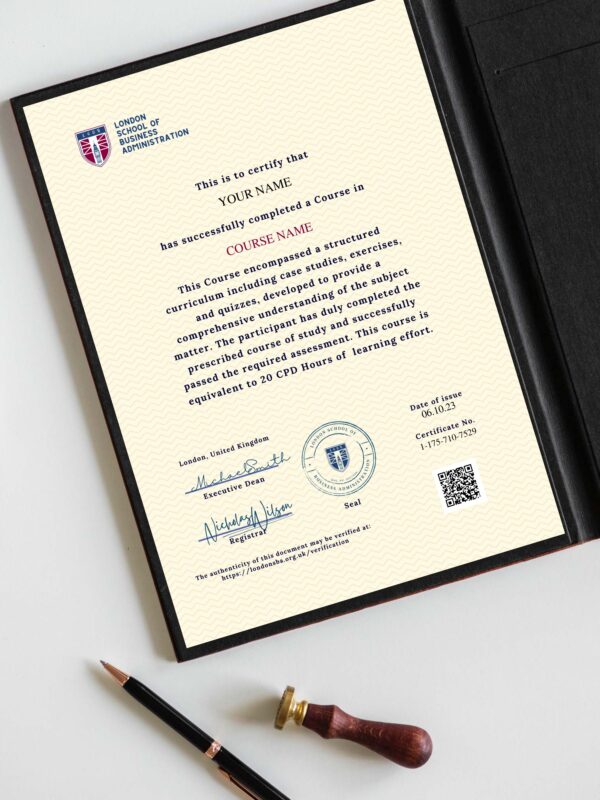
The course concludes with an online assessment comprising multiple-choice questions. Learners must achieve a passing grade to receive a Certificate of Completion from the London School of Business Administration.
Demonstration lecture – Introduction to Operations Management


