
A newly promoted manager arrives on Monday to find five people working across different locations, two deadlines already at risk and no shared understanding of who owns the unfinished work. One colleague is in the office, another is working from home, and a third is coordinating with a team in Singapore. Everyone appears busy, yet the manager can't tell whether the team is making progress, repeating work or accumulating risk.
This is the point at which many professionals ask, what is team management? The answer isn't just delegation, motivation or chairing meetings. Team management is the disciplined coordination of people, tasks, resources and review mechanisms so that a group can deliver agreed objectives consistently. In the UK, that discipline matters because management quality is measured as part of organisational performance, not treated only as a matter of personal style.
Table of Contents
- What Team Management Really Means in Practice
- Core Functions of Effective Team Management
- Roles a Team Manager Must Perform
- The Team Management Process from Planning to Review
- How Team Management Works in a UK Workplace
- Best Practices and Common Misconceptions
- Why Team Management Is a Measurable Capability
- Putting It All Together This Week
What Team Management Really Means in Practice
A newly appointed team lead in a UK firm may inherit a five-person operations team, hybrid working arrangements and a backlog of missed deadlines. Staff understand their individual duties, yet ownership overlaps in some areas and disappears in others. The manager must establish what will be delivered, who is responsible, what support is required and how progress will be checked.
Team management is the deliberate coordination of people, work and resources to achieve agreed objectives. It covers setting expectations, allocating responsibilities, monitoring delivery, developing capability, removing obstacles and reporting relevant information to stakeholders. Because these activities recur, they can be documented, reviewed and improved.
A useful analogy is a control system. Direction provides the intended destination, while team management sets the route, assigns the work, checks progress and corrects deviations. Leadership establishes direction, shapes culture and influences how people understand organisational purpose. Team management converts that direction into service standards, ownership rules, staffing decisions, review points and corrective action.
Why the distinction matters
Many managers inherit responsibility without formal preparation. The Chartered Management Institute found that 82% of UK managers entered management without formal management and leadership training, while 52% held no management and leadership qualification. The Chartered Management Institute management briefing sets out this evidence. Consequently, capable specialists often learn operational management through trial and error.
The Office for National Statistics assesses management practices through monitoring, targets, people management and continuous improvement. In 2023, the overall mean management-practice score for UK firms was 0.55 on a 0-to-1 scale, with a median of 0.60. The scores were 0.56 in England, 0.55 in Wales, 0.52 in Scotland and 0.52 in Northern Ireland, according to UK management evidence summarised by the Chartered Management Institute. These figures place team management within operational performance. The relevant practices determine how work is coordinated, reviewed and developed.
The definition provides a practical test. An activity belongs to team management when it clarifies objectives, allocates capacity, coordinates dependencies, develops people, checks results or informs stakeholders. Activities that merely create the appearance of progress require closer examination.
This approach also helps explain why hybrid teams need explicit working arrangements. Visibility cannot depend on people sharing an office. Clear ownership, documented decisions and regular review give managers evidence of progress without relying on impressions.
Core Functions of Effective Team Management
A customer operations team facing rising demand needs more than a capable supervisor. It needs defined outcomes, a fair distribution of work, visible dependencies and evidence that progress matches the agreed standard. These are operational functions that can be examined and improved. The ONS approach is useful because it directs attention towards management practices rather than personality traits.
Six domains to audit
-
Objective-setting and planning converts business priorities into outcomes, milestones and sequence. A practical indicator is the share of active work with a named objective, deadline and owner. For example, a customer operations team could turn a broad service priority into a documented queue-management plan, with a review date and agreed measures.
-
Resource allocation matches people, time, information and budget with the work requiring completion. Managers can record capacity conflicts, unassigned responsibilities and delays caused by missing skills. Allocation requires an assessment of workload and capability, not just assigning more work to the person who appears most capable.
-
Task coordination controls dependencies, handovers and workflow visibility. Useful checks include the number of blocked tasks, the age of open dependencies and the completeness of shift handover records. This function matters particularly when colleagues work across locations or departments, because informal observation provides less evidence of progress.
The guide to building and leading high-performing teams offers a related explanation of how managers organise collective work. A team concerned with technology change may also find the Digital Transformation in Business course useful for framing how digital work is coordinated.
-
People development builds the capability required for present and future work. Relevant indicators include completed development conversations, cross-training and progress against agreed actions. A manager might pair an experienced analyst with a colleague practising a new reporting process, then review the work rather than taking it over.
-
Performance monitoring compares actual progress with agreed standards. Measures may include on-time delivery, quality exceptions, unresolved risks and the age of overdue actions. Regular checks give the manager an opportunity to address a problem while there is still time to change the result.
-
Stakeholder reporting communicates decisions, risks, dependencies and outcomes to people outside the team. Each reporting cycle should make clear what has changed, what is at risk and what decision or support is required. Concise reporting helps senior colleagues respond without receiving excessive detail or an unduly reassuring summary.
The functions operate as a connected system. Weak planning complicates allocation, poor allocation creates coordination problems, and weak monitoring conceals development needs. Incomplete reporting can leave stakeholders unable to remove obstacles. Reviewing the links between these domains shows whether a team is managing work as a process rather than performing isolated administrative tasks.
Roles a Team Manager Must Perform
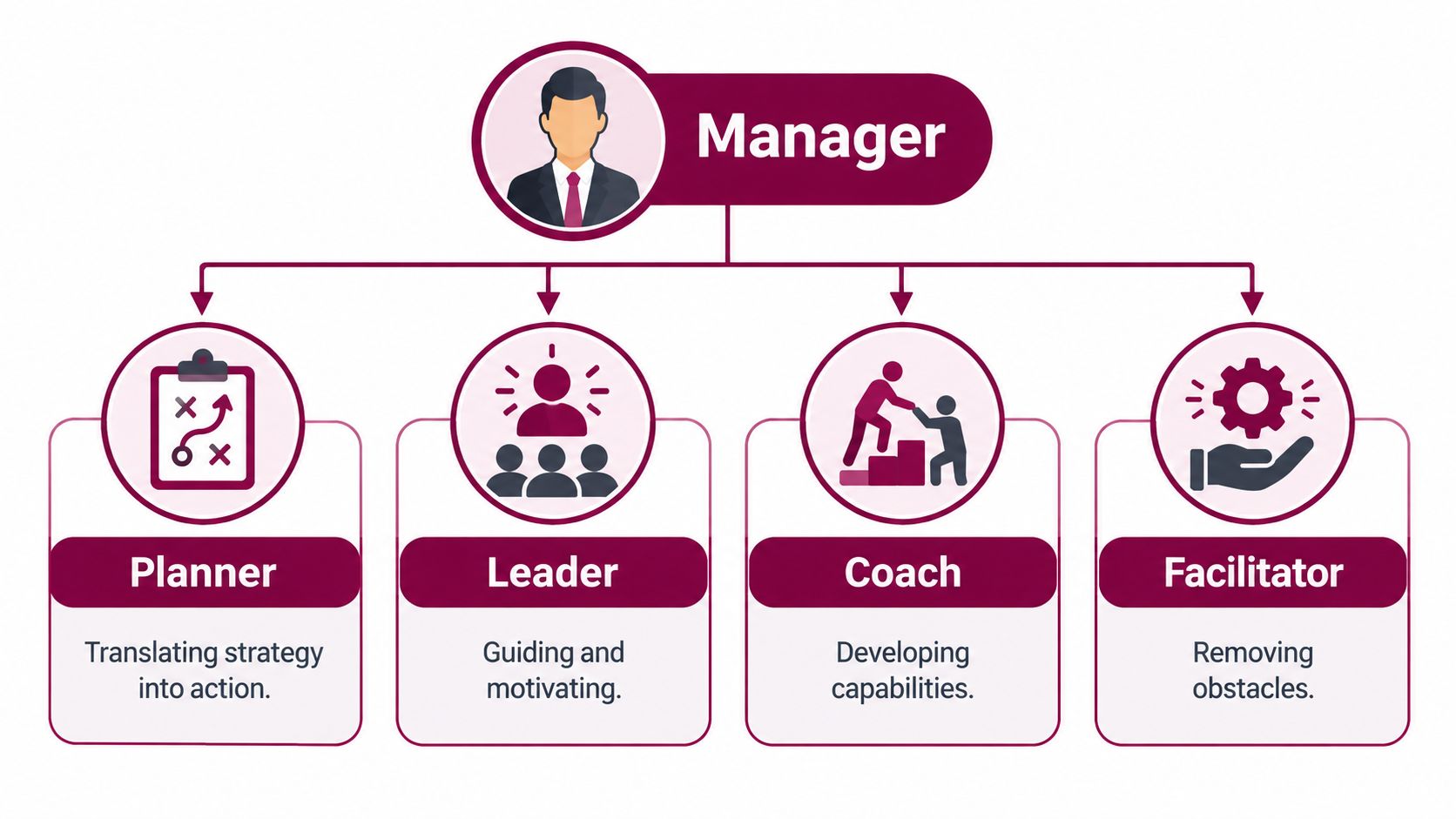
A team manager changes role as work develops. During a new project, the manager may define priorities and constraints. During delivery, the focus shifts to dependencies, capability and evidence of progress. Four roles recur: planner, coordinator, coach and reviewer. Together, they make management observable rather than a generalised leadership trait.
Planner
The planner turns objectives into workstreams, timelines and decision points. Useful artefacts include a delivery plan, responsibility map, milestone schedule and risk-and-issue record. Planning matters at the start of a project, during a restructure and whenever business priorities change. A sound plan makes trade-offs visible, so colleagues can see what will be delayed, reduced or resourced differently.
Coordinator
The coordinator keeps interdependent work aligned. This may involve handovers, meeting rhythms, hybrid attendance arrangements and escalation routes. Dependency logs, action registers and documented decisions provide evidence that coordination is taking place. The role becomes more demanding when a team serves several stakeholders or works across locations and time differences.
Coach
The coach develops capability through one-to-ones, feedback, guided practice and appropriately demanding assignments. Development notes and agreed actions give this work continuity. Coaching means creating conditions for someone to improve, not repeatedly taking over difficult tasks. A manager who rescues every problem may protect immediate output while reducing the team's ability to operate independently.
Hybrid working makes deliberate coaching more important because informal observation is less available. The CIPD evidence on flexible working in 2025 found that 74% of organisations had hybrid working in place, while formal policies were in place in 42% and 65% required minimum in-office days. These figures describe a management setting in which expectations, access and visibility require explicit arrangements.
Reviewer
The reviewer tests outcomes against agreed standards and adjusts course. Review records can include progress summaries, quality findings, retrospective notes and revised objectives. This role becomes prominent near a milestone, after a project or when performance falls below the expected level. It connects activity with evidence, much as an inspection checks whether a process produced the required result.
The roles support one another without becoming interchangeable. The planner establishes the route, the coordinator keeps dependencies moving, the coach builds capability and the reviewer tests the standard achieved. The guide to key skills every modern manager needs addresses related managerial capabilities. Together, these roles turn team-management functions into visible day-to-day behaviour.
The Team Management Process from Planning to Review
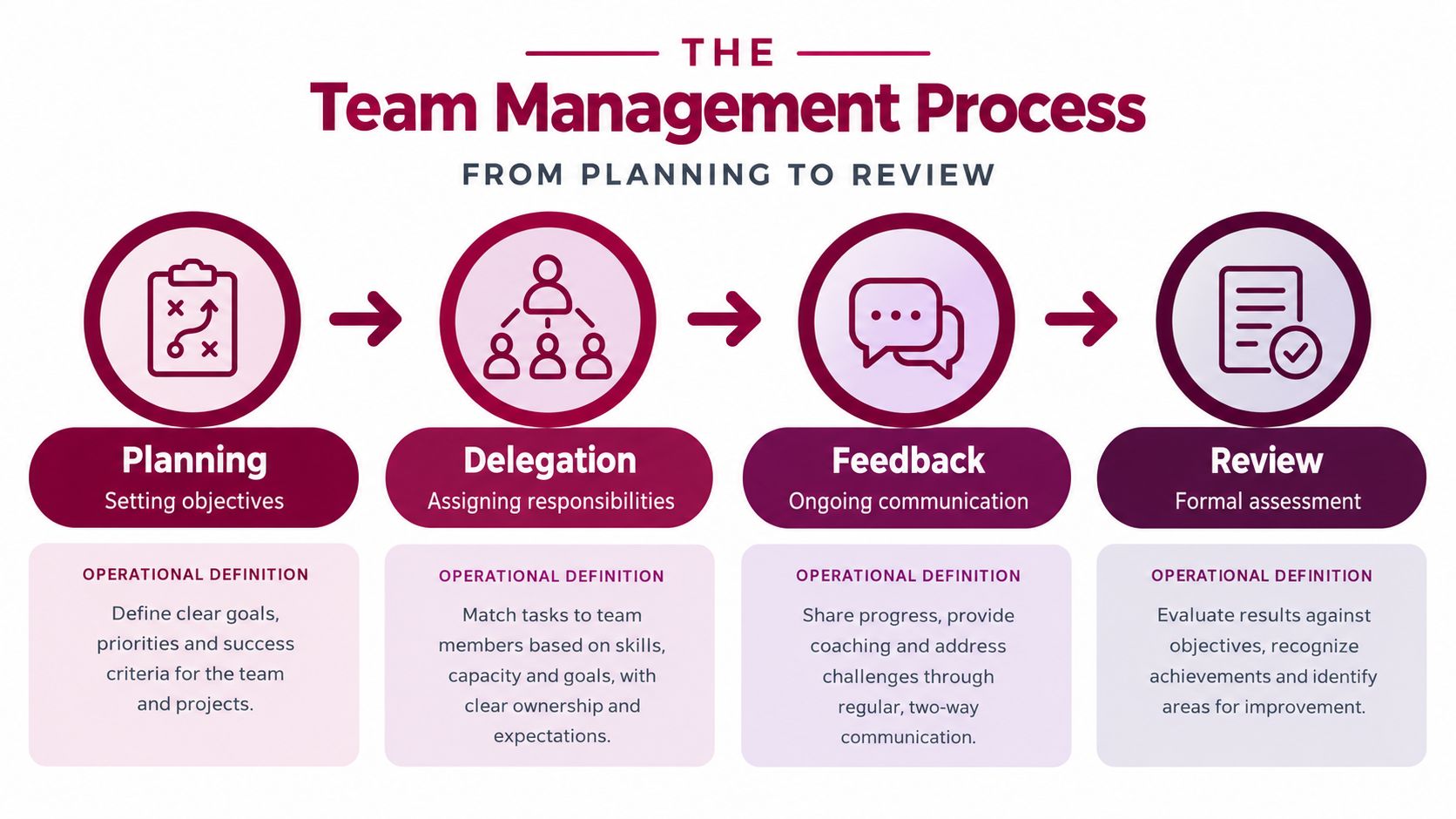
Team management works as a recurring cycle rather than a one-off act of delegation. The cycle starts with a shared objective, moves through allocation and delivery, and returns to planning after the team has examined what happened.
Planning and delegation
Planning defines the result, boundaries and timing. A SMART objective can make the intended outcome specific, measurable, achievable, relevant and time-bound. For example, a manager might define a service-improvement objective around a particular workflow, its quality standard and the date by which the team will review progress.
Delegation then matches responsibility with skill, capacity and authority. Effective delegation states the outcome required, the decision rights available, the support offered and the point at which progress will be checked. Over-delegation leaves people without sufficient guidance; under-delegation turns the manager into a bottleneck.
Feedback and review
Feedback operates throughout delivery. It can take the form of a brief progress discussion, a quality check, a peer observation or a one-to-one focused on a specific obstacle. The purpose isn't to create constant supervision. It is to identify deviation early enough for the team to correct it.
A formal review closes the loop. Quarterly business reviews, mid-cycle probation checkpoints and post-project retrospectives all provide opportunities to compare results with expectations, identify causes and record decisions. Gallup's UK workplace research reported that only 8% of employed Britons were engaged at work in 2016, down from 17% in 2012, while 73% were classified as not engaged. The same Gallup analysis of UK workplace culture points to collaborative expectations, continuous coaching and at least two formal progress reviews each year as practical management mechanics.
The stages depend on one another. Unclear objectives make delegation arbitrary. Poor delegation makes feedback personal rather than evidence-based. Absent feedback makes formal review feel punitive. A ritualistic review produces no useful learning for the next plan.
Practical rule: Every review should produce either a confirmed practice, a corrective action or a change to the next plan.
How Team Management Works in a UK Workplace
A newly promoted line manager inherits a hybrid team handling regulated work for a mid-sized UK employer. Some colleagues work from home, others from an office, and part of the workload depends on colleagues in India during the shared working period. The manager's first task is to turn these conditions into an operating system rather than rely on informal understanding.
A planning meeting sets out objectives, monitoring arrangements, people responsibilities and improvement work. Each output is recorded with its quality checks, named owner and supporting evidence. A brief handover record captures unfinished tasks before the India-UK overlap ends, so progress does not depend on one person's memory.
The manager also separates attendance from performance. Hybrid expectations specify when in-person presence is required, which meetings need shared attendance and how home-based colleagues will receive equivalent access to information and decisions. The CIPD flexible-working report cited earlier reports that 41% of UK employers said home or hybrid work increased productivity or efficiency, while 16% said it decreased it. The practical conclusion is limited but useful: location does not determine performance by itself. Coordination, access and clarity affect whether the arrangement works.
Skills and readiness
One-to-ones reveal uneven readiness. An employee understands the regulated process but lacks confidence with data work. Another has strong digital skills but needs more practice applying the compliance standard. The manager records development actions, assigns supervised work and checks progress at later review points.
The wider UK skills situation gives this work operational importance. A CIPD workplace learning report found that 57% of learning and talent development professionals saw a skills crisis. It also reported that 57% said executives were concerned that employees lacked the skills required to execute business strategy. Because the same figure refers to two separate survey findings, the claims should be read as distinct responses rather than combined evidence.
Social-care evidence points to a related management problem. Skills for Care data reported in UK workplace skills reporting found that 71.7% of respondents struggled to recruit people with the right skills for management roles, while 45.3% identified data, technology and digital skills as management-role gaps.
The manager therefore considers apprenticeship levy uptake and whether internal development can meet future capability needs. Time-zone overlap, hybrid attendance and skills planning sit within one management system. Its setting is UK-specific, but the method is transferable: team management works when responsibilities and processes match the team's labour, regulatory and working conditions.
Best Practices and Common Misconceptions
A team can appear busy while its management system remains weak. A useful audit therefore compares observable managerial behaviour with the conditions the team needs to deliver reliable work. The table turns common advice into checks that can be reviewed in practice.
| Best Practice | Common Misconception |
|---|---|
| Set measurable objectives that connect team work with business-plan priorities. | A broad statement of intent gives people enough direction. |
| Hold regular one-to-ones with recorded actions and clear follow-up. | Staff only need individual attention when performance declines. |
| Calibrate performance against shared standards and evidence. | The busiest person is necessarily the strongest performer. |
| Document decisions, ownership and changes to scope. | Written records create unnecessary administration. |
| Act on engagement findings, including concerns about clarity, resources and development. | An engagement survey is useful even when managers take no action afterwards. |
| Use feedback during delivery and formal review to close the loop. | Annual appraisal is the only legitimate feedback mechanism. |
As the accidental-manager figures cited earlier show, many managers inherit responsibility without preparation, which is why these misconceptions persist. A technically capable employee may still need support to set expectations, handle conflict and assess performance consistently. The earlier management matters briefing provides context for that management transition without making lack of preparation an excuse for weak practice.
What to examine in practice
A manager should test intentions against evidence. Are objectives specific enough to guide decisions? Can each team member explain their responsibilities? Do one-to-ones produce actions, owners and review points? Does the team know how to raise a risk? Are performance standards applied consistently across office and remote workers?
The audit should also examine whether decisions remain visible after meetings, whether changing priorities are recorded and whether development actions receive later review. These checks work like maintenance inspections: each one is modest, but together they reveal whether the operating system is functioning.
Emotional awareness supports these behaviours, but it does not replace them. Managers need to understand reactions, listen accurately and address difficult issues without abandoning the underlying standard. The role of emotional intelligence in leadership is relevant to that interpersonal work.
The ONS management-practice domains introduced above provide a useful frame for the audit. Monitoring, targets, people management and continuous improvement can be examined through records, routines and outcomes. The Chartered Management Institute’s summary of ONS findings offers the wider evidence base for those domains. A manager who delegates tasks but does not monitor outcomes is performing only part of the job.
Why Team Management Is a Measurable Capability
A team can meet one deadline through individual effort, yet still lack a dependable management system. In UK workplaces, the stronger test is whether managers set standards, allocate capability, review evidence and correct recurring weaknesses so performance remains consistent.
Several measures make that capability visible:
-
Attrition and retention: Employees’ intentions to stay can indicate whether ineffective management and unresolved problems are making continued work unattractive.
-
Delivery reliability: On-time completion, quality exceptions and unresolved dependencies show whether planning and coordination are producing dependable work.
-
Engagement evidence: Gallup’s Q12 methodology uses 12 survey items covering role clarity, resources, recognition, development and connection to purpose, as explained in its employee engagement methodology.
-
Skills utilisation: Managers can compare the capabilities available in a team with those required by current work, then monitor whether development changes the gap.
Retention offers a clear outcome measure. CMI’s management matters research, cited earlier, reported that 50% of workers who rated their manager ineffective planned to leave within 12 months, compared with 21% of those with effective managers. The comparison connects management practice with a business outcome rather than treating morale as a separate sentiment.
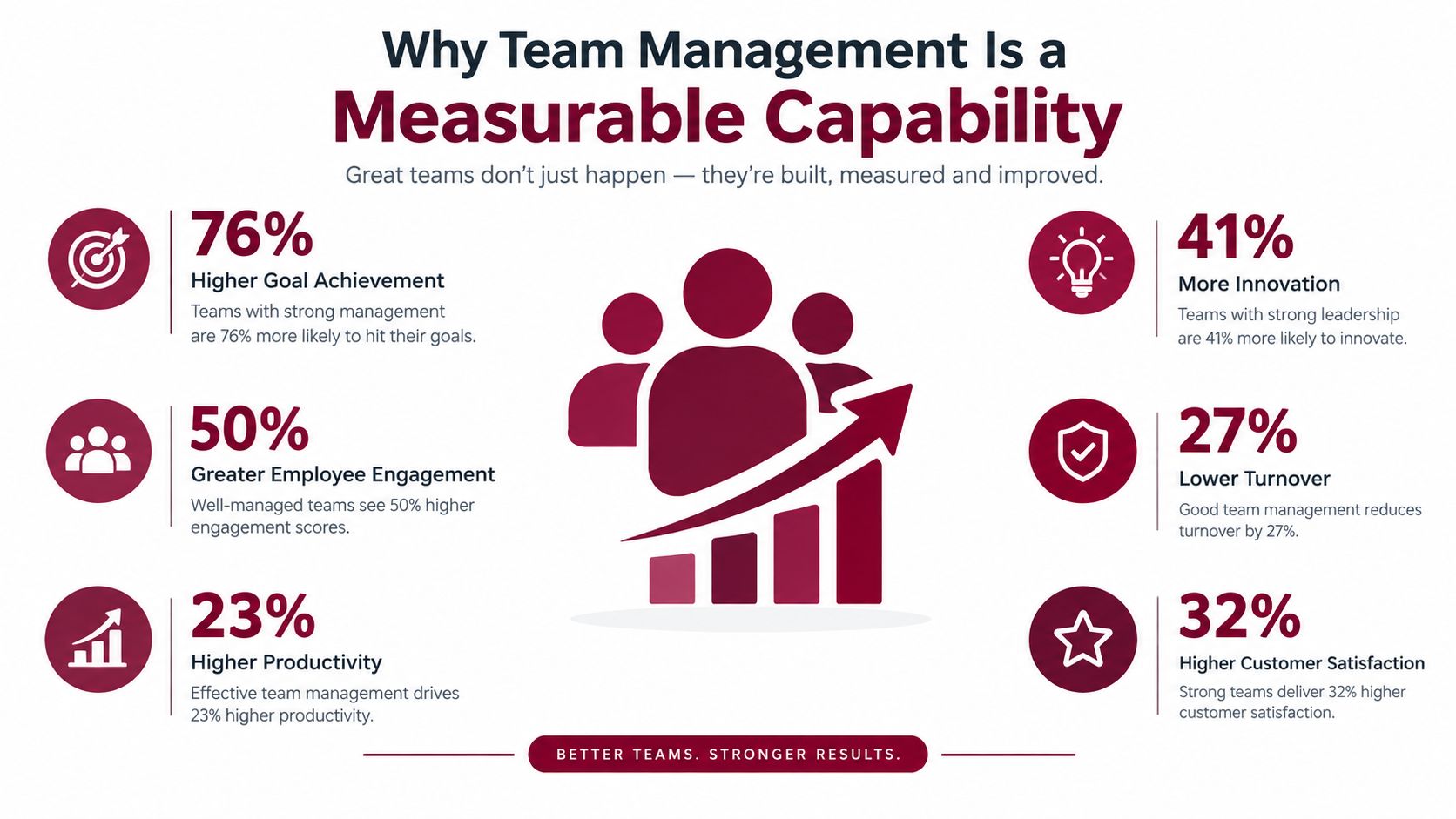
UK evidence also associates investment in management and leadership development with organisational results. The Chartered Management Institute reports, in its Better Management report, an average 23% increase in organisational performance and 32% increase in employee engagement and productivity among organisations making that investment. These figures do not guarantee the same return from every intervention. They indicate that management capability can be treated as an organisational input that leaders can develop and assess.
A longitudinal study of 42 UK manufacturing firms found that clarity and commitment to objectives, participation, task orientation and support for innovation independently predicted later productivity and profitability, as reported in the study of top management groups in manufacturing organisations. Team management therefore resembles an operating discipline: its quality appears in repeated practices and measurable outcomes.
Putting It All Together This Week
A manager can apply the framework during an ordinary working week. Start by rewriting the team’s objectives so each one has an owner, a defined outcome, a timescale and a review point. Vague priorities should become work that colleagues can recognise, discuss and assess.
Review one-to-one practice next. Each conversation should have a clear purpose, a short record of agreed actions and a later check on progress. Then map the week across four management stances: planner, coordinator, coach and reviewer. If one stance dominates, the pattern may indicate a process weakness or an unaddressed capability gap.
Add one feedback loop. A brief weekly review can examine risks, quality or dependencies, provided it produces an action and an owner. Select one bottleneck, such as an unclear handover or repeated approval delay, record its likely cause and test a specific correction. This gives the manager a small operational experiment rather than a general intention to improve.
These actions make what is team management easier to answer. It is the regular practice of setting direction, coordinating effort, building capability and checking results. Structured study is also available through self-paced, CPD-accredited programmes and a leadership pathway offered by the London School of Business Administration, combining recorded lectures, learning materials and assessments.
Managers who want to formalise their understanding of objectives, communication, development and review can visit the London School of Business Administration to examine its learning pathways and assess whether a course structure fits their professional responsibilities.