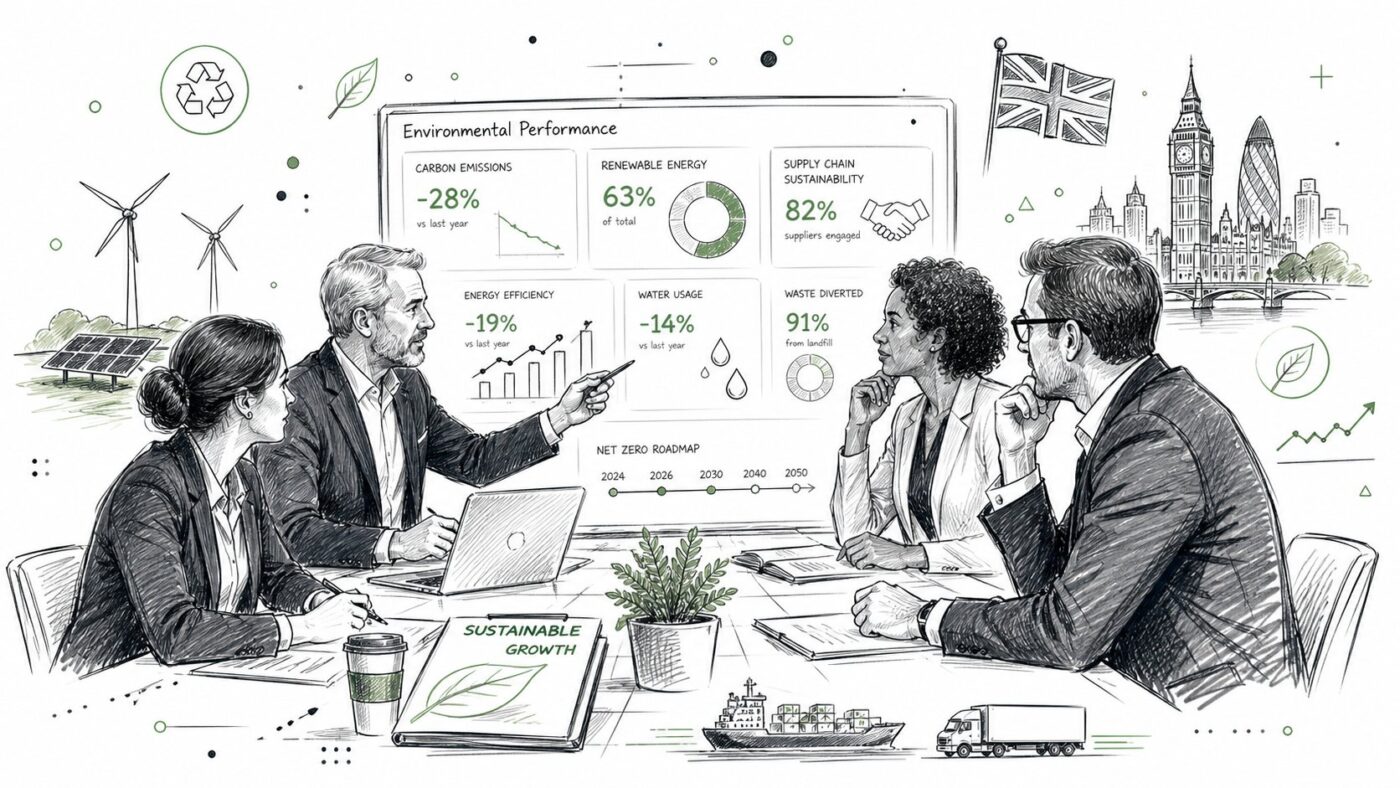
Business sustainability means integrating environmental risk management, resource efficiency and social accountability into core operational strategy so the organisation remains economically viable over time. In the UK, the implementation gap is stark: 39% of businesses were concerned about climate change in late 2022, yet 62% were taking no action to protect the environment.
That apparent contradiction is the important starting point. Sustainability has become a mainstream management issue, but awareness hasn't automatically produced reliable systems, assigned responsibility or verifiable results. A business can publish a responsible-sourcing statement while continuing to make procurement decisions without assessing supplier risks. It can announce an emissions ambition without knowing how energy, logistics and purchased goods contribute to its footprint.
To define business sustainability properly, leaders need to move beyond the familiar language of values and intentions. The practical definition concerns how an organisation manages its resources, risks, relationships and information while creating durable economic value. It includes environmental performance, working conditions, governance, disclosure quality and the resilience of the operating model.
Table of Contents
- Defining Business Sustainability in the Modern Economy
- The Core Principles of Sustainable Business Operations
- Navigating the UK Regulatory and Reporting Landscape
- Embedding Sustainability into Daily Operational Levers
- Measuring Performance and Ensuring Data Auditability
- Benchmarking Sustainability Maturity Against Industry Peers
- Strategic Integration and Leadership Development
Defining Business Sustainability in the Modern Economy
Business sustainability is now a management discipline, not a communications theme. The Office for National Statistics found that large UK firms were considerably more likely to have moved from awareness to implementation: 26% of businesses with 250 or more employees used a climate-change strategy and 22% had set a net-zero target, compared with 4% and 3% respectively across all businesses (UK business sustainability statistics). The contrast shows why a definition based only on concern is insufficient.
A sustainable business identifies environmental and social pressures, translates them into operational risks and opportunities, and assigns them to decisions that affect performance. Those decisions may involve energy procurement, fleet management, materials, supplier selection, employee welfare, product design, waste handling or capital investment. Sustainability therefore belongs in the operating model, not only in a corporate affairs department.
The distinction from traditional corporate social responsibility is useful. CSR often focuses on voluntary programmes, charitable commitments or community communications. Those activities can have value, but they don't define whether the organisation's central processes remain viable when resources become constrained, regulation changes or stakeholders demand stronger evidence.
From awareness to implementation
The UK data illustrates an uneven transition. Large companies have been more active, while many smaller organisations have yet to turn concern into a formal strategy. That doesn't mean smaller businesses lack influence. Smaller firms participate throughout supply chains, provide essential services and make decisions about purchasing, transport, premises and employment every day.
The British Business Bank estimates that SMEs represent around 37% of the UK's total greenhouse gas emissions, including non-territorial emissions, and about half of business emissions overall (sustainability guidance for smaller businesses). A definition that excludes SMEs would therefore misunderstand the UK business system.
A working definition for leaders
A useful working definition has four parts:
- Environmental risk management, including emissions, energy, materials, waste and exposure to climate or resource pressures.
- Social accountability, including labour practices, health and safety, suppliers and effects on local communities.
- Economic viability, meaning the organisation can continue creating value without undermining the resources or relationships on which it depends.
- Operational evidence, meaning objectives, controls, measures and reporting support the claims being made.
This framework gives managers a practical test. If sustainability doesn't influence budgets, procurement criteria, process design, risk registers and performance reviews, it remains an aspiration rather than an embedded capability. Further context on the business case appears in this discussion of sustainability as a cornerstone of future success.
The Core Principles of Sustainable Business Operations
A strong sustainability model connects environmental, social and economic performance rather than treating them as separate projects. The familiar “people, planet, profit” phrase is a useful reminder, but it doesn't tell managers where accountability sits or how performance should be controlled.
The British Business Bank describes sustainability in operational terms: businesses should avoid depleting natural resources and avoid negative effects on the environment, society and local communities. That perspective places logistics, waste, greenhouse gas emissions and asset use at the centre of analysis, rather than treating sustainability as a statement of corporate character.
Four principles for operational integration
1. Manage the system, not only the outcome. A year-end emissions figure is an outcome. The management system consists of the energy contracts, maintenance routines, production choices, travel rules and data ownership that produced it. Managers should examine those causes because changing the system makes improvement repeatable.
2. Connect impact to decision rights. Procurement teams control supplier requirements. Facilities teams control building energy and waste arrangements. Operations teams influence transport and asset utilisation. A sustainability target without a named decision owner is difficult to execute and even harder to audit.
3. Protect long-term value. Economic sustainability isn't the pursuit of profit at any environmental or social cost. A business model that depends on scarce inputs, unstable suppliers or unacceptable working conditions carries risks that can weaken future viability. Financial analysis should therefore consider resource dependence, transition exposure and stakeholder relationships.
4. Make trade-offs explicit. Sustainable operations can involve tensions. A lower-cost supplier may have weaker environmental information. A more durable product may require a different purchasing model. A local supplier may offer stronger relationships but limited capacity. Good governance doesn't pretend these tensions disappear. It records the criteria, evidence and rationale used to decide.
From initiative to control
A superficial CSR initiative usually has a defined activity but weak connection to core processes. An integrated approach changes the process itself. Supplier onboarding can require evidence about labour conditions and environmental management. Investment proposals can include resource efficiency and transition risks. Monthly reviews can examine progress alongside quality, service and financial indicators.
A manager studying these ideas formally might encounter them within The Credential of Business Management, alongside wider business and management concepts. The important point is application: sustainability becomes credible when governance, incentives and operational routines reinforce one another.
Practical rule: If a sustainability commitment doesn't change a decision, a control or a measure, it hasn't yet become part of the operating model.
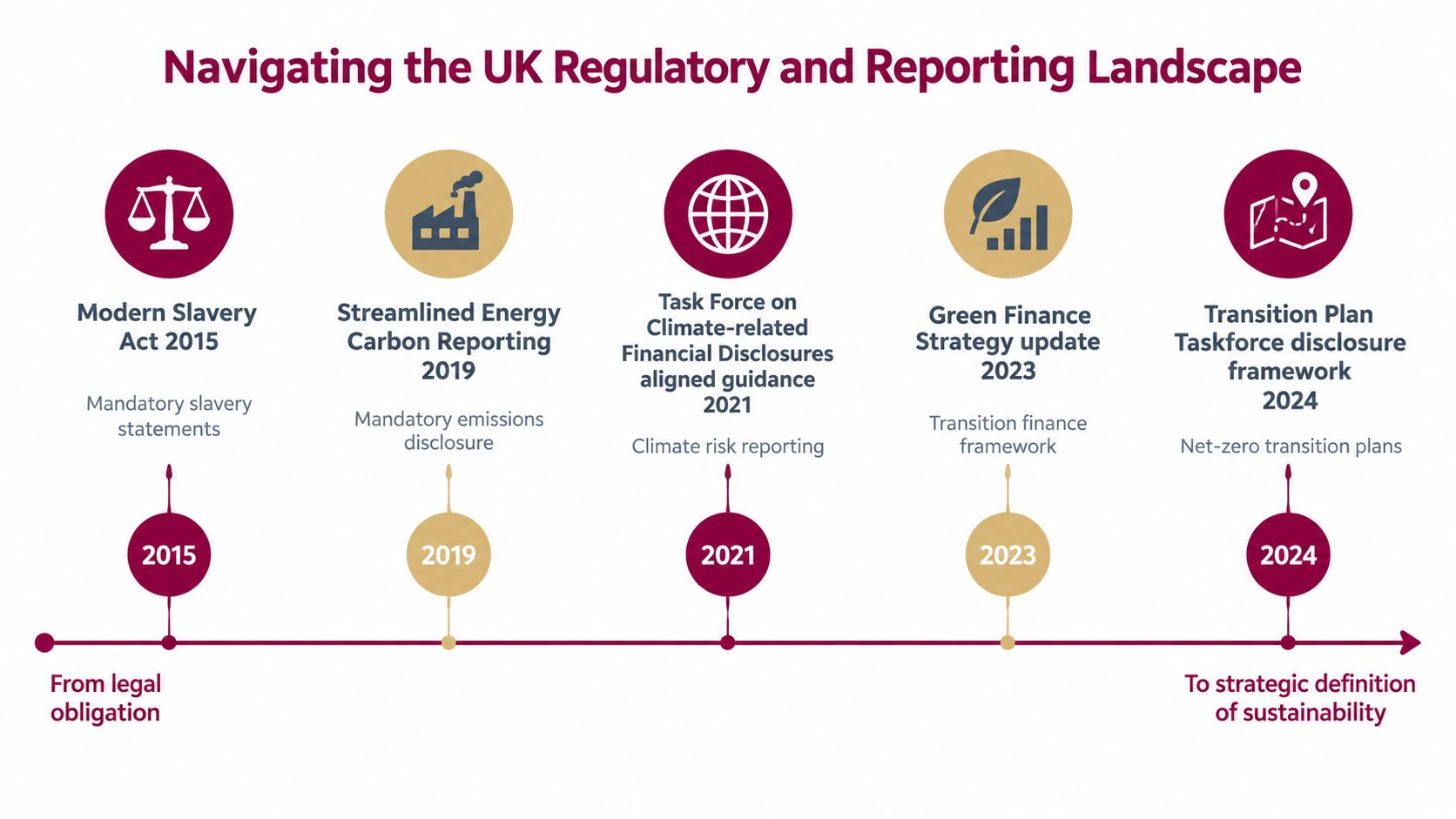
Navigating the UK Regulatory and Reporting Landscape
UK regulation increasingly connects sustainability with corporate reporting, governance and risk management, although the obligations aren't universal. Under UK company law, companies that aren't small must include an overview of the business in the strategic report, including its principal risks and uncertainties. This makes the strategic report a significant statutory location for sustainability-related and non-financial risks (UK sustainability reporting requirements).
The implication is practical. Directors and senior managers need to understand which environmental and social issues could affect the business model, financial position, strategy or reputation, then ensure that internal records can support the resulting narrative.
Disclosure is phased
The UK's phased ESG disclosure schedule is described as requiring Scope 1 and Scope 2 disclosures from 2026-27, Scope 3 disclosures from 2027-28, and disclosure of all material sustainability risks from 2028-29 (UK ESG fast facts). These are future reporting stages, not a universal obligation for every business at the same time. They indicate the direction of travel towards more detailed, risk-based accountability.
The climate-related disclosure regime also has defined thresholds. It applies to public interest entities, UK-registered AIM-listed companies with more than 500 employees, UK-registered companies with more than 500 employees and turnover above £500 million, and certain traded or banking LLPs meeting the relevant employee or turnover conditions. In-scope entities report across governance, strategy, risk management, and metrics and targets (UK climate-related disclosure requirements).
Build the evidence before the deadline
Reporting requirements shouldn't be treated as a last-minute writing exercise. The underlying information may sit across finance, facilities, procurement, human resources, transport and supplier management. A credible preparation process should therefore:
- Map the reporting perimeter. Identify entities, sites, activities and supply-chain relationships that fall within the relevant reporting scope.
- Assign data ownership. Establish who records, reviews and approves each material measure.
- Document calculation methods. Keep a clear record of boundaries, assumptions, source records and changes in methodology.
- Link risks to governance. Show how sustainability risks reach senior decision-makers and affect strategy.
- Retain an audit trail. Preserve evidence that supports both quantitative indicators and narrative statements.
Compliance doesn't replace ethical responsibility, but it changes the management standard. Sustainability now requires organisations to know what they claim, why the information is reliable and which governance process supports it.
Embedding Sustainability into Daily Operational Levers
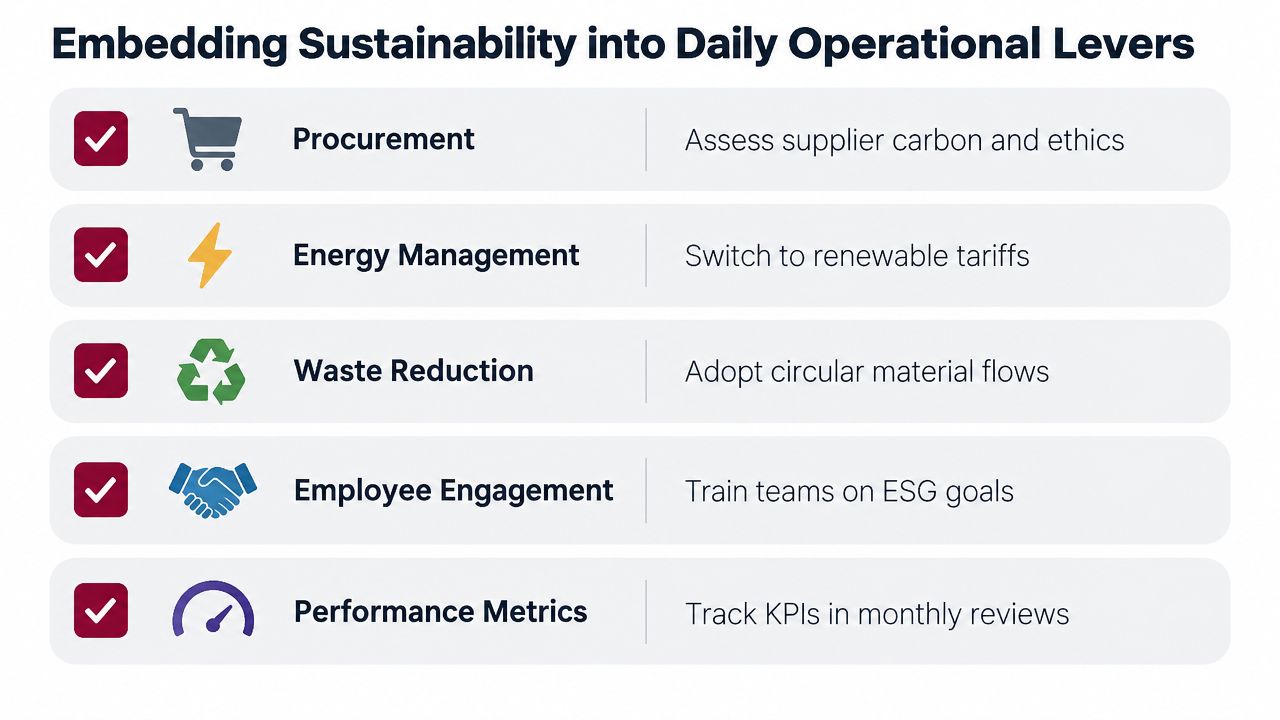
A strategy becomes operational when employees can see how it affects routine choices. The most effective starting point is to identify the levers that determine resource use, supplier exposure, workforce conditions and data quality.
Procurement often serves as a critical advantage. Purchasing teams can add environmental and social criteria to supplier selection, request relevant evidence, and distinguish between a supplier's stated intention and its management practice. The purpose isn't to reject every supplier that lacks detailed reporting. It is to understand risk, set proportionate expectations, and improve information over time.
Logistics provides another concrete example. Route planning, load utilisation, delivery frequency, packaging choices and supplier location all influence resource use and resilience. Managers responsible for sustainable logistics and green supply-chain practice can connect environmental objectives with the practical design of distribution systems.
Five operational questions
- Procurement: Which suppliers create material environmental, labour or ethical risks, and what evidence supports their assessment?
- Energy management: Which assets consume the most energy, who monitors them and which maintenance or purchasing decisions affect demand?
- Waste reduction: Which materials leave the process as waste, and can the organisation prevent, reuse or recover them?
- Employee engagement: Do employees understand the relevant objectives and know how to report problems or suggest improvements?
- Performance metrics: Are measures reviewed frequently enough to influence decisions rather than merely describe past performance?
These questions help SMEs avoid an overly complex starting point. A smaller company can begin with its main sites, key suppliers and most material resource flows, then expand its boundary as its systems mature. The emphasis should be on consistent information and clear ownership, not an impressive volume of disconnected initiatives.
Design the feedback loop
Operational sustainability improves through a feedback loop. The organisation establishes a baseline, sets a practical objective, changes a process, reviews the evidence and adjusts the process again. For example, a business may examine packaging waste, involve procurement and warehouse staff, test an alternative specification, monitor damage and waste, then revise the purchasing standard.
This approach also clarifies the relationship between efficiency and sustainability. Reducing unnecessary material use may lower waste and improve process control. Better asset maintenance may support reliable operations while reducing resource consumption. Yet managers shouldn't assume every environmental decision produces an immediate financial benefit. The responsible approach is to assess the full operational and risk profile.
Measuring Performance and Ensuring Data Auditability
A sustainability claim is only as strong as the process that produced its evidence. Many organisations need to deepen their definition of sustainability to address this. A policy can express intent, but measurement, review and assurance demonstrate whether management controls operate in practice.
Deloitte reported that 69% of FTSE 100 companies made prior-year adjustments to climate and sustainability metrics in 2025, compared with 46% the year before, while 86 companies said they obtained assurance over sustainability metrics (Deloitte's analysis of sustainability metric adjustments). The figures don't prove that every adjustment reflects poor management. They do show why data governance matters: organisations may revise boundaries, methods, source information or prior calculations as their reporting systems develop.
Ambition and evidence are different
An aspiration describes the direction of travel. A metric describes what has happened or what is being measured. An auditable metric also has a defined boundary, methodology, owner, source record and review process.
| Management question | Weak approach | Stronger approach |
|---|---|---|
| What is being measured? | A broad environmental ambition | A defined indicator with a clear boundary |
| Who owns the information? | Responsibility spread across departments | A named data owner and reviewer |
| How is it calculated? | Informal or changing assumptions | Documented methodology and version control |
| Can it be checked? | A narrative statement alone | Source records and retained evidence |
| How is it used? | Published at year end | Reviewed in operational and governance meetings |
This comparison explains why sustainability reporting resembles financial control more than promotional copy. The organisation needs consistency, traceability and appropriate challenge.
Establish internal controls
A practical control structure can include:
- Definitions: Agree what each metric includes and excludes.
- Boundaries: Record sites, entities, activities and value-chain categories covered.
- Data lineage: Trace reported figures back to invoices, meters, travel records, supplier information or other source documents.
- Review procedures: Require a second person to check unusual movements, omissions and methodological changes.
- Change logs: Explain why a prior figure was revised and whether comparative information must be restated.
- Assurance planning: Identify which measures may require external review and prepare evidence accordingly.
Leaders who need to strengthen this capability can study measuring and reporting environmental performance and impact as part of a wider development plan. The central principle remains straightforward: credible sustainability management depends on reliable information before it depends on polished reporting.
Benchmarking Sustainability Maturity Against Industry Peers
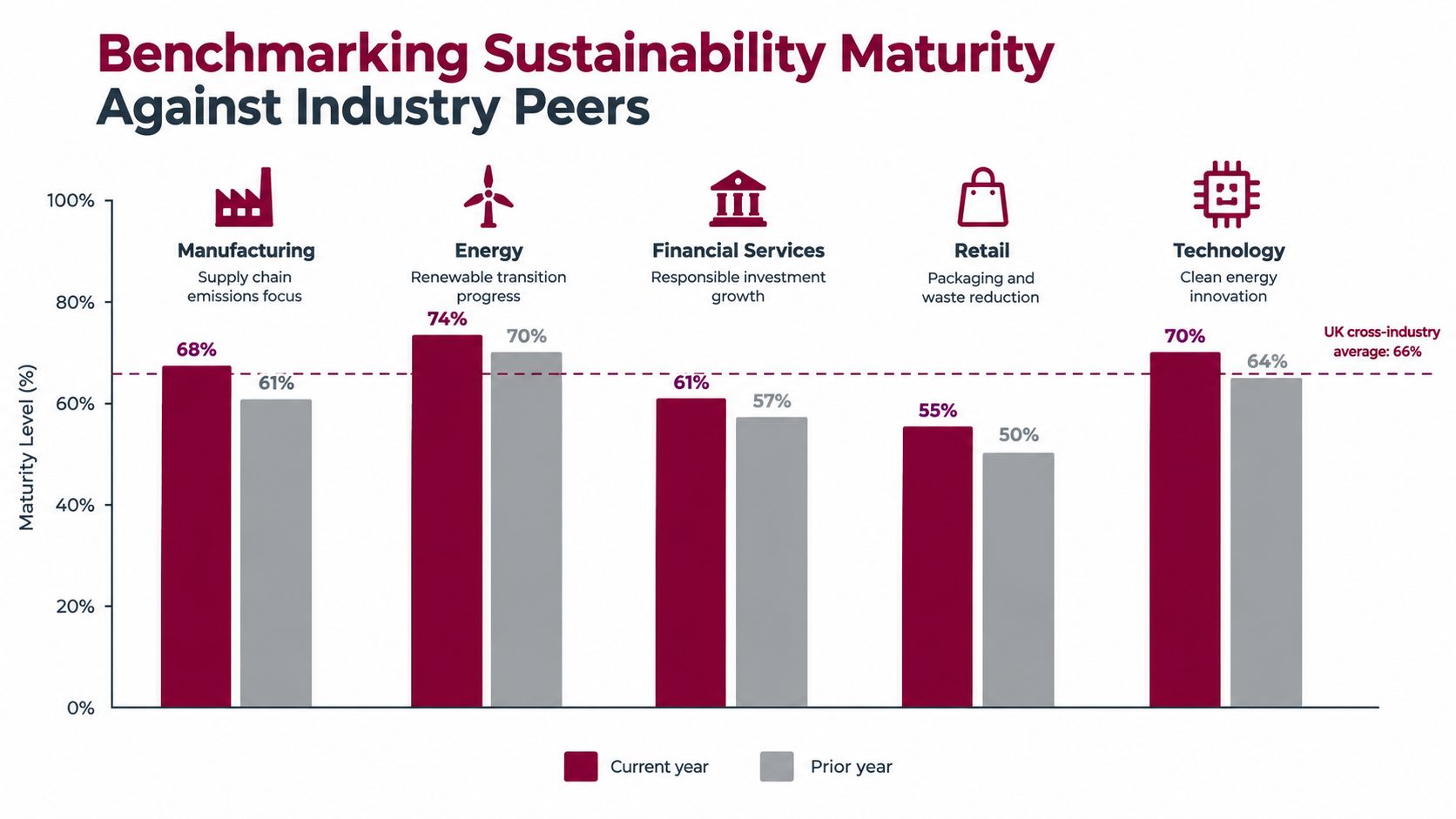
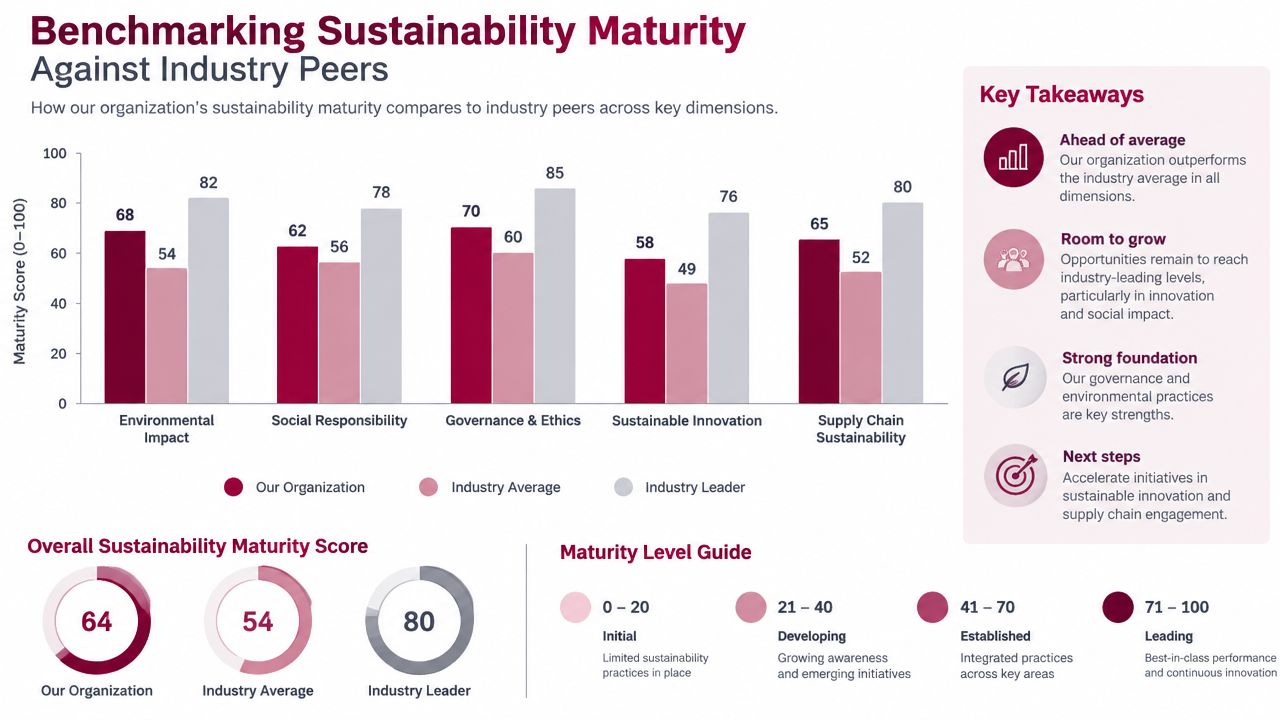
Benchmarking helps a business replace vague self-assessment with a structured view of capability. It doesn't provide a complete judgement of an organisation, because scores depend on scope, methodology and available evidence. It can, however, reveal where management systems are relatively strong and where specific exposures require attention.
EcoVadis assessed more than 5,000 UK businesses between 2020 and 2024. Across that dataset, the UK average score rose from 53.9 to 58.7 on a 0-100 scale, placing the country in the “Good” range and sixth globally (UK sustainability performance data). The same dataset reports that 92% of UK companies scored at least 45.
Read the dimensions, not only the total
The overall score can conceal uneven performance. UK firms recorded an average of 57.2 in Ethics and 61.5 in Labour and Human Rights in the EcoVadis dataset. These dimensions matter because sustainability maturity includes the quality of governance and employment practices, not just carbon or waste outcomes.
A business should therefore ask three questions when using a benchmark:
- What does the assessment measure? A score may cover policies, evidence, results and management systems, but those components should be understood before comparisons are interpreted.
- Which theme creates the greatest exposure? A strong total score doesn't remove a weakness in supplier controls, ethics, labour practices or environmental management.
- What management evidence is missing? A low result may indicate poor performance, weak documentation or both.
Prioritise the weakest exposure
The most useful benchmarking method is diagnostic rather than celebratory. First, establish a baseline across environmental management, labour and human rights, ethics and sustainable procurement. Next, identify the lowest or least evidenced theme. Finally, select a small number of controls that address its underlying risk.
For example, a weak procurement result may call for supplier screening, contractual requirements, evidence retention and escalation procedures. A governance weakness may require clearer accountability, documented approvals and regular management review. A labour concern may require improved due diligence, grievance processes or supplier engagement.
Broad pledges create visibility. Specific controls reduce exposure.
Benchmarking becomes valuable when it changes priorities, budgets and responsibilities. The score is a signal, not the strategy.
Strategic Integration and Leadership Development
Sustainability requires leaders who can connect environmental limits, social responsibility, governance and commercial judgement. That capability is broader than knowledge of reporting terminology. It involves asking better questions about risk, allocating accountability, interpreting imperfect evidence and persuading operational teams to change established routines.
Mid-career managers occupy an important position in this work. Senior executives set direction, while operational specialists control many of the decisions that determine performance. Managers translate between those levels. They can convert a strategic commitment into procurement criteria, review agendas, investment cases, supplier conversations and team objectives.
The strongest leadership approach treats sustainability as a source of organisational resilience rather than a compliance burden. Regulation may establish minimum expectations, but capable managers can use the same information to identify dependencies, strengthen controls and make the business more adaptable. That requires continuing development in ethical leadership, social responsibility, analytical reasoning and strategic decision-making.
Formal, CPD-accredited education can provide a structured route for professionals who need to organise these capabilities. Online, self-paced study is particularly relevant to managers balancing operational responsibilities with professional development, provided that learning is connected to real workplace decisions.
The practical next step is to select one material sustainability issue, map the decisions that influence it, identify the evidence currently available and assign an accountable owner. Once that discipline exists, broader sustainability strategy becomes more credible, more measurable and more useful to the organisation.
London School of Business Administration offers online, self-paced courses and structured programmes across business management, leadership, ethical leadership and social responsibility, with recorded lectures, study materials and assessments. Managers seeking to develop the skills needed to integrate sustainability into governance and operations can explore the London School of Business Administration and choose a learning pathway suited to their professional objectives.