


In the UK, 82% of managers entering management roles had received no formal management and leadership training, according to research from the Chartered Management Institute reported in the UK executive education evidence base. That figure changes the question professionals should ask about leadership training courses. The issue isn’t just whether a course might improve a career. It’s whether organisations can afford to place people in positions of influence without giving them a structured way to develop the judgement, communication and decision-making skills those positions require.
Leadership capability rarely develops reliably through promotion alone. Experience exposes managers to problems, but exposure doesn’t guarantee reflection, feedback or a coherent framework for responding to difficult situations. A rigorous course provides that structure, connecting management theory with workplace application and creating evidence of continuing professional development.
For mid-career professionals, the choice therefore deserves more care than a quick search for a convenient certificate. The relevant questions concern curriculum design, assessment, delivery, accreditation, verification and fit with professional objectives.
Table of Contents
- The Strategic Imperative for Formal Leadership Education
- Defining the Architecture of Leadership Training Courses
- Evaluating Delivery Formats and Assessment Methodologies
- Aligning Curriculum Pathways with Professional Objectives
- Translating Academic Theory into Organisational Impact
The Strategic Imperative for Formal Leadership Education
The UK management capability gap is visible in two measures: 52% of managers had no management and leadership qualifications, while 33% of current managers had never received formal management and leadership training, according to the published UK management capability evidence. These figures point to a structural weakness in how organisations prepare people for responsibility. They also show why leadership training courses should be assessed as capability interventions, rather than treated as generic career benefits.
Technical expertise, reliability and commercial success may explain a promotion. They do not, by themselves, prepare someone to delegate, resolve conflict, give difficult feedback or connect individual work with organisational priorities. A new manager can otherwise inherit the habits of previous supervisors, even when those habits fit neither a hybrid workplace nor cross-functional, rapidly changing work.
The resulting risks are practical:
- Unclear expectations: Team members receive inconsistent priorities and cannot judge what good performance requires.
- Delayed decisions: Managers postpone difficult choices because they lack a dependable method for evaluating options.
- Unresolved conflict: Tensions become personal or disruptive when leaders do not address them early.
- Weak development conversations: Employees receive instructions about tasks instead of useful coaching and feedback.
- Fragile succession: Organisations promote individuals without building a dependable leadership pipeline.
These problems can weaken operational stability and professional credibility. A manager who cannot explain decisions, balance competing interests or support colleagues through change may lose trust despite strong technical knowledge. The effects vary by organisation, but avoidable inefficiency, strained working relationships and difficulty retaining capable people are plausible consequences.
Confidence is an educational outcome
Formal education gives professionals a method and vocabulary for handling uncertainty. The UK evidence base found that formally trained managers were more confident in their abilities, with 83% reporting confidence compared with 71% of managers without the same formal training context. This second finding should be read carefully. Confidence is not authority, and it is not certainty.
A trained manager may still face incomplete information or competing demands. The difference is that structured learning helps the manager examine assumptions, choose a defensible response and explain the reasoning behind it. That discipline matters when commercial pressure must be balanced against employee needs, or immediate delivery against longer-term capability.
Practical rule: Promotion creates responsibility. Structured education helps create readiness for it.
For that reason, a leadership course should be connected to a structured Continuing Professional Development, or CPD, pathway. CPD turns isolated study into a sequence of learning, application, reflection and evidence. It gives professionals a way to identify capability gaps, apply new methods at work and review whether their behaviour has changed. The course becomes part of professional practice, rather than a certificate kept separate from it.
The wider learning market indicates that UK employers already organise substantial development activity. In 2024, 59% of UK employers funded or arranged training, and 19.6 million employees, representing 63% of the workforce, received training according to the UK Employer Skills Survey 2024. Leadership development should have a deliberate place within that activity, with learning outcomes linked to managerial responsibilities and organisational priorities.
A concise explanation of the organisational case is available in this discussion of why effective leadership is key to organisational success. The strategic argument is therefore specific: formal leadership education helps close a documented management capability gap by making readiness more consistent, visible and defensible. For mid-career professionals, a structured CPD route provides the disciplined intervention that promotion alone cannot supply.
Defining the Architecture of Leadership Training Courses
A high-quality leadership course has an architecture. It doesn’t present disconnected videos or inspirational ideas without showing how learners should apply them. Instead, it creates a sequence in which foundational concepts support more complex judgement.
A useful pathway usually contains four connected layers:
- Conceptual foundations: Learners examine what leadership means, how authority differs from influence and how managers shape team conditions.
- Applied capabilities: The curriculum addresses communication, decision-making, emotional intelligence, conflict resolution and team management.
- Workplace interpretation: Case studies and practical scenarios require learners to connect concepts with realistic organisational problems.
- Assessment and reflection: Learners demonstrate understanding, identify gaps and consider how behaviour should change in practice.
This sequence matters because leadership is behavioural as well as intellectual. A learner may understand a model of delegation but still fail to delegate clearly under pressure. Assessment should therefore test more than recall. It should ask whether the learner can interpret a situation, choose an appropriate response and justify that choice.
Structured CPD rather than fragmented learning
Continuing Professional Development, or CPD, gives learning a coherent purpose. A CPD pathway normally identifies the subject area, defines the scope of study and records completion in a way that can support professional development planning. It doesn’t make every course equally rigorous, so learners still need to inspect the syllabus, learning materials and assessment process.
Fragmented learning can be useful for immediate questions. A short resource may help a manager prepare for a difficult conversation, for example. Yet isolated resources rarely create cumulative competence because they don’t necessarily connect communication with decision-making, emotional intelligence, team development and strategic direction.
A structured programme makes those relationships explicit. Leadership Fundamentals, for instance, can be considered as one defined course within a broader learning decision, without assuming any facts beyond its published course listing at Leadership Fundamentals.
What learning outcomes should show
The strongest outcomes are observable. They describe what a learner can analyse, decide, communicate or demonstrate after completing the course. Useful wording focuses on action, such as evaluating a conflict, constructing a communication approach or applying a leadership framework to a team problem.
Learners should look for alignment between three elements:
- The stated outcome, which identifies the intended capability.
- The learning activity, which gives the learner a chance to practise or examine it.
- The assessment, which provides evidence that the capability has been understood.
When these elements match, a course becomes easier to evaluate. A programme that promises leadership judgement but assesses only passive content consumption offers weak evidence of capability. A programme that combines structured materials with interactive assessment gives learners a stronger route from theory to professional behaviour.
Evaluating Delivery Formats and Assessment Methodologies
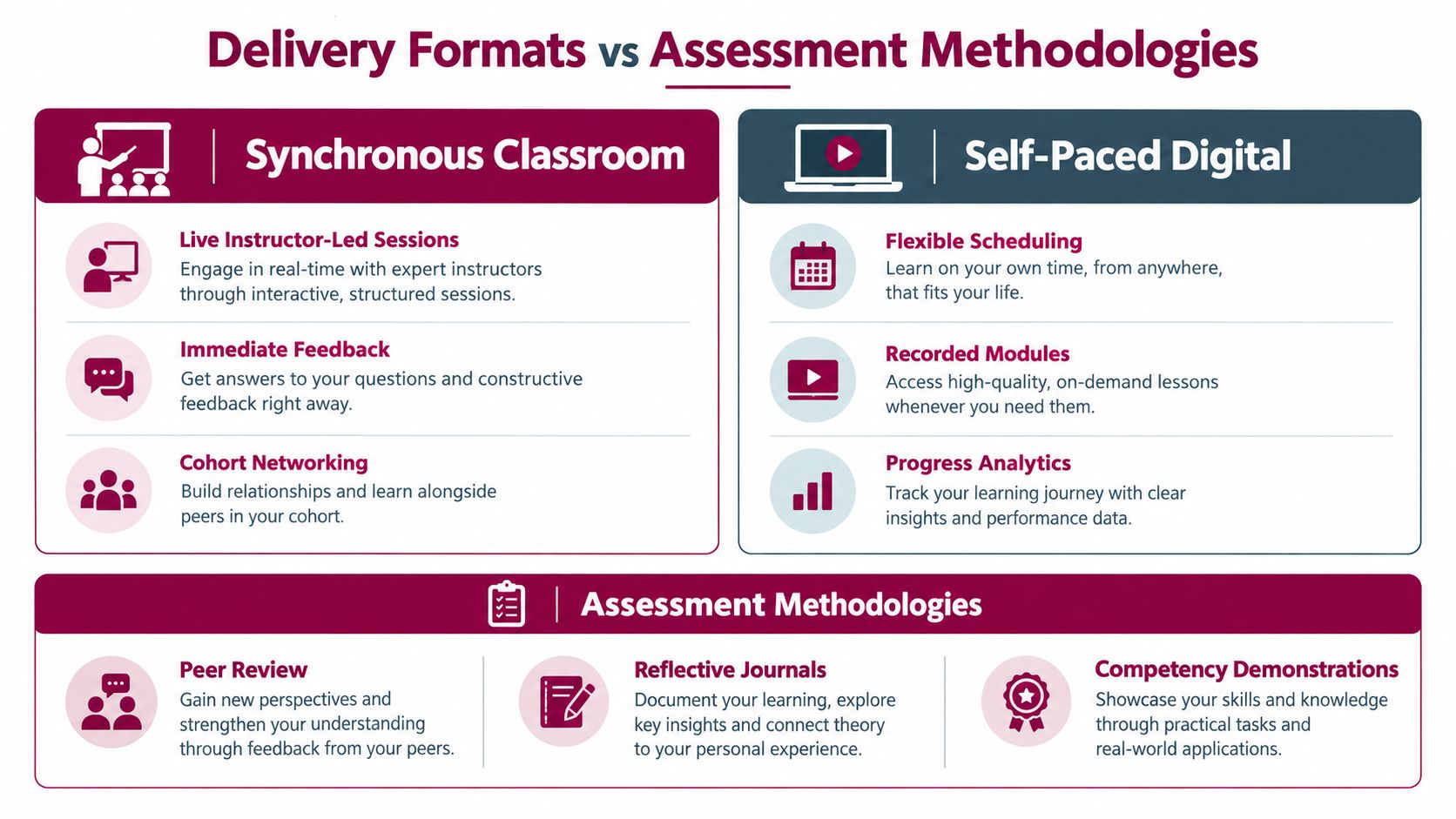
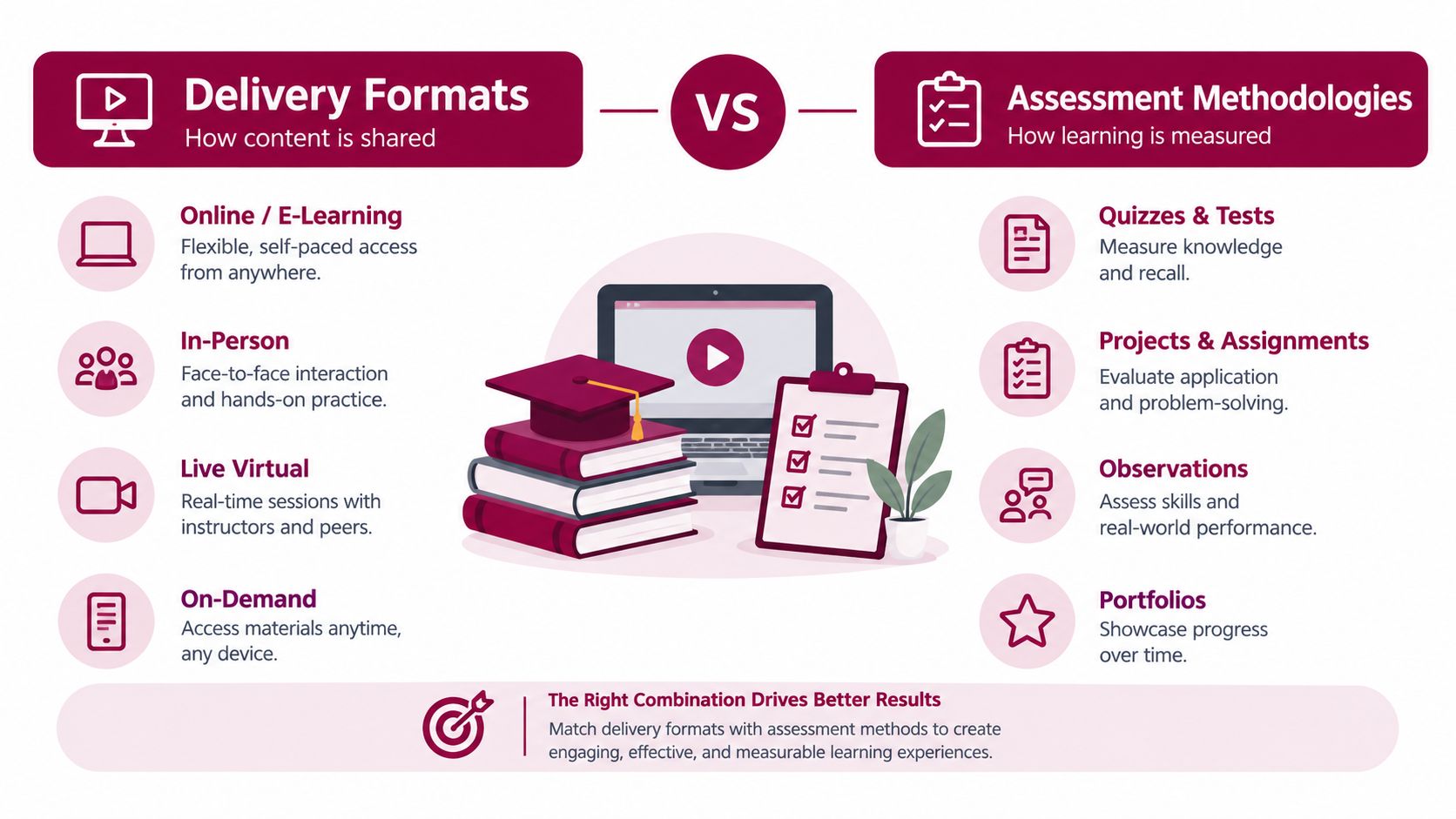
Delivery format should reflect both the learner’s working circumstances and the capability a structured CPD pathway is expected to develop. Synchronous classroom teaching offers live discussion, immediate clarification and cohort accountability. It suits activities such as negotiation, presentation and conflict practice, where feedback during the exercise can expose weak reasoning or unclear communication.
Self-paced digital learning addresses a different need. Recorded lectures and organised materials let professionals pause difficult explanations, revisit concepts and fit study around work and personal responsibilities. The flexibility is valuable, but progress depends on a planned routine and the learner’s ability to study without scheduled contact.
Blended provision combines independent preparation with scheduled interaction. The label itself says little about quality. Reviewers should ask whether the activities connect, whether participation is purposeful and whether learners understand how each task contributes to the intended outcome. A well-designed format works like a route map: each stage should prepare the learner for the next form of practice or evidence.
Matching format to the professional problem
A mid-career manager with unpredictable hours may need recorded content and modular progression. Someone preparing to lead a workshop may gain more from live rehearsal and peer feedback. Neither format is automatically superior. The choice depends on schedule, prior knowledge, confidence in independent study and the kind of practice required.
The course listing for Leadership and Organisational Behaviour can be considered as one option in that decision. Its suitability should be judged from the published information, without assuming delivery methods or content that the listing does not state.
| Decision factor | Synchronous classroom | Self-paced digital |
|---|---|---|
| Timing | Fixed sessions require protected calendar space. | Study can fit around professional commitments. |
| Interaction | Questions and discussion receive immediate responses. | Learners can revisit material before responding. |
| Accountability | Cohort attendance creates a visible routine. | Personal planning carries greater weight. |
| Accessibility | Location and time zone may affect participation. | Online access can reduce geographical constraints. |
| Evidence of learning | Participation and practice may be observed directly. | Assessments and completion records must show understanding. |
Assessment must produce credible evidence
Assessment methodology matters as much as delivery. Multiple-choice questions can check comprehension, while leadership capability also involves interpretation, judgement and application. Scenario responses, reflective journals, peer review and competency demonstrations can show how a learner reasons through ambiguity and chooses an appropriate response.
Digital verification provides an administrative check on that educational record. A certificate should identify the learner and course clearly. A verification facility allows an employer or professional body to confirm authenticity, making the record more auditable than an unsupported CV statement. Verification does not establish performance in every workplace, so assessment evidence and workplace application remain important.
A certificate becomes more useful when its issuer, scope and authenticity can be checked without relying solely on the learner’s description.
Aligning Curriculum Pathways with Professional Objectives
Course selection should begin with the workplace problem, not with the most impressive-sounding title. A manager dealing with recurring conflict needs a different sequence from an entrepreneur building a first team. A data-focused professional may need to strengthen influence and decision communication rather than learn more technical analysis.
The eight-course Credential of Leadership and Management demonstrates how a structured, modular pathway can address a broad range of leadership development needs. The programme comprises Leadership Fundamentals, Strategic Leadership and Corporate Direction, Decision-Making and Problem Solving, Emotional Intelligence in Leadership, Conflict Resolution, Change Management, Communication Skills for Leaders, and Team Building and Management. The pathway is CPD-accredited and carries 160 CPD hours.
For aspiring entrepreneurs
An entrepreneur often moves rapidly between strategy, operations and people management. A suitable curriculum should help connect vision with execution rather than treat leadership as a separate activity.
- Strategic leadership and corporate direction can support the translation of an idea into priorities, choices and a coherent direction.
- Decision-making and problem solving can provide a disciplined way to handle incomplete information.
- Communication skills for leaders can help an entrepreneur explain priorities to early employees, advisers and stakeholders.
- Team building and management becomes relevant when informal collaboration starts turning into a formal operating structure.
The value lies in sequence. Strategic thinking without communication can leave a team unclear about priorities. Communication without decision discipline can produce discussion without movement.
For mid-career managers
A manager who already carries operational responsibility may need targeted development rather than a general introduction. Emotional intelligence can support self-awareness and relationship management. Conflict resolution can help address disagreement before it disrupts delivery. Change management can provide a framework for communicating uncertainty while maintaining direction.
Consider a manager whose team is resisting a revised process. The immediate problem may look operational, but the leadership response involves several capabilities. The manager must understand the concern, explain the reason for change, invite useful challenge and clarify what support is available. A curriculum that connects emotional intelligence, communication and change management is more relevant than one that treats each topic as an isolated slogan.
For marketing and data-focused professionals
Professionals in marketing, digital marketing or data analysis often influence decisions without having direct authority over every contributor. Their development priorities may include stakeholder communication, conflict resolution and strategic interpretation.
A data-focused analyst, for example, may produce sound evidence but struggle to secure action from senior colleagues. Leadership study can help that professional frame recommendations, explain uncertainty and facilitate decisions across functions. A marketing professional may need similar skills when balancing creative disagreement, commercial objectives and customer insight.
The right curriculum therefore has to match authority, responsibility and desired transition. Recent graduates may require foundational management concepts. Experienced managers may need deeper work on change, conflict and organisational direction. Entrepreneurs may benefit from a pathway that combines strategy with team formation.
Translating Academic Theory into Organisational Impact
Experience remains essential to leadership, but it doesn’t automatically produce capability. A manager can spend years handling people and still rely on inconsistent assumptions about motivation, feedback or change. Experience becomes more valuable when formal study helps the professional examine it, challenge it and connect it with tested concepts.
That is why leadership training courses should be judged by the distance between academic understanding and workplace action. A learner should be able to move from a framework to a decision, from a case study to a conversation and from reflection to a change in behaviour.
The application test
A practical test asks three questions:
- What changed in the learner’s reasoning? Can the professional identify assumptions and distinguish symptoms from underlying issues?
- What changed in the learner’s behaviour? Can the professional communicate expectations, delegate or handle disagreement more deliberately?
- What evidence can be retained? Can the learner explain the decision, document the reflection or show how the approach was evaluated?
Case studies help because they create a controlled space for judgement. They allow learners to consider competing priorities without the immediate consequences of a live organisational decision. Applied assessments then require the learner to make those ideas more concrete.
Structured CPD also prevents development from ending when a certificate is issued. The UK training market is active, with employers spending £53.0 billion on training and development in 2024, equivalent to £1,700 per employee according to the UK Employer Skills Survey 2024. Leadership learning should sit within that continuing cycle, supported by reflection and further development rather than treated as a final badge.
The leadership-specific gap remains significant. A 2023 leadership development report found that 23% of employers provided no development for new leaders, 69% of HR professionals considered the training offered to new leaders inadequate, and only a quarter of employers refreshed leaders’ skills at least once a year as reported in the Northern Ireland evidence on management and leadership training. These findings reinforce the need for continuing pathways, not one-off induction.

Formal learning also strengthens professional conversations. A manager can discuss development using defined capabilities rather than vague claims about confidence. An organisation can identify gaps, select relevant modules and revisit progress through CPD records. Over time, that shared language supports more consistent management practice.
The assumption that experience alone creates strong leaders is therefore too narrow. Experience supplies context, while structured education supplies concepts, feedback and a route for deliberate improvement. For UK organisations facing a documented management capability gap, that combination is a practical foundation for resilience.
London School of Business Administration offers self-paced, CPD-accredited courses and structured programmes in leadership and management, supported by recorded lectures, learning materials, assessments and certificate verification. Professionals seeking a coherent route into formal leadership development can visit London School of Business Administration to review the available learning pathways and select a programme aligned with their objectives.