

Your finance team's new expense system goes live on schedule. Yet, in a typical scenario, three months later most claims still arrive by email because nobody explained who signs off, what changes for managers or when the old workflow closes. The technical delivery is complete, but the organisational change isn't.
Table of Contents
- What a Change Management Plan Must Cover
- How to Build the Plan in Seven Stages
- Communicating, Training and Handling Resistance
- Timelines, Consultation Rules and Governance Gates
- Measuring Benefits and Reviewing Progress
- Start Your Change Management Plan This Week
What a Change Management Plan Must Cover
A change management plan connects the proposed change to the decisions, capabilities and working practices required to realise its benefits. For the expense-system rollout, that means specifying more than a launch date: managers need approval rules, employees need practice, and finance needs authority to retire the email process.
The nine components of a change management plan
| Component | Question it answers | Output | Owner |
|---|---|---|---|
| Purpose and scope | What is changing, for whom, and what stays the same? | One-page scope statement | Senior sponsor |
| Stakeholder analysis | Who is affected, how much, and how supportive are they? | Stakeholder and readiness map | Change lead |
| Change vision | Why this change, and what does better look like? | Vision paragraph | Senior sponsor |
| Communications plan | What does each group hear, when, and through which channel? | Communications calendar | Communications lead |
| Training and capability | What must people be able to do, and how will they practise? | Role-based training plan | HR or learning lead |
| Resistance management | Where does opposition or silence appear, and how is it answered? | Resistance log and response actions | Change champions |
| Governance and roles | Who decides, approves and escalates? | RACI table and decision log | Programme board |
| Timeline and milestones | What happens in which order, and when does each gate close? | Phased plan with gates | Project manager |
| Metrics and evaluation | How is success measured against a baseline? | Benefits tracker and review schedule | Benefits owner |
Make the components work together
These documents shouldn't become separate administrative exercises. The stakeholder map determines the communications calendar; the readiness assessment determines training; the benefits tracker determines whether the sponsor should authorise further deployment.
A vision without metrics cannot demonstrate success. A timeline without consultation can collide with legal minimums, while training without revised decision rights can leave employees competent in a system they aren't authorised to use.
For every people-related action, record the starting position, intended output, accountable person and relevant consultation dependency. Include an inclusion check: who cannot access the proposed channel, attend the session or practise during their normal working hours?
Working-plan test: If a component lacks a named owner and a measurable output, it remains an intention rather than an operational commitment.
Ownership also requires capacity. Naming an already overstretched manager doesn't resolve responsibility unless the sponsor agrees what work that manager can stop or delegate.
How to Build the Plan in Seven Stages
Build the plan in dependency order. Establish what must improve before deciding how people should change their work, then test whether the proposed approach is usable and equitable.
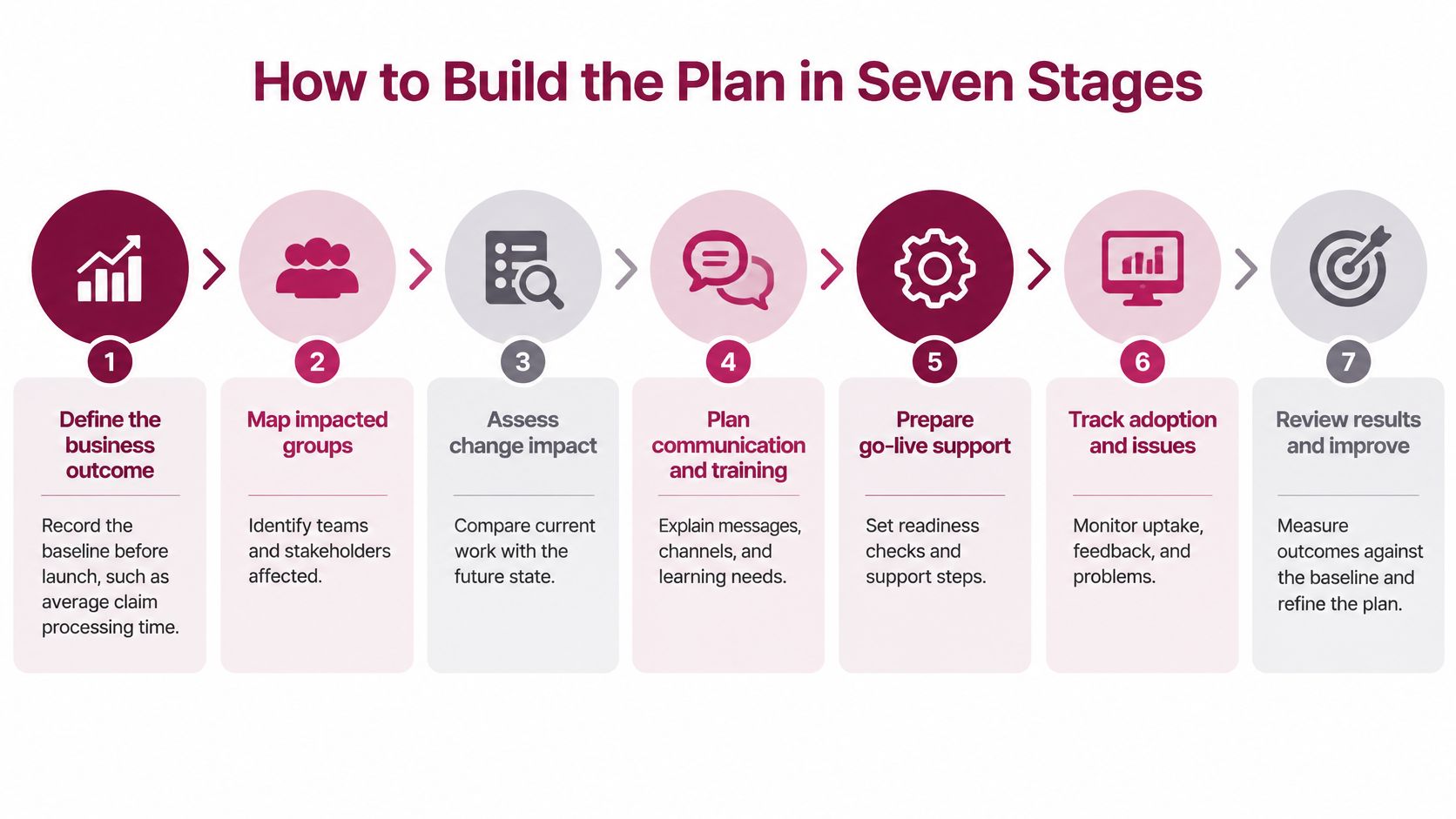
Establish the outcome and organisational impact
Define the business outcome and baseline. The benefits owner records current claim-processing time and agrees the target before launch. Measuring only afterwards leaves no reliable starting point against which to assess improvement.
Map affected roles, processes and decision rights. Put current and proposed workflows side by side, including staffing, working arrangements and skills. Identify who gains authority, who loses it and which gaps require retraining, redeployment or recruitment; an organisation chart alone misses these operational consequences.
Assess readiness and resistance by group. Use Lewin's unfreeze-change-refreeze model to consider preparation and reinforcement, Kotter's sense of urgency to test the rationale, and ADKAR's awareness, desire, knowledge, ability and reinforcement to diagnose individual needs. The common mistake is selecting generic training before identifying who is least prepared.
Establish leadership before testing delivery
Appoint the sponsor and local champions. Leadership and management were people-related technology-adoption enablers cited by 41% of UK businesses in the UK Innovation Diffusion and Adoption Survey. Give champions protected time, access to decision-makers and responsibility for surfacing problems; without these, they become messengers rather than influencers.
Write the change vision. The sponsor should explain, in a single paragraph, what improves, for whom and why now. Avoid presenting a preferred technical solution as though it were a business outcome.
Pilot against explicit criteria. The process owner confirms access, training, support and required consultation before entry. Define acceptable quality, usability and workload before exit, otherwise the pilot continues without a decision.
Deploy in controlled waves. The project manager schedules readiness reviews, escalation routes and the final closure decision, with inclusion checked before each wave. Don't release another group merely because the calendar says so.
The choice between agile and waterfall project management approaches should reflect delivery uncertainty, not remove approval obligations. Iterative testing can refine a process, but it cannot substitute for required consultation.
Before authorising deployment, ask representatives of every stakeholder group to explain the change in their own words. If their explanations conflict, the plan isn't ready.
Communicating, Training and Handling Resistance
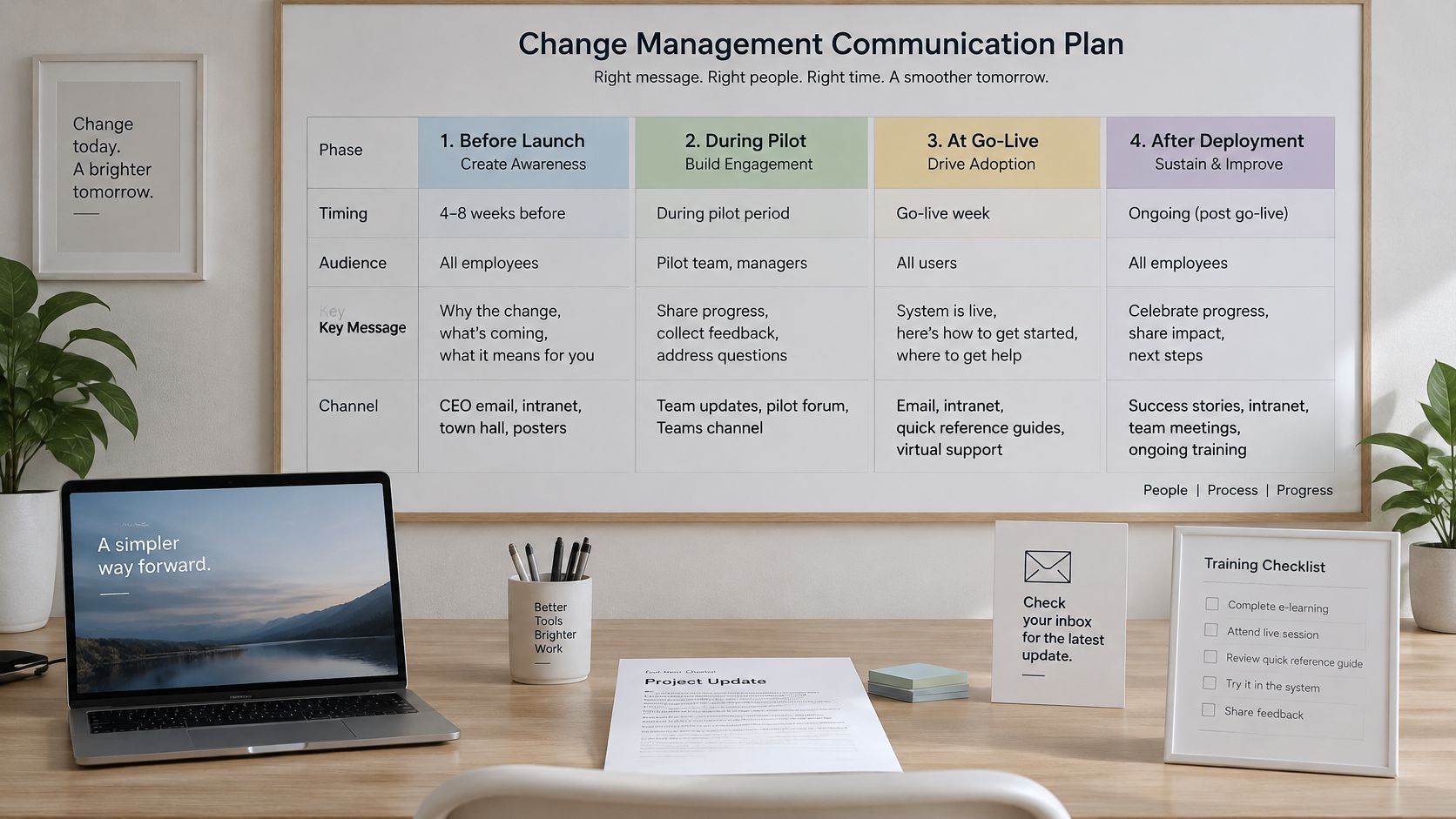
Announcements aren't communication. Employees need repeated opportunities to understand, question and practise the change before launch, during the pilot, at go-live and after deployment.
The CIPD employee voice factsheet reports that a quarter of employees experience high levels of workplace silence, while separate employer evidence it discusses found that 80% of organisations implementing change increased communication frequency. More messages may help, but only if employees can respond and managers act on what they hear.
Communications matrix by audience
| Audience | Core message | Channel | Timing |
|---|---|---|---|
| Senior leaders | Rationale, expected benefits and main risks | Steering meeting and written briefing | Before launch and at each gate |
| Managers | Workflow changes and what to tell their teams | Manager briefing and toolkit | Before pilot and before go-live |
| Frontline employees | What changes on day one, support routes and deadlines | Team meetings and quick guides | Go-live and weekly afterwards |
| Groups under consultation | Proposals, selection criteria and how to respond | One-to-one meetings, written consultation and trade-union meetings | Throughout consultation |
| All staff | Where to raise concerns and how quickly they will be answered | Confidential route and pulse survey | Continuous, with monthly review |
The communications lead owns the calendar, but line managers must explain local consequences. Strengthening communication skills for managers is therefore an implementation control, not an optional presentation exercise.
Diagnose the cause before prescribing the response
Build role-specific practice around actual tasks. An employee submits an expense, a manager rejects an incomplete claim, and finance resolves an exception; each scenario tests different knowledge and authority.
Provide paid practice wherever possible, accessible materials and supported alternatives for employees with limited digital confidence. Optional self-study transfers the implementation burden to people who may have the least time or access.
The Adecco Business Leader Survey material reports that 84% of businesses planned generative-AI implementation, but only 49% of employees felt prepared; it also records 67% of leaders identifying resistance and cultural barriers as obstacles to AI pilots, while 38% prioritised inclusive workforce transformation.
Silence is a risk signal, not evidence of agreement.
Before labelling low usage as opposition, investigate inadequate preparation, unclear accountability, employment concerns and impractical workflows. Give the change lead responsibility for a response log, confidential escalation and documented resolution decisions.
Judge communication through message reach, comprehension, completed training and sustained behaviour. Review completion and usage by team, grade and age group monthly where lawful and sufficiently aggregated to protect privacy, alongside readiness by role and digital confidence. An inclusion gap should trigger targeted coaching or process redesign, not another all-staff briefing.
Timelines, Consultation Rules and Governance Gates
Minimum consultation periods by scenario
| Scenario | Minimum consultation | What the plan must show |
|---|---|---|
| 20 to 99 redundancies at one establishment within 90 days | At least 30 days before the first dismissal takes effect | Proposals, selection criteria and representative meeting dates |
| 100 or more redundancies at one establishment within 90 days | At least 45 days before the first dismissal takes effect | Affected numbers, alternatives considered and feedback record |
| Restructure without redundancies | Commonly at least four weeks, depending on circumstances | Detailed proposal, response window and documented changes |
| Process or technology change with no job losses | Set a meaningful response period against applicable obligations and organisational policy | Consultation log and summary of feedback received |
For proposals involving 20 to 99 redundancies at one establishment within 90 days, consultation must begin at least 30 days before the first dismissal takes effect, as set out in Falkirk Council's organisational change policy; for 100 or more, the minimum becomes 45 days. The HR lead must confirm affected numbers early enough for the project manager to incorporate these constraints.
For restructures without redundancies, at least four weeks is a common consultation period in Bristol City Council's managing change policy, subject to circumstances and statutory requirements. This is a local policy benchmark, not a universal statutory minimum.
For process or technology changes without job losses, don't invent a standard consultation duration. HR should establish applicable contractual, representative and policy obligations, then allow sufficient opportunity to examine the proposal and respond.
Build the critical path around decisions
The operational sequence should run from business case and leadership approval through consultation, consideration of responses, final decision, implementation and an appeal window where applicable. Proposal approval permits consultation; it does not establish that the final design is settled.
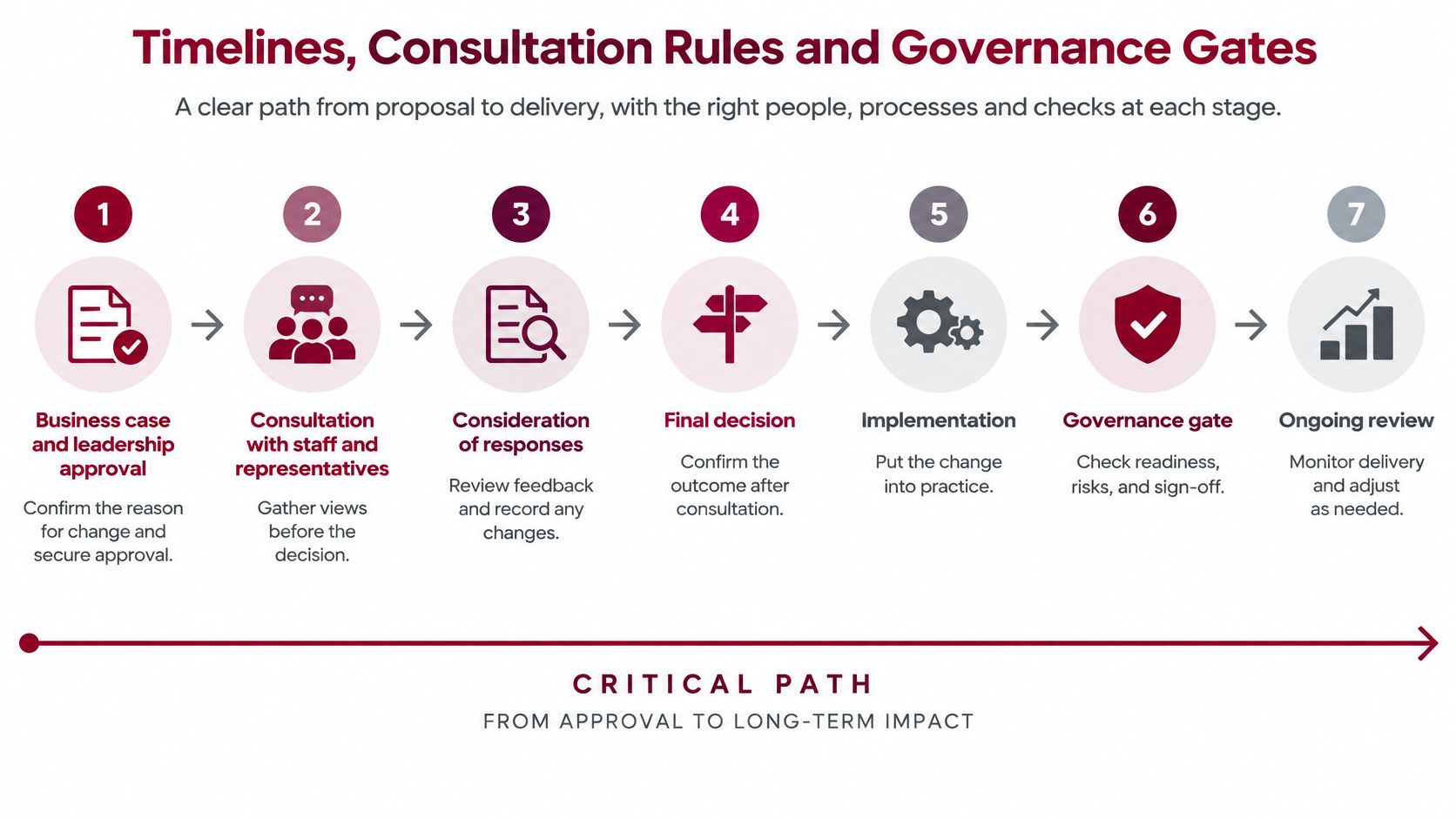
Give each gate a decision-maker and evidence requirement. The consultation gate needs sufficiently detailed proposals, a stated response window, representative meetings, an alternatives log and an explanation of how feedback affected the design.
The sponsor owns final authorisation, HR validates consultation completion, and the operational owner accepts readiness. A clear allocation of change management roles prevents the project manager from being expected to approve matters outside their authority.
Scheduling principle: A legal minimum is a floor, not proof that meaningful engagement has occurred.
Plan dependencies in weeks before committing to fixed dates. If consultation or response assessment takes longer, move the dependent implementation milestone automatically; where an external deadline is immovable, identify contingency and escalation before approving the business case.
Measuring Benefits and Reviewing Progress
Record the baseline before implementation. A benefits owner cannot demonstrate improvement against a starting value that nobody captured, and retrospective estimates should not be presented as equivalent to measured evidence.
The NISTA Major Projects Annual Report 2025–26 records 26 projects exiting the portfolio after successfully delivering their objectives, compared with 14 in the preceding year. These results support an outcome-focused review discipline, but they don't establish that any single planning technique caused successful delivery.
Separate activity from operational value
For each indicator, record the baseline, target, reporting frequency, escalation route and accountable owner. Specify the calculation and information source as well, otherwise different teams may report incompatible measures.
Benefits indicators by family
| Family | Example measures | Review points |
|---|---|---|
| Adoption | Active use and workflow compliance | 30, 90 and 180 days |
| Performance | Cycle time, cost, error rate and service quality | 30, 90 and 180 days |
| Experience | Workload distribution and extra work taken on | 90 and 180 days |
This proposed review cadence reflects the benefits-measurement approach discussed in a parliamentary submission on AI adoption and economic impact, which recommends assessment at 30, 90 and 180 days. Schedule the experience assessments after employees have encountered normal operating demands, while keeping an immediate route for reporting harm.
For the expense-system example, active accounts indicate access, not successful processing. Finance should examine elapsed processing time and errors, while managers check whether administrative work has merely moved from finance to claimants.
Compare equivalent operating periods and record changes in claim volume, staffing and policy. Where feasible, use a comparable group awaiting deployment to distinguish the intervention's effects from normal variation.
Agree intervention thresholds before reviewing results
The sponsor should approve stop, redesign and scale criteria before seeing the pilot results. A hypothetical rule might require redesign when a performance target is missed across consecutive reviews, or immediate suspension when a serious control failure occurs.
Faster processing should not compensate automatically for inaccessible workflows, excessive checking or unsafe automation. The benefits owner must explain who gains time, who takes on additional work and whether support reaches the least-prepared groups.
High usage is not the same as organisational value. Continue only when adoption produces defensible operational benefits without unacceptable workforce consequences.
Start Your Change Management Plan This Week
Use this week to establish a decision-ready proposal, not to manufacture premature certainty. On the first day, complete the component table with actual names, missing evidence and unresolved dependencies.
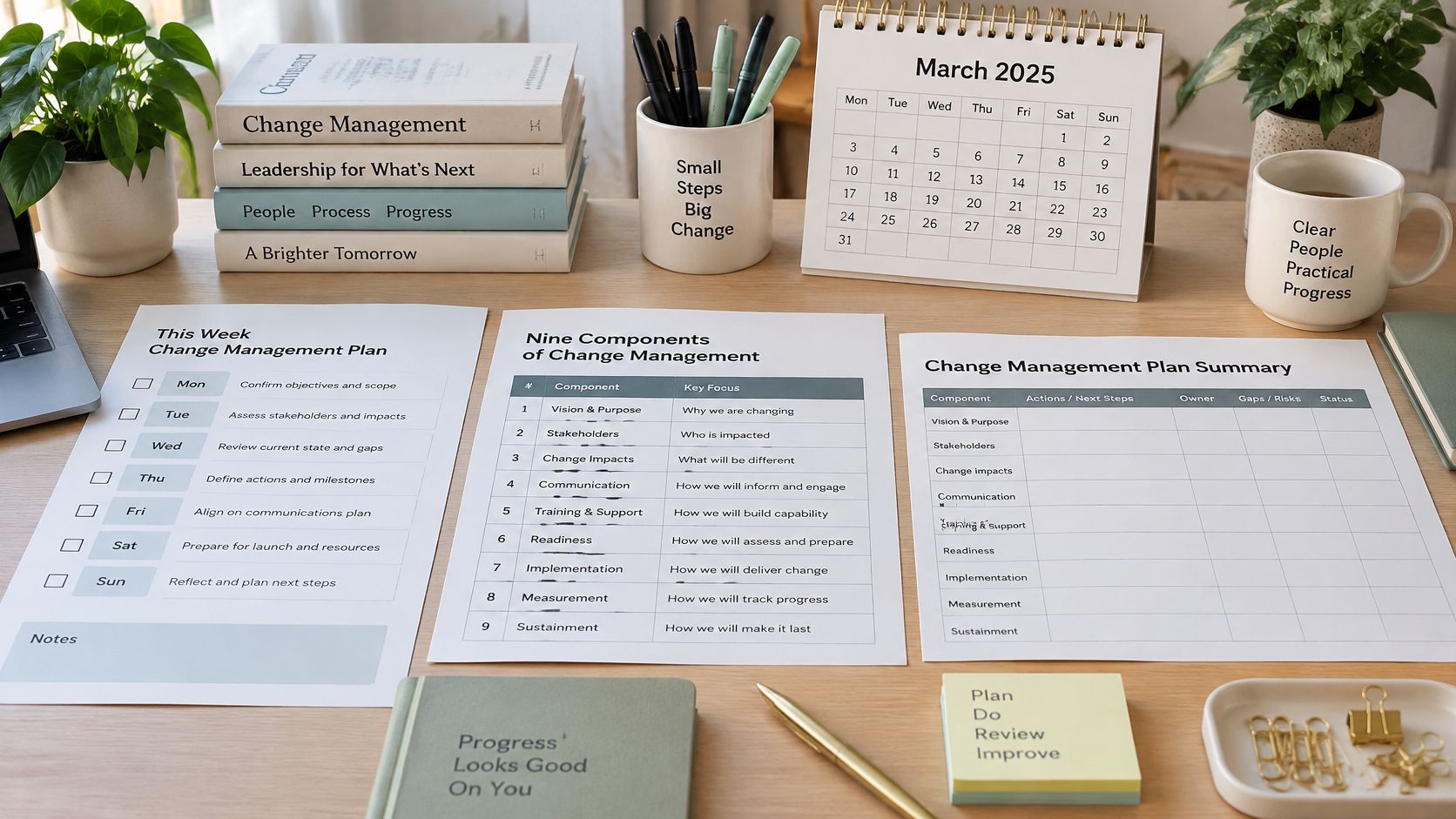
Assemble the working documents
- Define the proposal. Draft the one-page summary and obtain the sponsor's agreement on scope.
- Assess the people impact. Build the stakeholder and readiness map, including access needs and changes in authority.
- Prepare engagement. Create the communications calendar and consultation log, with response owners.
- Make outcomes auditable. Establish the benefits tracker and a decision table showing who approves each gate.
For a restructure, follow the practical comparison required by Brent Council's managing change procedure: place current and proposed structures, staffing, working arrangements and skills alongside each other. Turn each gap into an explicit retraining, redeployment, recruitment or role-design action.
For consultation, notify affected employees and representatives, issue the proposal, record questions and explain responses. Use Cherwell District Council's organisational change framework to keep business-case approval, consultation, final approval, implementation and appeal distinct rather than treating initial approval as permission to proceed immediately.
For structured support, our Change Management course costs £99.00, is fully online and self-paced, and includes recorded video lectures, text-based lessons, practical case studies, visual frameworks, reflection exercises and an online multiple-choice quiz, with a Certificate of Completion awarded on passing the assessment.
Start by drafting the intended outcome and recording the baseline you will use to judge it. Send both to your sponsor for agreement before committing the organisation to a launch date.
London School of Business Administration offers self-paced online business and management learning that connects structured frameworks with practical case studies and assessments. Visit London School of Business Administration to explore learning that can help you develop a change management plan with clear ownership, meaningful consultation and measurable outcomes.