
You've just been promoted to lead a new department, and the management approach that earned you glowing reviews last year has suddenly stopped working. With your former team, an open, consultative manner kept experienced specialists motivated and sharp. In this new role, the same open-ended questions leave junior staff anxious, missed deadlines are piling up, and your director is asking why nobody seems to know who owns what.
That friction is the everyday workplace problem behind contingency theories of leadership. Most managers don't fail because they lack intelligence or work ethic; they stumble because they import one preferred habit into a context that demands something different. UK leadership data illustrates how costly a narrow repertoire can be. A study reported by FM Magazine analysed 14,000 leaders across 400 organisations between 2005 and 2012 across six leadership styles (coercive, authoritative, affiliative, democratic, pacesetting, and coaching) and found that only 24% could draw on four or more styles, while 38% had mastered none or just one.
Those gaps showed up directly in workplace climate. Just 18% of UK leaders created a high-performance environment, compared with 53% who generated a demotivating one, and 48% of leaders producing high-performance climates were comfortable using at least four styles, against only 9% among leaders associated with demotivating climates. Style flexibility on its own doesn't guarantee results, yet the pattern points squarely to a practical truth: good leadership depends on reading the room accurately before deciding how to act.
Table of Contents
- Contingency Theory in Plain Terms
- Major Contingency Theories Compared at a Glance
- Fiedler's Model and the Favourability Matching Rule
- Situational Leadership and Follower Readiness
- Path-Goal and Vroom-Yetton Models in Practice
- Diagnose Your Team and Keep the Basics Fixed
Contingency Theory in Plain Terms
A skilled GP doesn't write the same prescription for every patient who walks through the surgery door. A sat-nav doesn't insist on the M1 when an accident has closed three lanes ahead; it recalculates the route around live conditions. Contingency theories of leadership apply that exact diagnostic logic to managing people.
Stated formally, the core claim is simple: leadership effectiveness results from the interaction between a leader's behaviour and situational variables, including task structure, leader-member relations, positional power, organisational culture, and employee capability. In plain terms for a manager, no single style wins in every room. Earlier trait theories searched for inborn qualities shared by great leaders, while universal-style models argued that one behavioural pattern (such as democratic or participative management) should work across all workplaces. Both struggled whenever an acclaimed leader moved to a different organisation and faltered.
Why Context Filters Leadership Through Culture
Empirical research in British workplaces confirms that leadership behaviour rarely acts in isolation. A study covering 2,662 employees across 311 UK organisations, available via Academia.edu, found that leadership style wasn't directly associated with organisational performance; instead, its impact worked through organisational culture (a mediating variable, meaning the intermediate mechanism through which one factor shapes an outcome). Supportive and participative behaviours showed a positive relationship with performance through culture, whereas purely procedural, rule-focused leadership showed a negative indirect relationship.
A leadership style isn't inherently superior or inferior. It's a tool whose value depends on the task, the people doing it, and the culture they work inside.
For a practising manager, that finding shifts the central question from "What kind of leader am I?" to "What does this specific situation require right now?" Consider a finance team closing an urgent regulatory audit under tight statutory rules. Clear, directive instructions prevent costly errors and reassure staff about priorities. Now picture the same manager running a quarterly product-design workshop where specialist knowledge is spread across six people. Issuing top-down commands there would choke off ideas and erode commitment, whereas structured participation draws out better solutions.
To apply contingency thinking without getting lost in abstract labels, three practical questions matter most: which major models exist, how each one diagnoses a workplace situation, and where UK evidence shows that adapting your style stops helping and fixed managerial standards must hold firm.
Major Contingency Theories Compared at a Glance
Students and managers often lump every context-based leadership model into one vague instruction to "be flexible". That shortcut hides important differences. Four major frameworks dominate UK business and management syllabuses, and they don't even agree on whether a leader can easily change their underlying style.
| Theory | Origin | Situational variables | Adjustable leader behaviour |
|---|---|---|---|
| Fiedler contingency model | Fred Fiedler (1967) | Leader-member relations, task structure, positional power | Matches stable LPC orientation to situational favourability |
| Hersey-Blanchard situational leadership | Paul Hersey and Ken Blanchard (1977) | Follower competence and commitment | Shifts between directing, coaching, supporting, and delegating |
| House path-goal theory | Robert House | Follower characteristics and task or work environment | Chooses directive, supportive, participative, or achievement-oriented behaviour |
| Vroom-Yetton-Jago decision model | Victor Vroom, Philip Yetton, and Arthur Jago | Decision quality requirement, available information, likelihood of acceptance | Sets how much staff take part in the decision |
Fred Fiedler's model serves as the historical starting point for the entire field. Presented in its most complete form in 1967, it broke with universalist thinking by proposing that effectiveness depends on fitting a leader's relatively stable motivational orientation to situational control. That framework proved remarkably durable: it generated more than 30 years of research across education, healthcare, industrial psychology, and international management, and a 2025 scholarly encyclopedia review on DOAJ covering applications from 1980 to 2022 reports that organisations continued to use it for leadership assessment and leader placement.
Four Different Diagnostic Questions
Where learners usually get tripped up is assuming these four models compete to solve the exact same problem. Each one answers a distinct management question, and understanding the broader leadership styles in management helps clarify how they sit alongside one another:
- Fiedler's contingency model asks who should lead this team. Rather than assuming you can rewire a manager's personality overnight, it evaluates whether a person's natural orientation fits the team's trust, task clarity, and formal authority, or whether the role itself needs redesigning.
- Hersey and Blanchard's situational model asks how to develop this specific person on this task. It treats leadership as an adaptable coaching toolkit that shifts as an individual gains skill and confidence.
- House's path-goal theory asks how to motivate people on a particular piece of work. It directs the manager to remove roadblocks and supply whatever guidance, encouragement, or stretch the work environment fails to provide on its own.
- The Vroom-Yetton-Jago model asks how much to involve staff in a single decision. It focuses narrowly on choosing between an autocratic call, consultation, and group consensus when a specific choice carries high stakes.
Keeping those four questions separate prevents a common error in essays and management appraisals alike: applying a decision-making tree when the issue is long-term staff capability, or prescribing style flexibility when structural authority is broken.
Fiedler's Model and the Favourability Matching Rule
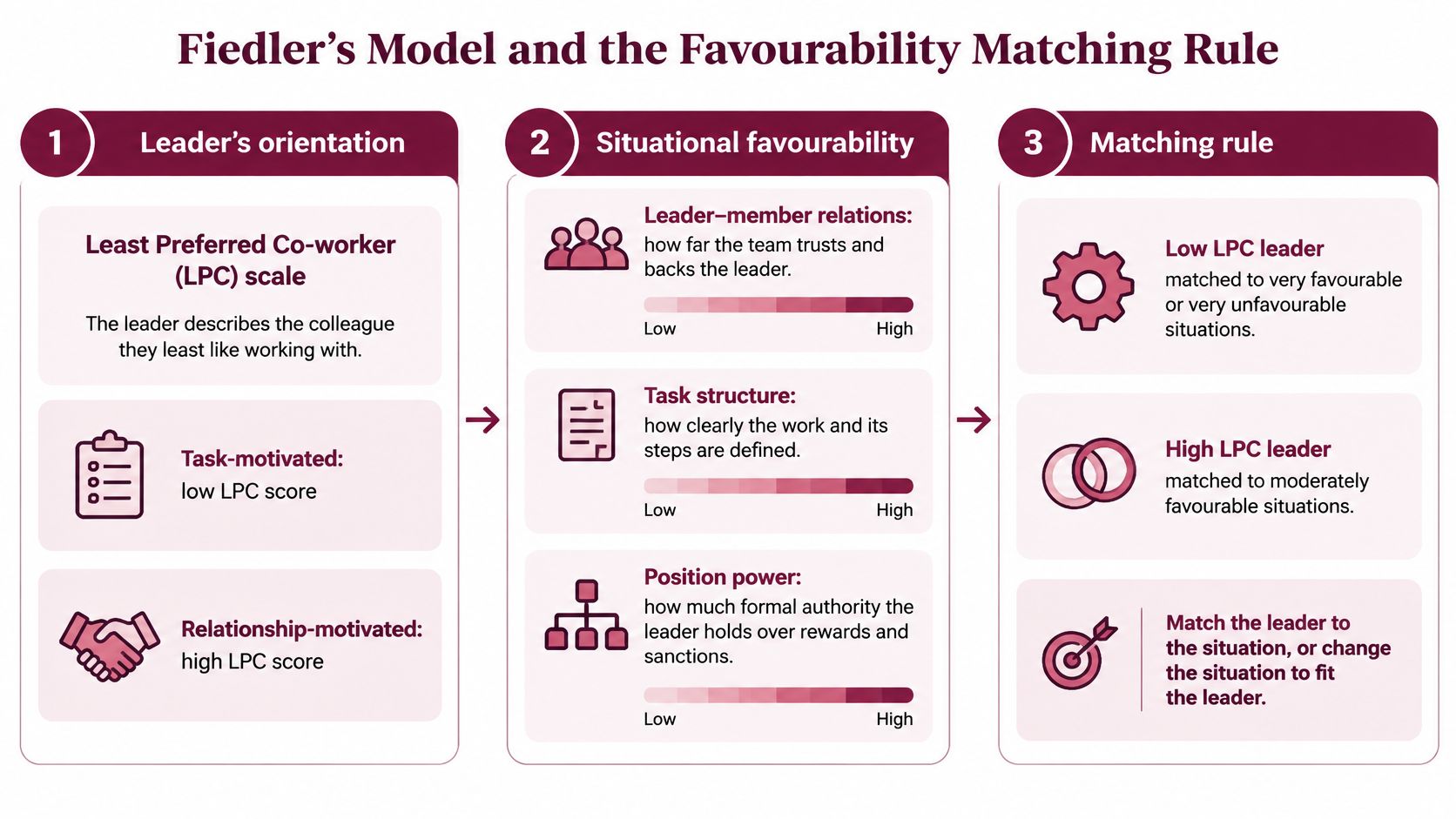
Imagine two football managers. One is a strict tactician who thrives on clear drills and total discipline; the other is a diplomat who shines when smoothing egos and coaxing collaboration out of divided dressing rooms. Fiedler argued that neither person can easily morph into the other, because a leader's core orientation is rooted in long-standing habits. His model therefore works in three distinct stages: measuring the leader, scoring the situation, and checking the match.
Stage One Leader Orientation and the LPC Scale
To identify a leader's underlying orientation, Fiedler created the Least Preferred Co-worker (LPC) scale. You think of the one colleague you've found hardest to work with across your career and rate them across opposing adjectives such as pleasant versus unpleasant, or cooperative versus uncooperative.
The counterintuitive twist is that the score measures you, not your difficult colleague. Managers who still describe that person in fairly generous terms record a high LPC score and are classed as relationship-oriented, meaning their regard for people survives friction. Managers who rate that colleague harshly record a low LPC score and are classed as task-oriented, meaning poor delivery colours how they judge the person as a whole.
Stage Two Scoring Situational Favourability
Next, the model measures situational favourability (sometimes called situational control), which reflects how much influence and predictability the workplace gives the leader. Three factors set the score, ranked from heaviest to lightest weight:
- Leader-member relations. The degree of trust, respect, and backing the team gives its leader. Without this foundation, formal authority rarely travels far.
- Task structure. How clearly goals, steps, and success criteria are defined. Processing standard insurance claims has high structure; inventing a brand-new public health campaign has low structure.
- Positional power. The formal authority attached to the role, such as setting pay, approving promotions, or issuing disciplinary sanctions.
Stage Three The Non-Linear Matching Rule
Here is where Fiedler surprises most first-time readers. The matching rule isn't a neat straight line where one style handles easy rooms and the other handles hard rooms. Instead, task-oriented leaders perform best at both extremes, while relationship-oriented leaders excel in the messy middle.
| Favourability | Typical conditions | Best-performing orientation |
|---|---|---|
| High | Good leader-member relations, structured task, strong positional power | Task-oriented (low LPC) |
| Intermediate | Mixed relations, partly structured task, moderate power | Relationship-oriented (high LPC) |
| Low | Poor leader-member relations, unstructured task, weak positional power | Task-oriented (low LPC) |
Picture a compliance lead overseeing a statutory data-protection audit with a trusting team, a clear checklist, and full sign-off power. That situation is highly favourable: because everyone already gets along and knows the rules, a low-LPC, task-oriented manager can drive execution cleanly without overthinking interpersonal dynamics. Now picture the opposite extreme: a newly appointed coordinator dropped into a struggling cross-functional project with ambiguous goals, fractious colleagues, and almost no formal authority. In that highly unfavourable setting, a task-oriented leader who imposes structure and basic order often prevents total drift, whereas a relationship-focused leader can stall while trying to win everyone over first.
In between lies the intermediate zone, such as leading a group of creative specialists who respect your expertise on loosely defined work where you lack formal hiring power. There, crude task commands alienate capable staff, so a high-LPC, relationship-oriented leader gets better traction by building goodwill and consensus.
Where the Evidence Is Mixed
Academic honesty requires flagging the model's limits clearly. As the NHS Leadership Academy's Towards a New Model of Leadership report notes when placing Fiedler's 1967 theory alongside situational, expectancy, and decision-making frameworks, empirical tests of the model have produced mixed or contradictory results, and scholars have repeatedly questioned both the LPC instrument and its supporting methodology. Self-reported ratings of a past colleague can drift over time, and treating leadership style as almost unchangeable ignores how much managers can learn through structured coaching and reflection.
Diagnostic takeaway: Don't treat an LPC score as a permanent verdict on a manager's worth. Use Fiedler's three situational levers to diagnose why a capable person is struggling in a specific post before blaming their character.
Even with those flaws, the framework remains a staple of British management curricula, including foundational university modules and structured courses such as Leadership and Organisational Behaviour, because it forces organisations to check whether they've set a leader up in a mismatched role. When fit breaks down, you don't just tell the manager to try harder; you either clarify the task, strengthen authority, repair trust, or move the person to a context that matches their strengths.
Situational Leadership and Follower Readiness
Where Fiedler argues that leaders rarely change their spots, Paul Hersey and Ken Blanchard took the opposite stance. Think of how a driving instructor works with a learner. On lesson one, the instructor gives crisp, step-by-step commands ("mirror, signal, clutch down"). Six months later, that same instructor sits beside a confident driver preparing for their test, offering occasional prompts rather than clutching the dual controls.
Hersey and Blanchard's 1977 model builds that progressive shift into a four-part management repertoire: directing, coaching, supporting, and delegating (some UK healthcare guides also refer to mentoring alongside coaching). Rather than scoring the whole organisation, the manager diagnoses an individual employee's follower readiness for a specific task across two factors: competence (the person's task-relevant ability, knowledge, and skills) and commitment (their confidence and motivation to do the work).
| Follower readiness | Competence | Commitment | Leader style |
|---|---|---|---|
| Enthusiastic beginner | Low | High | Directing |
| Disillusioned learner | Some | Low | Coaching |
| Capable but cautious | High | Variable | Supporting |
| Self-reliant achiever | High | High | Delegating |
How Task and Relationship Behaviours Shift Together
Underneath those four styles sit two practical dials that a manager adjusts continuously, as explained in the Research in Practice situational leadership guide. Task behaviour covers explicit instruction, goal setting, and tight guidance. Relationship behaviour covers active listening, emotional support, two-way dialogue, and visibly valuing staff contributions.
- Directing (high task, low relationship). An enthusiastic beginner wants to succeed but lacks the know-how. Clear instructions, demonstrations, and short feedback loops build competence safely without wasting time on abstract discussion.
- Coaching (high task, high relationship). Once the novelty fades and the work feels harder than expected, motivation often dips. The manager keeps structure high while adding encouragement, explaining the "why" behind procedures, and inviting questions.
- Supporting (low task, high relationship). A capable but cautious colleague already possesses the technical skill yet hesitates to act solo. Step back from micro-managing the method; listen, ask what they propose, and reinforce their judgement.
- Delegating (low task, low relationship). A self-reliant achiever has both mastery and confidence. Agree on the outcome and boundary conditions, then hand over autonomy with periodic check-ins rather than hovering.
Consider a newly qualified nurse joining an acute hospital ward. During their first month administering complex medication rounds, they need a directing style: explicit checklists, direct supervision, and immediate feedback. Three months in, after a stressful shift dents their confidence, coaching helps rebuild both skill and morale. A year later, that same nurse can manage routine ward handovers under a delegating style, while still needing directing again if they transfer into an unfamiliar intensive-care unit.
Applying Readiness Beyond the Individual
UK healthcare commentary stresses that follower readiness never sits in a vacuum. Across NHS hospitals, community trusts, and clinical departments, choosing the right balance also depends on the risk profile of the task, how effectively the wider team collaborates, the existing leader-follower relationship, and each person's prior experience. Exploring concrete situational leadership examples makes it easier to see how managers adjust those dials without appearing inconsistent to their teams.
Broader British workforce evidence underscores how much room remains for managers to sharpen this calibration. In the CIPD's Importance of People Management report, UK Working Lives analysis of roughly 6,000 workers surveyed in early 2022 confirmed that line-management quality shapes engagement, performance, health, and wellbeing, while Good Work Index findings showed that 79% of UK employees view their manager as supportive when a problem arises, yet only 63% say their manager helps them perform well and 64% say their manager supports learning and development. In other words, many British managers offer warmth when trouble hits without pairing it with structured coaching or targeted skill development.
Working rule: Diagnose readiness per task, not per personality. Move one step at a time up or down the four styles, and explain why you're stepping closer or stepping back so staff never mistake direction for distrust.
Path-Goal and Vroom-Yetton Models in Practice
Two further contingency frameworks sharpen a manager's day-to-day toolkit by narrowing the focus: one zeroes in on motivation, the other on decision-making. Used side by side, they show how contingency thinking moves from broad team supervision down to individual conversations and single high-stakes meetings.
House's Path-Goal Theory Clearing the Obstacles
Think of a manager using Robert House's path-goal theory as a mountain guide. Your job isn't to carry every hiker up the slope; it's to clarify the route to the summit, point out the rewards worth reaching, and clear boulders blocking the path. The model draws on expectancy theory (the idea that people put in effort when they believe effort will lead to good performance and valued outcomes) and maps four leader behaviours onto follower characteristics and task conditions:
- Directive leadership sets explicit standards, schedules, and rules. It works well when a task is ambiguous and staff are inexperienced, or when employees prefer clear external guidance, yet it feels suffocating to seasoned specialists doing routine work.
- Supportive leadership shows genuine concern for wellbeing and creates an approachable climate. When a task is repetitive, stressful, or emotionally draining (such as high-volume customer complaint handling), supportive behaviour cushions frustration where extra rules would only add irritation.
- Participative leadership invites suggestions and weighs team input before choosing a course. It suits complex, unstructured problems where employees have high belief in their own control (an internal locus of control) and want a genuine voice.
- Achievement-oriented leadership sets demanding stretch targets and signals confidence that the team can meet them. It sparks energy among experienced professionals tackling a clear but ambitious challenge, such as cutting project delivery times without sacrificing quality.
Watch how the same project manager adjusts across one week. On Monday, when two junior analysts inherit an ill-defined client brief, directive behaviour removes confusion so they can start productively. On Thursday, when senior engineers tackle a familiar system upgrade with a tough performance target, achievement-oriented leadership motivates far better than hovering over their code.
The Vroom-Yetton-Jago Model Calibrating Participation
While path-goal theory guides ongoing motivation, the Vroom-Yetton-Jago decision model tackles a sharper question: for this specific decision, should I decide alone, consult others, or share the final call with the group? It lays out five decision styles along a spectrum of involvement:
- AI (autocratic I). You solve the problem yourself using information you already have.
- AII (autocratic II). You gather specific facts from team members, then decide alone without necessarily explaining the full problem.
- CI (consultative I). You share the problem with relevant individuals one to one, hear their ideas, and make the final decision yourself.
- CII (consultative II). You bring the group together to discuss the issue collectively, then retain the final decision.
- GII (group II). You share the problem with the team as equals, facilitate discussion, and accept whatever consensus solution the group reaches.
To pick between those five options, a manager works through a structured decision tree asking practical questions: How important is technical decision quality? Do I already possess enough information? Are team members aligned with organisational goals? Will staff accept and execute the decision if I impose it unilaterally?
UK workplace sentiment makes this calibration especially relevant. A 2025 survey of 2,000 UK employees reported by money.co.uk found that 46% said they perform best when involved in decision-making, compared with 21% preferring transformational leadership and just 15% preferring autocratic leadership (with Wales recording the highest preference for transformational leadership at 23%). Employees clearly value voice, which explains why CI, CII, and GII earn stronger buy-in on strategic changes or hybrid-working norms where team commitment makes or breaks execution.
Still, democratic leadership isn't automatically optimal. If a cyber-security breach hits at 4pm on a Friday, or a statutory safety threshold is breached on a construction site, you don't convene a consensus workshop; AI or AII protects people and meets the deadline. Equally, running a full decision tree for routine daily choices wastes everyone's calendar. Reserve formal decision-making models in management for consequential calls where the cost of getting either technical quality or staff buy-in wrong is high.
Diagnose Your Team and Keep the Basics Fixed
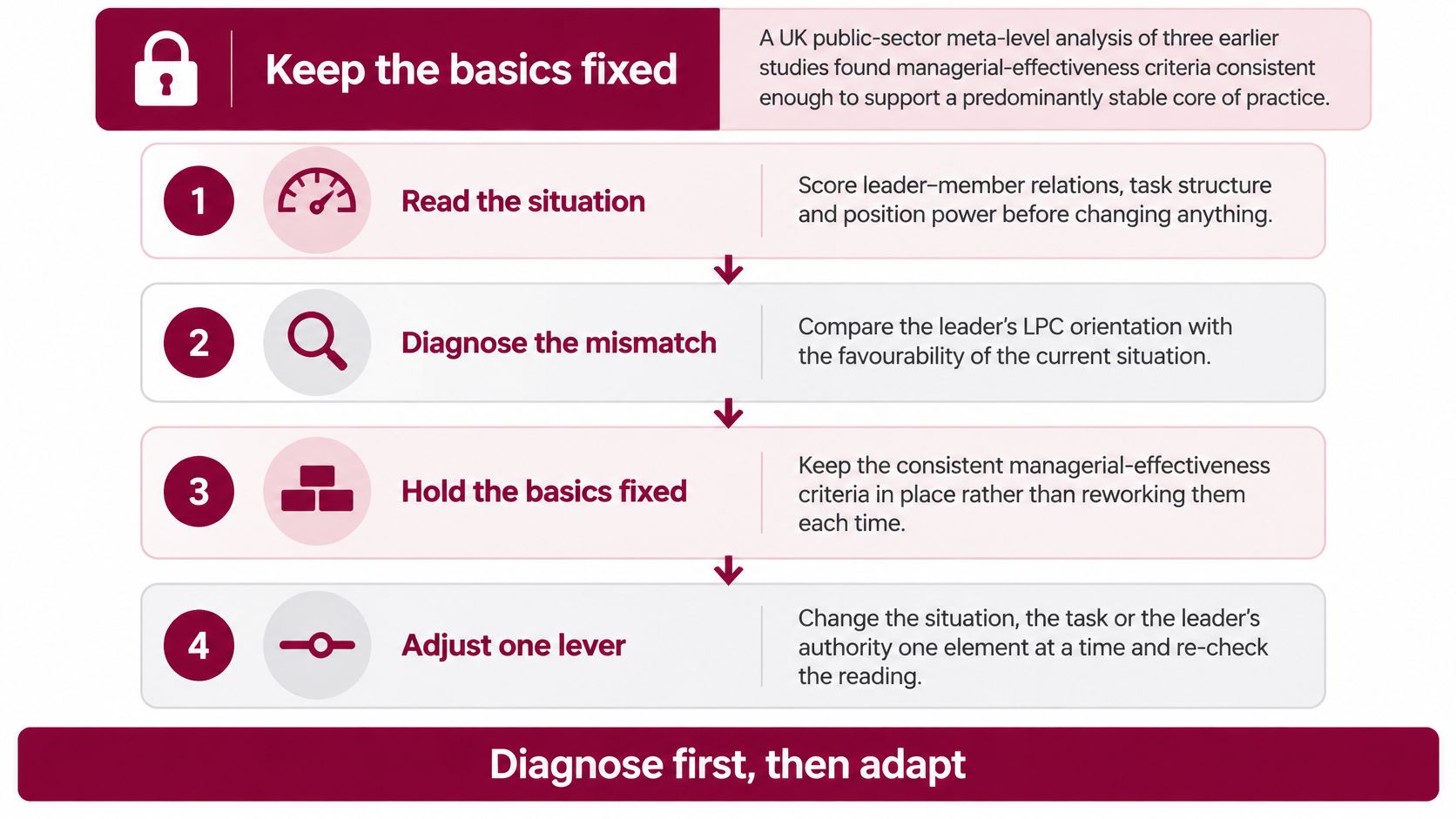
Every introductory textbook celebrates contingency theory's flexibility, yet that very popularity breeds a dangerous workplace misunderstanding. Early-career and mid-level managers sometimes read "adapt to the situation" as permission to reinvent their personality every Monday, swinging from warm collaborator to brusque micromanager without warning. Teams don't experience that as adept leadership; they experience it as unpredictability.
UK evidence directly challenges the notion that everything about leadership is purely situational. A UK public-sector meta-level analysis on Academia.edu comparing three previous studies across different types of public organisations found that managerial-effectiveness criteria were consistent enough to support a predominantly universalistic model rather than a purely context-dependent one. Certain core standards (communicating clearly, sharing information openly, treating people fairly, and developing staff) hold steady across almost every UK workplace. Contingency thinking works best when you treat those fundamentals as essential bedrock and flex only the tactical levers sitting on top of them.
| Behaviour | Status | Varies with |
|---|---|---|
| Clear communication and information-sharing | Fixed across contexts | Level of detail needed for the task |
| Fairness and respect | Fixed across contexts | Not applicable |
| Developing people | Fixed across contexts | Stretch and support matched to readiness |
| Amount of direction | Flexes | Urgency, risk, and follower competence |
| Amount of consultation | Flexes | Distribution of knowledge and need for commitment |
A Six-Step Diagnostic Routine for Practising Managers
Once the fixed basics are locked in, you can translate contingency theory into a disciplined monthly habit instead of guesswork. Follow these six steps before adjusting how you lead a piece of work:
- Name the task and its real urgency. Write down the exact deliverable, its deadline, and the downside cost of error. High regulatory risk or a hard 48-hour cutoff narrows your margin for loose oversight; routine operational projects rarely do.
- Assess each person's readiness on this specific task. Never diagnose the team average. One colleague may be an enthusiastic beginner on a new reporting system while another is a self-reliant achiever, meaning identical treatment will under-support one and patronise the other.
- Check the decision constraints. Ask whether technical quality, legal compliance, safety, or rapid execution limits how widely you can consult. Where specialist insight sits across the group and adoption depends on goodwill, build consultation into the timeline early.
- Audit your positional power and existing trust. Be candid about how much formal authority you hold and whether recent restructures or missed promises have frayed leader-member relations. Low trust turns directive orders into passive resistance unless you repair clarity and fairness first.
- Select the matching behaviour within the fixed basics. Adjust your level of direction, coaching, consultation, or delegation to fit the diagnosis, while keeping respect, transparency, and developmental feedback completely intact.
- Review concrete outcomes after four weeks. Don't judge success by whether a style felt comfortable in the meeting room. Check observable indicators across engagement, task delivery, staff wellbeing, and retention, then recalibrate one lever at a time.
Why Everyday Management Quality Carries High Stakes in the UK
Treating this routine as a serious operational discipline matters because poor line management inflicts measurable human and commercial damage across Britain. Analysis from the CIPD drawing on the UK Working Lives and Good Work Index 2022 surveys notes that almost 10 million people in the UK serve as line managers. Among employees whose managers fell in the lowest quality quartile, 50% reported that work harmed their mental health, twice as likely as the average and starkly higher than the 14% reported among employees with managers in the highest quality quartile. On the upside, 72% of employees with top-quartile line managers said they were willing to volunteer for duties outside their formal job description.
Precision matters when interpreting those figures. CIPD evaluated management quality using nine employee questions covering competence, constructive feedback, fairness, respect, support, and development; it didn't directly score Fiedler's LPC or Hersey and Blanchard's quadrants. Consequently, the numbers don't prove that one named contingency model single-handedly causes better performance. What they do provide is hard UK evidence for the underlying mechanisms contingency models highlight: responding attentively to employee needs, task demands, and working relationships while honouring fixed basics like fairness and constructive feedback.
Three Quick Checks Before You Change Your Style
Before shifting from consultative to directive management, or stepping back to delegate, run through three fast sanity checks:
- Is the situation different? Make sure you're reacting to a real shift in task ambiguity, risk, or follower capability rather than personal stress or a bad morning.
- Does this adjustment keep the basics intact? Switching to directive control during a crisis never excuses sarcasm, withheld context, or unfair treatment.
- Can I explain the reason plainly to the team? Saying "We have three hours before the regulator's cutoff, so I'm going to assign actions directly today and debrief together tomorrow" preserves trust while flexing your style.
Don't try to master four theories at once across an entire department. Pick one live team project, select one model that fits its core bottleneck, and run the six-step diagnosis deliberately for a single month.
At the end of those four weeks, review what changed in clarity, pace, and morale. That single disciplined cycle teaches far more about contingency theories of leadership than memorising diagrams in the abstract, because you see first-hand where situational flexibility improves performance and where steady, principled management keeps the team grounded.
For managers looking to build these diagnostic habits systematically, our Credential of Leadership and Management Programme consists of eight CPD accredited courses covering Leadership Fundamentals, Strategic Leadership, Decision Making, Emotional Intelligence, Conflict Resolution, Change Management, Communication Skills, and Team Leadership. Delivered entirely online and self-paced over 160 hours with recorded video lectures, structured learning materials, and interactive assessments, it connects core frameworks directly to workplace practice. Explore our programmes and course pathways at London School of Business Administration.