

Brand equity is the extra economic value created when customers recognise, trust and prefer a branded offer over a comparable unbranded alternative.
That value can be substantial, but it isn't secure. A familiar name may help customers choose, yet managers still need to establish why customers prefer it, what they'll pay for that preference, and whether the organisation consistently deserves their confidence.
Table of Contents
- What Brand Equity Means in Practice
- How Perceptions Turn into Price and Demand
- How to Measure Brand Equity with Evidence
- What UK Brand Values Reveal
- How Broken Trust Erases Brand Equity
- When Sustainability Claims Strengthen or Weaken Equity
- How to Build Brand Equity That Lasts
What Brand Equity Means in Practice
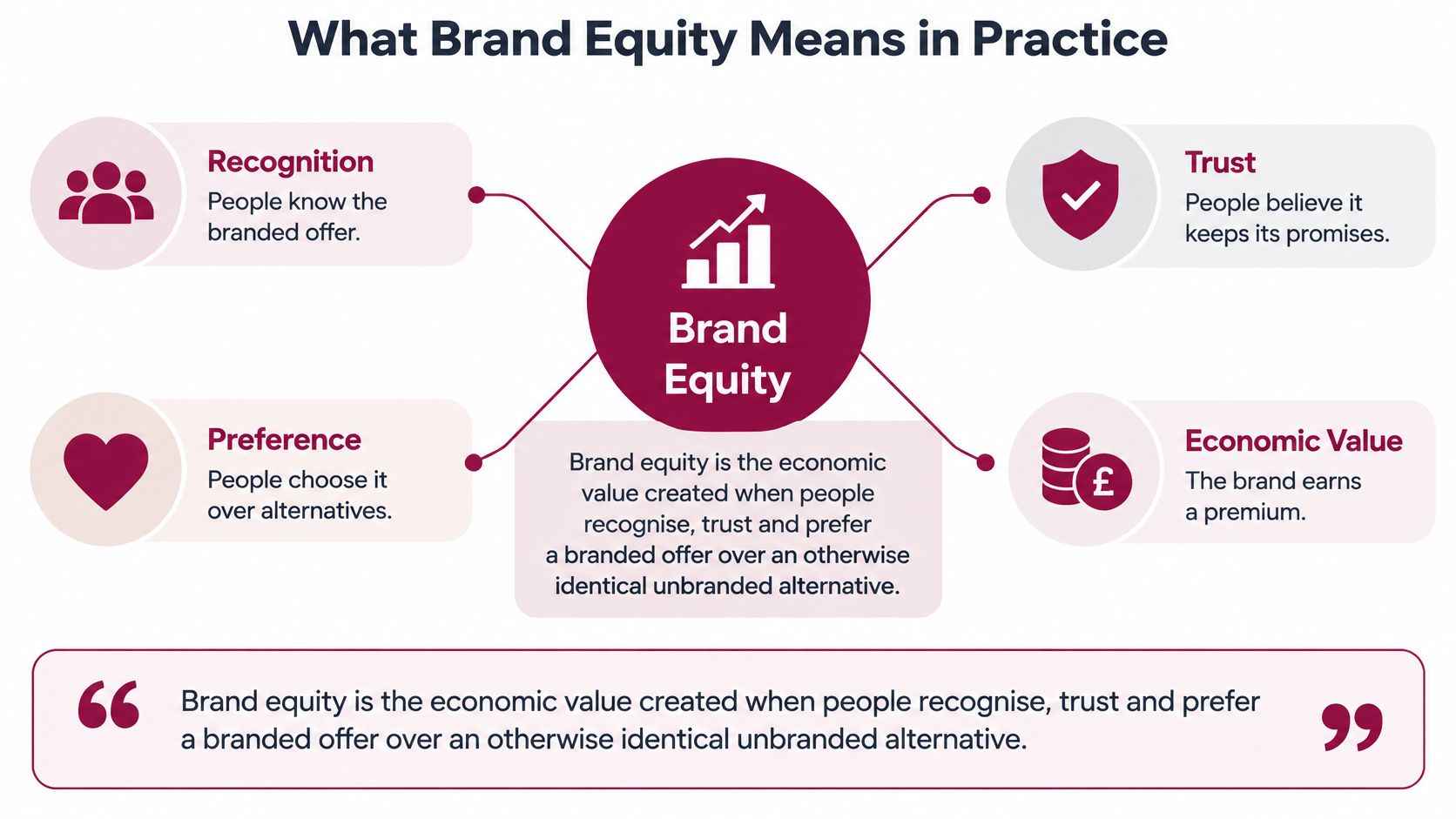
In practical terms, brand equity describes what the brand adds beyond the underlying offer. The UK government's intellectual property factsheet reports that UK market-sector firms invested approximately £15.1 billion in branding in 2014, with around £14 billion protected by trade marks.
Brand equity is the economic value created when people recognise, trust and prefer a branded offer over an otherwise comparable unbranded alternative.
Consider otherwise identical kettles on a shelf. A buyer might choose the recognised name more quickly, accept a higher price and expect a straightforward replacement if something goes wrong. If that buyer forgives an isolated fault because previous experiences were reliable, the brand has also created a degree of resilience.
The kettle's physical specification hasn't changed. The buyer's expectations have, and those expectations can affect commercial outcomes.
Separate perceptions, protection and valuation
Managers should distinguish the related layers rather than treating them as interchangeable.
- Customer perceptions include awareness, associations, perceived quality and loyalty. Customers hold these judgements, so a business can't establish them only by writing a positioning statement.
- Legal protection concerns names, symbols and other protected identifiers. Protection helps an organisation defend its identity, but registration doesn't establish customer preference.
- Financial valuation estimates the economic contribution associated with the brand. It translates expectations about demand into a monetary assessment rather than merely counting recognition.
The government factsheet also reports that trade-mark-intensive industries accounted for 38.4% of UK GDP and 21.5% of employment during 2011–2013. UK investment in intangible assets protected by intellectual-property rights rose from £47 billion in 2000 to £70 billion in 2014, while firms applying for trade marks were approximately 7% more productive than firms that didn't. These are findings from the same government analysis, not evidence that registering a name by itself causes greater productivity.
Identify what the brand actually adds
A useful managerial question is: What would change if customers couldn't see our name? If the answer is nothing, recognition may not yet produce meaningful equity.
Brand identity is what an organisation presents. Brand image is how people perceive it. Brand equity concerns the economic consequences of those perceptions, including choice, price acceptance and continued custom.
The managerial task therefore extends beyond communications. It requires connecting customer judgement with demand, credible measurement and financial value, while recognising that operational failures can undermine the asset.
How Perceptions Turn into Price and Demand
Customers don't pay more merely because an organisation has invested in a logo. They need a reason to see its offer as relevant, preferable or difficult to replace.
Kantar's UK BrandZ framework, whose UK analysis draws on approximately 177,000 consumer interviews, organises consumer perceptions around Meaningful, Different and Salient. These dimensions offer a useful diagnostic framework, although they aren't the only way to analyse brand equity.
How brand perceptions create commercial value
| Dimension | Customer judgement | Commercial effect | Weak signal |
|---|---|---|---|
| Meaningful | The brand meets a need that matters to this buyer | Demand, consideration and choice | Generic benefits any rival could claim |
| Different | The brand is hard to substitute | Sustainable price premium | Volume appears only when discounted |
| Salient | The brand comes to mind at the point of choice | Future growth and mental availability | Heavy media spend with low unaided recall |
A meaningful offer answers a problem the buyer has. A different offer gives the buyer a defensible reason not to substitute. A salient offer enters consideration when the need arises.
Those conditions can coexist, but managers shouldn't assume that improving one automatically improves the others. A highly recognisable business may remain easy to replace, while a distinctive specialist may be overlooked because potential customers don't remember its name.
Understand the valuation logic
Kantar combines financial value, based on earnings attributable to the business, with a consumer-derived Brand Contribution. In plain language, the model estimates how much customer choice and price premium can reasonably be attributed to the brand rather than to the offer's other characteristics.
The strategic concern is weak differentiation. Marketing Week's reporting on the UK BrandZ analysis states that brand contributed approximately 29% of total company value for UK brands, compared with 33% for global brands, interpreting the gap as evidence that many British brands were under-differentiated.
This isn't proof that every British organisation has the same weakness. It is a warning against confusing familiarity with a compelling reason to choose.
If customers regard suppliers as interchangeable, managers may need discounts or additional paid exposure to secure purchases. Stronger differentiation gives them a basis for testing whether customers will convert without continual promotional pricing.
Replace broad promises with evidence
Consider a hypothetical education provider. Flexible online study is a broad benefit that many providers could claim; a self-paced, CPD-accredited pathway with assessed work and a verifiable certificate gives learners more specific evidence to examine.
Even those attributes aren't automatically distinctive. Managers must establish whether learners value them, whether alternatives offer the same combination and whether the promised experience is delivered.
Understanding how customer needs influence buying behaviour helps prevent organisations from defining difference entirely from their own perspective. A feature matters commercially only when the intended customer understands its relevance.
Use the table as a diagnosis, not a campaign slogan. Ask which dimension is weak, what customer evidence supports that judgement and what operational or communications change would address it.
How to Measure Brand Equity with Evidence
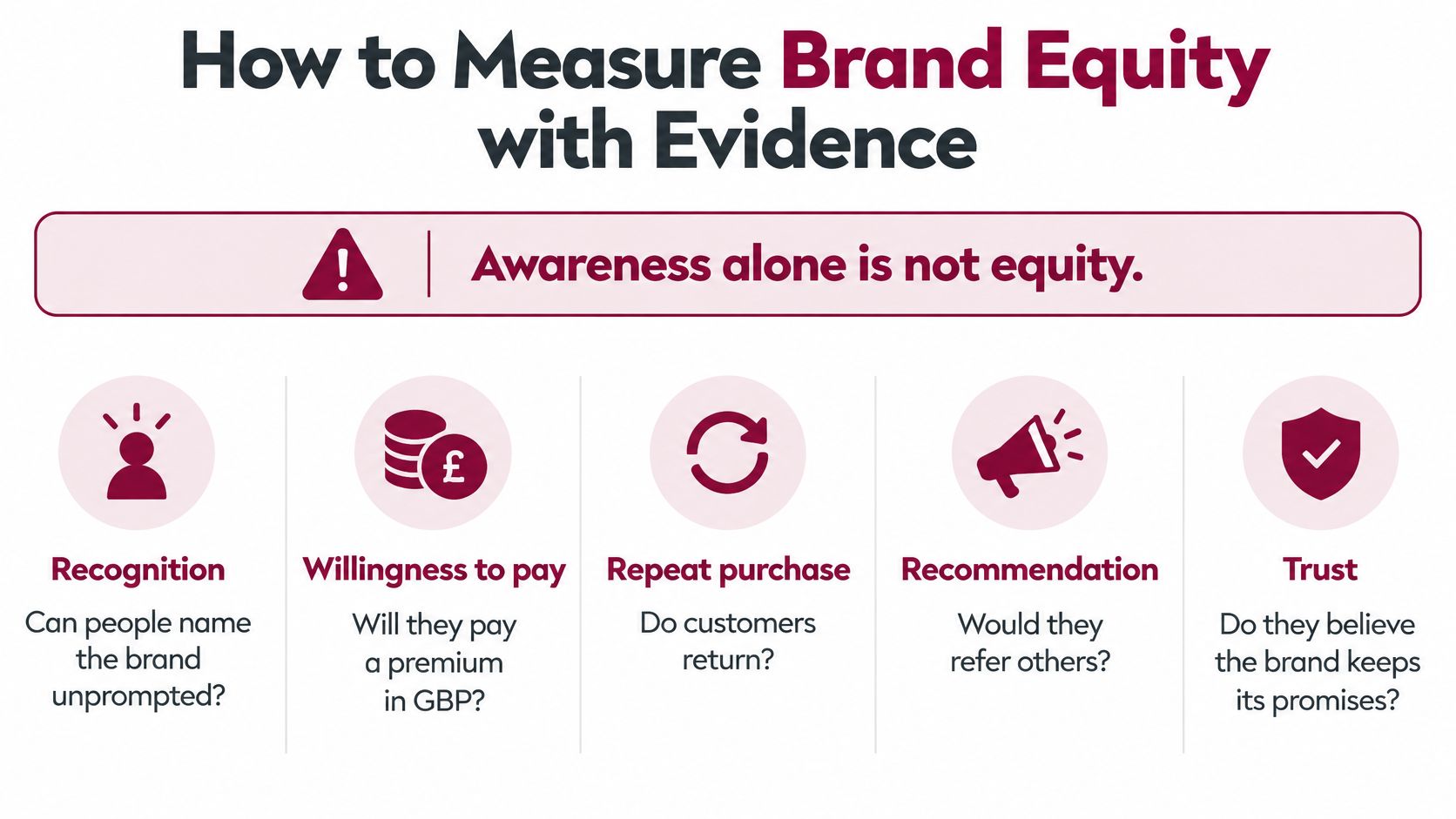
Awareness alone isn't equity. A widely recognised name can still perform poorly if customers won't choose it, pay its asking price, return or recommend it.
Start with a defined target segment and a realistic set of alternatives. An education provider, for example, should distinguish working managers seeking applied development from learners seeking an introductory qualification; combining their responses could conceal important differences.
The UK consumer trust study published through PR Newswire found that 80% of consumers consider trust important to purchase decisions, using a nationally representative survey of 20,041 UK shoppers, generating 104,017 brand evaluations across 166 categories. That makes confidence a relevant measurement priority rather than a vague reputational ambition.
Connect attitudes with behaviour
Adobe's August 2021 study of 2,017 UK consumers reported that 71% would buy more from trusted brands, 61% would recommend them, 41% would join a loyalty programme and 40% would publish positive reviews or social-media comments; 54% had stopped buying from a brand after a trust breach during the preceding year.
These are survey findings, not guaranteed outcomes for an individual business. They help identify behaviours worth observing, but a manager still needs evidence from the organisation's own customers.
Brand equity indicators and how to read them
| Indicator | What to observe | Useful benchmark | Weak reading |
|---|---|---|---|
| Trust in the purchase | Whether confidence affects choice | Trust matters to purchase decisions for most respondents in the UK trust study | Familiar name but low willingness to choose it |
| Extra purchasing | Whether trust increases demand | Stated willingness to buy more in Adobe's UK survey | Recognition without repeat purchase |
| Advocacy | Recommendation and public endorsement | Recommendation and positive-review intentions in Adobe's UK survey | No referral intent despite high awareness |
| Loyalty participation | Willingness to join a programme | Participation intentions among consumers considering trusted brands | Sign-ups driven only by a discount |
| Trust breach | Loss of demand after a broken promise | Reported purchasing cessation in Adobe's UK survey | Recovery plan based only on advertising |
Build a consistent measurement routine
Track unaided awareness, perceived relevance, distinctiveness, consideration, conversion, repeat purchase or course completion, referral intent and willingness to pay. Ask the awareness question before showing respondents a list of names, or the prompt will contaminate the result.
Read indicators together. High prompted recognition with weak unaided recall suggests that recognition hasn't become dependable mental availability; it doesn't, by itself, prove that advertising caused the weakness. Similarly, conversion that holds only during promotions suggests limited price acceptance, but managers should check seasonality and changes in customer mix before drawing conclusions.
Measurement rule: Compare the same customer segment, question wording and commercial conditions before attributing a change to brand-building activity.
Establish a baseline before changing a product, service process or message. Then compare customer responses with actual behaviour, keeping acquisition channels and promotional conditions visible.
A financial valuation multiple can't replace this work. It may summarise expected value, but it doesn't tell a manager which customer experience needs attention.
What UK Brand Values Reveal
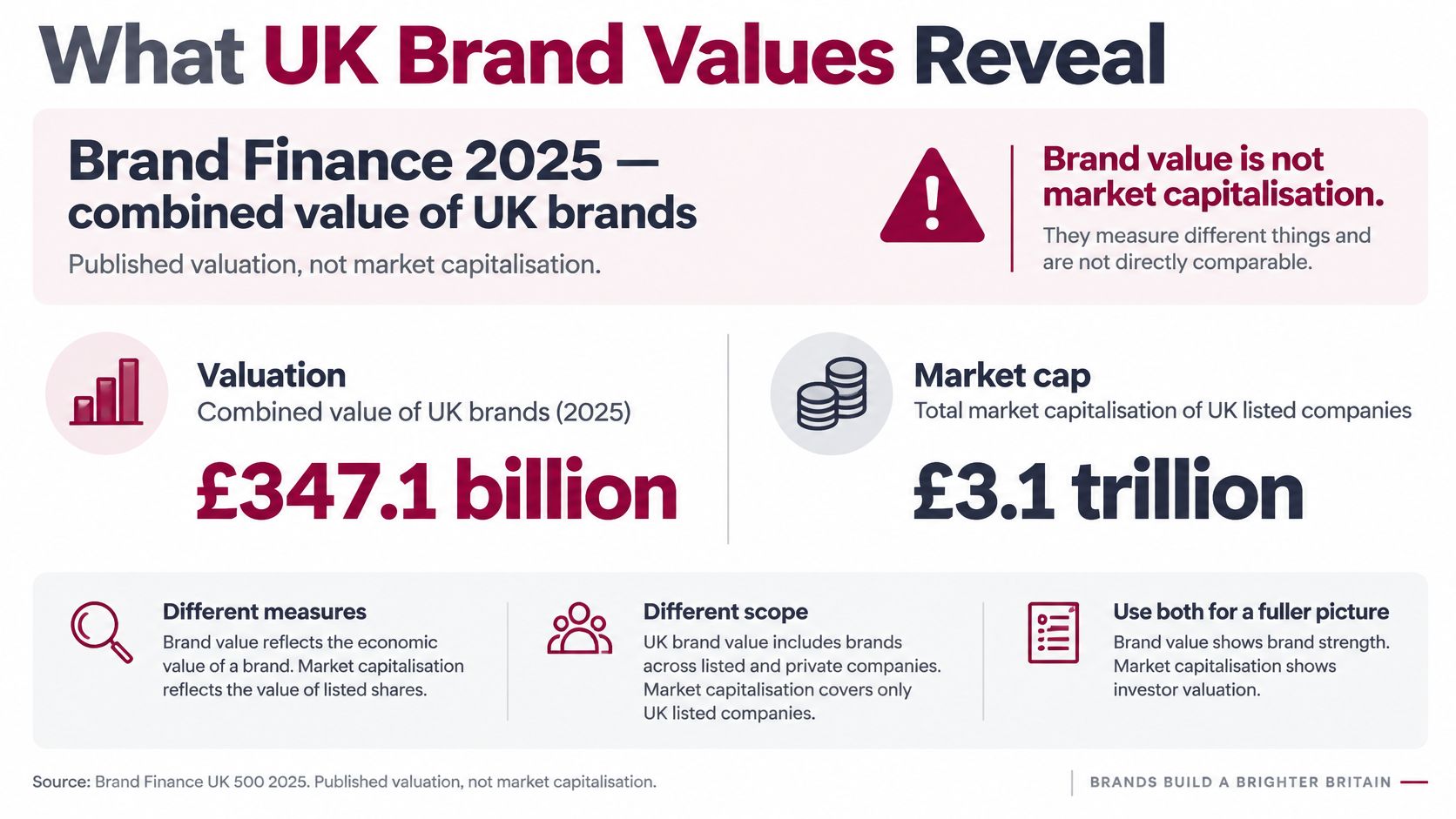
Published valuations make the economic scale of branding concrete. Brand Finance's 2025 assessment placed the combined value of the United Kingdom's 250 leading brands at £399.9 billion, a 3% year-on-year decline, with banking brands accounting for £64.1 billion and commercial-services brands for £71.1 billion.
The decline matters as much as the headline total. Established businesses can continue trading while analysts reduce the estimated value associated with their brands.
That doesn't establish that reputation caused the entire movement. Financial expectations, economic conditions and the assumptions used in valuation also matter.
Distinguish brand value from company value
Brand value isn't market capitalisation. Market capitalisation represents the equity market's valuation of a listed company, whereas a brand valuation estimates the contribution attributed specifically to its brand.
| Measure | What it represents | Managerial caution |
|---|---|---|
| Customer-based brand equity | The advantage associated with customer perceptions | Positive attitudes need behavioural confirmation |
| Financial brand value | An estimated monetary contribution attributable to the brand | Results depend on methodology and assumptions |
| Market capitalisation | The market value of a listed company's shares | Includes expectations about much more than branding |
A business owns or controls resources beyond its name and reputation. Operations, technology, distribution, contractual relationships and other assets can influence its overall value.
Managers should therefore resist describing a published brand valuation as the amount the whole company is worth. Nor should they assume that the estimate equals a separately recognised asset in its financial statements.
Interpret gains and declines carefully
A contrasting result comes from Kantar's 2025 assessment of HSBC, which named it the UK's most valuable brand at US$21.6 billion, up 14% year on year. That is a finding within Kantar's valuation system, not a directly interchangeable component of Brand Finance's sterling total.
Read the rise and the aggregate decline as evidence that brand-related value isn't fixed. Different organisations can move in different directions, and different valuation providers use their own methods.
A higher estimate may reflect stronger financial prospects, stronger brand contribution or both. It doesn't prove that customers became more trusting unless supporting customer evidence demonstrates that change.
For managers, a valuation is a periodic snapshot, not an operating instruction. Its practical value lies in prompting investigation: which customer behaviours changed, which assumptions changed and whether the organisation's distinctive position remains credible.
How Broken Trust Erases Brand Equity
Brand equity can become a liability when a familiar name raises expectations that the organisation repeatedly fails to meet. Customers may recognise the brand immediately and associate it with unfair treatment rather than reassurance.
In a nationally representative YouGov survey of 2,062 UK adults conducted in September 2025, 40% said unfair treatment caused them to lose trust, 35% cited unethical business practices and 31% cited brands ignoring complaints. Among those who lost trust, two-thirds stopped buying entirely, while 18% said internal reforms, such as policy changes or stronger oversight, would best restore trust.
Those findings direct attention towards management decisions, not merely creative execution. They don't establish a universal speed at which trust disappears, but they show why a communications-led recovery may miss the underlying problem.

Diagnose the failure before buying reach
It is useful to distinguish accumulated equity from its trust-dependent component. Advertising and a consistent identity can help establish recognition and associations, but customer treatment determines whether promises remain believable.
This distinction isn't an accounting split. It is a managerial way to identify which activities can strengthen a relationship and which failures can undo it.
- Locate the failure. Determine whether customers misunderstood a message, encountered an unfair policy or experienced a repeated service problem. Read complaint records alongside customer interviews.
- Change the process when treatment is the problem. Assign responsibility, correct the policy and establish oversight before increasing communications spend.
- Explain an experience that already works. If delivery is sound but poorly understood, invest in clearer explanation and salience rather than redesigning a functioning service.
- Measure the commercial loss. Track favourable associations alongside the share of affected customers who stop buying, so apparent reputational recovery isn't mistaken for restored demand.
Make corrective action observable
Suppose a service business promises a response time it routinely misses. A campaign celebrating customer care won't shorten the queue, clarify escalation rights or give staff authority to resolve complaints.
The manager must first examine capacity, ownership and handovers. Only then can communications accurately explain the revised service standard and how customers can seek help when it isn't met.
A new campaign can't repair an unchanged queue.
An apology can acknowledge the failure, but it doesn't substitute for a remedy. Customers need to understand what changed, who is accountable and how the organisation will prevent recurrence.
The decision rule is straightforward: repair the experience before amplifying the promise. Otherwise, greater visibility may expose more people to the same failure.
When Sustainability Claims Strengthen or Weaken Equity
A sustainability message doesn't automatically improve brand equity. The relevant question is whether the intended customer finds the claim credible, important and consistent with the organisation's conduct.
Marketing Week's reporting on Havas Media research found that 33% of UK consumers were sustainability sceptics, compared with 21% across the ten markets studied, while only 17% of UK respondents were engaged sustainability devotees. It also reported that 58% believed companies pursue sustainability mainly to protect or improve their image, although 67% thought business, rather than government, should lead on sustainability.
These findings reveal a credibility problem, not a simple rejection of business responsibility. Consumers can expect organisations to act while remaining doubtful about their motives and statements.
Make the claim narrower than the evidence
A credible claim should be specific, evidenced, relevant to the offer and supported by operational change. A broad statement about environmental leadership asks customers to accept far more than a documented statement about a particular material or process.
For a smaller organisation, limited evidence should lead to a narrower claim, not more ambitious language. A documented sourcing decision may be useful; presenting it as proof that the whole business is sustainable would require much broader substantiation.
| Stronger claim practice | Weaker claim practice |
|---|---|
| Identifies the product, process or activity concerned | Describes the entire organisation with an undefined adjective |
| Explains the evidence and its boundaries | Uses imagery as a substitute for substantiation |
| Connects the statement to an operational decision | Announces an aspiration as though it were an achieved outcome |
| Makes supporting information accessible | Leaves customers unable to check the claim |
Test relevance before making it central
Start by asking whether target customers value the issue and what evidence they expect. Don't assume that an internally important initiative will become a decisive purchase criterion.
A coherent business sustainability strategy helps connect claims with operational responsibilities. Managers should know who owns the evidence, how it was established and whether the wording remains accurate when circumstances change.
Then examine whether the claim improves credibility and consideration without creating confusion. Positive attention isn't sufficient if customers become less confident after reading the supporting detail.
Silence can be safer than an unsupported leadership claim. An organisation can continue improving its operations without presenting every incremental change as a defining reason to trust the brand.
How to Build Brand Equity That Lasts
Answering what is brand equity is useful only if managers can turn the concept into decisions. Begin with the customer's credible alternative, not with the organisation's preferred description of itself.
- Write the unbranded comparison. Describe what a buyer could obtain elsewhere at a similar specification, without relying on names or visual identity.
- Select a verifiable distinction. Choose a proof point customers can examine, such as an assessed outcome, an explicit service standard or a checkable certificate.
- Test commercial relevance. Assess consideration, conversion, retention and referral rather than treating reach as the result.
- Remove avoidable sources of distrust. Correct unfair treatment, ethical failures and ignored complaints before increasing exposure.
- Set an evidence boundary. Publish sustainability statements only when operations can substantiate their wording.
- Schedule a consistent review. Assign ownership of the indicators and investigate deteriorating customer responses before waiting for a financial valuation.
Turn principles into workplace judgement
Use branding strategy examples to examine the connection between a promise, supporting evidence and customer response. The useful question isn't whether an example looks impressive, but whether its logic would hold under your organisation's operating conditions.
For structured study, our marketing pathway includes Brand Management. The separate Marketing Strategy course covers setting objectives, identifying audiences, increasing awareness, selecting channels, implementing campaigns, measuring performance and evaluating outcomes, with relevance to marketers, owners, brand managers and analysts.
Our learning model combines interactive coursework, real-world examples and case studies. Programmes are online and self-paced, allowing learners to organise study around professional commitments without implying a guaranteed commercial result.
The enduring discipline is to keep the promise, the evidence and the customer's experience aligned. A distinctive identity helps people recognise an organisation; disciplined management gives them a reason to keep choosing it.
London School of Business Administration offers online, self-paced business and management study supported by coursework, real-world examples and case studies. To develop a structured approach to customer perceptions, positioning and marketing measurement, visit London School of Business Administration and explore the marketing learning pathway.