

83% of UK businesses surveyed said they were committed to the national net-zero target, yet only 18% had a dedicated implementation team, according to a 2024 BSI survey of more than 1,000 senior decision-makers. The management challenge isn't persuading people that sustainability matters. It's giving them the authority, information and resources to act.
For a smaller firm, that challenge can appear circular: reliable data require expertise, expertise requires funding, and funding requires evidence. A useful business sustainability strategy breaks this cycle through proportionate measurement and staged investment decisions, rather than waiting for perfect information.
Table of Contents
- Why UK Firms Need a Business Sustainability Strategy
- Sequencing a Business Sustainability Strategy
- Stakeholder Mapping and Useful Sustainability KPIs
- Reporting Boundaries That Shape the Strategy
- Prioritising Action When Resources Are Limited
- Measured Examples and Your Next Management Step
Why UK Firms Need a Business Sustainability Strategy
The UK's legally binding objective is net-zero greenhouse-gas emissions by 2050, compared with 1990 levels, but business implementation has been uneven: businesses accounted for 18% of national emissions in 2020; the share reporting no emissions-reduction action fell from 46% in April 2021 to 30% in December 2022; and, in December 2022, 26% of larger businesses versus 4% overall reported a climate-change strategy, while 22% versus 3% had a net-zero target, according to Office for National Statistics climate-change insights.
These historical figures distinguish taking action from managing a transition. An organisation can reduce printing or adjust heating without knowing its overall impact, the cost of further improvements or who should authorise them.
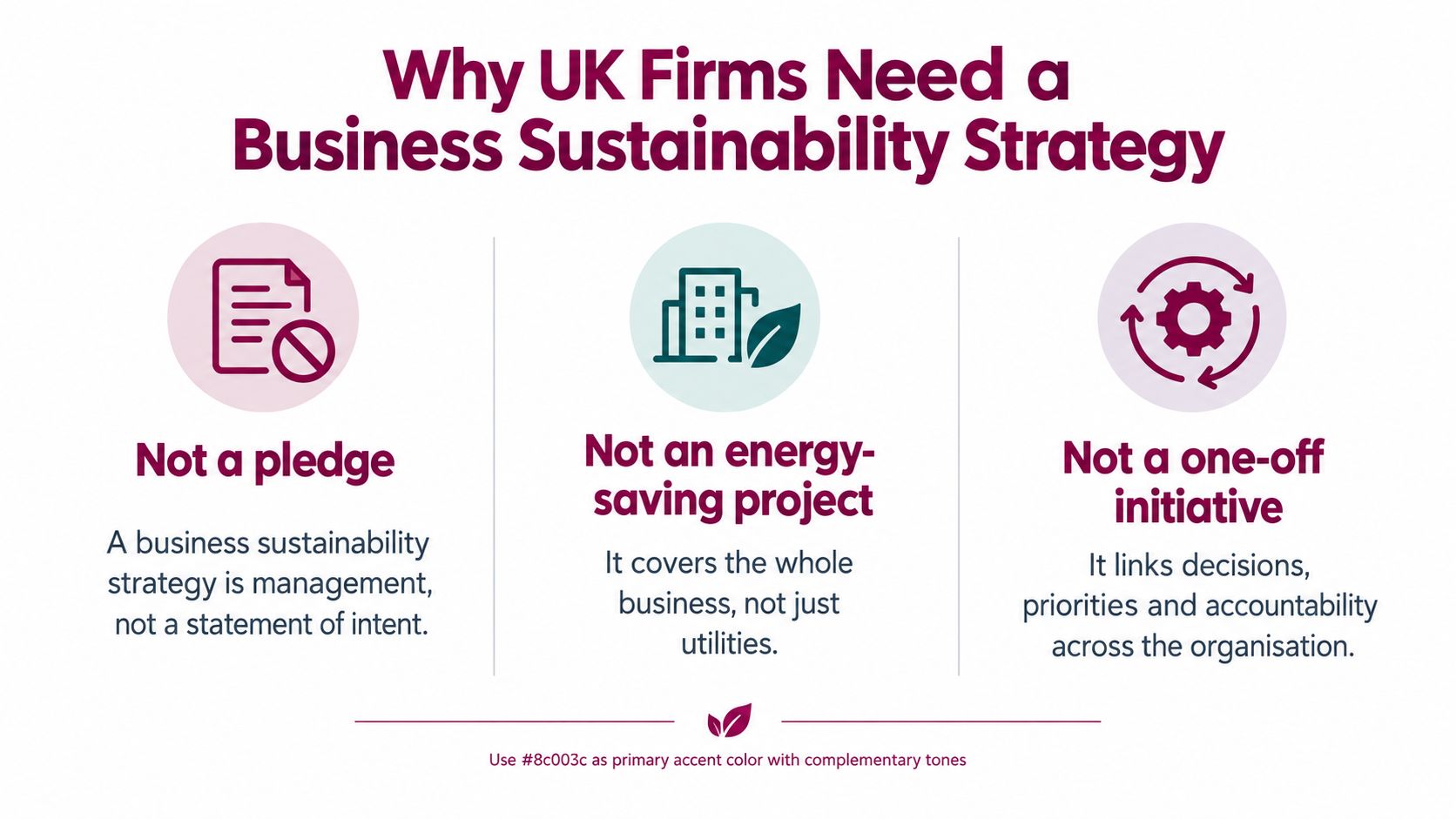
What makes sustainability a management strategy
A business sustainability strategy connects environmental and social priorities with organisational decisions. It specifies what matters, how performance will be assessed, who is accountable and which resources are available.
Understanding what business sustainability means helps distinguish this task from an environmental campaign. Sustainability concerns the organisation's activities and relationships, not merely the language used to describe them.
Material issues are matters significant enough to influence decisions because of their consequences for people, the environment or the business. For example, a delivery firm might examine vehicle emissions and driver working conditions. An education provider might consider purchased energy, accessibility and procurement practices.
Managers should ask:
- Significance: Which impacts deserve attention because of their scale, seriousness or relevance?
- Responsibility: Who can change the activity or influence the relationship?
- Resources: What expenditure and staff time would implementation require?
- Evidence: What would demonstrate an improvement rather than merely an completed activity?
Why isolated improvements aren't enough
Consider a hypothetical office replacing inefficient equipment. The purchase may be sensible, but managers still need to establish whether it addresses a significant source of consumption and whether the expected saving justifies the expenditure.
Without that assessment, visible projects can displace less conspicuous but more useful work. Improving procurement records, for example, may support better decisions even though it produces no immediate public announcement.
Management test: A credible strategy enables decisions that can be explained, funded and reviewed.
For an owner or early-career manager, the practical outcome is therefore not a longer sustainability statement. It is a manageable connection between impacts, responsibilities, expenditure and evidence.
Sequencing a Business Sustainability Strategy
Start with responsibility and scope, not a catalogue of projects. A smaller firm needs an order of work that prevents uncertain information from becoming an unsupported commitment.
UK research on sustainability implementation barriers identifies emissions measurement, Scope 3 accounting, transition costs and limited technical capacity as recurring difficulties. A staged management method helps address these constraints without pretending they disappear.
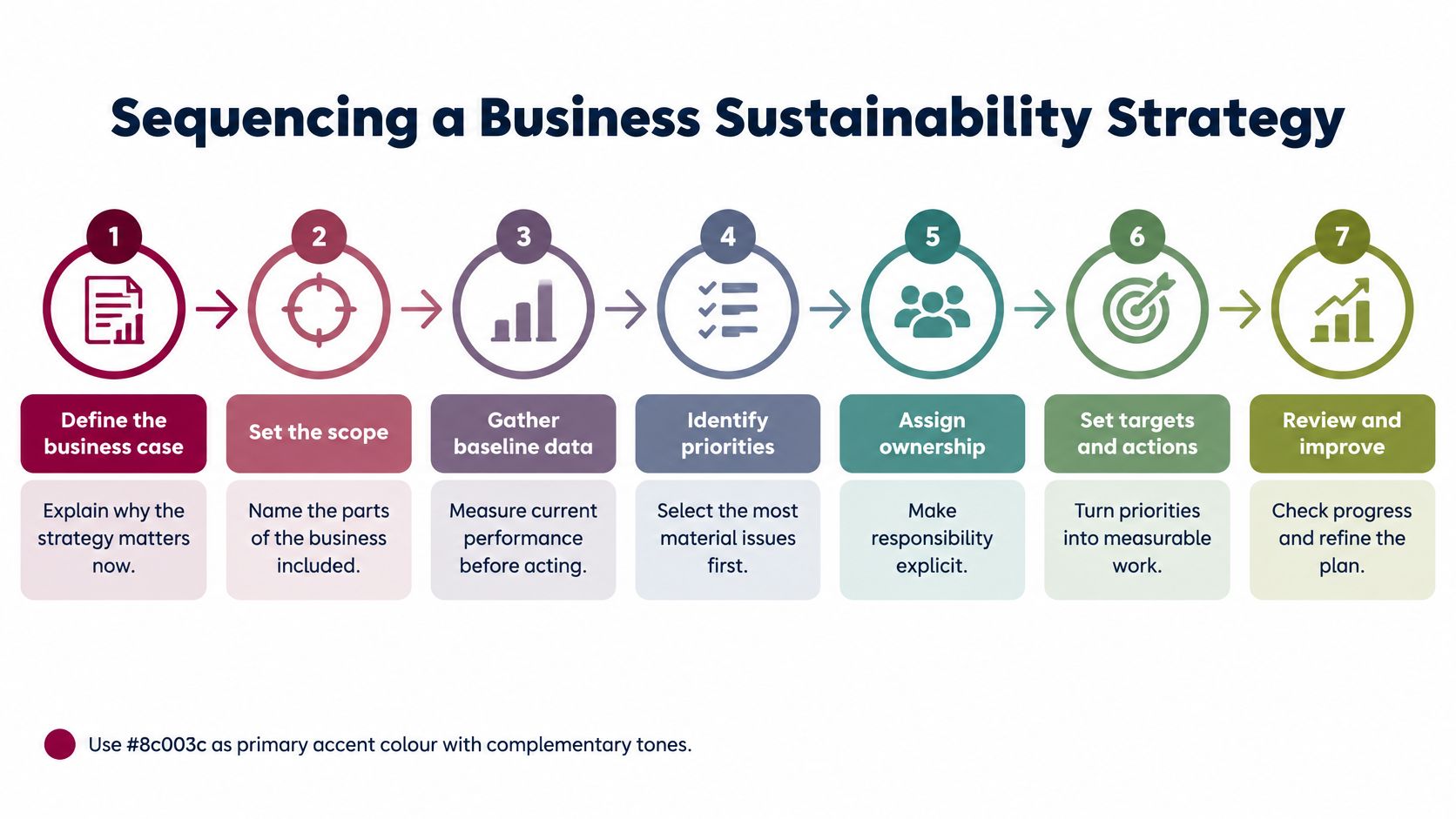
Establish responsibility before collecting information
Establish governance. Name an executive owner who can resolve competing priorities and approve resources. The output is a written responsibility statement, including who prepares information and who authorises decisions.
Map material impacts. Examine environmental, social and regulatory matters across the activities being considered. Produce a written organisational boundary and a short priority register, rather than treating every possible issue as equally important.
Create the baseline. Assemble energy, emissions and resource-use information for the agreed boundary. Include relevant Scope 3 categories, meaning value-chain emissions associated with activities such as purchasing and travel, while documenting gaps.
The output is a baseline note identifying records, coverage and limitations. Measuring before agreeing the boundary risks combining figures that describe different operations or periods.
Translate evidence into funded work
Set measurable, time-bound targets. Each target needs an indicator, a starting position and a deadline. Avoid promising reductions that depend on changes the organisation hasn't assessed.
Prioritise interventions. Compare emissions-reduction potential, capital cost, operational feasibility and payback. A short investment case should explain why the proposed action deserves resources ahead of alternatives.
Embed delivery in routine management. Put approved expenditure into budgets, translate relevant requirements into procurement documents and include responsibilities in performance discussions. The output is an authorised budget line and an operational assignment, not a separate list of aspirations.
Monitor quarterly. Prepare an evidence pack showing delivery, expenditure, results and unresolved issues. Record management decisions so that someone outside the original project team can understand what happened.
These stages are connected rather than mechanically rigid. Discovering an important supplier impact may require revisiting the boundary, while a feasibility assessment may show that a proposed target needs revision.
Define a realistic initial scope
For an education provider, a defensible starting programme could include:
- An organisational baseline: Reconcile available records and identify material omissions.
- Purchased-energy reduction: Select practical measures linked to consumption evidence.
- Procurement clauses: Specify proportionate information and performance expectations.
- Engagement measures: Track relevant staff or learner participation.
- Funded initiatives: Approve a limited portfolio with clear delivery responsibilities.
Exclude unsupported claims of complete value-chain coverage and broad commitments without an implementation route. Supplier engagement can begin early, but extensive supplier interventions shouldn't displace the work needed to make internal information reliable.
The standard is sufficient evidence for a defensible decision, followed by planned improvement.
Stakeholder Mapping and Useful Sustainability KPIs
A stakeholder map is useful only when it changes who decides, who acts or who supplies information. A list of people receiving sustainability updates doesn't establish accountability.
For each stakeholder, record their interest, influence, decision right or obligation, and data ownership. The practical importance of stakeholder engagement lies in understanding these relationships before asking people to support a programme.
Map responsibilities rather than audiences
Directors approve priorities and accept significant trade-offs. Finance reconciles expenditure and assesses investment proposals, while operations staff explain how equipment and processes function.
Procurement manages supplier requirements. Human resources can coordinate relevant training and working-practice information, but staff must also have a route to identify operational problems.
| Stakeholder group | Management contribution | Information responsibility |
|---|---|---|
| Directors and finance | Authorise expenditure and challenge assumptions | Budgets, costs and investment decisions |
| Operations and staff | Assess feasibility and deliver changes | Consumption records and operating conditions |
| Procurement and suppliers | Agree workable purchasing requirements | Product, service and supplier evidence |
| Customers and learners | Clarify expectations and service effects | Requirements, feedback and participation |
Suppliers deserve particular attention. A customer's questionnaire may arrive before a small supplier has established its own measurement system, so requests should distinguish essential information from desirable detail.
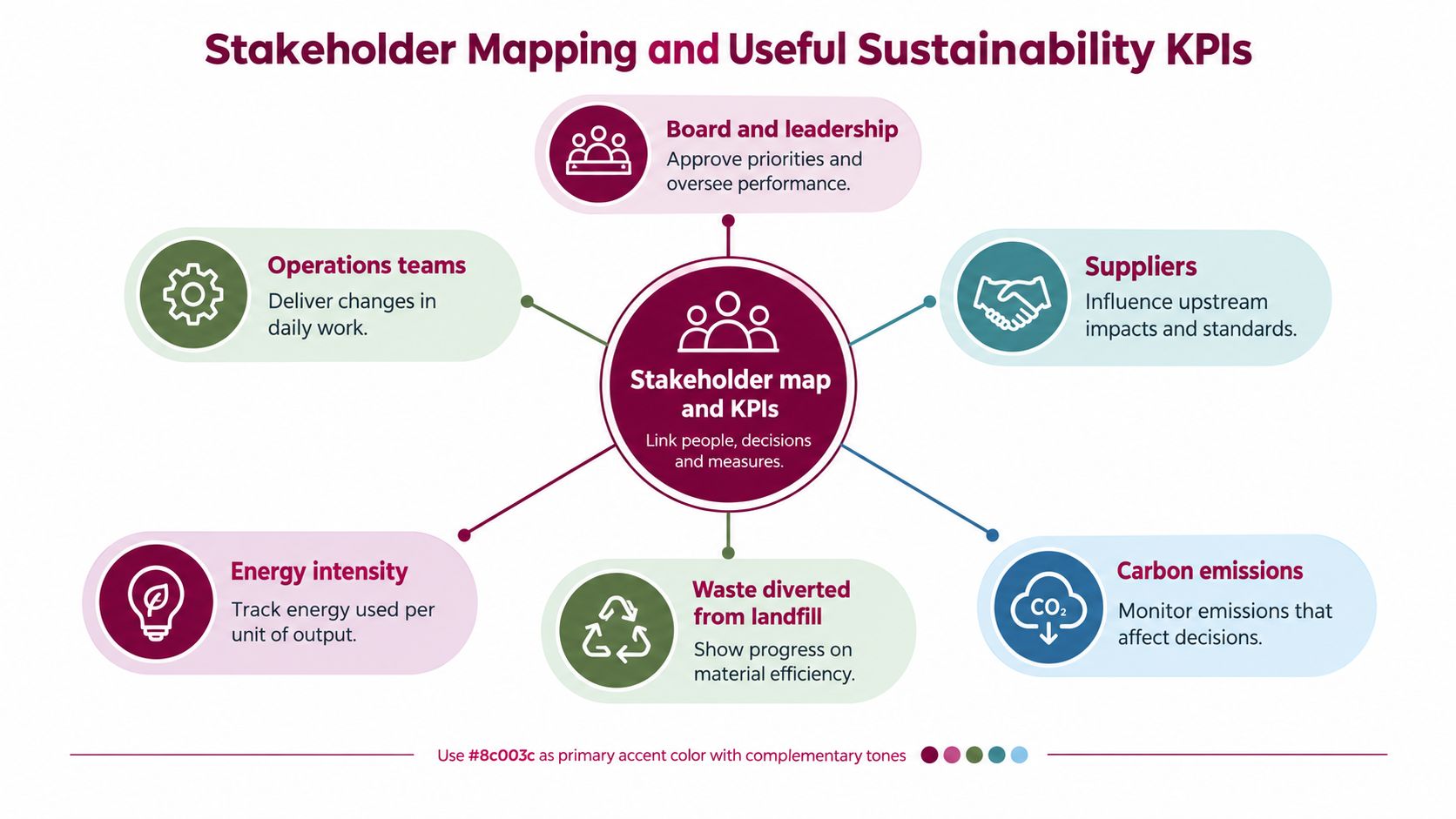
Choose indicators that support a decision
A proportionate dashboard might connect emissions, energy, travel, procurement, waste, operating costs and customer requirements. Each indicator should answer a management question, rather than exist because another organisation collects it.
Leading indicators show whether enabling work is happening. Examples include the percentage of suppliers screened, staff trained or planned energy projects funded.
Lagging indicators describe realised results, including absolute emissions and emissions intensity. Use both: absolute emissions indicate the total impact, while intensity relates that impact to an appropriate measure of activity.
ACCA's Measure What Matters report argues that collection should reflect business size, structure and activities, and that carbon-intensity measures can avoid penalising growing businesses. Nevertheless, improved intensity shouldn't be presented as proof that total emissions have fallen.
For a hypothetical training provider, energy per learner could support operational analysis. Managers would still need to examine total energy use and explain changes in delivery methods or occupancy.
Govern uncertainty openly
For estimated information, record the assumption, calculation boundary, evidence quality, owner and intended improvement. Don't combine measured and estimated values without identifying the distinction.
External assurance should be proportionate to the consequences of error, reporting obligations and intended use. A preliminary internal estimate requires different scrutiny from information supporting a significant public claim.
Data discipline: Before collecting another metric, identify the decision it supports or the obligation it fulfils.
Don't reject legally required information or essential customer evidence. Where a request serves neither purpose, seek clarification, negotiate a simpler response or defer collection.
Reporting Boundaries That Shape the Strategy
Internal management information and external reporting aren't interchangeable. Managers may need detailed operational records to improve performance, while formal disclosures have particular scope and content requirements.
Company status and size therefore matter. Managers shouldn't assume that every UK firm must publish the same sustainability statement.
Identify the applicable reporting duties
The ICAS overview of the sustainability-reporting landscape describes Strategic Report requirements under the Companies Act 2006, non-financial reporting matters including environmental and social issues and anti-corruption and anti-bribery policies, and Streamlined Energy and Carbon Reporting requirements for quoted companies, large unquoted companies and qualifying limited liability partnerships.
The distinction between preparing a Strategic Report and satisfying particular non-financial statement requirements needs careful attention. Managers should verify the provisions applicable to their organisation rather than treating a general summary as an eligibility assessment.
For organisations within scope, sustainability reporting belongs within formal corporate governance. Relevant policies, material matters and performance evidence need to be consistent with the organisation's business reporting, rather than developed separately as promotional copy.
- Confirm applicability: Establish the organisation's legal status and relevant size classification.
- Document coverage: Identify entities, sites and activities included in each disclosure.
- Allocate responsibility: Assign preparation, review and approval duties.
- Retain evidence: Keep records supporting policies, calculations and statements.
Use proportionality without borrowing another sector's rules
The central-government sustainability-reporting guidance for 2025–26 applies minimum requirements to relevant bodies preparing annual reports under the Government Financial Reporting Manual where they have more than 500 full-time-equivalent staff or more than £500 million in operating income or grant funding.
Those thresholds aren't private-sector rules. Their useful management principle is proportionality: define which operations fall within the boundary and what information larger or higher-impact units must supply.
A private firm can apply that principle by documenting materiality thresholds and explaining exclusions. It shouldn't omit an inconvenient operation merely because its information is difficult to obtain.
The triple bottom line approach can help managers consider environmental, social and financial consequences together. It doesn't replace an assessment of legal reporting duties.
Distinguish policy direction from an enacted requirement
The government's green-finance strategy call for evidence described proposals towards mandatory transition-plan publication, the Transition Plan Taskforce's intended gold-standard approach, the UK's position as the first G20 country to mandate Task Force on Climate-related Financial Disclosures reporting across the economy, and a roadmap towards broader Sustainability Disclosure Requirements.
These statements describe policy direction and historical developments, not a substitute for checking current applicability.
A transition plan explains how an ambition will be delivered. It connects assumptions, dependencies, implementation measures and financing with targets, allowing directors to assess capital requirements and risk rather than approve an emissions aspiration alone.
Prioritising Action When Resources Are Limited
For a smaller firm, a sustainability project competes with other demands on cash, staff time and management attention. A decision-useful strategy makes those trade-offs explicit. Ease of communication or an enthusiastic sponsor is not, by itself, a sound reason to approve a project.
The British Business Bank's 2025 SME net-zero evidence reports that 83% of SMEs faced at least one barrier. The evidence also discusses a BSI benchmark in which reported sustainability action fell from 83% in 2024 to 49% in 2025. The table translates the reported barriers into checks managers can apply before releasing funds.
SME Barriers and the Matching Investment Gate
| Barrier | Share of SMEs | Gate before wider action |
|---|---|---|
| High costs | 66% | Test low-cost options before capital approval |
| Lack of finance or grants | 57% | Confirm funding before committing expenditure |
| Lack of time | 52% | Assign delivery capacity before expanding scope |
| Inadequate infrastructure or policy uncertainty | Roughly half | Assess dependencies and alternative scenarios |
| Lack of expertise | 47% | Obtain proportionate technical review |
| Lack of trusted information | 46% | Validate evidence before selecting an intervention |
Reported activity does not establish that emissions or other impacts have improved. Managers need to compare outcomes with a baseline and investigate material changes in performance.
Apply staged investment gates
Each gate should answer a different question: what uncertainty can be resolved cheaply, what merits capital, and when is wider supplier engagement supportable?
Initial gate: Approve low-cost information gathering and efficiency work. Use this stage to clarify important uncertainties before committing substantial capital.
Capital gate: Require a quantified business case. It should state baseline consumption, expected annual reduction, implementation cost, operating impact, accountable owner, completion date and verification method. If emissions data are incomplete, record the assumptions and identify what must be measured before the next decision.
Value-chain gate: Consider wider supplier interventions when internal information is dependable enough to guide them. This staged approach does not set aside Scope 3 emissions. It prevents a firm from building an elaborate supplier programme on an unreliable understanding of its own operations.
Assess payback alongside resilience, compliance exposure, customer requirements and financing implications. A lower-carbon option may cost more or prove less reliable in the short term. Record the trade-off and the evidence behind it, rather than assuming that every environmental measure creates an immediate commercial benefit.
Choose an appropriate capability route
A specialist hire provides continuing technical capacity, but the firm needs enough recurring work and management support to make that commitment useful. Ad hoc advice can suit a bounded problem; the organisation should still retain the knowledge needed to apply the findings.
Structured study can help managers assess proposals and coordinate work across functions. It does not replace specialist carbon-accounting or legal advice. The Credential of Business Management is one programme option to review. Confirm its current scope before choosing a study route.
Avoid pledges without delivery arrangements, activity-only reporting, neglected value-chain impacts, unverified offsets and targets unsupported by finance.
Review projects quarterly against agreed cost, carbon and delivery thresholds. If a project misses them, stop it, redesign it or approve a documented exception.
Measured Examples and Your Next Management Step
Public-sector programmes can illustrate disciplined implementation without becoming templates for every business. Their value lies in the relationship between a starting position, an operational indicator and a dated commitment.
The Greening Government Commitments reporting requirements require departmental emissions reductions against a 2017–18 baseline, reporting of kilowatt-hours for combusted fuel and purchased electricity and heat, and kilometres travelled for business transport; their fleet milestones specified 25% ultra-low-emission government cars by 31 December 2022 and a target of 100% zero-emission-at-the-tailpipe government cars and vans by 31 December 2027, with quarterly reporting covering fleet totals, vehicle types, fuel types and vehicles on order.
Learn from the measurement design
The fleet requirements connect procurement and operational information with a specific intended outcome. Reporting vehicles on order also allows reviewers to examine planned implementation, rather than waiting until the deadline to discover a delivery problem.
These requirements don't establish that every milestone was achieved. They demonstrate how a programme can make its commitments assessable.
A credible strategy defines a baseline, sets dated targets, assigns indicators and requires regular progress reporting.
For a small business, the transferable lesson is not to reproduce a government reporting pack. It is to select evidence that lets the responsible manager judge whether delivery remains plausible.

Make the next quarter operational
Use the next quarter to produce an initial decision pack:
- Confirm ownership: Obtain agreement from an executive who can authorise resources.
- Write the boundary: State which activities are included and explain material exclusions.
- Assemble the baseline: Reconcile energy information and the most material travel or procurement category.
- Approve bounded action: Select low-cost work with a responsible owner and a verification method.
- Record unresolved questions: Identify which missing information could change the next investment decision.
This pack needn't imply complete knowledge. It should show what managers know, what remains uncertain and why the proposed action is reasonable despite those limitations.
Managers seeking further structured development can review the Advanced Professional Certificate in Business Management and confirm its current scope, assessment arrangements and self-paced delivery before enrolling. The relevant learning objective is practical judgement: evaluating evidence, coordinating responsibilities and explaining trade-offs.
London School of Business Administration offers self-paced business and management study supported by learning materials and assessments. To develop the judgement needed to evaluate sustainability proposals and organise implementation, visit London School of Business Administration and compare current programme content with the responsibilities in your decision pack.