
Two members of your team have stopped handing work over properly. One says the other ignores requests, the other says they're being set up to fail, and both now expect you to decide who's at fault. That pressure to judge quickly is where most managers go wrong. Effective conflict resolution for managers starts earlier, with a diagnosis of whether you're facing a performance problem, an impossible workload, or a relationship breakdown, and with an honest check on your own contribution before you speak to anyone.
Table of Contents
- The Five-Step Framework at a Glance
- Separating Performance, Workload and Personal Conflict
- How to Run the First Private Conversation
- Facilitating a Joint Discussion Between Colleagues
- Deciding When to Escalate or Bring in a Mediator
- Following Up So the Agreement Holds
- Plan Your First Conversation This Week
The Five-Step Framework at a Glance
Conflict isn't an occasional disruption you can improvise through. The CIPD's 2024 Good Work Index, based on a survey of more than 5,000 UK workers, found that 25% had experienced conflict or abuse at work during the preceding 12 months, equivalent to approximately eight million employees. At that scale, conflict handling is routine management, not an exception reserved for formal grievances.
| Stage | What the manager does | Question to ask | Output |
|---|---|---|---|
| 1. Intervene early | Hold a private, impartial conversation within two working days of noticing the problem | What has changed in how we work together? | First meeting held and recorded |
| 2. Establish each account | Listen using open questions and reflect back what you hear | What does this look like from your side? | Both accounts noted in writing |
| 3. Separate evidence from assumptions | Check what is observed against what is inferred | What have we actually seen, and what are we assuming? | Facts list and likely causes |
| 4. Agree actions | Set specific, observable steps with owners and deadlines | What will each of you do differently, and by when? | Agreed action plan |
| 5. Document and review | Record the outcome and book a follow-up | How will we know this has worked in four weeks? | Dated review in the diary |
How the stages connect
Run the stages in order, but don't treat them as a one-way conveyor. If stage three reveals that what looked like refusal is in fact three competing priorities you set, you loop back to stage two and hear the other account again with that knowledge. New evidence should reopen earlier conclusions, not be forced to fit them.
The sequence also protects you from the commonest error, which is jumping from noticing tension straight to a solution. A solution agreed before both accounts are heard usually settles the manager's discomfort rather than the problem.
By the end of stage five you should hold three things, a written action, a named owner and a date to review it. If any one is missing, you haven't finished.
Separating Performance, Workload and Personal Conflict
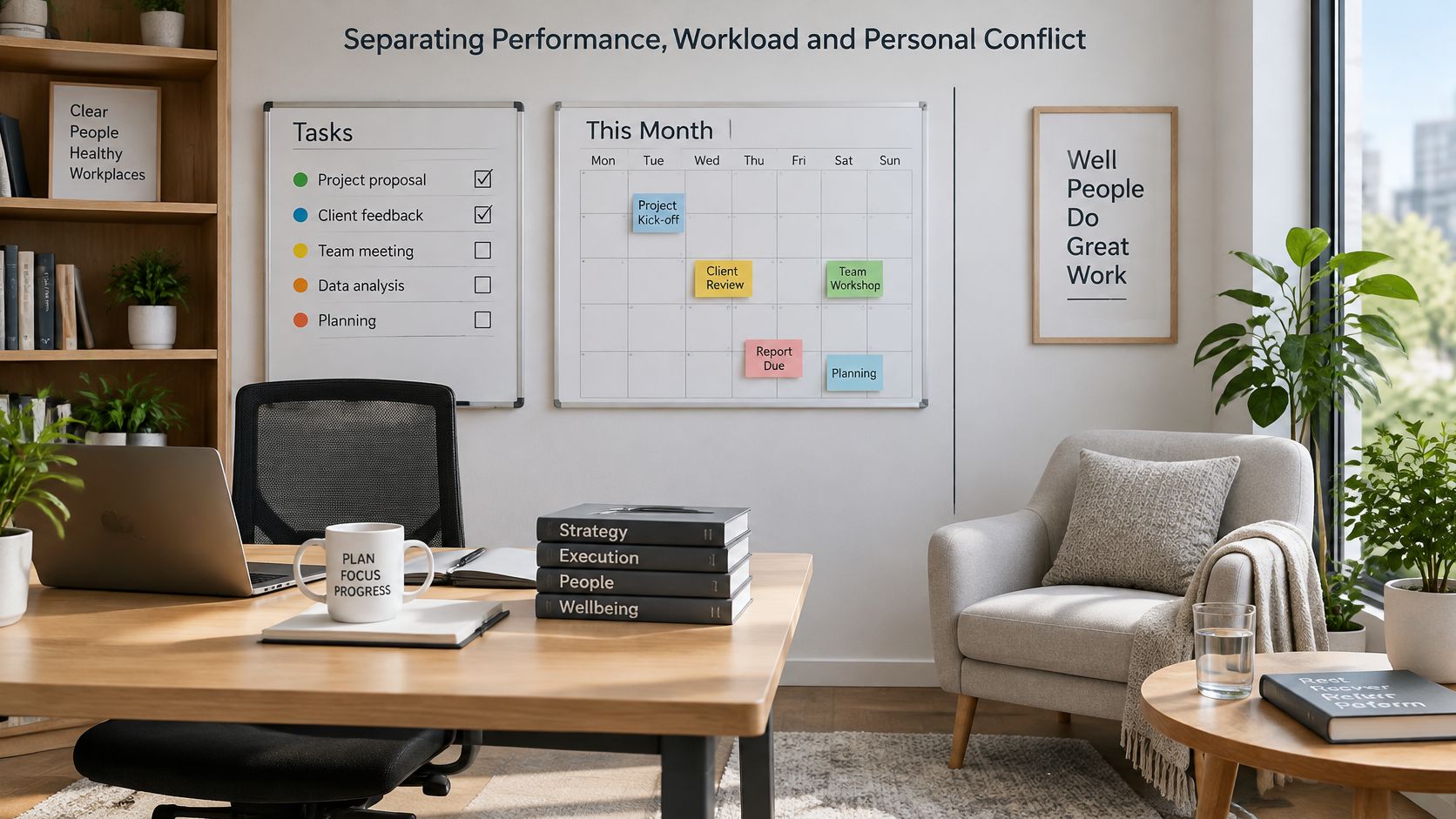
Many disputes labelled as personality clashes are nothing of the kind. According to Acas research on workplace conflict, capability and performance is the most common conflict topic, identified by 38% of Great Britain workers who experienced conflict in the previous 12 months. That means the first intervention often isn't better listening. It's clearer expectations.
Run this check before you meet anyone
- Expectations written and shared: Could the person describe the standard you're judging them against, in their own words?
- Workload realistic: Does the work fit the hours available, or have priorities stacked up?
- Training provided: Has the person been shown how to do what you're asking?
- Health or disability involved: If so, discuss reasonable adjustments separately from performance, and don't let one conversation contaminate the other.
- Possible misconduct: Deliberate wrongdoing belongs on the formal route, not in an informal chat.
Check your own conduct first
CIPD research on workplace conflict found that 49% of employers also admitted that managers can cause conflict within their teams; this rose to 61% in public-sector organisations. So review your allocation of work, your communication and your recent decisions before judging anyone else. This is also where why emotional intelligence is important becomes practical rather than abstract, and structured development such as Emotional Intelligence in Leadership addresses that self-awareness directly.
Say you assume a developer is disengaged because deadlines keep slipping. Then you notice you moved those deadlines three times in a fortnight. The first conversation is no longer about their commitment. It's about your prioritisation, and it should sound completely different.
How to Run the First Private Conversation
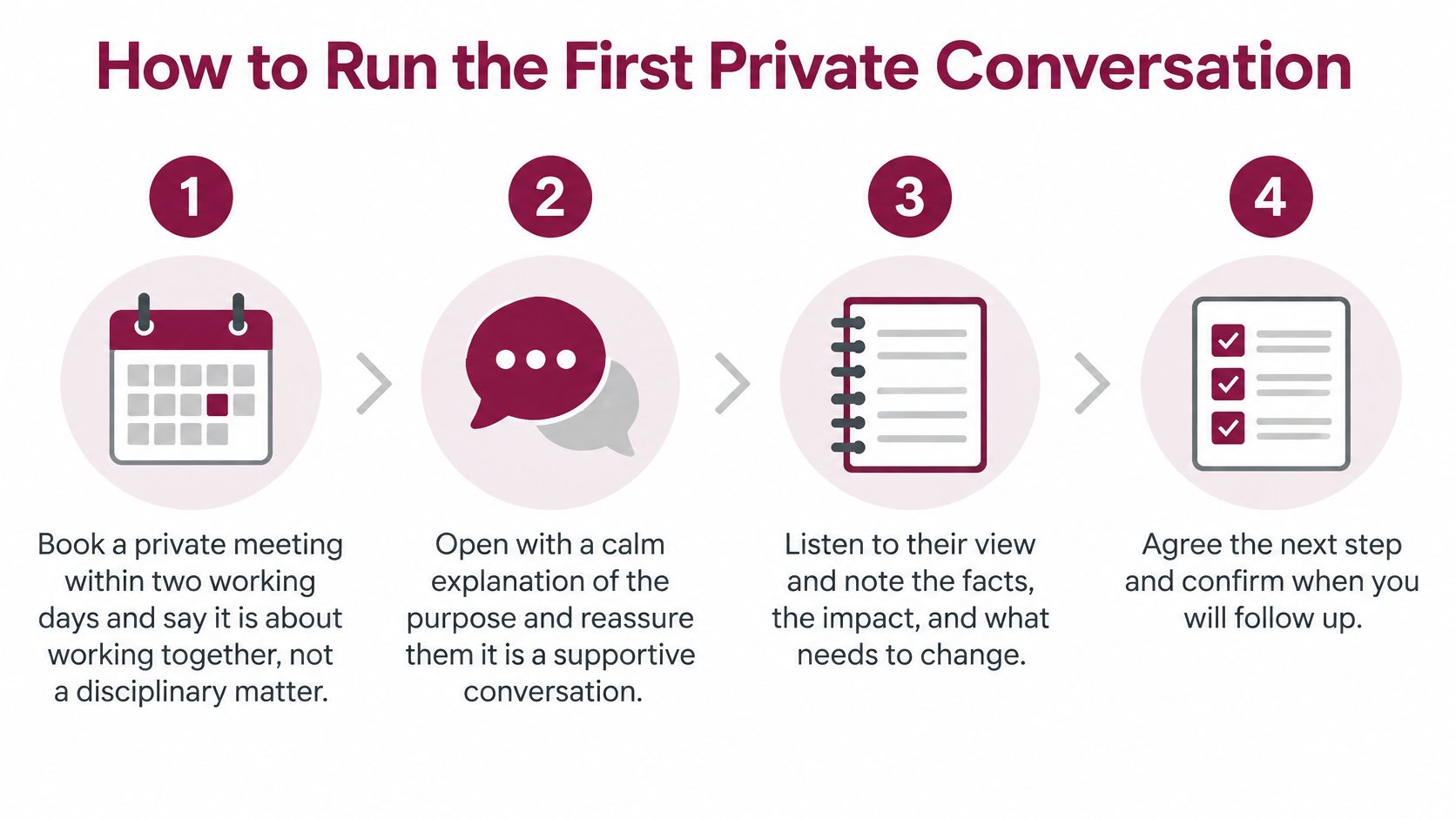
Speak to each person separately before you bring them together. A private meeting lets someone tell you what they won't say in front of a colleague, and it stops the joint discussion becoming an ambush.
Seven steps with the words to use
Book it within two working days. Say it's about working together, not a disciplinary matter. Delay signals that you don't take it seriously, and ambiguity about the purpose makes people defensive before they sit down. Try "I'd like thirty minutes tomorrow to talk about how the handovers are working. It's an informal conversation, not a formal process."
Open with a specific observation. Name behaviour and dates, not character. "I've noticed the handovers were late twice this week and I want to understand what's happening from your side." The common slip is opening with a conclusion, such as "you've been difficult lately", which invites argument about the label instead of discussion of the work.
Ask open questions before offering any view. "What makes this hard at the moment?" and "What happens on your side when a request comes in?" work because they can't be answered with yes or no. If you state your theory first, you'll hear reactions to your theory rather than their account.
Listen and reflect back. Summarise in your own words and check accuracy. "So the file arrives after your deadline has already started. Have I got that right?" This is the core skill in communication skills for managers, and it's also covered in structured form by Communication Skills for Leaders. Don't interrupt to correct detail. You'll lose the thread that matters.
Separate what you've seen from what you assume, out loud. "What I've seen is two missed handovers. What I don't know is why." Saying this plainly shows the person you haven't already decided, which is often their main fear.
Agree one or two concrete next steps. Keep them small and observable, with a named owner. "You'll post the cleaned file by 3pm on weekdays, and I'll confirm priorities each Monday." Trying to resolve everything in one sitting produces vague promises nobody can keep.
Close by summarising and fixing the next check-in. Restate the agreement, thank them for being candid, and put a date in both diaries before they leave the room. Keep the whole meeting to about thirty minutes. An hour-long session drifts into old grievances.
What this looks like in practice
Priya and James are analysts whose data-cleaning work overlaps. Each believes the other ignores their requests. Their manager meets them separately and opens with the handover pattern, not with attitude. Priya explains she can't start until a source file lands, often late. James explains he's never been told Priya's deadline.
Neither is ignoring anyone. The manager leaves with a shared rota, a fixed file deadline and a review date two weeks later. Notice that no one apologised and no one was blamed, because the problem was a process gap wearing the clothes of a personal dispute.
Practical rule: If you can't state the problem as an observable pattern with dates attached, you're not ready to hold the meeting yet.
Facilitating a Joint Discussion Between Colleagues

A joint meeting earns its place only after each person has had a private conversation and both have agreed to talk. Bringing people together cold, hoping proximity will sort it out, usually hardens positions in front of an audience.
Set the ground rules in the first minute. One person speaks at a time. The purpose is future working arrangements, not deciding who was right last month. The meeting lasts 30 to 45 minutes and ends on time whether or not everything is settled.
Techniques that keep the room workable
Summarising neutrally means restating each position in language both people would accept. If either person winces at your summary, you've loaded it. Rewrite it until both nod.
Reframing turns a position into an underlying interest. "You always rush" becomes "you need the client files to be accurate before you send them". Interests can be negotiated. Accusations can't.
Naming a pattern keeps attention on behaviour rather than people. "The handovers keep slipping on Thursdays" is a problem the room can solve together. "You're unreliable" is a verdict.
When a heated remark lands, pause rather than filling the silence. Then invite a response with a question, such as "What's your reaction to that?" The pause gives both people time to step back from the first thing they wanted to say.
- Sit at the same height: Avoid standing over seated colleagues or placing yourself behind a desk.
- Keep notes visible: Write agreed points where both can see them, so the record feels shared rather than secret.
- Don't take sides publicly: If you must correct a factual error, correct the fact and move on without endorsing either account.
A short worked example
Two team members dispute who owns a client report. Each has been editing the other's draft, and both feel undermined. The manager asks each to describe what a good report looks like and what they need from the other to produce it.
Their answers overlap almost completely. Both want one drafter, one reviewer and a single deadline. The disagreement was never about standards. It was about an undefined split of labour that nobody had written down.
Record the outcome before anyone leaves, the agreed arrangement in writing, both people's sign-off and a follow-up date. An agreement that exists only in memory will be remembered differently by Friday.
Deciding When to Escalate or Bring in a Mediator
Most disputes between colleagues stay within your remit. The ones that don't share a common trait: something in the situation makes you the wrong person, or informal handling the wrong process, for it. Read the table against your own position first, because a manager who is part of the conflict cannot also referee it.
| Situation | Warning sign | Response |
|---|---|---|
| Early disagreement, no lasting harm | Tension, but both want to keep working together | Manager-led private conversation and joint meeting |
| Relationship broken after direct talks | Avoidance, repeated complaints, one person declines to meet | Voluntary structured mediation with a trained mediator |
| Manager is one of the parties | Your own decisions or conduct are being challenged | Independent mediator or HR lead, not you |
| Allegation of bullying, discrimination or safeguarding | Harm, a protected characteristic or a threat to safety | Formal policy route at once, with a record kept |
The bottom two rows are where managers most often misjudge. Waiting to see whether a bullying allegation settles down turns a formal matter into a failed informal one, and mediating a dispute about your own decisions convinces both parties the process is rigged. When either row applies, step aside quickly and say so plainly: "This needs a route I can't run myself."
The mediation pathway
Structured mediation follows a sequence. Obtain voluntary agreement from both parties, appoint a trained impartial mediator, hold confidential pre-meetings with each person, define the issues without assigning blame, run a joint session focused on interests and future working arrangements, record mutually accepted actions, and schedule a follow-up review. Mediation stays voluntary throughout, so a refusal is itself information: it usually means the relationship needs the formal route or more time.
The outcomes justify the effort. The Acas guide to mediation reports that an Acas SME study found 49% of managers said their most recent mediation resolved issues completely while 82% reported complete or partial resolution, that Acas recorded a 76% success rate for individual mediation in 2019-20, and that 33% of surveyed Great Britain workers said their organisation lacked people with the necessary mediation skills. Don't act as a pseudo-mediator where your neutrality, confidentiality or a power imbalance is compromised.
Power and access come first
Informal discussion isn't equally safe for everyone. It fails where you're the source of the conflict, where an employee fears retaliation, or where disability, communication differences or remote working limit participation. Acas polling on rising workplace conflict indicates that disabled employees reported more conflict with line managers than non-disabled employees, 38% versus 29%. Check whether each person can take part fully, and offer written summaries, video calls or a trusted colleague present. If someone asks for a companion or a different format, treat it as routine.
If you're one of the parties, or an allegation involves bullying, discrimination or safeguarding, stop informal handling and use the formal policy route.
Following Up So the Agreement Holds
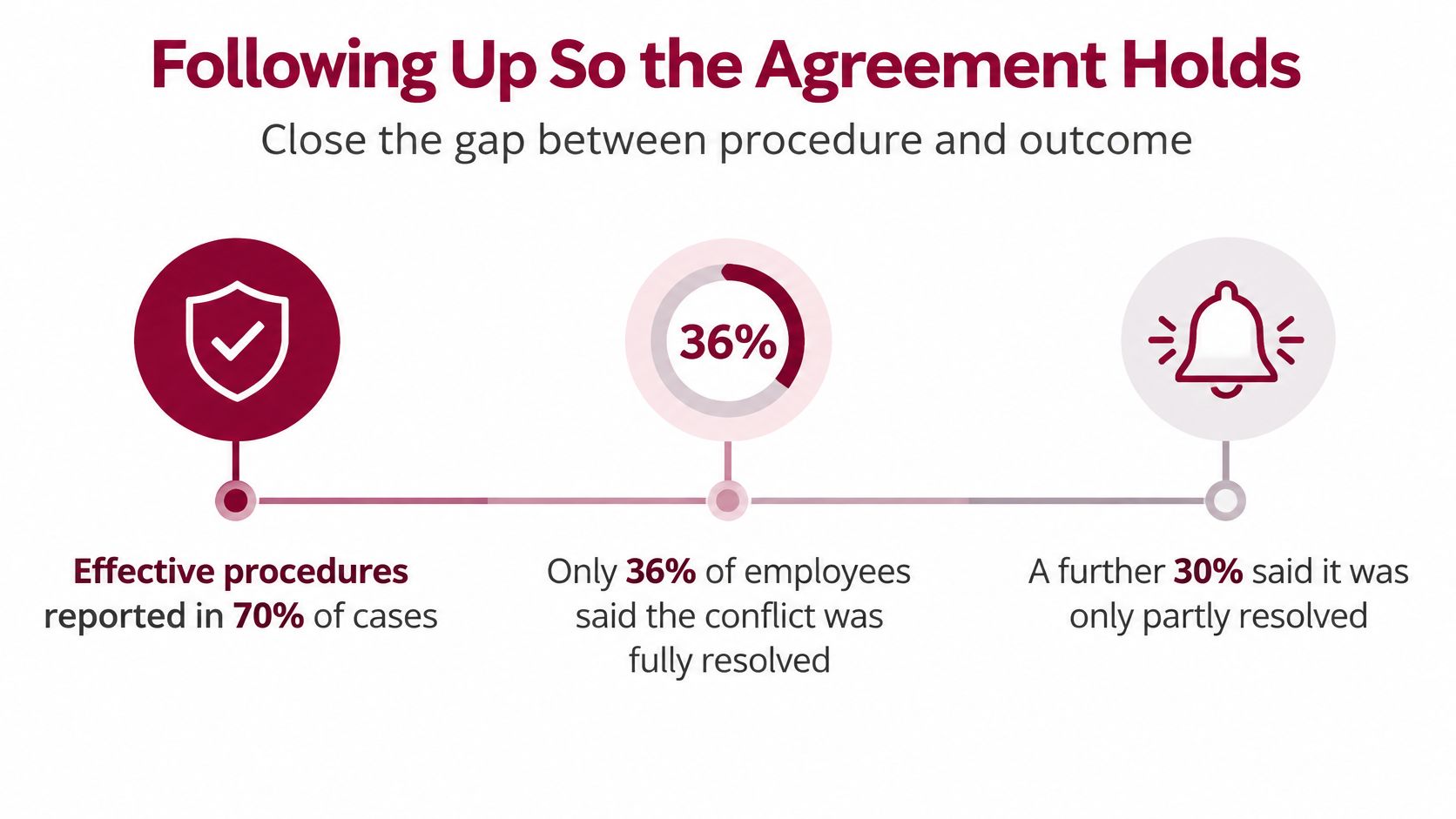
A closed case isn't the same as a resolved one. The CIPD report on bullying and harassment at work found that although 70% of employers reported that their organisation had effective procedures for resolving interpersonal conflict, only 36% of employees who had experienced conflict said that it had been fully resolved, and a further 30% reported that their conflict had been only partly resolved. Procedures get completed. Relationships often don't recover.
A cadence you can copy
| Checkpoint | Timing | Question to ask | Record |
|---|---|---|---|
| Early check-in | One week | Have the agreed actions started? | Actions started and any blockers |
| Formal review | Four weeks | Are the observable measures improving? | Measures met, partly met or missed |
| Relationship check | Three months | What has been easier since we met? | Working relationship status and open issues |
At one week you're testing momentum, not results, so ask what's blocking the first step. At four weeks you judge against the observable measures you agreed, such as handovers on time or a rota followed. At three months you ask the wider question, "Is there anything still getting in the way?" These later conversations are where how to improve team communication pays off, because people raise small problems early when they trust you'll act.
Record each check briefly. Note what changed, what remains open and the next date. Three lines written the same day are worth more than a page reconstructed from memory.
Signs the agreement is failing
- Repeated missed actions: The same commitment slips twice without explanation.
- Avoidance returning: One person stops attending shared meetings or routes everything through you.
- Colleagues reporting tension: Third parties notice the atmosphere before either party complains again.
- The original complaint resurfacing: The same grievance reappears in new language.
When two or more of these appear, reopen the case rather than extending deadlines. Go back to establishing each account, because something has changed or something was missed. If a second attempt fails, move to mediation or the formal route instead of holding a third identical conversation.
Plan Your First Conversation This Week
Choose the conflict you're carrying most. Not the loudest one, and not the one someone else wants you to fix, but the one you keep thinking about after hours. That's usually the one costing the team most.
Run the diagnostic check on expectations, workload, training, health and your own conduct. Then book a private conversation within two working days. Waiting for a calmer week is how a two-week problem becomes a six-month one.
Prepare four things
- One sentence of observation: The specific pattern, with dates, that you'll open with.
- Two or three open questions: Written down, so you don't default to interrogation when the room gets tense.
- An outcome you'd accept: Know your minimum workable arrangement before you start negotiating.
- A follow-up date: Book the one-week check-in before the meeting ends, not afterwards.
Record the outcome the same day, while the wording is still fresh. Managers who want to build these skills across a team can look at Team Building and Management alongside their current role. London School of Business Administration offers a Conflict Resolution course within its Credential of Leadership and Management Programme, which consists of eight CPD accredited courses covering Leadership Fundamentals, Strategic Leadership, Decision Making, Emotional Intelligence, Conflict Resolution, Change Management, Communication Skills, and Team Leadership.
Open your diary now and choose the first conversation. Put a name, a time and a room against it before you do anything else today.
If you'd like to build these habits into a recognised qualification, London School of Business Administration offers self-paced, CPD-accredited study in leadership and management, including conflict resolution, communication skills and team leadership within the Credential of Leadership and Management. Visit the site to review the programme structure and choose the courses that match the conversations you're handling now.