
In the UK, 82% of managers entered management without formal management or leadership training, according to research the Chartered Management Institute carried out with YouGov for its Management and UK 2030 report. The workforce has a name for these people: accidental managers. They are the reliable engineer, the careful nurse, the analyst who never misses a deadline, handed responsibility for other people because they were unusually good at a different job.
That single figure reframes how to become a leader in the UK. Leadership isn't conferred at a handover meeting, and it isn't a personality trait you either have or lack. It's a set of observable workplace behaviours, and the people who get promoted twice are usually the ones who made those behaviours visible to whoever was deciding.
What follows is the roadmap I'd give a newly promoted manager, or someone chasing a first leadership role with no formal training behind them. It compares the routes, sets an honest baseline, builds five behaviours, turns daily work into evidence, and closes with the mistakes that stall capable people.
Table of Contents
- Leadership Development Routes Compared
- How to Take an Honest Leadership Baseline
- Core Leadership Behaviours and How to Build Them
- Turning Daily Work into Visible Leadership Evidence
- Your First 90 Days in a Leadership Role
- Common Pitfalls That Stall Aspiring Leaders
- Confirm Your Next Leadership Step
Leadership Development Routes Compared
Promotion remains a common route into UK leadership, but preparation is often limited. CMI research summarised in CIPD's report on improving UK management capability found that only 8% of the UK's estimated 8 million managers were working towards a management or leadership qualification, while around 30% had done nothing to develop their management and leadership skills in the previous three years.
Five routes can build leadership capability, and they work best in combination. The table compares who each suits, its typical time commitment and the evidence it can produce.
| Route | Best suited to | Typical time commitment | Evidence it produces |
|---|---|---|---|
| Formal management qualification | Managers promoted without training | Often several months, depending on the programme | A recognised certificate for employers |
| Stretch project with defined outcomes | Staff seeking responsibility for a team or result | One quarter alongside the day job | Documented results against a measurable target |
| Structured mentoring | Early-career professionals | Regular sessions over six months | Written development goals and reviewed progress |
| Sponsorship from a senior leader | Staff in organisations with unclear promotion criteria | Ongoing | A named advocate in promotion decisions |
| 360-degree feedback | Anyone checking behaviour against team views | One review per development cycle | Feedback from managers, peers and direct reports |
A qualification builds vocabulary and frameworks for describing leadership practice. A stretch project tests those ideas against a measurable result, while mentoring helps you examine situations that formal frameworks may not resolve. Feedback from managers, peers and direct reports can reveal gaps between your intentions and the behaviour colleagues experience.
Sponsorship addresses a different constraint: promotion decisions depend on organisational processes as well as individual performance. The UK Government's 2025 summary of the FTSE Women Leaders Review reported that women held 1,275 board positions, 43% of board roles, across FTSE 350 companies. The figures show progress in representation; they do not, on their own, establish what caused it. Advocacy and succession planning are practical organisational mechanisms for making capable people visible to decision-makers.
Where to start: If you lack formal training and a clear promotion route, begin with a 360-degree review. Use the feedback to choose a course or project that addresses a specific behaviour gap.
For formal options, this overview of leadership training courses outlines points to consider before committing.
How to Take an Honest Leadership Baseline
Six steps, each with a reason and a slip that ruins it without warning. Keep the slips visible while you work.
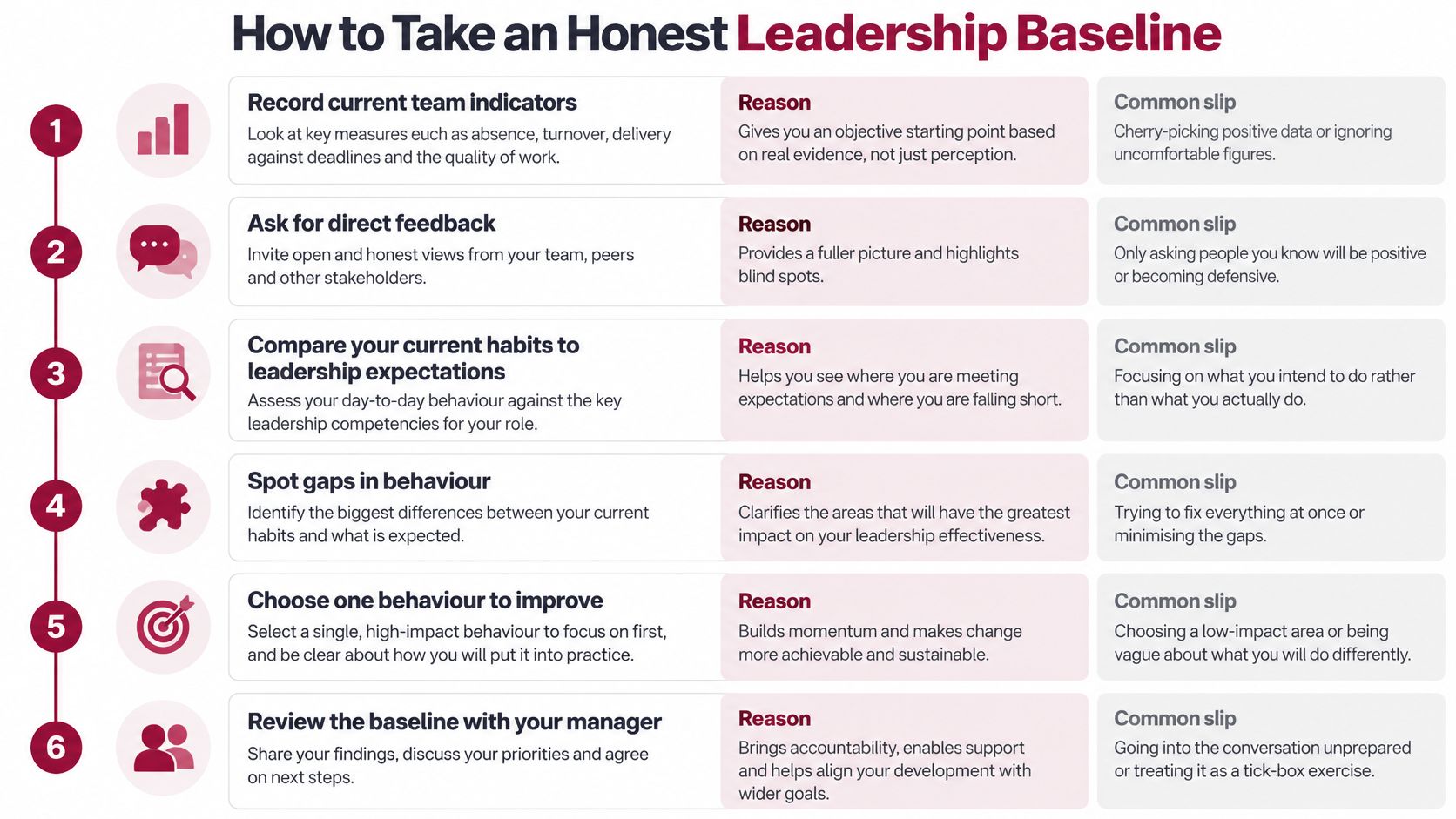
- Record current team indicators. Absence, turnover, delivery against deadlines and the quality of your one-to-ones. The reason is simple: no later change can be shown without a starting point. The common slip is reconstructing last quarter's numbers from memory instead of pulling the actual system report.
- Complete a skills self-assessment against four core behaviours. Communication, delegation, decision-making and conflict resolution. The slip is rating your intentions rather than your observed practice. Ask what you did in the last difficult conversation, not what you believe in principle.
- Ask at least three stakeholders for confidential feedback. Ideally one senior person, one peer and one direct report. The slip is asking only people who already agree with you. The direct report is the one who holds the useful information.
- Separate leading indicators from lagging ones. Leading indicators include response time to issues and clarity of objectives. Lagging indicators include turnover, customer outcomes and productivity. Early change shows up in the leading set weeks before the lagging set moves.
- Choose one behaviour to focus on for the coming month. Changing several at once makes the results impossible to attribute, and attribution is the whole point.
- Write a one-page summary and date it. The review in 30 to 60 days needs something concrete to compare against.
Measurement of this kind has a track record beyond individual careers. In 2016, British manufacturing businesses in the top half for structured management practices had average productivity 38% higher than those in the bottom half, as reported in the UK government's job and skills data.
A useful baseline ends with three to five gaps, each tied to a behaviour someone could observe without asking you what you meant. "Improve communication" is not a gap. "Stops giving feedback once a deadline slips" is.
Core Leadership Behaviours and How to Build Them
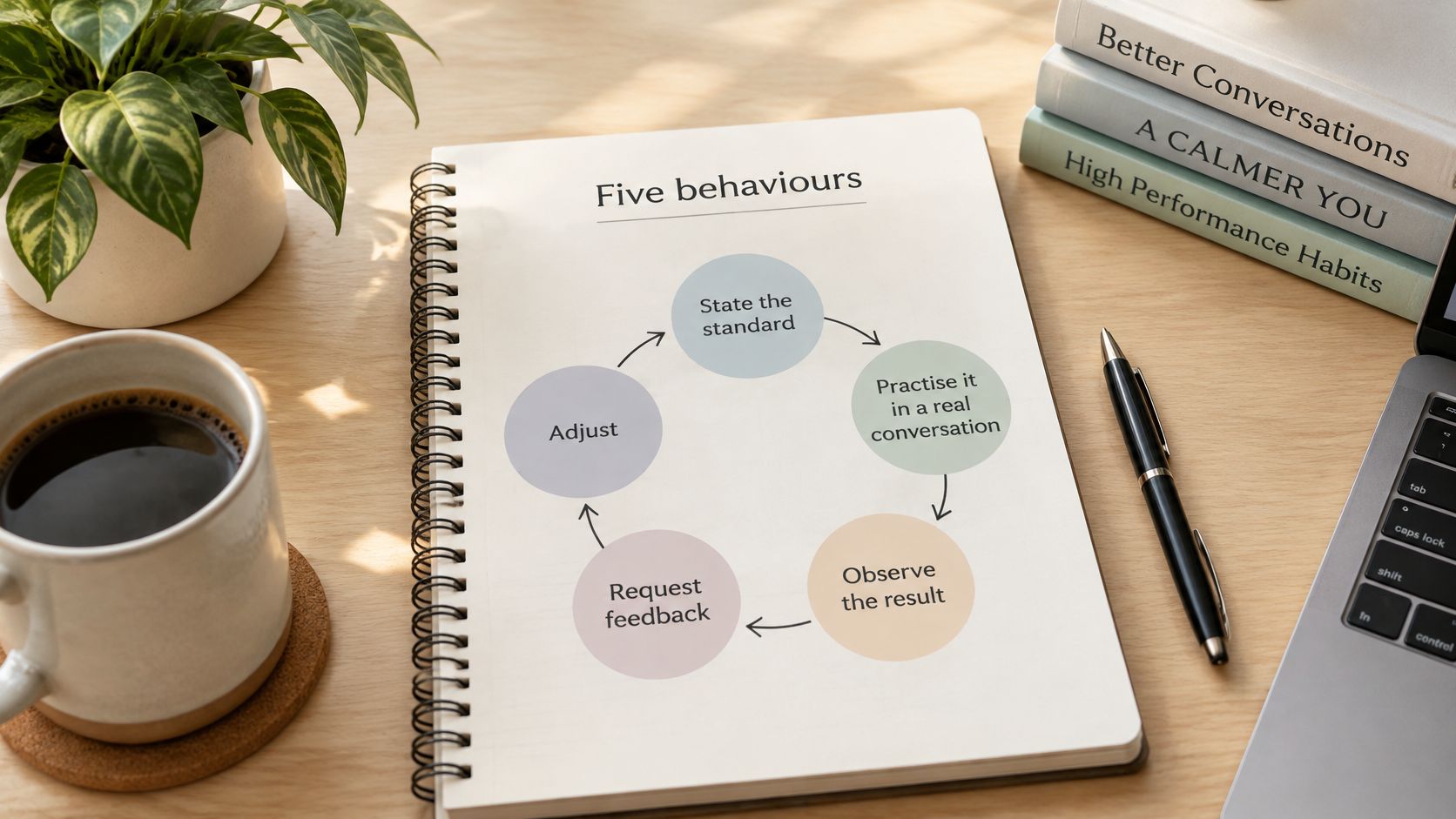
Leadership becomes credible through behaviours colleagues can observe. Use the same five behaviours assessed in your baseline: expectation-setting, coaching, conflict management, decision-making and feedback. Practise each in real work, where deadlines, competing priorities and relationships shape what happens.
| Behaviour | Workplace practice | What to look for |
|---|---|---|
| Expectation-setting | Agree written objectives with each report | Fewer priority queries and more reliable delivery against agreed outcomes |
| Coaching | Hold structured one-to-ones | Team members take on new responsibilities and build capability |
| Conflict management | Address disagreement promptly in a private conversation | Concerns are raised early and resolved before they disrupt work |
| Decision-making | Record decisions and review their consequences | Decisions are revisited when planned, with the reasoning and outcomes clear |
| Feedback | Give specific feedback about observable behaviour | Issues are addressed promptly and people know what to repeat or change |
Take expectation-setting. A team leader agrees three or four written objectives with each direct report and sets review dates. If colleagues ask less often what to prioritise, and delivery reviews focus on progress rather than renegotiating expectations, the behaviour is making a practical difference. The trade-off is time spent agreeing priorities now in return for fewer misunderstandings later.
Reading the indicators honestly
Managers cannot claim credit for every change in team results. A shift in delivery or staff retention may have several causes, so compare workplace observations with outcomes rather than treating either as proof on its own.
Research summarised by the London School of Economics on management practices and productivity found that differences in management practices were estimated to explain between one-quarter and one-third of total-factor-productivity gaps across and within countries. The practical lesson is to make management behaviour consistent enough that teams can act on it.
Communication, emotional intelligence and team development support all five behaviours. Emotional intelligence, for example, helps a manager distinguish a team that is quiet because it is focused from one that is reluctant to raise concerns. Read more about why emotional intelligence matters in leadership. For structured learning across these areas, the Credential of Leadership and Management consists of eight CPD-accredited courses covering leadership fundamentals, strategic leadership, decision-making, emotional intelligence, conflict resolution, change management, communication skills and team leadership.
Choose the evidence that fits the behaviour. A written objective is evidence of an agreed standard; a documented decision review shows whether the decision was examined; a specific example of feedback shows what was addressed. A general claim such as “I communicate well” gives a promotion panel little to assess.
Practise until the behaviour holds under pressure: a difficult performance conversation, disagreement between colleagues or a period when results fall short.
Turning Daily Work into Visible Leadership Evidence
Leadership is credible only when other people can see it. A manager who believes they're decisive while their team describes them as absent from hard calls hasn't got a communication problem. They've got an evidence problem, and effort won't solve it.
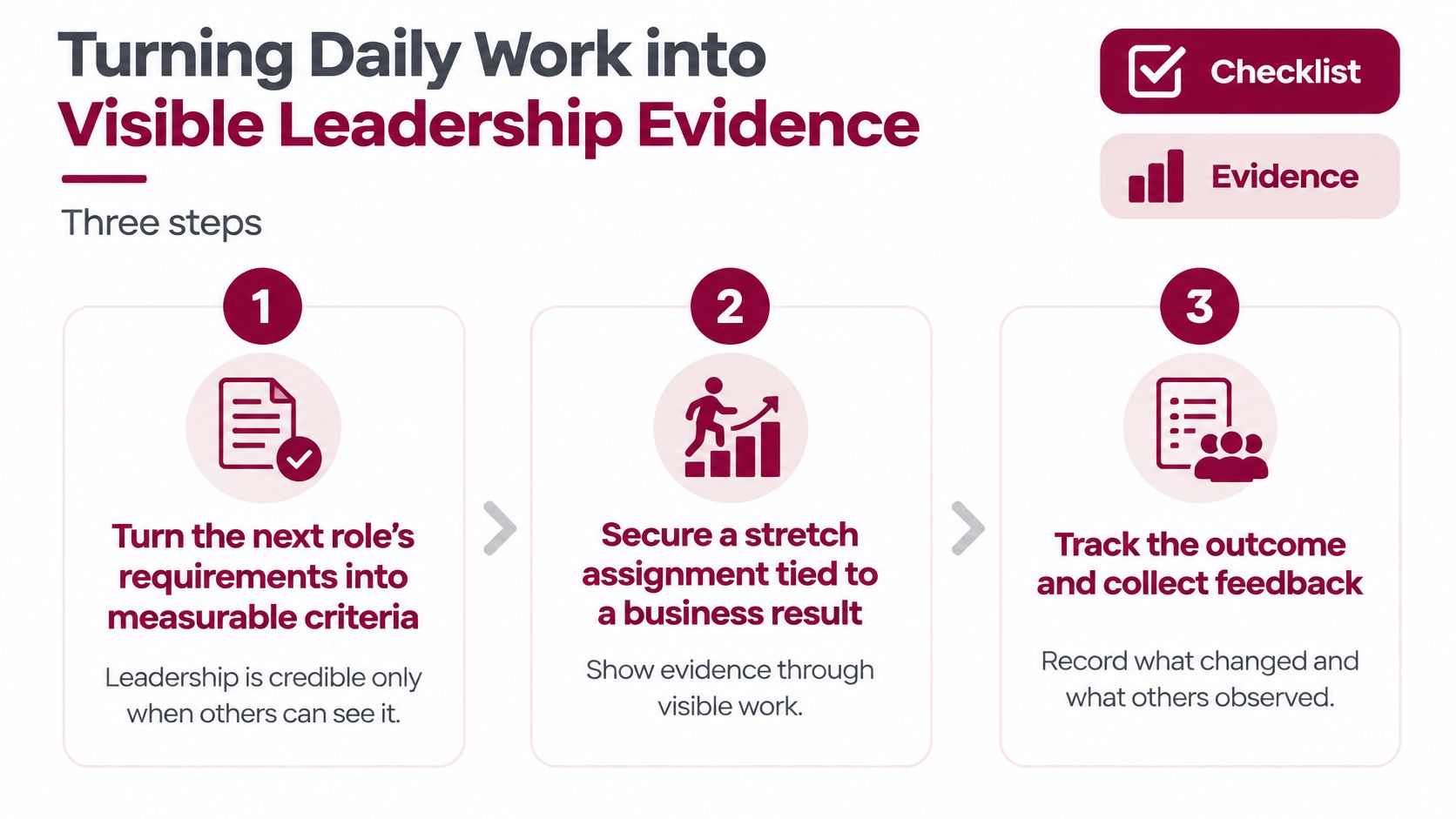
The conversion takes three moves. First, turn the next role's requirements into measurable criteria: take the person specification line by line and rewrite each one as something observable, such as "has run a team through a change without losing a customer" rather than "strong change management skills". Second, secure a stretch assignment tied to a business result, not a tidy-up task. A cleared delivery backlog, a reduced churn rate, a handover process that stops losing clients. Third, document the outcome with dates and figures and collect feedback from the people who watched you do it.
Then there's the distinction that decides more promotions than any course: a mentor advises, a sponsor speaks. When a vacancy is discussed in a room you're not in, the sponsor is the person who names you and cites your result. Ask for that explicitly, with a date attached. Something like, "The team leader vacancy closes in May. I'd like you to raise the delivery turnaround work when it comes up, and I'll send you the figures beforehand." Vague requests for support produce vague support.
For readers who want to practise the translation deliberately, from theory to practice sets out how to apply course material to live work rather than storing it.
The test for a real promotion pathway
Self-development doesn't guarantee advancement, and the structural evidence is blunt. The 2026 Women's Leadership Benchmark for Wales reports that the share of respondents reporting clear promotion pathways fell from 44% in 2024 to 39% in 2026, even as confidence in seeking internal leadership advice rose from 67% to 72%. Confidence and mentoring improved while access narrowed.
Four questions test whether your employer offers genuine progression. Are promotion criteria published? Is there a named route from your level to the next one? Have people been promoted from your level in the last two years? Is there a process for querying criteria that are unclear or applied inconsistently?
If the answer to two or more is no, escalate through formal development or performance processes and ask for the criteria in writing. If the organisation still can't produce them, treat sponsorship and external evidence as your primary strategy rather than a supplement.
Your First 90 Days in a Leadership Role
A newly promoted manager begins a team meeting by assigning work, only to find that staff still seek approval from their former manager. Before changing routines, establish who decides what and how the team expects to work together. The first 90 days are a chance to make those expectations clear and show leadership through observable actions.
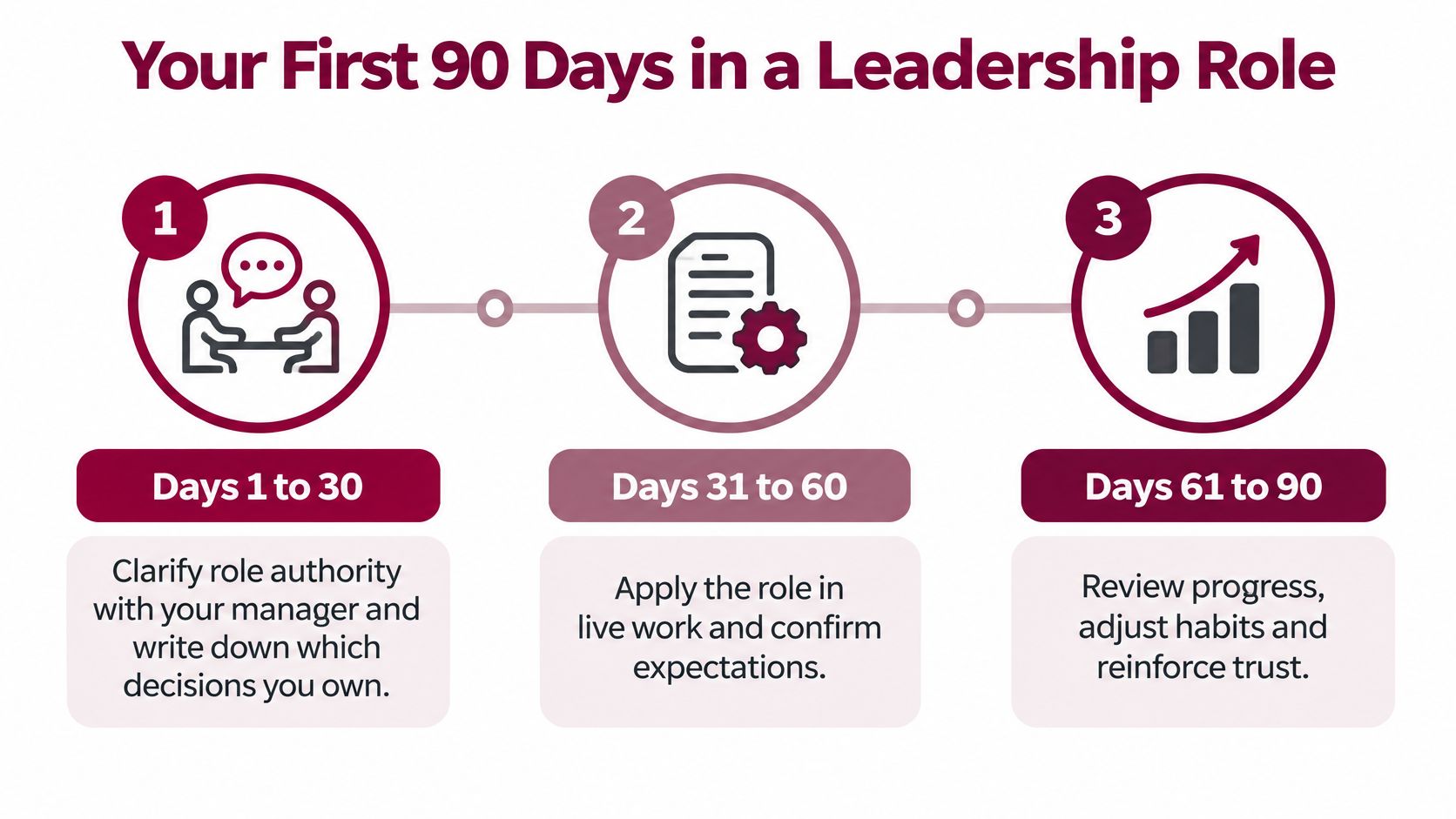
Days 1 to 30: clarify authority. Agree with your manager which decisions you own, which require sign-off and which you should recommend. Meet each direct report one-to-one and ask what they need from you to do their job well. Unclear decision rights can create friction, even when the people involved are capable.
Days 31 to 60: agree outcomes and practise on real cases. Write down team outcomes and set one measurable goal per person. Practise giving feedback on a live piece of work that is late or below standard. A written agreement makes expectations easier to revisit if memories differ.
Days 61 to 90: review your decisions and behaviour. Record three decisions and their consequences, then discuss what you could improve with your manager. Ask staff for a specific example of a change they have noticed in your management. Their feedback gives you an external check on whether your actions are visible.
Waiting for a course before you lead can delay useful feedback. Choose a real workplace behaviour to practise, then review the result with the people affected.
What a credible review shows
By day 90, your review should show clearer objectives than the ones you inherited, fewer unresolved issues and a specific example of changed management behaviour from the team. If colleagues cannot name a change, identify one behaviour to practise and agree how you will check its effect.
Common Pitfalls That Stall Aspiring Leaders
A promotion can give you responsibility before it gives you a clear route to prove your leadership. These five assumptions can obscure the workplace behaviours that colleagues and decision-makers need to see.
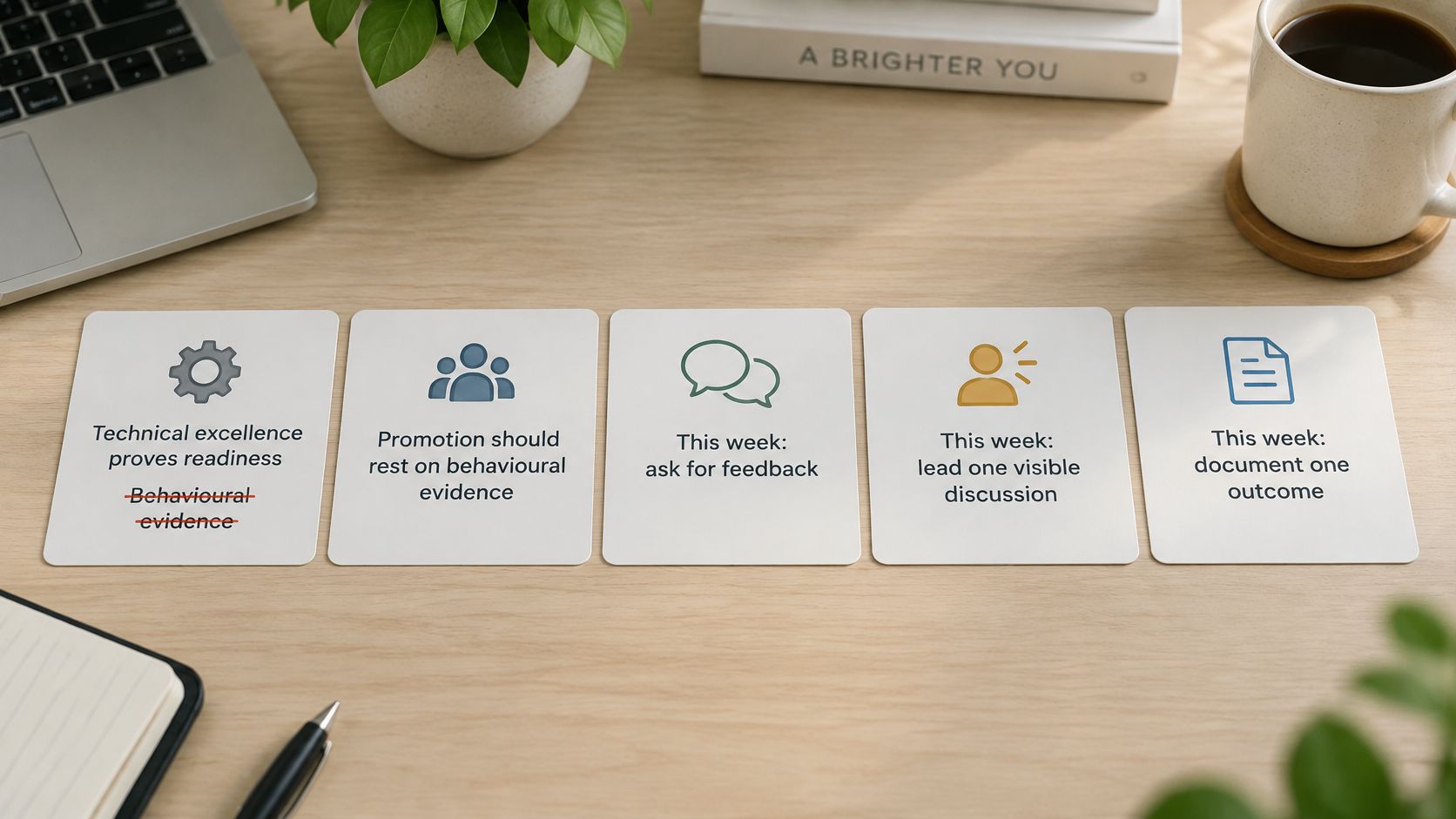
“I'm known for good work, so I'll be promoted.” Strong technical performance matters, but it does not show how you set objectives, handle disagreement or explain decisions. Ask your manager which of these behaviours would count as evidence of readiness. Where promotion criteria are unclear, capable people can struggle to make their contribution visible.
“I should lead the way my last manager did.” A behaviour that worked in one team may misfire in another. Keep the principle, adapt the approach, and check whether the change helped the person you were speaking with.
“A course will make me ready.” Training can provide useful frameworks, but knowledge alone does not show how you apply them. Choose a workplace situation where you can practise a specific behaviour and assess its effect.
“Being liked means I'm leading well.” Good relationships help, but they do not replace clear decisions and reliable delivery. Compare team feedback with the outcomes you are responsible for.
“My team will develop without my input.” Development needs time and specific conversations. Ask each person which skill they want to strengthen and agree an opportunity to practise it. Without that support, day-to-day work can keep people productive while leaving their progress stalled.
Confirm Your Next Leadership Step
Write down the leadership behaviour that would most change how your team describes your leadership if you improved it this month. Use the answer to choose a practical next step, then set a review date.
I will hold a written objectives conversation with each direct report in next week's one-to-ones, measure response time to issues, and review the result on the date set in my baseline summary.
If your main gap is formal grounding, a structured programme can provide frameworks to apply at work. The Credential of Leadership and Management at London School of Business Administration is delivered online and self-paced over 160 hours across eight CPD-accredited courses. Its content covers leadership fundamentals, strategic leadership, decision-making, emotional intelligence, conflict resolution, change management, communication skills and team leadership.
Which behaviour, if it improved this month, would most change how your team describes your leadership? Start there. The answer is your next step. Compare the programme's listed content with the skills you want to develop at London School of Business Administration.