

Ask UK owner-managers what stands between them and a larger business and the answer rarely concerns ambition. 61% of SME employers named taxation, VAT, PAYE, National Insurance or business rates as their main obstacle to growth, according to the government's Longitudinal Small Business Survey 2024, with energy prices cited by 50% and market competition by 40%. Cost and cash come first, growth second.
That ordering explains why so many plans collapse in their second quarter. A strategy built on demand alone, with no line for the bank balance or the hours the management team can give, is a forecast with a cover page. Business strategy development works when every option is tested against cash and capacity before it reaches the plan, not after.
The method below runs six stages in a fixed order, from an honest diagnostic to a dated review. Each stage produces something the next stage can use, and each one can be stopped if the evidence says stop.
Table of Contents
- The Business Strategy Development Process at a Glance
- Assess Where the Business Stands Today
- Set Objectives You Can Measure
- Compare Strategic Options on the Same Criteria
- Stress-Test Assumptions Before You Commit
- How to Build the Action Plan Step by Step
- Book a 90-Day Strategy Review This Quarter
The Business Strategy Development Process at a Glance
Six stages carry a strategy from an honest look at the books to a dated decision about what to continue, pause or stop. The table sets out the sequence, the question each stage answers and the output that has to exist before the next one begins.
| Stage | Core question | Output |
|---|---|---|
| Assess the current position | Where does the business stand on cash, capability and demand? | Baseline diagnostic |
| Set strategic objectives | What must change within 12 to 36 months? | Two or three measurable objectives |
| Evaluate strategic options | Which route offers the best return for the risk? | Ranked options with reasons |
| Stress-test the choice | What breaks if key assumptions are wrong? | Scenario-tested shortlist |
| Build the action plan | Who does what, and by when? | Owned initiatives with milestones |
| Review and reset | Is the strategy still working? | Quarterly and annual decisions |
Objectives written before a diagnostic tend to copy a competitor's ambitions, because the team has nothing local to aim at. Options chosen before stress-testing tend to fail on cash rather than on strategy, because the arithmetic arrives after the commitment. The sequence exists to put evidence in front of enthusiasm.
Timing is more forgiving than many expect. A firm with eight staff can run all six stages in six to ten weeks by giving each stage one owner and one working session. A multi-site business may need a month per stage, mostly for the evidence gathering in the first.
Two terms need separating before any work starts. Corporate strategy decides which businesses a group should own and how capital moves between them. Business strategy decides how one unit wins customers in one market, against named competitors, with the resources it already has. Most managers work at the second level, even inside a group that sets the first.
If you can't name the customer group you're taking business from and the competitor losing it, you're writing corporate strategy by accident.
Treat the rows as checkpoints rather than a calendar. A plan that skips the stress test and the review isn't a strategy; it's a budget with adjectives. The hardest row is also the first, because an honest diagnostic has to survive a finance lead reading it line by line.
Assess Where the Business Stands Today
The UK's productivity record sets the frame for every diagnosis. Output per hour worked grew at roughly 2% a year in the decade before the 2008 financial crisis and at around 0.4% a year afterwards, a slowdown of about 80% in the average growth rate, according to the government's Backing your business evidence annex. The same evidence names two firm-level drivers as decisive: better leadership and management practice, and the adoption and diffusion of digital technology.
That narrows the question a diagnostic must answer. Is growth held back by demand, or by capability? A firm that blames the market while its quote-to-cash cycle takes nine weeks is diagnosing the wrong constraint.

Four checks that produce a baseline
- Market and demand. Take 24 months of revenue by customer group, the repeat purchase rate and the share of sales from the top five customers. Our guide to how to do market research shows how to gather customer evidence without a consultancy budget.
- Capability. List the skills, systems and managers the plan depends on, then write the hours each one has free each week. A plan that needs 20 hours a week from a manager with four available will slip.
- Cash. Work out the cash conversion cycle, the months of fixed costs covered by reserves and the cost of the finance available. These figures decide which options survive the next stage.
- External pressure. Record the regulation, input costs and competitor behaviour the firm can't control, and estimate what a change in any of them would cost.
A PESTLE scan and a SWOT add value only when they stay small. Limit each SWOT box to three points and tie every weakness to the cash or capacity figure it moves. Anything longer becomes a list of adjectives.
The one-page summary
The output of this stage is one page, not a deck. It names the binding constraint, the single factor most likely to stop the strategy if it's left alone, and shows the evidence behind that claim. If the constraint is cash, every later option gets tested on cash first. If it's management hours, the answer is fewer initiatives, not more.
Set Objectives You Can Measure
A strategic objective is a sentence a manager can act on by Friday. A vision statement is a sentence a manager can admire and then ignore. The gap between them is the work of this stage.
Five moves that turn a diagnosis into an objective
- Choose the outcome that carries the most weight. Gross margin, customer retention and revenue per employee are the three that usually decide the next three years. Picking all three at once defeats the purpose.
- Take the current number from the baseline. No baseline, no objective. A target without a starting figure is an aspiration with a deadline attached.
- Set a target tied to a capacity you can name. "45% by next March because we free two days a week of the account manager's time" beats "grow retention significantly".
- Give one owner decision rights. Not a committee, not "the team". One name, plus the authority to decline conflicting work.
- Fix a review date and a leading indicator. Pipeline volume, renewal conversations booked or trial conversions move weeks before the lagging figure does.
A worked example from a 25-person firm
A services business with 25 staff finds repeat-client revenue at 38% of sales. The objective becomes: raise repeat-client revenue to 45% of sales within 12 months, owned by the operations director, tracked monthly through the number of renewal conversations held. The target is ambitious and tied to a named capacity, the owner can change how account reviews are scheduled, and the leading indicator tells the leadership team in month two whether the plan is working.
Public strategy follows the same logic at a larger scale. The House of Commons Library briefing on industrial strategy records that interest in industrial strategy revived after the 2008 financial crisis, and that the 2017 Industrial Strategy put £37 billion into productivity investment, covering areas such as transport and digital connectivity, plus a £20 billion action plan for businesses with high growth potential. A 10-year plan with named priorities, allocated money and measurable outcomes is the same discipline an owner-manager applies with two objectives instead of eight.
Objective, target or vision
A vision describes the business you intend to become and carries no date. An operating target describes a weekly number someone already manages, such as units shipped. A strategic objective changes a capability or a position within 12 to 36 months and needs an owner, a baseline and a date. Mixing the three produces plans where the vision gets reviewed monthly and the objective gets reviewed never.
Three objectives is the working ceiling. Four or more dilutes management time and makes every initiative look equally urgent, which in practice means the cheapest one gets done and the important one doesn't.
One-minute test: could a new manager read the objective, check one figure and say whether it's on track? If not, it's still a slogan.
Compare Strategic Options on the Same Criteria
Four growth routes exist, and every strategy picks one or more of them whether or not the team uses the framework's name. Comparing them on the same criteria is what stops a preference from being mistaken for an analysis.
| Option | Growth route | Typical cash need | Main risk | Reversibility |
|---|---|---|---|---|
| Market penetration | Sell more existing products to current customers | Low to moderate | Price competition | High |
| Product development | New products for existing customers | Moderate to high | Weak product-market fit | Medium |
| Market development | Existing products in new markets | Moderate | Unfamiliar buyers and channels | Medium |
| Diversification | New products in new markets | High | Capability gaps and a split focus | Low |
Score each route one to five against the objectives you set, on four criteria: cash need, speed to evidence, reversibility and fit with current capability. Weight cash and reversibility double when reserves cover less than six months of fixed costs, because for those firms a slow option is a dangerous one. Innovation is common but not automatically valuable: the UK Innovation Survey 2025 found that 34% of UK businesses were innovation-active during 2022 to 2024. Activity is a cost before it's a return, which is why the scoring has to ask who pays.
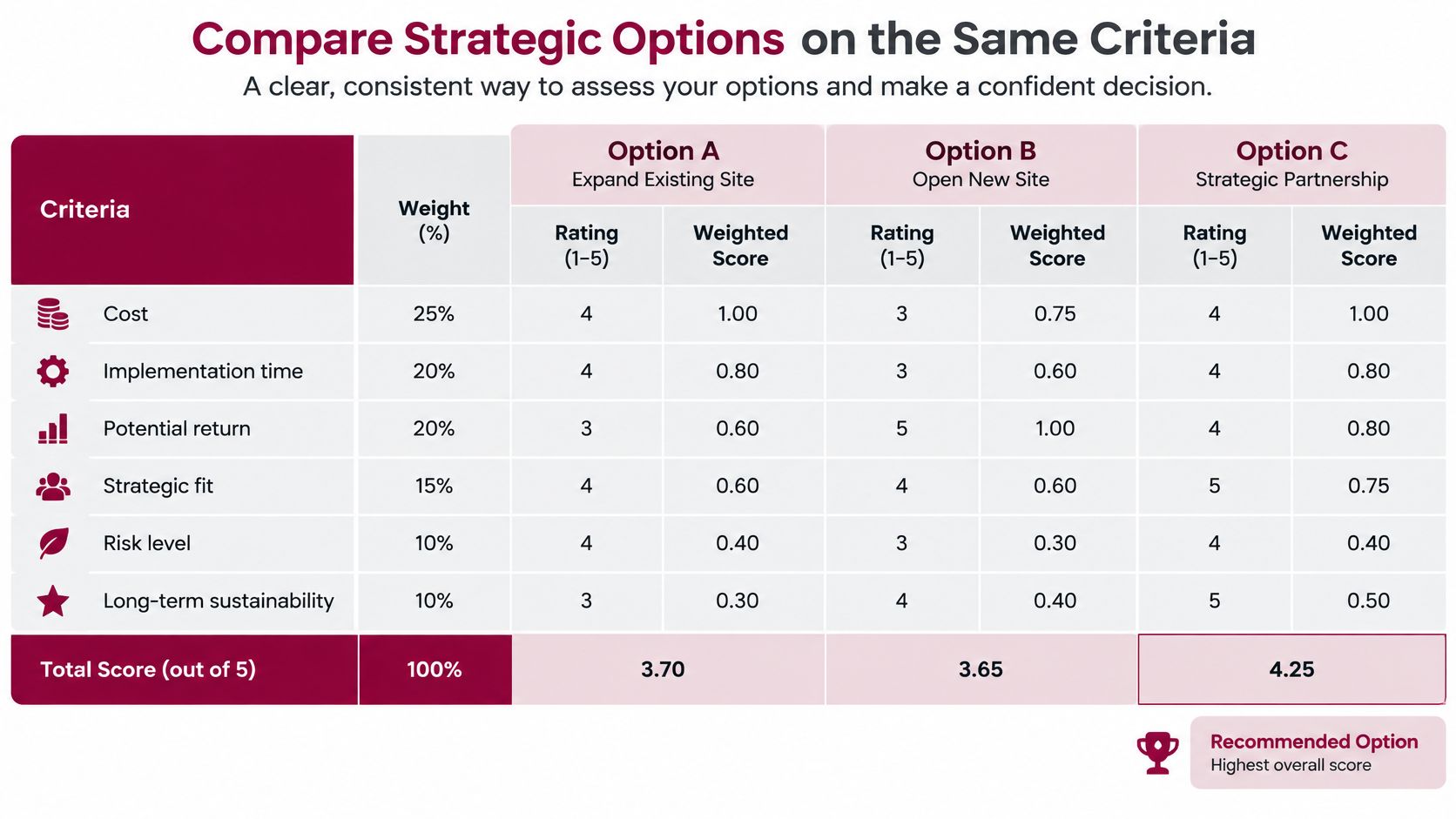
The bakery weighing three routes
Say a bakery with one shop weighs a second site, a wholesale range and a price rise on existing lines. The second site scores well on market development and badly on cash, reversibility and evidence speed: a lease deposit, fit-out costs and a twelve-month wait before the footfall is known. The wholesale range needs a production shift and a van, and it's partly reversible. The price rise costs a menu reprint and shows in the till within a month.
Test the wholesale range with five trial customers before committing, and the ranking often moves. The option that scored poorly on cash need starts returning evidence in weeks while the second site is still with the solicitors.
Three edge cases worth pricing
- Cheap options with hidden capacity costs. A new product line can take almost no cash and 15 hours a week of the owner's time, which is the scarcest resource in the business.
- Reversibility that exists only on paper. A 10-year lease with a penalty clause isn't reversible, whatever the spreadsheet column says.
- Cannibalisation. A cheaper range can take sales from the premium line, so the score has to count lost margin as a cost.
Budget rule: prefer the option that can be tested for under 5% of the annual budget before full commitment.
Carry no more than two options into stress-testing. Three or more keeps the team in analysis and delays the only thing that resolves uncertainty, which is contact with customers. If the decision criteria need sharper definition first, a structured look at the strategic decision-making process can help the team agree how choices get made before they argue about which one to take.
Stress-Test Assumptions Before You Commit
A plan that works only in the base case isn't a plan; it's a forecast with a signature. The downside case is the one that decides whether the business survives long enough to enjoy the upside.
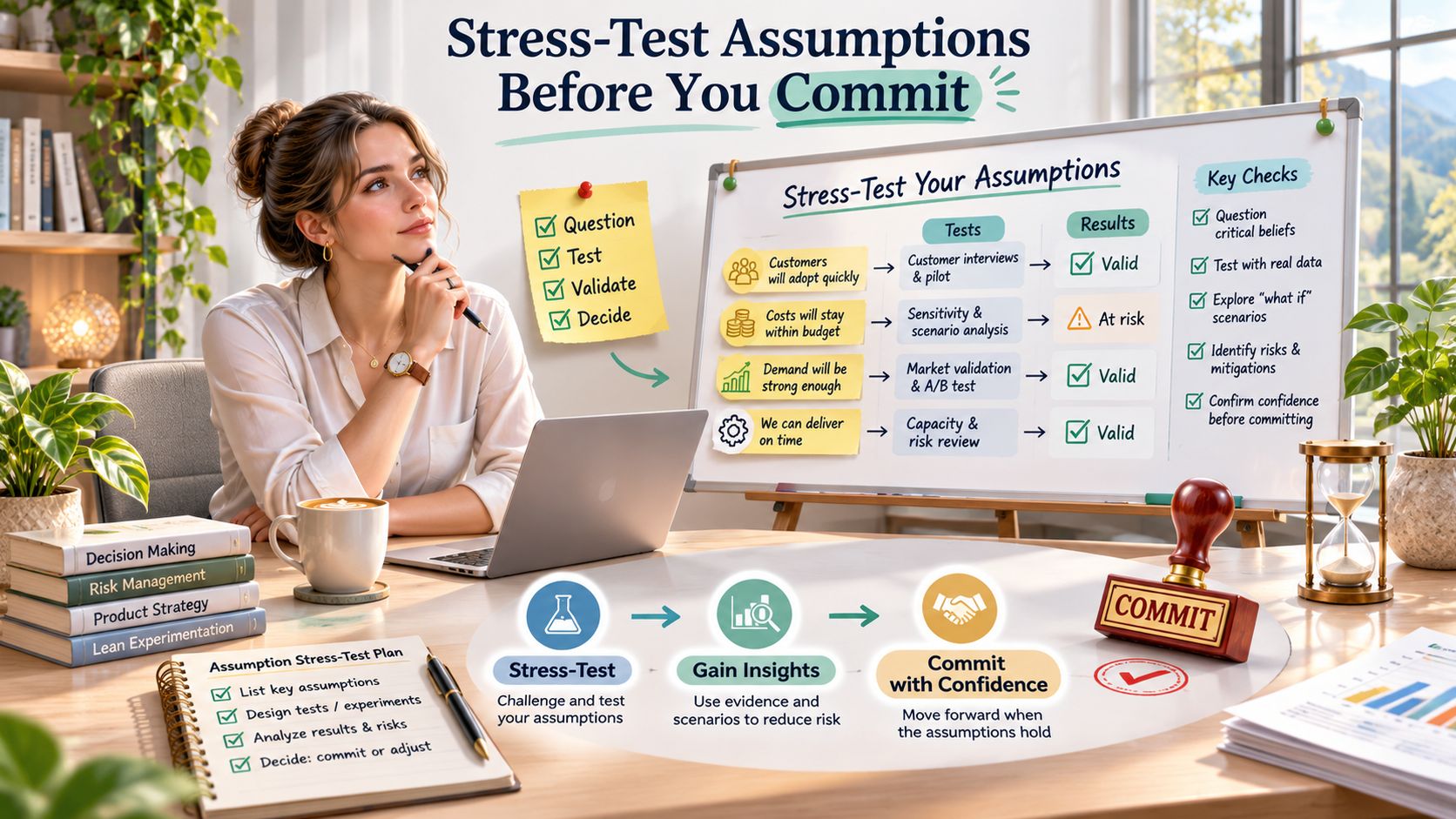
Write three scenarios for each shortlisted option, then agree in advance which measurable trigger tells the team which one is unfolding.
| Scenario | Core assumptions | Trigger to watch | Planned response |
|---|---|---|---|
| Base | Demand and costs track the current plan | Monthly revenue within 10% of forecast | Continue the plan and review quarterly |
| Downside | Demand falls, or energy and tax costs rise | Two months of margin below threshold | Pause new fixed costs and protect cash |
| Upside | Demand exceeds forecast | Repeat orders above plan for two quarters | Release reserved capacity in stages |
Sensitivity, one variable at a time
Change a single assumption and record the effect on 12 months of cash: a 15% fall in demand, a 10% rise in energy costs, a two-point rise in the cost of renewing a facility. Then run the variables together, because costs and demand tend to move in the same quarter. The variable that moves the result most is a decision variable, not background commentary, and the plan should state the level at which the business acts.
Financing sits at the centre of the downside case more often than teams admit. The State of Innovation 2025 summary report found that 49% of innovators said barriers constrained their innovation activity, and among those affected, 74% named a lack of bank or equity finance, while 50% cited uncertain demand and 50% regulation or legislation. A downside case that leaves out funding, demand and compliance is a costs-only exercise.
Kill and scale criteria agreed in advance
Name the numbers before the pilot starts: maximum acquisition cost, minimum gross margin, payback period and validated customer usage. When a criterion is hit, the decision is already made and the team only confirms it. This is what separates a staged investment from an open-ended one.
The frequent failure is a plan that clears the base case and runs dry in the downside, usually because fixed costs were committed in month one. Agree what the business will stop if the trigger fires: the second-site deposit, the extra hire, the trade show.
Deciding to stop in a calm room costs nothing. Deciding it in a bank manager's office costs the relationship as well as the money.
Where the team needs a firmer method for weighing evidence under uncertainty, Decision Making and Problem Solving covers how to set criteria and compare options before the pressure arrives.
How to Build the Action Plan Step by Step
The plan that gets executed is short, owned and dated. Six steps turn the tested shortlist into something a team can start on Monday.
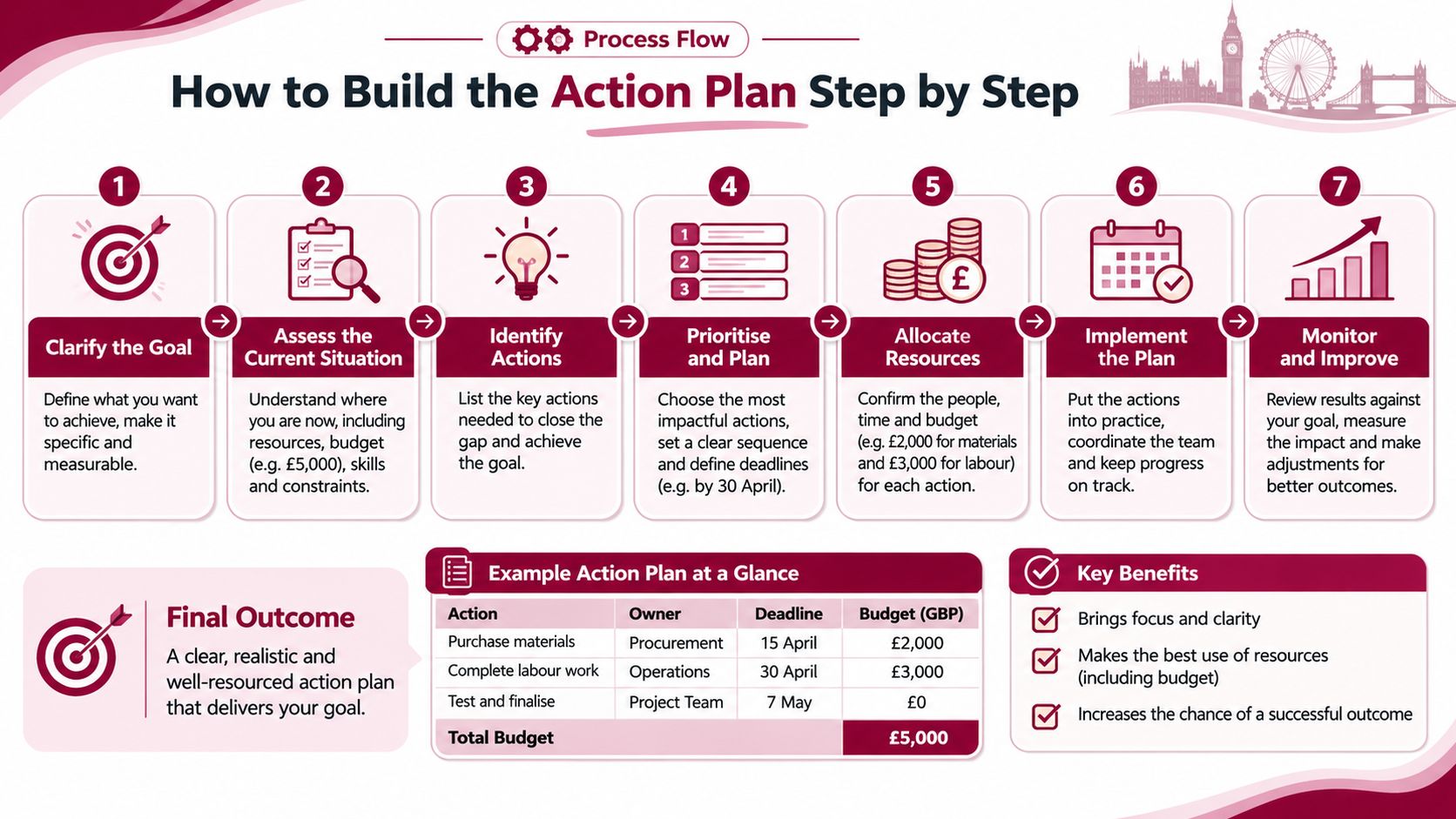
- List each initiative with its objective, owner and cost. One line per initiative. If it needs a paragraph to explain, it isn't defined yet.
- Rank by cash impact and reversibility. Low-cost, reversible tests go first because they buy information at the lowest price and can be stopped cheaply.
- Break each initiative into 30, 60 and 90-day milestones. Every milestone needs a measurable output, such as five customer interviews completed or a pilot margin confirmed at the target level.
- Cap the hours each owner can give. Write the number in the plan, then add the totals. If they exceed the free hours in the diagnostic, cut initiatives until they fit.
- Build a risk register. Link each assumption to an evidence source, a probability, an impact and a mitigation, so the quarterly review has something specific to test.
- Put the reviews in the diary before work starts. Monthly operational, quarterly strategic. A plan without dates is a wish with a table attached.
Capacity, not ambition, is the usual limit. The Longitudinal Small Business Survey 2025 found that only 36% of SME employers planned to increase managers' leadership capability, while 59% planned to increase workforce skills. The technical side of growth gets planned more carefully than the management side that has to deliver it.
One initiative, worked through
A firm that wants to use AI in customer service should treat it as a single initiative with a 90-day milestone, not a transformation programme. The AI adoption research reports that 49% of UK SME leaders not planning to use AI cite data privacy and security concerns, 30% don't see the value and 19% are deterred by ethical concerns. Those three objections map directly onto the risk register: a privacy design, a value test on one queue, and an oversight rule a manager can apply. The 90-day test asks whether the pilot reduced handling time without increasing complaints, and the answer decides whether it scales.
The common slip is loading the 90-day plan with five parallel projects when management time supports two. Rolling a new process across a team is a change-management problem as much as a strategy problem, and Change Management deals with how adoption happens rather than how the decision gets announced. A written change management plan sets out who communicates what, and when, so the rollout doesn't stall in week three.
A usable plan fits on one page: named owners, dated milestones, and a short list of what the team has agreed not to do this quarter.
Book a 90-Day Strategy Review This Quarter
Book the review within the next four weeks, date it, and invite the people who will argue with you. The review is the cheapest part of business strategy development and the part teams often skip.
Five items belong in it: a re-read of the baseline diagnostic, progress against each objective, the status of each scenario trigger, a reading of the quarterly scorecard and a decision on every initiative to continue, pause or stop. The scorecard tracks revenue, gross margin, customer acquisition, retention, revenue per employee and cash conversion, reviewed quarterly rather than weekly.
Attendees should be the owner of each objective, a finance lead, and one person from outside the leadership team whose job is to challenge assumptions rather than defend them. That third seat is what stops a review from becoming a report on effort.
Capability claims need evidence too. The Employer Skills Survey 2024 found that 63% of employees had received training in the previous 12 months, but only 43% of training employers provided training intended to lead to a nationally recognised qualification, while 48% of employers had provided on-the-job training. Participation isn't proof of capability; an auditable record is, which is why structured learning with assessment belongs in the plan beside the operational milestones.
Where the team lacks grounding in finance, scenario planning or market analysis, structured study fills the gap faster than another planning session. Strategic Management and Business Environment covers strategy formation and the external environment, as one option among several.
Then repeat the six stages each year, with a lighter reset each quarter: re-read the baseline, retest the triggers, and reset market assumptions before the budget cycle starts rather than after it.
London School of Business Administration teaches the disciplines this process depends on, from strategic management and the business environment to decision making and change management, through self-paced, CPD-accredited online courses that combine recorded lectures, structured materials and assessments. If you'd rather build the capability before the next planning round, browse the programmes and start when your calendar allows at London School of Business Administration.