

UK employers spent £53.0 billion on training and development, according to the 2024 Employer Skills Survey. Yet expenditure alone doesn't establish whether managers lead differently afterwards. A useful leadership development plan connects learning to observable changes in decisions, conversations and working conditions, then tests whether those changes benefit both organisational performance and team wellbeing.
Table of Contents
- Why a Structured Leadership Development Plan Matters
- What a Leadership Development Plan Contains
- Assessing Competency Gaps and Setting Priorities
- How to Build Your Plan and Choose Activities
- Measuring Impact and Building CPD Evidence
- Why Plans Fail and What to Do This Week
Why a Structured Leadership Development Plan Matters
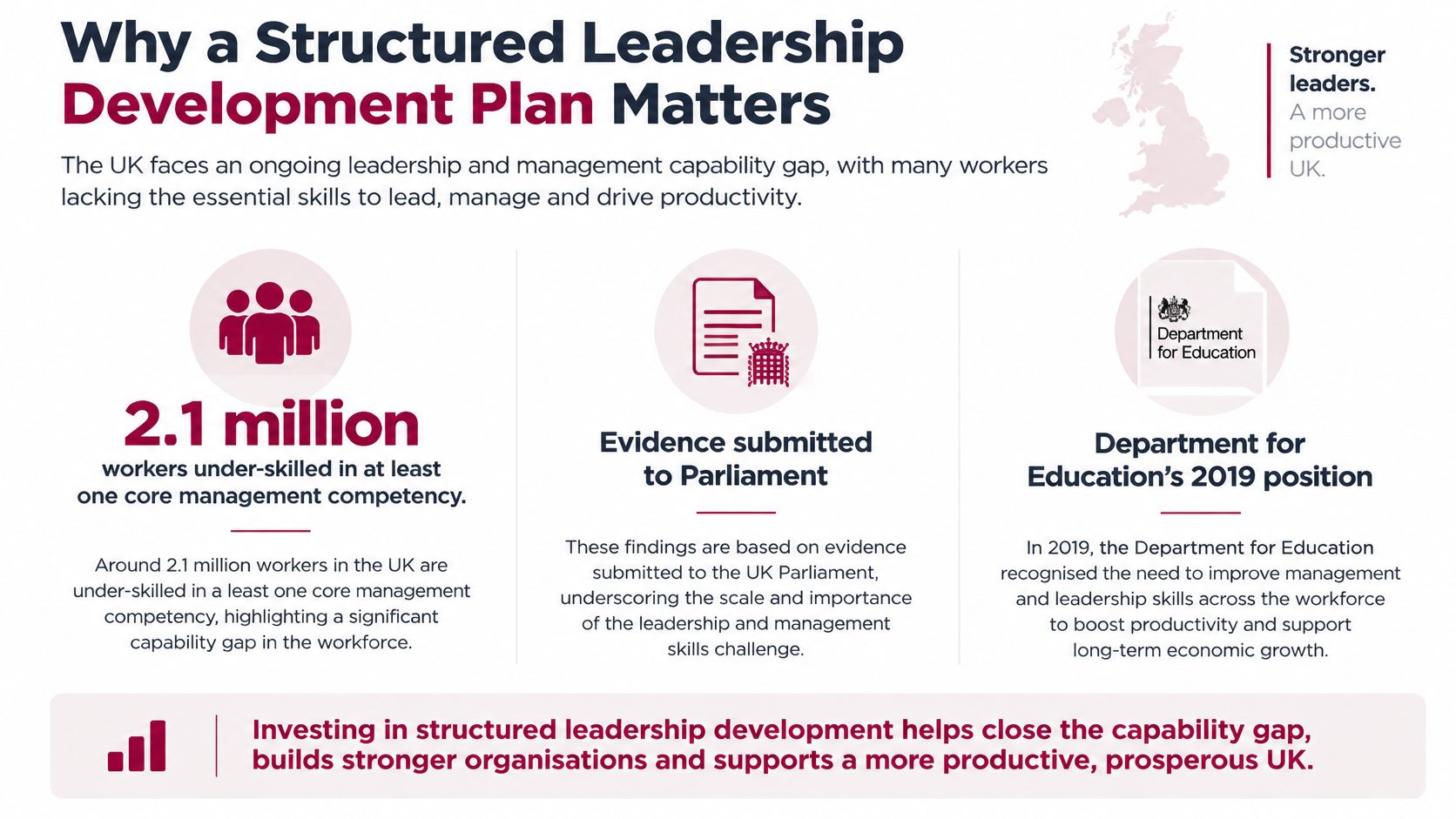
Approximately 2.1 million UK workers were likely to be under-skilled in at least one core management competency, according to evidence submitted to the UK Parliament, which also cites the Department for Education's 2019 Employer Skills Survey finding that 57% of employers identified management and leadership skills as a workforce skills gap. The same parliamentary evidence reports that 98% of managers and 95% of directors surveyed by the Chartered Management Institute and Institute of Directors considered improving these skills critical to organisational performance in the following financial year.
These findings place management development firmly within workforce capability, rather than treating it as an optional employee benefit. Organisations need managers who can explain priorities, make defensible decisions and support people through uncertainty.
A working commitment rather than a course list
A leadership development plan is a short written commitment recording development objectives, competency gaps, learning activities, milestones and workplace evidence. Its purpose is to make improvement deliberate and assessable.
Without that commitment, a manager might attend a workshop but never practise its techniques, obtain feedback or examine the consequences. Under workload pressure, development becomes incidental: the urgent task gets attention, while the difficult conversation remains postponed.
Practical rule: Judge the plan by what colleagues can observe changing, not by the amount of learning the manager completes.
The document should serve the person's responsibilities. An early-career supervisor might concentrate on delegation; a mid-level leader on cross-functional influence; a business owner on distributing decisions without losing oversight.
Shared ownership and a manageable scope
The learner owns the actions, while a line manager or mentor helps test priorities and secure opportunities to practise. That relationship matters because a manager can't demonstrate a capability they have no authority or opportunity to use.
Keep the structure simple:
- Record the commitment: Use a concise template rather than an extensive personal manifesto.
- Diagnose before prescribing: Identify capability gaps before selecting activities.
- Make progress reviewable: Agree what evidence will justify continuing, adapting or closing an objective.
The practical sequence is a one-page commitment, a capability diagnosis, targeted activities and an evidence cycle. Continuing professional development, or CPD, then records demonstrated progression rather than attendance alone.
What a Leadership Development Plan Contains
One-page leadership development plan template
| Plan element | What to record | Worked example |
|---|---|---|
| Development objective | The capability to build, linked to a role priority and organisational goal | Lead the CRM migration while maintaining service levels |
| Current versus required level | Baseline and target rating for the priority competency | Influencing senior stakeholders: 2 of 5 now, 4 of 5 by month six |
| Priority competency gaps | Two or three gaps carried forward from the capability matrix | Delegation, constructive feedback, stakeholder influencing |
| Learning activities | A blend of on-the-job work, coaching and structured courses | Lead the pilot squad, fortnightly coaching, Strategic Leadership course |
| Timeline and milestones | Dated checkpoints with a deliverable at each | 30 days plan agreed, 60 days first feedback round, 90 days migration review |
| Evidence and KPIs | Measures showing learning has transferred into work | One-to-one completion rate, pulse survey score, on-schedule delivery |
| Review and refresh | When the plan is revisited and updated | Quarterly review with line manager, full refresh at six months |
Making the example assessable
Consider a newly promoted operations manager responsible for migrating a customer relationship management system, or CRM. The table illustrates a hypothetical plan, not a prescribed timetable or guaranteed improvement.
The development objective combines leadership capability with a business responsibility. Completing a migration is a project outcome; securing agreement, delegating responsibilities and responding constructively to concerns are the leadership behaviours needed to achieve it.
For the current versus required level, define the rating scale before using it. In this example, the lower influencing rating might mean the manager needs help presenting recommendations, while the target means they can explain trade-offs and respond independently to challenge.
The priority gaps should remain limited. Delegation, feedback and influencing are plausible choices for this scenario, but they should emerge from diagnosis rather than from a standard list assigned to every new manager.
Connecting activities, milestones and evidence
The learning activities combine explanation, practice and support. A course can introduce a framework, coaching can examine a difficult interaction, and the pilot squad gives the manager responsibility for applying both.
Milestones identify deliverables rather than merely recording elapsed time. The migration review should therefore examine decisions, stakeholder responses and service continuity, not just confirm that meetings occurred.
Evidence and key performance indicators, or KPIs, need interpretation. A completed one-to-one is an activity measure; employee feedback helps establish whether the conversation clarified expectations or resolved a concern.
Finally, the review clause allows the manager and sponsor to change the approach when responsibilities, risks or evidence change.
Keep the plan to one page, with no more than two or three objectives. Store supporting evidence separately, and add it as work happens rather than reconstructing it before a review.
Assessing Competency Gaps and Setting Priorities
Leadership capability matrix for gap assessment
| Competency | Typical gap indicator | Diagnostic method | Example target behaviour |
|---|---|---|---|
| Communication | Unclear briefs, avoidable rework and escalations | 360-degree feedback, team pulse survey | Fortnightly structured one-to-ones with an agreed agenda |
| Motivating staff | Low engagement, deadlines missed without escalation | Engagement survey, observation of team meetings | Weekly recognition linked to team goals |
| Influencing others | Proposals rejected or ignored in senior forums | Stakeholder feedback, meeting observation | One persuasive proposal presented to leadership each quarter |
| Objective setting and resource planning | Conflicting priorities, overloaded team members | Project retrospectives, workload data | Quarterly team plan with owned and dated objectives |
| Decision-making | Slow or inconsistent calls, repeated escalation | Decision log review | Stated framework and recorded rationale for significant decisions |
| Leading change | Resistance and confusion during transitions | Change readiness check, absence trends | Stakeholder map and communication plan for every change |
| Leading AI adoption | At the survey date, only one in three employers used AI; among those using or planning to use it, 56% rated organisational knowledge as beginner or novice, according to the UK government employer survey | Use-case review and output check with the team | One approved use case with human sign-off and a staff-concerns note |
Interpret gaps in their workplace context
The UK Employer Skills Survey 2017 identified shortages in managing or motivating staff (35%), persuading and influencing others (33%), and setting objectives or planning resources (25%) in its analysis of skill-shortage vacancies, with management and leadership shortages especially prevalent in hotels and restaurants (62%) and financial services (61%).
These historical findings identify concrete capabilities worth examining, not a current diagnosis of any individual manager. Sector context should shape the questions: a hospitality supervisor might need to clarify shift priorities, while a financial-services manager might need to explain a complex recommendation to stakeholders.
Use the matrix alongside a broader understanding of leadership skills for managers, but assess actual work rather than familiarity with leadership terminology.
Combine perspectives before choosing priorities
Begin with a structured self-assessment. For each competency, record a recent situation, the action taken and the result, including an example that didn't go well.
Next, gather 360-degree feedback from the manager, peers and team members. Ask behaviour-focused questions, such as whether instructions make ownership clear, rather than inviting general judgements about personality.
Then examine operational signals: survey responses, absence patterns, escalation rates and project retrospectives. These are prompts for investigation, not proof that the manager caused the problem.
A manager may believe they delegate effectively because they distribute tasks. Team members may report that they still need approval for every decision, while project records show work waiting for sign-off. Together, those observations reveal a more precise development need.
- Replace vague ambition: Improve communication becomes conduct fortnightly structured one-to-ones using an agreed agenda.
- Specify the evidence: Track completion, employee feedback and avoidable escalations.
- Select the consequential gaps: Carry only two or three priorities into the plan, favouring those that affect colleagues most directly.
Where technology change is part of the role, include responsible AI leadership. Select a suitable use case, check outputs before acting, retain human decisions on people issues and discuss employee anxiety openly. A generic digital-transformation objective doesn't establish whether the manager can make these judgements.
How to Build Your Plan and Choose Activities
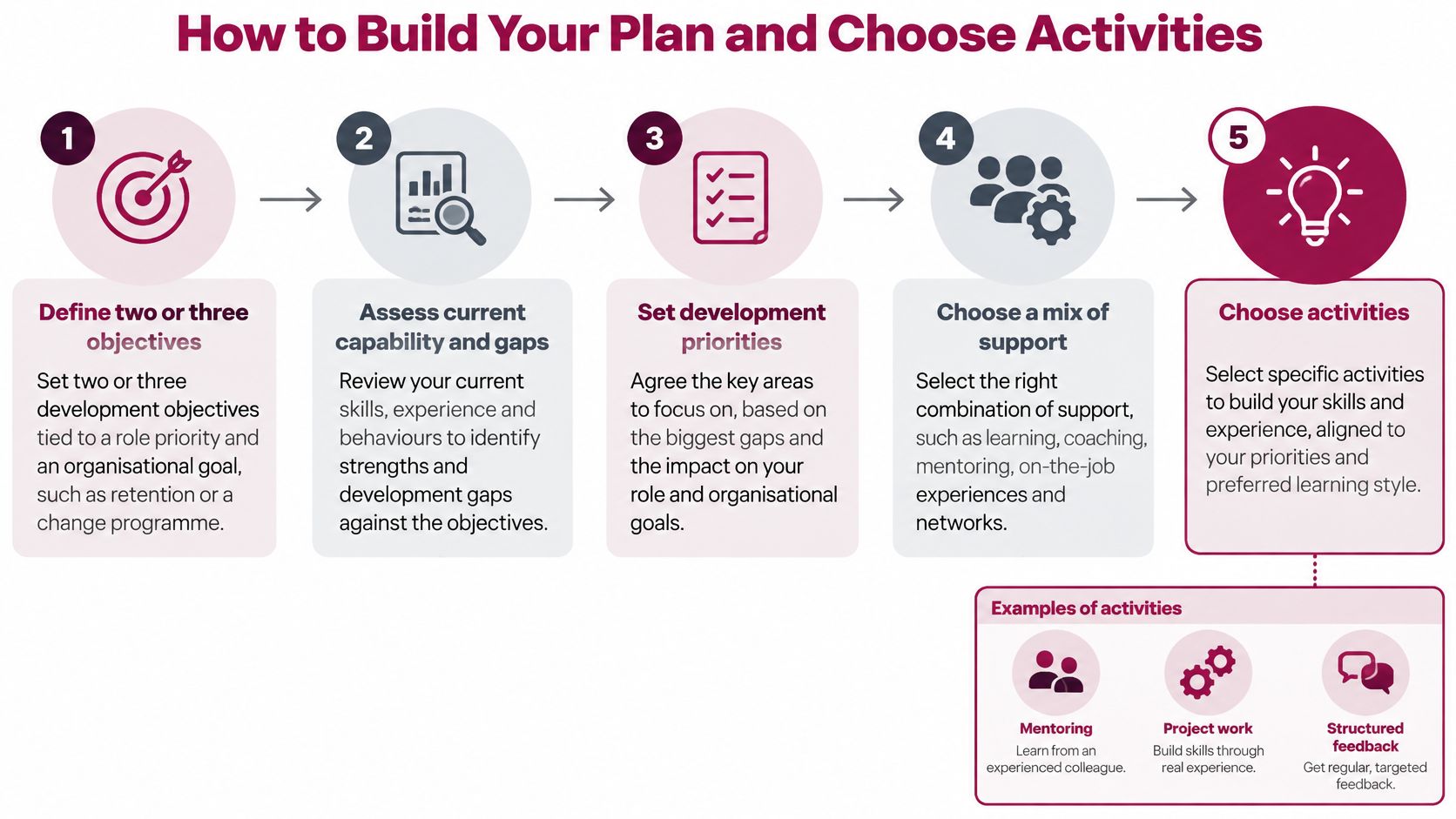
A development plan needs a procedure that connects organisational priorities with everyday practice. The following sequence keeps activity selection subordinate to the capability the manager needs to demonstrate.
Build the commitment before selecting training
Define objectives tied to the role. Choose two or three development objectives connected to an organisational priority, such as retaining colleagues or delivering a change programme. Distinguish the desired business result from the manager's contribution: a retention objective might require better career conversations, clearer expectations or earlier action on workload concerns.
Assess current capability. Assemble self-assessment, manager observation, colleague feedback and business-performance evidence. Check whether the apparent gap concerns knowledge, behaviour, authority or resources, because training isn't the appropriate response to every problem.
Prioritise the gaps with the greatest team effect. Consider both consequence and opportunity to practise. A manager who repeatedly reverses delegated decisions may need to address decision rights before attempting a broader strategic-thinking objective.
Write observable outcomes and establish a baseline. Describe what someone could see or hear the manager doing differently. For structured one-to-ones, examine existing coverage, agenda quality and whether agreed actions receive follow-up, rather than starting with an unsupported improvement target.
The distinction between capability and conditions is important. If a manager understands how to give feedback but avoids disagreement, coached practice may help; if they can't access performance information, the sponsor must address that obstacle.
Choose activities for the gap they can address
- Blend structured learning, supported practice and real responsibility. In the CIPD leadership-development evidence review, formal training represented 41% of interventions and job assignments 32%; the review also found that 70% of studies measured learning, compared with 30% measuring organisational performance and 19% using financial performance. These are characteristics of the reviewed evidence, not recommended allocations of a manager's development time.
Select activities by their function. Courses address knowledge gaps, coached practice helps change interaction patterns, and real assignments test judgement under constraints.
For example, a delegation objective could combine leading a project with explicit decision rights, fortnightly coaching and a short team-management course. The manager would practise agreeing outcomes, defining boundaries and resisting unnecessary intervention.
Matching learning activities to development needs
The time commitments below are illustrative planning allowances, not claims about standard course lengths or universal requirements.
| Activity type | Best for developing | Time commitment | Evidence produced |
|---|---|---|---|
| On-the-job project or stretch assignment | Decision-making, change leadership, delegation | Ongoing within normal work | Delivered project, decision memo, retrospective notes |
| Coaching or mentoring | Self-awareness, influencing, stakeholder management | One to two hours per month | Coaching goals, action notes, manager observations |
| Structured online course | Frameworks, knowledge and assessed practice | 20 to 160 hours, self-paced | CPD certificate where provided, assessed coursework, applied assignment |
| Peer or action learning set | Communication, feedback, perspective taking | One to two hours per month | Session notes and agreed commitments |
| Shadowing or secondment | Strategic thinking, cross-functional awareness | One to five days | Observation log and reflection summary |
For coaching, bring a specific incident rather than a broad request to become more confident. Reconstruct what happened, explore alternative responses and agree a behaviour to try in the next comparable situation.
A coaching leadership style can also become an applied objective: asking questions that help a colleague develop a solution instead of immediately supplying the answer. However, the manager should still give direct instruction when safety, urgency or unfamiliarity requires it.
Activity selection test: If an activity can't produce evidence relevant to the objective, remove it or redesign the assignment.
Establish the evidence cycle and adapt
Set checkpoints and secure sponsorship. Use a 30-60-90 evidence cycle: by day 30, confirm the baseline and agree the working plan; at day 60, examine the first feedback round; at day 90, review workplace evidence and decide what should change. Schedule a quarterly review, protect practice time in the diary and name the line manager responsible for supporting access to assignments and feedback.
Revise using outcomes, not enthusiasm alone. Continue an activity when evidence supports its usefulness, adapt it when the behaviour remains inconsistent, and replace it when it doesn't address the diagnosed gap. Record the reason so the next review can examine whether the adjustment helped.
Suppose the operations manager completes an influencing module but stakeholders still leave meetings unclear about the decision required. Adding another module may be less useful than rehearsing a decision paper and asking an observer to assess the recommendation, alternatives and requested action.
Alternatively, stakeholders may understand the proposal but reject it because the migration would disrupt a critical service period. The development need then concerns consultation and planning, not presentation confidence.
Agree access to evidence before the assignment begins. The sponsor might observe a meeting, review a decision memo or seek feedback from colleagues who experienced the manager's approach directly.
Assessments should require applied outputs, such as a change plan, conflict-resolution scenario or decision memo. Follow those outputs with workplace observation so that a well-written assignment isn't mistaken for consistently effective management.
Measuring Impact and Building CPD Evidence
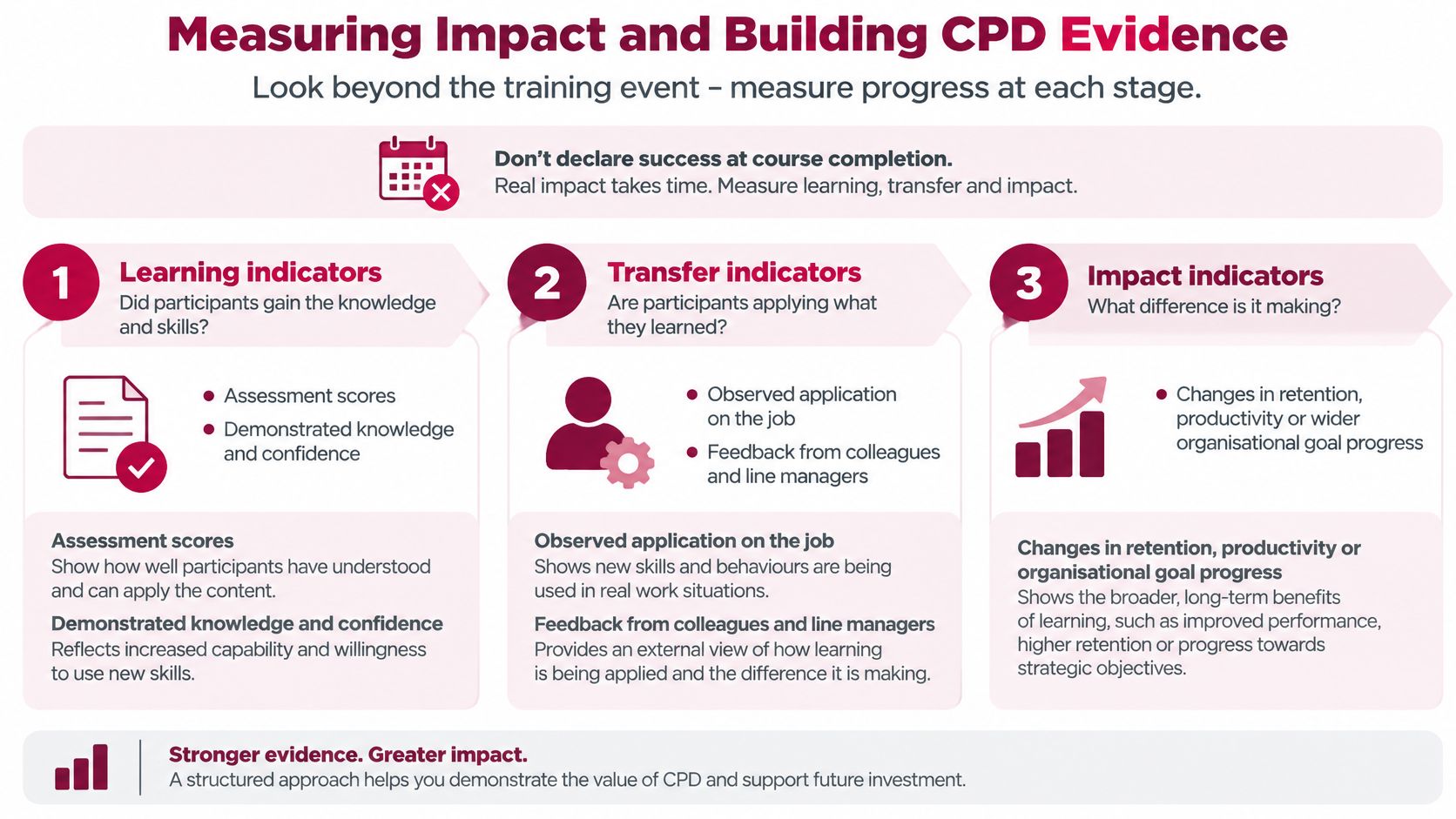
Learning, transfer and business impact answer different questions. Learning asks what the manager understands; transfer asks what they do differently; business impact asks whether relevant organisational outcomes improve.
Distinguish understanding from application
Learning indicators include assessment scores, demonstrated knowledge and confidence. Treat confidence cautiously: a manager's self-belief can increase before colleagues experience more effective leadership.
Transfer indicators include observed delegation quality, useful feedback, decision records and delivered project responsibilities. Examine the quality of behaviour, not merely its frequency; a regular meeting can still leave priorities unresolved.
Business indicators include retention, productivity, engagement, sickness absence and escalations. Compare these with the starting position at quarterly reporting points, while recording other changes that could influence results, such as staffing levels or altered demand.
Don't attribute every favourable movement to the plan. A stronger judgement combines outcome trends with credible evidence that the manager changed relevant behaviours.
Build a verifiable CPD portfolio
Collect evidence while learning and practice are underway:
- Participation records: Retain CPD certificates and completion records.
- Assessed work: Store coursework and feedback showing what the learner understood.
- Applied outputs: Include a change plan, decision memo or conflict-resolution scenario.
- Reflection and review: Record what changed, what remains difficult and the line manager's assessment.
When choosing leadership training courses, consider how the learning will contribute to that portfolio. A certificate documents completion, while workplace evidence supports a claim of capability.
Include healthier working conditions
Around one-quarter of workers believed their job negatively affected their health in the CIPD Good Work Index 2025, which also identified a strong relationship between line-management quality and whether employees experienced work as beneficial or harmful to wellbeing.
Include workload conversations, employee voice, pulse-survey wellbeing and perceptions of manager support alongside output measures. Check whether colleagues can raise concerns safely and whether the manager follows up with practical action.
Higher output isn't sufficient evidence of better leadership if colleagues achieve it through sustained overload or feel less able to challenge unrealistic expectations.
Handle wellbeing information sensitively. Record agreed managerial actions without turning the development portfolio into a repository of identifiable health disclosures.
Why Plans Fail and What to Do This Week
Finished documents can fail for different reasons: the learning may be poorly targeted, or managers may lack the conditions to apply it. More content won't resolve either problem unless the organisation identifies which constraint is operating.
UK findings summarised in the Employer Skills Survey 2024 report include 69% of surveyed employers and HR decision-makers considering leadership learning inadequate, 84% reporting development barriers, and only about a quarter refreshing leaders' skills at least annually; earlier evidence cited there found 38% of leaders and HR professionals rated their organisations' programmes highly effective.
Address relevance and capacity separately
Generic content, absent reinforcement and undefined success criteria are practical risks to check. They shouldn't be treated as proven explanations for every survey response.
Time requires a separate conversation. In CIPD analysis of the 2023 UK Working Lives survey, 52% of private-sector and 53% of public-sector line managers reported adequate information and training, but only 40% and 33%, respectively, reported enough time to manage staff; just 29% and 23%, respectively, reported adequate training, sufficient time and a satisfactory workload together.
A credible plan therefore names what work will stop, move or be delegated. It also identifies who protects practice time and who resolves a resource barrier when the learner can't.
Start with four actions this week
- Book a diagnostic conversation with your line manager. Bring a recent leadership challenge and agree the organisational outcome that matters.
- Score the capability matrix. Support ratings with examples and identify where colleague feedback could challenge your interpretation.
- Draft the one-page plan with protected practice slots. Name the assignment, sponsor, evidence owner and work that will be reduced or reassigned.
- Diarise the day-30 check and quarterly refresh. Send the invitations now, with an agenda requiring evidence, obstacles and decisions about the next actions.
London School of Business Administration offers The Credential of Leadership and Management, comprising eight CPD-accredited courses covering Leadership Fundamentals, Strategic Leadership, Decision Making, Emotional Intelligence, Conflict Resolution, Change Management, Communication Skills and Team Leadership. Delivered entirely online and self-paced over 160 hours, the programme includes recorded video lectures, structured learning materials and interactive assessments that you can incorporate into a workplace-focused development plan. Visit London School of Business Administration to explore the programme and identify learning that supports your priority leadership behaviours.