
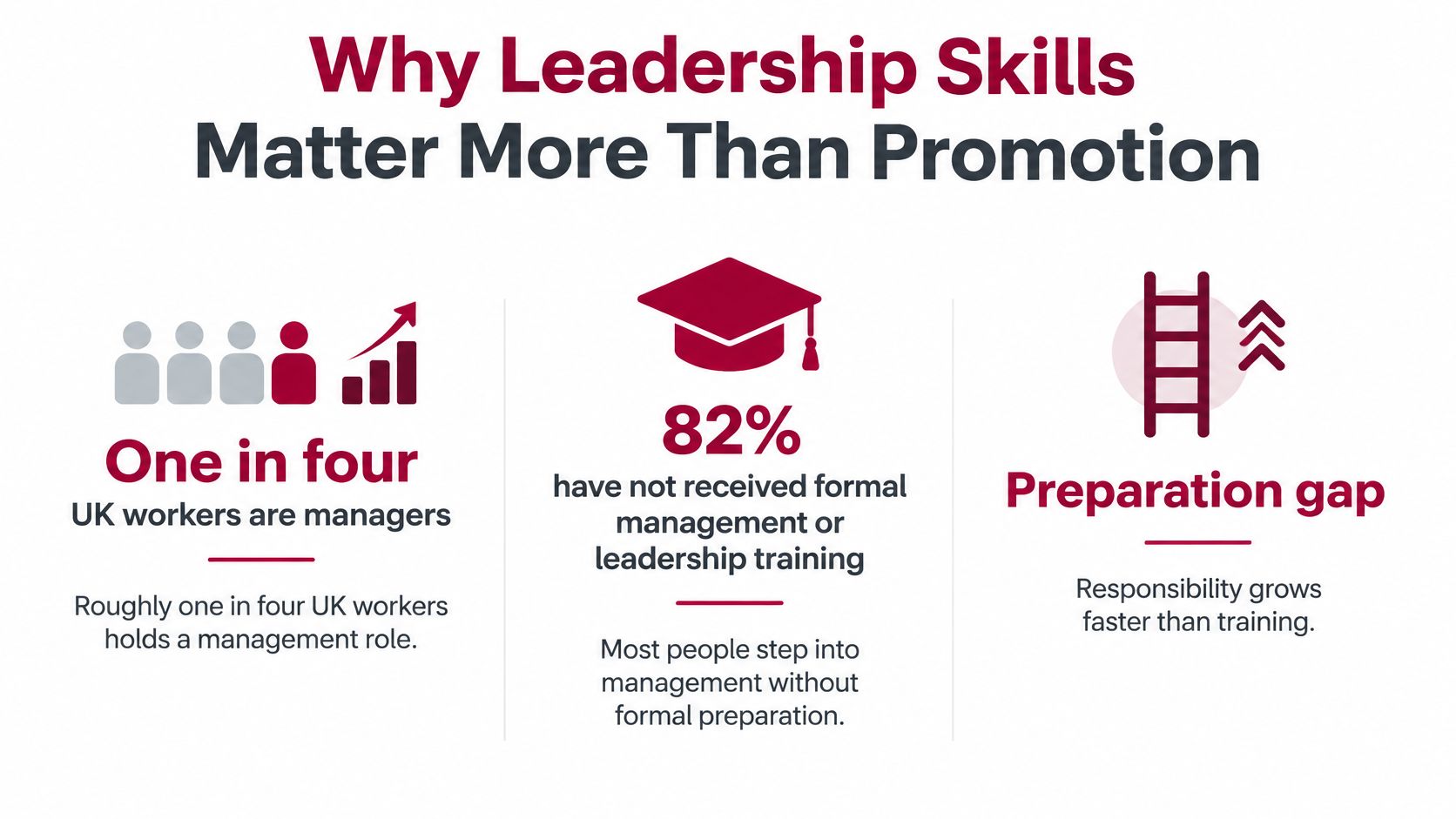
82% of people entering management roles in the UK have not received formal management or leadership training, according to the Chartered Management Institute (CMI). That figure changes the way we should think about management: responsibility often arrives before preparation, so leadership skills need to be learned and practised, not assumed to appear with a new job title.
A manager's influence is built in ordinary moments: setting a clear expectation, listening when someone raises a concern, making a decision others can understand, and following through on an agreement. These behaviours are learnable. They also give you practical ways to spot where your team needs support and where your own habits need attention.
Table of Contents
- Why Leadership Skills Matter More Than Promotion
- The Seven Leadership Skills and What They Look Like
- Emotional Intelligence and Communication on a Working Day
- Decision-Making and Strategic Thinking Under Pressure
- How to Resolve Conflict Early and Fairly
- Leading Change and Building Teams That Hold Together
- Scoring Your Own Leadership Skills
- Confirm Your Development Path Before You Enrol
Why Leadership Skills Matter More Than Promotion
Approximately one in four working people in the UK are managers, yet 82% of people entering management roles have not received formal management or leadership training. CMI describes employees promoted because of technical performance or seniority, without structured preparation for managing people, as “accidental managers”. It also reports that 52% of managers do not hold a management or leadership qualification.
Promotion can feel like being handed the keys to a car without driving lessons. You may know the vehicle, understand where it needs to go and be trusted to take the wheel. But steering under pressure, responding to hazards and getting other people safely to their destination are separate capabilities. Technical expertise can help you understand the work; it doesn't, on its own, teach you to delegate, give feedback, resolve a disagreement or develop a team.
The gap matters because management affects far more than senior leaders. The UK Department for Education's 2019 Employer Skills Survey found that 57% of employers reporting skills gaps cited management and leadership skills. The figures point to a practical need: treat leadership as a professional capability made up of observable behaviours that can be practised and improved.
This guide sets out seven core skills and what they look like in a working week. It also examines emotional intelligence and communication, decision-making, conflict, change and team building, before offering a way to score your current habits and choose a development route. You should finish with a shared definition of each skill, a self-score, a practice to begin this week and a clearer choice between informal practice and structured training.
The Seven Leadership Skills and What They Look Like
| Skill | What it looks like in practice | Early warning sign |
|---|---|---|
| Emotional intelligence | Reads team mood and adjusts how difficult news is raised | Team stops raising concerns in meetings |
| Communication | States expectations clearly and checks what was understood | The same questions recur about the same task |
| Decision-making | Weighs evidence, owners and deadlines before committing | Decisions are reversed within weeks |
| Strategic thinking | Links team priorities to business goals and resource trade-offs | The team is busy but working on the wrong priorities |
| Conflict resolution | Addresses disagreement early, privately and with specific examples | Disputes escalate to HR or go unaddressed |
| Change management | Explains the reason for change, involves people early and tracks adoption | Low uptake continues weeks after the announcement |
| Team building | Clarifies roles, shared standards and follow-through | Work is duplicated or nobody owns the outcome |
Read across each row. The middle column describes a behaviour you can observe in a normal week; the final column describes a possible symptom when that behaviour is missing. A warning sign isn't proof of a personal failing. It gives you a reason to ask what the team needs and which management habit might help.
How the skills fit together
These capabilities overlap. Clear communication won't repair a dispute that nobody addresses, because people may understand the words and still distrust the process. Similarly, a manager can make a sound decision but fail to build commitment if they don't explain the reasoning or clarify who owns the follow-through.
Technical specialists often bring strong subject knowledge and may be comfortable analysing options or planning work. Their development need can sit elsewhere: asking for input, coaching someone through a problem, or making roles clear enough that the team can work without constant intervention. That's why the people-facing skills deserve the same attention as operational expertise.
A useful starting point: Mark the two or three rows that best describe what is happening in your team now. Treat them as clues about where to practise, not as labels for yourself or your colleagues.
Those marked rows also give you concrete behaviours to assess later. For example, if the team repeatedly asks the same question, try stating the task, owner and deadline in writing, then ask the recipient to explain the request back in their own words.
Emotional Intelligence and Communication on a Working Day
A team lead notices that a capable analyst has become quiet. The analyst still completes urgent work, so the lead assumes everything is fine. When the analyst resigns, the lead learns that the workload had become unmanageable. A regular one-to-one could have surfaced the risk well before the resignation.
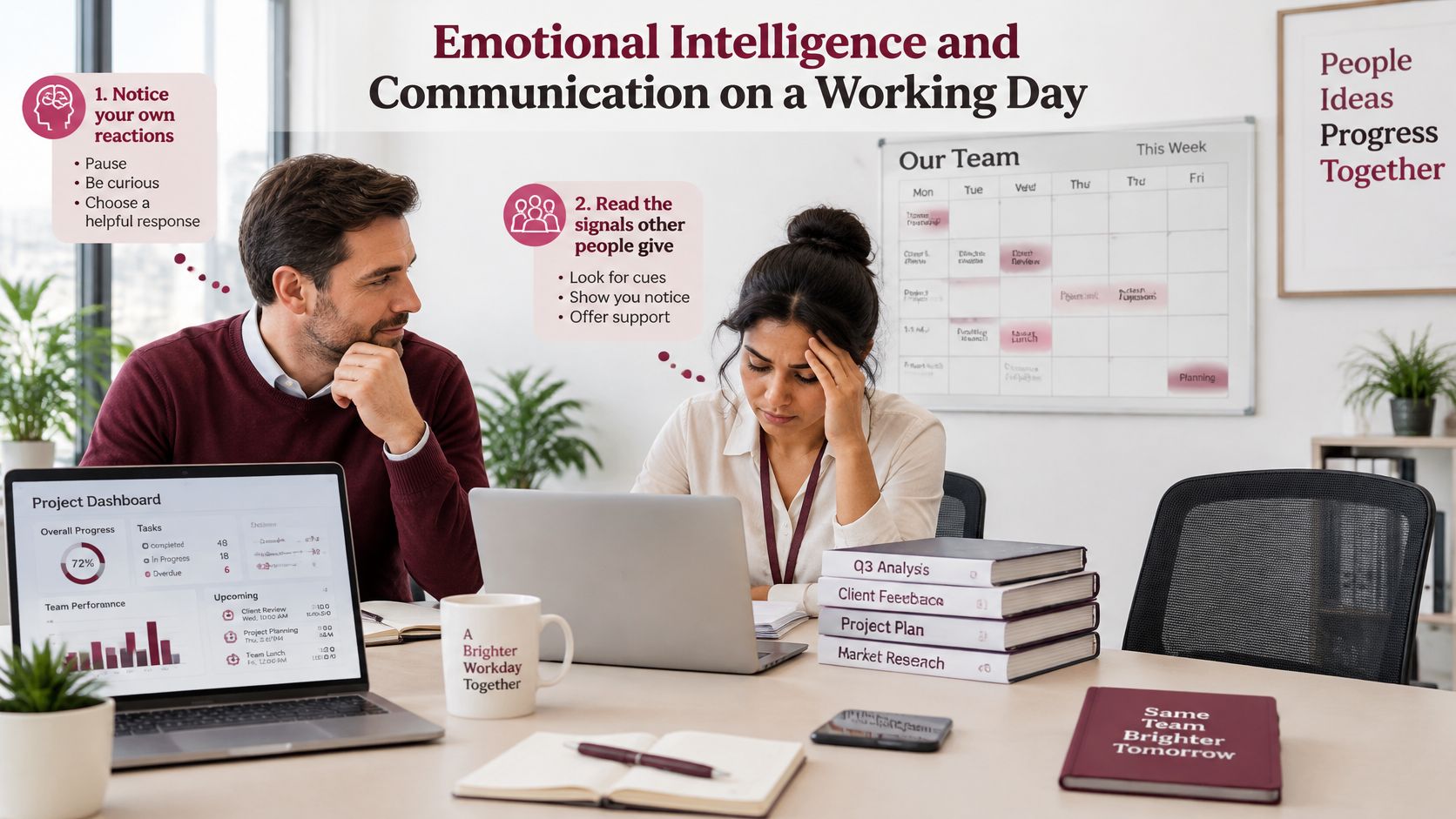
Emotional intelligence starts with noticing your own reactions and reading the signals other people give you. A manager who spots tension can slow down before responding sharply; one who notices repeated silence can ask a calm, open question rather than conclude that everyone agrees. The point isn't to guess what someone feels. It's to make it easier for them to tell you.
CIPD analysis found that 50% of workers whose managers ranked in the bottom quartile for management quality said work negatively affected their mental health, compared with 14% of workers whose managers ranked in the top quartile. Job satisfaction was 30% among workers with the lowest-rated managers and 88% among those with the highest-rated managers; willingness to volunteer for tasks beyond formal requirements was 38% and 74%, respectively, according to the CIPD analysis of management quality. Those differences underline why fair treatment, useful feedback and dependable conversations matter in day-to-day management.
A short routine that makes concerns easier to raise
Build a practical rhythm into the working week:
- Clarify expectations in writing. State the outcome, owner and deadline, especially where work crosses roles.
- Hold regular one-to-ones. Ask what is going well, what is getting in the way and what support would help.
- Give specific feedback within a week of an event. Describe what happened and its impact, then agree what to do next.
- Check workload risk monthly. Ask what should be stopped, delayed or reassigned if priorities exceed available time.
- Record development actions. Note the agreed action, who owns it and when you'll revisit it.
Good communication is two-way. After giving an instruction, ask the other person to restate it in their own words. If they understood something different, clarify the gap then, rather than discovering it when the deadline is missed. For practical guidance on everyday conversations, see communication skills for managers.
When someone is visibly distressed, pause before discussing performance. Separate the work issue from the wellbeing concern, listen without rushing to defend the decision, and agree a date to return to the performance conversation. Jenna Tiffany integrates real-world organisational scenarios into the Leadership and Management Programme design, combining structured frameworks with applied case-based learning. The Emotional Intelligence in Leadership course is another available option for learners who want to study this skill as a distinct topic.
Decision-Making and Strategic Thinking Under Pressure
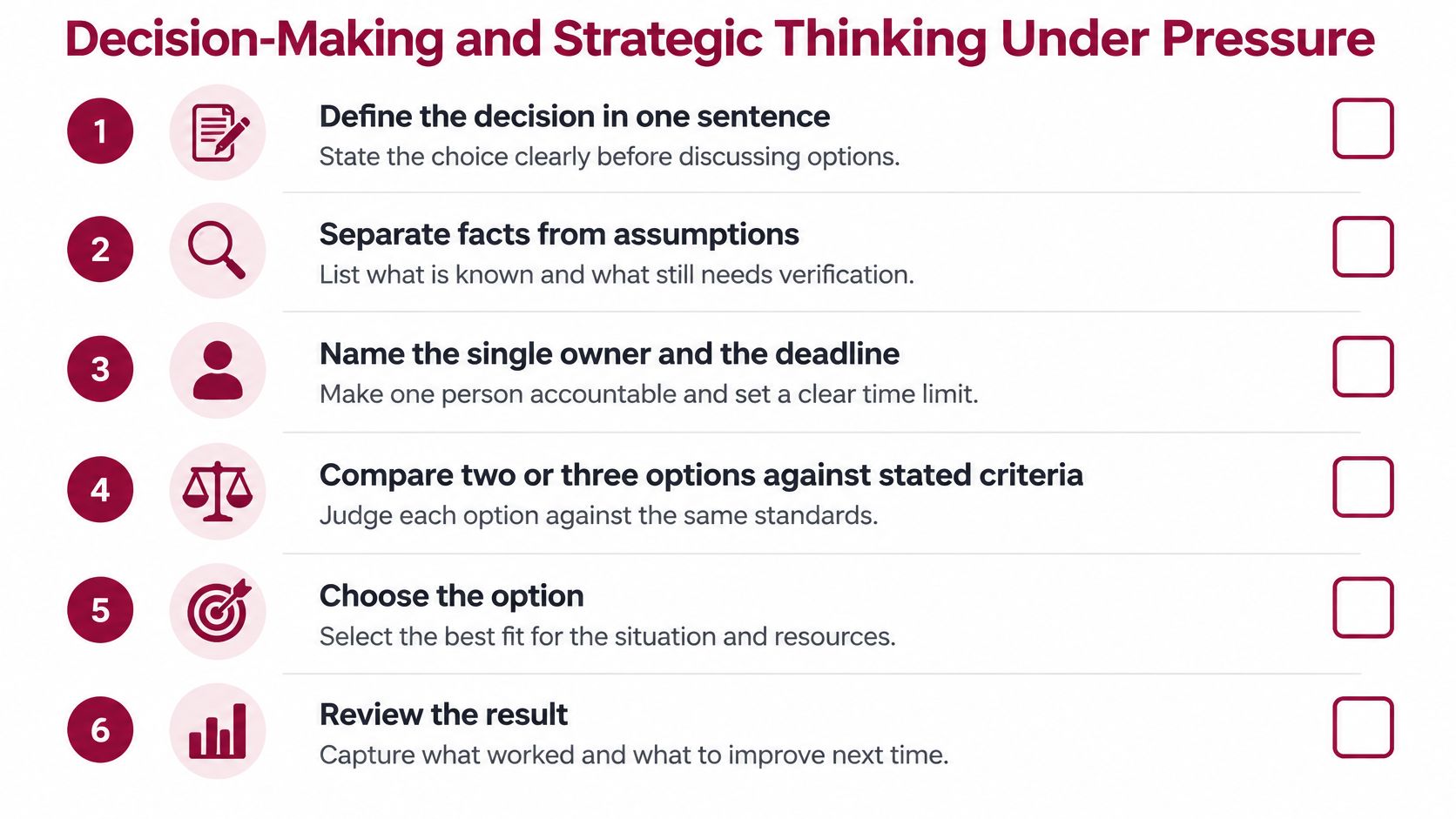
A decision becomes harder to manage when nobody can say exactly what is being decided, who owns it or when it must be resolved. Use this six-step method to make the choice visible and leave a record others can follow:
- Define the decision in one sentence.
- Separate facts from assumptions.
- Name a single owner and a deadline.
- Compare two or three options against stated criteria.
- Decide and record the reasoning.
- Review at a fixed date.
Say a team lead must choose between releasing a feature sooner and allowing more time for testing. Instead of arguing from instinct, the lead writes down what is known, what remains uncertain, the customer impact of an error and the likely cost of rework. The owner then compares the options against those criteria, records the decision and sets a date to review the outcome. That makes the trade-off discussable rather than hiding it inside a confident-sounding announcement.
Match the decision process to the risk
Four questions help determine how much deliberation a decision deserves:
- Reversibility: Can you undo the choice without lasting harm?
- Cost of delay: What is lost if you wait for more information?
- People affected: How many roles, customers or teams will feel the result?
- Evidence quality: Are you working with verified facts or assumptions?
A routine, reversible choice with good evidence may need a quick decision. A hard-to-reverse choice affecting many people deserves more careful discussion. If speed is essential, make a provisional decision, state when you'll review it and invite challenge before that date.
Strategic thinking means translating organisational aims into a few measurable outcomes for your team. A manager might turn a broad objective into clear measures for delivery, quality or customer response, then review the results regularly and explain how the team's choices affect wider priorities. The CIPD report on UK management capability says only just over one-tenth of people managers are likely to have a direct role in determining their employer's strategic direction. Most managers therefore need to connect team decisions upwards, rather than wait for strategy to arrive as a complete set of instructions. The strategic decision-making process offers further guidance on making choices explicit. Decision Making and Problem Solving is also available as a standalone course.
How to Resolve Conflict Early and Fairly
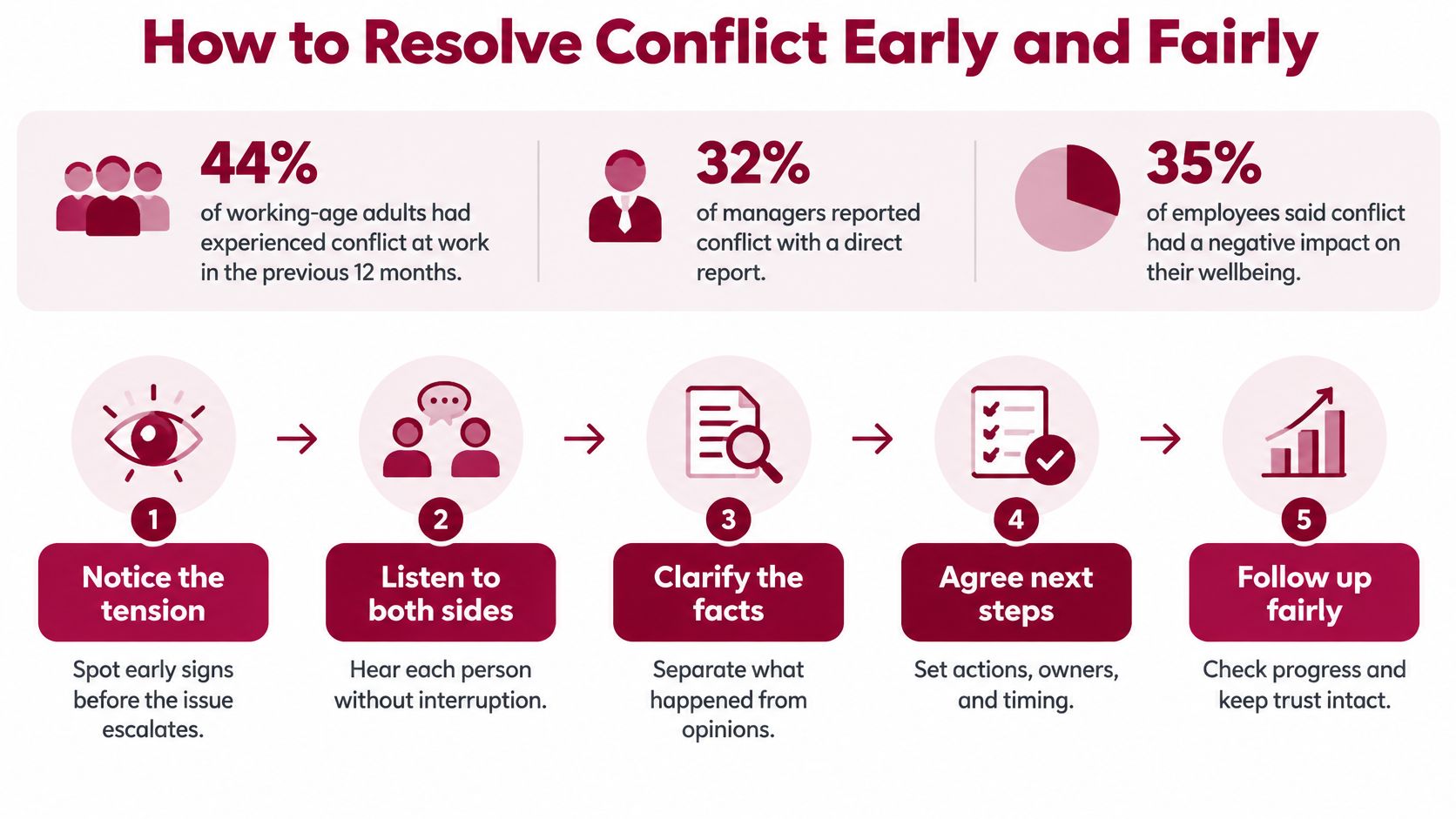
In Great Britain, 44% of working-age adults had experienced conflict at work during the previous 12 months, and 32% of managers reported conflict with a direct report, according to Acas research on workplace conflict. The gap between noticing conflict and acting on it matters: 35% of managers said they had done nothing about conflict with a direct report, compared with 19% of workers who took no action in conflicts generally.
Silence can feel safer in the moment, especially when a manager worries that a conversation will make things worse. But leaving people to interpret missed deadlines, terse messages or exclusion from meetings can turn a manageable disagreement into a larger problem. Use a proportionate process:
- Notice early signs. A changed tone, missed deadlines or withdrawal from meetings may signal that something needs attention.
- Arrange a private conversation promptly. Set a specific time rather than raising a sensitive issue in front of colleagues.
- Describe behaviour, not character. Give a concrete example and explain its impact without labelling the person.
- Listen fully. Ask for examples and separate what happened from what each person assumes it meant.
- Agree practical actions. Set out two or three next steps, with an owner for each and a date to review progress.
- Write a short summary. Share what was agreed so both people can check their understanding.
- Involve HR when needed. Seek support if a policy may have been breached or the review date passes without progress.
Keep the response fair and proportionate
A manager may also be part of the disagreement. If conflict involves your own line manager, seek advice from HR before raising it directly and keep a dated record of what happened. If the conversation is safe and appropriate, focus on specific actions and their effect on the work rather than attempting to prove what the other person intended.
Acas reported that 55% of managers spent a week or less managing their main conflict. That points to the value of early, focused conversations, not to a promise that every disagreement will be settled quickly. If the problem remains unresolved, use the organisation's established process instead of repeatedly trying the same informal approach. The guide to handling conflict at work can help you prepare for those conversations, and Conflict Resolution is available as a standalone course.
Leading Change and Building Teams That Hold Together
Only 12% of managers report feeling “very confident” leading AI-enabled teams, while just 18% strongly believe senior leaders fully understand AI's benefits. At the same time, 64% of senior leaders encourage AI experimentation, but only 13% of managers strongly agree that senior leaders actively experiment themselves, according to the CMI discussion of management skills in AI-enabled workplaces. That mismatch leaves managers responsible for implementation without always having a visible example to follow.
The answer isn't to become a technical specialist or to ask the team to adopt a tool without safeguards. Treat change as a people and work-design challenge:
- Explain the reason for the change in plain language.
- Involve affected people before the decision is final.
- State what changes for each role, including what stays the same.
- Treat resistance as information. Ask what risk or practical obstacle it reveals.
- Provide training before the deadline, so people can practise.
- Track adoption regularly and adjust support where people are getting stuck.
For an AI-enabled team, make three routines explicit: a short written agreement describing acceptable use, review checkpoints for AI-generated work, and escalation rules for decisions that need human judgement. A team introducing a drafting tool, for example, might agree that all outputs sent externally receive human review and that uncertain or sensitive material is escalated before use. The manager remains accountable for the team's decisions, even when a tool helps produce the first draft.

Make team trust visible in the work
Trust depends on predictable follow-through. Put roles and decision rights in writing, agree shared standards for quality and response times, and keep commitments made in meetings. When work is duplicated or nobody owns the outcome, clarify the owner before adding another meeting or reporting requirement.
Managers also need to be realistic about capacity. UK survey findings cited in a report on managers' wellbeing priorities identify heavy workloads (58%), time pressure (53%) and insufficient senior-leadership support (30%) as barriers to supporting teams. When there isn't time to do everything, prioritise three practices: a direct workload conversation, clear priorities and timely feedback. These small routines won't replace adequate staffing or senior support, but they help a team see what matters now and how to raise a problem. The Change Management course is designed for managers, team leaders, HR professionals, project managers and other professionals working with organisational change.
Scoring Your Own Leadership Skills
Turn each of the seven skills into a statement about something you did during the past month. Keep the statement specific: “I gave behaviour-specific feedback within a week of an event” is easier to assess than “I communicate well”. Rate each statement from 1, rarely, to 5, consistently, then add the seven ratings for a total out of 35.
| Total score (out of 35) | What it suggests | First development action |
|---|---|---|
| 28–35 | Strong across most skills | Keep the routines and test your scores against team feedback each quarter |
| 21–27 | Several habits are working, with room to strengthen consistency | Choose the lowest-rated skill and practise it deliberately |
| 14–20 | Gaps are likely to affect team outcomes | Start with the one-to-one routine and the conflict procedure |
| 7–13 | Foundational gaps across several skills | Seek mentoring and structured training before taking on new responsibilities |
A score is a starting signal, not a verdict on your ability. Look at the individual ratings as well as the total: one low score can point to a specific behaviour to practise, while several low scores may mean you need more structured support.
Choose one technique for each skill
Match practice to the behaviour you want to change:
- Emotional intelligence: Keep a short reflection log after difficult conversations. Note what you felt, what the other person signalled and what you might try next time.
- Communication: Ask a colleague to summarise your instructions. Notice where their understanding differs from yours.
- Decision-making: Keep a decision log with the options considered, the criteria used and the date you will review the result.
- Strategic thinking: Hold a monthly session that connects team measures to business goals and resource choices.
- Conflict resolution: Rehearse a difficult conversation with a peer before holding it.
- Change management: Pilot a change with one team before considering a wider rollout.
- Team building: Write a short team charter that sets out roles, shared standards and how you will follow through.
Self-ratings can be overly generous or too harsh. Ask three people who work with you to rate the same seven statements. If your score and the team's score differ by three points or more on any skill, treat that behaviour as a priority for a conversation and a practice plan, not as a reason to become defensive.
Confirm Your Development Path Before You Enrol
Choose your development route according to the gap you need to close. If your self-score shows one or two specific habits to improve, daily practice may be enough to make progress. If you're unsure which behaviour is causing difficulty, mentoring can help you make sense of what others experience. A structured programme is more suitable when your score is below 21 or you need recognised evidence of capability.
| Route | Best suited when | Commitment or evidence |
|---|---|---|
| Daily practice | Self-score shows one or two gaps | Self-review routine within the working week |
| Mentoring | Uncertain which behaviours need changing | Regular sessions with a senior manager; agree a review date together |
| Structured programme | Score below 21, or recognised evidence of capability is needed | Eight CPD-accredited courses, 160 hours, online and self-paced |
Mentoring works best when each session focuses on an example from your working week. Bring a specific situation, identify what you did, and agree one behaviour to test before the next conversation. Decide together when to review progress so that the support leads to an observable change.
The London School of Business Administration's Credential of Leadership and Management is an eight-course, CPD-accredited programme covering Leadership Fundamentals, Strategic Leadership, Decision Making, Emotional Intelligence, Conflict Resolution, Change Management, Communication Skills and Team Leadership. It is delivered entirely online and self-paced, with a duration of 160 hours, and includes recorded video lectures, structured learning materials and interactive assessments. Before enrolling in any programme, check its accreditation, the time commitment and whether the certificate can be verified.
Choose one route, name the skill you'll work on first, and set a review date 90 days from today. Put the first practice in your calendar now, then compare your own examples with feedback from the people you manage. That gives development a clear starting point and a practical way to judge whether your daily behaviour is changing.
London School of Business Administration offers self-paced, CPD-accredited courses and structured programmes covering leadership and management, including an eight-course Credential of Leadership and Management. Explore the options at London School of Business Administration and choose a learning route that matches the leadership skill you want to strengthen.