

The strategic decision making process is the structured sequence through which an organisation frames long-term objectives, gathers evidence, appraises options, commits resources and reviews outcomes. In the UK it is also measurable. The Office for National Statistics recorded an average management-practice score of 0.55 on a scale from 0 to 1 in 2023, which suggests that most firms use formal processes but apply them unevenly.
Table of Contents
- Why Strategic Decision Making Matters
- What Makes a Decision Strategic
- The Seven Stages of the Strategic Decision Making Process
- Comparing Strategic Decision Making Models
- Common Decision Making Biases and How to Counter Them
- Measuring Strategic Decisions with KPIs and Reviews
- Strategic Decision Making in Practice
- Developing Your Strategic Decision Making Skills
Why Strategic Decision Making Matters
Structured decisions aren't bureaucratic ritual. They're a performance lever. The Office for National Statistics examined target setting, key performance indicators, performance monitoring and problem response in its Management and Expectations Survey for 2016 to 2023, and found a statistically significant relationship between management quality and productivity, where a 1% increase in labour productivity was correlated with a 0.02-point increase in the management-practice score.
That relationship matters because it reframes a familiar debate. Managers often defend intuition on grounds of speed or experience, yet intuition without explicit objectives and review leaves no trail to audit. A documented process lets you test whether experience was right, where assumptions failed and what should change next time.
What Competence Looks Like in Practice
Competence here is not the ability to recite stages. It's the ability to frame a problem correctly, choose a decision model that fits the uncertainty you're facing, counter predictable biases and instrument the chosen course with indicators before results arrive. You'll also need to distinguish a well-made decision from a lucky outcome, since those two are often confused in boardroom folklore.
Consider a training provider weighing whether to enter a new professional market. Intuition might focus on visible demand. A structured process forces harder questions about accreditation, employer recognition, delivery cost and the evidence that would justify withdrawal. The difference is not paperwork. It's whether the commitment can be defended and revised.
Practical rule: If you cannot state in advance what evidence would make you reverse a decision, you have made a commitment, not a strategy.
UK organisations stand to gain because the gap between firms is wide, not because every firm lacks ambition. Formalising how choices are framed and reviewed creates a repeatable link between priorities and execution, a discipline explored further in strategic planning for managers and turning vision into action. By the end, you should be able to run that link deliberately rather than reconstruct it after the fact.
What Makes a Decision Strategic
Not every consequential decision is strategic, and not every strategic decision feels dramatic. The classification depends on time horizon, irreversibility, uncertainty and breadth of impact. If a choice commits significant resources for a long period, is costly to undo and constrains later options, it warrants the full process. If it can be reversed cheaply next week, routine judgement usually suffices.
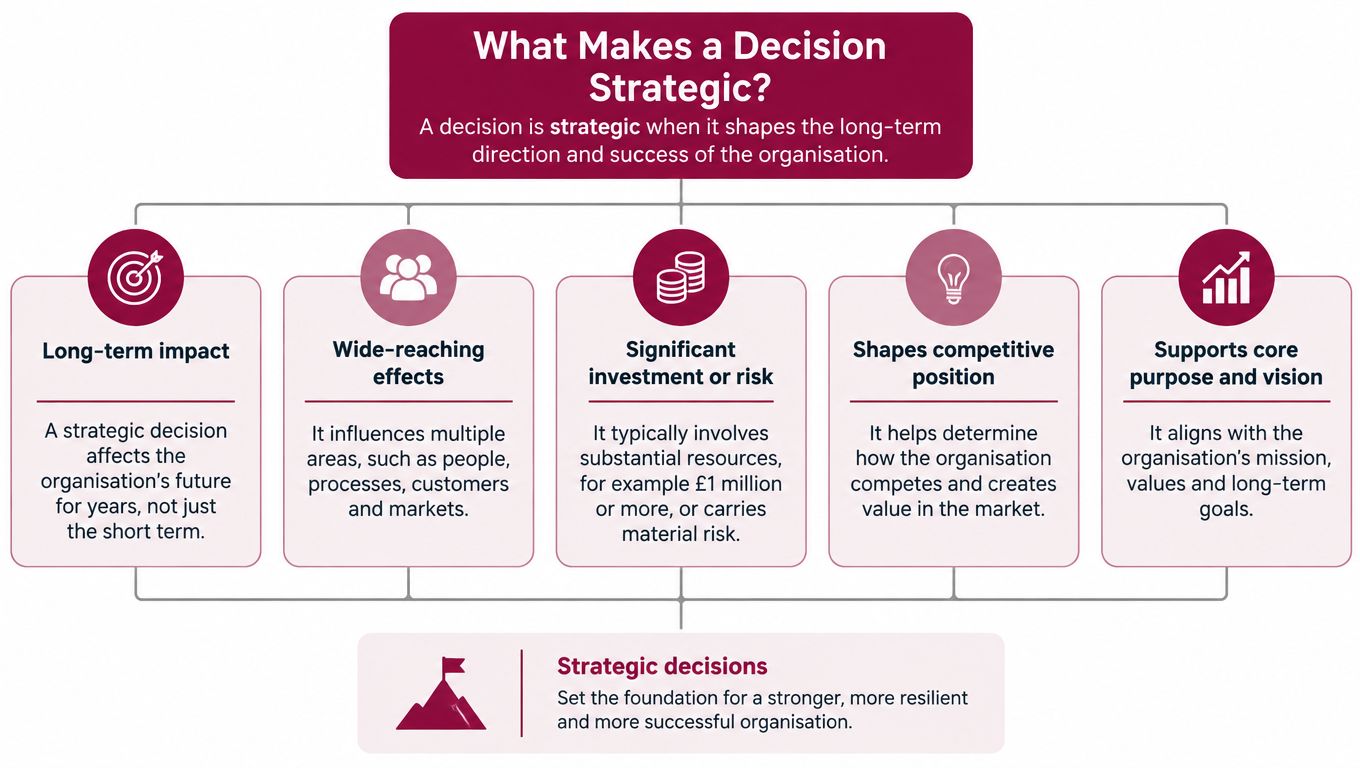
Take one organisation and three levels of choice. An education provider decides whether to launch a new credential in data analytics. That decision shapes curriculum investment, staffing, marketing positioning and reputation over several years, so it's strategic. Deciding how to sequence the modules within that credential is tactical, because it serves a direction already set. Scheduling this week's tutorial slots is operational, because it's frequent, local and easily revised.
Five Tests of a Strategic Decision
Apply these tests before you invest analytical effort. They save you from two opposite errors, treating a minor choice as a board matter and treating a defining commitment as routine.
- Long horizon: Effects persist well beyond the current planning cycle and outlast the people who made the choice.
- Material commitment: Money, senior time or reputation is committed in amounts that would hurt to write off.
- High uncertainty: Outcomes depend on competitor moves, regulation or demand shifts that you cannot forecast precisely.
- Cross-functional reach: Several departments must change behaviour for the decision to work at all.
- Stakeholder trade-offs: Gains for one group, such as learners, impose costs on another, such as teaching staff.
Strategic decisions are also governance events. Choosing a new market implicitly sets risk appetite, since you're declaring which uncertainties the organisation is willing to carry. It also sets the agenda for dozens of smaller decisions that will later appear independent but aren't, because each inherits the original framing.
That inheritance is why misclassification is expensive. A provider that treats credential launch as a marketing question will optimise enrolment copy while neglecting assessment capacity. Framed strategically, the same question forces early attention to tutor supply, verification processes and employer trust. You're not adding formality for its own sake. You're matching the depth of analysis to the cost of being wrong.
The Seven Stages of the Strategic Decision Making Process
A usable process has seven stages that loop rather than terminate. You'll frame the strategic problem, set measurable objectives, gather intelligence, generate options, appraise them, implement with named owners and review outcomes against your original assumptions. Review then feeds back into reframing, so the sequence behaves as a cycle of organisational learning rather than a corridor to a single announcement.
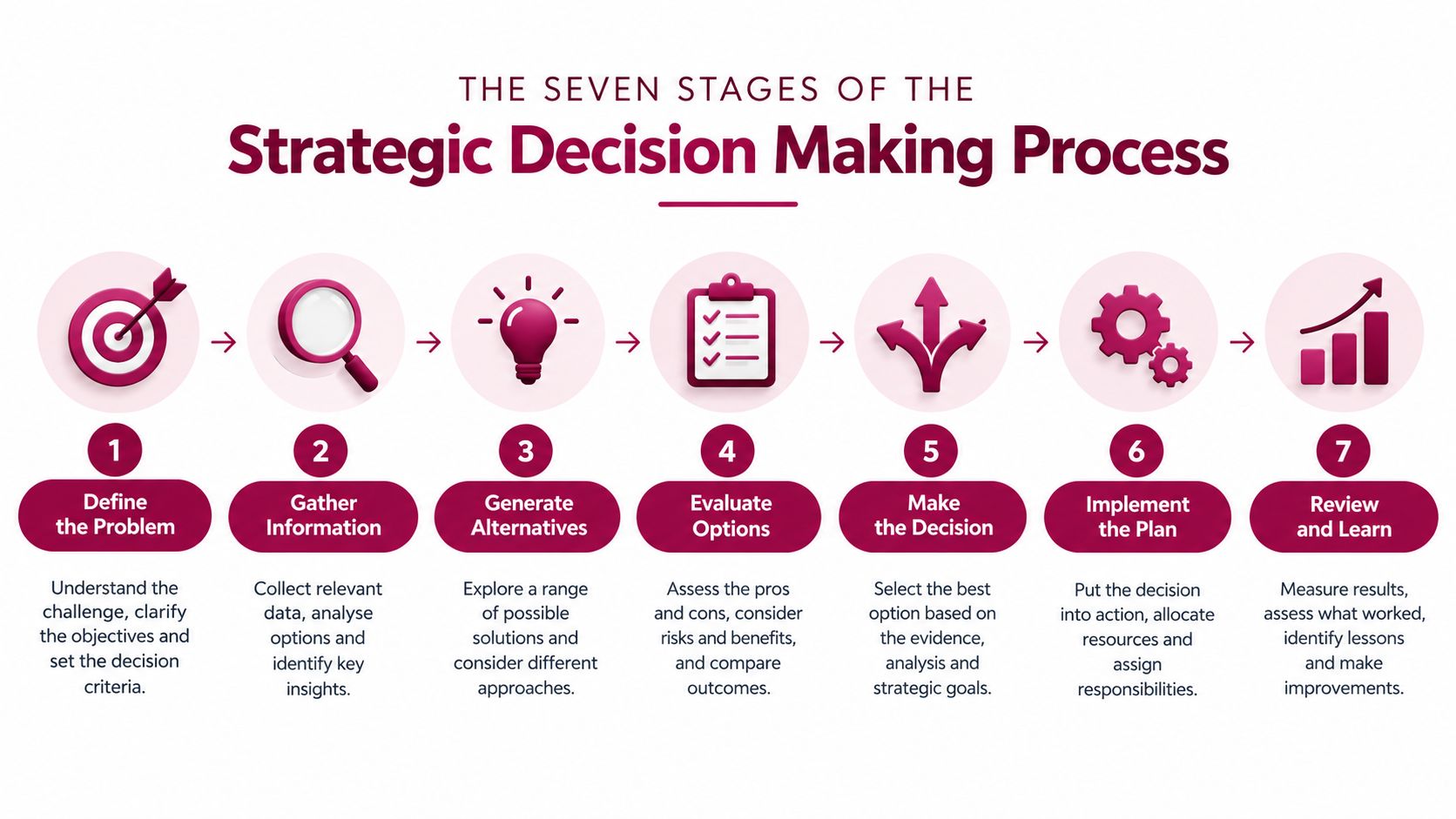
Framing comes first and does the most damage when done badly. State the problem in decision terms, such as whether to enter a market rather than how to enter it, because the second phrasing has already smuggled in an answer. Then set objectives and critical success factors before you discuss options, since criteria invented afterwards tend to be reverse engineered to favour a preferred choice.
Intelligence gathering should be proportionate and targeted. You're looking for evidence that could change the ranking of options, not an exhaustive library. That distinction is the core skill behind moving from data to decisions and building analytics capability, because undifferentiated data collection delays commitment without improving it.
From Longlist to Shortlist
Rigour concentrates at the appraisal stage. The UK Government's Green Book defines strategic appraisal as assessing the costs, benefits and risks of different options for achieving stated objectives, and its method is instructive for any organisation. Under the Green Book appraisal guidance, you generate a longlist of feasible options, assess it against your objectives and reduce it to a shortlist containing a preferred way forward.
Note what that requires. Rejected alternatives stay on record for scrutiny, and monetisable and non-monetisable costs and benefits both count, alongside distributional effects. The guidance is explicit that it is not a mechanical algorithm, so judgement remains yours. What the method removes is the comfortable fiction of comparing one favoured plan against a straw alternative.
Implementation and Review as Design Tasks
Implementation isn't a handover. Assign an accountable owner, milestones and decision thresholds at the moment of commitment, while enthusiasm is high and before vested interests form. For an education provider, quarterly reviews of enrolment conversion, learner completion, assessment performance and acquisition cost turn a launch into a monitored hypothesis.
Review closes the loop by comparing outcomes with the assumptions recorded earlier, not with revised explanations. If enrolment met target only because advertising costs fell unexpectedly, the decision was partially lucky and the model needs correction. Documented in this way, each stage can be audited by someone who wasn't in the room, which is precisely the point.
Comparing Strategic Decision Making Models
Models are frequently taught as rivals competing for your loyalty. They're better understood as answers to different conditions. Your task is diagnostic. Establish how much information is available, how contested the objectives are and how much time you have, then select the model whose assumptions resemble your situation.
The rational model assumes clear objectives, full information and systematic comparison of alternatives. It suits capital appraisal or location decisions where variables are quantifiable and stable. Bounded rationality accepts that managers satisfice under limited information, time and cognitive capacity, choosing an option that's good enough against explicit criteria. That's not a failure of rigour. It's rigour adjusted to reality.
Four Strategic Decision Making Models Compared
| Model | Core Assumption | Best Suited To | Main Limitation |
|---|---|---|---|
| Rational | Objectives are clear and information is complete | Quantifiable, stable choices such as capital appraisal | Collapses when information is partial or objectives conflict |
| Bounded rationality | Decision makers satisfice within cognitive and time limits | Pressured choices with adequate but incomplete evidence | Can settle too early on a merely acceptable option |
| Garbage can | Problems, solutions and people meet loosely in organised anarchies | Ambiguous settings with fluid participation | Outcomes may reflect timing rather than merit |
| Scenario planning | The future cannot be forecast as a single outcome | Deep uncertainty where probabilities are unreliable | Produces insight but no decision by itself |
The garbage can model describes organisations where solutions chase problems. A director arrives with an existing partnership proposal, a budget line becomes available and a decision happens because elements coincide. Naming this pattern matters because many firms live in it while believing they operate rationally. Recognition lets you impose minimal structure, such as requiring a stated problem before a solution is funded.
Scenario planning takes the opposite stance toward uncertainty by rehearsing several plausible futures. A UK Parliament review states that evidence should inform strategy formulation, development and evaluation throughout the process, and that scenario and futures methods are particularly useful for agenda setting, exploring uncertainty and engaging stakeholders, while cautioning that they do not automatically guarantee better decisions and that leadership judgement remains necessary.
Use scenarios when probabilities can't be estimated reliably, because a risk matrix would then manufacture false precision. Test how shifts in learner demand, advertising cost or regulatory expectations would alter your priorities, then look for options that perform acceptably across futures. Match the model to the condition, and record why you chose it.
Common Decision Making Biases and How to Counter Them
Bias is best taught as a process design problem, not a character flaw. Intelligent managers fall into the same traps because the traps are built into how information arrives and how groups discuss it. Locate each bias at the stage where it strikes and you can engineer a countermeasure into that stage.
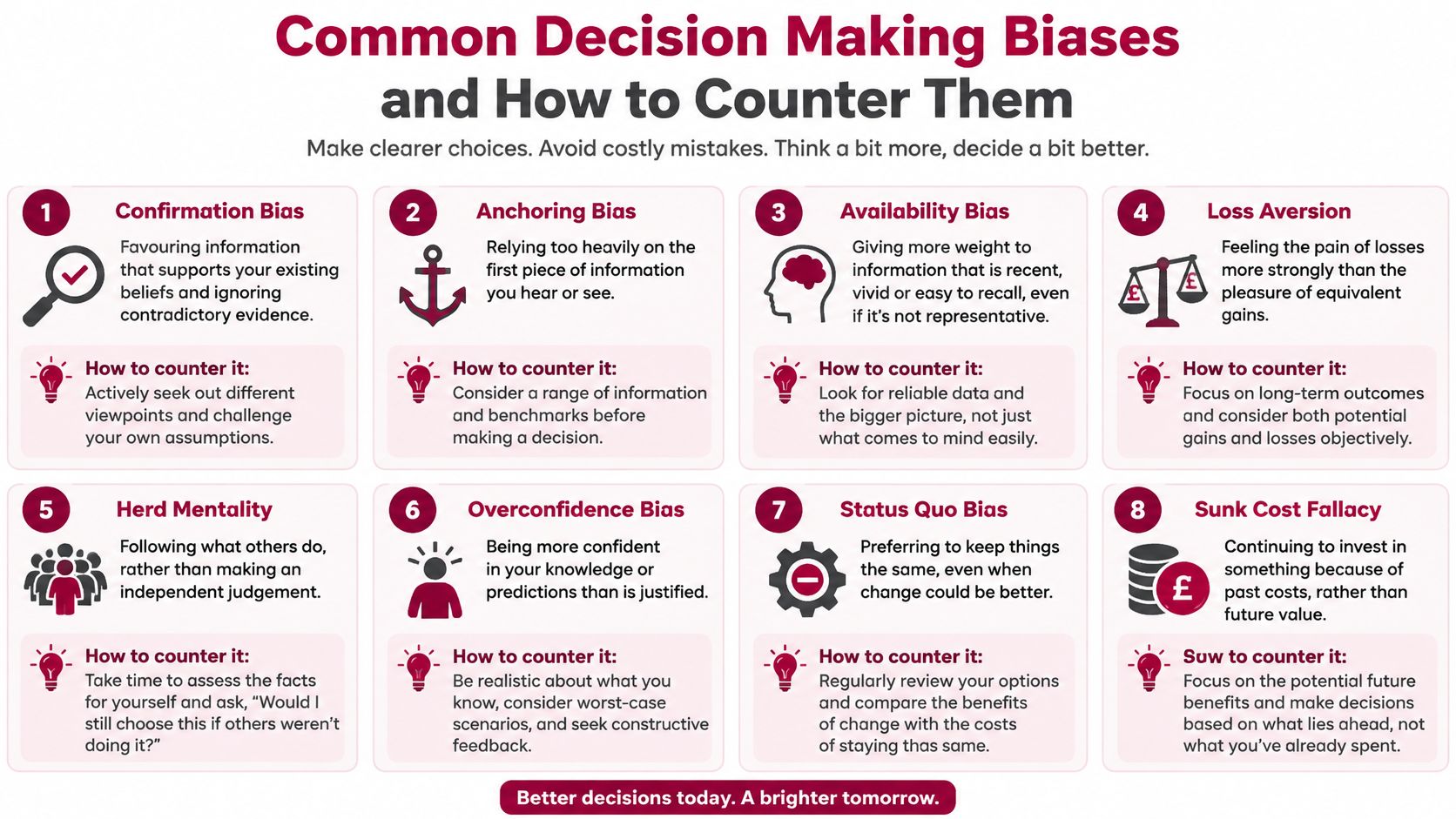
Anchoring distorts objective setting when the first number mentioned, often last year's result, drags every later estimate toward it. Counter it by requiring independent estimates in writing before discussion. Confirmation bias then corrupts intelligence gathering, as teams search for evidence that supports the emerging favourite. Assign someone explicit responsibility for finding disconfirming evidence, and reward them for finding it.
Countermeasures You Can Build In
- Premortem exercise: Before commitment, assume the decision has failed badly and ask each person to write the story of why.
- Designated devil's advocate: Give one member formal licence to attack the preferred option, rotating the role so dissent doesn't attach to a personality.
- Red team review: For major commitments, commission a small group to build the strongest case for a rejected alternative.
- Decision log: Record assumptions, forecasts and the evidence relied upon in advance, dated and attributable.
- Pre-agreed exit criteria: Specify the conditions under which an initiative stops, decided while you're still dispassionate.
Overconfidence inflates appraisal, usually through optimistic timelines and underestimated delivery cost. Reference class thinking helps, since asking how comparable projects performed disciplines your own forecast. Groupthink suppresses dissent at selection, particularly where a senior figure has signalled a preference early. Have the most senior person speak last and collect views anonymously where hierarchy is steep.
The sunk-cost fallacy arrives last and does quiet damage at review, when teams continue funding a failing initiative because stopping would admit error. Exit criteria agreed at launch convert that emotional decision into a mechanical one. None of these techniques requires psychological insight. Each is a small structural change that makes honest thinking easier than comfortable thinking.
Measuring Strategic Decisions with KPIs and Reviews
A decision can be well made and still produce a poor result, because outcomes contain luck. Separating decision quality from outcome quality is therefore essential. You judge decision quality by whether objectives were explicit, alternatives genuine and assumptions tested. You judge outcome quality by results, while remembering that results alone can't tell you whether the process deserves repeating.
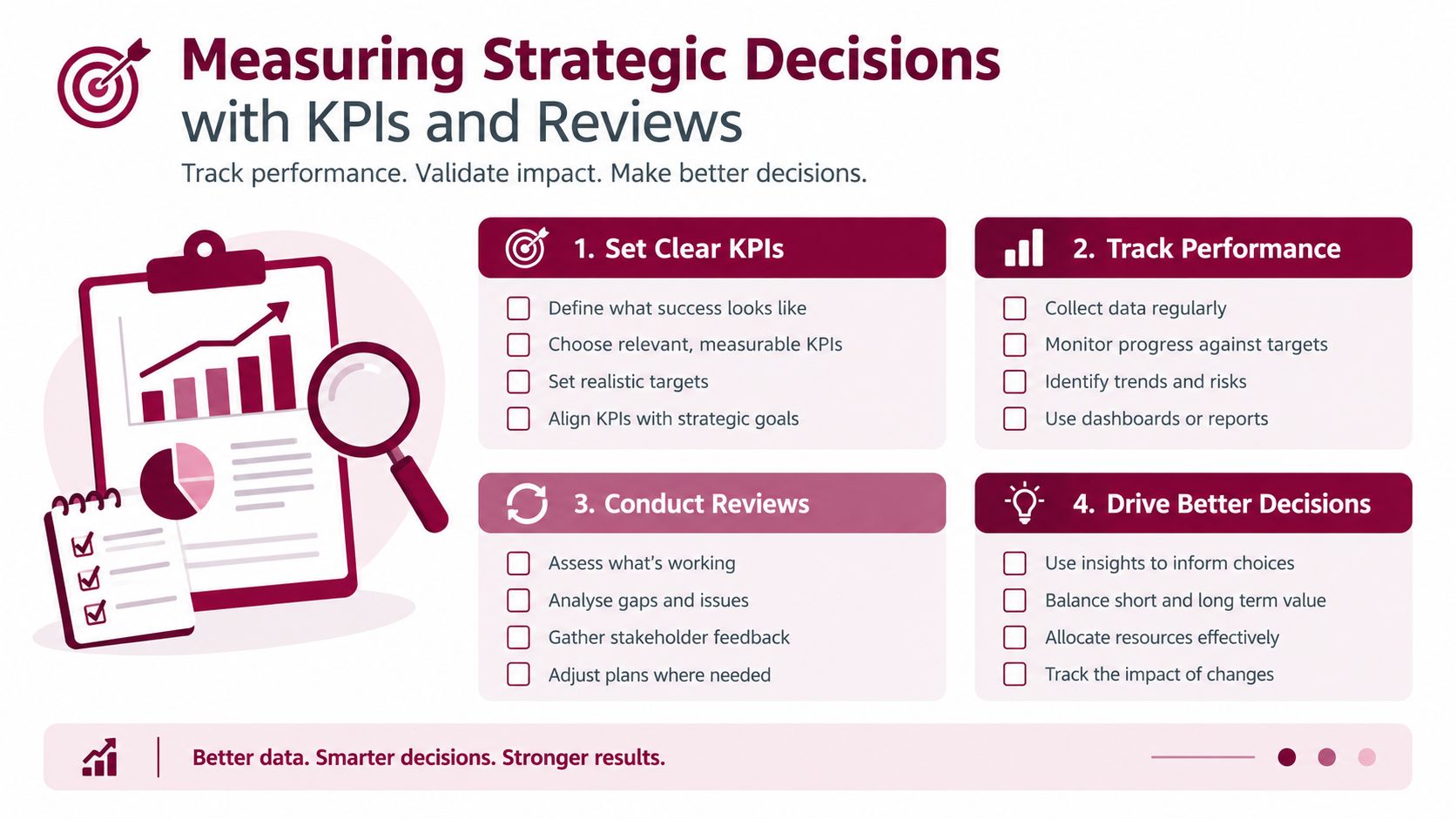
Instrumentation begins with leading indicators, which move early enough to permit correction, rather than lagging measures that merely confirm history. Enquiry to enrolment conversion leads revenue. Early module completion leads final completion. Pair each indicator with a threshold and a named owner, because a dashboard without decision rights produces reporting rather than action.
The Governance Layer Behind the Numbers
Data only pays when authority is designed alongside it. Nesta's econometric analysis of UK businesses found that firms in the highest group for online data use were more productive, and that employee decision autonomy strengthened the data use benefit substantially compared with centralised decision making. The implication is bounded autonomy, where local managers act within predefined limits and escalate major commitments.
Common definitions held centrally, operational decisions delegated locally. That division gives you consistency and speed at once, rather than forcing a choice between them.
Availability of data isn't the constraint for most firms. The UK Business Data Survey reports that 86% of businesses handled digitised data in 2025 to 2026, yet only 25% of businesses handling digitised data analysed it to generate new insights, according to the UK Business Data Survey 2026. Possessing information therefore doesn't create evidence based decisions. An explicit analytical stage does, which is the capability developed in programmes such as the Advanced Professional Certificate in Data Analytics for Business.
Review also has a formal rhythm at board level. The Financial Reporting Council's UK Corporate Governance Code 2024 states that boards should determine the principal risks they're willing to take, and Provision 29 of the Code requires effectiveness of the risk management framework to be reviewed at least annually on a comply or explain basis. Adapt that cadence to your scale. Set review gates at implementation, keep the log current and audit forecasts against reality, so review becomes evidence rather than hindsight.
Strategic Decision Making in Practice
Frameworks earn their keep under constraint. Consider a small specialist training firm with cash for one of two bets, a new corporate programme or an expansion of its consumer offer. It has no strategy department and no analyst. What it needs is a lightweight process that preserves discipline without consuming the week.
Start by separating reversible from irreversible elements. A landing page and a small advertising test are reversible. A long lease and two permanent hires aren't. Run low-cost experiments on the reversible parts for both options, such as testing employer interest through structured conversations and a priced pilot outline. Then commit to one bet on a stated date, with assumptions captured in a one-page decision log.
This reflects a decision capacity gap rather than an ambition gap. UK polling found AI was regularly discussed and prioritised at board level in 61% of large businesses but only 18% of small and micro businesses, as reported in analysis of barriers to AI adoption among UK businesses. Smaller firms also cite expertise, cost and uncertain return as leading barriers. More analysis can therefore reduce decision quality when it delays action beyond what the firm can absorb.
An AI Assisted Decision With Explicit Gates
Now consider a larger provider piloting AI support for learner queries. Standard stage lists go quiet here, yet the governing questions are specific. Who remains accountable for an output a model generated, what data quality is acceptable and when does the pilot stop?
Build a decision gate. Define the business problem narrowly, perhaps response time on routine queries. Set risk and accuracy thresholds before exposure to learners, run a limited pilot with human review and measure incremental outcomes against the existing process. Document the accountable owner by name. Research found 19% of UK SMEs already use AI for decision making despite concerns about unreliable outputs, according to polling of UK SME leaders on AI adoption, which makes governance rather than enthusiasm the binding constraint. AI adoption is primarily an operating model problem, because scaling an unaccountable process merely accelerates error.
Four tools support both scenarios. Weighted decision matrices make criteria explicit, premortem templates surface failure modes, scenario canvases organise uncertainty and the decision log preserves your reasoning for later audit. Applied training in these techniques is available through the Decision Making and Problem Solving course, which sits alongside related provision for managers who want structured practice rather than abstract theory.
Developing Your Strategic Decision Making Skills
Strategic decision making is a learnable discipline. It combines a repeatable process, a model matched to conditions, deliberate countermeasures against bias and honest review after commitment. None of that depends on temperament. It depends on habits that can be taught, rehearsed and checked, which is encouraging news for managers who currently rely on experience alone.
Formal study accelerates the move from understanding to habit because it supplies what workplaces rarely do. You'll get structured cases where the correct framing isn't obvious, feedback on your reasoning rather than your results and frameworks you must apply under assessment conditions. Reading about premortems is not the same as writing one and defending it.
Choosing a Sensible Next Step
Match the scale of study to the gap you've identified. If you need a broad leadership foundation, the London School of Business Administration offers the Credential of Leadership and Management, an eight-course, 160-hour CPD-accredited pathway that includes decision making content alongside Strategic Leadership and Corporate Direction. If your gap is narrower and more analytical, the standalone Data Driven Decision Making course provides focused upskilling without a full pathway commitment.
Delivery is self-paced and online, built around recorded lectures, structured materials and assessments, so study fits around an existing role rather than competing with it. Completion produces a certificate with online verification, giving employers portable evidence of capability instead of an unsupported claim on a curriculum vitae. That portability matters when you're evidencing judgement, a quality that's otherwise hard to demonstrate.
Whichever route you choose, begin applying the process to a live decision this quarter and record your assumptions before outcomes are known. Pair that practice with reading on strategic thinking for leaders and turning vision into action so the framing stage sharpens alongside your appraisal skills. Capability compounds when each decision leaves behind evidence you can learn from, and that's the lasting return on formalising how you choose.
If you're ready to turn structured decision making from an aspiration into a practised management habit, explore the self-paced, CPD-accredited business and leadership programmes at London School of Business Administration, where decision making, strategic leadership and data analytics are taught in applied, assessment based form. Choose a focused course or a full credential pathway, study online around your current role and finish with a verifiable certificate that evidences the judgement you've built.