
Communicate more is probably the most familiar advice in change management. It's also incomplete. Managers can explain a transformation repeatedly while leaving employees without the time, authority or practical support to implement it. A persuasive announcement won't resolve conflicting incentives, unclear responsibilities or an overloaded project portfolio.
Change efforts can stall before implementation because leaders approve the destination without preparing the organisation for the journey. Project leads inherit delivery deadlines, line managers absorb additional responsibilities, and employees must reconcile new expectations with existing work. Treating these problems as a lack of enthusiasm mistakes an implementation constraint for an attitude problem.
Change management best practices connect strategic intent with observable changes in everyday work. They require managers to establish a credible rationale, allocate decision-making authority, understand stakeholder concerns and build capability before expecting sustained adoption.
More communication isn't a substitute for removing the conditions that prevent people from changing.
The practices below follow the progression from initial justification to permanent operational ownership. Their practical value lies less in applying every model mechanically than in recognising where progress has stopped and choosing an intervention that addresses the actual constraint.
Table of Contents
- 1. Establish a Clear Case for Change
- 2. Secure Visible Executive Sponsorship and a Guiding Coalition
- 3. Communicate the Vision Consistently and Transparently
- 4. Conduct Stakeholder Analysis and Engagement Planning
- 5. Apply the ADKAR Model for Individual Change
- 6. Apply Lewin's Three-Stage Model of Unfreeze, Change, and Refreeze
- 7. Assess Change Readiness and Organisational Impact
- 8. Build Capability Through Training and Empowerment
- 9. Pilot and Phase Implementation to Generate Early Wins
- 10. Reinforce Change Through Systems, Recognition, and Measurement
- How the ten change management best practices compare
- Turning Ten Practices into a Lasting Change Plan
1. Establish a Clear Case for Change
Managers often stall when they describe the proposed solution more clearly than the problem. Buying a platform, restructuring a department or introducing automation isn't a sufficient rationale. Employees need to understand what isn't working, why it matters and what improvement would look like.
In a Censuswide survey of UK employees, 38% identified insufficient awareness of the reason for change as a cause of resistance, according to the Oak Engage change report. Explain the business rationale alongside the consequences for employees, rather than assuming organisational benefits automatically establish personal relevance.

Make the problem testable
Alan Mulally's turnaround at Ford provides an organisational example of confronting business difficulties openly rather than concealing them. The transferable principle is candour, not manufactured urgency.
For a customer-service redesign, assemble:
- Current performance: Document avoidable handovers, unresolved enquiries and duplicated work.
- Expected improvement: Specify which service outcomes should change.
- Consequences of inaction: Explain what continuing the existing process would mean.
Test the explanation with frontline employees before wider publication. Ask them to describe the problem in their own words.
Understanding why change management is important helps distinguish a business case from a sales pitch. The trade-off is specificity versus certainty: acknowledge assumptions instead of presenting estimated benefits as guaranteed results.
2. Secure Visible Executive Sponsorship and a Guiding Coalition
A sponsor who approves expenditure but disappears when departments disagree is an authoriser, not an effective change leader. Progress stalls when project managers must resolve conflicts that require executive authority.
Kotter's guiding-coalition approach provides a useful organising principle: combine formal authority with operational expertise, credibility and leadership capability. Include people who can authorise resources and people whose colleagues trust their judgement.
IBM's transformation under Lou Gerstner offers an organisational example of aligning leadership around customer needs and integrated services. For practitioners, the relevant lesson is to make senior managers accountable for cross-functional outcomes rather than allowing each department to optimise its own position.
Turn sponsorship into defined work
Write a short coalition charter covering decision rights, meeting cadence, escalation routes and unresolved dependencies. Distinguish the sponsor's responsibilities from those of the project manager and operational managers through explicit change management roles.
For a shared customer-record system, the sponsor should resolve disputes about process ownership and data standards. The project manager should coordinate delivery, not negotiate indefinitely between executives with incompatible priorities.
The trade-off is authority versus participation. A powerful coalition can remove obstacles quickly, but an exclusively senior group may overlook practical problems. Give frontline representatives a route to challenge assumptions without requiring executive status.
Leadership development can support this distinction between position and influence. Our Leadership and Organisational Behaviour course is one relevant subject area for structured study.
3. Communicate the Vision Consistently and Transparently
Employees may understand the strategic vision yet remain uncertain about what to do differently. Communication stalls at the point where abstract ambition must become role-specific instruction.
Microsoft's cultural transformation under Satya Nadella offers a useful example of connecting organisational direction with expectations about learning and collaboration. The practical lesson is that leaders must demonstrate the behaviours they describe, rather than treating a cultural message as a campaign slogan.
A UK public-sector digital-transformation survey found that 71% of respondents said employees didn't see the need for change, while 62% said employees didn't understand the technology involved, as reported in the Local Government digital-transformation supplement. These are different problems and require different responses.
Separate purpose from instruction
For a new assessment platform, explain the intended improvement in learner feedback before demonstrating how tutors record decisions. Then provide recurring opportunities to discuss exceptions and unresolved concerns.
- Senior leaders: Explain purpose, priorities and material decisions.
- Line managers: Translate the change into team responsibilities.
- Process specialists: Demonstrate tasks and clarify technical questions.
Maintain a decision log that distinguishes confirmed decisions from proposals. When plans change, explain the reason and identify which previous guidance no longer applies.
The trade-off is transparency versus information overload. Publish what employees need to act, with accessible detail for those affected. Repeating every project update to everyone can obscure the decisions that matter.
4. Conduct Stakeholder Analysis and Engagement Planning
Stakeholder analysis becomes ineffective when managers produce a power-interest grid and then file it away. The useful output isn't the diagram. It's a set of engagement decisions that changes how the programme operates.
Map influence, impact and dependency separately. Someone with little formal authority may carry substantial implementation risk because they maintain a critical workflow or understand an undocumented exception.
The Health and Safety Executive's organisational-change guidance recommends consulting staff, including contractors, before, during and after implementation. It also emphasises transferring key responsibilities and assessing risks arising from the transition itself.

Map consequences, not just job titles
Consider a hypothetical learner-portal implementation at London School of Business Administration. Tutors, learners, administrative staff and contractors would require different discussions because their tasks and dependencies differ. This is a planning scenario, not a claim about a particular implementation.
Assign a named relationship owner to stakeholders whose decisions or specialist knowledge could affect delivery. Record their concerns, the response and any resulting change to the plan.
Incorporate these actions into the change management plan rather than maintaining a disconnected consultation document.
The trade-off is breadth versus decision speed. Consultation doesn't mean every stakeholder has a veto. State what participants can influence, what is already constrained and who makes the final decision.
5. Apply the ADKAR Model for Individual Change
Training attendance can conceal a fundamental adoption problem. Employees may know how a system works but see no reason to use it, or support the change while lacking the opportunity to practise.
Prosci's ADKAR model distinguishes Awareness, Desire, Knowledge, Ability and Reinforcement. Treat these as diagnostic outcomes rather than labels to assign permanently to employees.
For an illustrative enterprise-software rollout at Ford, a manager could use ADKAR to distinguish employees who don't understand the business rationale from those who need supervised practice. The example describes how to apply the model, not Ford's documented use of it.
Find the earliest unresolved barrier
Use brief conversations, task observation and pulse questions to investigate:
- Awareness: Can the employee explain why the change is necessary?
- Desire: What concerns affect their willingness to participate?
- Knowledge and ability: Can they explain and perform the task?
- Reinforcement: Do routines and management responses support continued use?
A person who understands the software but cannot obtain the necessary permissions has an implementation barrier. Another training session won't remove it.
Diagnostic rule: Match the intervention to the barrier, not to the training package already purchased.
The trade-off is individual diagnosis versus organisational responsibility. ADKAR helps managers identify personal support needs, but it mustn't turn workload pressure, poor system design or conflicting targets into alleged employee deficiencies. Address those conditions directly.
6. Apply Lewin's Three-Stage Model of Unfreeze, Change, and Refreeze
A technically successful launch can leave the old operating model intact. Employees use the new process during demonstrations, then return to familiar spreadsheets because approvals, incentives and reporting still favour them.
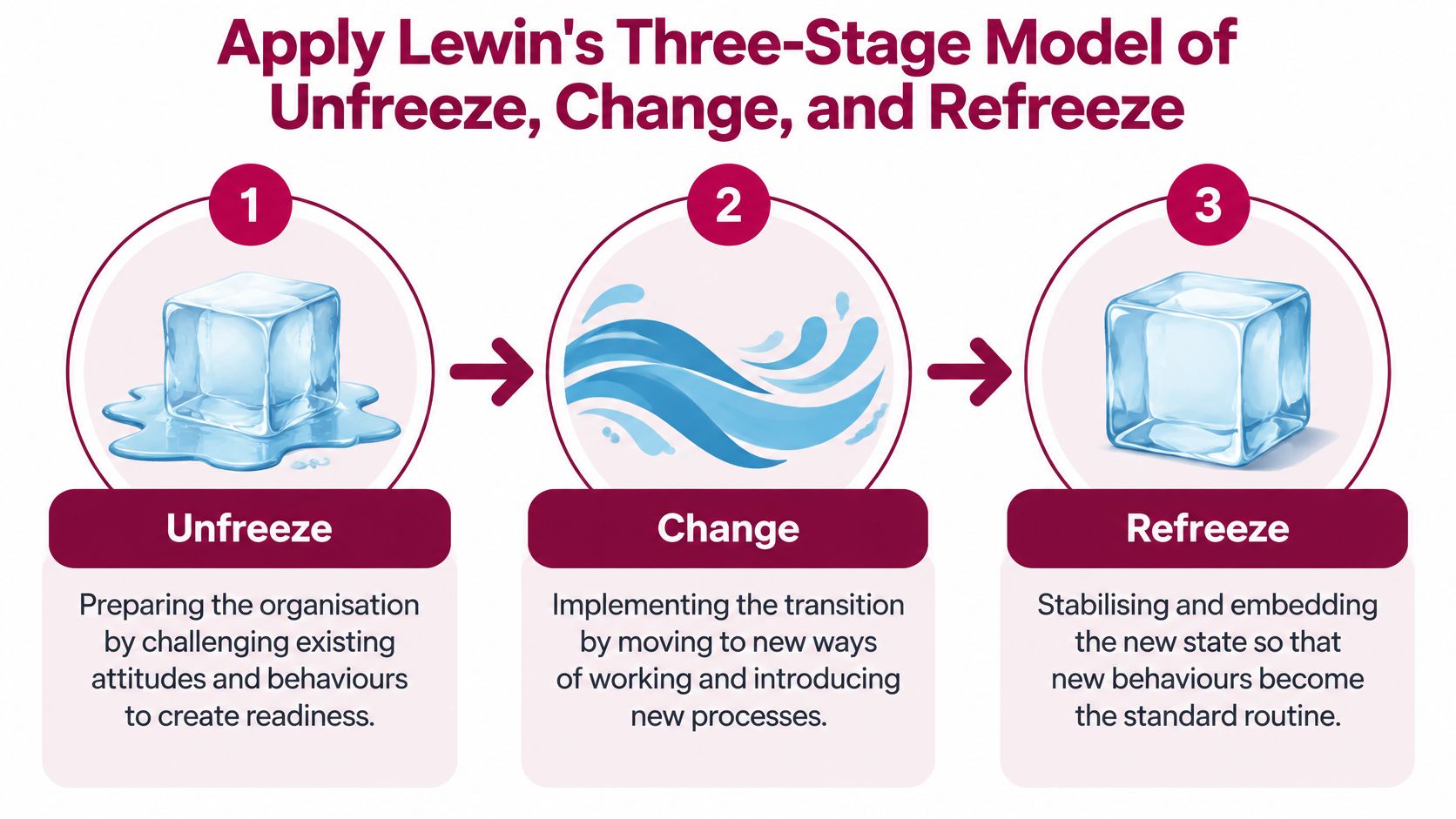
Lewin's model of unfreeze, change and refreeze provides a planning scaffold. Prepare people to question existing routines, support movement towards the new approach, and stabilise the behaviours that should become normal practice.
Define what stabilisation means
Take an illustrative production-method change at Toyota. Unfreezing would involve examining the limitations of the existing method; changing would involve supported trials; refreezing would involve agreed standard work, supervision and performance review. This is an application of the framework, not a claim about Toyota's formal methodology.
Define observable evidence of stabilisation, such as consistent execution, reliable exception handling and clear process ownership. Don't equate a revised procedure document with embedded practice.
The Office for National Statistics' public-sector management survey pilot found that 41% of surveyed public-sector organisations reported too little time to think about or implement management changes. Stabilisation therefore needs protected operational capacity, not merely a closing presentation.
The trade-off is consistency versus adaptability. Refreezing should establish a dependable baseline without preventing improvement. Our Change Management course examines Lewin alongside other organisational-change frameworks.
7. Assess Change Readiness and Organisational Impact
Readiness isn't a confidence score. It's a judgement about whether the people, processes and resources required for implementation are available under realistic operating conditions.
Managers stall when they collect survey responses but avoid the decision those responses imply. If a department lacks cover for training or faces overlapping deadlines, the appropriate intervention may be resequencing rather than stronger messaging.
Deloitte's UK Human Capital Trends findings report that 76% of UK respondents said their wellbeing had suffered from tiredness caused by too many workplace changes, according to its UK findings announcement. Treat cumulative change load as an operational constraint.
Make readiness evidence consequential
For an illustrative enterprise-resource-planning deployment at IBM, assess process documentation, data ownership, training capacity and support coverage by department. A single organisation-wide average could conceal a function that isn't ready.
- Role impact: Identify tasks, responsibilities and approvals that will change.
- Available capacity: Compare implementation demands with existing commitments.
- Decision consequence: Specify what would trigger additional support, reduced scope or postponement.
Keep the assessment brief enough to repeat when conditions change. Include conversations about workload and perceived control alongside technical preparation.
The trade-off is momentum versus absorption capacity. Delaying a launch has costs, but proceeding without essential capability transfers those costs to employees and service users. A credible readiness process permits a decision not to proceed.
8. Build Capability Through Training and Empowerment
Knowing the procedure and having permission to apply it are different capabilities. Employees can complete training successfully yet remain dependent on approvals, inaccessible information or managers who discourage experimentation.
Toyota's kaizen approach provides an organisational example of connecting problem-solving capability with employee participation in improvement. The relevant principle is to pair learning with an authorised opportunity to change work.
For AI-enabled work, this distinction is particularly important. Among UK AI users, 45% said their work had become more complex and 44% reported heavier workloads, according to PwC's UK workforce findings. Usage alone isn't evidence that employees have gained capacity.
Design practice around real decisions
For a marketing team introducing AI-assisted drafting, provide approved examples, practice tasks and explicit human sign-off rules. Clarify who checks factual accuracy, who approves publication and when staff must reject an output.
Remove a structural barrier before launching training. That might mean providing access to approved reference material or clarifying delegated approval authority.
Training should change what employees can do at work, not merely what they can recall in an assessment.
The trade-off is autonomy versus control. Give employees discretion within clear boundaries, with escalation routes for unfamiliar cases. Unrestricted experimentation can create quality risks, but excessive approval requirements can eliminate the practical benefit of new skills.
9. Pilot and Phase Implementation to Generate Early Wins
An easy pilot can produce reassuring results that tell managers little about wider implementation. Progress stalls when leaders mistake enthusiastic volunteers and unusually generous support for representative operating conditions.
Choose a pilot group that includes realistic workload pressures, relevant exceptions and ordinary management support. Define success before collecting results, including the conditions under which the organisation would modify or stop the rollout.
The UK government's cross-government Microsoft 365 Copilot experiment reported that coordinated change-management activity and licence rollout increased adoption to 83%, with adoption remaining around 80% for the rest of the experiment. This is a contextual example of coordinated implementation, not a universal target.
Test the operating model
For a retailer piloting a new store process, assess staffing demands and exception handling alongside transaction performance. A promising customer outcome may still require an unsustainable amount of manager intervention.
- Define outcomes: Specify service quality, task performance and acceptable support demand.
- Record conditions: Document staffing, coaching and workarounds used during the pilot.
- Expose limitations: Publish unresolved problems as well as early wins.
The trade-off is speed versus transferability. A tightly supported pilot can establish technical feasibility quickly, but a representative pilot is more useful for deciding whether the organisation can scale. Phase implementation according to demonstrated readiness rather than announcement deadlines.
10. Reinforce Change Through Systems, Recognition, and Measurement
Launch teams often leave just as operational managers begin confronting difficult exceptions. Without a clear handover, employees receive mixed signals and quietly restore previous routines.
Reinforcement means aligning the management system with the new way of working. Update responsibilities, performance criteria, induction materials, governance and recognition before closing the programme.
In the Towers Watson study reported by HR Magazine, 64% of highly effective organisations continued demonstrating new behaviours and skills after implementation, compared with 8% of low-effectiveness organisations. The comparison supports examining what happens after launch, rather than treating delivery as completion.
Transfer ownership explicitly
Consider an illustrative new reporting workflow at Netflix. Permanent line managers would need responsibility for data quality, exceptions, user support and future improvements. Naming a process owner without providing authority or capacity would leave the handover incomplete.
Recognise contributions that improve quality and help colleagues adopt the process. Avoid rewarding visible activity that adds little value, such as logging into a system without completing meaningful work.
The trade-off is accountability versus gaming. A narrow usage target may encourage nominal compliance. Combine behavioural evidence with outcomes, support demand and employee feedback.
Agree who reviews deterioration, who funds corrective action and when obsolete processes will be retired. A change becomes sustainable when ordinary managers can maintain it without relying on the original project team.
How the ten change management best practices compare
| Item | Popularised by | Key pro | Key con |
|---|---|---|---|
| Establish a Clear Case for Change | John P. Kotter; Alan Mulally | Reduces resistance with a rational explanation | Overstated urgency can cause change fatigue |
| Secure Visible Executive Sponsorship and a Guiding Coalition | John P. Kotter; Lou Gerstner | Speeds decisions and strengthens credibility | Sponsor turnover can stall momentum |
| Communicate the Vision Consistently and Transparently | John P. Kotter; Satya Nadella | Builds shared understanding and reduces uncertainty | Too much communication can dilute key messages |
| Conduct Stakeholder Analysis and Engagement Planning | Ronald Mitchell, Bradley Agle, and Donna Wood; Prosci | Reveals risks and improves engagement targeting | Analysis can become outdated |
| Apply the ADKAR Model for Individual Change | Jeff Hiatt; Prosci | Helps target support to individual needs | Assumes a potentially unrealistic linear progression |
| Apply Lewin's Three-Stage Model of Unfreeze, Change, and Refreeze | Kurt Lewin | Simple framework for planning change phases | Offers limited guidance on specific actions |
| Assess Change Readiness and Organisational Impact | Prosci; PMI change management practices | Supports realistic scheduling and resourcing | Assessments can delay action |
| Build Capability Through Training and Empowerment | Taiichi Ohno; Toyota Motor Corporation | Increases employee confidence and adoption | Training can be costly and time-consuming |
| Pilot and Phase Implementation to Generate Early Wins | John P. Kotter; Eric Ries | Limits exposure and builds momentum | Pilot results may not generalise |
| Reinforce Change Through Systems, Recognition, and Measurement | John P. Kotter; Peter Senge | Makes change more durable | Metrics may be gamed or miss meaningful outcomes |
Turning Ten Practices into a Lasting Change Plan
Change management works best as a sequence of connected decisions rather than a collection of techniques. A credible case establishes purpose, sponsorship provides authority, and stakeholder engagement exposes practical constraints. Capability building and phased implementation then help employees translate that intent into dependable work.
The sequence isn't rigid. A pilot may reveal that the original rationale overlooked an important service requirement, while a readiness assessment may show that the planned timing is unrealistic. Effective managers revisit earlier decisions without treating revision as failure.
Begin where progress has stopped
Select the practices most relevant to the current constraint. If employees support the objective but cannot perform the new task, invest in practice and barrier removal. If managers disagree about ownership, resolve sponsorship and decision rights before commissioning more communication materials.
For each intervention, name an owner, define the expected evidence of progress and establish a review point. Separate project outputs from operational outcomes: issuing guidance, delivering training and provisioning access are activities; reliable task performance and improved service are results.
Protect implementation capacity explicitly. Identify work that can stop, pause or reduce while employees learn. When leaders approve additional change without making corresponding choices about workload, they leave line managers to negotiate the contradiction informally.
Use resistance as diagnostic information, not as a verdict on commitment. Employees may be identifying an unclear rationale, a poorly designed process or an unmanageable transition. Investigate those possibilities before escalating persuasion.
Build judgement alongside method
Formal study can help managers understand when different frameworks are useful and where their limitations lie. Our online, self-paced course is designed for managers, team leaders, project managers and HR professionals, among other learners. It examines major change frameworks and uses practical case studies, visual frameworks and reflection exercises to support application.
The managerial responsibility remains concrete: decide what must change, establish the conditions that allow people to change, and confirm that the resulting practice is worth sustaining. A model can organise that work, but it cannot replace judgement about resources, fairness, risk or organisational priorities.
Start with a live initiative and write down its most important unresolved implementation barrier. Assign responsibility for resolving it, identify the evidence needed for a decision and bring that decision to the next appropriate management meeting.
London School of Business Administration offers online, self-paced business and management study, including learning on organisational change, leadership and implementation. Visit London School of Business Administration to explore course content and choose structured study relevant to the change responsibilities you're preparing to undertake.