
A programme can have a sound strategy, a detailed plan and a well-funded delivery team, yet stall within a quarter because nobody owns the decision when a department pushes back. That failure rarely comes from a single weak individual. More often, the organisation has placed sponsorship, coordination, local influence, communication, readiness, learning and sustainment into overlapping or vacant seats.
The practical answer is to treat change management roles as a connected operating model rather than a collection of job titles. This guide sets out eight roles in the order most organisations encounter them, from executive mandate through to post-programme sustainment. Each profile explains what the role is for, the skills it needs, the pitfalls that undermine it, a sample job description, a RACI example and a suggested LSBA learning pathway.
Table of Contents
- 1. Change Sponsor
- 2. Change Manager
- 3. Change Agent
- 4. Communications Lead
- 5. Organisational Readiness Manager
- 6. Change Network Lead
- 7. Learning and Capability Manager
- 8. Change Sustainability Lead
- 8-Role Change Management Comparison
- Assembling Your Change Roles Before the Next Programme Starts
1. Change Sponsor
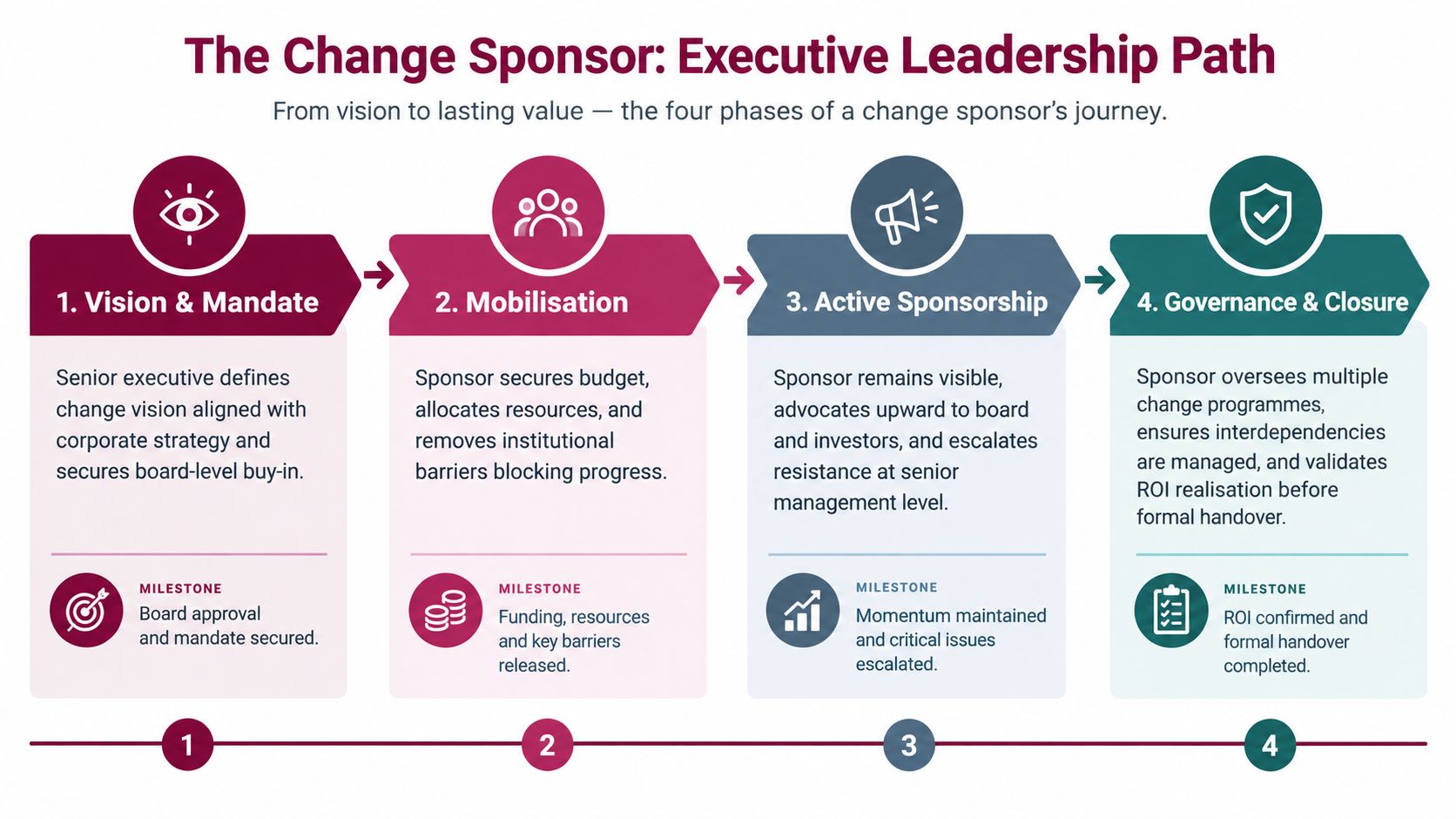
The Change Sponsor gives the initiative its authority. This is the executive or senior leader who connects the change with organisational direction, secures resources and makes decisions when competing priorities threaten delivery. A sponsor might be a Chief Operating Officer overseeing a major operating-model redesign, a Chief Digital Officer leading a technology transformation, or a senior clinical leader supporting a new care pathway.
The role isn't ceremonial. The sponsor establishes the business case, confirms the outcomes that matter and removes institutional barriers that a project team can't resolve. UK Government guidance places ultimate accountability for intended organisational change with the senior responsible owner or portfolio director, while the relevant programme or project manager manages the change framework. The Government Project Delivery Profession's guidance makes that distinction important: sponsorship owns the mandate, while delivery roles turn it into action.

Practical rule: A sponsor should be visible enough to legitimise the change, but distant enough to let the Change Manager manage delivery.
The common failure is passive sponsorship. A named executive may approve the business case, then disappear from employee communications and governance meetings. Effective sponsors set decision rights, maintain a regular touchpoint with the Change Manager, document decisions and model the behaviours they expect from other leaders.
Sample job description: “Own the strategic mandate, business case, executive alignment and resource decisions for the change. Remove barriers, chair sponsor governance and communicate the importance of the transition to senior stakeholders.”
RACI example: Sponsor, Accountable; Change Manager, Responsible; business leaders, Consulted; affected employees, Informed.
For structured development, Strategic Leadership and Corporate Direction can sit alongside leadership's role in change management as a pathway for executives who need to connect strategic intent with credible sponsorship.
2. Change Manager
The Change Manager converts the sponsor's mandate into a coordinated transition. This person integrates the change plan with technical delivery, stakeholder engagement, readiness activity, communications, learning and implementation. The role requires both disciplined programme control and the judgement to respond when resistance, dependencies or operational pressures alter the original plan.
A Change Manager may coordinate a retailer's omnichannel operating-model transition, guide a manufacturer through a lean process implementation or manage adoption during a regulated system replacement. In each case, the difficult work lies between the formal milestones. The manager must know which decisions are blocked, which groups are unconvinced, where capacity is stretched and which risks need escalation.
UK vacancy evidence illustrates why the role isn't a single narrow occupation. In a six-month sample, “Senior” appeared in 343 listings, “Analyst” in 316, and “Lead” in 184, while “Support Analyst” appeared in 124 and “ITSM Analyst” in 110. These figures come from UK change-management vacancy analysis, and they reflect the mixture of leadership, analysis, service management and operational support through which change work is delivered.
Sample job description: “Lead the planning, coordination and stabilisation of the change initiative. Maintain integrated plans, stakeholder maps, risk and issue logs, readiness actions, adoption measures and governance reporting.”
RACI example: Change Manager, Responsible; Sponsor, Accountable; Change Agent and Communications Lead, Consulted; wider stakeholders, Informed.
The role benefits from clear visual dashboards, stakeholder mapping, dependency tracking and retrospectives. It fails when the manager becomes a task administrator without authority, or when project status is reported without showing whether people can perform differently. Change Management offers a relevant learning route for professionals moving into this coordinating position.
A useful development focus is the ability to translate technical progress into business readiness. A system can be installed while managers remain unable to explain new decisions, teams lack confidence and old workarounds continue.
3. Change Agent
The Change Agent works close to the people whose routines will change. Unlike the central Change Manager, this person understands the local workflow, informal influence structure and practical constraints of a department or business unit. A Change Agent might support clinicians adopting a patient-management system, help a regional office interpret a regulatory transition or guide a customer-success team through a platform migration.
The role is valuable because enterprise plans rarely survive contact with local operations unchanged. A central team may define a standard process, while a Change Agent identifies staffing constraints, customer commitments or control requirements that demand careful adaptation. That local knowledge should improve implementation, not create a collection of unapproved exceptions.
Local influence is useful only when the boundaries of local discretion are explicit.
The most common pitfall is appointing an enthusiastic volunteer without giving them authority, time or access to the central team. Change Agents can then become informal messengers who absorb frustration without being able to resolve it. Pairing them with the relevant line manager, defining escalation routes and holding regular forums helps prevent that isolation.
Sample job description: “Represent the change within a defined function. Translate enterprise plans into local implications, surface operational barriers, support adoption activity and escalate decisions that exceed local authority.”
RACI example: Change Agent, Responsible for local engagement; Change Manager, Accountable for the overall approach; line manager, Consulted; employees, Informed and involved in feedback.
A practical support package includes local stakeholder maps, peer networks, resilience support and simple measures such as participation, recurring issues and unresolved escalations. The Change Agent shouldn't be asked to manufacture enthusiasm. Their credibility depends on acknowledging genuine difficulty and showing how feedback reaches a decision-maker.

4. Communications Lead
The Communications Lead manages the information environment around change. The job is not only to announce milestones. It involves shaping a credible narrative, segmenting audiences, selecting suitable channels, answering difficult questions and creating a feedback loop that allows the programme to correct misunderstandings.
For a restructuring, employees may need a clear explanation of rationale, process and support. For a technology transition, users may need role-specific information about timing, workflow and assistance. For a merger, customers, employees, suppliers and regulators may require different messages, even when the strategic narrative is shared.
The role becomes ineffective when communication is treated as a broadcast service. A polished newsletter won't compensate for decisions that appear predetermined, inconsistent messages from managers or questions that receive no answer. The 2025 CIPD/YouGov Working Lives survey of 5,017 UK employees found that 37% said managers allowed employees or their representatives to influence final decisions, while 51% said managers sought their views. The survey report highlights a practical distinction between consultation and meaningful influence.
Sample job description: “Develop and deliver segmented communication plans, executive messages, FAQs, listening sessions and feedback reporting. Maintain message consistency while enabling appropriate local adaptation.”
RACI example: Communications Lead, Responsible; Change Manager, Accountable for integration; Sponsor and Change Agents, Consulted; affected groups, Informed and invited to respond.
Communication test: Can the recipient explain what is changing, why it matters, what they must do and how their concerns will affect the next decision?
Useful practices include a communications calendar, audience map, early-adopter briefings, listening sessions and response-to-feedback tracking. Measure knowledge and behaviour, not just distribution. A message that reached every inbox may still have failed.
The communicating change effectively lesson can support a learning pathway alongside Communication Skills for Leaders, particularly for managers who must communicate uncertainty without making promises the programme can't keep.

5. Organisational Readiness Manager
The Organisational Readiness Manager asks whether the organisation can absorb and sustain the proposed change. That assessment includes skills, capacity, leadership alignment, competing initiatives, cultural conditions and the practical confidence of affected teams. Readiness isn't a one-off gate before implementation. It should shape sequencing, intervention design and sponsor decisions throughout the programme.
A manufacturer introducing a new production system may discover that supervisors need different coaching before operators can adopt the process. A financial services organisation may find that regulatory technology is technically ready while teams are already overloaded by other initiatives. A healthcare organisation may identify that clinicians understand the benefits of a new diagnostic tool but lack time and confidence to incorporate it into routine work.
The role's central trade-off is between useful evidence and false precision. A dashboard can help leaders compare patterns across departments, but a single readiness score can conceal local concerns. Interviews, observation, role-based assessments and documented barriers should sit alongside structured tools.
Sample job description: “Assess capability, capacity and psychological preparedness. Translate findings into training, coaching, sequencing, organisational-design and leadership interventions, then track whether readiness barriers are reducing.”
RACI example: Readiness Manager, Responsible; Change Manager, Accountable for integration; line leaders and Learning Manager, Consulted; Sponsor, Informed and responsible for strategic decisions.
The role works best when readiness findings can change the programme. If leaders commission an assessment but refuse to adjust timing, resources or scope, the exercise becomes compliance theatre. It also needs departmental analysis rather than an assumption that the organisation is a single population.
The assessing organisational readiness lesson provides a focused learning route, while Leadership and Organisational Behaviour can complement the people and systems perspective needed for this role.
6. Change Network Lead
The Change Network Lead creates the distributed community that carries change beyond the central programme team. Network members may be subject-matter experts, frontline representatives, managers or local champions. The Lead gives them a shared purpose, practical guidance, routes for escalation and a way to learn from one another.
A digital champion network might support cloud adoption across regional offices. A public-service network might share lessons from service redesign. In manufacturing, a continuous-improvement network can help preserve new problem-solving habits after the formal programme has reduced its activity.
This role differs from the Change Agent. The Change Agent has a defined local responsibility. The Network Lead designs and sustains the system connecting many such contributors. That distinction matters because a network without governance can become a discussion forum with no decision rights, while a network controlled too tightly by the centre loses the peer credibility that makes it useful.
Sample job description: “Establish and facilitate the change network. Define member responsibilities, coordinate learning, curate practical knowledge, identify cross-functional themes and maintain the network through implementation and stabilisation.”
RACI example: Network Lead, Responsible; Change Manager, Accountable; Change Agents and subject-matter experts, Consulted and active contributors; wider employees, Informed.
Practical design choices include an induction programme, member role descriptions, a knowledge repository, regular forums and an escalation protocol. Members also need recognition and realistic time expectations. Asking people to perform network duties invisibly creates a predictable drop in participation.
A network is sustainable when members gain useful access, influence or learning, not merely another meeting.
Track issues raised, solutions reused, participation quality and the extent to which local knowledge changes delivery decisions. The network should also have a transition plan, so it can continue contributing after programme governance closes.
7. Learning and Capability Manager
The Learning and Capability Manager makes the new way of working performable. This role begins with capability analysis by role and level, then designs learning journeys, performance support and reinforcement. Formal training is only one part of the work. Employees may also need coaching, practice environments, job aids, manager support and time to apply unfamiliar skills safely.
Consider a retail system transition. Frontline colleagues may need short digital modules, guided practice, in-store coaching and concise prompts at the point of work. A professional-services firm changing its delivery model may need case-based workshops, manager observation and peer feedback rather than a single information session. A manufacturing change may require supervisor development because line managers reinforce the behaviour every day.
The role's most important trade-off is coverage versus relevance. A standard course can be distributed efficiently, but it may fail to address distinct responsibilities. Highly customized learning can be more useful, but it requires careful governance to prevent duplication and delay.
Sample job description: “Assess capability needs, design role-based learning pathways, coordinate subject-matter input, provide performance support and measure competence, confidence and application in the changed environment.”
RACI example: Learning Manager, Responsible; Change Manager, Accountable for alignment; subject-matter experts and line managers, Consulted; learners, Responsible for participation and application.
Effective practice includes pre-learning assessments, blended delivery, accessible materials, train-the-trainer support and reinforcement after launch. Completion data alone isn't enough. A person may finish a module without being able to perform the new process under operational pressure.
The strongest learning plans are linked to actual work. They show what learners must do, which decisions they must make, what evidence demonstrates competence and who will coach them when performance slips.
8. Change Sustainability Lead
The Change Sustainability Lead prevents regression after formal delivery ends. This role embeds new practices in governance, process ownership, performance conversations, controls, documentation and local leadership routines. It begins during programme planning, not at the point when the delivery team wants to hand over an unfinished problem.
A financial-services organisation may need post-implementation monitoring to keep a compliance process configured correctly. A healthcare trust may use clinical governance to maintain a revised care protocol. A manufacturing operation may rely on peer review and continuous-improvement routines to prevent old practices returning when attention moves elsewhere.
The role is often underfunded because technical implementation creates a visible endpoint. Yet sustained adoption depends on whether business-as-usual managers understand the changed process, whether measures reveal drift and whether employees can refresh their capability. The Sustainability Lead should challenge any handover that transfers responsibility without transferring knowledge, authority or capacity.
Sample job description: “Design and manage the sustainment plan. Embed ownership in business-as-usual governance, maintain monitoring and review mechanisms, coordinate post-implementation learning and escalate evidence of regression.”
RACI example: Sustainability Lead, Responsible; operational process owner or Sponsor, Accountable; Change Manager and line managers, Consulted; employees and assurance functions, Informed.
Useful controls include handover documentation, process ownership records, peer reviews, capability refreshers and dashboards that show operational and behavioural indicators. Review points should be agreed in advance, with attention to whether benefits are being realised and whether unintended burdens have emerged.
The UK Government Functional Standard requires change to be addressed in solution design and delivery strategy from the beginning and throughout the lifecycle. It also requires named role-holders, clear responsibilities and accountability lines. GovS 002 therefore supports a central sustainability principle: ownership must remain visible after the project team leaves.
8-Role Change Management Comparison
| Role | Implementation complexity | Resource requirements | Expected outcomes | Ideal use cases | Key advantages |
|---|---|---|---|---|---|
| Change Sponsor | Strategic-level complexity; low hands-on but high governance demand | Executive time, decision rights, budget authority, governance support | Secured funding, strategic alignment, removed senior blockers | Large-scale transformation, cross-programme or regulatory change | Legitimacy, rapid executive decisions, protected resources |
| Change Manager | High, end-to-end coordination of technical and people activities | Dedicated full-time lead, PM tools, cross-functional teams | Coordinated delivery, schedule/budget control, adoption readiness | Programme delivery, system implementations, complex rollouts | Single point of accountability, integration of workstreams, tactical agility |
| Change Agent | Moderate, local adaptation and behavioural focus within units | Embedded presence, coaching, local stakeholder time | Faster local adoption, early issue resolution, feedback to centre | Departmental rollouts, frontline behaviour change, regional pilots | Local credibility, contextual tailoring, rapid response |
| Communications Lead | Moderate, strategic narrative plus multi-channel execution | Communications expertise, content production, analytics tools | Consistent messaging, informed stakeholders, reduced rumours | M&A, restructures, high-sensitivity initiatives | Message consistency, emotional engagement, targeted outreach |
| Organisational Readiness Manager | High, diagnostic and systemic assessment across organisation | Assessment tools, skilled facilitators, time for evaluations | Clear readiness picture, identified capability gaps, informed pacing | Pre-implementation checks, capability-constrained environments | Prevents adoption failures, evidence-based sequencing, capability building |
| Change Network Lead | High, coordination and governance of distributed peer networks | Facilitation capacity, knowledge-management systems, member incentives | Scaled peer-led adoption, embedded knowledge, early warning signals | Large, geographically dispersed organisations, scale-dependent change | Scalability, peer influence, sustained organisational capability |
| Learning and Capability Manager | Moderate–high, design, delivery and reinforcement of learning pathways | Instructional designers, LMS, trainers, assessment and coaching resources | Validated competencies, reduced performance variability, sustained skills | Skill-intensive changes, system migrations, role redefinition | Competency assurance, performance support, measurable learning impact |
| Change Sustainability Lead | Moderate, embedding practices into BAU over extended period | Monitoring systems, governance handover, refresher programmes | Sustained adoption, reduced regression, continuous improvement | Post-implementation consolidation, long-term process changes | Preserves benefits, institutionalises new ways of working, ongoing improvement |
Assembling Your Change Roles Before the Next Programme Starts
The eight roles form a sequence, but they shouldn't be treated as eight isolated full-time posts. In a smaller initiative, one person may hold several responsibilities. That arrangement can work when the organisation records the combination, checks for conflicts and gives each responsibility enough time. It fails when one overloaded manager is assumed to be sponsor, Change Manager, local advocate, trainer and process owner without a clear escalation route.
Start by mapping the roles against the initiative you already have. Record the named person, their authority, the decisions they can make, the information they need and the point at which they must escalate. UK public-sector guidance expects accountability and responsibility to be defined in the governance and management framework and reviewed regularly, specifically to prevent duplicated responsibilities and unmanaged gaps. The Government Project Delivery Profession's change guidance provides a useful basis for that exercise.
A practical role review should answer four questions:
- Who owns the mandate? Can the sponsor secure attention, resources and decisions when the programme conflicts with established priorities?
- Who coordinates the transition? Does the Change Manager have a complete view of dependencies, readiness, communication, learning and operational risk?
- Who represents affected work? Are Change Agents, managers and network members able to surface local constraints without becoming symbolic participants?
- Who owns the future state? Has a named operational owner accepted responsibility for sustaining the new process after formal closure?
Role clarity also needs to include employees and their representatives. The University of Cambridge's organisational-change guidance expects managers to consult throughout the process, consider feedback with an open mind, keep written records, account for absent employees and support fair, transparent selection or redeployment. Its organisational-change guidance demonstrates that good change practice includes accessibility, procedural fairness and record-keeping, not only communication and scheduling.
Look for the gap most likely to stop the change at its vulnerable point. If senior decisions are slow, strengthen sponsorship. If local workarounds are multiplying, strengthen Change Agents and process ownership. If employees are informed but can't influence outcomes, redesign participation rather than only increasing message volume. If training completion is high but behaviour remains unchanged, examine performance support, manager reinforcement and workload.
Skills can then be developed against real responsibilities. The Change Management course within LSBA's Credential of Leadership and Management offers a structured entry point for professionals preparing to coordinate change, while adjacent learning in leadership, communication and organisational behaviour can support the wider role system. The aim isn't to collect titles. It is to create a governance and capability model in which every important decision, adoption barrier and sustainment duty has a credible owner.
Before the next programme begins, map each of these eight roles against your current initiative and record who holds it, who is missing and who needs upskilling. Start with the gaps that would stop a change at its most vulnerable point, then assign learning, mentoring and governance support before implementation pressure makes role redesign more difficult.
London School of Business Administration offers online, self-paced business and management courses, including a Change Management pathway within its Credential of Leadership and Management. Visit London School of Business Administration to review the relevant learning options and connect role clarity with practical professional development.