

Your business is profitable, customers return, and the team understands what makes the offer work. Yet growth has slowed. You could sell more to existing customers, enter another market, or invest in systems that let employees handle greater demand. Each option looks credible, but cash, management attention and delivery capacity are limited.
Choosing between strategies for business growth means deciding which uncertainty you can afford to test. More sales won't help if every order creates a service backlog. Equally, upgrading technology won't generate demand unless you connect the investment to a customer need.
The scale of the opportunity is substantial. According to the Office for National Statistics' analysis of UK business dynamism, scale-ups represented 0.8% of the UK business population in 2023, yet accounted for 25% of total business turnover.
Ten growth levers, ranked by risk and readiness, provide a practical starting point:
- Test the familiar first: Increase demand for proven offers before accepting unfamiliar product or market risks.
- Build capacity alongside demand: Improve customer knowledge, processes and management before accelerating expansion.
- Commit capital progressively: Release further investment when a pilot demonstrates commercial value.
The opening strategies progress from familiar markets towards greater uncertainty. The remaining strategies address the capabilities needed to support that expansion. Each includes an audience, an implementation step and a practical example, because the right choice depends on readiness, not ambition alone.
Table of Contents
- 1. Market Penetration
- 2. Market Development
- 3. Product Development
- 4. Diversification
- 5. Strategic Alliances and Partnerships
- 6. Data-Driven Decision Making
- 7. Digital Marketing and Content Marketing
- 8. Customer Retention and Loyalty
- 9. Operational Efficiency through Lean and Six Sigma
- 10. Leadership Development and Talent Management
- How the ten growth strategies compare on focus, main risk, key measure and related LSBA pathway
- From Priorities to Practice Sequencing Your Next Move
1. Market Penetration
Market penetration increases sales of existing products within existing markets. It generally involves less uncertainty than launching an unfamiliar offer or entering a new territory because managers already understand the product and customer.
For early-stage founders with a proven offer, this is often the most accessible starting point. Improve distribution, remove purchasing friction, adjust bundles or encourage appropriate repeat purchases before financing expansion elsewhere.
Say a neighbourhood supermarket wants customers to visit more regularly. A loyalty-card offer on frequently purchased essentials may encourage another visit, whereas a blanket discount could reduce the margin on purchases customers already intended to make.
Start with customer behaviour
First implementation step: Segment customers by purchase frequency, recent activity and contribution margin. Choose a group whose needs you understand, then test a relevant offer against its usual purchasing behaviour.
- Improve availability: Resolve stock shortages, inconvenient opening arrangements or checkout friction.
- Test packaging: Bundle complementary products where the combination provides genuine customer value.
- Protect economics: Track contribution margin and customer lifetime value alongside sales.
The trade-off is straightforward: penetration usually needs less capital, but an established market may offer limited room for expansion. Aggressive pricing can also encourage customers to wait for promotions.
Practical rule: Judge a promotion by incremental contribution after discounts and fulfilment costs, not by the revenue it appears to generate.
2. Market Development
A proven product doesn't automatically have a proven market everywhere. Market development introduces an existing offer to a new geography, customer segment or distribution channel, adding uncertainty around demand and delivery rather than product design.
For scaling firms with repeatable operations, it can extend the commercial reach of an established offer. However, managers must investigate local purchasing habits, competition, payment preferences and applicable requirements before committing resources.
Consider a software supplier serving independent retailers. Selling the same core product to hospitality businesses may look straightforward, but buyers could need different integrations, training and support arrangements.
Pilot a narrow entry
First implementation step: Select a clearly defined target segment and write a market-entry hypothesis. Specify the customer problem, purchasing route, expected delivery requirements and conditions under which you would stop.
Use PESTLE analysis, covering political, economic, social, technological, legal and environmental factors, to identify assumptions requiring investigation. Then test demand through a limited launch rather than a broad advertising campaign.
- Validate willingness to pay: Seek purchasing commitments rather than expressions of interest.
- Calculate delivered margin: Include support, localisation, logistics and channel commissions.
- Check capacity: Confirm that serving new customers won't undermine existing accounts.
The main trade-off is between speed and adaptation. Excessive localisation can make a proven business model expensive to replicate; insufficient adaptation can leave the offer poorly matched to buyers.
Expansion is justified when the pilot demonstrates both demand and a workable delivery model.
3. Product Development
Customers repeatedly asking for a missing capability may indicate a growth opportunity. Product development turns that insight into a new or substantially improved offer for an existing market.
The opportunity requires disciplined selection. The UK Innovation Survey 2025 found that 34% of UK businesses were innovation active during 2022–2024, including activity involving improved products, services, processes or organisational methods.
For established managers with strong customer access, product development can address unmet needs without starting from an unfamiliar audience. Nevertheless, existing customers' enthusiasm isn't sufficient evidence of willingness to pay.
Validate the problem before the specification
Say an accounting-software provider considers adding cash-flow forecasting. Rather than immediately building a complex forecasting engine, the team could test a basic prototype with customers who currently manage forecasts in spreadsheets.
First implementation step: Document the customer problem, existing workaround and proposed purchasing reason. Test those assumptions before agreeing the full development roadmap.
- Prioritise outcomes: Select features that solve a meaningful problem rather than accumulate requests.
- Test usability: Observe whether customers can complete the intended task.
- Assess adoption: Check whether customers continue using the capability after initial interest.
Development creates costs beyond design and launch. Training, maintenance, compatibility and support all affect profitability.
A smaller improvement that customers adopt consistently may be preferable to an ambitious product that stretches engineering resources and complicates the existing offer.
4. Diversification
A manufacturer with specialist maintenance expertise may be able to sell that service to operators using similar equipment. The capability transfers, but the new market still brings unfamiliar customer needs, pricing decisions and service responsibilities.
Related diversification builds on an existing capability, customer relationship or asset. Unrelated diversification has less operational overlap and demands greater management oversight.
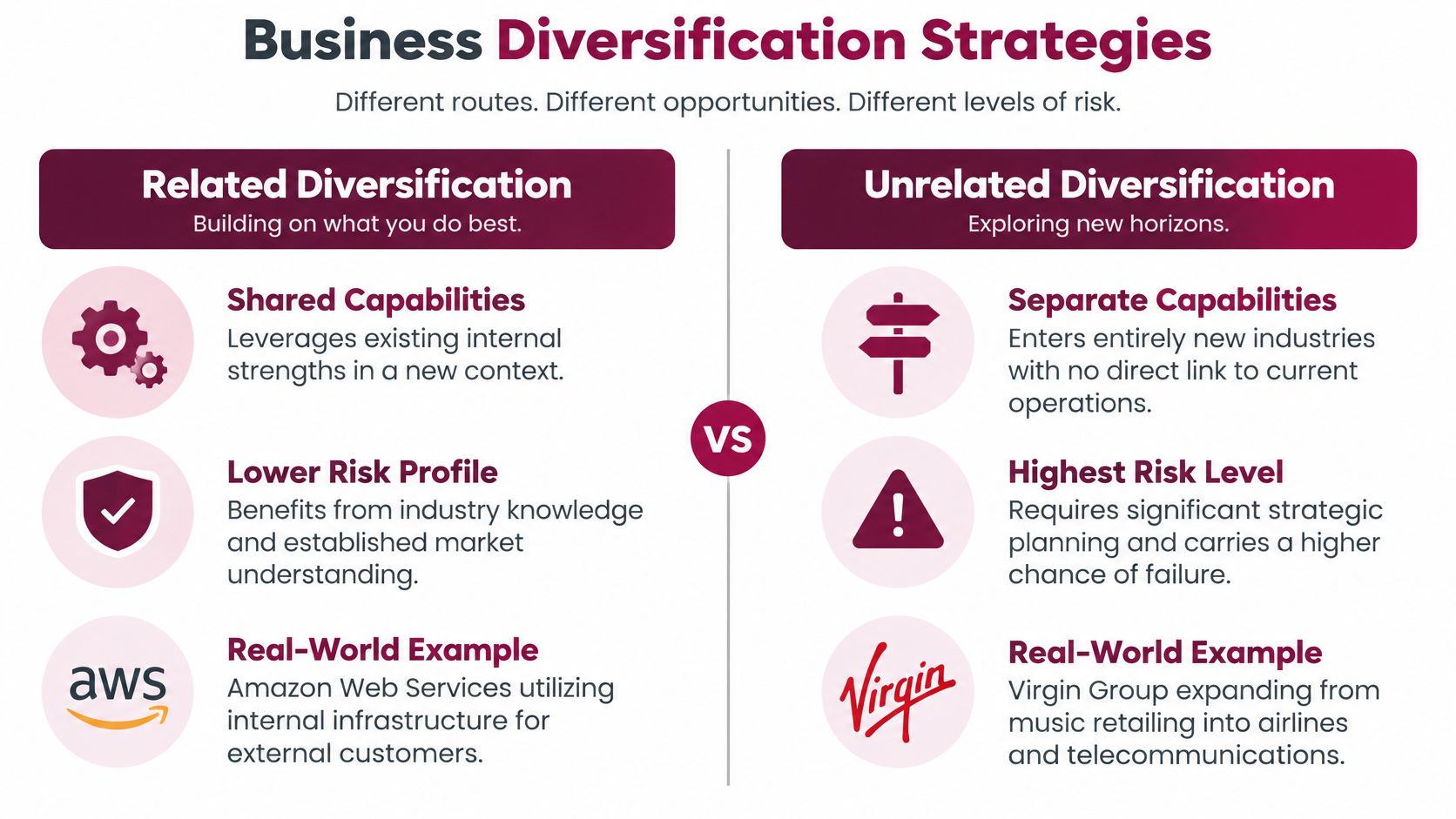
For established firms with surplus management capacity and investment resources, related diversification can create another revenue stream. Diversify only when an existing capability offers a credible route to customers, and address weaknesses in the core business separately.
Identify the transferable advantage
First implementation step: Write a strategic-fit assessment that names what transfers, what must be built and why customers would choose the new venture.
A shared brand or an enthusiastic sponsor does not establish commercial fit. The assessment should show how the venture will reach paying customers and who will manage delivery.
Stage investment through a limited pilot or a separately accountable business unit. Set funding limits, reporting responsibilities and closure conditions before expansion.
Diversification can broaden revenue sources while increasing operational complexity. Protect the core business from open-ended funding commitments, and do not assume success in one activity proves competence in another.
5. Strategic Alliances and Partnerships
A complementary partner can provide market access or capability without requiring you to build everything internally. Strategic alliances include referral arrangements, licensing, co-marketing, supplier collaboration and joint ventures.
For early-stage founders and scaling firms, partnerships can reduce initial capital requirements. However, they replace some investment risk with dependence on another organisation's priorities, service standards and commercial behaviour.
Say a cybersecurity consultancy partners with a managed IT provider. The provider gains specialist expertise, while the consultancy reaches relevant customers through an established relationship. The arrangement only works if both parties understand who owns the customer relationship and who resolves service failures.
Agree governance before promotion
First implementation step: Draft a joint operating brief before announcing the partnership. Explain the customer benefit, each party's contribution, commercial terms and decision-making responsibilities.
- Define attribution: Agree how referrals, revenue and delivery costs will be recorded.
- Assign accountability: Name an owner for customer complaints and missed commitments.
- Plan separation: Specify how customer information, outstanding work and branding will be handled if the arrangement ends.
Choose complementary capabilities rather than relying on brand visibility alone. A prominent partner may provide little value if its sales team has no incentive to recommend your offer.
Start with a bounded commercial activity before accepting exclusivity or substantial integration costs. Continue only when the partnership demonstrates profitable customer value, not merely meetings, introductions or shared publicity.
6. Data-Driven Decision Making
Data-driven decision making means using consistent evidence to improve choices about customers, pricing, demand and resources. It doesn't require an advanced analytics department at the outset.
The UK Business Data Survey 2026 reports that 86% of UK businesses handled digitised data in 2025–26, but only 25% of data-handling businesses analysed it to generate new insights. Collecting information and using it effectively are different capabilities.
For business analysts and established managers, the immediate opportunity is often a clearer decision process rather than an advanced dashboard.
Begin with a business question
First implementation step: Choose a recurring decision, such as which customer segment deserves additional sales attention. Define its metric, data owner and review schedule.
Suppose an online education provider wants to improve completion. Connecting enrolment, engagement and support records could help staff identify where learners encounter difficulties and test appropriate assistance.
- Describe: Establish what happened using consistent definitions.
- Predict: Assess likely outcomes only when the underlying records are sufficiently reliable.
- Act: Assign responsibility for testing an intervention and reviewing its effects.
Our article on big data and strategic decision-making examines the connection between analysis and management choices. We also offer the Advanced Professional Certificate in Data Analytics for Business.
Protect confidential information and challenge apparent relationships before treating them as causes. A precise-looking forecast can still support a poor decision.
7. Digital Marketing and Content Marketing
A useful article attracts attention; a coherent marketing system turns relevant attention into enquiries and customers. Digital marketing coordinates channels such as search, email, social media and paid advertising, while content marketing supplies material that helps buyers make decisions.
For early-stage founders and marketing practitioners, this offers a testable route to demand. It isn't automatically inexpensive: content requires expertise, paid acquisition requires budget, and both need reliable measurement.
Consider a commercial cleaning firm targeting facilities managers. A practical guide to assessing cleaning tenders can attract suitable buyers, while a service-comparison page and clear enquiry form help them progress towards a purchasing conversation.
Connect content to commercial intent
First implementation step: Map a customer question to a useful content asset, a distribution channel and a relevant next action. Ensure the destination page explains who the service is for.
- Awareness: Explain the customer's problem and available approaches.
- Evaluation: Provide specifications, comparisons and answers to purchasing objections.
- Conversion: Offer an appropriate enquiry, demonstration or purchase route.
Track qualified enquiries, acquisition cost and resulting contribution rather than treating impressions as commercial success. Our discussion of how digital marketing is redefining business growth worldwide provides further context for connecting channels with growth objectives.
The central trade-off is speed versus durability. Advertising can test demand quickly, while useful search content requires sustained development. Don't increase either investment until you can distinguish relevant demand from low-quality traffic.
8. Customer Retention and Loyalty
A cluster of cancellations during onboarding points to a different problem than customers leaving after repeated service failures. Customer retention depends on continued value, reliable delivery and effective problem resolution. For scaling firms with an established customer base, improving these factors can support growth with less exposure than entering unfamiliar markets. Some accounts may remain unprofitable despite reasonable corrective action, so assess retention decisions against the value of the relationship.
Repair the experience before rewarding it
First implementation step: Analyse cancellations by customer cohort, purchase reason and stage of the relationship. Combine transaction records with exit feedback and recurring support themes to identify where customers disengage.
- Improve onboarding: Help customers reach the outcome that motivated their purchase.
- Resolve recurring friction: Address repeated complaints at their operational source.
- Design relevant benefits: Reward behaviour that supports customer value and sustainable margins.
Set a retention test against a defined period. For example, choose a target for the 90-day cancellation rate, then compare each customer cohort with it. If cancellations exceed the target, examine the reasons before adding incentives.
Retention test: Would customers still want the relationship if you removed the incentive? If not, investigate the underlying offer.
Personalisation also needs restraint. Use information customers reasonably expect you to hold, and avoid excessive messages. A reliable service and relevant renewal conversation may serve customers better than a complicated points system.
9. Operational Efficiency through Lean and Six Sigma
When employees spend their day correcting orders, searching for information or chasing approvals, additional demand can worsen performance. Operational efficiency creates room for growth by reducing avoidable work and improving consistency.
Lean focuses on activities that don't add customer value. Six Sigma uses structured analysis to reduce process variation and defects. For established managers facing capacity constraints, both approaches can improve delivery before further sales investment.
Digital tools can support this work. The SME Digital Adoption Taskforce report cites evidence of firm-level productivity improvements ranging from 7% to 18% per technology adopted, depending on the digital product.
Improve the process before automating it
First implementation step: Map a high-cost or error-prone workflow from customer request to completion. Record handovers, waiting, rework and unclear responsibilities.
Suppose a wholesaler repeatedly corrects manually entered orders. Standardised order capture and validation may address the underlying problem more effectively than adding staff to handle corrections.
- Establish a baseline: Measure cycle time, error rate and cost per completed transaction.
- Remove unnecessary steps: Challenge duplicate entry and approvals without a clear purpose.
- Confirm customer value: Check that faster processing doesn't weaken quality or responsiveness.
Our guide to lean management principles for the modern business develops this process-focused approach.
Efficiency becomes counterproductive when managers remove resilience or overload employees. Preserve necessary controls and distinguish waste from capacity that protects reliable service.
10. Leadership Development and Talent Management
A founder approving every quotation can become a constraint even when demand and delivery systems are strong. Leadership development and talent management build the managerial capacity needed to distribute decisions without losing accountability.
For scaling firms, this means developing capable managers before expanding their responsibilities beyond what they can reasonably handle. For established managers, it means aligning succession, feedback and development with the organisation's intended direction.
The requirement is practical rather than ceremonial. A leadership workshop won't resolve unclear authority, conflicting objectives or a founder's unwillingness to delegate.
Develop capability against real decisions
First implementation step: Map the decisions required by the growth plan and identify where authority or competence is concentrated. Select a genuine responsibility that another manager can assume with defined support.
Suppose a professional-services firm wants to open another office. A prospective office leader could first manage an existing client portfolio, including staffing, delivery quality and commercial reviews.
- Clarify authority: Specify which decisions the manager can make independently.
- Provide feedback: Review actual choices and outcomes rather than relying on general impressions.
- Build succession: Identify cover for critical responsibilities and provide opportunities to practise.
Use mentoring, structured reflection and applied case discussions to connect learning with workplace behaviour. Assess progress through decision quality, team coordination and delivery outcomes, not attendance alone.
Development requires time away from immediate production. That investment is justified when managers gain responsibilities they can exercise effectively, rather than titles unsupported by authority or resources.
How the ten growth strategies compare on focus, main risk, key measure and related LSBA pathway
The sequence below moves from lower-commitment actions in familiar markets towards strategies that generally require greater investment, new capabilities or organisational readiness. Risk, capital and readiness vary by business, so treat the tiers as a guide. Each row gives a first step and the audience most likely to benefit at that stage.
| Sequence and strategy | Growth focus | Risk tier and specific failure mode | Capital requirement | Readiness level | Audience segment | First implementation step | Key measure | Related LSBA pathway |
|---|---|---|---|---|---|---|---|---|
| 1. Market Penetration | Sell existing products to existing markets | Lower. Discounting to win sales can reduce margins without building repeat demand. | Low | Early. Existing offer and customer base | Early-stage founders | Identify one customer segment and test a change to pricing, promotion or distribution. | Sales volume, repeat purchases and market share | Marketing Strategy |
| 2. Customer Retention and Loyalty | Keep existing customers and increase their value over time | Lower. Loyalty incentives can cost more than the repeat business they generate. | Low to moderate | Early. Customer service and purchase records need tracking | Early-stage founders and scaling firms | Review repeat-purchase patterns and identify one preventable reason customers leave. | Retention rate, repeat purchases and customer lifetime value | Digital Marketing |
| 3. Digital Marketing and Content Marketing | Attract and convert customers through online channels | Moderate. Platform changes or weak conversion can make attention costly without producing sales. | Low to moderate | Early to intermediate. A clear offer and conversion path are needed | Early-stage founders and scaling firms | Choose one online channel and define the conversion action to measure. | Conversion rate and cost per acquisition | Digital Marketing |
| 4. Data-Driven Decision Making | Use data to identify and act on growth opportunities | Moderate. Inaccurate records can distort forecasts and direct resources towards the wrong opportunity. | Low to moderate | Intermediate. Relevant, consistently recorded data | Scaling firms and established managers | Select one growth decision and check whether the underlying data is complete and consistent. | Forecast accuracy and decision outcomes | The Credential of Data Analytics for Business Programme |
| 5. Operational Efficiency through Lean and Six Sigma | Reduce waste, improve quality and lower unit costs | Moderate. Cutting time or cost without tracking quality can increase defects and rework. | Moderate | Intermediate. Processes and performance measures must be visible | Scaling firms and established managers | Map one process and record its cycle time, defects and cost per unit. | Cycle time, defect rate and cost per unit | Operations and Process Management |
| 6. Market Development | Take existing products into new markets | Moderate to high. An offer that works in one region or segment may fail under different regulations or customer expectations. | Moderate to high | Intermediate. Existing offer and delivery capacity are established | Scaling firms | Test demand in one new region or customer segment before committing to wider expansion. | Uptake in the new region or segment | Strategic Marketing for Startups |
| 7. Strategic Alliances and Partnerships | Grow through shared capabilities, resources or market access | High. Misaligned responsibilities can stall delivery, while unclear information boundaries expose knowledge. | Moderate | Intermediate to advanced. Commercial goals and accountability need agreement | Scaling firms and established managers | Set a shared objective, define each party's responsibilities and agree how results will be measured. | Performance against agreed goals | Leadership and Organisational Behaviour |
| 8. Product Development | Offer new or improved products to existing markets | High. Development can absorb resources before customer demand is demonstrated. | High | Advanced. Customer insight and development capacity are available | Scaling firms and established managers | Validate one customer problem before committing to a full product build. | Customer adoption and product performance | Product Development |
| 9. Leadership Development and Talent Management | Build leadership capacity to support growth | High. Training may not improve delivery if staff lack authority to apply new skills or leave before the organisation benefits. | Moderate to high | Advanced. Growth plans and management responsibilities are defined | Established managers and scaling firms | Identify a growth-critical responsibility and assess who can take it on with appropriate support. | Leadership readiness and talent retention | Leadership and Organisational Behaviour |
| 10. Diversification | Introduce new products to new markets | Highest. The business must prove both a new offer and a new audience, increasing the chance that assumptions about demand or delivery are wrong. | High | Advanced. Existing operations can support a separate market test without disrupting the core | Established managers | Test one product-market combination on a limited scale before broader investment. | Performance of new revenue streams | Strategic Management and Business Environment |
From Priorities to Practice Sequencing Your Next Move
Effective strategies for business growth work together, but they rarely need to start at once. A profitable firm may benefit from improving retention before funding another acquisition campaign. An expanding firm may need stronger operational control before entering a new market.
Sequence decisions by readiness, risk and available capital. Start with market penetration or retention when the offer and customer base are established. Before committing to further growth, check whether records, processes and management capacity can support the added workload.
Match the commitment to the evidence
Market or product development calls for clear evidence about what works and what the expansion will require. Set out the expected costs, management time and cash-flow effects before approving the commitment.
Funding should fit the purpose and risk. The British Business Bank's Small Business Finance Markets Report 2025 factsheet reports £62 billion in gross bank lending in 2024, a 4.5% year-on-year increase. This is an aggregate figure, not evidence that borrowing suits a particular expansion.
- Use retained earnings deliberately: Reinvestment preserves ownership but can limit the pace of growth.
- Match repayments to cash generation: Predictable expansion may support planned repayments; uncertain income makes them harder to meet.
- Protect operating capacity: Include working capital, implementation effort and management time in the investment decision.
Location also matters when assessing access to finance. The British Business Bank's strategic plan reports that 53% of high-growth businesses were outside London, the South East and the East of England in 2024, while those regions received 23% of UK smaller-business equity investment. A firm's growth case still needs to rest on its commercial prospects and ability to fund delivery.
Choose a commitment that the business can finance and manage, with a clear measure for reviewing its results.
Within the next quarter, select one strategy, define its success metric and assign a named owner. Make the choice against the firm's current constraint, investment capacity and management readiness.
London School of Business Administration offers self-paced, CPD-accredited courses and structured programmes across business management, leadership, marketing, entrepreneurship and data analytics. Explore London School of Business Administration for learning related to the commercial, analytical or management capability your chosen growth strategy requires.