
One in four UK employees was aware of conduct that broke the law or their organisation's own standards in the previous year, and one in three of those who noticed said nothing about it, according to the Institute of Business Ethics' findings on unreported misconduct. In the same survey, the two deterrents cited most often were fear of jeopardising employment and doubt that corrective action would follow, each named by 34% of respondents.
That silence is the measure that matters. A code of conduct, a values poster or a hotline on the intranet only records what a company claims to believe. Ethical leadership in business is proved by what happens to the person who uses them, and by what everyone watching concludes about whether honesty was worth the cost. Retaliation works like any other failed control: an alarm that staff are afraid to pull tells you nothing about the building, and everything about the culture.
Watch what employees observe. A leader publishes standards, then lets a high performer bypass them. The lesson that travels through the organisation outlasts any policy document, because people calibrate their own behaviour to the consequences they witness, not the rules they read. The rest of this article examines how leaders close that gap, from defining ethical leadership to testing whether people trust the system enough to speak.
Table of Contents
- What Ethical Leadership Means in Business
- Why Ethical Leadership Pays Off for UK Businesses
- Legal Duties and Governance Foundations
- How to Work Through an Ethical Dilemma Step by Step
- Testing Whether Employees Trust Your Ethics
- Ethical Leadership in Practice Through a Supplier Scenario
- Turning the Audit Into Your First Action
What Ethical Leadership Means in Business
Ethical leadership is the practice of making and communicating decisions that are honest, fair and accountable, particularly when those qualities cost the business something. That last clause carries the weight. Standards hold easily while targets are being met; the test arrives with a supplier who is cheap because someone further down the chain is being underpaid, a productive colleague who demeans junior staff, or a forecast that needs a small, convenient adjustment to land.
A leader works like a compass rather than a map. A map describes the terrain once. A compass sets a bearing the team reads in every meeting, every bonus round and every redundancy conversation. Shift that bearing a few degrees and nothing looks different on the first day. Six months later, the team has arrived somewhere the leader never intended to go, and nobody can point to the moment it happened.
From personal character to organisational consequence
A private individual's standards affect the people at their own table. A manager's standards travel. One senior person who exempts the top salesperson from an expenses rule teaches the whole commercial team more about what the company believes than any induction module. Employees make this inference constantly. They watch what happens to the colleague who raises a problem, and they recalibrate their own behaviour accordingly.
Ethics governs how people act when pressure is high and evidence is incomplete. A team that expects fair treatment flags risk early. A team that expects blame buries it until it becomes a crisis.
That expectation is measurable. The speed and safety with which bad news reaches a decision-maker, and what happens to the person who delivered it, reveal more about a leader's ethics than the wording of any policy.
Where the principles meet daily decisions
| Principle | What it looks like | Warning sign |
|---|---|---|
| Honesty | Tells people bad news early and corrects errors openly | Information is filtered before it reaches decision-makers |
| Accountability | Owns decisions and their consequences, and names responsibility | Blame is passed down the line |
| Fairness | Applies the same standards to senior and junior staff | Exceptions are made for high performers |
| Transparency | Explains the reasons behind decisions to those affected | Decisions arrive without explanation |
| Courage | Raises concerns about peers and superiors | Meetings are silent when problems are visible |
Read the table as a self-audit. Choose the row where your own team is weakest, and hold it in view. Each of the sections that follows tests one version of the same question: does the principle survive contact with a real decision, made under time pressure, with money attached?
Why Ethical Leadership Pays Off for UK Businesses
In 2025, 96% of UK business leaders said they remained committed to responsible business, according to Business in the Community's State of the Nation report, which draws on interviews with more than 100 senior leaders. A stated commitment costs little; a demonstrated one costs something, and the public has its own view of what proof looks like. In 2024, 61% of the British public said it was important or very important for a chief executive's pay to reflect the company's ethical performance, according to the Institute of Business Ethics' attitudes research.
The commercial case rests on four things a leader can observe: trust that makes bad news travel faster, retention of people who could work elsewhere, lower exposure when misconduct surfaces, and a reputation that survives a difficult news cycle. Notice what those four have in common. None of them lives in a code of conduct or a hotline poster. Each one registers in employee experience, which means each can be measured: whether people raise concerns early, whether someone who reports a problem is still treated fairly months later, and whether a report ever changes anything.
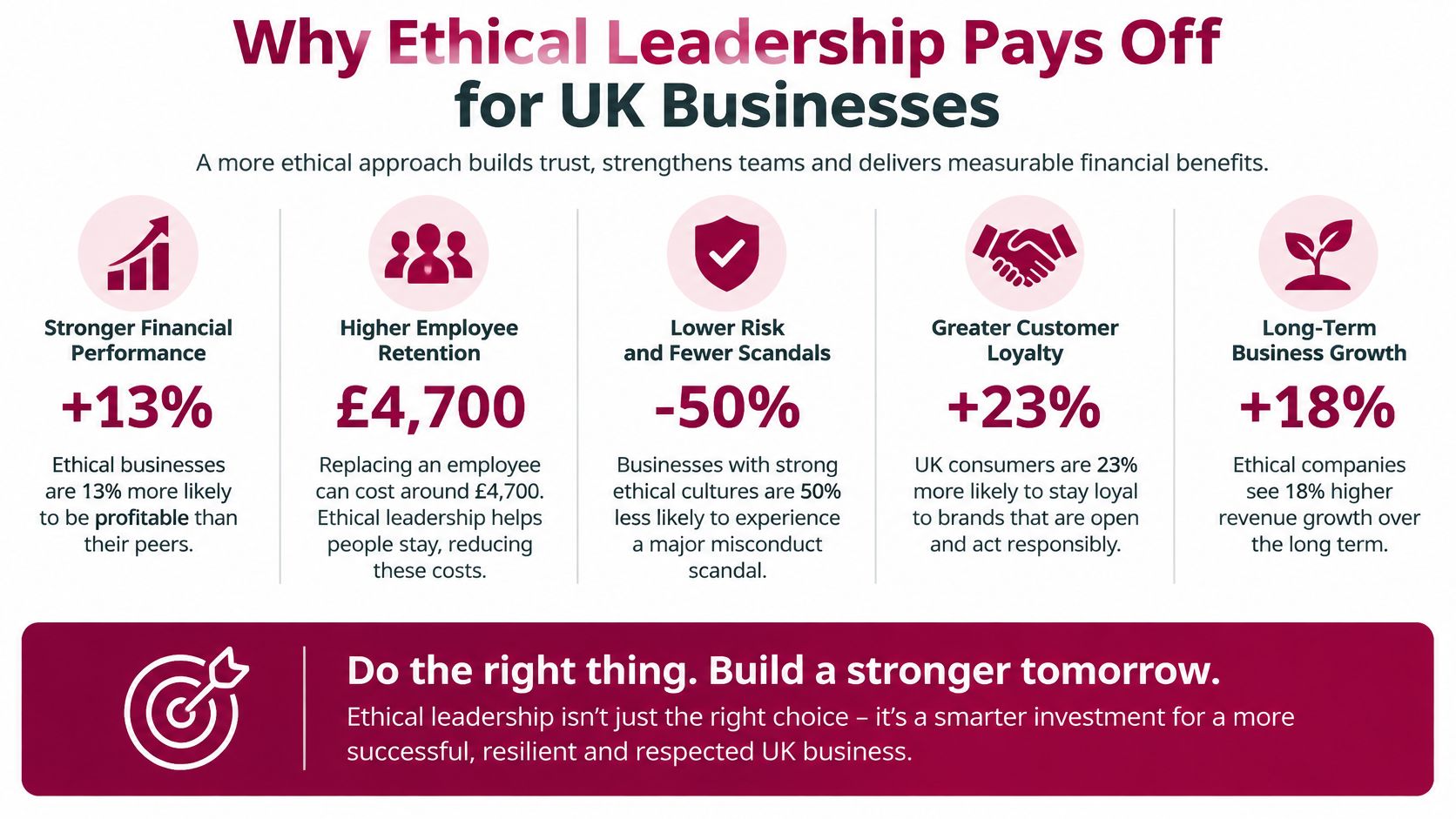
The gap between stated and demonstrated ethics is visible in the survey data. In the Institute of Business Ethics' 2018 Ethics at Work survey, 70% of UK employees said their organisation acted responsibly in all its business dealings, 24% had been aware of misconduct at work against a 30% European average, and 38% said their organisation provided all four of the ethical "building blocks" it assessed, against 19% across Europe, according to the survey's published results.
The transmission mechanism is the line manager. In the institute's more recent UK results, a majority of employees said their line manager set a good example of ethical business behaviour, and an even larger share said the manager supported them in following organisational ethical standards. A line manager works like a gauge on the whole system: employees read that person's daily behaviour the way an engineer reads a pressure dial, and they calibrate their own conduct to it. No board can buy that effect directly, and no communications plan can fake it for long.
The evidence test: a commitment that survives a bad quarter is a value; a commitment that appears only in the annual report is a sentence.
The practical implication is narrow. Employees do not weigh your stated values. They weigh your last difficult decision and generalise from it to their own. That is why the return shows up first in small signals: a concern raised early, a report that leads to a visible correction, a whistleblower whose career continues intact. Retaliation after a report is a measurable control failure, and it erases the return on everything else. If you want the benefit of the doubt in a crisis, the visible behaviour has to have earned it in ordinary weeks.
Legal Duties and Governance Foundations
UK company directors carry seven statutory general duties under the Companies Act 2006, set out in the director information hub on general duties. These duties convert ethics from a personal disposition into an operational expectation with a documented trail, which is why governance is the first place to test whether stated values hold under pressure.
| Duty | What it requires in practice |
|---|---|
| Act within the company's constitution | Decisions stay within the articles and the authority granted |
| Promote the company's success | Consider long-term effects, employees, suppliers, community, environment and reputation |
| Exercise independent judgement | Decide without being directed by others or by a third party |
| Exercise reasonable care, skill and diligence | Take informed decisions with proper competence and information |
| Avoid conflicts of interest | Identify and avoid situations where personal interests clash with the company's |
| Refuse benefits from third parties | Decline payments or benefits offered because of the directorship |
| Declare interests in proposed transactions | Disclose personal interests in proposed deals before they are approved |
The duty to promote success is the one that surprises directors most often. It reaches well beyond short-term shareholder returns: it requires weighing the likely long-term consequences of a decision, the interests of employees, relationships with suppliers and customers, community and environmental impacts, the company's reputation for high standards of business conduct, and fairness between members. Directors can take professional advice, yet the judgement itself stays with them. Documented reasoning is the protection.
How the Cadbury Code turned principle into board practice
The framework most UK boards work inside began with the Cadbury Committee, established in May 1991 by the Financial Reporting Council, the London Stock Exchange and the accountancy profession, and reporting in December 1992 after a run of governance failures, as the Cadbury archive at Cambridge Judge Business School records. The Code recommended separating the roles of board chair and chief executive, ensuring boards contained a majority of outside directors, staffing remuneration committees mainly with non-executive directors, and creating audit committees with at least three non-executive directors.
The London Stock Exchange gave those recommendations teeth through comply or explain: listed companies had to disclose whether they followed the Code and account for any departure. That single mechanism linked leadership integrity, transparency and independent oversight to formal board practice, and it shaped later developments including the 2010 UK Corporate Governance Code and the Stewardship Code for investors. The lesson reaches well below board level. Structures that reduce conflicts of interest and force scrutiny outlast the good intentions of whoever happens to be in post.
The modern slavery statement as a test of senior ownership
Transparency duties now reach further than the boardroom. Commercial organisations with an annual worldwide turnover of at least £36 million that carry on business in the UK must publish an annual slavery and human trafficking statement describing the steps taken to ensure modern slavery isn't occurring in their operations or supply chains, or state explicitly that no steps have been taken. In the Financial Reporting Council's review of this reporting, only 14% of annual reports provided a direct link to the relevant statement, while 87% of sampled companies placed a visible homepage link.
That gap is instructive. Most of the sampled companies made the statement easy to find, yet very few made it traceable inside the report where it belongs. Visibility is the appearance of compliance; traceability is the substance of it. The same distinction separates a code that exists from a code that operates: the test is whether someone examining the record can follow a decision from concern to consequence.
Recording decisions well is the discipline that ties all of this together, as our article on corporate governance and accountability explains. After each significant decision, capture four things: the options considered, the reasons for the one chosen, the stakeholders consulted, and the name of the approver. That record is what an employee cites when deciding whether raising a concern will lead anywhere. Managers who want those frameworks set out systematically can work through our course on Principles of Business Ethics.
How to Work Through an Ethical Dilemma Step by Step
Pressure shortens judgement. Under it, people reach for the fastest available answer, and the fastest answer usually protects the person deciding. A shared sequence slows that reflex down just enough to check it against the values you claim to hold, the way a pre-flight checklist slows a pilot who is certain the runway is clear.
In 2025, 88% of surveyed UK organisations said they had an ethical decision-making framework in place, according to Corporate Conscience Index research commissioned by Freeths, which drew on responses from 250 UK general counsels and chief legal officers. Having a framework is rarely the missing piece. Using it under pressure is.
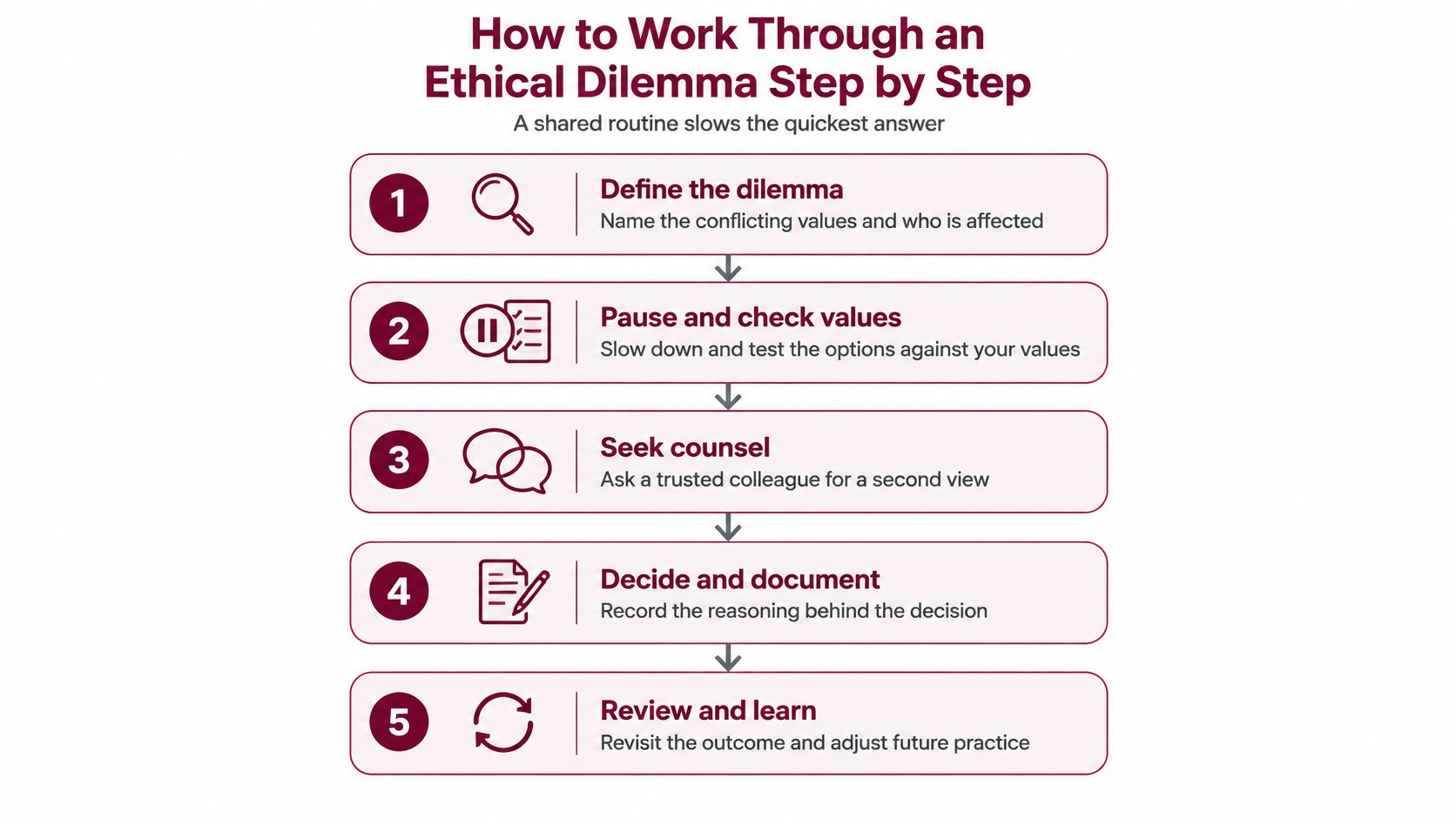
The sequence below takes a dilemma from first unease to a recorded, reviewable decision.
- Define the dilemma in one sentence and name who is affected. Precision matters because what looks like one problem often turns out to contain two separate questions: what happened, and who bears the cost of fixing it. Common slip: describing the situation as a personality clash, which makes it sound unresolvable.
- Check the legal and policy requirements, including any duties under the Companies Act 2006. Legal requirements define the minimum standard a decision must meet; whether it should be made at all is a further question, and the gap between the two is where difficult choices live. The distinction between morality and legality deserves attention before you rely on it. Common slip: treating compliance as the finish line.
- List the stakeholders with a stake in the outcome, including staff, suppliers and customers. Write them down rather than relying on memory, because a list on paper is harder to shorten than a list in your head. Common slip: dropping the least powerful party when a deadline is close, which is exactly when their absence matters most.
- Apply four tests. Would the outcome be fair to the person with least power? Could you explain the decision, in full, to those it affects? Would you be comfortable seeing it reported? Can any harm be corrected if you're wrong? Common slip: running the tests to justify a decision you had already taken.
- Choose the option and record the reasons, the alternatives considered and who approved. The record is what makes the decision reviewable later, by auditors, a board or a tribunal. Common slip: recording only the conclusion and leaving the reasoning invisible.
- Review the outcome after a set period and communicate what changed. Treat ethics as a loop that you revisit after each decision, because a decision never checked against what happened teaches the organisation nothing. Common slip: never diarising the review, so the decision is never evaluated against its real consequences.
Practical rule: if the written record would embarrass you in front of the person the decision affects most, the reasoning isn't finished yet.
Reduce the whole routine to a single page you can keep beside you: one sentence defining the issue, the legal check, the stakeholder list, the four tests, the decision and approver, and the review date. A page that fits in a drawer gets used.
Testing Whether Employees Trust Your Ethics
A written code and a reporting hotline prove that a mechanism exists. They say nothing about whether anyone believes that mechanism leads anywhere, and belief is the variable that decides whether risk reaches you early or never at all. A hotline that employees distrust works like a smoke alarm with the battery removed: the casing sits on the wall, the wiring is dead, and the first sign of trouble is the fire itself.
The practical test is a small set of indicators read together, each one measuring a different stage of the journey from concern to consequence.
| Indicator | What it reveals | Warning sign |
|---|---|---|
| Psychological safety survey, split by level | Whether frontline staff feel safe raising mistakes | Senior scores far above junior scores |
| Whistleblowing reports per 100 employees | Volume of concerns reaching the channel | Falling numbers with no explanation |
| Share of reports made anonymously | Whether employees trust confidentiality | Sudden shift away from named reporting |
| Substantiation rate of closed cases | Quality of investigations | Very high or very low rates over time |
| Median time to resolution | Speed of corrective action | Cases open beyond the agreed timeline |
| Repeat issues in the same team | Whether lessons change practice | The same complaint recurring |
| Retaliation or disadvantage after reporting | Whether speaking up is protected | Complainants passed over, moved or dismissed |
| Turnover after a complaint | Whether complainants face consequences | Departures clustered after reports |
Benchmarks give those numbers a reference point. UK benchmarking data for 2024 recorded a median of 0.61 whistleblowing reports per 100 employees, a median anonymous-reporting rate of 69%, and a median 44% substantiation rate among closed cases, according to the 2025 UK whistleblowing benchmarking findings. Read your own figures against these medians with care. A report count well below the median can mean a healthy culture, or it can mean a silent one. Falling reports alongside rising turnover after complaints points to the second.
The gap between what leaders believe and what employees experience is itself a diagnostic. 91% of surveyed HR professionals believed employees felt safe reporting misconduct, while 57% of employees who experienced bullying or harassment had not reported it, according to The Employee Voice 2025. When the people running a process rate it far more kindly than the people who might need it, the process is grading itself.
Measurement has its own failure mode. In 2025, 63% of companies reportedly used a basket of culture metrics, up from 50% in 2024, yet only 6% tied culture to long-term incentive plans, 13% included it in annual bonuses, and nearly 45% of surveyed UK employees said they did not feel comfortable raising mistakes or potential risks, according to Grant Thornton's 2025 governance review. Tracking culture while attaching no consequence to it produces dashboards rather than change, and a badly chosen metric can reward managers for suppressing the very complaints the system exists to surface.
So triangulate. Pair a leading indicator, such as psychological-safety scores split by seniority, with a lagging one, such as turnover after a complaint or the same issue recurring in one team. Then treat every substantiated case of retaliation after a report as a control failure in its own right, investigated and logged with the same rigour as a financial irregularity. A single unpunished act of retaliation teaches more employees to stay silent than any awareness campaign can teach them to speak.
Ethical Leadership in Practice Through a Supplier Scenario
An operations director for a regional division learns that a key supplier has withheld pay from agency workers. The contract is mid-cycle, volume targets are tight, and the supplier's account manager describes the gap as an administrative delay. Three responses are available, and only one of them holds up under scrutiny.
Ignore it. The schedule holds, the workers stay unpaid, and the director becomes answerable if the matter surfaces later through a grievance, a journalist or a due diligence request. Silence is still a decision. It is the one that scales worst, because everyone who saw the report learns what the organisation tolerates, and they adjust what they are willing to raise accordingly.
Handle it discreetly. A private assurance from the supplier may stop the immediate harm. It leaves no record for the board, the auditors or the published statement on modern slavery, and no evidence that anyone raised the issue at all. The next person who spots a problem sees that concerns disappear into phone calls.
Escalate with a documented remediation plan. Name the risk in writing, set a deadline for back pay, pause new orders until payment is confirmed, record who approved each step, and report the outcome to the audit committee. The supplier may push back. The record survives either way, and the lesson on ethical sourcing and supplier selection covers the sourcing and selection questions that sit behind a decision like this.
The national picture explains why the third route matters beyond one contract. More than 19,000 potential victims were referred to the National Referral Mechanism in 2024, the highest number recorded and a 13% increase on the previous year, according to the UK Parliament's 2024–25 modern slavery statement. That figure counts people entering the official identification system, not total prevalence, because exploitation is hidden and not every case is detected. It still shows that recruitment practices, labour providers and procurement controls deserve named owners.
Three lessons carry across. Structures outlast personalities: the escalation route should exist before the difficult case arrives. Transparency is a practice: a statement nobody can find or verify is a filing exercise. Ethics shows in what leaders do when it costs them, and the supplier decision sits exactly there. One further test follows the escalation itself. Watch what happens to the person who raised the concern in the months that follow. If their workload shrinks, their shifts change or their name drops off the next project, every other control in the organisation reads as theatre. What happens after a report is the evidence people use to decide whether speaking up is safe.
The Credential of Leadership and Management Programme works through decision-making frameworks of this kind, and Jenna Tiffany integrates real-world organisational scenarios into its design, combining structured frameworks with applied case-based learning. You can review The Credential of Leadership and Management for the full structure.
Turning the Audit Into Your First Action
Choose one behaviour to audit this month rather than attempting the whole framework at once. Five moves turn the indicators in this guide into something you can report on.
- Pick the weakest principle from the self-audit table above. The row you resisted choosing first is usually the honest one.
- Pull the matching indicator and split it by level. Compare senior scores with frontline scores instead of reading an average that hides both.
- Ask three people outside your reporting line whether they would raise a concern about that behaviour, and what they expect would happen if they did. Their answer is the trust measure that matters.
- Run one live dilemma through the six-step routine and file the record with the decision. One documented case teaches the habit faster than a training session.
- Set a review date three months ahead and agree in advance what counts as improvement. Write the threshold down now, while you still have no stake in the result.
A culture audit isn't proof that you're ethical. It's evidence about whether your people believe speaking up changes anything.
That belief is the outcome worth measuring. Everything else, the framework, the statement and the channel, only creates the conditions for it.
London School of Business Administration teaches this material through courses including Ethical Decision-making in Organisations and Principles of Business Ethics, and through the eight CPD-accredited courses that make up our Credential of Leadership and Management, which emphasises decision-making frameworks and corporate direction. Our learning model pairs interactive coursework with real-world examples and case studies, so the tests and routines in this guide get applied to decisions rather than only described. Visit London School of Business Administration to see how the programmes are structured and where to begin.