

If your legal adviser confirms that a decision is lawful, have you finished the ethical work, or have you only cleared the first hurdle? That question exposes a persistent gap in managerial thinking. Many organisations treat compliance as proof of responsibility, yet stakeholders often judge conduct by a wider standard.
Table of Contents
- Introduction to Morality and Legality in Business
- How Public Morality Shifts While the Law Lags
- Comparing Morality and Legality Across Key Criteria
- The Two-Stage Governance Test for Managers
- When the Law Institutionalises Moral Expectations
- AI Decision-Making Where Legality and Morality Diverge
- Why Ethics Policies Fail Without Psychological Safety
- Building a Practical Ethical Decision Framework
Introduction to Morality and Legality in Business
Consider a manager who's asked to approve a new pricing practice. It's permitted by contract and doesn't breach consumer law, but it relies on customers overlooking a renewal term buried in small print. The finance team sees predictable revenue. A junior colleague asks whether you'd be comfortable explaining the practice openly to those customers. That discomfort is informative, not sentimental.
Morality and legality answer different questions. Legality asks what enforceable rules permit, require or prohibit. Morality asks whether an action is right in light of values such as fairness, dignity and responsibility. They overlap frequently, but they aren't interchangeable, and confusing them creates predictable errors.
A practical distinction, not an abstract debate
A board may lawfully restructure a team, select a cheaper supplier or automate a screening process. Lawfulness alone doesn't settle whether people were treated with respect, whether risks were shared fairly, or whether the explanation given was honest. Conversely, an employee may feel a moral urge to disclose information yet still face legal constraints on how disclosure should happen.
Managers therefore need two habits. First, identify the applicable legal floor with precision. Second, test whether the proposed action retains ethical legitimacy for the people affected. Skipping the second test is how technically compliant decisions damage trust, morale and reputation.
A lawful decision can still be indefensible if you couldn't justify its effects to those who bear them.
Why the gap matters now
Public expectations move, technologies change what organisations can do with data, and employees don't automatically accept an instruction because it's compliant. That's why morality and legality should be taught as an operational discipline. You need concepts first, then evidence, then a repeatable method for documenting judgement.
The sections that follow build that sequence. You'll see how attitudes shift faster than statutes, how the two frameworks differ, and how UK law sometimes converts moral expectations into duties. Later sections apply the distinction to automated decisions, speak up culture and a framework you can use in approval meetings.
How Public Morality Shifts While the Law Lags
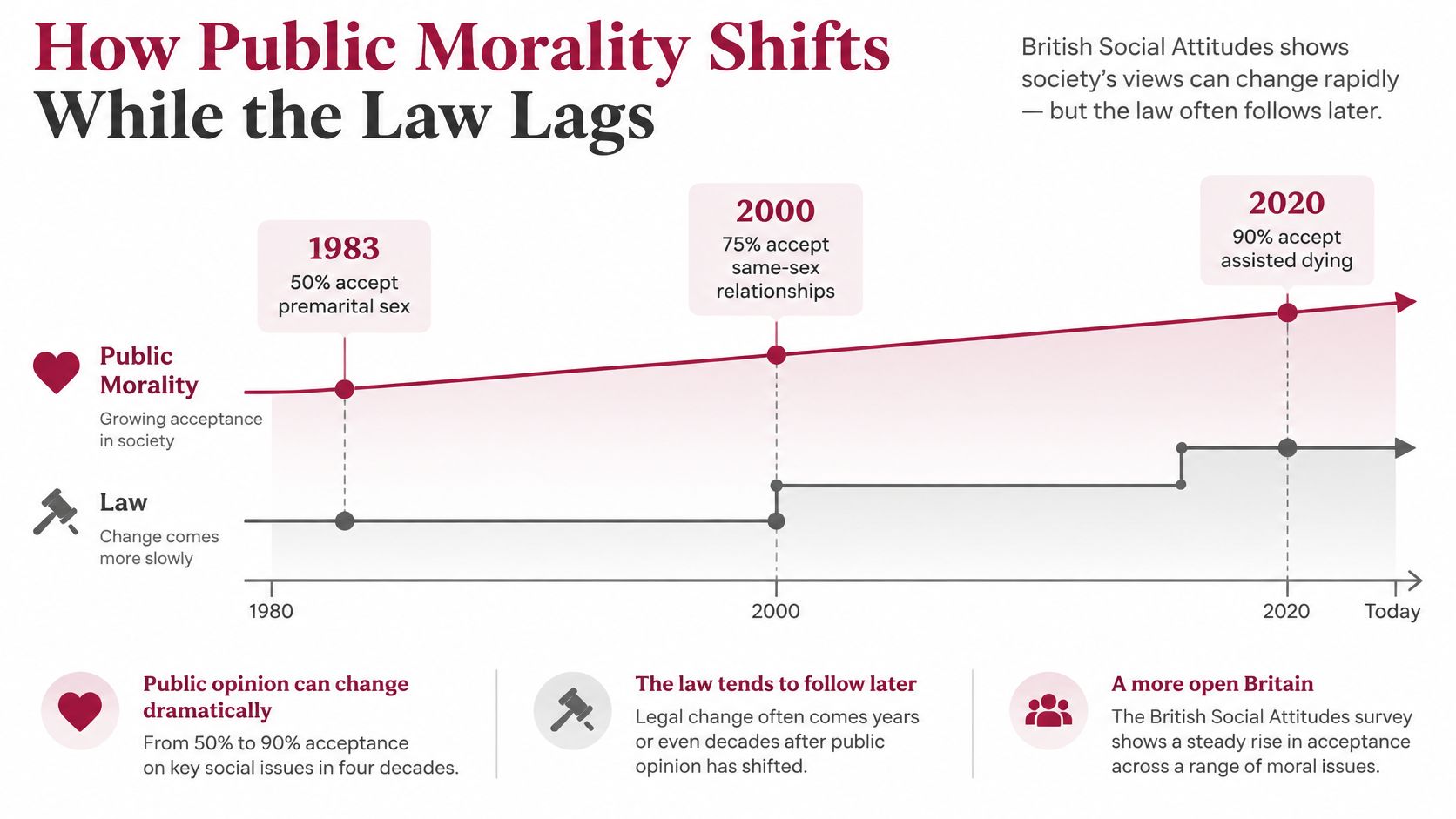
Moral attitudes rarely move in lockstep with legislation. Parliament deliberates, courts interpret, and regulators consult, while everyday judgements about relationships, family life and personal autonomy can change within a generation. For managers, that time lag matters because customers and employees bring current moral expectations to work, not the expectations that prevailed when a rule was drafted.
What UK attitudes show
The British Social Attitudes survey on moral issues reported that 75% of people considered sex before marriage "not at all wrong," an increase of 11 percentage points since 2012 and 5 points since 2015. Acceptance of same sex relationships also rose, with 64% saying such relationships were "not wrong at all," compared with 59% in 2015 and 47% in 2012.
Those shifts sit alongside longer legal history. Private homosexual acts between men were decriminalised in England and Wales in 1967, while same sex marriage received legal recognition in England and Wales from 2014. The Abortion Act 1967 permitted abortions under specified conditions, originally for pregnancies below 28 weeks, and later reforms reduced the general upper limit to 24 weeks. Law, morality and social practice influenced one another, but none moved automatically.
Where divergence remains sharp
Assisted dying illustrates the opposite tension. In the same survey evidence, 77% supported allowing a person with a painful, incurable disease to legally request that a doctor end their life, while UK law continued to prohibit assisting suicide. Majority approval didn't immediately produce legal change, just as legality doesn't guarantee moral approval.
- Monitor expectations, not only statutes: Workforce and customer values can shift before policy catches up.
- Expect uneven change: Some issues liberalise quickly, others remain contested despite survey majorities.
- Separate popularity from justification: A moral position isn't right because it's widely held.
That last point guards against a common confusion. Survey data tells you what legitimacy risks you face, it doesn't settle what you ought to do. Responsible managers read social change carefully, then reason about harm, rights and fairness rather than outsourcing judgement to either a statute book or a poll.
Comparing Morality and Legality Across Key Criteria
Students often ask whether morality is informal law. It isn't. The two frameworks differ in where they come from, how they're enforced and what happens when you breach them. Seeing those differences side by side prevents a familiar mistake, namely assuming that because no sanction follows, no wrong has occurred.
Morality vs Legality in Decision-Making
| Criterion | Morality | Legality |
|---|---|---|
| Source of authority | Shared values, professional norms, conscience and cultural expectations | Parliament, courts, regulators and enforceable contracts |
| Form | Often unwritten and open to interpretation | Codified in statutes, regulations and case law |
| Flexibility | Varies by context and community, can evolve informally | More uniform within a jurisdiction, changes through formal process |
| Enforcement | Social approval, criticism, loss of trust and reputation | Fines, damages, injunctions, prosecution and regulatory action |
| Consequence of breach | Guilt, reputational harm, weakened legitimacy | Legal liability and state backed sanctions |
| Managerial question | Should we do this, and can we justify it? | May we do this, and have we complied? |
Law prioritises certainty. Businesses need to know which tax is payable, which disclosures are required and which employment procedures must be followed. That certainty comes at a price. Rules are drafted for general cases, so they can't anticipate every morally salient feature of a particular decision.
Morality, by contrast, is sensitive to motive, context and consequences. It asks whether a technically available loophole exploits an information imbalance, or whether a lawful redundancy process was conducted with candour. Because moral norms aren't centrally codified, reasonable people may disagree. Disagreement doesn't make the test redundant, it makes structured reasoning essential.
The minimum standard problem
Treat legal compliance as a floor, not a ceiling. Meeting the floor protects you from sanction, but it doesn't demonstrate that you've acted fairly. A marketing claim might avoid a literal falsehood while still misleading by omission. A supplier contract might be valid while shifting unreasonable risk onto a small firm that can't negotiate.
Practical rule: If your only defence is "we're allowed to do it," you haven't yet made an ethical case.
Holding both frameworks in view also clarifies accountability. Lawyers advise on permissibility. Managers remain responsible for purpose, proportionality and impact. When those roles are blurred, organisations either become paralysed by excessive caution or hide behind compliance to avoid harder judgements.
The Two-Stage Governance Test for Managers
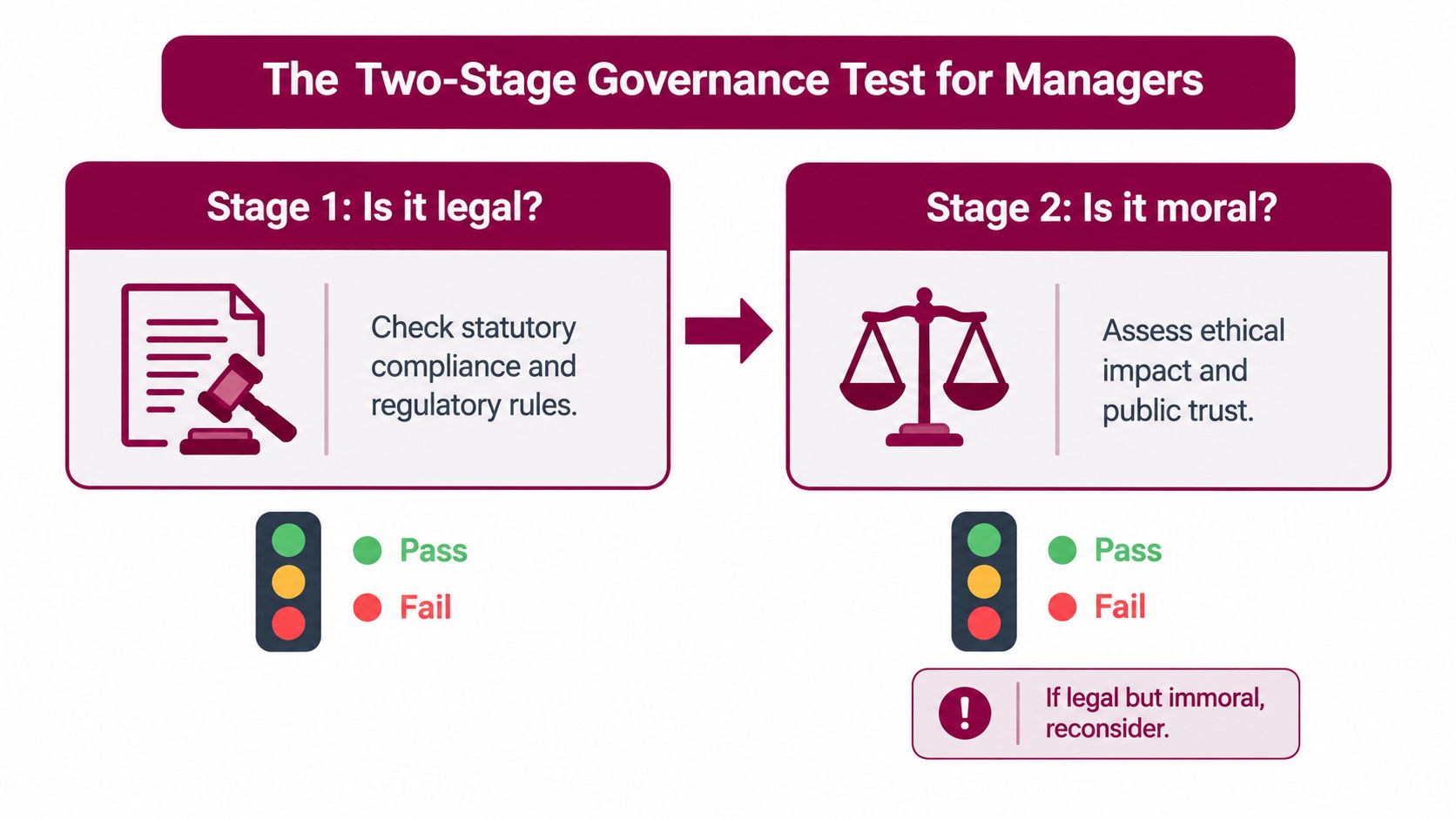
A useful way to operationalise the distinction is to run two tests in sequence and record both. UK Statistics Authority guidance on inclusive data illustrates the logic. It requires compliance with the Equality Act 2010, the Data Protection Act 2018 and UK GDPR, while also requiring work that advances equality, avoids harm and eliminates discrimination, as set out in its ethical guidance on inclusivity of data for research and statistics. Lawfulness is necessary, it isn't sufficient.
Stage one and stage two
Stage one asks, is it legal? Verify the lawful basis, relevant regulatory duties, contractual limits and retention requirements. If it fails here, you stop or redesign. There's no ethical argument that licenses casual illegality in ordinary management.
Stage two asks, is it morally defensible? Examine who may be disadvantaged, whether the action is necessary, whether a less intrusive alternative exists, and whether benefits and burdens are proportionate. Legal frameworks can produce such outcomes: lawful data segmentation, for example, might still exclude a protected group in practice.
A checklist you can evidence
- Legal basis and purpose: State why you're acting and which rule permits it.
- Necessity and proportionality: Show why this scope, and not a narrower one, is required.
- Equality impact and harms: Identify affected groups before deployment, not after complaint.
- Review and contestability: Name who can challenge the outcome and how errors are corrected.
This discipline aligns closely with wider corporate governance and accountability in today's business environment, where documented reasoning supports oversight. It applies well beyond statistics, to recruitment analytics, automated assessment, customer segmentation and employee monitoring. In each case, technically valid processing can amplify unequal effects.
Don't let a compliance sign off close the discussion. Ask the approver to sign the ethical assessment separately, with harms and mitigations recorded. That small procedural change creates auditable evidence that you designed responsibly, and it gives dissenting colleagues a legitimate place to raise concerns before launch.
When the Law Institutionalises Moral Expectations
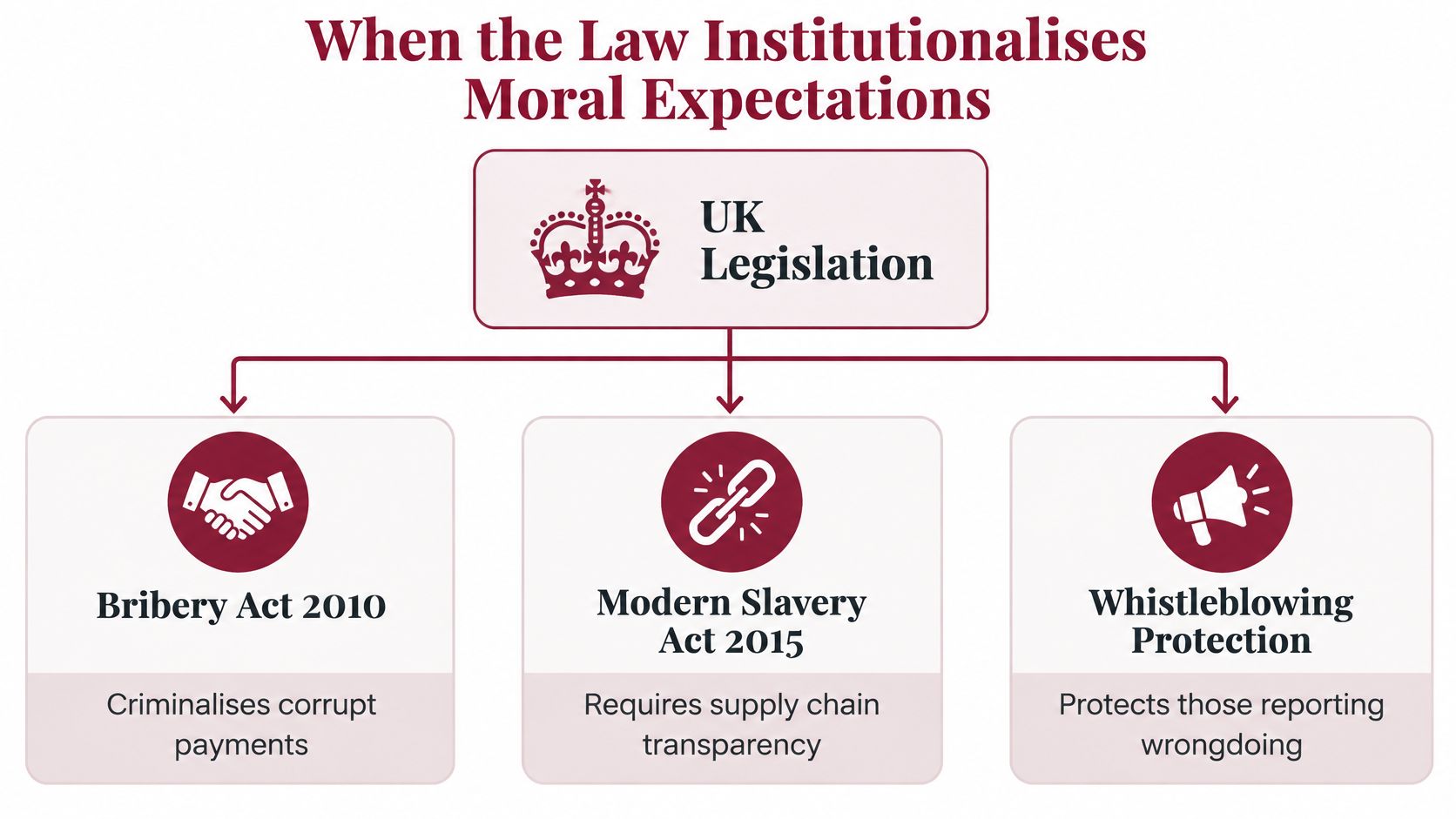
Sometimes society decides that voluntary moral standards aren't reliable enough and converts them into legal duties. UK public life offers a clear precedent. The Committee on Standards in Public Life was established in 1994 and produced the Nolan principles, including selflessness, integrity, objectivity, accountability, openness, honesty and leadership, a development described in Parliamentary material on standards in public life. By 1997, the committee had moved closer to a legal approach by recommending a statutory offence covering misuse of public office.
Three conversions from values to duties
The Bribery Act 2010 establishes four principal offences, including a commercial organisation's failure to prevent bribery by an associated person, and a company can rely on a statutory defence if it proves it had adequate procedures, as explained in the UK Government guidance on the Bribery Act 2010. Those procedures are structured around six principles, including proportionate procedures, top level commitment, risk assessment, due diligence, communication and monitoring.
Senior responsibility isn't optional decoration in that model. The Serious Fraud Office guidance on evaluating a corporate compliance programme reflects expectations that top level management demonstrate commitment, assess risks periodically and monitor controls. Integrity becomes a governance system.
The Modern Slavery Act 2015 takes a transparency route. A commercial organisation with annual turnover of £36 million or more must produce a slavery and human trafficking statement each year, a threshold set out in the 2015 regulations on turnover for transparency statements. Exploitation in distant supply chains becomes a board reporting issue.
Whistleblowing law completes the picture. Under the Public Interest Disclosure Act 1998 framework, a worker must reasonably believe a disclosure is in the public interest and concerns specified matters such as a criminal offence or danger to health and safety, as summarised in guidance on protection under the Public Interest Disclosure Act. The moral impulse to expose wrongdoing gains legal form, but through defined tests.
Learners who study Principles of Business Ethics encounter this pattern across topics. Law institutionalises morality selectively, often after trust has been damaged, and it does so through procedures managers must operate.
AI Decision-Making Where Legality and Morality Diverge
Automated decision making makes the gap unusually visible. A system can follow an approved data flow, produce a consistent score and still reject a capable applicant for reasons nobody can explain. Consistency isn't fairness, and scale can turn a small bias into a systematic disadvantage.

A more permissive legal setting
The Data (Use and Access) Act 2025 allows certain solely automated decisions with significant effects, subject to safeguards such as notice, human intervention, the ability to make representations and contestation, and the automated decision making provisions took effect on 5 February 2026, as summarised in the UK section of an artificial intelligence regulatory guide. That date is now part of the operating context you must verify for your own use case.
The harder question is whether review is genuine. UK public sector leaders identify data governance at 57%, explainability at 51%, bias and unfair outcomes at 44% and legal accountability or liability at 44% as major AI compliance concerns, figures reported in the same regulatory guide. Those concerns show why a checklist reading of legality won't reassure affected people.
What to test before deployment
Ask whether a person can understand the main reasons for an adverse outcome. Check whether human reviewers have time, competence and authority to overturn the model, rather than merely rubber stamp it. Examine error rates across groups and decide in advance what disparity triggers suspension.
This connects directly with business ethics in the age of AI and new moral dilemmas, because accountability can't be delegated to a vendor's model. Managers with analytics training, including those completing an Advanced Professional Certificate in Data Analytics for Business, still need an ethical test for fairness and proportionality. If you can't explain, contest or correct a decision, its moral legitimacy remains weak even where statutory safeguards are formally present.
Why Ethics Policies Fail Without Psychological Safety
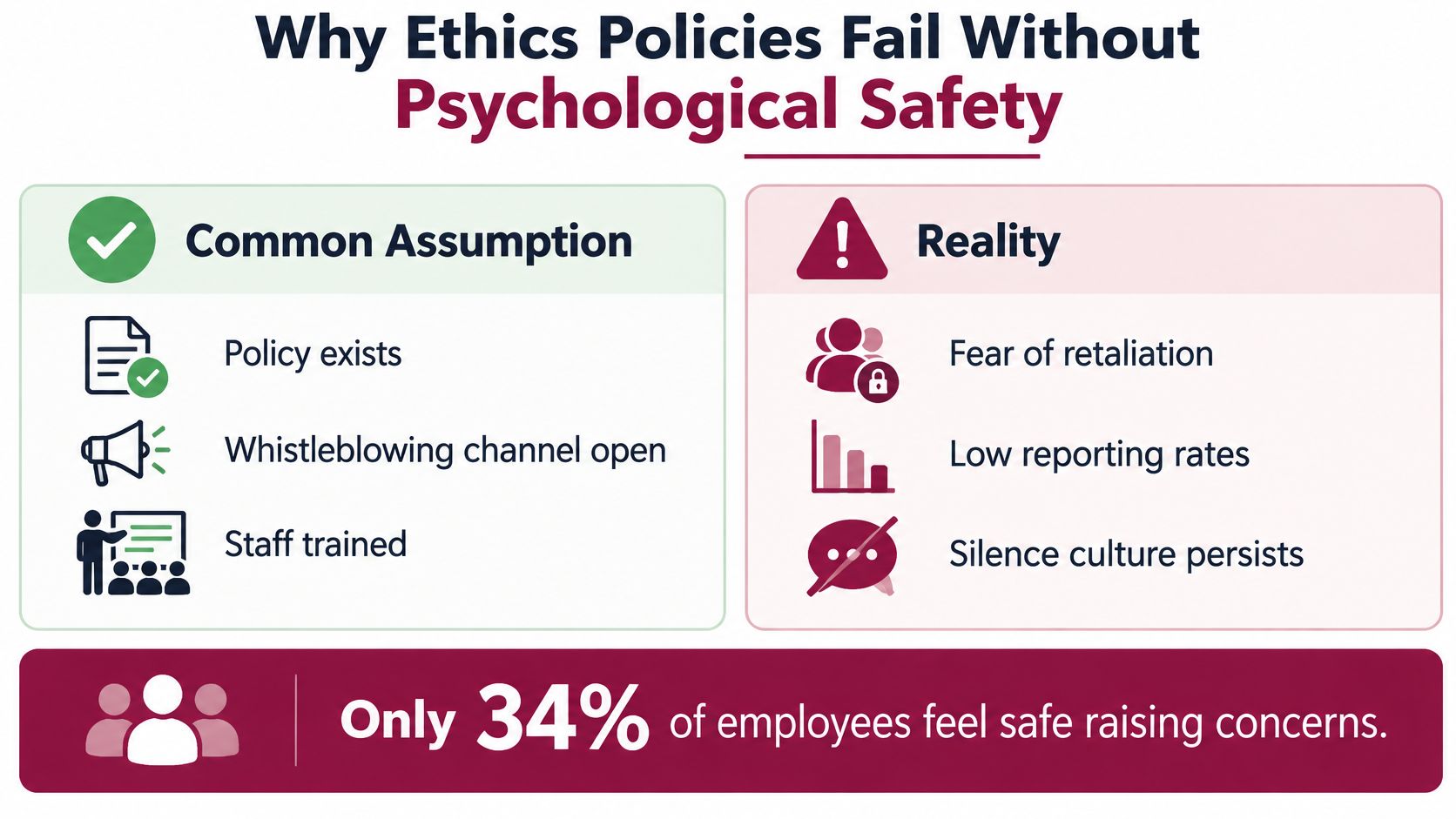
Many organisations assume that a code of conduct plus a reporting channel equals an ethical culture. That assumption confuses architecture with behaviour. People judge safety by what happened to the last colleague who challenged a profitable decision, not by the quality of the policy document.
Evidence of an implementation gap
A 2026 survey of UK senior legal professionals found that 88% of organisations had ethical decision making frameworks, but only 58% of respondents felt comfortable speaking up about ethical issues, as reported in the Corporate Conscience Index on ethical decision making in UK organisations. In that survey, 54% said profit motivations regularly conflicted with moral concerns, while 83% said doing the right thing too often became secondary to profit.
Those figures support a contrarian conclusion. The central problem may be less about ignorance of rules than about incentives, status and fear. Early career professionals often spot questionable supplier choices, marketing claims or layoff practices first, yet they hold the least power to insist on review.
Practices that make dissent usable
- Document dissent: Record objections and the response, so concerns don't vanish from minutes.
- Protect escalation routes: Offer routes outside the immediate line manager where conflict exists.
- Audit retaliation risk: Track outcomes for people who raise concerns, including shifts and appraisals.
- Link reward to conduct: Connect executive incentives to ethical outcomes, not revenue alone.
Work on how to build a strong company culture is relevant here because culture determines whether formal channels are trusted. Leaders must respond visibly when concerns are valid, including when that response costs money or delays a launch. If speaking up is praised in induction and punished in practice, employees will learn the actual rule quickly.
Psychological safety isn't comfort. It's the belief that raising a hard truth won't be held against you.
Building a Practical Ethical Decision Framework
A defensible framework brings the earlier ideas into one sequence you can use under time pressure. It doesn't remove disagreement, and it shouldn't. Its purpose is to make reasoning explicit enough that colleagues, auditors and affected stakeholders can see how you moved from legal permissibility to ethical justification.
Five steps for approval decisions
- Identify the law: Record applicable statutes, contractual duties and regulatory guidance.
- Map stakeholders and harms: Name who benefits, who bears risk and who lacks a voice.
- Test alternatives: Ask whether a fairer or less intrusive option achieves the legitimate aim.
- Decide proportionately: Explain why the chosen action is necessary and why burdens are justified.
- Provide review: Set escalation, appeal and monitoring arrangements before implementation.
This structure is prudent because conscience doesn't always align with obedience. The British Social Attitudes survey on civil liberties reported that 47% of respondents believed there are exceptional occasions when people should follow their conscience even if doing so means breaking the law. That finding doesn't endorse unlawful conduct in your organisation. It warns you that nearly half the public may judge an action's legitimacy by more than its formal status.
Apply the framework to contentious areas such as surveillance, equality disputes, environmental choices and performance targets. For each, distinguish legal permissibility, ethical justification, stakeholder legitimacy and operational risk as separate lines in your decision record. If one line is weak, don't let a strong legal line conceal it.
Finally, review outcomes after implementation. Moral judgement improves when you compare predicted harms with actual effects and revise policy openly. Treat legal compliance as the floor of responsible management, and build your professional reputation on what you construct above it.
If you're ready to strengthen your judgement on morality and legality in real managerial decisions, explore the self paced business, leadership and ethical leadership courses offered by the London School of Business Administration and choose a pathway that fits your role. You'll study through recorded lectures, structured materials and assessments designed to connect theory with workplace practice.