
Only 40% of 1,011 people managers surveyed said their organisation had provided people-management training, according to CIPD research on managing workplace conflict. That finding reframes team building and management: organisations cannot assume that appointing someone to supervise work prepares them to manage relationships, difficult conversations and collective performance.
Social activities can create opportunities for colleagues to connect. They aren't a substitute for designing work properly, developing managers and establishing fair ways to address problems.
Table of Contents
- Why Team Performance Is a Management Concern
- Designing Roles, Outcomes and Processes Before You Hire
- Hiring and Onboarding Team Members Well
- Leadership Behaviours That Build Psychological Safety
- Measuring Team Performance and Developing People
- Resolving Conflict and Managing Change in Teams
- Managing Hybrid Teams and Taking the Next Step
Why Team Performance Is a Management Concern
The proportion of British employees working in teams rose from 47% in 1992 to 55% in 2001 and 59% in 2006; over the same period, participation in non-self-directing teams increased from 26% to 45%, while self-directing teamwork declined from 21% to approximately 14%, according to research drawing on British workplace surveys.
These are historical figures, not estimates of today's workforce. Their significance lies in the organisational shift they document: more employees worked collectively, but that didn't mean formal supervision disappeared.
For managers, the implication is straightforward. Assigning people to a group doesn't resolve questions about priorities, authority, dependencies or responsibility for shared results.
Coordination requires deliberate management
Consider a project involving operational staff, customer-facing colleagues and a specialist adviser. Each person may complete their assigned task competently, yet the project can still stall because nobody owns the handover or resolves competing requirements.
Treat team performance as a management responsibility by distinguishing:
- Individual contribution: Whether each person delivers the work their role requires.
- Collective coordination: Whether colleagues exchange information, manage dependencies and provide appropriate support.
- Management conditions: Whether priorities, resources and decision rights allow the group to function.
This distinction also changes how managers diagnose problems. An apparent motivation issue may require a clearer decision process rather than an engagement workshop.
Social connection has a supporting role
A social event can provide space for informal conversation, especially when colleagues haven't worked together before. However, attendance won't demonstrate that responsibilities are understood or that employees can challenge an unrealistic deadline.
Practical rule: Choose a team-building intervention only after identifying the working problem it should help resolve.
A structured approach starts before recruitment, continues through onboarding and leadership practice, and includes measurement and proportionate conflict resolution. Managers remain responsible for connecting those activities to the work, rather than delegating team cohesion to occasional events.
Designing Roles, Outcomes and Processes Before You Hire
A service team can replace a coordinator before agreeing who owns customer escalations. The new colleague may arrive capable and willing, yet adjacent teams still route urgent cases through different inboxes and response times slip. The problem sits in the design: the role was drawn around a vacancy, while the work needed clearer boundaries.
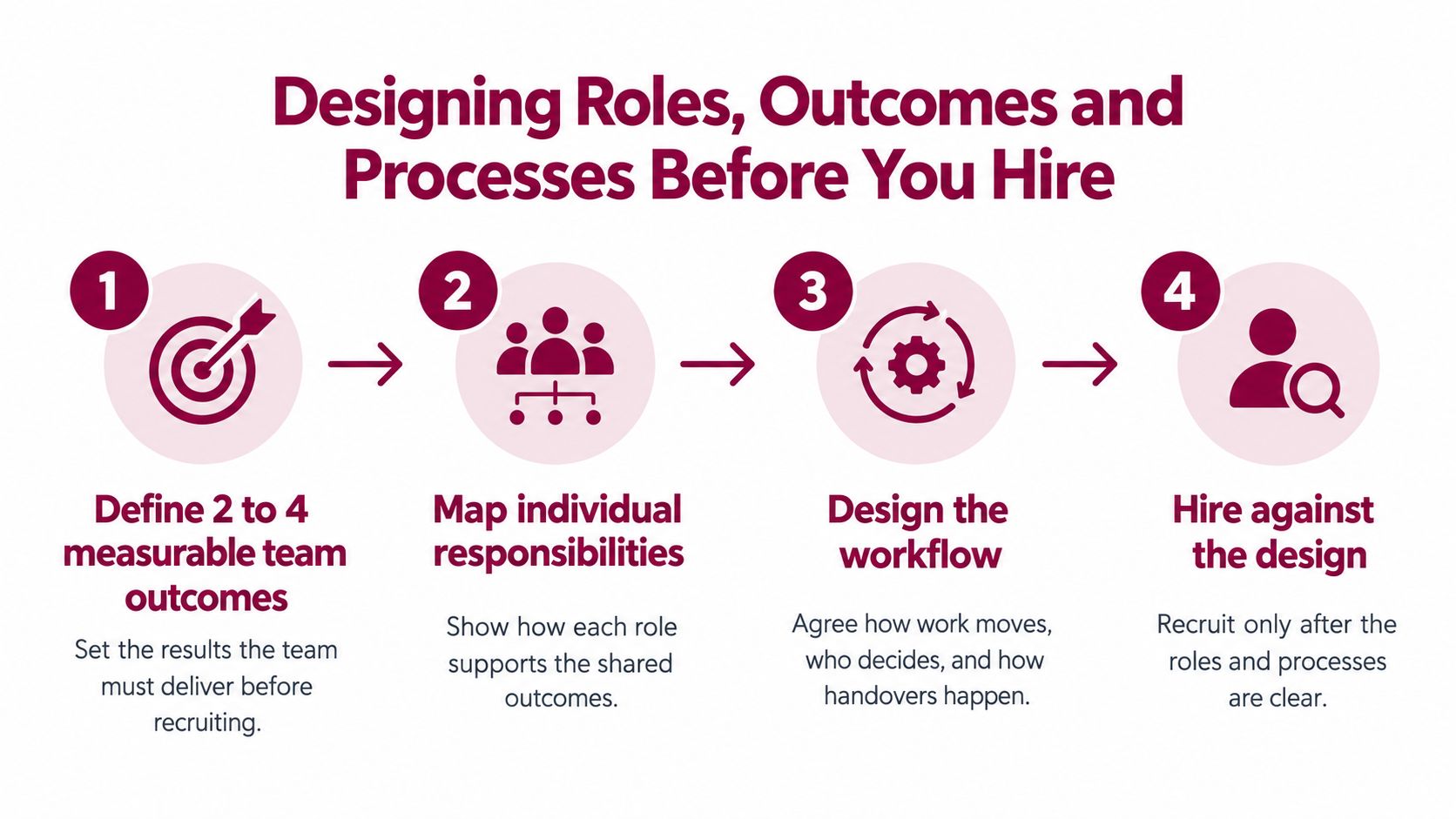
The CIPD evidence review supports a sequence combining goal-setting, teamwork training, debriefing and relationship-focused intervention; its practical application includes two to four measurable outcomes and baseline comparisons at 30, 60 and 90 days (high-performing teams practice summary). Treat that sequence as a management system: define the result, design the handovers, then hire for the behaviour those handovers require.
Turn outcomes into working boundaries
Write each outcome so two managers would interpret it the same way: delivery reliability, first-time resolution, escalation within agreed hours, or defects found before release. Attach the evidence that would show progress, then set decision rights around it: who contributes, who decides, who is consulted and who is informed after the decision.
A short working agreement should cover the interfaces that usually fail first. Keep it to observable commitments: what information moves between roles, where it is recorded, when it must arrive, how workload pressure triggers reprioritisation, which tasks have trained cover and which decisions stay with the role holder. In hybrid teams, give the same attention to links with adjacent teams; distance tends to weaken those boundaries before it weakens friendships inside the team.
Reserve collective decision-making for calls that are hard to reverse. Requiring agreement on everyday priorities slows the work and blurs ownership.
Learn inside the workflow, then recruit for it
Plan brief after-action reviews around significant tasks: intended result, actual result, what helped or hindered and the change to test next. Keep them beside operational work so a manager can see whether the altered behaviour reduces rework, delays or avoidable escalation.
When an interaction keeps blocking delivery, facilitate that specific exchange rather than commissioning a general communication workshop. Establish whether colleagues disagree about priorities, cannot reach the information or read the boundary differently; each cause points to a different remedy. The final specification follows from this design: if the post depends on frequent handovers and shared calls, selection should test those capabilities beside technical competence. Document enough to make responsibilities usable, and revise the agreement when tasks, staffing or dependencies change.
Hiring and Onboarding Team Members Well
Selection is where role design meets reality. A specification built around handovers and shared decisions only pays off if the interview itself tests those behaviours.
Take a replacement joining an established project team, presented here as an illustration rather than a reported case. The manager needs to judge both technical expertise and the candidate's ability to work within existing dependencies. A realistic coordination problem does that job: describe incomplete information, competing deadlines or a handover that falls short of the agreed standard, then ask how the candidate would respond.
Evaluate the reasoning behind the answer rather than rewarding confidence alone. A candidate who names uncertainty and asks useful questions may offer a more workable approach than one who promises to resolve everything independently.
From appointment to working agreement
Onboarding functions as a structured transfer of context. Explain why the role exists, what successful work looks like and which decisions sit outside its authority. Much of that context is a dependency map, which a short briefing document can capture.
| Dependency | What the new colleague needs to know |
|---|---|
| People they rely on | Who supplies information, approvals or specialist input |
| People relying on them | Whose delivery depends on their output |
| Working references | Current procedures, decision records, examples of acceptable outputs |
| Support routes | Where to ask questions and how to escalate a blocked task |
Written expectations matter, but checking them matters more. Give the new colleague a real assignment and ask them to talk through the task and its dependencies; uncertainty surfaces there that a general settling-in question never reaches.
Adapt the shape of onboarding to the group. In a newly formed project team, shared working practices may need building alongside individual induction. In an established team, the harder task is surfacing unwritten assumptions that existing colleagues no longer notice. Hybrid hiring sharpens this problem: a colleague who rarely shares a workspace does not absorb dependencies through informal contact, so introductions to upstream and downstream partners need deliberate scheduling.
Early check-ins should separate learning needs from placement concerns. Repeatedly missed handovers warrant investigation, but first confirm the colleague received consistent instructions and access to the required resources. As the induction period closes, review both delivery and integration, agreeing what support should continue and which responsibilities they now hold alone.
For managers formalising their knowledge of staffing responsibilities, Human Resource Management covers recruitment and induction practice in more depth, alongside supervised workplace application.
Leadership Behaviours That Build Psychological Safety
A colleague who spots a delivery risk but stays silent can leave a team with fewer options to respond. Managers shape whether concerns reach the people who can act on them. Psychological safety depends on how leaders respond to questions, mistakes and disagreement, while clear standards still apply.
Research on creating the conditions for psychological safety identifies openness and effective conflict management as foundations for trust and cooperation. Research involving 289 players also links identity leadership and a shared sense of belonging with psychological safety, teamwork and resilience. These findings come from sport, so managers should apply them to workplace teams with care. They do, however, underline the influence of both formal and informal leaders.
Make the response to dissent visible
A written team value cannot show whether people feel able to challenge a decision. Watch what happens when someone raises an inconvenient point: does the discussion examine the evidence, or does it turn to defending the decision-maker?

In meetings, invite contributions from people who have not yet spoken. Offer time for written responses when colleagues need to think before answering. When a decision goes ahead despite dissent, record the concern and the reason for the decision. That gives the team a basis for review if the risks materialise.
Managers also set the tone by explaining where their own assumptions were wrong and what they changed as a result. Credible peers can reinforce this behaviour, provided they are encouraged to raise concerns rather than endorse management choices. These everyday actions support a strong company culture, where stated values are reflected in decisions and reactions.
Pair candour with accountability
A 2025 survey of 2,000 UK working adults found that 45% did not feel safe raising mistakes or risks, while 15% reported making preventable mistakes because they felt unsafe speaking up, according to the British Safety Council's report on workplace speaking-up concerns.
Employees should be able to disclose an error without humiliation. They remain responsible for following agreed standards. Managers can support both aims by separating learning reviews from formal performance procedures, while explaining when misconduct or persistent concerns require a different process. Avoid promising immunity that organisational policy cannot provide.
Use anonymous pulse questions to check whether people feel able to raise concerns, ask for help and challenge decisions respectfully. Compare responses with what happens in meetings and during day-to-day work. A favourable average does not establish that every colleague feels safe.
Emotional Intelligence in Leadership is one development option for managers, alongside direct feedback on how they respond under pressure.
Measuring Team Performance and Developing People
Measure team performance to guide decisions, not to rank employees. A dashboard is useful only if the manager can explain what each indicator means and what action a change might justify.
The CIPD review of UK management capability reports that manufacturing businesses in the top half for structured management practices had 38% higher average productivity than those in the bottom half in 2016, with people-management practices particularly strongly associated with differences. This is an association, not evidence that adopting a particular management routine guarantees the same result.
Combine behaviour with results
Behavioural indicators help managers understand how colleagues work together. Outcome indicators show what the team delivers.
Neither is sufficient alone. A team might complete work quickly while transferring unresolved problems to another department, or communicate frequently without improving delivery.
Team Measures Reviewed at Each Checkpoint
| Indicator type | Examples | Purpose at each checkpoint |
|---|---|---|
| Coordination behaviour | Handover quality, response reliability, workload visibility | Identify where dependencies are failing |
| Risk and voice | Escalation time, speaking-up frequency | Examine whether concerns reach decision-makers |
| Operational outcomes | Quality, delivery time, customer measures | Assess whether working changes support delivery |
| People outcomes | Retention, development access, readiness for broader responsibilities | Consider sustainability and progression |
Record a baseline before changing the team's practices, then use the follow-up schedule established during design. Keep definitions consistent so that a changed recording method isn't mistaken for improved performance.
Check context before drawing conclusions. Changes in demand, staffing or task complexity may explain a result more plausibly than the intervention itself.
Turn findings into development decisions
Suppose handovers remain incomplete despite a clear template. Review actual examples with the employees involved before prescribing training.
The underlying issue may be technical knowledge, uncertainty about the recipient's needs or insufficient time to complete the work. Each requires a different response.
- Training: Use it where colleagues lack a defined skill or shared method.
- Coaching: Help an employee examine judgement, choices and recurring difficulties.
- Stretch assignments: Provide supported opportunities to practise broader responsibilities.
Development test: A performance conversation should end with a clearer next action, not merely a judgement about the employee.
Discuss progression explicitly, including the evidence needed for additional responsibility. Don't assume employees can infer a development path from favourable feedback.
Retention should be interpreted cautiously: an employee leaving doesn't automatically demonstrate poor management, and remaining doesn't prove satisfaction. Use exit information and development conversations to understand the circumstances.
Managers seeking formal analytics study can consider the Advanced Professional Certificate in Data Analytics for Business, while keeping workplace measurement proportionate to the decisions it must support.
Resolving Conflict and Managing Change in Teams
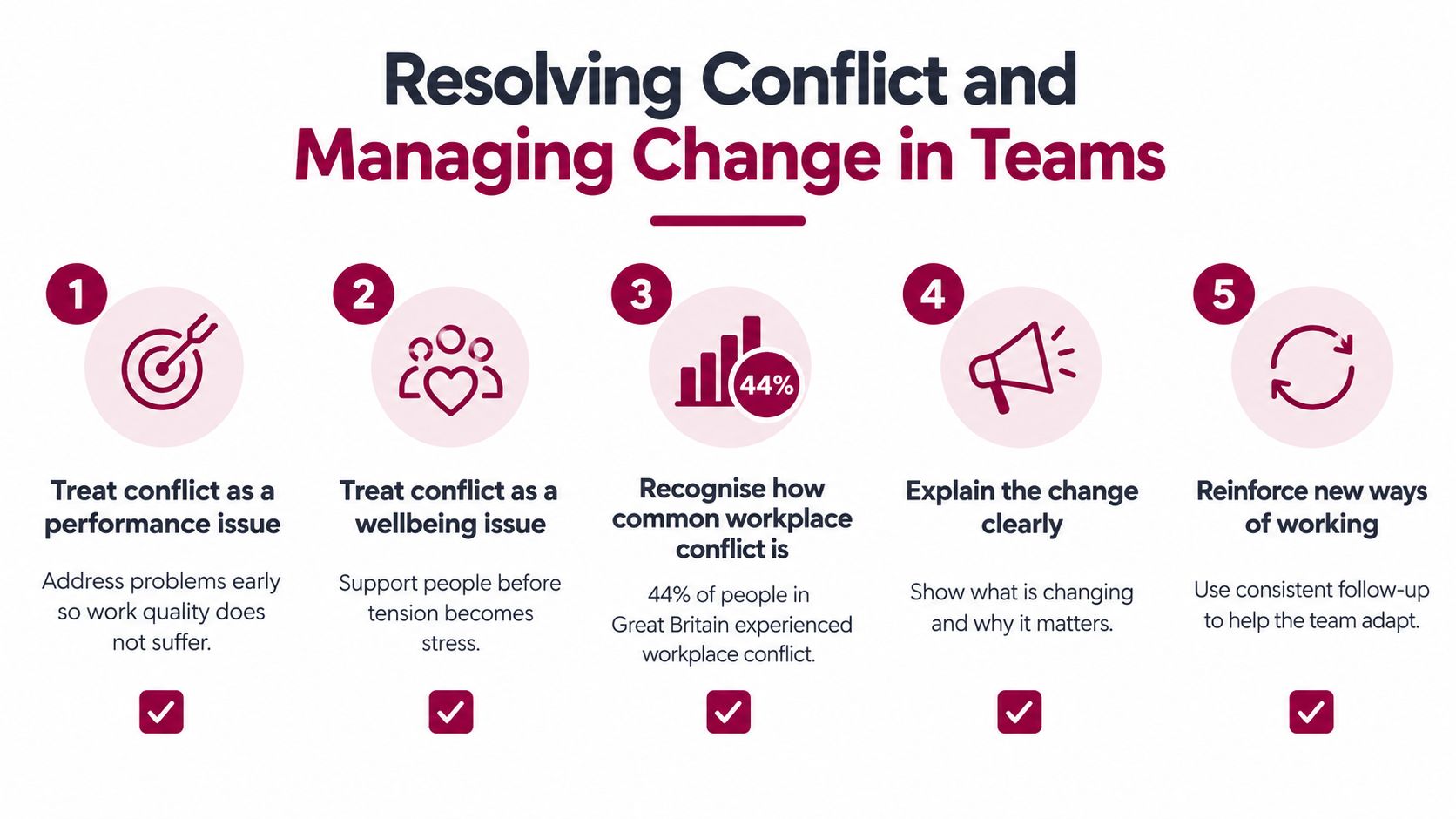
Conflict isn't merely a communication problem. It can involve disputed standards, uneven workloads, capability concerns and the power imbalance between a manager and an employee.
Acas research on workplace conflict found that 44% of people in Great Britain experienced conflict during the previous year, with capability and performance cited by 38% of those affected; where managers experienced conflict with direct reports, 98% attempted informal discussion and 49% also involved HR. Those findings challenge the idea that arranging a conversation is a complete resolution process.
Diagnose before assigning blame
Start with observable work and conduct, not personality labels. A record stating that required information was missing from a handover is more useful than describing someone as careless.
Before concluding that capability is the problem, examine:
- Expectations: Was the required standard clear and consistently applied?
- Support: Did the employee have suitable instruction, resources and access to help?
- Workload: Were competing demands realistically manageable?
- Evaluation: Could assumptions or unequal treatment be influencing the judgement?
Invite the employee's account before deciding what happened. Because the manager controls important employment decisions, silence or apparent agreement shouldn't automatically be treated as genuine acceptance.
Escalate proportionately
Use informal resolution where the issue and circumstances make it appropriate. Agree the required change, support available, review arrangements and how the discussion will be documented.
Serious allegations or unresolved concerns may require formal procedures. Follow organisational policy, involve appropriate specialists and avoid presenting a predetermined decision as an open conversation.
Practical guidance on how to handle conflict at work should sit alongside, not replace, applicable grievance and disciplinary processes.
The same discipline applies during organisational change. Explain what is changing, which decisions remain open and how employees can raise implementation risks.
Don't interpret every objection as resistance. A colleague may identify a dependency that the proposed change overlooks.
After difficult conversations, check whether working relationships remain functional. Clarify revised responsibilities and follow through on promised support, rather than assuming that closing the formal issue restores trust.
Managing Hybrid Teams and Taking the Next Step
Hybrid work shouldn't be judged solely by whether employees are physically present. A July 2025 survey reported that 70% of UK managers believed hybrid or remote working had improved their team's performance, according to published hybrid-work statistics.
This is a report of managerial perceptions, not an objective causal estimate. Nevertheless, it provides a reason to examine results rather than assume that distributed work necessarily reduces performance.
Look beyond the immediate team
A team may meet its own targets while becoming less connected to colleagues elsewhere. Managers should therefore distinguish within-team delivery from cross-team connection.
Review whether distributed colleagues have comparable opportunities to:
- Join shared projects: Participate in work involving other functions rather than remain confined to local tasks.
- Access mentoring: Build relationships beyond their immediate supervisor.
- Receive information: Obtain decisions and context without relying on informal office conversations.
- Develop visibility: Contribute to discussions and access progression opportunities regardless of location.
Compare these experiences by work location, while protecting privacy where groups are small. Investigate unexplained differences before imposing a uniform attendance rule.

Choose a focused development route
Use shared office time for tasks that benefit from joint attention, rather than requiring attendance without a working purpose. Equally, don't add cross-team meetings unless participants have a clear contribution or learning objective.
Guidance on managing distributed teams effectively can support this assessment. The management task is to connect working arrangements to delivery, inclusion and access to opportunity.
The Team Building and Management course forms part of the Credential of Leadership and Management. It offers a structured study route alongside workplace coaching, peer learning and supervised practice.
Begin with a specific management problem, select an appropriate learning activity and identify evidence that would indicate progress. That keeps professional development connected to the responsibilities managers hold.
London School of Business Administration offers online, self-paced business and management courses, including Team Building and Management within its leadership credential. Visit to review the course and programme information, then choose a study route that supports a concrete improvement in how you design, lead or evaluate your team.