
Around 25% of UK businesses reported using AI in late December 2025, yet adoption ran at 44.4% among firms with 250 or more employees against 24.3% among the smallest, according to written evidence submitted to a UK parliamentary committee. Two employers can license identical software on the same afternoon. A year later one has faster processes and lower operating costs; the other has a live system, a training deck and a spreadsheet of workarounds. The tool matters less than whether anyone redesigned the work around it, taught people to use it and kept checking that the promised value arrived.
Change management is that work. Treated as an operating capability rather than a communications add-on, it is the mechanism that converts technology spend into productivity, financial value and workforce outcomes. The UK evidence for those conversions is uneven and measurable: the same written evidence puts adoption at 44.4% among large employers and 24.3% among the smallest, a gap that shows how unevenly the conversion is proceeding.
Table of Contents
- The Short Answer to Why Change Management Matters
- What Change Management Is and How It Works
- How Change Management Lifts Productivity and Performance
- Protecting Financial Value Through Benefit Tracking
- People Outcomes for Engagement, Wellbeing and Trust
- Common Pitfalls and Real UK Examples
- Start Your Change Programme with These Steps
The Short Answer to Why Change Management Matters
Change management matters because a new system, a new structure or a redesigned process only produces value when people change what they do. The software can be live by Friday. The benefit turns up much later, and only if workflows, decision rights, targets and skills move with it.

What change management changes in an organisation
Four outcomes are at stake in every programme, and each behaves differently depending on whether anyone is managing the human side of the work.
| Outcome | Without change management | With change management |
|---|---|---|
| Organisational performance | Tools are bought but workflows stay unchanged | New processes are redesigned and embedded in daily work |
| Financial returns | Spend is judged on delivery, not on value | Benefits are defined, owned and tracked after launch |
| People outcomes | Uncertainty turns into disengagement and absence | Clear rationale and manager support sustain engagement |
| Trust and fairness | Restructures feel arbitrary and unexplained | Change is seen as legitimate, predictable and supported |
Think of a new motorway opened without signage, lane markings or traffic management. The capacity is real on paper, but drivers keep to the routes they know, queue at the junctions they recognise and conclude the scheme was a waste of money. Change management is the signage and the traffic control. It moves people onto the new route and keeps them there long enough for the benefit to appear.
None of the four outcomes is automatic, and each failure leaves its own paper trail: a go-live date met, an adoption curve flat, a sponsor surprised. The practical question for any manager reading this with a live programme is narrower than a philosophy debate. Which of the four outcomes does your initiative most expose, and does anyone own that risk by name?
The test: if nobody can name the owner of the adoption risk, you have a sponsor for the announcement but not a change programme.
What Change Management Is and How It Works
Change management is a structured approach to moving people, roles, processes and systems from a current state to an intended state, and to making the new state hold after the project team has moved on.
The engine room can be immaculate and the ship still miss its destination. The crew must change watches, learn new routines and trust the new heading, and someone has to hold the navigation plan that keeps all of that coordinated. The engine is your technology. The navigation plan is change management, and no amount of engine maintenance substitutes for it. That distinction matters in UK firms because the adoption evidence points less to software choice than to managerial capacity.
Three frameworks earn their place in practice. Lewin's three stages, unfreezing, changing and refreezing, give language to the awkward middle of a transition, the stage where most programmes lose momentum. Kotter's eight steps put urgency and a guiding coalition ahead of vision, and short-term wins ahead of consolidation, which is the correct order for organisations that announce a solution before agreeing on the problem. ADKAR works one person at a time, through awareness, desire, knowledge, ability and reinforcement, so a line manager can tell whether a team has stalled at understanding why the change matters or at being able to perform it. Used together, they cover the system, the sequence and the individual. Used as slogans, they become slideware.
The enablers are managerial
The UK evidence supports that ordering. The Innovation Diffusion and Adoption Survey found 56% of businesses were already adopting at least one surveyed technology, and that the enablers they named were managerial: leadership and management (41%), proven evidence of effectiveness (40%), employee capabilities (39%) and employee openness to change (39%); it also found technology adoption improved workforce productivity for 39% of businesses, created new or more flexible processes for 31% and reduced production or operating costs for 29%. The Innovation Diffusion and Adoption Survey names management skills, including strategic planning, project management, team leadership and operational planning, as a significant internal barrier to adoption. The implication is uncomfortable for programme boards: a technology decision can be sound and still fail on management capacity.
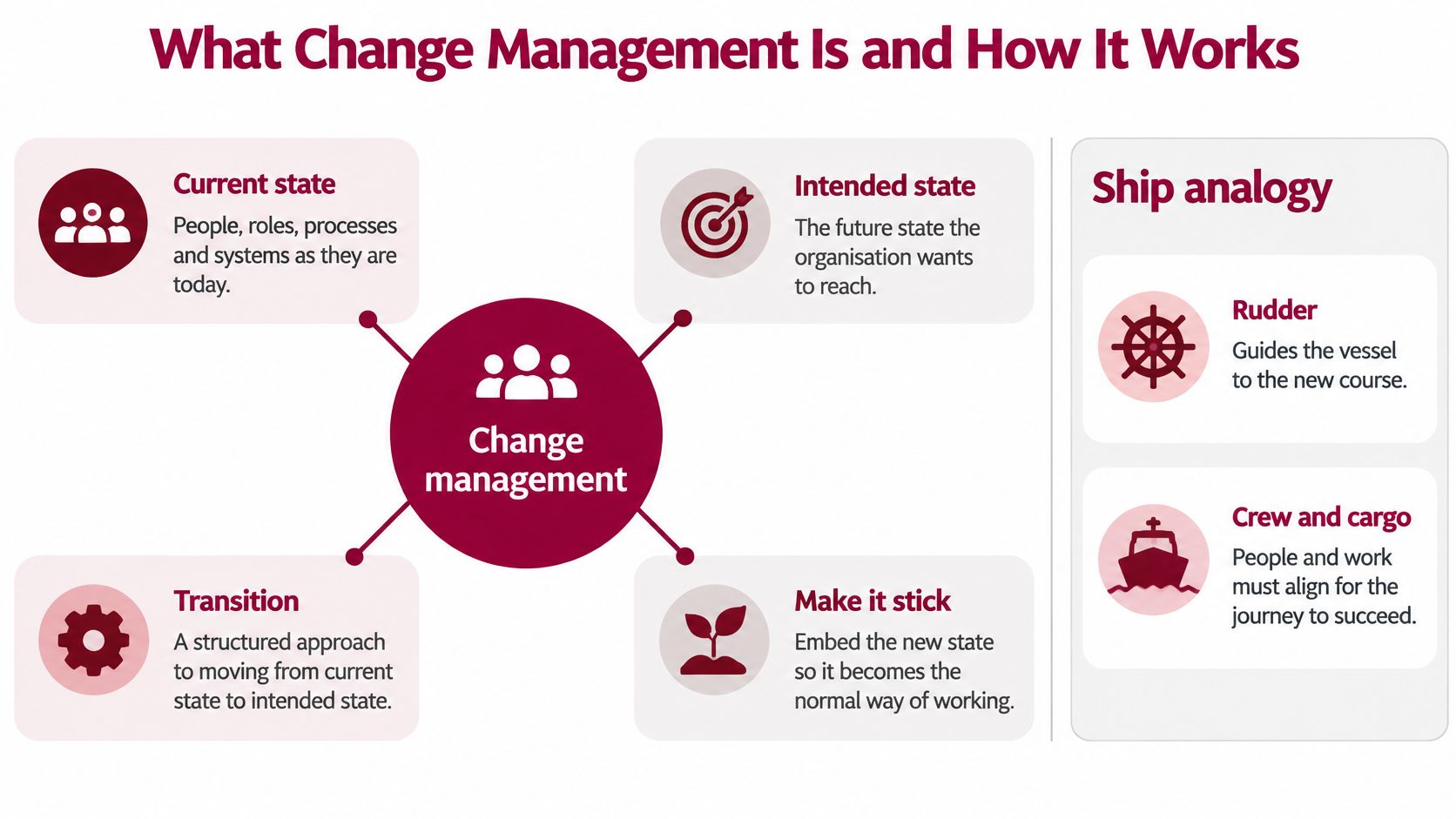
Before any of that, three things need writing down: the current state in operational terms, the intended state in measurable terms, and whose work changes to get from one to the other. Teams that skip the third item usually meet it during the resistance.
Five principles that hold up in practice
- Start with a reason people can repeat. A team that can't state why the change is happening in one sentence will fill the gap with rumour.
- Make leadership ownership visible from day one. Sponsorship that appears at launch and vanishes at the first difficult decision endorses the announcement, not the change.
- Design around the people whose work alters. Map the tasks, not the organisation chart.
- Build capability before expecting adoption. Training scheduled after go-live is a repair job with a poor success rate.
- Measure adoption and benefits after launch. A launch is a date. Adoption is a trend, and only one of them tells you anything useful.
For managers who want to examine how managerial behaviour shapes whether a team follows a change or works around it, our Leadership and Organisational Behaviour course covers the relevant research.
How Change Management Lifts Productivity and Performance
A 0.1-point improvement in a firm's management practice score accompanies a 9.6% higher productivity figure, according to the Business Productivity Review. The review identifies two major drivers of firm-level productivity: leadership and management practice, and the diffusion of digital technologies. Only one of those can be bought. The other has to be changed, which is why the technology figures below span such a wide range.
Productivity evidence linked to management and technology
| Evidence | Reported effect | Source |
|---|---|---|
| Management score rise of 0.1 point | Associated with 9.6% higher productivity | Business Productivity Review |
| Basic business technologies adopted | Productivity gains of 7% to 18%, depending on the technology | Enterprise Research Centre research cited in the review |
| Small firms using at least two business-management technologies | Gains of up to 25% | Office for National Statistics analysis cited in the review |
Read those figures as associations drawn from a body of evidence, not promises attached to a purchase order. Each gain depends on how thoroughly the organisation changes the way work is done, and the spread between 7% and 18% reflects how much of a given process a technology touches. A tool that removes one approval step sits near the bottom of the band. A tool that reorganises how work is allocated, measured and reviewed can sit near the top.
A small accountancy buys a practice-management system. The licence is live within a week. Staff keep their spreadsheets for another six months, because approval steps, job responsibilities and month-end routines were never redesigned and nobody took them through the new sequence. The gain doesn't arrive when the system goes live. It arrives when the partner who signs off accounts changes what she asks for.
The review is explicit that managers and employees need training to embed new technology, and that smaller firms struggle here because they often lack the skills, knowledge, finances and capacity required to restructure processes. Training and restructuring are change activities. No supplier sells them alongside the licence.
Keep the two drivers together. Management practice without technology caps out, and technology without changed practice gets written off as a failed system.
One qualification belongs with the largest number. It describes small firms running at least two business-management technologies, so a single tool implemented on its own should not be expected to deliver it. The pattern in the evidence is cumulative: firms that stack technologies and redesign the surrounding work outperform firms that buy one system and leave the workflow alone.
Process design sits beside change management for exactly this reason, since capacity, cycle time and quality decide whether a system shortens a task at all, and our operations management article on efficiency and productivity works through that side of the problem. What remains on this side is the part that decides whether a licence turns into output: who redesigns the process, who is trained before go-live, and what gets measured after it.
Protecting Financial Value Through Benefit Tracking
Reported by HR Magazine, a Moorhouse study of more than £3.4 billion of UK organisational change investment found average project spend above £17 million, and fewer than one-quarter of organisations measured benefits properly after completion. Applying that one-quarter share to the investment total gives about £850 million. That figure is a calculation from the reported totals, not a sum the study published, and it is only a ceiling on the spend where benefits were measured if non-measuring organisations hold a similar share of the money. The remainder of the portfolio then has no clear evidence of realised outcomes.
A restaurant can buy a new oven and still have no idea whether plates improved or waste fell. The invoice records the spend. Waste, ticket time and margin after the install are what show whether the spend became value. Technology programmes lose financial value in the same way when go-live is the only result anyone records. Change management is the measurement and ownership system that turns that invoice into productivity and a financial result, not a communications add-on after the purchase.
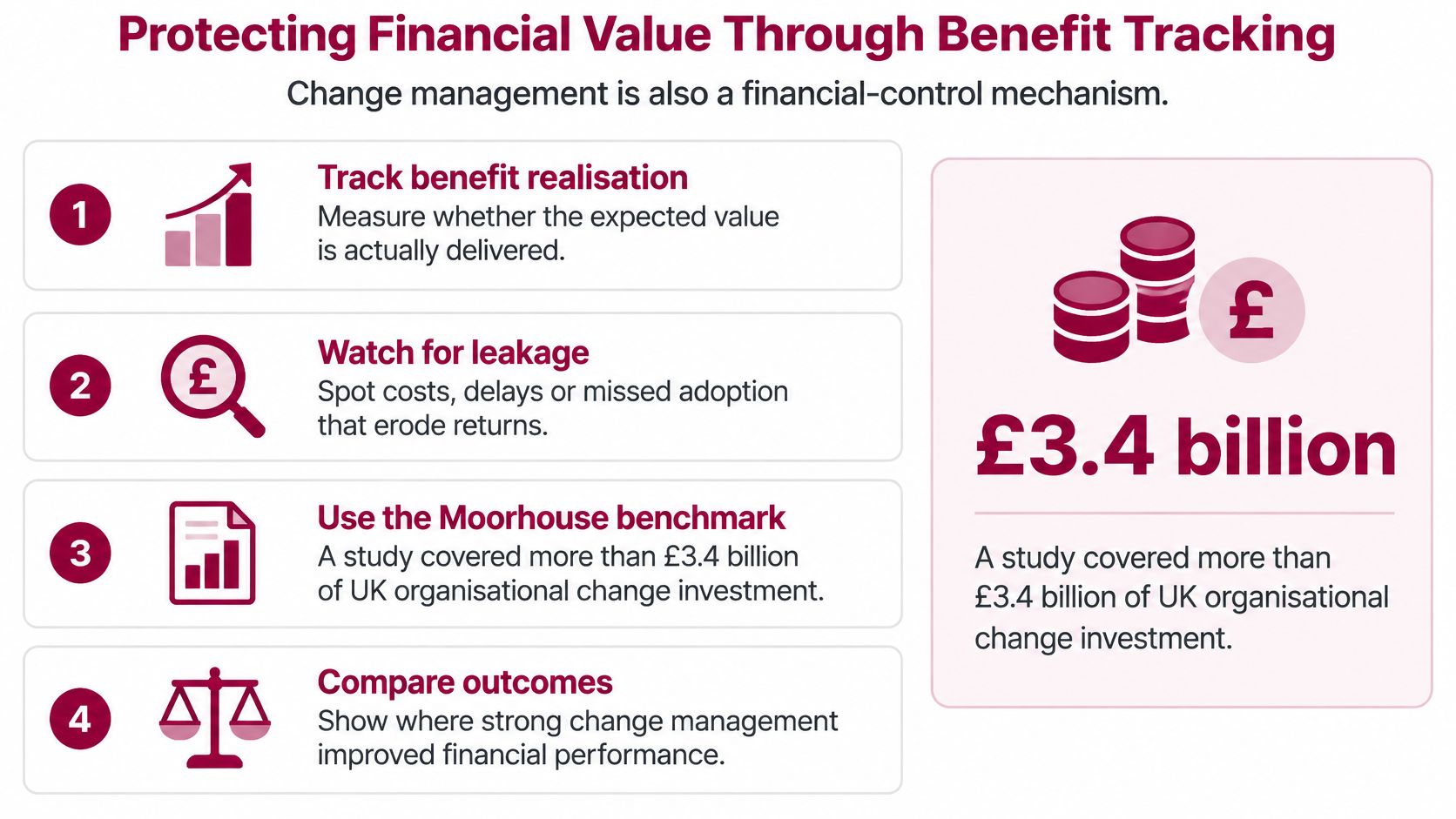
Four controls that keep the money attached to the outcome
- Define measurable benefits before launch. "Improved reporting" isn't a benefit. A five-day month-end close moving to three days is.
- Assign a named owner to each benefit. Shared accountability for a number is how a number stops being tracked.
- Track adoption and performance indicators after go-live. Delivery metrics tell you the system works. Adoption metrics tell you whether anyone uses it.
- Set review points that feed corrections back into the plan. A review with no decision attached is a meeting, not a control.
The same study identifies lack of staff or stakeholder ownership, insufficient project-team capability and poorly defined objectives as major threats to success. Those threats sit inside financial governance: without a named sponsor, capable roles and a defined objective, the benefit never attaches to the spend.
Early results often look worse than the business case. Enterprise Research Centre research found that long-term adoption of workplace practices was associated with productivity gains, while short-term adoption could coincide with a productivity decline. New processes slow work at first, training takes hours out of the week, and data problems surface. Judge the trend across several reviews, not the first month.
Set the benefit baseline with the same discipline as budgeting and forecasting: a baseline, an owner and a review date, with people changing the work in the middle of the numbers.
People Outcomes for Engagement, Wellbeing and Trust
A system can go live and still miss the productivity the business case assumed. The missing piece is usually whether people stay engaged, well and willing to use it.
The Civil Service People Survey technical guide identifies leadership and managing change as the strongest driver of employee engagement, ahead of several other workplace themes. Engagement works like a gauge on a machine: commitment, satisfaction and discretionary effort tend to show up later as fewer plans to leave, lower absence, and better performance. That reading comes from one large public-sector survey, so it is a strong signal for UK employers, not a fixed formula for every workplace. The commercial point still holds. How leaders run the change sits closer to workforce results than a separate morale message.
Wellbeing is a change outcome, not a separate programme
New reporting lines, workloads, technology or performance expectations create uncertainty, and pressure builds in that gap. The Health and Safety Executive reported that 12.5 million working days were lost to work-related stress, depression or anxiety in 2016/17, affecting 526,000 workers, figures summarised in University of East Anglia research on what makes employees happy. The year is old, so use the scale, not the date, as the warning.
A large study of UK organisations found no evidence that individual steps such as mindfulness, resilience training, relaxation classes or wellbeing apps improved employee wellbeing. Changes to scheduling flexibility, management practice, staffing, performance reviews and job design looked more promising. Handing someone a better umbrella does less than fixing the roof. The stress often comes from the job the change created.
The cost lands on the payroll. A University of Warwick estimate, summarised in published workplace wellbeing research, puts poor mental wellbeing at £33 billion to £42 billion a year for UK employers through absenteeism and presenteeism. Technology spend that raises strain without redesigning the work can eat part of its own return in lost days and weaker output.
Trust depends on the explanation, not the announcement
More than half of surveyed workers in organisations with at least 500 employees had experienced a restructure in the previous 12 months, 12 percentage points higher than in 2024, yet fewer than half said the reasons were clearly explained and only 42% believed their employer was good at helping them adapt, according to LSE Business Review analysis of restructures. People judge whether the reasons were explained and whether support arrived.
Culture is what people revert to under pressure, and changing a culture moves more slowly than deploying a system. Watch proficiency rather than attendance, real use rather than a live install, absence before it becomes exits, and leaving intentions in the roles you most need. Without those readings, a project can look finished while productivity, cost and the workforce are still slipping.
Common Pitfalls and Real UK Examples
A new scheduling system can be bought, installed and still leave overtime untouched. In a mid-sized firm, one training session on day one leaves managers unable to answer questions. Staff rebuild the old rota in a shared spreadsheet, and absence and complaints rise within two months. The licence was spent. The productivity was not collected, because nobody owned the briefing before launch or the feedback afterwards. A spare key works the same way: the new lock is fitted, and people keep using the key that was never logged. Manager briefings, a set time for problems, and a senior person who reads that channel are what turn the spend into a working process.
Surveys keep pointing at leadership, timing and communication, not at awkward personalities.
| Pitfall | Evidence | Fix |
|---|---|---|
| HR brought in only at implementation | 53% of UK business leaders say HR joins transformation only when implementation starts, in a survey reported by SME Business News | Involve HR and people leads in design and the business case |
| Weak change-management skills | 33% identify weak change skills as a reason people-related workstreams fail, in the same survey reported by SME Business News | Build manager capability through role-based training |
| Unclear purpose | 44% of workers say they do not understand why changes are taking place, per PwC's 2024 Global Workforce Hopes & Fears Survey. The sample is global, so read it as a workforce signal, not a UK-only rate | Explain the rationale before publishing the timetable |
| Repair left out after major change | Waves of change with no time to relearn the work show up as lost adoption and higher workload, not as a tidy communications miss | Schedule repair and feedback after each major change before the next wave starts |
| Overloaded pace | 62% say the pace of change increased and 45% report a significant workload increase, in PwC's 2024 Global Workforce Hopes & Fears Survey. Again, this is a global workforce survey | Sequence changes and protect delivery capacity |
Public-sector digital programmes show the same leak from spend to results. In 2025, only 16% of UK public-sector organisations had fully implemented digital-transformation strategies across the whole organisation, down from 23% in 2023, according to a Vanson Bourne survey in the 2025 UK public sector digital transformation report. A strategy that is funded but only partly in use is a balance-sheet item, not a productivity gain. The drop since 2023 is a warning about finish, not about ambition: partial rollout leaves the old process and the new one running together.
Blanket training does not close that gap. The CIPD's Resourcing and Talent Planning Survey reports that 29% of organisations replaced some jobs with technology and automation, while 48% increased efforts to develop talent in-house and 52% reported more competition for well-qualified talent. Reskilling pays when it targets the tasks the system will not cover: judgement, relationships and analysis. How leaders word the reason matters as much as the syllabus, which is why Communication Skills for Leaders centres on explaining decisions people did not choose.
The pitfall your plan is most likely to trigger is the first place the technology budget turns into extra workload instead of output. Name it, and the first corrective action is already on the table.
Start Your Change Programme with These Steps
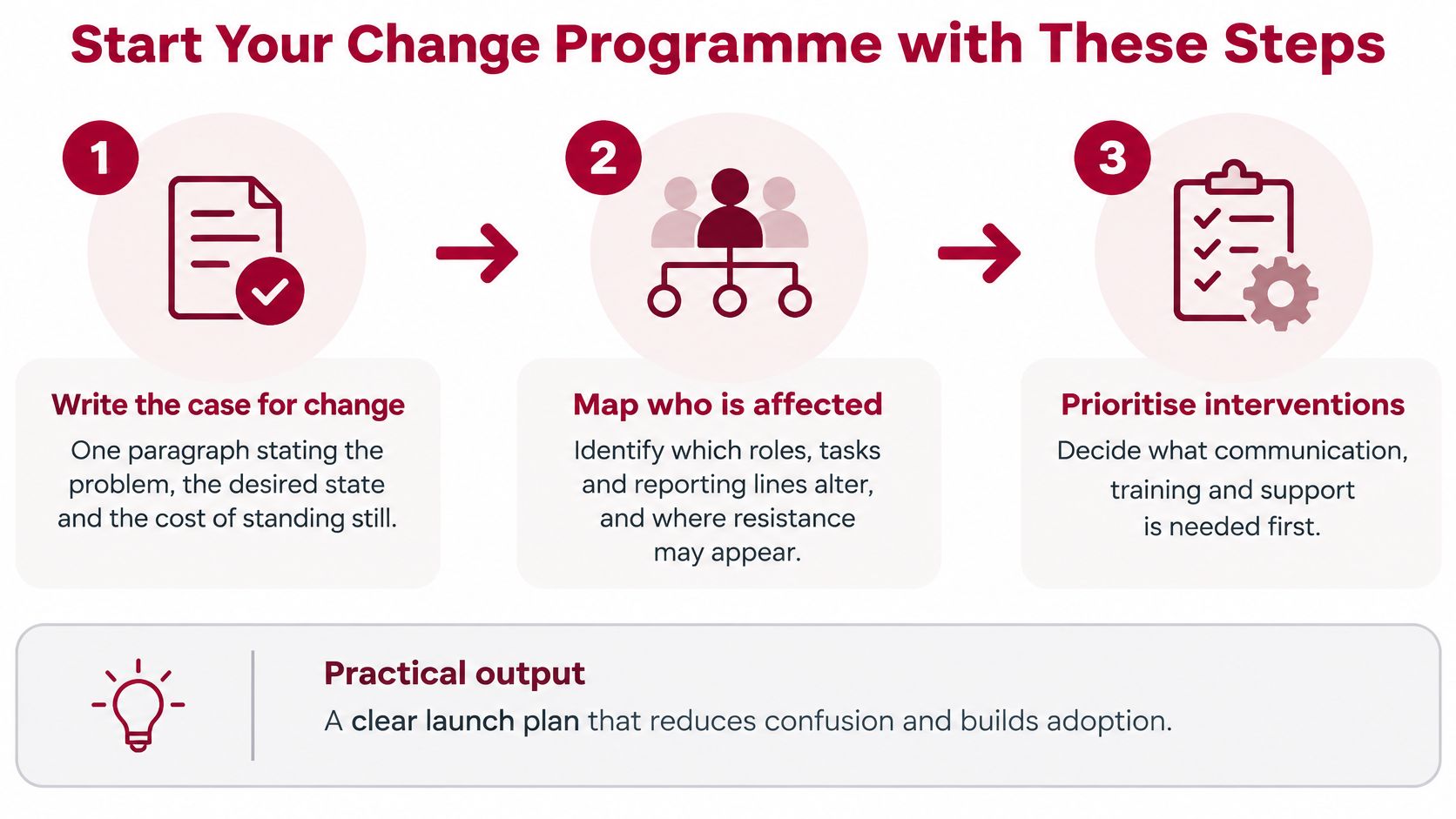
- Write the case for change in one paragraph. State the problem, the desired state and the cost of standing still, because a case that needs a slide deck won't survive the corridor conversation.
- Map who is affected. Identify which roles, tasks and reporting lines alter, since that's where resistance will be concentrated and specific.
- Name an owner and a baseline for each benefit. Without a baseline you'll be arguing about whether things improved, not measuring it.
- Assess readiness and capability. Check manager skills, training time and workload capacity, because this is the stage where most later pitfalls are created.
- Pilot in one team. Collect feedback and adjust before wider rollout, while adjustment is still cheap.
- Set review points for adoption, people and financial indicators. Keep them running for at least six months after launch, since the first quarter mostly measures transition.
- Reinforce through objectives, recognition and training. What gets reviewed gets done, and what gets ignored reverts.
Where leaders have to show up themselves
- Sponsorship that is visible rather than announced. Senior leaders answering the same three questions in the same words, repeatedly, in rooms where no project manager is present.
- An honest account of why the change is needed. Including what happens if the organisation doesn't make it.
- Managers equipped with answers and time. A manager with no briefing and no capacity will improvise, and improvisation is where trust leaks.
- Listening channels that lead to visible decisions. Feedback that changes nothing teaches people to stop giving it.
The skills behind those actions are learnable. Our Change Management course costs £99.00, is delivered entirely online and self-paced, and examines Lewin's Change Model, Kotter's 8-Step Model, ADKAR and McKinsey's 7-S Framework through recorded video lectures, text-based lessons, practical case studies, visual frameworks and reflection exercises. It's built for managers, team leaders, HR professionals, consultants and project managers who want a working command of the discipline rather than a vocabulary.
London School of Business Administration exists to make this kind of applied management knowledge accessible to people building careers in real organisations. If this article has convinced you that the gap between a technology investment and its return is closed by people, not by procurement, our self-paced, CPD-accredited courses give you the frameworks to close it in your own programme. Visit London School of Business Administration to see the full range and choose where to start.