
The most repeated advice on changing a culture is to write the values, announce them, and train people until the words stick. That sequence wastes time and money. Culture is what colleagues do on an ordinary Tuesday, under ordinary pressure, not what a poster says. A launch message that arrives before anyone can disagree safely teaches staff that the programme is a broadcast.
I would not start with a vision statement. I would describe current norms, name five to seven behaviours a colleague could see, and open a working voice channel before any announcement goes out. Leaders then change calendars, meeting agendas and appraisal criteria before they ask anyone else to change. Popular programmes reverse that order, and staff notice.
Table of Contents
- The Seven-Phase Framework at a Glance
- How to Assess Your Current Culture
- Defining Observable Behaviours and Securing Leader Buy-In
- Communication and Voice Channels That Carry the Change
- Rituals, Policies and Training That Embed New Habits
- Measuring Progress and Avoiding False Wins
- Confirm Your First 90-Day Plan
The Seven-Phase Framework at a Glance
Changing a culture is a phased programme that usually runs for 12 to 18 months, and a launch announcement is only one step in it. Each phase produces a named output the sponsor can check before the next starts. Phases overlap in calendar time, but diagnosis finishes before behaviours are chosen, and voice channels exist before the first change message goes out.
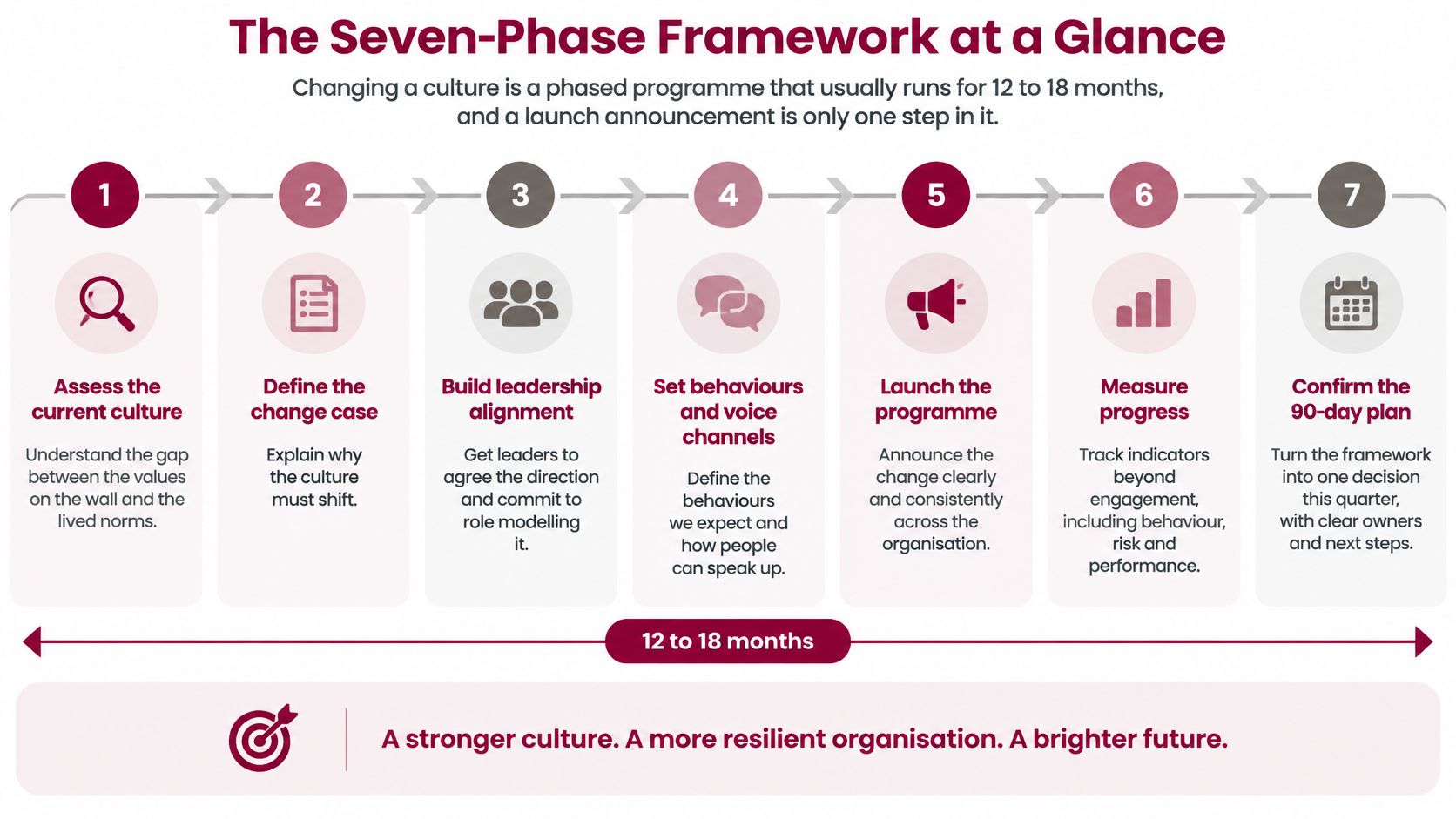
| Phase | Output | Lead | Indicative timing |
|---|---|---|---|
| 1. Diagnose | Culture baseline with norms and gaps | People team, with external support if needed | 4-6 weeks |
| 2. Define | Five to seven observable behaviours | Senior sponsor with leadership team | 2-3 weeks |
| 3. Align leaders | Written leadership commitment and role changes | Chief executive or sponsor | 2-4 weeks |
| 4. Communicate and open voice | Two-way channels and feedback closure | Line managers and internal communications | Ongoing from launch |
| 5. Build capability | Manager practice and skill-building | Learning and development | 3-6 months |
| 6. Embed systems | Hiring, promotion and policy aligned to behaviours | HR and operations leads | 6-12 months |
| 7. Measure and reinforce | Quarterly indicators and review | Sponsor and people analytics | Quarterly, ongoing |
The people team usually leads diagnosis. A senior sponsor secures written alignment. Line managers carry daily reinforcement once channels are open. Read the wider set of change management strategies every leader must know as context for sponsorship, not as a substitute for this sequence.
Take this table to a sponsor meeting and agree owners and dates before any launch communication.
How to Assess Your Current Culture
You can't change a culture you haven't described. Many failed programmes skip this step and then wonder why the new language never shows up in decisions.
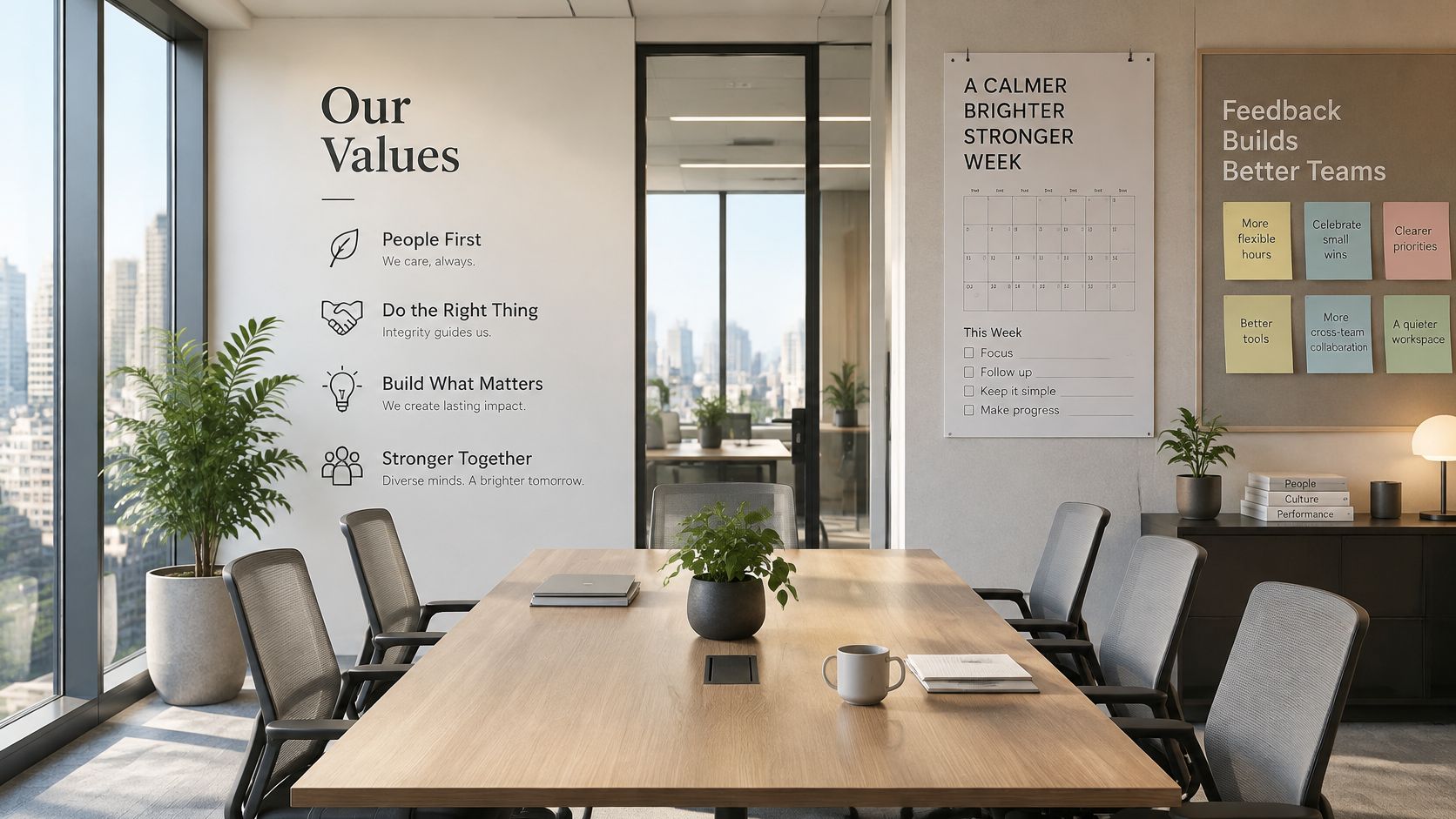
The values on the wall and the norms people follow on an ordinary Tuesday are often different documents. One is aspirational. The other is what gets rewarded, rushed, or punished without notice. EY's UK organisational-change research reports that 88% of change initiatives fail to deliver what they set out to achieve, associating failure with poor communication, inadequate commitment and weak engagement. Its practical recommendation is to benchmark “how things are done around here” before selecting interventions, and to involve cultural icons, respected employees whose behaviour already embodies the values.
Four diagnostic steps
- Map current norms with at least three methods. Interviews, a short pulse, observation and a decision audit catch different distortions. One method alone flatters the organisation.
- Name the gap between stated values and rewarded behaviour. Look at who is promoted, whose work is rushed through, and which risks are escalated.
- Note informal networks. Record who staff already trust when something goes wrong, across functions, not only the formal hierarchy.
- Write a one-page baseline. Name the three behaviours most likely to block the change. Every later measure is compared with this page.
| Method | What it reveals | Main limitation |
|---|---|---|
| Structured interviews | Unwritten rules, stories and informal power | Time-intensive; candour depends on trust |
| Pulse survey | Trends across large groups | Can hide low-trust teams and under-reports dissent |
| Meeting and workflow observation | Real behaviour under normal pressure | Observer effect; needs careful note-taking |
| Decision audit | Who decides, how fast, and what gets rewarded | Requires access to records and some sensitivity |
Decision audits often reveal more than surveys. A team can say it values collaboration while one manager signs off every assessment change. Say an online course provider reports healthy engagement, yet its decision records show no review step before learner-facing changes. The score and the record describe different organisations. Useful indicators in that setting include assessment turnaround, learner-support responsiveness, ethical escalation, collaboration across course teams and employee engagement, read together rather than as a single annual survey.
Interview at least three levels and two functions. A baseline built only from senior workshops describes the culture leaders wish they had.
Imposing an idealised culture that conflicts with established identity alienates staff and produces symbolic compliance.
Defining Observable Behaviours and Securing Leader Buy-In
Values matter only when colleagues can see them in everyday decisions. Translate each one into an action someone could observe during a normal working day. If the wording describes a feeling rather than an action, make it more concrete.
From diagnosis to a signed commitment
Select five to seven observable behaviours that reflect the baseline. Write each as an action with a frequency or threshold, then test the wording with two frontline teams. Drop any behaviour they cannot picture in practice.
Ask six to ten senior leaders to sign a written commitment covering what they will start and stop doing. The stop list often exposes the trade-off: a leader may endorse collaboration while continuing to reward individual speed.
| Value as usually stated | Observable behaviour | Leader signal |
|---|---|---|
| Customer focus | Learner queries resolved within an agreed target, such as two working days | Leaders review resolution times in team meetings, not satisfaction scores alone |
| Psychological safety | Managers invite challenge at project reviews and record the objections raised | Leaders publicly thank people who flag problems early |
| Collaboration | Course teams share assessment feedback before publishing changes | Shared objectives are written into every appraisal |
When a senior leader disagrees
Hold a time-boxed one-to-one. Specify which behaviours protect safety, fairness and honest reporting, then agree a decision point for resolving the disagreement. If the leader still refuses to model the commitment, address the role consequences. A visible exception at the top signals that the behaviour is optional.
Make the first change concrete: replace a meeting agenda item that rewards speed alone with a review of whether the work meets the agreed standard. Colleagues can then see what the commitment means in practice.
Communication and Voice Channels That Carry the Change
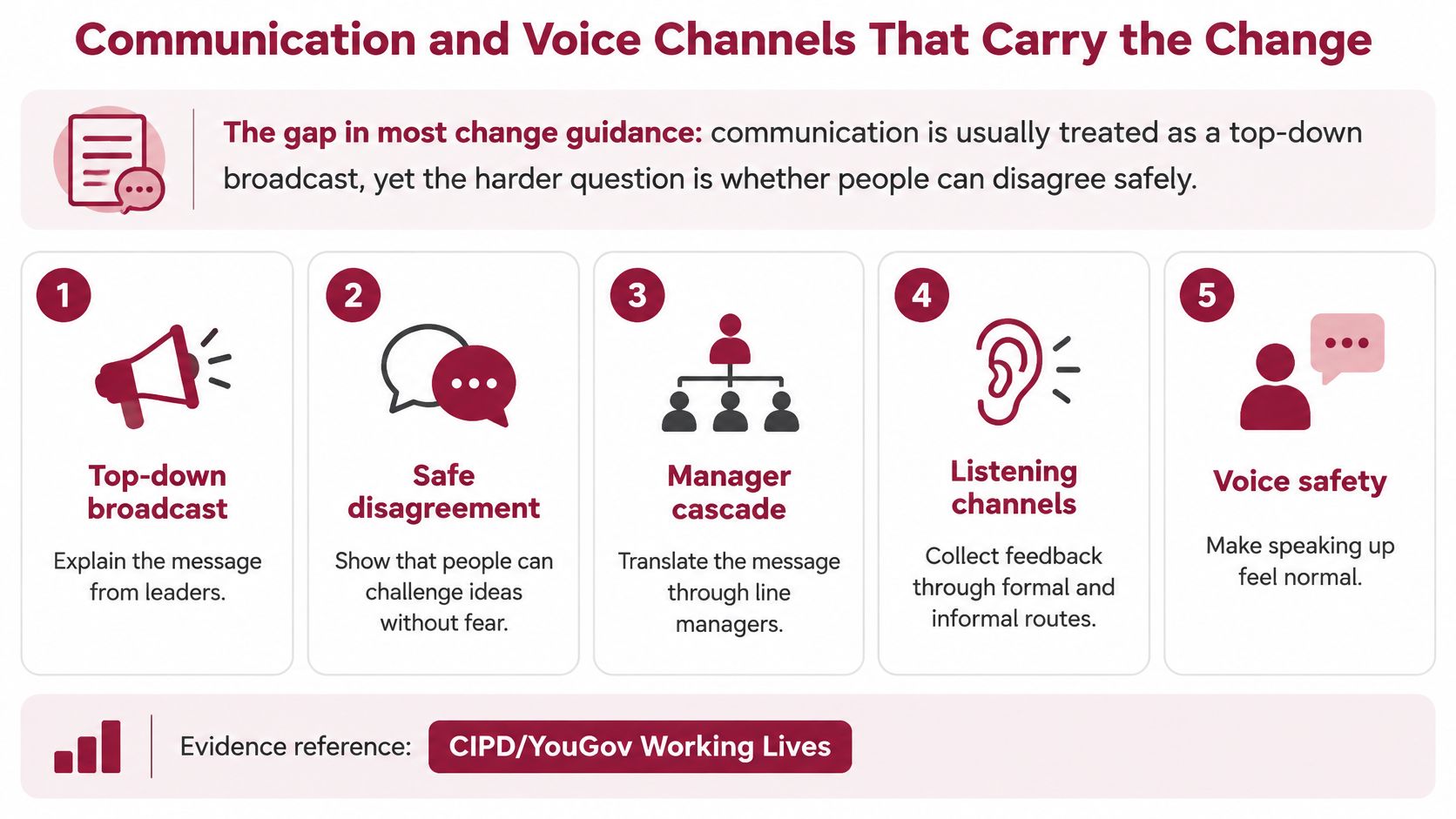
A launch message cannot create honest feedback. If employees have no safe way to challenge a decision, leaders hear agreement when they may be hearing silence. Set up and test a working voice channel before announcing the change.
The CIPD/YouGov Working Lives survey of 5,074 UK employees, conducted from December 2025 to February 2026, found that 20% had no workplace voice channel. The same survey found that 38% of employees in organisations with fewer than 50 staff had no channel, compared with 9% in organisations with 250 or more employees. These figures make channel coverage a practical starting measure, particularly for smaller organisations. A positive engagement score alone cannot show whether people can raise problems safely.
Sequence before any launch line
- Leaders explain why the change matters and what will stay the same. Naming what is stable helps people distinguish the intended shift from unnecessary disruption.
- Managers translate the message into team-level actions within two weeks. The translation should be concrete: what changes in decisions, handovers or day-to-day work? Practical communication skills for managers help managers make that connection.
- Open voice channels before the launch. Start with structured one-to-ones and a route for anonymous escalation. A channel introduced after employees are asked to support the change can look like a response to criticism rather than a genuine invitation.
- Set a response period, such as ten working days, and meet it. Acknowledging a concern without explaining what happens next leaves people guessing.
- Keep a decision log showing how feedback was handled. Record whether it changed the plan, exposed a risk or did not alter the decision, and explain why.
Separate unclear communication from a material risk by asking what would change if an objection were correct. If the answer is a flawed assessment rule, an inclusion concern or an ethical exposure, treat it as operational information and assess it. If the concern is that the change has not been explained clearly, improve the explanation rather than labelling the response resistance.
- Named channels: Each team has structured one-to-ones and anonymous escalation before launch.
- Response time: Concerns receive a reply within the agreed period, for example, ten working days.
- Decision log: The record shows how feedback affected decisions, including when the plan stayed unchanged.
- Protection from retaliation: Written guidance explains how concerns can be raised and how reports of retaliation will be handled.
- Coverage count: The sponsor reviews how many teams lack a working voice channel. Use the survey figures above as context, not as a substitute for checking local access.
Rituals, Policies and Training That Embed New Habits
Culture becomes durable when daily routines and work systems reward the behaviours leaders say they want. Begin with practice, then align the rules and decisions that shape people's work. Publishing a charter before managers have practised the conversations it requires often produces compliance on paper, with little change in how decisions are made.
The 2025 Owl Labs survey of UK full-time workers reports that 87% were already using AI at work. Set clear expectations for acceptable use, accountability and when a human check is needed. Hybrid work raises a related issue: if recognition rewards speed alone, careful output-checking, confidentiality and relationship-building can go unseen.
Levers, in the order that avoids theatre
Practise the target behaviours first. Use small-group role-play for difficult conversations, then align hiring scorecards, promotion panels and recognition so that they reinforce those behaviours. Managers and sponsors can also use team-building and management guidance to consider how team routines support day-to-day collaboration.
| Lever | Specific change | Evidence it is working |
|---|---|---|
| Hiring scorecard | Add two behaviour questions with a scored example | Candidates describe the behaviours without prompting |
| Promotion panel | Ask for an example of the target behaviour under pressure | Panels weigh behaviour alongside results |
| Recognition | Name the behaviour when praising a result | Staff describe the behaviour as well as the outcome |
| Team rituals | Set meeting norms and a review format built on the behaviours | Reviews cover how work was done and what was delivered |
| Manager training | Practise difficult conversations in small groups | Managers address a live challenge at team level |
| Policy | Publish AI-use or hybrid-work norms after practice begins | Teams apply the policy to real decisions and raise exceptions |
Embedding can take six to twelve months. Managers should be able to describe the behaviours and give an example from their own team before another all-staff message is sent.
A policy published before practice begins is a poster with a version number.
Measuring Progress and Avoiding False Wins
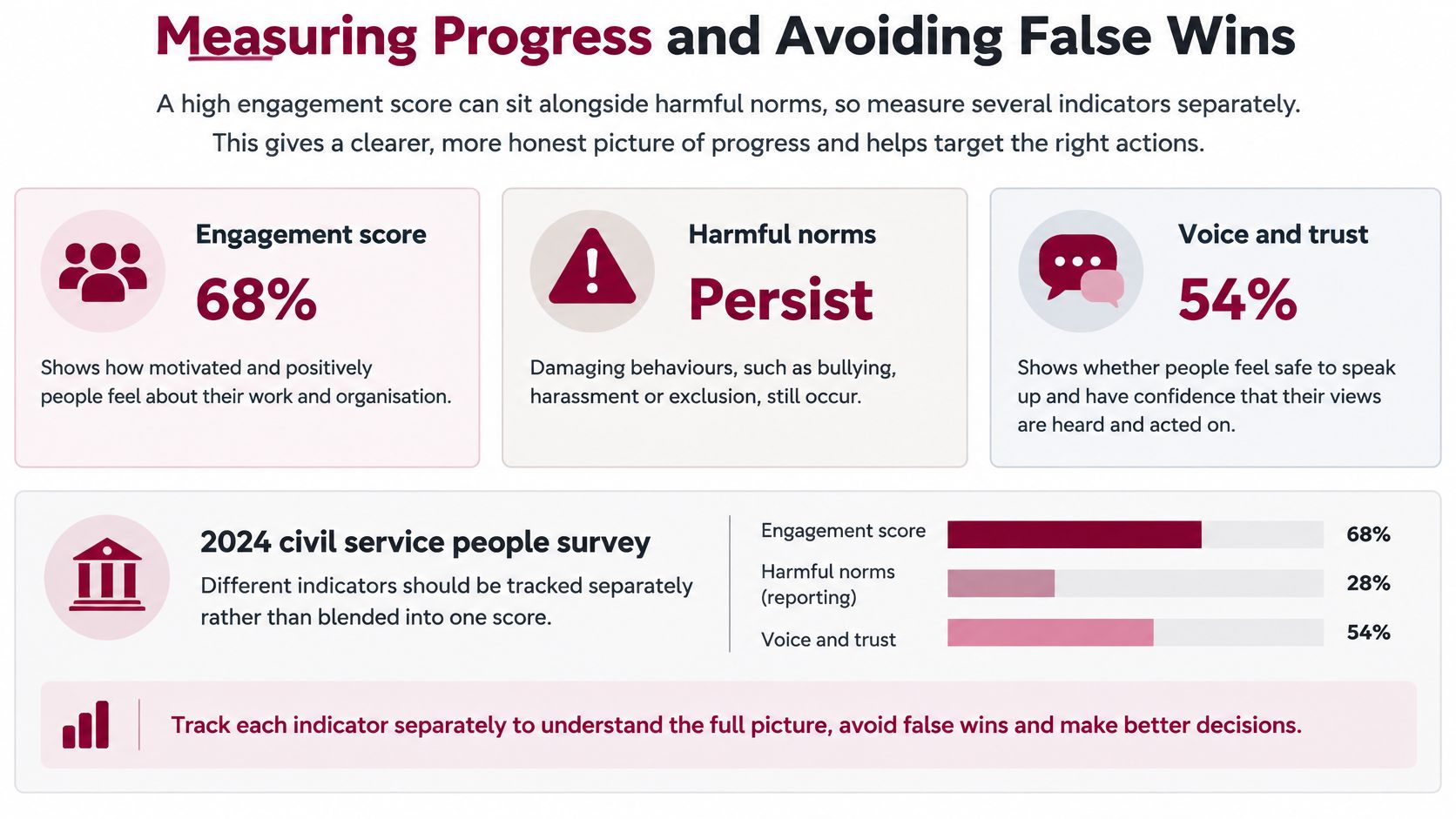
A rising engagement score can mask harmful behaviour. Track separate measures for trust, safety, follow-through and operational outcomes, then check who benefits from any improvement.
The 2024 Civil Service People Survey received responses from 354,962 civil servants across 103 UK organisations, a 61% response rate. In that survey, engagement ranged from 56% at HM Revenue and Customs to 72% at the Department for Culture, Media and Sport. Among respondents who reported bullying or harassment, 29% said appropriate action had been taken, and 39% said the behaviour had stopped by the time they completed the survey. The survey also recorded benchmarks of 7% for discrimination and 8% for bullying and harassment. Taken together, these measures show why engagement alone cannot establish whether concerns are being addressed.
The 2025 Civil Service People Survey puts overall engagement at 65%, with departments ranging from 57% to 71%. It also records that 8% of respondents reported bullying or harassment.
A cycle with a refusal to scale early
NHS England describes culture work as repeated plan, do, study, act cycles, with explicit measures and checks for unintended consequences. The independent evaluation of the NHS Culture and Leadership Programme reviewed all 35 participating trusts and reported improvements between 2018 and 2020 in CQC ratings, staff engagement and registered-nurse turnover relative to national averages. The practical lesson is to test changes on a small scale, then expand only when the chosen measures improve without creating new problems.
- Set the baseline using the diagnostic findings, not recollection.
- Choose three to five indicators covering engagement, safety, follow-through and an operational outcome.
- Break results down by team and working pattern. Organisation-wide averages can hide where trust is falling.
- Review the pilot measures regularly and record side effects, including added workload for people who raise concerns.
- Expand selectively. Keep changes in pilot where the indicators have not improved.
| Indicator | Benchmark from research | Review cadence |
|---|---|---|
| Employee engagement | 65% across the civil service in 2025, with departments ranging from 57% to 71% | Twice yearly, split by department |
| Discrimination reports | 7% in the 2024 Civil Service People Survey | Quarterly |
| Bullying and harassment reports | 8% of respondents reported it in the 2025 Civil Service People Survey | Quarterly |
| Action after reports | 29% said appropriate action was taken in the 2024 Civil Service People Survey | Quarterly, with case review |
Judge progress by whether people experience safer, fairer work and see concerns acted on. If the headline score rises while one team reports worsening harm or unanswered concerns, the culture has not improved there.
Confirm Your First 90-Day Plan
Turn the framework into one decision this quarter. Choose one team, two observable behaviours and one voice channel for a 90-day pilot. Finish the baseline in the first four weeks, hold a mid-point check at day 45, and review results at day 90 against the indicators already chosen. Expand only to teams where those indicators have moved, and record every change to the baseline so later comparisons stay valid.
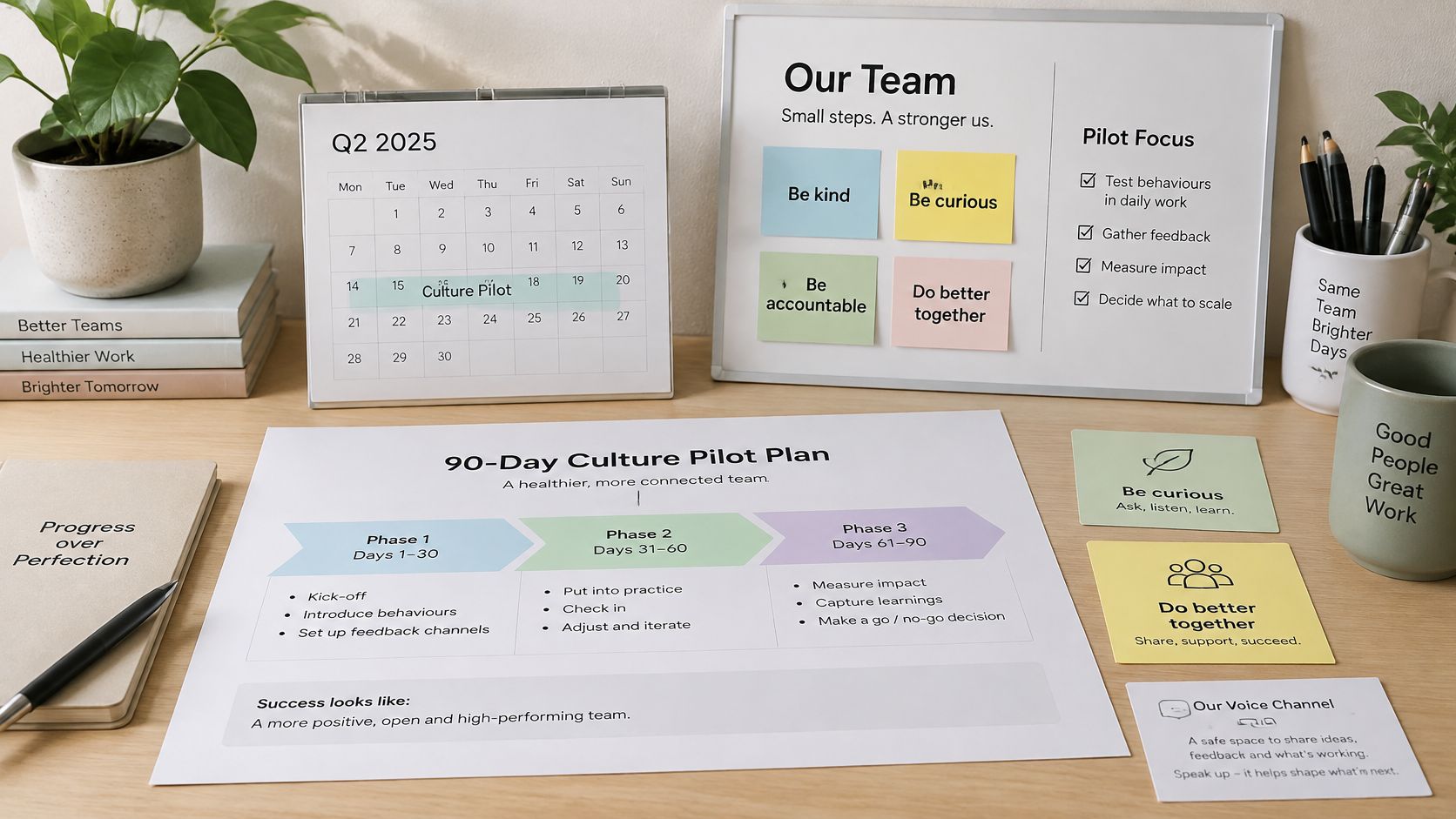
- Name a sponsor and a people lead with written responsibility for the pilot.
- Run the baseline interviews and a decision audit across at least three levels and two functions.
- Agree the two behaviours, the voice channel and the day-90 review date before any launch communication.
Managers who want the underlying theory before rollout can study Change Management, which supports this local diagnosis rather than replacing it. The course costs £99.00, is delivered 100% online and is self-paced, and includes recorded video lectures, text-based lessons, practical case studies, visual frameworks and reflection exercises. Topics include Introduction to Change Management (1h 07m), Drivers and Types of Organisational Change (0h 58m), Models and Frameworks for Change Management (0h 57m), Leadership and Change (1h 16m), Resistance to Change (0h 56m), Communication in Change Management (0h 42m), Organisational Culture and Change (1h 01m), Sustaining and Embedding Change (0h 51m), Change in Global and Digital Contexts (1h 28m), and The Future of Change Management (0h 45m).
The London School of Business Administration offers self-paced, CPD-accredited study in leadership, change and team practice for managers who need structured theory beside a live pilot. If you are changing a culture and want that study to sit next to your 90-day plan, visit London School of Business Administration and choose the course that matches the gap you are closing.