
Only 36% of UK businesses were innovation active during 2020–2022, according to the UK Innovation Survey 2023, whose definition includes changes to business structures and management, not just new products. Organisational change is therefore broader than installing technology, and its value cannot be judged by whether a system goes live.
Managing organisational change means coordinating decisions about work, capability, authority and employee expectations. The difficult question is rarely whether leaders can announce a new direction. It is whether employees have credible reasons, sufficient capacity and practical support to follow it. Resistance may be a rational assessment of an unrealistic plan, while apparent compliance may conceal workarounds and exhaustion.
Table of Contents
- The Five Phases of Managing Organisational Change
- Choosing a Change Model That Fits Your Organisation
- How to Diagnose Readiness and Plan the Change
- How to Communicate So Employees Trust the Change
- Handling Resistance and Change Fatigue
- Implementing in Stages and Running Pilots
- Measuring Whether the Change Has Worked
- Start With One Change This Quarter
The Five Phases of Managing Organisational Change
Start by diagnosing readiness, then plan and design, communicate and involve people, implement in stages, and embed and evaluate. Each phase must produce evidence that supports the next decision, rather than merely another presentation.
Change phases, guiding questions and key outputs
| Phase | Question it answers | Key output | Usually led by |
|---|---|---|---|
| 1. Diagnose readiness | How ready are we, and where are the gaps? | Baseline measures and stakeholder map | HR or change lead |
| 2. Plan and design | What will change, for whom, and how will we know it worked? | Business case, success criteria and owners | Sponsor with change lead |
| 3. Communicate and involve | Do people understand why, and do they trust the reason? | Briefing plan and feedback channels | Line managers with HR |
| 4. Implement in stages | Does the change work in a real team before wider rollout? | Pilot results and go or no-go decision | Project or operations lead |
| 5. Embed and evaluate | Has the change stuck, and what did it deliver? | Post-implementation review and benefits report | Sponsor with finance or HR analytics |
The most common mistake is moving directly from a plan to an announcement without diagnosing readiness. A sponsor may approve the expenditure while operational managers lack time to train staff, resolve competing priorities or maintain service levels during transition. That is an implementation constraint, not a messaging problem.
Use the sequence without making it rigid
A failed pilot should return the proposal to design. Evidence of fatigue during employee discussions may justify changing the implementation timetable, even where the underlying business case remains sound.
Accountability also needs continuity. The sponsor remains responsible for benefits after the project lead completes delivery, and line managers need authority to escalate operational problems rather than distribute updates. Reviewing lessons from business transformations is useful when those lessons are translated into explicit decisions and responsibilities.
Find the phase your change occupies today, identify its missing output, and withhold progression until that output is credible.
Choosing a Change Model That Fits Your Organisation
Choose a model according to the problem you must solve, not its familiarity. Models are lenses rather than recipes: no single framework adequately addresses strategic alignment, sponsorship, individual learning and continuing adjustment.
Common change models compared
| Model | Core idea | Best suited to | Main limitation |
|---|---|---|---|
| Lewin's Change Model | Unfreeze, change, refreeze | Contained, one-off shifts in relatively stable teams | Assumes a stable state that many organisations no longer have |
| Kotter's 8-Step Model | Urgency, coalition, vision, quick wins, anchoring | Top-down transformations with a visible senior sponsor | Sequence can feel rigid for continuous or agile change |
| ADKAR | Awareness, desire, knowledge, ability, reinforcement | Individual adoption of new tools, roles or behaviours | Says little about structure, strategy or systems |
| McKinsey 7-S Framework | Aligns strategy, structure, systems, shared values, skills, style and staff | Diagnosing misalignment before a merger or restructure | Diagnostic lens rather than a step-by-step plan |
Consider a hypothetical services firm with around 400 staff moving to a shared-service structure. Its leadership team might use the 7-S framework to identify inconsistencies between the proposed structure, existing systems and available skills. Kotter's emphasis on urgency and coalition-building could help secure agreement among senior managers who would otherwise protect separate departmental arrangements.
ADKAR would address a different question: can frontline employees perform the new work? Awareness of a shared-service strategy does not establish ability to resolve requests through unfamiliar systems.
Make the selection explicit
Use these criteria to constrain the choice:
- Scale: A local workflow adjustment needs less governance than a restructure spanning multiple functions.
- Continuity: A contained transition permits a clearer end state than continuing operational adaptation.
- Behavioural dependence: Where benefits rely on employees changing daily decisions, assess individual adoption alongside structural redesign.
Combining frameworks is defensible when each has a defined purpose. Combining their terminology indiscriminately creates unnecessary administration and leaves managers unsure which activities matter.
Name one primary model and one diagnostic tool in the plan. Use additional concepts only when they resolve a specific gap.
How to Diagnose Readiness and Plan the Change
Readiness is the ability to undertake the transition while continuing essential work. Enthusiasm alone is insufficient: a supportive team may still lack the time, skills or decision-making authority required.
The ONS management-practices bulletin reports that 89% of surveyed firms took some action to improve management quality in 2023, and 64% of those firms consulted employees about improvement areas. Consultation should inform the diagnosis, not merely endorse a solution already selected.
Build a decision-ready diagnosis
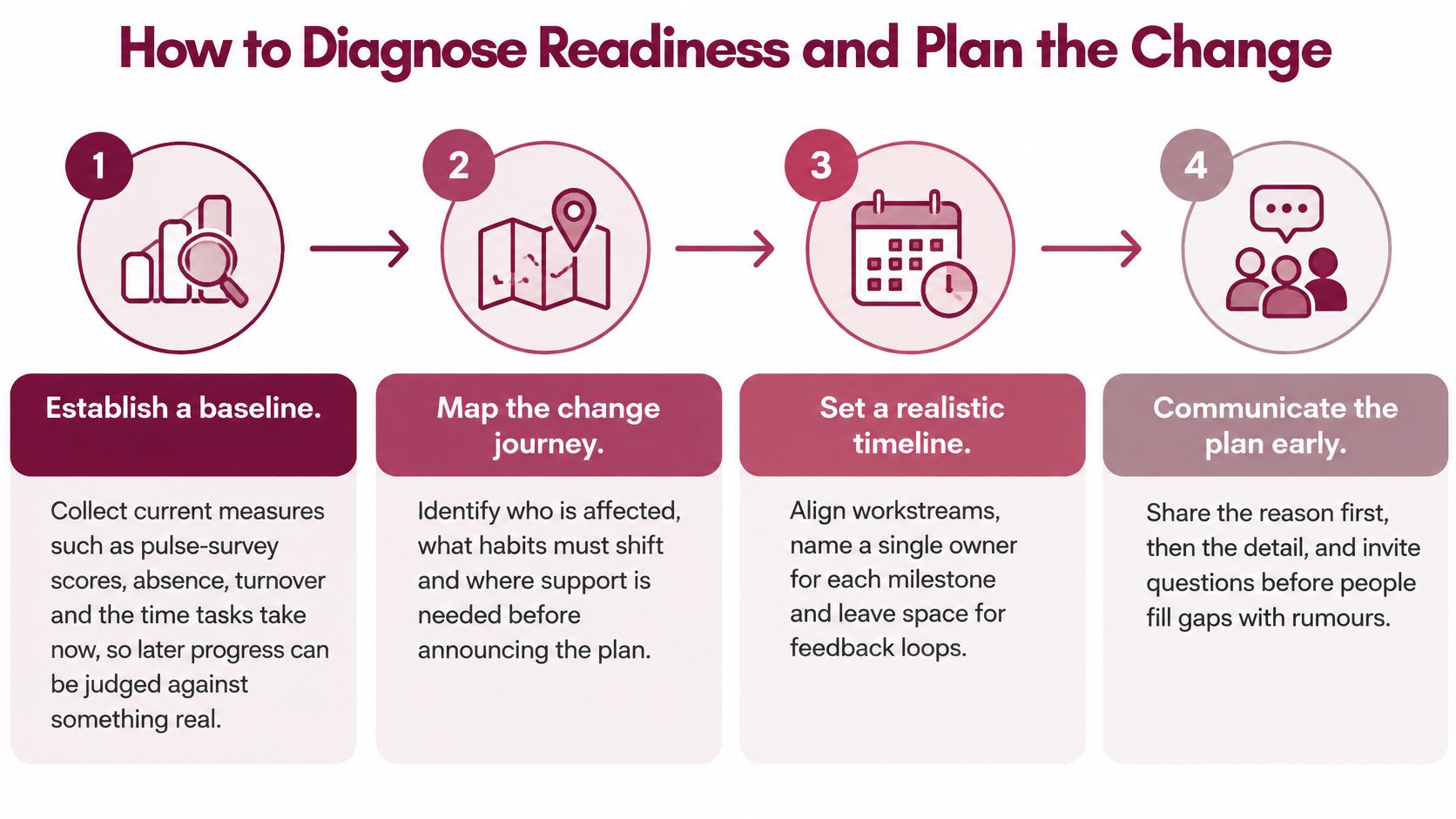
Establish the baseline. Collect existing pulse-survey scores, absence, turnover and task-duration measures from HR and operations. Record definitions and measurement periods so that later comparisons are meaningful.
Map stakeholders. Assess both influence over the decision and exposure to its consequences. Record likely objections and their causes, including lost autonomy, additional workload or unresolved experiences of previous changes.
Segment roles and locations. Separate groups whose work will change differently, including remote staff, shift workers and teams using older systems. Give each group an identifiable support requirement rather than assuming a standard briefing will suffice.
Assess capacity and capability. Check managers' available time, employee skills, training cover and funding for transition support. In the 2025 Longitudinal Small Business Survey, 31% of microbusinesses planned to increase managers' leadership capability, compared with 73% of medium-sized businesses, making manager development a budget item to examine explicitly.
Assign success criteria and owners. Specify the operational result required and name someone with authority to act when performance falls short. Separate the person collecting the measure from the person accountable for improving it where necessary.
Agree the launch gate. Require explicit approval of readiness, resources and unresolved risks before implementation begins. Record who can postpone launch and what evidence would justify that decision.
Test the business argument
Avoid skipping the baseline, appointing owners after launch or treating the business case as an approval document that employees never understand. Ask operational managers to explain the problem, the proposed intervention and the trade-off in their own words.
If they cannot explain why this intervention is preferable to a smaller process improvement, the proposal needs further work.
Diagnostic question: Can the affected teams absorb this change while maintaining acceptable service, and what evidence supports that judgement?
How to Communicate So Employees Trust the Change
People need the reason before the detail. State the business problem in language a frontline employee could repeat, then the proposed response and its consequences. Before anyone is briefed, write what a trusted announcement looks like: who hears it first, which facts are confirmed, and which questions stay open. That standard has to exist before launch. A definition written after the rumour has already travelled will not reset what people believe.
A nationally representative Censuswide survey of 1,035 UK employees, conducted in February 2023 and reported by WalkMe, found that 41% identified mistrust in the organisation or its leadership as a cause of resistance, while 38% said insufficient awareness of the reason for change would make them resistant. After a run of restructures, a thin explanation is read as evidence. Sending the same line more often will not repair an account staff already find implausible.

Equip managers before briefing everyone
Test the explanation with a small group of employees and ask them to repeat it back. Listen for the gap between what leaders intended and what staff understood, particularly on job security, workload and customer impact.
Give line managers a briefing pack covering confirmed decisions, matters still open to consultation, and questions nobody can yet answer. Strengthening communication skills for managers means teaching them to name what is unknown and say when an answer is expected. I would rather a manager leave a question open than fill it with an assurance they cannot keep. The invented line is what people remember.
Use a practical communication rhythm:
- Announcement: State the rationale, scope, uncertainties and immediate next steps.
- Team briefing: Schedule this within two weeks, with time for role-specific questions.
- Implementation updates: Publish fortnightly progress reports, including setbacks and decisions changed through feedback.
- Standing questions channel: Accept anonymous questions and publish answers that all affected teams can access.
The intervals are planning defaults; they do not guarantee trust.
Make participation consequential
Invite employees to shape decisions that remain open, such as workflow handovers or rota arrangements. Explain which constraints are fixed so consultation does not imply authority employees do not possess. After several changes in a short period, skipping another workshop is often a rational response to fatigue. Say what their input will change, and what it cannot.
A regional retailer's staff read about proposed store closures in a newspaper before their managers briefed them. The next announcement needs more than a better subject line. Leaders should acknowledge the failure, separate proposals from decisions, and give every affected team the same route to reliable answers.
For the next communication, use this order: what changes, why now, what it means for each role, and where to ask questions. Put the reason ahead of the implementation detail, and show how employees can still influence the work that is open.
Handling Resistance and Change Fatigue
Resistance is usually a rational response. Employees who have absorbed repeated restructures and heavy workloads object because experience tells them what the change will cost them, and lumping distrust, uncertainty, missing information, perceived threats and fatigue together as obstruction destroys evidence you need. Each cause requires a different response.
In ONS coverage of AI in UK businesses, 52% of employees report a restructure in the previous 12 months. The same coverage records a 12-percentage-point increase in reporting restructures or redundancies compared with 2024. Repeated change is the context in which many UK employees will hear your announcement, so assess capacity and trust before concluding you have an attitude problem.

Resistance types, signals and responses
| Resistance type | Typical signal | Response |
|---|---|---|
| Distrust of leaders | Doubts about motives and references to past broken promises | Build credibility through consistent follow-through and visible leadership |
| Uncertainty | Questions about what the change means for a specific role | Clarify the effects for each role in writing |
| Missing information | Questions already answered elsewhere and requests for facts | Brief managers fully and publish the answers |
| Threat to role | Concern about job security or status | Name the risks openly and test them with affected staff |
| Fatigue | Falling discretionary effort, rising absence and sceptical rather than curious questions | Sequence the next change after a stabilisation period |
Diagnose the objection before responding
Ask managers to maintain an objections log for two weeks, recording the concern, supporting evidence and required decision. Review patterns without naming employees unnecessarily, and involve employee representatives where appropriate.
Distinguish an untested cost estimate or service risk from a preference for familiar routines. When an objection is valid, amend the plan and explain the amendment publicly. Otherwise employees learn that consultation has no practical consequence, and the next round of feedback arrives thinner and less honest.
A finance team faces its third system change in 18 months. Its staff may support standardisation in principle yet object to another stretch of duplicate entry and relearning. The objection concerns capacity, so a stabilisation period will achieve more than motivational messaging.
Absence and reduced discretionary effort should be investigated before they are attributed to fatigue. The same signals appear when a team is covering for a broken process, and the remedies differ. Decide which concerns require a design change and which require a direct explanation of a decision that will stand.
Define what successful adoption looks like before launch, and share that definition with the teams affected. Sceptical employees have usually seen targets moved to fit results after the fact; a success measure agreed in advance is one of the few forms of proof you can offer them.
Implementing in Stages and Running Pilots
A pilot should expose weaknesses before the organisation commits to wider implementation. Selecting only enthusiastic employees or providing support that cannot be sustained elsewhere produces reassuring results with limited operational value.
Run the pilot as an operational test
Select a representative team. Include relevant differences in workload, experience, location and system access. Where practical, include employees who have raised substantive objections.
Set thresholds before starting. Agree minimum requirements for adoption, delivery and early employee confidence. Record which failures prevent progression and which can be corrected during a subsequent wave.
Protect participation. Allocate working time for learning and testing, provide a named support contact and supply the agreed briefing materials. Otherwise, the pilot measures employees' willingness to work additional hours rather than the feasibility of the change.
Record unintended effects. Track overtime, duplicate processing, informal workarounds and service deterioration alongside intended benefits. Ask staff what they stopped doing to accommodate the new process.
Hold the decision gate. Compare results with the pre-agreed thresholds and record a go, conditional go or no-go decision. A no-go requires redesign and retesting, not pressure to reinterpret weak results.
Scale through controlled waves. Stabilise each group before adding further demands, and carry forward corrections to training, staffing and process documentation.
For AI-enabled workflows, add explicit checks on human review, professional judgement and the time spent correcting outputs. Tool usage alone does not demonstrate that employees complete work more effectively.
Preserve the right to stop
A conditional approval needs an owner, corrective action and review point. It must not become permission to proceed indefinitely with unresolved operational risks.
Scaling is a decision earned against agreed thresholds, not a date the team must defend because it appears in the project plan.
Measuring Whether the Change Has Worked
Define success before launch, because leaders can otherwise select favourable measures after implementation. Delivery, adoption, realised outcomes and sustainability answer different questions and should remain visible separately.
A UK-linked academic analysis of organisational-change case studies classified 145 of 200 initiatives as successful, a 72.5% reported-success rate. These were self-reported classifications, not an objective probability that another organisation's programme will succeed.
Separate delivery from benefits
Define the assessment across these dimensions:
- Delivery: Was the agreed scope delivered within the authorised schedule and budget?
- Behavioural adoption: Can employees perform the required work, and do they use the intended process?
- Realised outcomes: Have business, customer or learner results improved?
- Sustainability: Can operational teams maintain the improvement without exceptional project support?
Approve these definitions with the business case, test them through the pilot and revisit the evidence at each scaling decision. Complete a post-implementation review after responsibility has transferred to operational owners.
Leading and lagging indicators for a change programme
| Indicator type | Indicator | Example measure | Review interval |
|---|---|---|---|
| Leading | Training completion | Share of affected staff completing required training by go-live | Fortnightly |
| Leading | Manager participation | Share of managers attending briefings and team sessions | Fortnightly |
| Leading | System or process usage | Active users or completed transactions per week | Fortnightly |
| Leading | Employee confidence | Pulse-survey score on confidence in the change | Monthly |
| Lagging | Delivery against scope, schedule and budget | Milestones met and variance against budget | At each stage gate |
| Lagging | Productivity or service quality | Output per team or service resolution time | Three and twelve months |
| Lagging | Retention and benefits realised | Staff turnover in affected teams and benefits against the business case | Twelve months |
Interpret the dashboard rather than displaying it
Use these review intervals as a starting schedule. Review leading indicators fortnightly during rollout, retain a monthly confidence pulse, and examine longer-term outcomes at three and twelve months where the benefit timetable supports it.
Check denominators and practical meaning. Training completion can remain high while employees cannot perform an unfamiliar task, and system usage can rise because staff must enter the same transaction repeatedly.
Apply data-driven decision-making by assigning corrective action to each material variance. Check alternative explanations, including workload changes or seasonal demand, before attributing improvement to the programme.
An initiative launched on time has completed a delivery milestone. It has not yet demonstrated success.
Start With One Change This Quarter
Choose one live or planned change rather than attempting to rebuild the entire change function. A bounded initiative allows managers to test their discipline without creating another layer of organisational activity.
Set the first evidence-review date before scheduling other activity, then complete these actions in order:
- Run the readiness baseline using measures HR and operations already hold.
- Select a primary model and diagnostic tool, recording their distinct purposes in the plan.
- Book the stakeholder briefing and first stage gate, including the date for reviewing leading indicators.
For structured preparation alongside this work, our Change Management course is an online, self-paced option for managers and team leaders implementing organisational change. It examines Lewin, Kotter, ADKAR and the McKinsey 7-S Framework, alongside diagnosing barriers, addressing resistance and sustaining change.
Keep the immediate commitment concrete. Write down the first decision you will take this week, the evidence you need to take it, and the person you will tell.
London School of Business Administration offers self-paced business and management education combining recorded lectures, structured learning materials and assessments. Visit London School of Business Administration to explore study options that support more disciplined diagnosis, employee involvement and evaluation in your next organisational change.