
You have a team member whose work is slipping, whose tone in meetings has sharpened, and whose colleagues have started routing tasks around them. You have already tried a quiet word. Nothing has settled. The next conversation will either restore a workable standard or harden into a grievance, a sickness absence, or a tribunal file.
How to manage difficult employees, in a UK workplace, is less about personality and more about diagnosis. A skills gap, a conduct breach, a relationship dispute and a health condition can look identical from across the office. Punishing the wrong cause is the decision that loses both the employee and the case.
I would not open with a warning. I would classify the issue, hold a fact-finding meeting, and only then choose coaching, a written plan, or a formal route. What follows is that sequence, in the order a line manager faces it.
Table of Contents
- Work Out Which Type of Difficult Employee You Face
- How to Run a Fact-Finding Meeting Before Any Warning
- Coaching Scripts for Performance Conversations
- Building a Performance Improvement Plan That Holds Up
- Escalating Difficult Cases and Deciding on Exit
Work Out Which Type of Difficult Employee You Face
A team lead in a Manchester contact centre sees incomplete call notes, an agent who snaps at colleagues, and three late starts in a fortnight. The first job is to decide what kind of problem this is. Each type needs different evidence and a different first move. Behaviour that looks like misconduct can sit on a capability gap, a health condition, or a dispute between two people.
Why the label matters
Acas research on why conflict happens reports that 44% of working-age adults experienced workplace conflict in the previous 12 months. Capability or performance issues were the most common reported cause at 38%, and personal disagreements or relationship problems accounted for 33%. A manager who assumes a personality problem will miss the two causes that show up most often.
The Acas annual report and accounts 2023 to 2024 recorded 104,884 Early Conciliation notifications in 2023–24, alongside 33,507 employment tribunal claims (ET1s) received. That volume is why classification belongs in writing before any route is chosen.
Difficult employee issue types and first moves
| Issue type | Typical evidence | First move |
|---|---|---|
| Capability or skill gap | Errors that stop once the task is re-taught; output below a documented standard | Check training, role clarity and resources before any warning |
| Conduct | Dated incidents such as repeated lateness, rudeness or unauthorised absence | Gather attendance records and witness accounts, then hold a fact-finding meeting |
| Relationship conflict | Friction between two or more people, often mutual, with competing accounts | Record both accounts separately and offer voluntary mediation where it is safe |
| Health or disability-related | Patterns linked to stress, depression, a long-term condition or an impairment | Ask neutrally about support; consider reasonable adjustments and occupational health advice |
| Bullying, harassment or discrimination | Targeted or unwanted conduct affecting a colleague's dignity or a protected characteristic | Investigate first; do not mediate; follow the grievance or formal route |
Questions that sort the file
- Is the standard written down? If the rota rule or the note standard was never issued, you don't yet have a conduct case.
- Has the person been trained, and is the workload realistic? Repeated errors after coaching point one way. The same errors with no training, or with an overloaded queue, point another.
- Is anything changing outside work, and is anyone else involved? A new pattern of lateness may be health. Snapping that is returned in kind may be a relationship dispute, not a solo attitude.
Write one sentence per concern. Name the type, the standard breached, and the dates of two examples. Do that before you decide the next step.
For the Manchester agent, that might read as three lines: incomplete notes against the call-note standard on two named dates, sharp remarks to two named colleagues, and late starts on three rota dates. Those lines decide whether you coach, investigate, or ask about support.
How to Run a Fact-Finding Meeting Before Any Warning
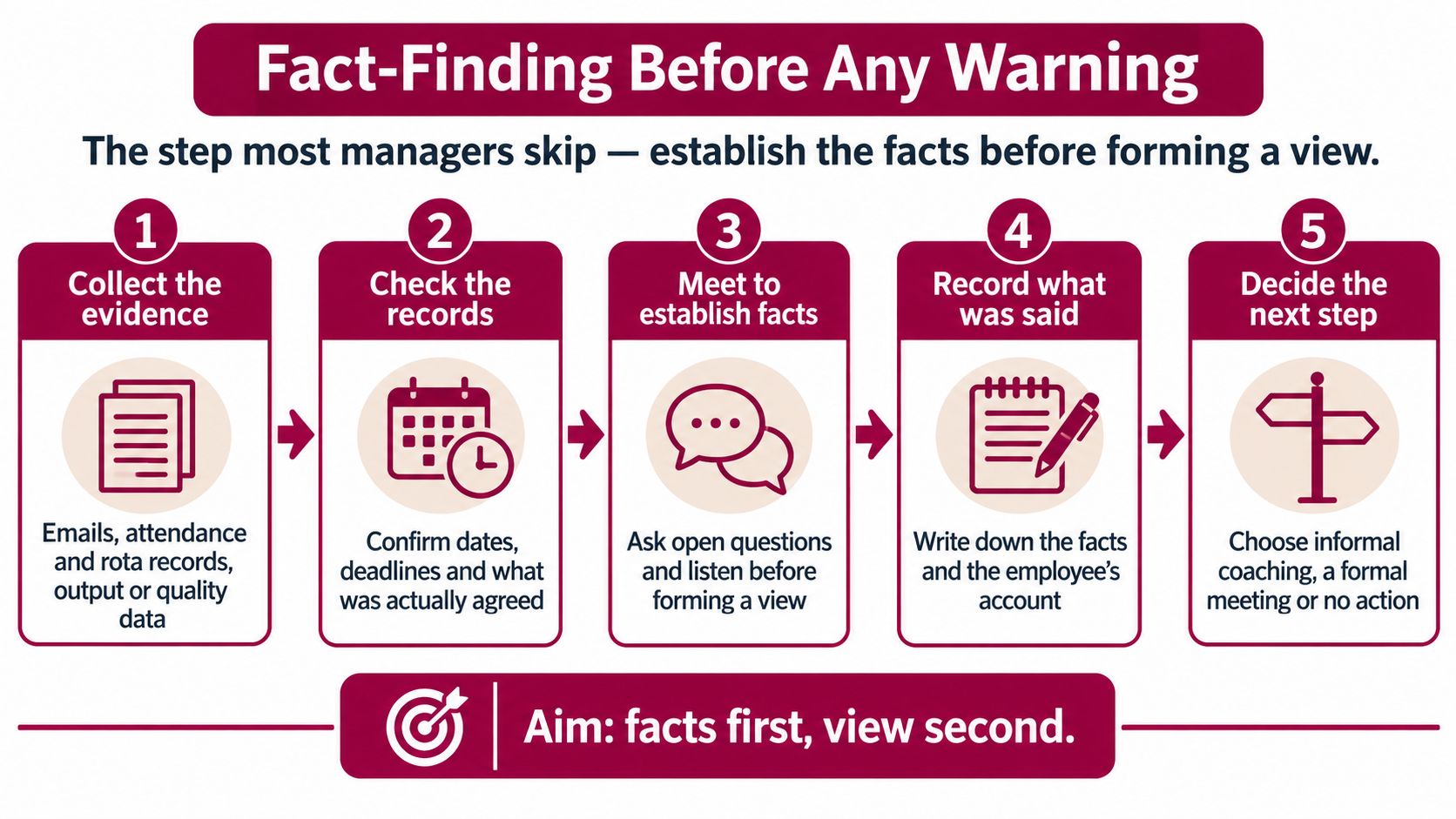
This is the step most managers skip. The aim is to establish facts before you form a view. A warning issued on a hunch is difficult to defend and easy for the employee to experience as unfair.
Acas estimates approximately 1.7 million formal disciplinary cases annually, with an average management-time cost of about £1,141 per case, around £2 billion in total. Informal discussion and workplace mediation are estimated to cost approximately £250 million annually. Early resolution is the cheaper route only where it stays fair. Serious misconduct, failed informal measures, or material risk to people still belong on a formal path. The same Acas account of practice warns against labels such as "difficult attitude", sanctions without context, inconsistent treatment, and no reasonable chance to improve.
The meeting in order
- Collect the evidence. Pull emails, attendance and rota records, output or quality data, objectives, and witness accounts. Date each item and sort it into direct evidence and hearsay. Hearsay can prompt a question. It should not carry the finding on its own.
- Book a private meeting with reasonable notice. Say plainly that this is a conversation about concerns, not a disciplinary hearing. Springing the meeting on someone produces defence, not an account. A practical treatment of early dialogue sits in this guide to how to handle conflict at work.
- Describe behaviour and impact with two dated examples. "Your notes for the calls on 4 and 11 March omitted the outcome code, so the next agent could not see what was promised." That is usable. "Poor attitude" is not. The common slip is to argue the label instead of the dates.
- Ask for the explanation and listen without arguing. Note what they say about workload, health, training, or unclear expectations. You are collecting an account, not winning a point.
- Test the cause. Check whether capability, workload, health, disability, or an unclear standard is contributing, and whether a reasonable adjustment applies. Repeated lateness can be an impairment. Discipline before that question is the wrong instrument.
- Agree two or three measurable actions and a review date. A usable action is concrete, such as responding to internal requests within a stated window, or completing call notes before the next break. Vague promises to "be more professional" cannot be reviewed.
- Write the note within 24 hours. Record what was said, what was agreed, and when you will meet again. Send it to the employee so they can correct anything you have misheard.
Managers who need the procedure behind these conversations can study Human Resource Management as part of a wider management pathway.
A healthy outcome has three parts. The standard is clear, the review sits within four to six weeks, and the employee has seen the written record and had a chance to respond. If they dispute a date, correct the note. If they raise health, pause the conduct framing and take advice before you go further.
Coaching Scripts for Performance Conversations
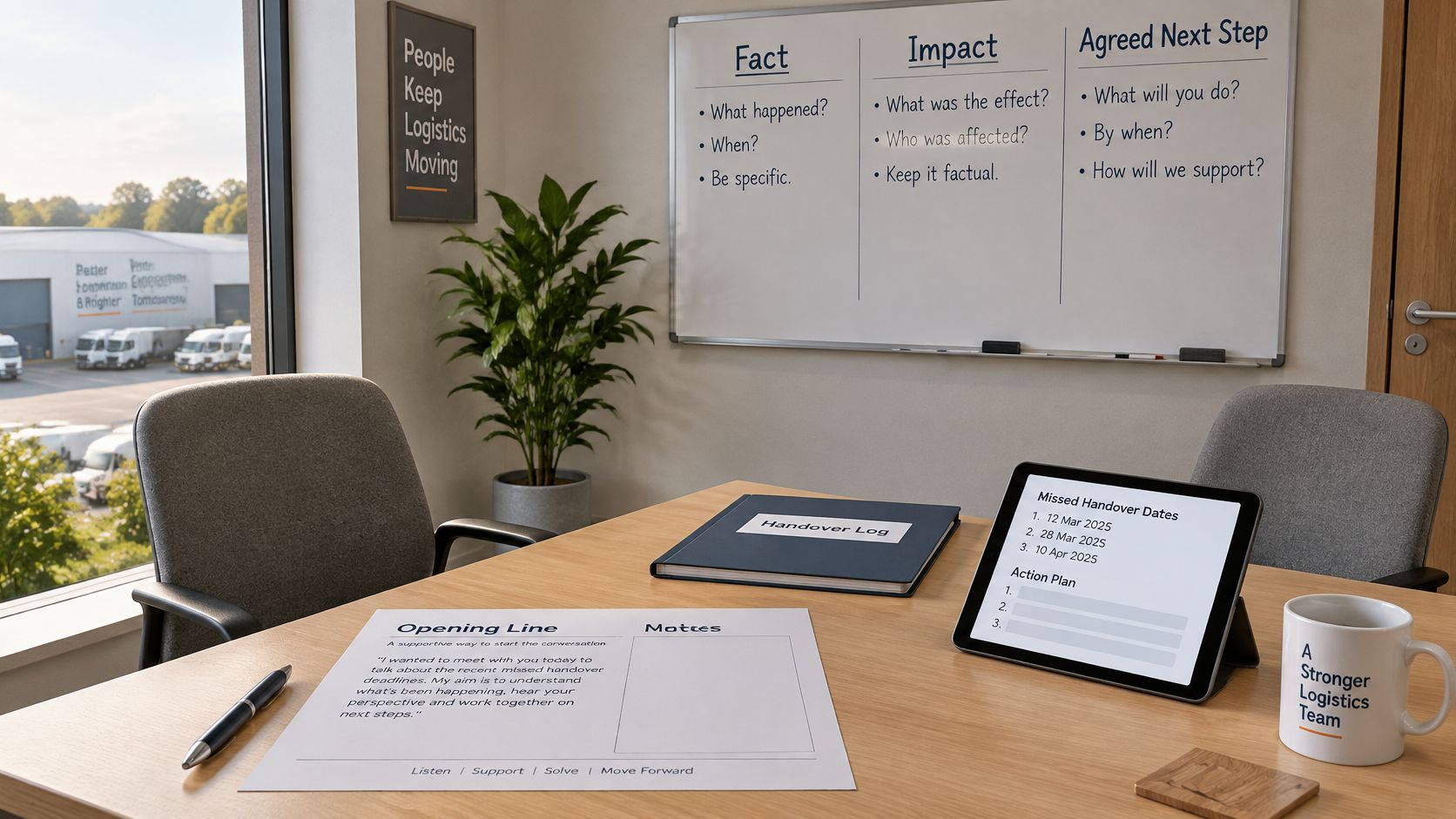
Coaching is the right next step when the fact-finding meeting shows a gap the person can close with support, not a serious conduct breach. Ahmed is a logistics coordinator. He has missed three handover deadlines in a month. His manager wants to coach rather than discipline.
Opening on the behaviour
The opening names the behaviour and the reason for the conversation. "I want to talk about the handovers, because two of the last three went out after 4pm." It doesn't open with character, and it doesn't apologise for raising a standard. Ahmed knows which files are in scope before anyone discusses motive.
Questions before advice
Ask before you advise, then reflect back what you hear. Useful lines are short. "What got in the way of the 4pm send?" "What would make the handover easier to finish on time?" "What support would help?" If Ahmed says the warehouse update lands at 3.40pm, repeat that back before you propose a fix. Advising first teaches him that his account doesn't matter. A coaching leadership style depends on that order: question, reflection, then a standard he can meet.
The close fixes the agreement in one line. "For four weeks the internal cut-off is 3pm, and we will review on the 28th." A 3pm cut-off gives him a buffer before the external send. The date stops the arrangement drifting into a vague hope.
Three responses you will actually get
- Denial. Return calmly to the dated examples. "The handovers on the 2nd, the 9th and the 16th left after 4pm. Let's stay with those three." Don't add new incidents mid-meeting.
- Workload. Ask which tasks could move, then check the rota yourself. If the afternoon queue is impossible, the standard is the organisation's problem as well as his. If other coordinators meet 3pm on the same rota, say so with the comparison, not with a lecture.
- Defensiveness. Pause. "We don't have to finish this today. We will reconvene within two days, and the 3pm cut-off still stands from tomorrow." Heat is not the same as refusal. A same-day sanction for a raised voice, where no abuse occurred, usually wrecks the coaching.
The test of a good coaching conversation is simple. Ahmed leaves able to state the standard, the next action, and the date of the review in his own words. If he can only say that you were annoyed, the meeting failed. The phrasing of these questions is part of what Communication Skills for Leaders is there to develop.
Building a Performance Improvement Plan That Holds Up
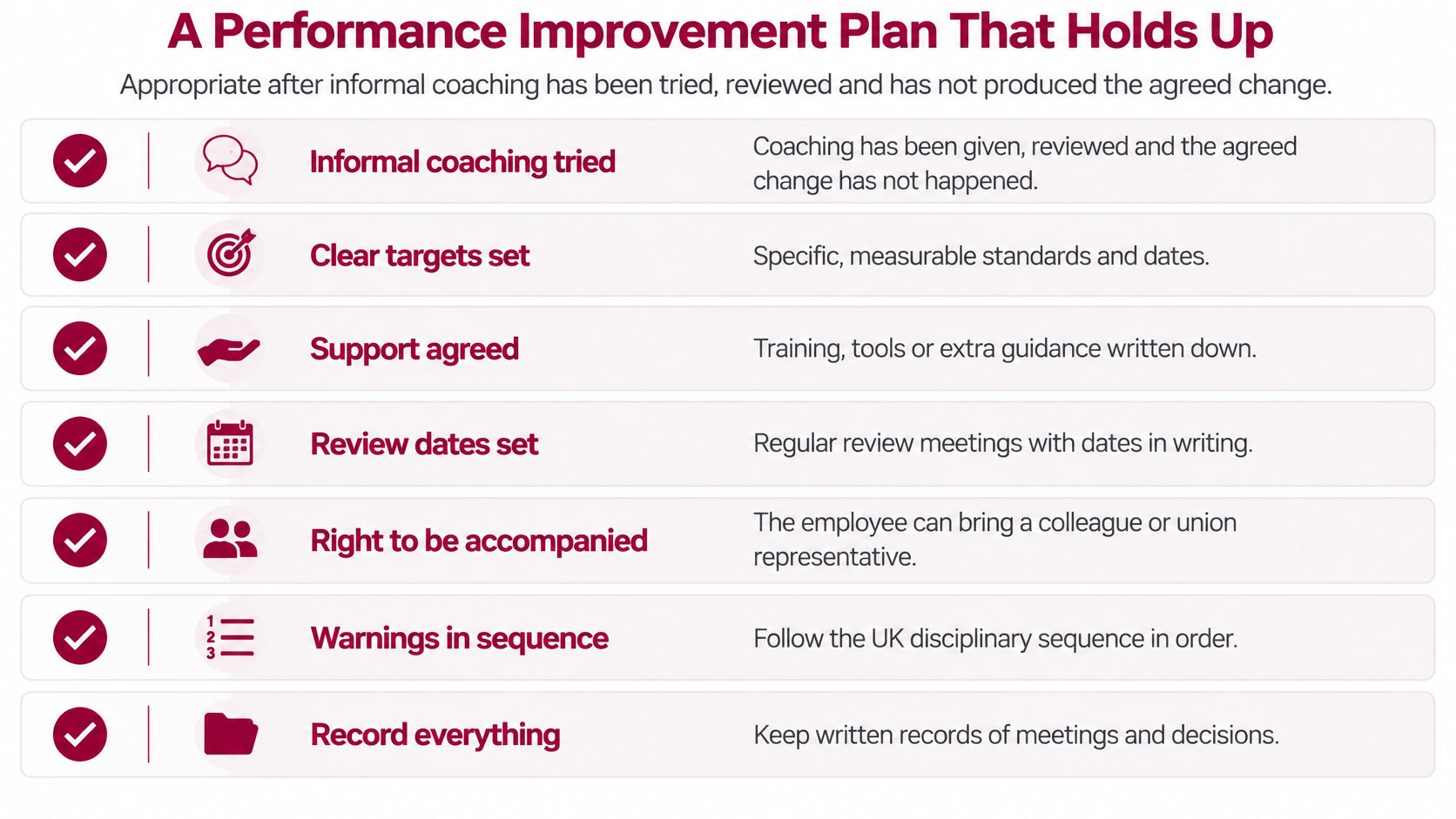
A performance improvement plan is appropriate after informal coaching has been tried, reviewed, and has not produced the agreed change. It is not a first conversation, and it is not a disguised dismissal. If Ahmed's 3pm cut-off was agreed, reviewed at four weeks, and the late handovers continued, a plan is now proportionate. If nobody reviewed the coaching, go back and hold that review.
Where the plan sits in procedure
Government guidance on disciplinary procedures expects a specific sequence: a written letter setting out the issue, a meeting to discuss it, a disciplinary decision, and an opportunity to appeal. The procedure should also say which performance and behaviour may lead to action, what the employer may do, and whom the employee can approach if they disagree. Before you start, check that the handover rule was communicated and that comparable coordinators have been treated the same way.
The letter has to name the concern clearly enough for Ahmed to respond. "Three handovers after 4pm on these dates, against the team rota policy" can be answered. "Poor attitude" cannot. Separate fact-finding from the final decision wherever practicable, record his explanation, and keep the right of appeal intact.
Components of a performance improvement plan
| Element | What it should contain | Example |
|---|---|---|
| Standard | The specific, measurable expectation and the source it comes from | Handover sent by 3pm internal cut-off, per team rota policy |
| Support | Training, adjustments, workload changes or mentoring the organisation will provide | Two shadowing sessions and a reduced task list for four weeks |
| Measures | How progress will be counted and recorded | Count of late handovers per week, logged by the manager |
| Timescale | Start date, review dates and the end point of the plan | Four weeks from start, with reviews at weeks two and four |
| Review meetings | Who holds them, how long they last and what they cover | Line manager, 30 minutes, with the employee's own record of progress |
| Outcome | What happens if the standard is met, partly met or not met, and the right of appeal | Standard met closes the plan; not met triggers a formal disciplinary meeting |
The support row is the one that usually fails. A plan that demands a 3pm send but offers no shadowing, no workload change, and no check on whether the warehouse update arrives in time is hard to defend. You are asking for a result you have not enabled. Holding that review well is a management skill, and The Credential of Leadership and Management is structured around the decisions managers make in that room.
Draft the plan this week with four items on the page: the standard, two measures, a review at four weeks, and the name of the person who will hold that meeting. If you are both investigator and decision-maker, say so and offer a note of how he can appeal.
Escalating Difficult Cases and Deciding on Exit
Ahmed's manager closed the four-week plan on Friday and drafted a dismissal letter over the weekend. On Monday, Ahmed raised a grievance about how the reviews were run, and occupational health still had not reported. That letter goes in the drawer. The route changes with the facts, not with how irritated the manager feels.
Coaching and a written plan close some files. Others move straight to a different procedure, and a few reach exit only after support has been real and the standard is still missed. Escalating on irritation, and coaching a case that has already failed its own tests, both produce the same problem: a process a tribunal can unpick.
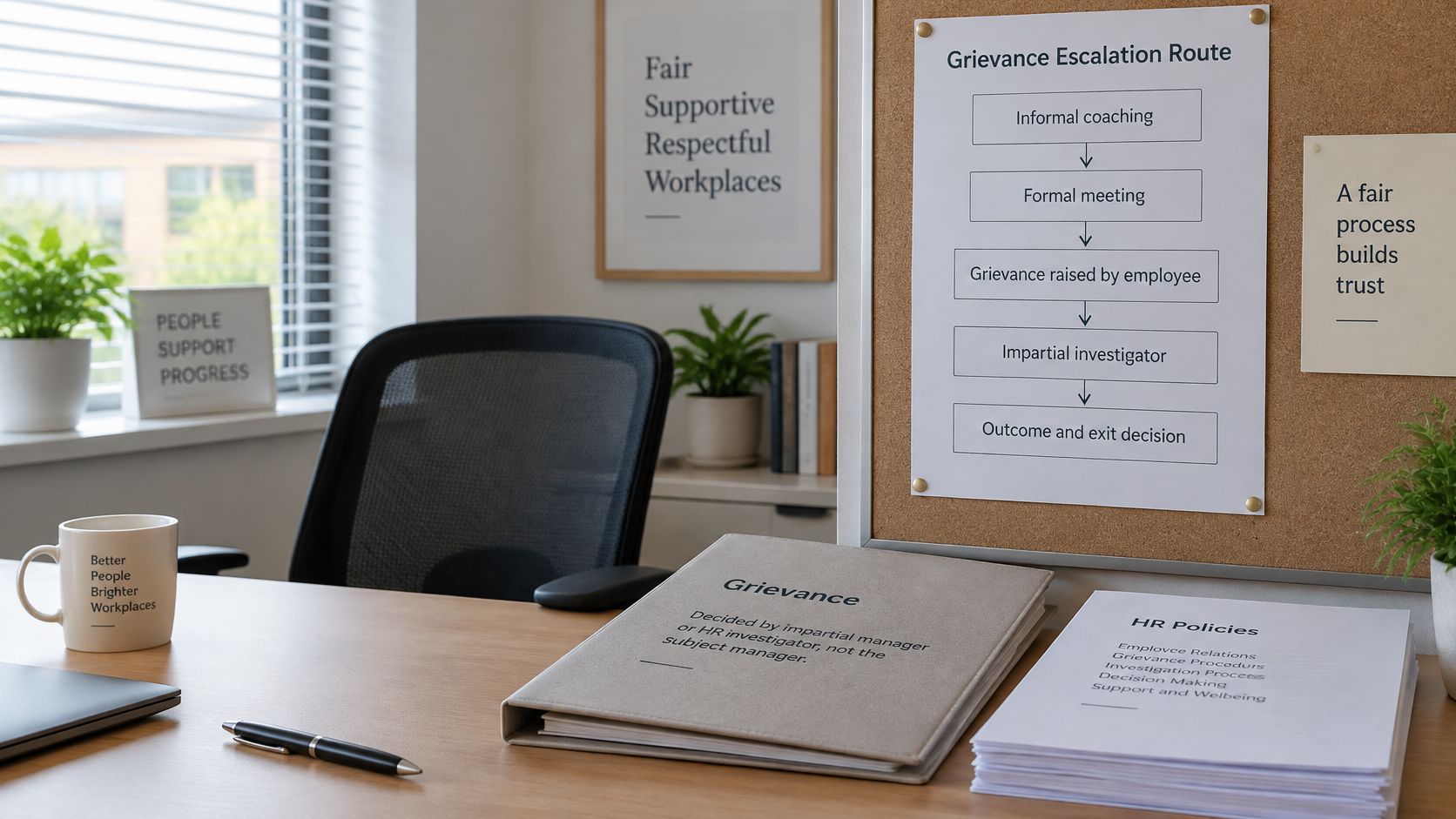
Escalation routes by situation
Name the cause before you choose the route. A skills gap, a conduct issue, a broken working relationship, and a health condition are not the same case, and none of them should be punished as misconduct until that distinction is on the file.
| Situation | Route | Timing |
|---|---|---|
| Employee raises a grievance about you | Impartial manager or HR investigator; you do not decide the outcome | Hearing ideally within five working days |
| Alleged harassment or discrimination | Separate investigation; do not force mediation | Act without unreasonable delay |
| Possible disability or health cause | Occupational health referral and a review of reasonable adjustments | Before any disciplinary decision |
| Disputes spreading across a team | HR involvement and early advice on wider conciliation | Early, before the matter escalates |
| Formal disciplinary action needed | Written letter, meeting, decision and right of appeal | As set out in the written procedure |
When the employee complains about you
A grievance is still a grievance when you think it is tactical. UK Government guidance on grievance procedures requires a written procedure that names whom to contact, how to make contact, the time limits, an alternative contact where the usual person is involved, and how to appeal. Unresolved informal concerns lead to a hearing, and the employee may be accompanied by a colleague or a trade-union representative.
You do not decide a complaint about yourself. An impartial manager or an HR investigator hears it, ideally within five working days. The outcome addresses each issue, states any action, and explains appeal rights. The Acas Code is not legally binding, but an employment tribunal can adjust compensation where the Code has not been followed. Record dates, evidence, meetings, accompaniment, decisions, and appeals. Treat the file as a procedure, not as a verdict on whether you like the person. The employment law rights and obligations of employers and employees set the boundary around that record.
The trade-off is time against fairness. Pausing your own decision feels slow when the handover is still late. Hearing your own complaint is faster, and it is the version that fails later.
Health, harassment, and the wider team
A possible disability or health cause stops the disciplinary clock. Refer to occupational health and review adjustments before any disciplinary decision. An adjustment might be a later start, a reduced handover window while treatment is arranged, or a different way of receiving the warehouse update. You can still hold the standard once that health point is on the file and the adjustments have been considered.
Harassment or discrimination is a separate investigation. Do not force mediation, and do not fold it into Ahmed's handover plan because both happen to involve the same people. Protect the person affected first, keep the investigator independent, and keep the two files from contaminating each other.
When the dispute spreads across a team, bring HR in early. A single late handover is a line-manager problem. A rota dispute that has split a shift, produced counter-grievances, or stopped people covering each other is wider than one plan. Formal action, when it is needed, still follows the written sequence of letter, meeting, decision, and appeal. Skipping the letter because "everyone knows" is how a fair concern becomes an unfair process.
Four tests before exit
Dismissal is a last resort. It is defensible only once support has been provided and the standard is still missed. I would not move to exit unless four tests are met.
- Standards are written and were communicated. Ahmed can point to the rota policy and the letter. If he cannot, you are not ready.
- Review meetings were held and recorded. The week-two and week-four notes exist, including his own account of progress.
- Adjustments were considered. Health, disability, workload, and training were asked about, and the answer is on the file. A capability problem and a health problem stay labelled as such. They are not rewritten as misconduct to make the exit cleaner.
- The same standard applies to comparable colleagues. Other coordinators on the same rota are held to 3pm, or the difference is explained.
A clear no on any test returns the case to coaching or the plan. If every test is met and the standard is still missed, obtain HR and legal advice, confirm notice and the procedural requirements in the contract and the handbook, and keep the employee informed in writing at each stage.
That advice is the point where judgement stops being a private call. A manager who is both investigator and decision-maker should say so, and should offer a note of how the employee can appeal. Conflict about the person is not a reason to shorten the sequence.
What you write down this week
Record the decision in one paragraph. Either you are running another coaching cycle, with the standard and the review date named, or you are starting formal proceedings, with the letter drafted and the hearing officer identified. "We will see how next month goes" is how a file drifts. Name the route, the cause you have separated out, and the date of the next step.
London School of Business Administration offers CPD-accredited, self-paced programmes in leadership, human resource management, and employment-related management practice for people who have to make these calls at work. The courses use recorded lectures, structured materials, and assessments so you can build the judgement behind classification, coaching, and fair procedure around a working week. Visit London School of Business Administration to see the programmes and start with the pathway that matches the decisions on your desk.