44% of working-age adults experienced conflict at work in the previous 12 months, and most workplace disputes are still resolved through informal conversations. The practical answer is to intervene early, speak directly where it's safe, and escalate to managerial involvement, mediation or a formal procedure when informal resolution stalls or the issue demands a documented process.
Conflict at work isn't automatically a sign of poor leadership. It's a normal feature of organisations where people have different responsibilities, pressures, expectations and interpretations of events. The leadership test is not whether disagreement occurs, but whether people respond to it fairly, promptly and proportionately.
Table of Contents
- Understanding the Scale of Workplace Conflict
- Early Intervention and Informal Resolution
- Effective Communication Strategies for De-escalation
- When to Use Mediation and Formal Processes
- Comparing Informal and Formal Resolution Pathways
- The Business Case for Proactive Conflict Management
- Conclusion – Building a Culture of Constructive Resolution
Understanding the Scale of Workplace Conflict
The latest Acas and NatCen research on workplace conflict found that 44% of working-age adults in Great Britain experienced conflict at work during the previous 12 months, the highest level recorded in that research series. That finding changes the management question. Conflict shouldn't be treated as an exceptional personal failure. It should be treated as a recurring operational responsibility, much like performance conversations, workload planning or health and safety.
The causes also point beyond personality clashes. Capability and performance issues accounted for 38% of conflict, while personal disagreements and relationship issues accounted for 33%, according to the same research. A dispute about missed deadlines may therefore reflect unclear standards, inadequate support, competing priorities or a deteriorating relationship. If a manager addresses only the tone of an argument, the underlying problem is likely to return.
What the figures mean for managers
UK workplaces generally rely on early, informal intervention. Acas found that 45% of cases were resolved through informal discussion with managers, while 30% were resolved by speaking directly with the other person. These figures support a practical principle: a calm, timely conversation is usually the first professional response, provided there's no safety concern, serious misconduct allegation or significant power imbalance.
The manager's role is to create enough structure for people to discuss what happened, identify the impact and agree what needs to change. That doesn't mean deciding who is morally right. It means separating observable behaviour from assumptions about intent and checking whether systems, expectations or working relationships are contributing to the dispute.
Practical rule: Treat conflict as information. It may reveal a performance gap, an unclear process, a resourcing problem or a relationship that needs deliberate repair.
The objective isn't to eliminate every disagreement. It's to ensure that disagreements don't become unmanaged patterns of exclusion, hostility, underperformance or distress. Good conflict management combines human judgement with a clear escalation route.
Early Intervention and Informal Resolution
Acas advises that workplace conflict should be addressed early and informally where possible, with formal disciplinary and grievance procedures available when they're needed. Early action works because people still have room to correct misunderstandings before they harden into fixed positions. Delay, by contrast, often gives each person more evidence for their own version of events and less confidence that management will act fairly.
Start by clarifying what you know. Speak privately with the person raising the concern, ask for specific examples, and distinguish facts from interpretation. Useful questions include:
- What happened: Which behaviour, decision or event created the difficulty?
- Work impact: What has changed in delivery, cooperation, wellbeing or team functioning?
- Desired outcome: What would a workable resolution look like?
- Immediate risk: Is there any concern about safety, harassment, discrimination, retaliation or serious misconduct?
If the matter is suitable for direct discussion, invite the other person to a private conversation. Explain the purpose without prejudging the outcome. A manager might say, “I'd like us to understand what happened and agree how to work together effectively from here.” Set expectations for respectful communication, listen without interruption, then summarise what you've heard before testing possible solutions.
Make the agreement visible
Informal doesn't mean casual or undocumented. Record the issue in neutral language, the points agreed, who will do what and when you'll review progress. Avoid creating an argumentative transcript or labelling someone's character. A short factual note can prevent later disagreement about what was decided.
Follow-up matters just as much. Check whether the new arrangement is working, ask each person what remains difficult and address slippage quickly. If the same conduct continues, the informal route may no longer be credible.
Managers who want a structured learning resource can review Conflict Resolution and the practical conflict resolution strategies for leaders and managers lesson. The boundary is clear: informal resolution shouldn't be used to minimise serious allegations, pressure someone into silence or replace a fair investigation where one is required.
Effective Communication Strategies for De-escalation
Under pressure, people often argue about intent. One person says, “You deliberately left me out,” while the other responds, “You're always looking for a problem.” Neither statement gives the conversation a useful route forward. De-escalation begins by moving from accusation to observable behaviour, impact and a specific request.
Try this sequence:
- Describe the behaviour: “The project update was sent without the operational figures.”
- Explain the impact: “The team then worked from incomplete information.”
- Ask for perspective: “How did you decide what to include?”
- Identify the need: “We need a consistent check before updates go out.”
- Agree the next action: “Shall we use a shared checklist for future reports?”
This approach doesn't require the manager to agree with every interpretation. Validation means acknowledging that an experience matters, not confirming that every conclusion is correct. “I can see why that felt dismissive” is different from “You were definitely treated unfairly.”

Listen for interests, not just positions
A position is what someone says they want. An interest is the reason it matters. “I won't change the rota” may conceal a concern about childcare, fairness or predictability. “I need exclusive ownership of the client” may reflect accountability, recognition or anxiety about quality. Open questions uncover those interests without turning the conversation into an interrogation.
Keep your own language measured. Replace “You never communicate” with “There have been several occasions when information arrived after the decision was made. What would help us share it earlier?” Avoid absolute terms, interruptions and public confrontation. If emotions rise, pause the discussion and agree when it will resume rather than forcing a resolution while people are defensive.
The active listening and empathetic communication lesson offers a focused route into this skill area, while Communication Skills for Leaders is listed as a separate course. The practical standard remains simple: both people should leave knowing what was heard, what remains unresolved and what happens next.
When to Use Mediation and Formal Processes
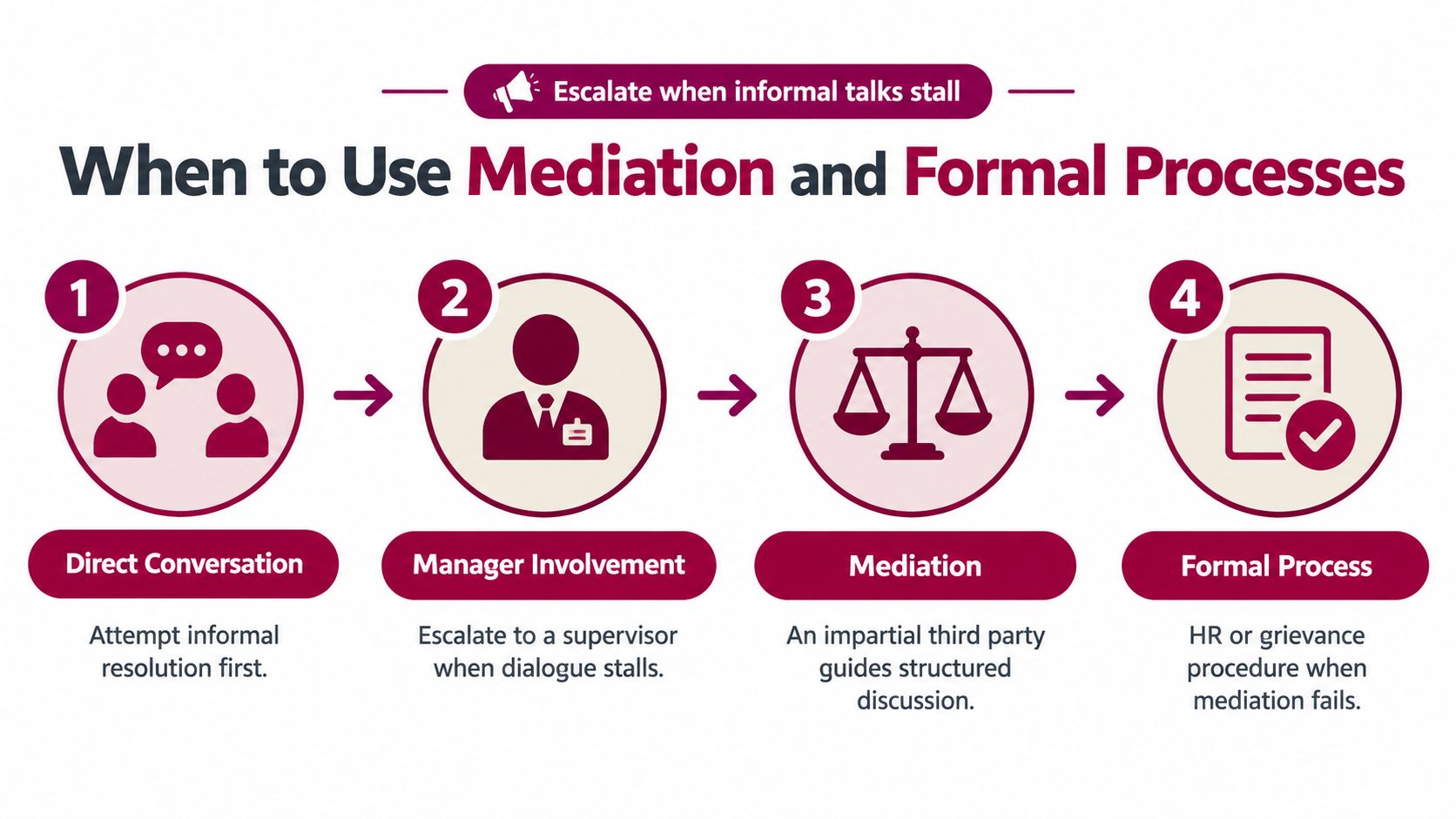
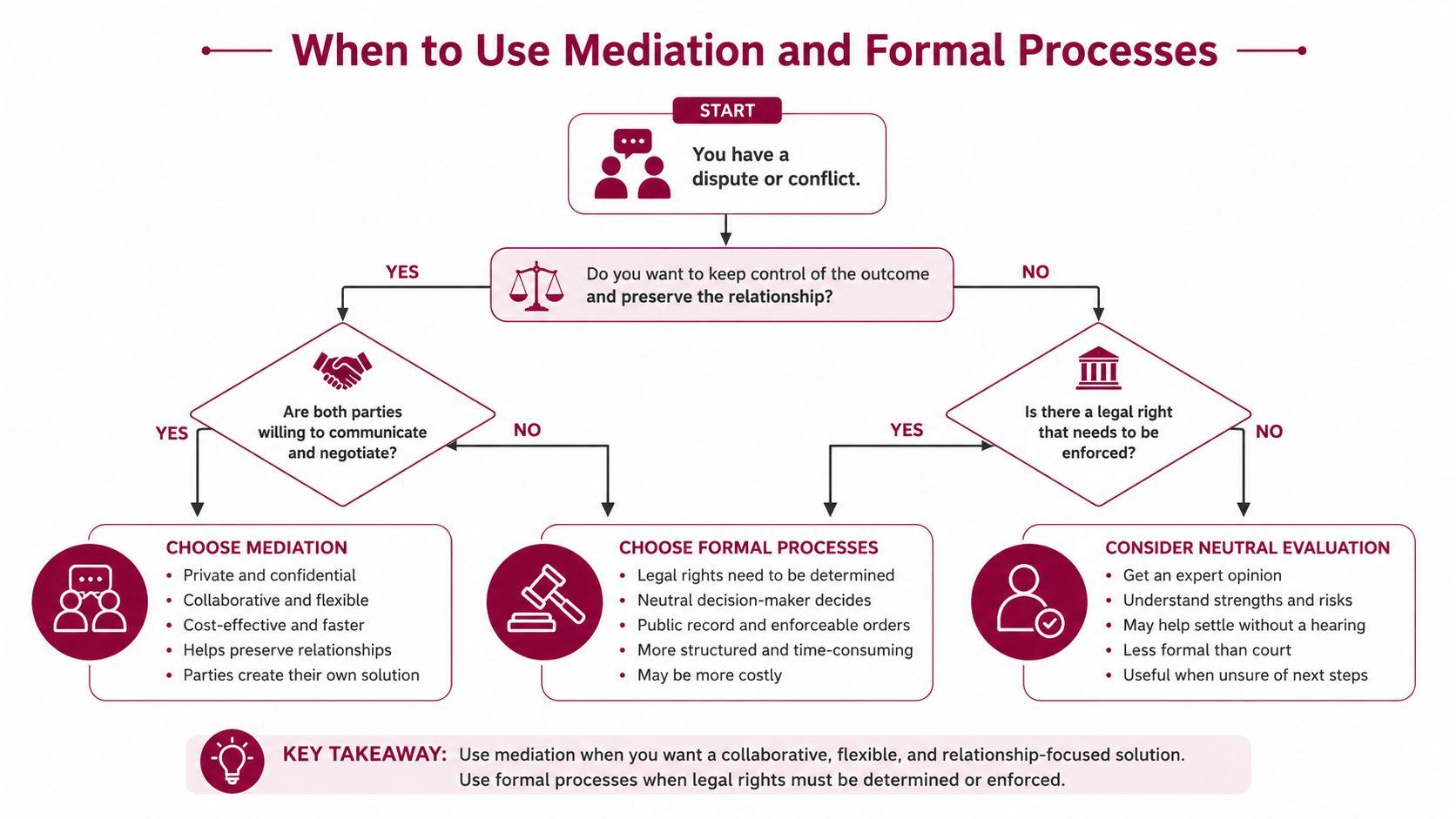
Informal conversation has reached its limit when the parties have attempted to resolve the issue but the behaviour or dispute continues, trust has deteriorated, or the manager can no longer act as a credible neutral facilitator. Escalation may also be required where allegations involve bullying, harassment, discrimination, violence, retaliation, serious misconduct or a material breach of policy. In these situations, pressing people into another private conversation may increase harm and weaken confidence in the fairness of the response.
Mediation suits a damaged working relationship or recurring disagreement where the main need is to improve communication and agree workable changes. It is less suitable where the organisation must establish facts or decide whether misconduct occurred. UK Government guidance on workplace mediation describes mediation as an independent and impartial process involving employees, or an employee and employer. It is normally considered after informal discussions have failed and remains voluntary. The mediator manages the discussion, but cannot impose an outcome or require either party to accept an agreement.
A proportionate escalation decision
Use mediation deliberately when early intervention has not resolved the working problem, while recognising that participation does not guarantee agreement. The practical test is whether both parties can take part freely, whether the issue is suitable for discussion, and whether an independent mediator can help them reach a workable resolution.
Formal procedures are more appropriate when an allegation requires investigation, evidence must be tested, or the possible consequences include disciplinary action. A grievance process gives an employee a defined route for raising a concern. A disciplinary process addresses alleged conduct or performance issues. Keep those routes distinct, follow the organisation's policy and seek appropriate HR or legal advice when the facts are complex, the risks are high or the required outcome could affect employment.
Acas guidance and the organisation's own procedure should shape the decision, especially where fairness, confidentiality, reasonable adjustments or protection from retaliation are relevant. Record the reason for choosing mediation or formality, the steps taken and any agreed review point.
Escalate when informal talks stall, not simply when the conversation feels uncomfortable.
The structured mediation and third-party intervention lesson helps managers distinguish facilitation from formal adjudication. Escalation decisions sit with you as the manager. Digital transformation planning is a separate leadership task and does not replace conflict-resolution capability or an employment process. The Digital Transformation in Business course addresses that separate management responsibility.
Comparing Informal and Formal Resolution Pathways
The right pathway depends on the seriousness of the issue, the relationship between the parties, the risk of retaliation and the outcome the organisation needs. Informal resolution is usually more flexible and less adversarial. Formal resolution is slower and more demanding, but it creates a defined process when fairness, evidence and accountability matter more than speed.
| Attribute | Informal Resolution | Formal Resolution |
|---|---|---|
| Primary purpose | Repair communication, clarify expectations and agree practical changes | Investigate allegations and reach a decision under an established procedure |
| Best suited to | Misunderstandings, early friction and manageable working disagreements | Serious conduct concerns, repeated failure to improve and complex disputes |
| Managerial role | Facilitates discussion and supports an agreement | Acts within policy, gathers evidence and maintains procedural fairness |
| Documentation | Brief factual notes and agreed actions | Detailed records, statements, evidence and outcome documentation |
| Relationship effect | Can preserve trust when people participate in good faith | May protect fairness, but can make the relationship more adversarial |
| Main risk | The issue may be minimised or recur without follow-up | The process may become disproportionate, slow or unnecessarily defensive |
A manager shouldn't choose informality merely because it's convenient. If one person has substantially more power, if the employee feels unsafe speaking directly, or if the allegation could lead to disciplinary action, a private informal meeting may not provide adequate protection. Equally, formalising every disagreement can discourage candour and make ordinary collaboration feel like a legal contest.
Use a decision test
Ask three questions before choosing a route:
- Can the parties participate safely and voluntarily?
- Is the main need relationship repair, or fact-finding and a decision?
- Would failing to create a formal record expose someone to unfairness or further harm?
Acas guidance on conflict and resolution recognises both early informal handling and formal grievance or disciplinary routes, and it connects some disputes with employment tribunal time limits. That makes procedural awareness essential. Managers shouldn't promise an outcome, discourage a formal complaint or allow informal discussions to run on indefinitely when a formal route is warranted.
The Business Case for Proactive Conflict Management
Workplace conflict creates operational costs alongside human costs. It absorbs managerial time, weakens cooperation and can lead capable employees to disengage or leave. The business case for early action rests on protecting work quality, wellbeing, retention and fair decision-making, rather than trying to make every relationship harmonious.
CIPD's 2024 UK Good Work Index findings estimated that one quarter of UK employees, about 8 million people, experienced workplace conflict in the past year, while only 36% of employees who experienced conflict said it had been fully resolved. The report also found that 33% of conflicted employees were likely to leave their job in the next 12 months, compared with 16% of employees who didn't report conflict. Exhaustion all or most of the time affected 42% of conflicted employees, compared with 18% of those without conflict.
A meeting that ends politely does not necessarily resolve the operational problem. The disagreement may have gone quiet while someone withdraws from collaboration, considers leaving or continues to experience exhaustion. Managers should assess whether behaviour, expectations or working arrangements have changed in a durable way.
Build capability before the difficult conversation
Organisations can improve their response by:
- Training line managers: Give managers practice in listening, documenting events, setting boundaries and recognising when specialist or formal support is needed.
- Clarifying standards: Clear responsibilities and performance expectations reduce disputes caused by inconsistent assumptions.
- Reviewing patterns: Recurring conflict in one team may point to workload, role design, communication or management problems, rather than difficult individuals.
- Following through: Assign each agreed action an owner and review point. Without follow-up, the organisation signals that resolution is optional.
The economic case reinforces the need for management capability. ReWAGE estimates that unresolved conflict carries an organisational cost of about £28.5 billion annually, or more than £1,000 per employee. Proactive conflict management belongs in leadership development and operational planning. Treat it as a control that limits relationship damage before it becomes absence, turnover, formal complaint or legal exposure. It also helps managers judge when a conversation has done enough and when mediation or a formal procedure is the safer, fairer route.
Conclusion – Building a Culture of Constructive Resolution
Knowing how to handle conflict at work means using judgement rather than applying one script to every disagreement. Start early when it's safe. Establish what happened, listen for the underlying interests and focus on behaviour, impact and agreed action. Then monitor whether the agreement changes the working reality.
Escalation is not a failure of informal management. It's a sign that the situation requires a different level of structure. Mediation can help when people need an impartial process to rebuild a working relationship, while grievance or disciplinary procedures are necessary when allegations require investigation, evidence and a formal decision. The practical skill lies in recognising the difference.
Managers should also look beyond the immediate parties. HSE's Management Standards identify Relationships as one of six work-design areas associated with work-related stress, including positive working, unacceptable behaviour and the need for clear procedures to report, prevent or resolve conflict quickly. A team's recurring disputes may therefore reveal a design or management issue that individual conversations alone can't fix.
Constructive resolution doesn't mean avoiding challenge. It means creating conditions where people can raise concerns early, managers can respond consistently and formal routes remain available when required. Make conflict competence part of manager expectations, review patterns rather than isolated incidents and treat follow-up as part of resolution itself. That's how difficult conversations become a source of clearer standards, stronger working relationships and more resilient teams.
London School of Business Administration offers online, self-paced business and management courses, including learning focused on conflict resolution and communication skills for leaders. Visit London School of Business Administration to explore its course and programme options and choose learning that supports more confident workplace conversations.