Over 90% of UK employees have experienced organisational change in their business, so changes in organisations are now a routine operational reality, not an exception. In practice, that means leaders need to manage continuous transition, not occasional disruption.
Modern UK workplaces are being reshaped by restructuring, leadership turnover, and repeated process change. The key question is no longer whether change will happen, but whether organisations can absorb it without exhausting the people expected to deliver it.
Table of Contents
- The Reality of Continuous Change in the Modern Workplace
- Identifying Types of Organisational Change
- Understanding the Key Drivers of Change
- Applying Proven Change Management Frameworks
- Navigating the Challenges of Change Fatigue
- Practical Strategies for Effective Implementation
The Reality of Continuous Change in the Modern Workplace
A useful way to understand changes in organisations is to stop treating them as special projects. They are better understood as a steady condition of work, especially in the UK, where change is now woven into normal business life.
The evidence is blunt. A 2024 UK survey by the Institute of Internal Communication found that 40% of respondents said their organisation had restructured in the previous 12 months, 22% reported redundancies linked to that restructuring, and 19% said they had witnessed a change of CEO (source). Those figures matter because they show that structural redesign, workforce reduction, and leadership turnover often happen together, not in isolation.
Change is now a working condition
That pattern changes the management task. If a significant share of employees see restructuring, layoffs, and executive turnover in the same period, then change readiness becomes part of day-to-day operational discipline, not an occasional leadership concern.
A second UK data point reinforces the same point. A nationally representative survey of 1,035 employed adults found that 91% had experienced organisational change within their business, with fieldwork conducted on 16 to 17 February 2023 (source). That level of prevalence means most employees already have lived experience of transition, so change management must account for memory, expectation, and fatigue, not just project delivery.
Practical rule: if your change plan assumes people will treat the next initiative as “the first time”, your plan is already behind reality.
Why this matters for leaders
The managerial implication is simple. Organisations need repeatable methods for planning, communicating, and embedding change because staff are already living inside recurring change cycles. A one-off announcement does not solve a recurring operating condition.
That is why change management belongs in the core management toolkit. It is also why internal communication, line-manager capability, and implementation discipline matter so much, because each new shift lands on people who have often already adapted to several others. For a practical example of how leadership lessons translate into organisational transition, see navigating change and business transformation.
Identifying Types of Organisational Change
A change programme should be judged by what it touches. A process tweak, a reporting-line reset, and a shift in culture all demand different responses, because they create different levels of disruption and different kinds of risk.
Developmental, transitional, and transformational change
A developmental change improves what already exists. It might refine a process, sharpen a policy, or improve how a team collaborates. The risk is usually limited because the core structure stays intact.
A transitional change replaces one known state with another. Implementation discipline matters most here, because people are being moved from a current process to a new one and both states are visible. A move to Digital Transformation in Business fits this category when new systems alter workflows, reporting, and capability requirements.
A transformational change is more demanding. It alters how the organisation thinks, behaves, or competes. These changes are harder because they affect identity as well as process.
Structural, digital, and cultural change
Ask what a change touches and the right response usually becomes obvious.
- Structural change alters reporting lines, spans of control, or business units.
- Digital change alters tools, data flows, and task design.
- Cultural change alters behaviour, norms, and the expectations people bring to work.
These categories overlap, but they do not behave the same way. Structural change can be designed on paper, yet still fail if managers do not change how they run teams. Cultural change usually moves more slowly, because it depends on what people see rewarded, tolerated, or ignored.
Practical rule: define the type of change before you choose the method. A cultural shift managed like a process update usually disappoints both leaders and staff.
For a fuller breakdown of what drives each category, see drivers and types of organisational change.
Diagnostic language matters. If leaders call every initiative “transformation”, they blur the level of risk and make it harder to decide where to focus effort. The better habit is to name what is changing, the structure, the technology, the behaviour, or all three, and then match the management response accordingly.
Understanding the Key Drivers of Change
Change rarely begins with a strategy slide. More often, it starts with pressure, from outside the organisation, from inside it, or from both at once.
External pressure and internal necessity
External drivers are usually the most visible. Market volatility, technology adoption, supply pressure, and regulation can force leaders to adjust faster than they would choose. In UK-heavy restructuring environments, EY notes that labour shortages and supply chain risks are acute, and that construction, retail, hospitality, and healthcare are among the sectors expected to see the highest restructuring activity in H2 2025 (source). That matters because it shows change is often being driven by operating stress, not just ambition.
Internal drivers are more mundane, but just as powerful. Leaders may need better efficiency, clearer accountability, or new skills in the workforce. Those needs often show up as reorganisations, role redesign, or process standardisation. If the business is carrying avoidable complexity, change is usually the mechanism used to strip it out.
Reading the trigger correctly
The mistake I see most often is not failure to act, but failure to diagnose. A team may launch a communication-heavy programme when the actual issue is role ambiguity. Another may invest in process redesign when the deeper problem is leadership inconsistency. The trigger has to be understood before the intervention is designed.
That is why the best change responses start with a frank question. Is the business reacting to a temporary shock, or to a structural weakness that has already been exposed? If it is the latter, the organisation must treat change as a repair of capability, not a short-term fix.
When pressure comes from both the market and the organisation's own operating model, leaders need to sequence decisions carefully. Otherwise, people experience the change as noise rather than direction.
Predictive thinking matters here, which is why programmes such as Predictive Analytics are relevant in a broader management context. They help leaders spot patterns earlier, so change is framed before it becomes crisis management.
Applying Proven Change Management Frameworks
Frameworks matter because they stop leaders improvising under pressure. The strongest models don't remove judgement, they give it structure.
Kotter and Lewin serve different purposes
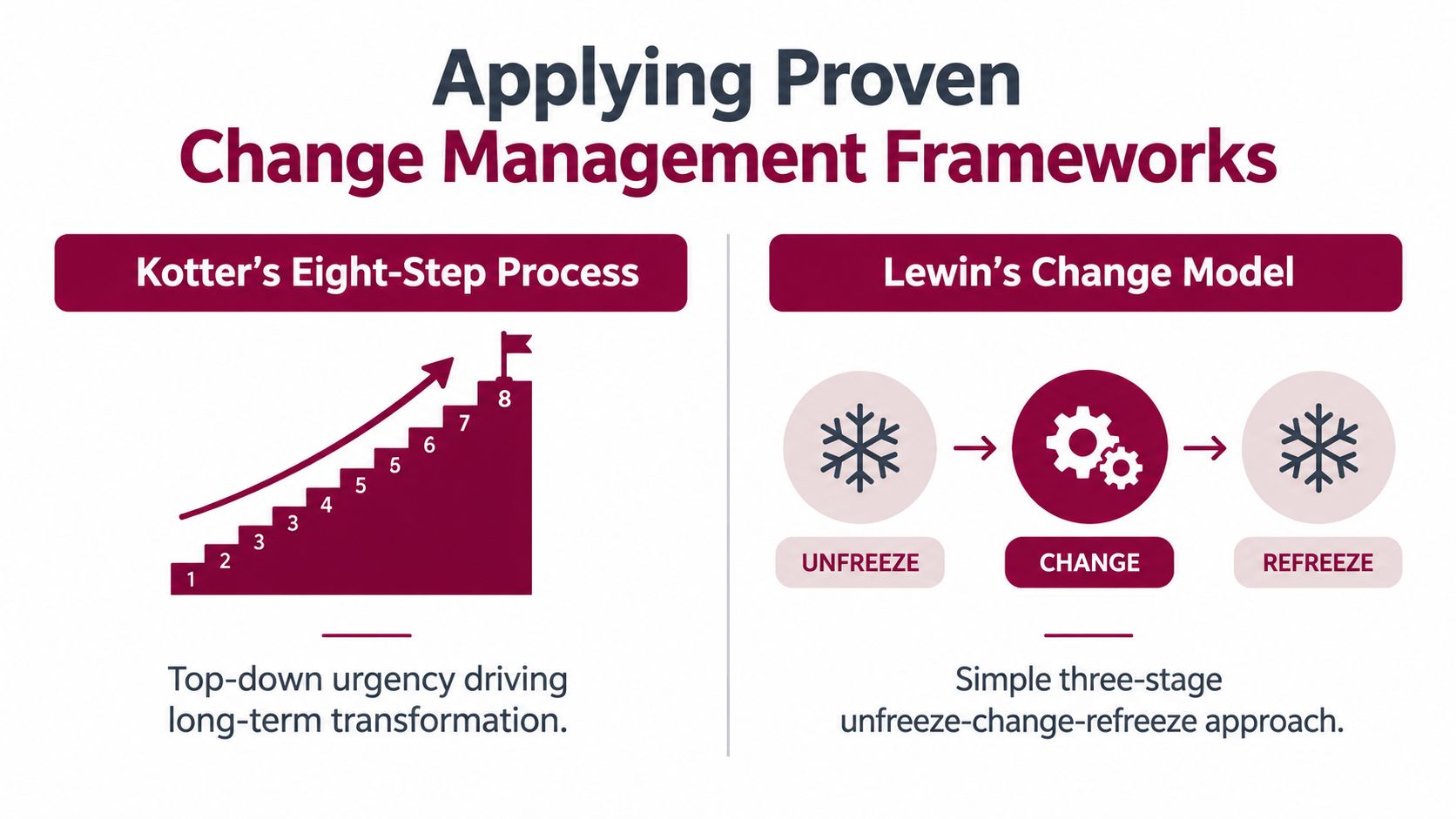
Kotter's Eight-Step Process is stronger when the change is complex, political, or organisation-wide. It pushes leaders to create urgency, build commitment, and anchor the new state in culture. That makes it useful when adoption depends on leadership alignment and visible momentum.
Lewin's Change Model is simpler. Its unfreeze, change, and refreeze logic is helpful when the organisation needs a clear sequence and the scope is manageable. It works best when the challenge is to move people from one stable state to another without overcomplicating the process.
The difference is not academic. Kotter is useful when inertia is the main obstacle. Lewin is useful when clarity and discipline matter more than elaborate stakeholder choreography.
Choosing a model that fits the situation
The wrong model creates friction. A simple change managed with excessive ceremony slows execution. A large transformation managed too lightly leaves managers guessing.
- Use Kotter when the issue is mobilisation, sponsorship, and sustained commitment.
- Use Lewin when the task is to create a clean transition and prevent relapse.
- Blend both when the change is technical but adoption will be uneven across teams.
A structured course such as the Change Management option can help managers build that judgment without forcing one model onto every situation.
The practical lesson is that frameworks are decision aids, not dogma. They work when leaders use them to clarify what kind of support the organisation needs.
Navigating the Challenges of Change Fatigue
The most neglected problem in continuous change is not resistance in the abstract, it is exhaustion. When change becomes permanent, people don't just disagree, they tire.
The human cost is measurable
UK workplace evidence shows that change programmes have a direct personal cost. Investors in People reports that 39% of employees felt more stressed at work as a direct result of change programmes, one in three said change had worsened their work-life balance, one in four considered leaving their role because of the amount of change they were experiencing, and one in five felt worn down by organisational change (source). Those figures should change how leaders think about implementation.
The right response is not to deny fatigue. It is to accept that repeated transformation consumes attention, trust, and energy. If staff are already overloaded, then every new initiative competes with recovery time, not just with routine workload.
More communication is not a full solution
That point is reinforced by Gallagher's UK-heavy employee communications survey. It found that 44% of respondents said change fatigue would have a high impact in 2025, 18% said their organisation had no change communications strategy, and 39% said they were highly impacted by a lack of direction from the top (source). The same source also says 70% of UK respondents rated stakeholder management as highly critical, which suggests that sequencing, local leadership, and decision quality matter as much as messaging.
That is the critical correction. More emails, more town halls, and more slides do not automatically create commitment. They can even worsen fatigue if people keep hearing announcements without seeing a workable plan.
Practical rule: if the workforce sees repeated announcements but little visible prioritisation, it starts to treat leadership messages as background noise.
A more disciplined approach is to pace change, reduce simultaneous demands, and equip managers to explain not just what is changing, but what is not changing yet. That is how trust is rebuilt. Not through volume, but through coherence.
Practical Strategies for Effective Implementation
Good implementation is rarely heroic. It is usually orderly, paced, and visible enough for people to believe it is real.
What leaders should do first
Start with alignment at the top. If senior leaders are not clear on the purpose, scope, and boundaries of the change, managers down the line will improvise. That creates inconsistent execution and erodes credibility quickly.
Then define ownership. Every change needs named leaders, clear responsibilities, and a simple way to escalate problems. Without that, issues drift until they become political or personal.
Build adoption, not just announcement
Employee engagement works best when people can see their role in the change. That means involving the line managers who translate strategy into practice, not just broadcasting updates from the centre. It also means checking whether the new way of working is actually possible with existing workloads and systems.
A practical change checklist looks like this:
- Clarify the business reason: state the problem the change is solving.
- Set scope boundaries: identify what is changing and what isn't.
- Assign visible owners: one lead should own each workstream.
- Support line managers: they need talking points, timing, and escalation routes.
- Measure implementation: track whether the change is being used, not just announced.
- Reinforce the new normal: update routines, expectations, and rewards so the change sticks.
For a more applied discussion of how leaders can sequence these steps, see change management strategies every leader must know.
The core principle is sustainable capability. Organisations that manage changes in organisations well don't rely on one-off energy bursts. They build repeatable processes that protect people while the business moves.
London School of Business Administration offers structured, self-paced learning in business and management, including change management and digital transformation. If you want to strengthen your ability to lead continuous change with more discipline and less fatigue, visit London School of Business Administration and explore the programmes that support managers through real organisational transitions.