
You're preparing for a one-to-one when another message arrives asking you to approve a decision your employee could probably make. You can answer quickly, but that leaves you solving the same kind of problem again next week. Asking a useful question might help them develop judgement, provided they already have the knowledge, authority and time to act.
That distinction matters. A coaching leadership style isn't just a more supportive way of managing. It's a deliberate choice to develop someone's thinking, with clear boundaries around when instruction, performance management or specialist support would serve them better.
Table of Contents
- What the Coaching Leadership Style Means
- Coaching Compared With Other Leadership Styles
- What the Evidence Says About Coaching Benefits
- When Coaching Fits and When to Direct Instead
- How to Coach Using Skills, GROW Steps and a Sample Conversation
- Common Challenges and How to Fix Them
- How to Measure Whether Coaching Works
- Choose Your Next Coaching Development Step
What the Coaching Leadership Style Means
A sports coach doesn't play the match, yet shapes players' decisions through practice, questions and feedback. A coaching leader works similarly: the employee does the work, while the manager helps them understand the situation and make better decisions.
Coaching leadership means helping people set goals, examine their circumstances, generate options and build capability, rather than relying mainly on instruction or supervision. The manager remains accountable for standards and resources. They don't need to make every decision personally.
The Chartered Institute of Personnel and Development's coaching and mentoring factsheet describes coaching as a structured conversation intended to improve skills, knowledge or work performance. It identifies line managers as the people most likely to hold primary responsibility for delivery, commonly within routine one-to-one meetings and performance discussions.

What this looks like at work
Suppose an analyst repeatedly sends unfinished reports to their manager for approval. Instead of rewriting the next report, the manager helps the analyst identify what a decision-ready report needs, where their uncertainty begins and which checks they can complete independently.
The conversation rests on these core moves:
- Ask before telling. Find out how the employee understands the problem before offering your solution.
- Reflect back what you hear. Check your interpretation rather than assuming that hesitation means incompetence.
- Leave appropriate decisions with the employee. Agree the boundaries, then let the person responsible choose how to act.
Trust requires more than a friendly manner. Establish what remains confidential, what must be recorded and when information may need to reach HR or another responsible person. Don't promise absolute confidentiality that your managerial responsibilities won't allow you to maintain.
Coaching is not friendly chat without direction, therapy or a replacement for every managerial decision. Nor does asking questions automatically make a conversation developmental. An employee who must guess the answer you've already chosen isn't exercising meaningful ownership.
A useful test: Does the employee leave with a clearer plan they own?
Coaching Compared With Other Leadership Styles
Leadership styles compared on the same criteria
| Style | Leader's main move | Who decides | Best suited to | Main risk |
|---|---|---|---|---|
| Directive | Tells people what to do | Leader | Crises, new recruits, safety-critical tasks | Dependence and low ownership |
| Coaching | Asks questions and builds capability | Employee, with leader input | Developing skills and ownership over time | Slow when urgency is high |
| Mentoring | Shares experience and advice | Mentee, guided by mentor | Career and industry guidance | Advice can crowd out the mentee's own judgement |
| Transformational | Inspires a shared vision | Leader sets direction | Large change programmes | Vision can outpace practical support |
| Democratic | Consults before deciding | Group, leader ratifies | Decisions shared with expert teams | Slow, with unclear accountability |
The central difference concerns where the answer comes from. A directive manager specifies what should happen. A coaching manager helps the employee reason towards an appropriate response, within agreed limits. A mentor contributes experience that the other person can interpret and use.
Suppose an employee is preparing to lead a difficult stakeholder meeting. Direction might involve prescribing the agenda and required message. Mentoring might involve explaining how the manager handled a similar situation. Coaching would involve exploring the employee's intended outcome, assumptions about the stakeholders and possible responses to disagreement.
Complementary approaches, not competing identities
Coaching takes time. When a deadline is immediate, telling someone the required action may be more responsible than extending the discussion. The developmental opportunity can come afterwards, when both people can examine the decision without delaying essential work.
Transformational leadership provides the wider direction within which coaching can operate. A leader might establish a vision for better customer service, then coach employees as they work out how to improve their own processes. Vision and individual development address different managerial tasks.
Democratic leadership involves a different distribution of authority. In the comparison above, the group reaches the decision and the leader ratifies it. Coaching usually retains individual accountability unless the issue belongs to the whole team.
Choose a style for the work and the person, not as a permanent description of yourself.
A practical combination is to explain unfamiliar procedures directly, invite discussion where expertise is distributed and coach experienced employees who need to strengthen judgement. Make the switch explicit. Employees shouldn't have to guess whether you're seeking their decision, consulting them or issuing an instruction.
What the Evidence Says About Coaching Benefits
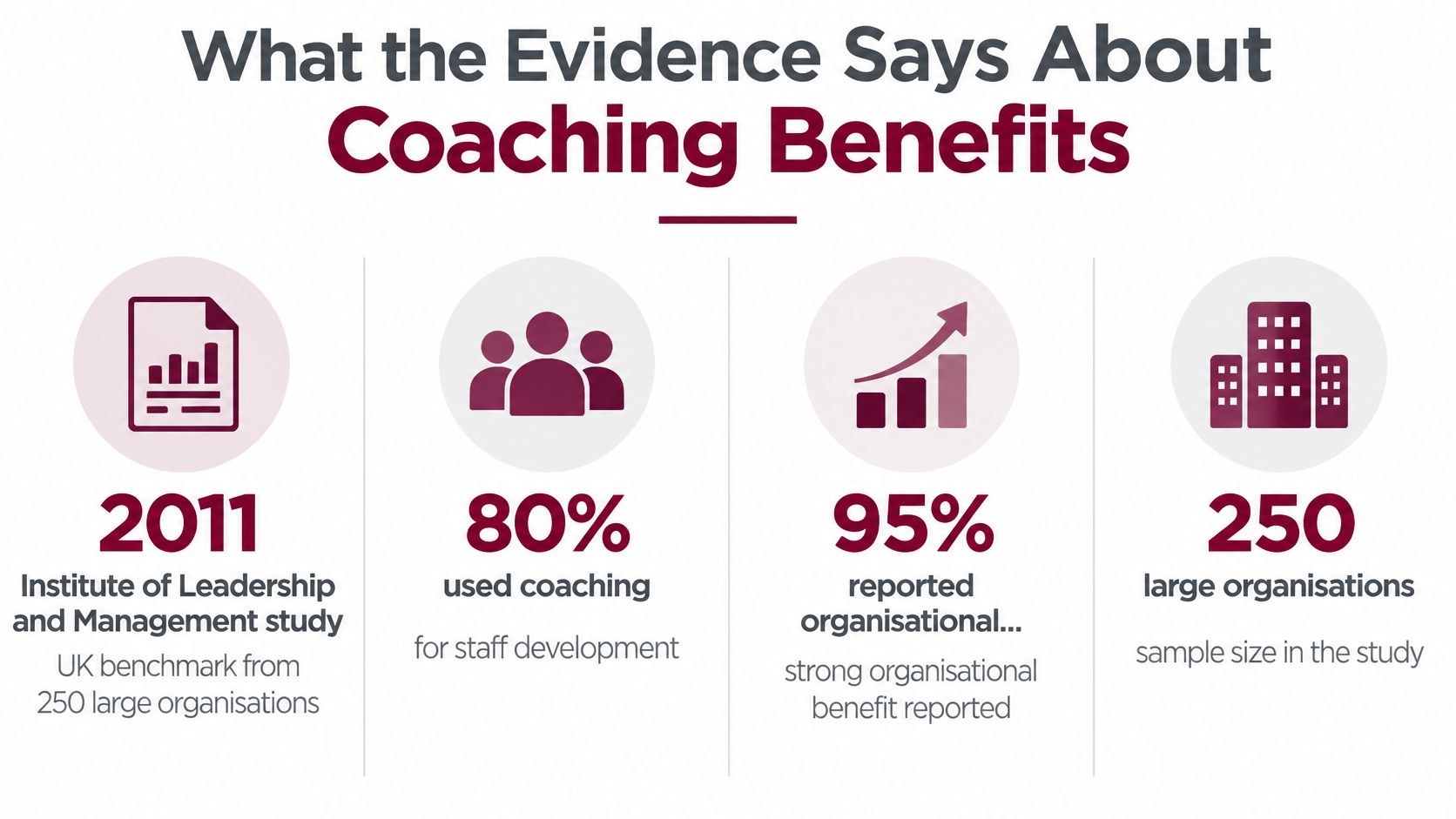
The 2011 Institute of Leadership and Management study, reported by HR Magazine, interviewed learning and development managers at 250 large organisations: 80% used coaching for staff development, 95% reported organisational benefits and 96% reported benefits for the individual coached.
UK coaching benchmarks and their scope
| Measure | Figure | Scope and caveat |
|---|---|---|
| Organisations using coaching for staff development (ILM 2011) | 80% | Telephone interviews with L&D managers at 250 large organisations |
| Organisations reporting benefit to the organisation (ILM 2011) | 95% | Same study; self-reported by organisations |
| Organisations reporting benefit to the individual coached (ILM 2011) | 96% | Same study; self-reported by organisations |
| Coaching available to senior managers and directors (ILM 2011) | 85% | Shows access concentrated at the top |
| Coaching available to non-management staff (ILM 2011) | 52% | Same study; the access gap |
| Organisations using or planning coaching (2023/24) | 89% | Military Skills and Productivity Skills Report: 80% using and 9% planning; survey-based |
| Organisations making coaching available to all staff (2023/24) | Just over 50% | Same report; primary audience remained managers, directors or middle management in 85% of organisations |
| Employees of effective coaches who are more engaged (CIPD) | 40% | CIPD-reported findings; compared with employees of ineffective coaches; correlational |
| Employees of effective coaches showing more discretionary effort (CIPD) | 38% | Same comparison; correlational |
| Leaders self-identifying with coaching leadership (People Insight, 2025) | 43.3% | People Insight's leadership-style analysis; more than 30,000 participants; self-report, not a measure of practice |
The historical benchmark establishes widespread adoption, not a guaranteed return from any particular coaching conversation. Organisational representatives reported benefits; the study didn't assign comparable workplaces randomly to coaching and non-coaching conditions.
The access figures also qualify the positive picture. Senior employees had substantially greater access than non-management staff. The later business survey indicates continued adoption without demonstrating that developmental support had become universally available.
How coaching might improve team performance
A study of 182 knowledge workers and their managers across 60 teams, summarised by Aston University, found an indirect relationship between managerial coaching skill and team performance through team-level architectural knowledge. This means shared understanding of how expertise, roles and dependencies fit together; the relationship was stronger when managers had a high learning-goal orientation.
That mechanism is more specific than saying coaching improves confidence. A manager might help colleagues recognise whose expertise they need, clarify a handover or understand how their decisions affect another role.
The engagement and discretionary-effort comparisons are encouraging, but they don't establish that coaching alone caused the differences. Effective coaches may also manage workloads, relationships and expectations more effectively.
Measure your own team rather than assuming these findings will transfer unchanged. Finally, the self-identification result in the table indicates how participants described themselves. A self-selected, self-report sample doesn't establish how consistently or competently they coached.
When Coaching Fits and When to Direct Instead
Coaching isn't appropriate just because a manager wants to be supportive. It requires a problem the employee can meaningfully explore and enough knowledge to generate workable options.
Choosing coaching, directing or referral by situation
| Situation | Better approach | Reason |
|---|---|---|
| Employee new to the role and lacking basics | Direct first, then coach | Questions cannot build skills that do not yet exist |
| Experienced employee facing a complex problem | Coach | Options and ownership come from the person |
| Safety, legal or urgent operational decision | Direct | Time and risk rule out open exploration |
| Repeatedly missed performance standards | Performance management | Coaching cannot replace clear expectations and consequences |
| Suspected mental-health difficulty | Refer to HR or occupational health | Managers are not qualified therapists |
| Isolated remote or hybrid employee | Coach with structured check-ins | Clear direction and regular contact come first |
| Highly autonomous employee | Coach with a light touch | Space to think suits self-directed people |
For a new employee, demonstrate the task and check understanding before asking them to evaluate alternative approaches. Otherwise, a question intended to build confidence can feel like a test for which they haven't received the necessary teaching.
Corrective feedback also needs clarity. State the required standard, describe the observed shortfall and explain the next steps. You can explore obstacles afterwards, but don't disguise a mandatory requirement as an optional coaching question.
Where development ends and referral begins
TELUS Health's leadership-development guidance reports that 32% of managers were unsure what to do if they suspected an employee was experiencing a mental-health issue, while a further 9% didn't know what to do. The practical response is to listen, acknowledge the concern and use the organisation's HR or occupational-health route without diagnosing.
Move beyond coaching when the issue requires clinical expertise, raises a safeguarding concern or indicates immediate danger. Follow the relevant organisational escalation procedure and seek urgent assistance where necessary. Explain what information needs to be shared and with whom, keeping records factual and proportionate.
Boundary rule: A manager can support access to help without becoming the person who provides specialist treatment.
Remote working requires additional attention to contact, expectations and inclusion, addressed under the practical challenges below. Location alone doesn't tell you whether someone needs closer support or greater autonomy.
Before choosing your approach, ask:
- Knowledge: How much does this person already understand?
- Risk and urgency: What could happen if exploration delays the decision?
- Underlying issue: Is the difficulty skill, clarity, capacity or something requiring specialist support?
How to Coach Using Skills, GROW Steps and a Sample Conversation
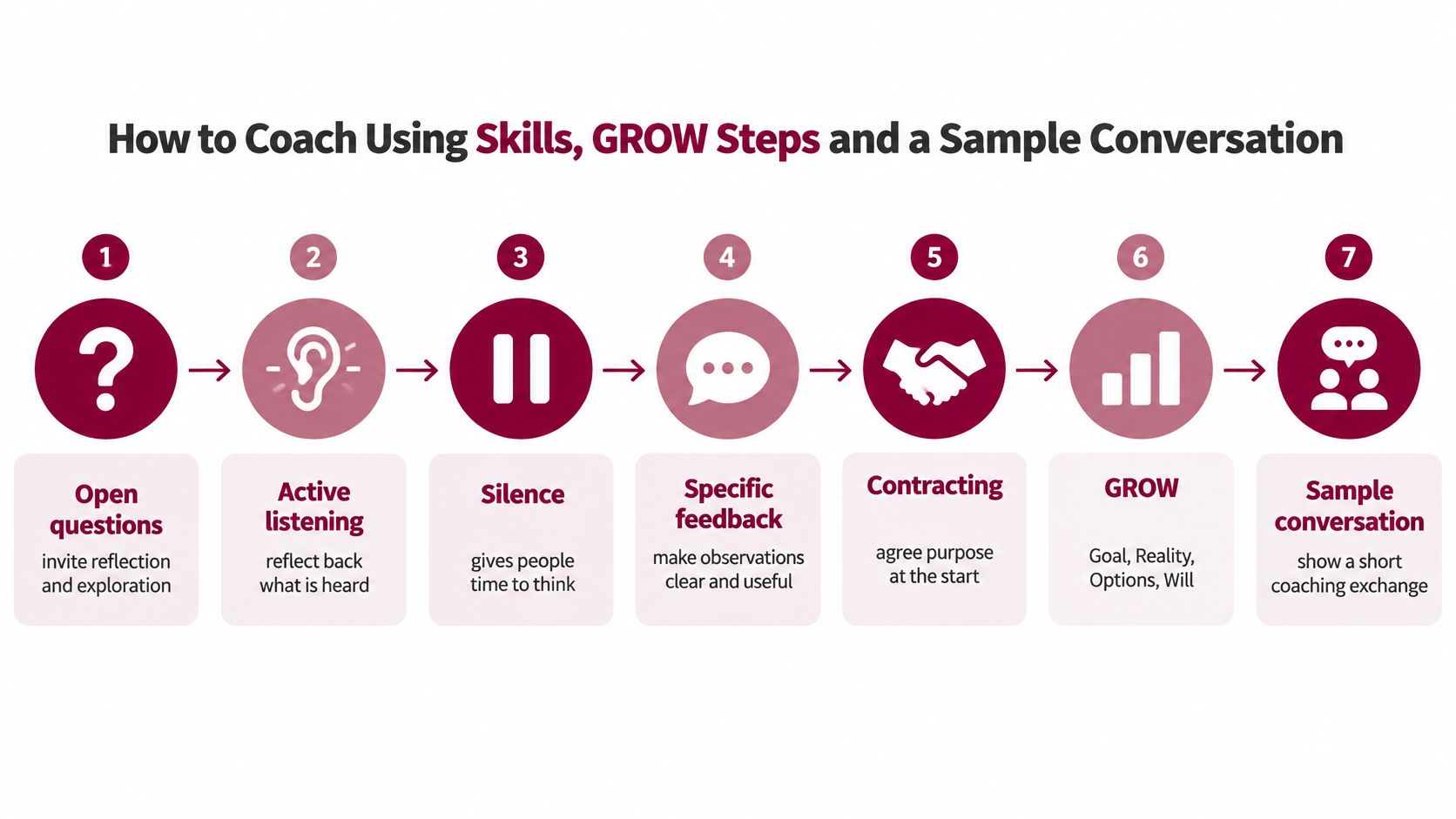
Begin with open questions, active listening, useful silence and specific feedback. Reflect the employee's meaning back before challenging it, and resist filling every pause. Understanding why emotional intelligence matters is relevant here because managers need to recognise their own impatience, defensiveness and assumptions.
Contracting comes first: agree the purpose, available time, decision boundaries and confidentiality arrangements. Then use GROW, Goal, Reality, Options and Will, as a flexible sequence rather than an interrogation script.
A worked GROW conversation
Consider an analyst who keeps escalating reports that fall within their authority.
Goal
Ask what the employee wants to achieve and by when.
Manager: What would a decision-ready report look like, and what would you like to handle independently?
Analyst: I'd like to send routine reports without needing you to check my recommendations.The common slip is accepting a broad ambition such as greater confidence without defining the work that would demonstrate it.
Reality
Establish what happens now and what the employee has already tried.
Manager: At what point do you decide the report needs my approval?
Analyst: When the figures conflict. I check the totals, but I'm unsure whose interpretation should guide the recommendation.Don't jump to options before distinguishing missing technical knowledge from uncertainty about authority.
Options
Invite several possible actions before contributing your own.
Manager: What three approaches could help you resolve that uncertainty?
Analyst: I could clarify the reporting rule, consult the relevant specialist or include an explicit assumption.The slip here is steering every answer towards your preferred solution. Offer expertise where needed, but identify it as advice.
Will
Turn a preferred option into a specific commitment.
Manager: Which two changes will you test this week, by when, and what might obstruct them?
Analyst: I'll confirm the interpretation with the specialist and add an assumptions check before submitting the next report.Don't accept a vague promise to try harder. Agree the action, responsibility and review point.
Connect people with expertise
CIPD-reported findings distinguish Connector managers, associated with performance improvements of up to 26%, from Always-On managers, whose continuous feedback was associated with performance falling by as much as 8%. The practical distinction is between connecting someone with appropriate help and making yourself a constant source of commentary.
The senior-leader coaching dataset described in the leadership-development guidance covered 461 sessions with 141 leaders across 46 organisations. Its most common focuses were navigating ambiguity, at 20.5%, and communication and influence, at 19.3%. These are useful Reality and Options topics: clarify what remains uncertain and whose understanding or cooperation matters.
Open the next one-to-one by reviewing the agreed action. Case-based practice also lets managers rehearse before using these moves live. Jenna Tiffany integrates real-world organisational scenarios into our Leadership and Management Programme design, combining structured frameworks with applied case-based learning.
Common Challenges and How to Fix Them
Coaching problems, likely causes and fixes
| Symptom | Likely cause | Fix |
|---|---|---|
| Team waits for the manager to answer | Questions asked but ownership never agreed | Ask what they would do first and agree a decision date |
| Conversations drift into general chat | No agreed goal or contract | Open with the goal and a time frame |
| Employee disengages after feedback | Corrective feedback delivered as coaching | Separate development talk from performance feedback and state the standard |
| Visible office staff get more attention | Hybrid bias in who is coached | Schedule the same check-ins for everyone and log them |
| Manager reverts to telling | Pressure and tight deadlines | Agree in advance when directing is the right call and say so |
| No change after sessions | No follow-up and no protected time to act | Set follow-up actions and block time for them |
When employees still wait for answers, inspect the decision agreement rather than asking more questions. They may reasonably believe that you retain approval, particularly if you regularly reverse their choices.
Specify what the employee can decide, what requires consultation and what must be escalated. Then respond consistently when they exercise that authority. Otherwise, the conversation encourages independence while your behaviour discourages it.
Make hybrid coaching equitable
The CIPD's flexible and hybrid working report found that 74% of organisations had hybrid working in place in 2025, compared with 84% in 2023, and identifies effective team leadership, connection to purpose and organisational culture as continuing challenges.
Schedule comparable developmental check-ins for office-based and remote employees. Rotate opportunities to participate in person and record coaching time so that informal visibility doesn't determine access.
For online conversations, check privacy, reduce interruptions and use a shared action note. In person, don't assume proximity creates psychological safety. In either setting, assess autonomy through agreed outputs, timely communication and willingness to raise problems, not constant availability.
Give people time to apply learning
In the CIPD's 2023 Learning at Work survey, 51% of respondents said line managers encouraged learning and development, but only 39% believed employees received time away from ordinary duties to participate, a 12-percentage-point gap.
Put the agreed development action in the diary and identify which task will pause or move. Encouragement without workload adjustment leaves the employee choosing between learning and meeting existing expectations.
A straightforward misunderstanding may resolve in a single conversation; testing a different working habit may require a week or longer. Treat those as planning possibilities, not promised results. Persistent lack of progress may mean the obstacle isn't developmental and coaching is the wrong intervention.
How to Measure Whether Coaching Works
Completed conversations show activity, not value. Evaluation should establish whether employees apply learning and whether that application contributes to an agreed workplace outcome.
The CIPD's analysis of learning value reports that, in its 2023 findings, only 8% of learning and development teams prioritised learning transfer, while 50% of respondents reported a process for assessing impact. Those findings justify measuring what changes after the conversation, not merely recording attendance.
Follow the path from skill to outcome
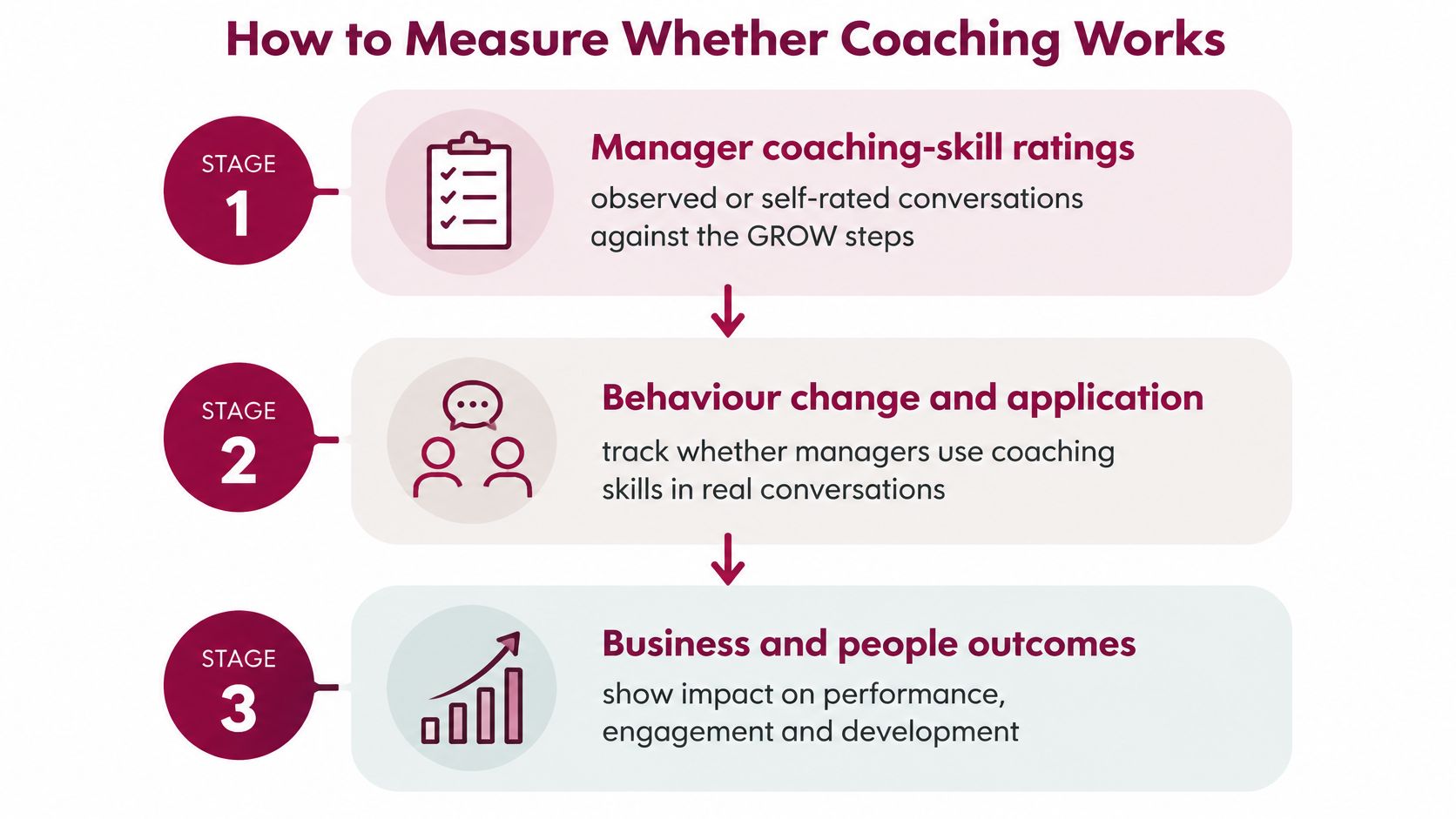
Use a measurement hierarchy informed by the managerial-coaching study's distinction between coaching skill, shared knowledge and team performance:
- Manager coaching skill. Review observed or self-rated conversations against the GROW stages. Look for genuine exploration, accurate reflection and an employee-owned action, rather than counting questions.
- Workplace application and coordination. Check whether employees use what they agreed, know where relevant expertise sits and complete handovers with the necessary information.
- Performance outcomes. Examine an objective or supervisor-rated result connected to the original goal, such as report quality or reliable delivery.
Self-ratings can support reflection, but don't treat them as independent confirmation. Where possible, combine them with employee feedback or an agreed observation.
Keep the scorecard usable
Maintain a monthly action list and calculate the percentage of agreed actions completed. Add a brief pulse question about whether employees feel able to solve relevant problems independently, then review a chosen team outcome after six months.
| Measure | Baseline | Target | Review date |
|---|---|---|---|
| Agreed actions completed | Record the current completion rate | Agree a realistic improvement | Monthly review |
| Independent problem-solving | Record the initial pulse response | Define the desired change | Next pulse check |
| Relevant team outcome | Record current quality or delivery | Agree the required standard | Six-month review |
Compare before and after, using consistent definitions. Note changes in staffing, workload or systems that could also explain the result.
Improved results after coaching are evidence worth examining, not automatic proof that coaching caused them.
Choose Your Next Coaching Development Step
Start with a bounded workplace experiment rather than trying to change your entire management approach at once.
- Choose a suitable conversation. Pick a team member with enough knowledge to explore a genuine problem using GROW.
- Record a baseline. Agree a measure that connects the conversation with workplace application.
- Invite review. With the employee's agreement, ask a peer or your manager to observe or review a session while respecting confidentiality.
- Reassess after four weeks. Decide whether to adapt the approach, widen its use or choose a different intervention.
For a longer learning route, compare leadership training courses that address emotional intelligence, communication, conflict resolution and change management. Start with emotional intelligence if listening and self-awareness are your main development needs.
Our Credential of Leadership and Management comprises eight CPD-accredited courses, covering Leadership Fundamentals, Strategic Leadership, Decision Making, Emotional Intelligence, Conflict Resolution, Change Management, Communication Skills and Team Leadership. It's entirely online and self-paced, with a 160-hour duration, recorded video lectures, structured materials and interactive assessments.
Favour applied scenarios that let you practise making managerial choices, not just recall definitions. Use the stated accreditation, duration and delivery format to judge whether a programme fits your needs. Begin with a conversation, examine what happened and choose further learning around the difficulty you encountered.
London School of Business Administration offers online, self-paced leadership learning that combines structured materials, recorded lectures and applied assessments. Visit London School of Business Administration to explore a learning route that supports the listening, judgement and communication needed for responsible coaching leadership.