Table of Contents
- The Growing Demand for Emotional Intelligence in UK Workplaces
- Understanding the Four Components of Emotional Intelligence
- The Measurable Impact of EI on Business Performance
- The Calibration Trap Why More EI Is Not Always Better
- EI in Action Across Hiring Teams and Wellbeing
- Practical Steps to Develop Emotional Intelligence as a Leader
- Embedding EI into Leadership Development Systems
- Key Takeaways for Leaders Building EI Capability
The Growing Demand for Emotional Intelligence in UK Workplaces
The demand for emotional intelligence has moved beyond leadership theory. UK employers are confronting changing skills requirements, pressure on wellbeing and the practical difficulty of keeping teams effective when roles, priorities and expectations shift quickly. A 2025 UK workplace analysis reported that 61% of employees believed their skills could become redundant within three years, which helps explain why adaptability, empathy and collaboration are increasingly treated as future-facing capabilities. The same analysis reported that 75% of workers identified poor relationships with colleagues as a major cause of stress, while employees who felt unsupported by their line managers were 63% more likely to report a decline in mental health. These figures appear in the UK workplace analysis of the emotional recession.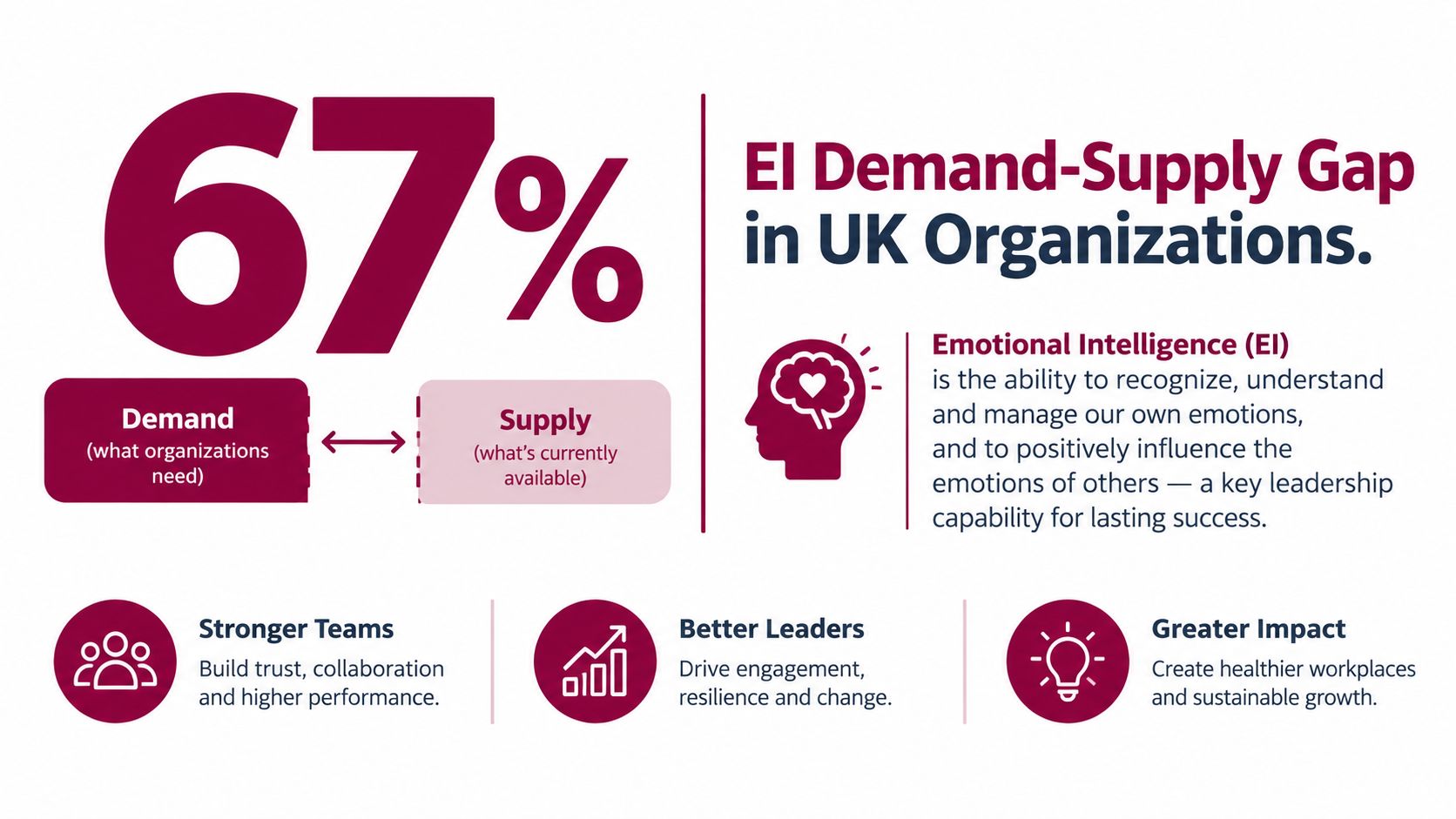
EI is a capability, not a personality label
Emotional intelligence is best understood as a set of learnable leadership behaviours. It includes recognising your own emotional responses, managing those responses under pressure, noticing what other people may be experiencing and using that understanding to communicate and act effectively. This distinction matters. Calling someone “empathetic” can sound like a fixed description of character. Assessing whether a manager pauses before reacting to challenge, asks useful questions during conflict or adjusts communication for a worried employee creates something more practical. These behaviours can be observed, discussed and developed. A UK management research summary found that 90% of 50 surveyed UK organisations described emotional intelligence as important or vital to working relationships, stress management and leadership. That finding supports a capability-based approach, because it connects EI with ordinary management work rather than with an abstract ideal of being pleasant.Why managers need a balanced model
Goleman's widely used framework identifies four connected areas: self-awareness, self-management, social awareness and relationship management. A manager needs all four. Self-awareness without self-management can produce insight without control. Empathy without relationship management can leave a leader understanding a problem but failing to address it. For UK managers, the practical question is therefore not whether EI sounds valuable. It is how to translate it into recruitment decisions, feedback conversations, team routines, wellbeing practice and formal development. Resources such as guidance on future-of-work skills for the new economy can help place these behaviours within wider management capability discussions, but organisations still need to define what effective EI looks like in their own roles.Understanding the Four Components of Emotional Intelligence
Consider a manager whose team has missed an important deadline. The immediate temptation might be to send a sharp message, demand an explanation and focus on accountability. Emotional intelligence doesn't remove accountability. It changes the quality and timing of the response. The manager first notices a personal reaction: perhaps frustration, fear about senior scrutiny or disappointment in the team. That is self-awareness. Think of it as a dashboard readout. It doesn't tell the driver what to do, but it shows the signals that may affect judgement. A self-aware manager can say internally, “I'm worried about the consequences, and that may be making my response more severe than the facts require.”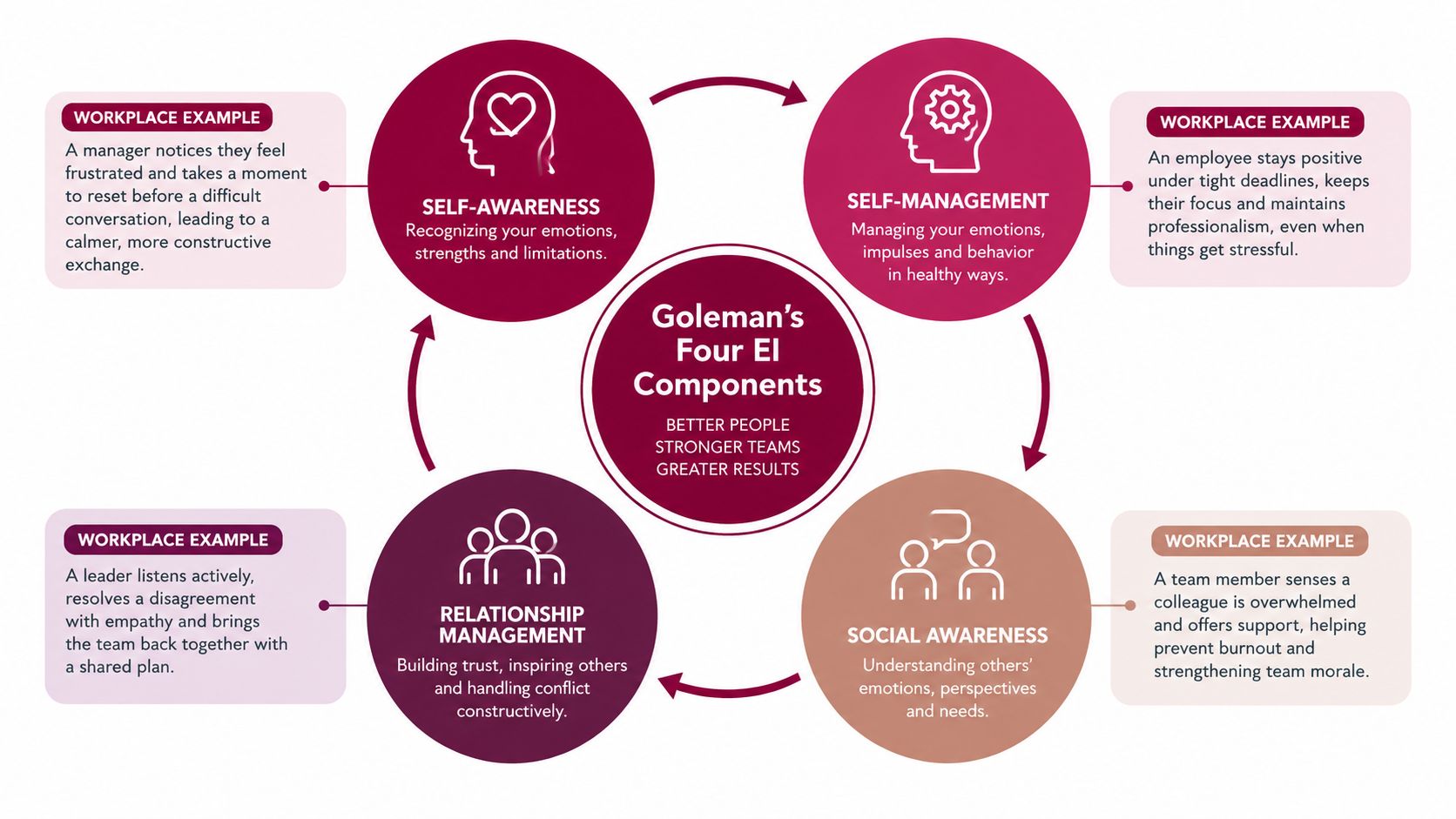
From reaction to deliberate action
The next capability is self-management. If self-awareness is the dashboard, self-management is the thermostat. It helps the manager regulate the intensity of the response rather than allowing the first emotional impulse to set the temperature for everyone else. That might mean delaying the message, checking the facts and entering the meeting with a clear purpose. The manager can still ask what went wrong, clarify responsibilities and set a revised expectation. The difference is that the conversation is less likely to become an outlet for unmanaged frustration. Social awareness then widens the view. The manager asks what the team may be experiencing. Was the deadline missed because priorities changed, because a dependency failed or because people were reluctant to raise a problem early? Social awareness isn't mind-reading. It involves attentive listening, careful observation and curiosity about the pressures shaping other people's behaviour.Turning understanding into a working relationship
Finally, relationship management converts awareness into action. The manager needs to explain the impact of the missed deadline, invite an honest account and agree practical next steps. If two colleagues disagree about responsibility, relationship management involves addressing the conflict directly without humiliating either person. The four components work as a sequence, but they aren't separate boxes. A leader who notices anxiety but can't regulate it may transmit that anxiety to the team. A leader who understands another person's concern but avoids a necessary decision may be compassionate in intention but ineffective in practice. Managers who want a structured treatment of the framework can consult the lesson on the five components of emotional intelligence. The Emotional Intelligence in Leadership course is also listed by the London School of Business Administration as a distinct learning option.The Measurable Impact of EI on Business Performance
A 10% increase in a manager's emotional intelligence score was associated with a 7% increase in overall business performance, including profitability, in a study of 150 managers and staff across 30 companies, as reported by UK business media coverage of emotionally intelligent managers. This is an association, not evidence that every EI programme will deliver the same result. It does show why emotional intelligence belongs in performance discussions, not only in conversations about personal wellbeing. The managerial mechanism is practical. Leaders shape whether employees raise risks early, whether disagreement becomes useful debate and whether new colleagues receive enough support to contribute. These effects may appear in engagement, retention, collaboration and execution quality rather than in one isolated business measure. EI therefore works like a control system for team performance: it helps a manager notice pressure, adjust their response and keep work moving without ignoring people.What the wider evidence indicates
A UK study of 306 employees found that overall emotional intelligence predicted engagement beyond age and gender. Higher happiness, emotion management and self-motivation were associated with higher engagement. The authors also cautioned that the findings should not be generalised beyond the UK population because the dataset was UK-only. The findings are detailed in the UK employee engagement study. Together, these findings point to several useful measurement routes. An organisation can examine whether one-to-ones become more constructive, whether employees feel able to raise concerns, whether conflict is resolved promptly and whether engagement feedback changes after development activity. These indicators do not prove that EI alone determines turnover, absence or customer experience. Each outcome has several causes, although managerial behaviour can influence the conditions behind them. The link between EI and performance also needs a clear boundary. A manager who listens carefully but avoids a decision may preserve short-term comfort while leaving priorities unclear. A manager who combines awareness with appropriate challenge can support people and still protect delivery. This is why EI is better treated as a calibrated managerial capability than as a soft skill to maximise without limit. For how these performance effects connect with motivation and trust, see our analysis of emotional intelligence in leadership driving team motivation and trust. A manager can connect an EI objective to an existing leadership measure. “Handles difficult conversations more effectively” might be assessed through observed behaviour, colleague feedback and follow-up on agreed actions. Leaders combining interpersonal capability with evidence-led decision-making may also encounter the Advanced Professional Certificate in Data Analytics for Business as a separate catalogue item.The Calibration Trap Why More EI Is Not Always Better
Emotional intelligence is often presented as an uncomplicated virtue. More empathy, more sensitivity and more emotional attunement appear to promise better leadership. The difficulty is that managers don't lead in a vacuum. They must balance care with challenge, inclusion with prioritisation and understanding with timely decisions. A UK NHS-based study involving over 300 managers found an optimum-point pattern. Beyond that point, very high emotional intelligence was linked to lower staff satisfaction, weaker change implementation and reduced effectiveness. The study of emotionally intelligent managers therefore offers an important corrective to the assumption that EI should be maximised without limit.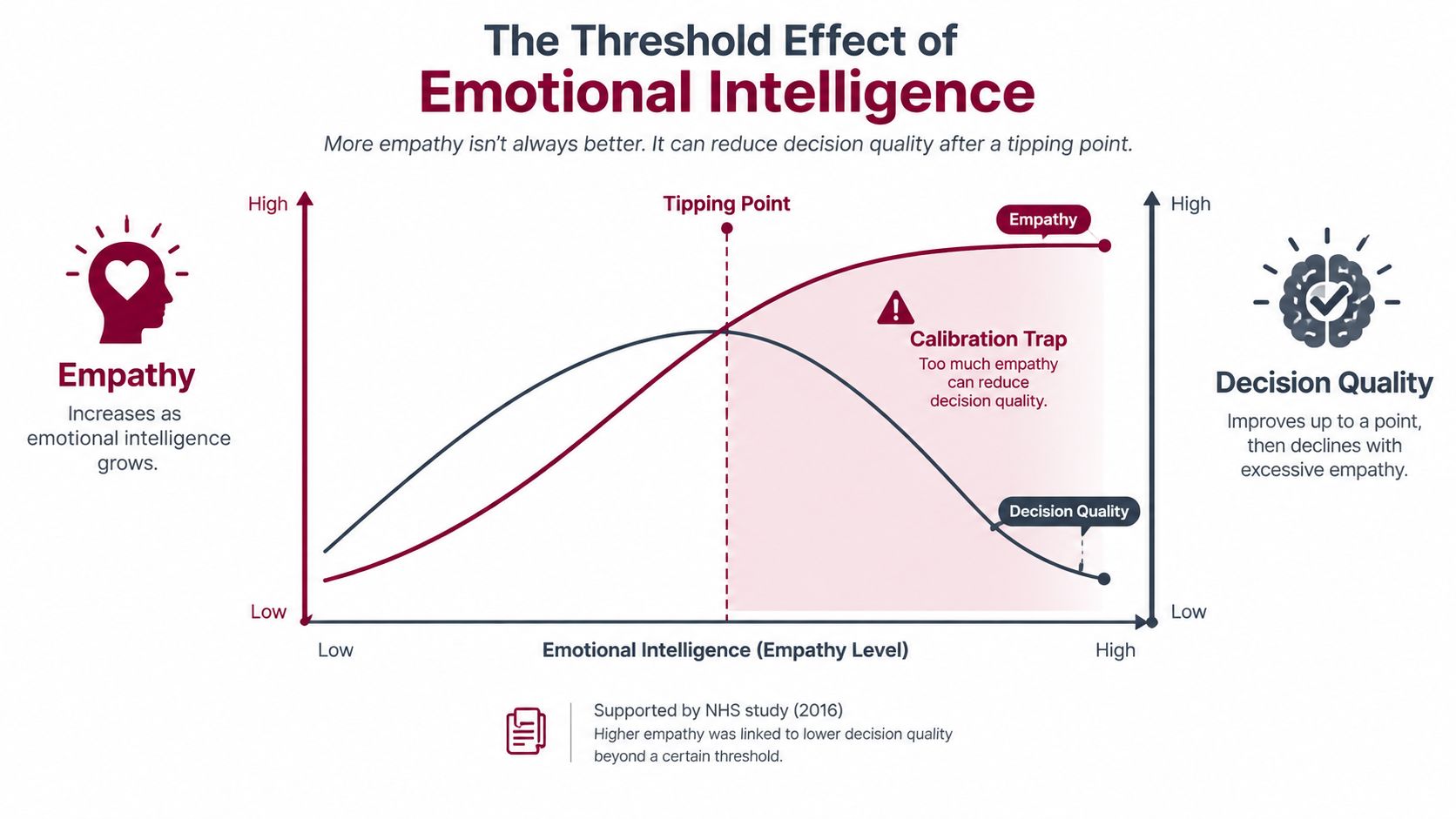
When empathy starts to obstruct leadership
Consider a manager overseeing a restructure. Moderate empathy helps the manager understand fear, explain the rationale clearly and create space for questions. Excessive emotional absorption may produce a different pattern. The manager could delay a necessary announcement, repeatedly reopen settled decisions or make inconsistent concessions to relieve immediate discomfort. That response may feel humane in the moment, but it can increase uncertainty for everyone else. People need honest information, clear boundaries and a credible process as well as emotional recognition.Practical rule: Use empathy to understand the human impact of a decision, not to avoid making the decision.Calibration depends on context. A manager supporting someone after difficult news may need to slow down and listen. The same manager responding to a serious operational risk may need to acknowledge concern briefly, establish responsibility and act. Both responses can be emotionally intelligent because both match the emotional demand to the leadership task.
A better development question
Instead of asking, “How can this leader become more empathetic?”, ask, “What level and form of emotional attention does this situation require?” Development should include assertiveness, boundary-setting and decision discipline alongside listening and compassion. This is why EI shouldn't be treated as a single score that leaders pursue indefinitely. The aim is reliable judgement under emotional pressure. A calibrated manager recognises distress without becoming paralysed by it, remains considerate without becoming vague and can hold a difficult line without becoming needlessly harsh.EI in Action Across Hiring Teams and Wellbeing
A hiring manager interviews two candidates for a role requiring collaboration. One candidate gives polished answers but seems unprepared when asked to describe a disagreement. The other becomes visibly anxious, loses fluency and struggles to organise an otherwise thoughtful response. A manager using emotional intelligence doesn't excuse weak preparation, but also doesn't confuse interview composure with capability. They ask a follow-up question, allow the candidate time to think and distinguish a temporary anxiety response from a lack of understanding. The observable result is a more informed hiring decision, because the manager has gathered better evidence instead of allowing one emotional moment to dominate the assessment.Collaboration under pressure
In another team, a detail-oriented analyst and a big-picture strategist repeatedly criticise one another's work. The analyst sees the strategist as careless. The strategist sees the analyst as obstructive. A team lead who applies social awareness listens to each person separately before bringing them together. The discussion reveals that the analyst is under pressure from repeated last-minute changes, while the strategist is responding to a client expectation for rapid direction. The manager doesn't ask either person to become more like the other. Instead, they define a division of labour: the strategist sets the decision context and priorities, while the analyst identifies risks and confirms the detail needed for delivery. The result is not perfect agreement. It is a workable operating arrangement in which disagreement becomes part of the process rather than a personal contest.Wellbeing before crisis
A people manager notices that a usually resilient team member has become less energetic, is sending sharper emails and has begun missing agreed deadlines. These signs don't prove burnout or establish a diagnosis. They do indicate that the manager should stop relying on assumptions about resilience and hold a private, respectful conversation. The manager describes the observable changes, asks how the workload is affecting the employee and listens without promising an immediate solution. Together, they may clarify priorities, review support and agree a follow-up conversation. The specific outcome is earlier visibility of a potential problem, which gives the employee and organisation more room to respond before absence, disengagement or resignation becomes the only remaining signal.Emotional intelligence produces practical value when it improves the quality of a decision, a conversation or an early intervention.Across these examples, EI isn't about being agreeable. It helps managers gather better information, interpret behaviour more carefully and choose responses that protect both people and performance.
Practical Steps to Develop Emotional Intelligence as a Leader
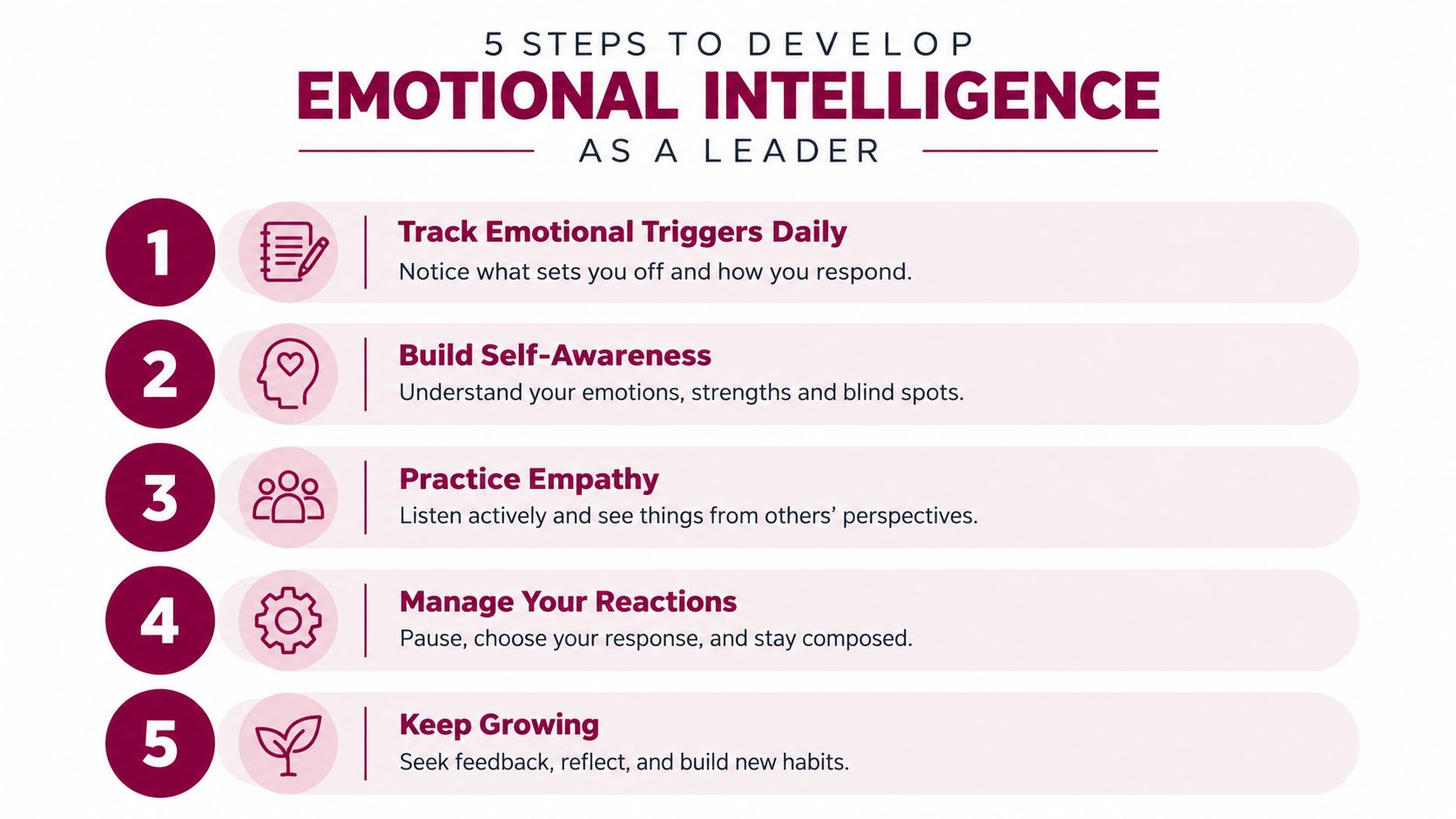
A busy manager can begin developing EI during an ordinary working week. The objective isn't to create a private theory of your personality. It is to notice repeatable patterns and change one behaviour at a time.Start with structured observation
At the end of each working day, record three brief points:- Trigger: What event changed your emotional state?
- Response: What did you say or do next?
- Difference: What did you intend to communicate, and what might others have experienced?
Pause before you label
In a high-stakes conversation, pause long enough to name the emotion privately. “I'm angry”, “I'm anxious” or “I'm embarrassed” creates a little distance between feeling and action. You can then choose whether to continue, ask a question or take a short break. When giving feedback, separate observation from interpretation. “The report arrived after the agreed time” is an observation. “You don't care about deadlines” is an interpretation. Start with what you know, explain the impact and invite the other person's account.Read the interaction, not just the words
During one-to-ones, notice changes in tone, pace, posture and responsiveness. Don't treat any single cue as proof of an emotion. Use it as a reason to ask a careful question, such as, “You seem quieter than usual. How are things going with this workload?” End each week by asking yourself:- Which conversation did I avoid?
- Where did I react faster than I listened?
- Which person may need clearer support or challenge from me?
- What will I do differently in the next similar situation?
Embedding EI into Leadership Development Systems
The gap between recognising emotional intelligence and embedding it is a systems design problem, not just a motivation problem. UK evidence found that only 26% of organisations had embedded EI into leadership development or talent strategies, despite expectations that it will become a prerequisite for success. The same Capgemini UK analysis estimated a 2.2x to 4.4x return on investment from sustained EI investment. A workshop may introduce the subject, but systems determine whether behaviour changes. A practical system has four connected stages:- Diagnostic baseline: Use a validated 360-degree process with behavioural markers. Assess how managers handle challenge, give feedback, listen and make decisions under pressure.
- Custom development: Connect the four EI components with competencies the organisation already measures, including communication, people leadership, change management and accountability.
- Practice integration: Protect time for role-play, coaching, peer observation and workplace application. Managers need repeated opportunities to practise difficult conversations, not only learn concepts.
- Measurement and feedback: Review behavioural evidence through line-manager check-ins, engagement feedback and relevant people metrics. Measure capability growth rather than attendance at a course.
Key Takeaways for Leaders Building EI Capability
Emotional intelligence is important because it shapes how managers turn judgement into collective action. The strongest case for EI isn't that leaders should become endlessly agreeable. It is that they should become more accurate in reading themselves, other people and the situation before choosing how to act. Five principles provide a practical guide:- Treat EI as calibrated capability: Match empathy, challenge and decisiveness to the circumstances.
- Use evidence responsibly: UK findings connect EI with engagement and business performance, but leaders should avoid claiming that one capability explains every organisational outcome.
- Respect the threshold: Excessive emotional concern can weaken decision quality, change implementation and effectiveness.
- Practise in daily work: Track triggers, label emotions, separate observations from interpretations and ask better questions in one-to-ones.
- Build systems, not isolated enthusiasm: Use diagnostics, structured practice, coaching and feedback so EI becomes part of leadership development rather than a temporary theme.
London School of Business Administration offers online, self-paced business and management learning, including a Credential of Leadership and Management with an Emotional Intelligence in Leadership component. Visit London School of Business Administration to review the available programmes and choose a structured route for developing practical leadership capability.