

Transformational leadership is an approach that combines a clear vision, intellectual stimulation, individual consideration and inspirational motivation to lift followers beyond their own self-interest towards a shared purpose. It matters to UK managers because 82% of people entering management have received no formal management or leadership training, so promotion alone cannot establish the capability to lead change.
You may recognise the situation: you've become a team leader, the department is tired, and your manager wants better results without explaining what should change. You can chase outstanding tasks, but you also need colleagues to understand the direction, contribute ideas and trust your judgement.
The useful question isn't whether you're naturally charismatic. It's whether employees experience your leadership as clear, supportive and participative.
Table of Contents
- A Clear Working Definition of Transformational Leadership
- The Four Core Behaviours That Define the Style
- Why the Style Matters for UK Managers
- Transformational Compared With Other Leadership Styles
- Two UK Workplace Stories of the Style in Practice
- The Honest Limits and Risks of the Style
- Developing the Style in Your Own Team
- Frequently Asked Questions for UK Learners
A Clear Working Definition of Transformational Leadership
A newly promoted supervisor in a UK customer-service department inherits a backlog and a discouraged team. Asking everyone to work harder might secure temporary compliance, but it doesn't explain why the backlog exists or help colleagues change the process.
A transformational leadership style means helping people understand a worthwhile direction, reconsider established ways of working and develop the confidence and capability to contribute. The emphasis is on changing how people understand their work, rather than relying primarily on rewards or close supervision.
Think of a coach who lifts a team's ceiling rather than enforcing the rules. The coach establishes what the team is trying to achieve, demonstrates the expected standards, invites players to think and adapts support to each person.
A memorable working definition is this: help people see the purpose, improve the approach and grow into the responsibility.
A practical map of the style
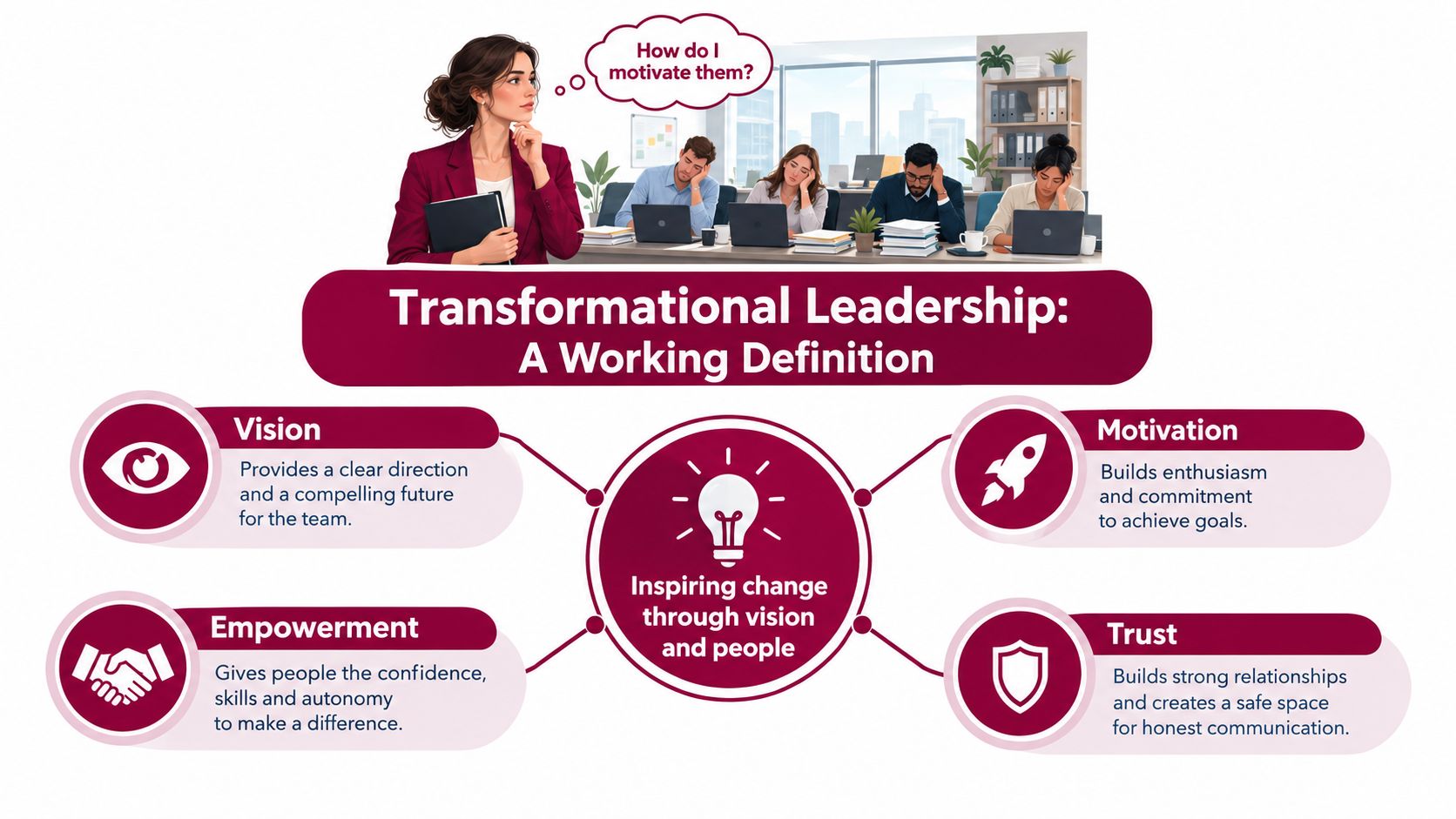
The framework can be remembered through these connected ideas:
- Vision: Explain what a better future would look like in terms employees can recognise.
- Motivation: Connect ordinary tasks to a purpose people can understand.
- Empowerment: Give employees meaningful opportunities to influence improvements.
- Trust: Make participation credible through consistent conduct and individual support.
These ideas become useful when translated into routines. In a UK NHS qualitative study involving 20 healthcare professionals across 10 hospitals, relevant leadership behaviours included open-door communication, brainstorming, inclusive participation and explicit connections to shared purpose. The researchers identified professional engagement as a mediator linking leadership behaviours with psychological safety, shared meaning, motivation, innovation and perceived performance.
That evidence explains a possible mechanism, not a numerical guarantee of improvement. For the customer-service supervisor, an appropriate application would be a structured discussion about recurring problems, followed by agreed authority to test improvements and feedback on what happened.
Shared purpose doesn't mean abandoning personal interests. Employees still need fair treatment, manageable workloads and development opportunities. A credible leader connects those needs with collective goals rather than asking people to sacrifice them.
The Four Core Behaviours That Define the Style
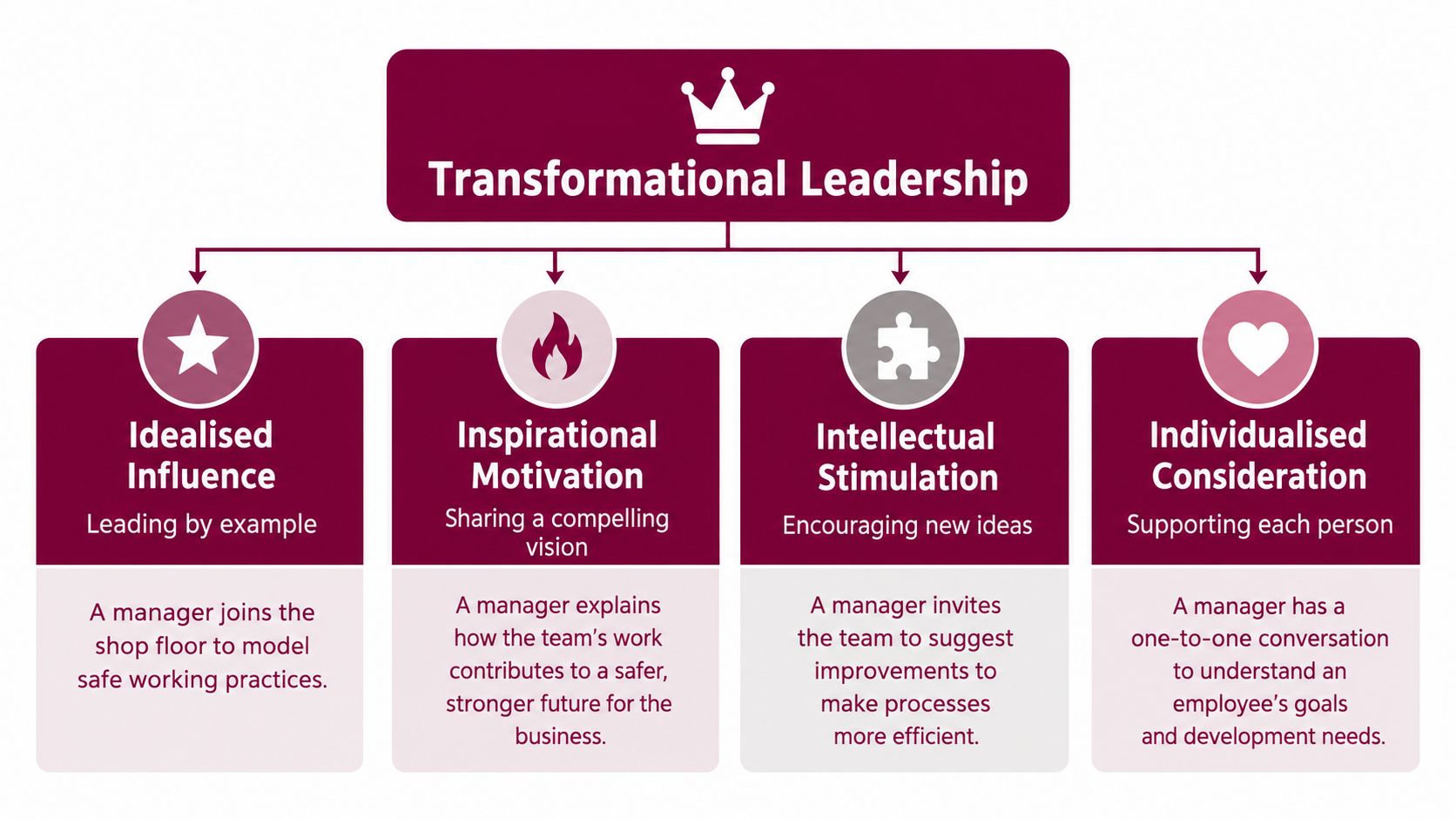
The formal behavioural framework uses idealised influence, inspirational motivation, intellectual stimulation and individualised consideration. These terms sound academic, but each describes something a manager can practise and colleagues can observe.
Credibility and direction
Idealised influence means leading by example. Consider a warehouse supervisor who insists on safe handling procedures but bypasses them when dispatch is running late. Their conduct contradicts their message; a credible alternative is to follow the procedure, acknowledge the delay and address the scheduling problem.
Try a simple exercise: identify a standard you expect from colleagues, then examine whether your own behaviour meets it under pressure. Choose a visible action that closes any gap.
Inspirational motivation concerns the meaning behind the work. A housing-service manager might explain that clearer case handovers help residents avoid repeating distressing circumstances, rather than presenting handover quality as another administrative target.
- Practice explaining purpose: Describe the desired improvement, who benefits and how the team's work contributes.
- Test understanding: Ask a colleague to explain the direction in their own words. Don't assume your explanation was clear because nobody objected.
Better thinking and tailored support
A finance administrator notices that staff repeatedly enter the same information into separate forms. Intellectual stimulation occurs when the manager treats that observation as a useful challenge to the process, rather than dismissing it because the forms are established practice.
For practice, bring a recurring difficulty to a team discussion and ask which assumption might be wrong. Listen before proposing your preferred answer, then agree how an alternative could be examined without compromising necessary controls.
Individualised consideration means responding to different development needs. A new colleague might need a demonstration and feedback; an experienced colleague might benefit from greater discretion and a stretching assignment.
A useful exercise is to ask each person what they're trying to learn and what currently prevents progress. Agree suitable support rather than offering everyone identical coaching.
Understanding why emotional intelligence is important can help managers distinguish reluctance, uncertainty and overload before deciding how to respond.
The test across these behaviours is practical: can employees point to something you did? A compelling speech isn't sufficient if nobody experiences coaching, constructive challenge or dependable conduct afterwards.
Why the Style Matters for UK Managers
Management capability matters far beyond executive roles. The CIPD's report on improving UK management capability estimates that almost 10 million people are line managers, with nearly half working in small and medium-sized enterprises, and links people-management quality with engagement, performance, health and wellbeing.
The same report records that, in British manufacturing in 2016, businesses in the top half for structured management practices had average productivity 38% higher than those in the bottom half. That comparison concerns structured management broadly, not transformational leadership alone.
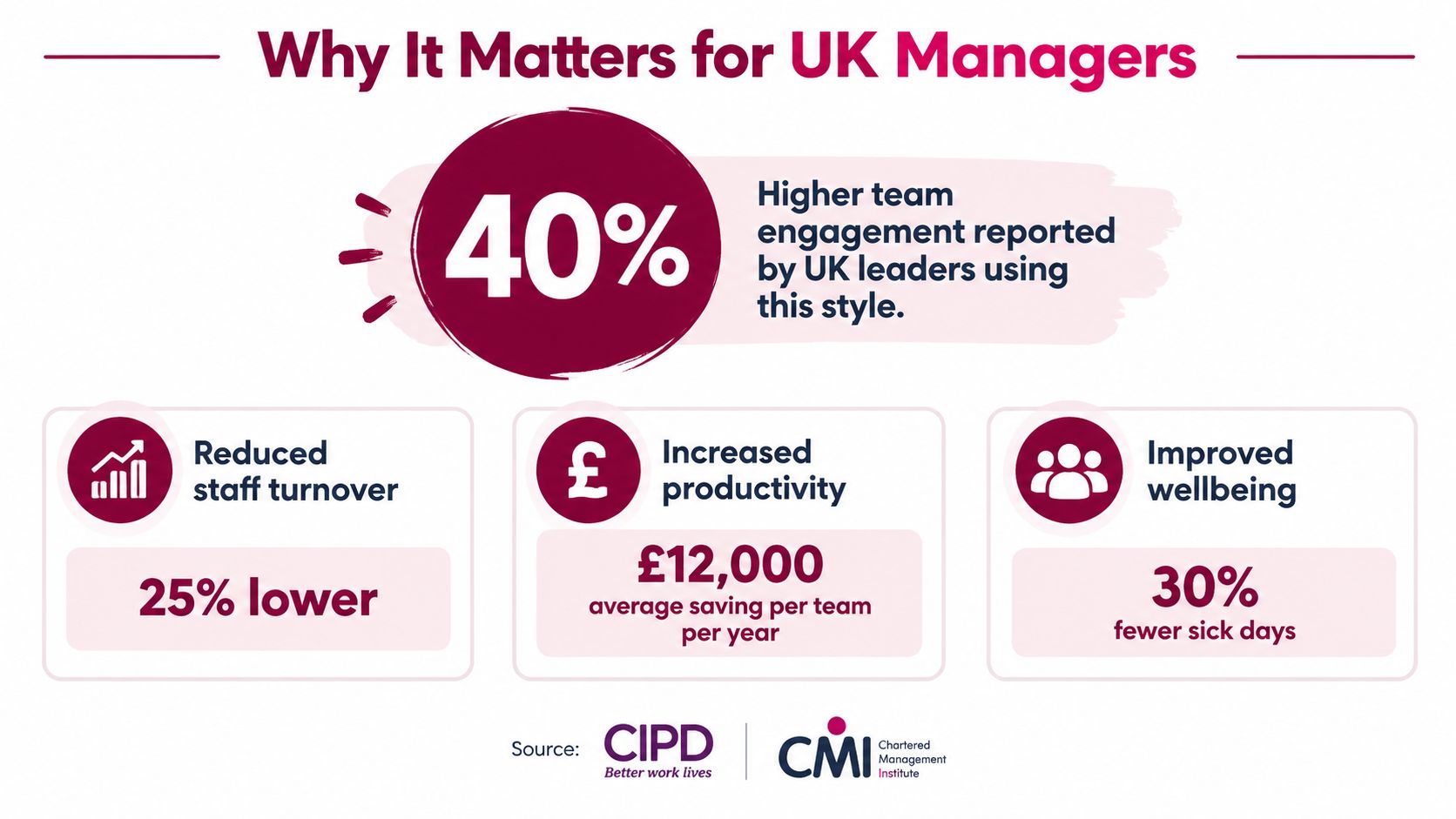
Treat the numerical benefit claims in this illustration as unsubstantiated, not as evidence of transformational leadership's effects. The cited research supports a more qualified account.
From shared interpretation to service consistency
A University of Manchester study of a four-year employee–customer panel across 255 UK DIY stores found that transformational leadership was positively associated with consensus about the unit's high-performance work system. Greater consensus was associated with less variation in job satisfaction, while more consistent employee attitudes were positively related to customer satisfaction.
For a branch manager, that suggests a useful measurement approach:
- Check shared interpretation: Ask employees what the service priorities mean in practice.
- Examine disagreement: Look at differences between teams, not just the overall engagement average.
- Connect measures carefully: Track employee experience and customer outcomes without assuming the former automatically causes the latter.
The practical issue is whether colleagues understand management expectations consistently. Further reading on motivation for leaders can support reflection on how managers explain those expectations.
Capability rather than optional soft skills
Written evidence submitted to the UK Parliament attributes around 50% of the UK productivity gap with the United States to differences in management capability and projects a need for more than 120,000 additional managers by 2030.
These claims don't isolate transformational leadership as a causal variable. They do strengthen the argument for treating communication, people development and change leadership as capabilities to learn and assess, rather than personality preferences.
Transformational Compared With Other Leadership Styles
A leadership style is a way of approaching responsibility, not an identity you must defend in every situation. You can encourage participation while maintaining firm standards, and you can issue a direct instruction without abandoning your commitment to employee development.
The following comparison offers practical distinctions rather than a ranking. The workplace situations are illustrative applications, not findings from comparative trials.
Transformational leadership against three common UK alternatives
| Style | Dominant behaviour | Best fit | Main risk |
|---|---|---|---|
| Transformational | Connect people to shared purpose and develop their contribution | Redesigning a service or building a new team capability | Ambition without sufficient practical support |
| Transactional | Clarify expectations, monitor delivery and connect performance with consequences | Routine processing with defined standards and deadlines | Compliance without questioning ineffective methods |
| Servant | Prioritise employees' needs, development and ability to contribute | Supporting a professional team whose members need obstacles removed | Avoiding difficult decisions in the name of support |
| Autocratic | Make decisions centrally and give direct instructions | An immediate safety incident requiring coordinated action | Suppressing useful judgement if continued unnecessarily |
Choose according to the task
Transactional leadership is particularly useful when people need an unambiguous agreement about responsibilities. A payroll manager can specify approval requirements, deadlines and escalation arrangements without turning every routine decision into a discussion about vision.
Its limitation is not that clarity is undesirable. It's that clear instructions can preserve an inefficient process if nobody is encouraged to question it.
A servant leadership approach starts with how the leader can enable others to contribute. The distinction explored in what servant leadership style means is useful when deciding whether your immediate priority is removing obstacles for employees or mobilising them towards organisational change.
Those priorities may overlap, but they aren't identical. Supporting colleagues doesn't remove the responsibility to decide between competing needs.
Direction without unnecessary control
Autocratic leadership involves centralised decision-making. During an immediate workplace hazard, a manager may need to stop activity and assign actions rather than invite an open-ended debate.
Once the immediate danger has passed, continued central control can prevent employees from contributing what they know. The manager should reconsider how much authority needs to remain concentrated.
Practical rule: Choose the amount of direction the situation requires, not the amount that makes you feel most in control.
For a UK operations manager, a sensible combination might be participative process redesign alongside firm safety requirements. Adaptation is professional judgement, provided employees understand which decisions are open to influence and which are not.
Two UK Workplace Stories of the Style in Practice
The following contrasting stories are hypothetical teaching examples, not documented case studies. They show how similar intentions can produce very different employee experiences without claiming measured performance gains.

A branch reset with employee influence
An operations manager takes responsibility for a UK service branch where colleagues are frustrated by duplicated work and conflicting priorities. Instead of announcing a complete turnaround, she asks staff to describe where customer requests become difficult to resolve.
She gives the team a concrete direction: customers should receive a coherent answer without unnecessary transfers between colleagues. She also acknowledges that her own reporting requests have contributed to the duplication.
Employees propose a clearer handover process. The manager agrees what they may change, protects time for testing and provides coaching to a colleague who wants to coordinate the work but lacks confidence.
Before claiming success, she would need to examine:
- Employee experience: Whether colleagues feel clearer about priorities and safer raising difficulties.
- Implementation: Whether agreed changes are used during busy periods.
- Operational evidence: Whether the branch's existing service measures improve without hidden workload costs.
The defining feature is not the manager's enthusiasm. Employees have a route from identifying a problem to influencing a decision and receiving support.
A bold announcement without practical backing
Elsewhere in the same imagined organisation, a senior leader announces an ambitious transformation. He invites everyone to take ownership but leaves existing responsibilities unchanged and provides no clear way to resolve competing demands.
In meetings, he welcomes ideas that support his proposal but treats concerns as resistance. Employees learn that visible optimism receives approval, while realistic questions about capacity do not.
In this hypothetical scenario, some colleagues become exhausted and disengaged; others begin looking for work elsewhere. Those outcomes illustrate a risk, not a reported result from an actual organisation.
The corrective response would be to listen privately as well as publicly, clarify what can stop and establish a credible route for challenging decisions. Ownership without decision rights or resources is responsibility transferred, not true authority.
The Honest Limits and Risks of the Style
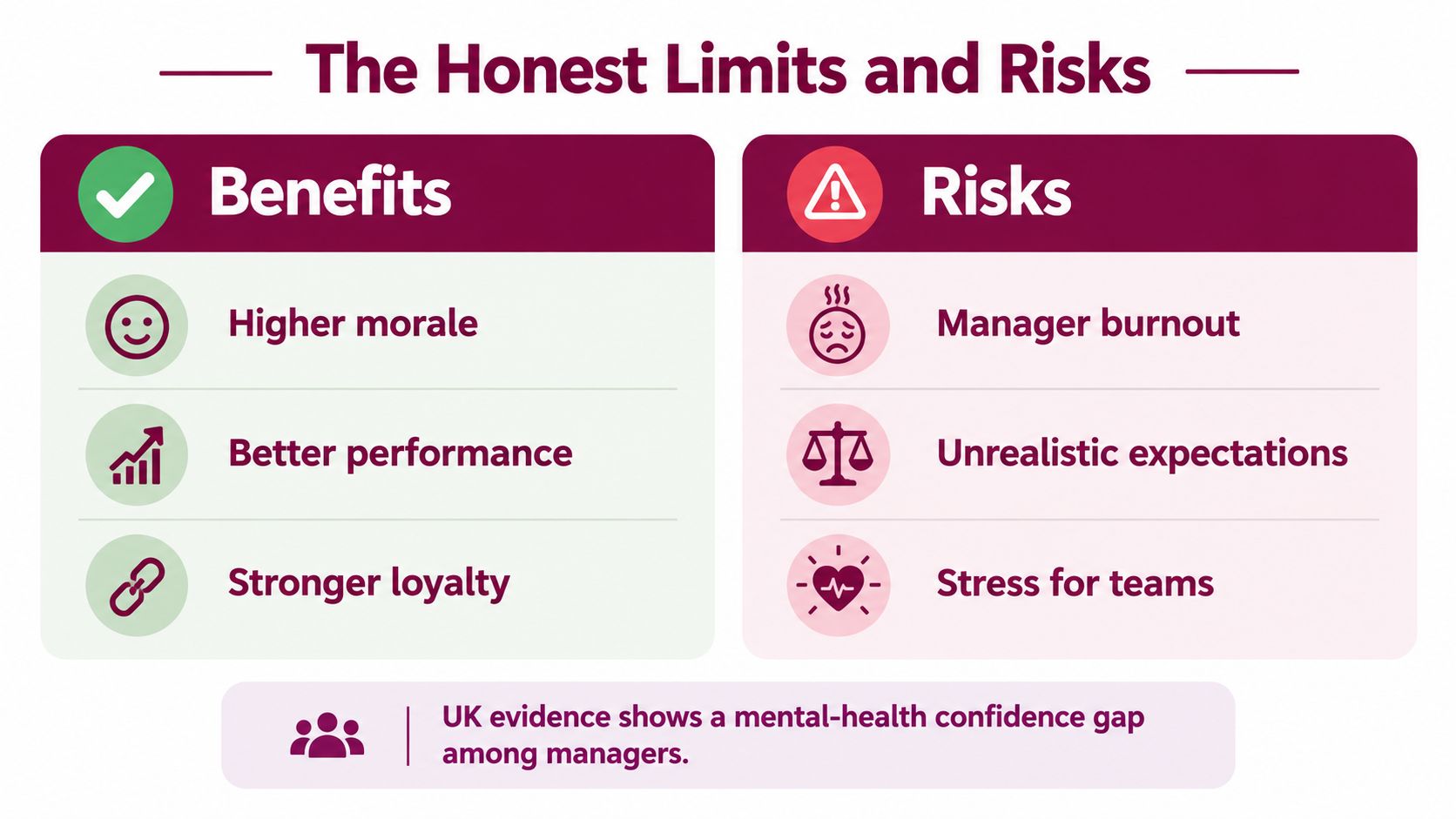
An ambitious vision can become pressure disguised as purpose. A manager who asks colleagues to stretch without changing resources, priorities or support may increase demands while believing they are being inspirational.
UK evidence discussed by TELUS Health reports 964,000 workers in Great Britain experiencing work-related stress, depression or anxiety, accounting for 22.1 million lost working days. It also reports that 32% of managers were unsure what to do if they suspected an employee had a mental-health problem, while 9% did not know what to do.
Those figures don't establish that transformational leadership causes ill health. They show why managers need practical wellbeing and referral skills alongside motivational techniques.
Check whose experience counts
Inclusion also requires testing rather than assuming. A 2025 UK study published by Onvero reported that 82% of business decision-makers believed leaders championed inclusion, compared with 60% of employees; 89% of leaders reported that their organisation had some form of DEI strategy.
The gap matters because a leader can interpret consultation as inclusive while employees experience little influence. Confident contributors may dominate meetings, and people working remotely or flexibly may have fewer informal opportunities to shape decisions.
- Audit participation: Identify whose suggestions influenced the final decision and whose concerns remained unresolved.
- Review access: Check who receives development opportunities, including less visible colleagues.
- Examine outcomes: Where appropriate and lawful, assess differences by role, gender, ethnicity, disability and work pattern while protecting confidentiality.
Pair ambition with boundaries
A team's willingness to accept more work is not proof that it has the capacity to deliver it safely.
When employees are overloaded, a more transactional response may be responsible: establish priorities, define limits, allocate resources and monitor delivery. Managers should also know how to use their organisation's support and referral arrangements rather than attempting to diagnose mental-health conditions.
Accountability means changing the plan when employee experience contradicts leadership intention. Listening without making necessary adjustments leaves the underlying problem intact.
Developing the Style in Your Own Team
Begin with a development need you can observe, not a promise to become a different kind of person. Ask colleagues which leadership behaviour would make their work clearer or more manageable, then select a practice you can review together.
Organisational support matters too. CIPD research on people management and productivity found that only 27% of organisations said most of their managers, defined as more than three-quarters, had received people-management training.
A sensible development approach combines supervised practice, mentoring, feedback and structured education. The Credential of Leadership and Management is one programme option to consider alongside workplace-based development.
Connect learning with an observable action
Use the following sequence to connect management study with practice. It is a learning plan, not a claim about the detailed syllabus of any particular programme.
- Leadership fundamentals and vision-setting: Define an improvement that employees can recognise, then examine your own responsibilities in achieving it.
- Emotional intelligence: Practise responding calmly to disagreement and checking your interpretation of another person's reaction. Emotional Intelligence in Leadership is a relevant area of study here.
- Team building and conflict resolution: Establish how colleagues will contribute, challenge proposals and resolve differences.
- Change management: Identify what employees will need to do differently and what support that requires.
- Decision-making and problem-solving: Compare alternatives, identify constraints and explain the basis of your decision.
- Communication and strategic direction: Connect the local change with organisational priorities without obscuring uncertainties.
Study of Leadership and Organisational Behaviour can also help you examine the relationship between individual conduct, team dynamics and organisational expectations. Apply learning to a current workplace issue rather than keeping it separate from your management responsibilities.
A short self-assessment
Before starting, ask yourself:
- Purpose: Can colleagues explain the improvement we're pursuing?
- Influence: Can they identify a decision their input changed?
- Development: Have I agreed support suited to individual needs?
- Credibility: Do my actions match the standards I expect?
- Review: What employee feedback would persuade me to change course?
Choose the weakest answer as your starting point. Agree an observable action and a review arrangement, then judge progress through colleagues' experience rather than your confidence alone.
Frequently Asked Questions for UK Learners
Does it work in small businesses?
It can be applied without a large management structure. An owner-manager might explain a proposed service change, invite staff to identify practical obstacles and delegate a bounded improvement task. Keep the process proportionate, and don't confuse informality with clarity.
How is it different from servant leadership?
The distinction is one of emphasis: developing employees' capacity to contribute to change, compared with prioritising how the leader serves and supports them. Ask which need is most pressing in your situation rather than trying to fit every action into a single label.
Can I practise without formal authority?
Yes, within your existing remit. You can explain the purpose of a shared task, invite colleagues' suggestions and demonstrate dependable conduct. Seek agreement before changing responsibilities or processes you don't control.
Is formal training genuinely necessary?
Experience matters, but it doesn't automatically expose gaps in your practice. The CMI survey reported by People Management, involving more than 4,500 UK workers and managers, found that 82% of people entering management had received no formal management or leadership training.
In that survey, 83% of trained managers felt confident in their managerial abilities, compared with 71% of those without equivalent training. Confidence is not proof of competence, and the association doesn't establish causation, but it supports taking development seriously.
A structured leadership and management pathway can organise your learning. Pair it with feedback and workplace application so that you assess what colleagues experience, not merely what you know.
London School of Business Administration offers online, self-paced business and management education, including leadership-focused study. To explore learning relevant to communication, people development and organisational change, visit London School of Business Administration and compare the available options with the development need you identified in your self-assessment.