

Popular advice about motivation for leaders often begins in the wrong place. It assumes that capable professionals naturally want authority, that a larger title will compensate for heavier responsibility, and that a compelling vision can sustain effort when the working conditions are poor. UK evidence points towards a different diagnosis: leadership motivation is shaped not only by personality or ambition, but by the perceived cost of accepting responsibility.
The central question, therefore, isn't just how organisations can inspire leaders. It is whether they have designed leadership roles that people can reasonably want. Sustainable motivation depends on the relationship between purpose, autonomy and growth on one side, and workload, support, training and credible progression on the other.
Table of Contents
- The Leadership Aspiration Paradox
- Evaluating the Cost of Management Roles
- Intrinsic and Extrinsic Motivational Drivers
- The Impact of Learning and Development Deficits
- Operational Conditions for Sustained Engagement
- Strategies for Leadership Development and Retention
- Aligning Individual Purpose with Organisational Infrastructure
The Leadership Aspiration Paradox
The assumption that high performers naturally want to manage others is attractive, but it does not survive close examination. UK evidence shows a clear gap between viewing leadership as interesting and choosing it as a serious career direction. Among UK Gen Z respondents, 84% expressed interest in leadership roles at some point, yet only 5% identified leadership as their primary career goal; among UK Millennials, the corresponding figures were 73% and 3%. These figures are reported in Deloitte's UK Gen Z and Millennial Survey.
That gap matters because interest and commitment are not the same thing. Interest signals a possible future identity. A primary career goal reflects a willingness to organise work, learning, and personal trade-offs around leadership. Many younger professionals can see the value of influence, contribution, and progression, while still judging the role itself to be too costly.
Prestige versus perceived cost
The deterrents are direct. UK respondents associate leadership with stress and burnout, excessive responsibility, and work-life balance concerns, according to the same Deloitte UK research cited above. A separate UK leadership-pipeline analysis, drawing on more than 110,000 responses to Motivational Maps, found that only 38% of UK employees aspired to management, down from 51% a few years earlier. The report also states that 61% associate management with stress and burnout. Those figures appear in the leadership-pipeline analysis.
The conclusion is a rational one. If promotion brings accountability without authority, administration without time, and responsibility without development, the title becomes a poor exchange. Organisations often mistake that hesitation for a confidence issue and respond with encouragement alone. The deeper problem is job design.
Analytical implication: Leadership aspiration weakens when organisations raise the liabilities of the role faster than its meaningful rewards.
Historical Motivational Maps evidence points in the same direction. In the UK-based study, the motivator called “Director” ranked eighth out of nine, with only 2.6% selecting it as their number-one driver, and an average score of about 16 out of 40. By comparison, “Searcher” averaged above 25. The evidence is historical, so it should not be treated as a full description of every modern workplace, but it still suggests that formal authority is rarely the strongest motivator. Meaning, growth, and purpose often carry more weight than status alone.
The psychology of good leadership, as explored in the psychology of leadership, helps explain behaviour and capability. It does not, by itself, make an exhausting or unsupported leadership role attractive. The motivation problem starts before appointment, in the institutional conditions that shape whether people see leadership as a worthwhile future.
Evaluating the Cost of Management Roles
Management roles carry a motivational price. Salary, title and influence are visible returns. Workload, emotional labour, accountability and reduced autonomy are less visible costs. Employees considering promotion assess the balance between them, even when they never express that assessment in financial terms.
UK workforce evidence indicates that the cost side has expanded. The UK leadership-pipeline report associates management with stress and burnout for 61% of employees, while management aspiration has fallen from 51% to 38%. These figures do not show that every management role is unattractive. They show that managerial work has acquired a damaging reputation, one that organisations must address through job design rather than branding.
The hidden exchange
Organisations often treat leadership prestige as compensation for managerial burdens. That exchange breaks down when status is symbolic but the burdens are operational. A manager may carry responsibility for performance, wellbeing and delivery while lacking the time, authority or support required to influence those outcomes. Authority then creates exposure rather than control.
Promotion can therefore reduce motivation. Recognition may arrive alongside the removal of conditions that previously enabled strong performance. The new manager spends less time applying professional expertise and more time resolving escalations, completing administration and absorbing uncertainty from senior leaders and team members.
The quality of a management role can be tested through four questions:
- Decision rights: Can the manager make the decisions for which they remain accountable?
- Workload: Has leadership work replaced lower-value activity, or has it been added to the existing role?
- Support: Can the manager obtain timely advice, peer discussion and senior sponsorship?
- Progression: Does the role provide a credible route towards greater mastery, influence and purpose?
These questions explain why a title rarely creates durable motivation. External rewards may attract interest, but they cannot repair a role whose daily conditions contradict its stated value. The practical response may involve clearer reporting lines, fewer approval stages or protected time for coaching. Another recognition initiative will have limited effect if the underlying workload remains unchanged.
A rational reluctance
Early-career professionals may fear that management makes them accountable for problems they cannot solve. Responsibility becomes demotivating when resources and authority do not match the outcomes demanded. Burnout concerns then function as rational information about the organisation's employment model, rather than evidence of weak resilience.
Hesitation also has several reasonable interpretations. An employee may want meaningful work without unnecessary bureaucracy, or may prefer to build competence before accepting broader accountability. Employers that label these concerns as resistance risk overlooking people who could develop into thoughtful, capable leaders.
A leadership pathway becomes more attractive when it offers influence without needless overload, structured development and a visible connection between managerial work and beneficial outcomes. The decisive distinction is between roles whose rewards and costs are credibly aligned and roles that require individuals to compensate for organisational weakness with personal energy. That alignment depends on institutional support, decision-making authority and the removal of avoidable work, not on ambition alone.
Intrinsic and Extrinsic Motivational Drivers
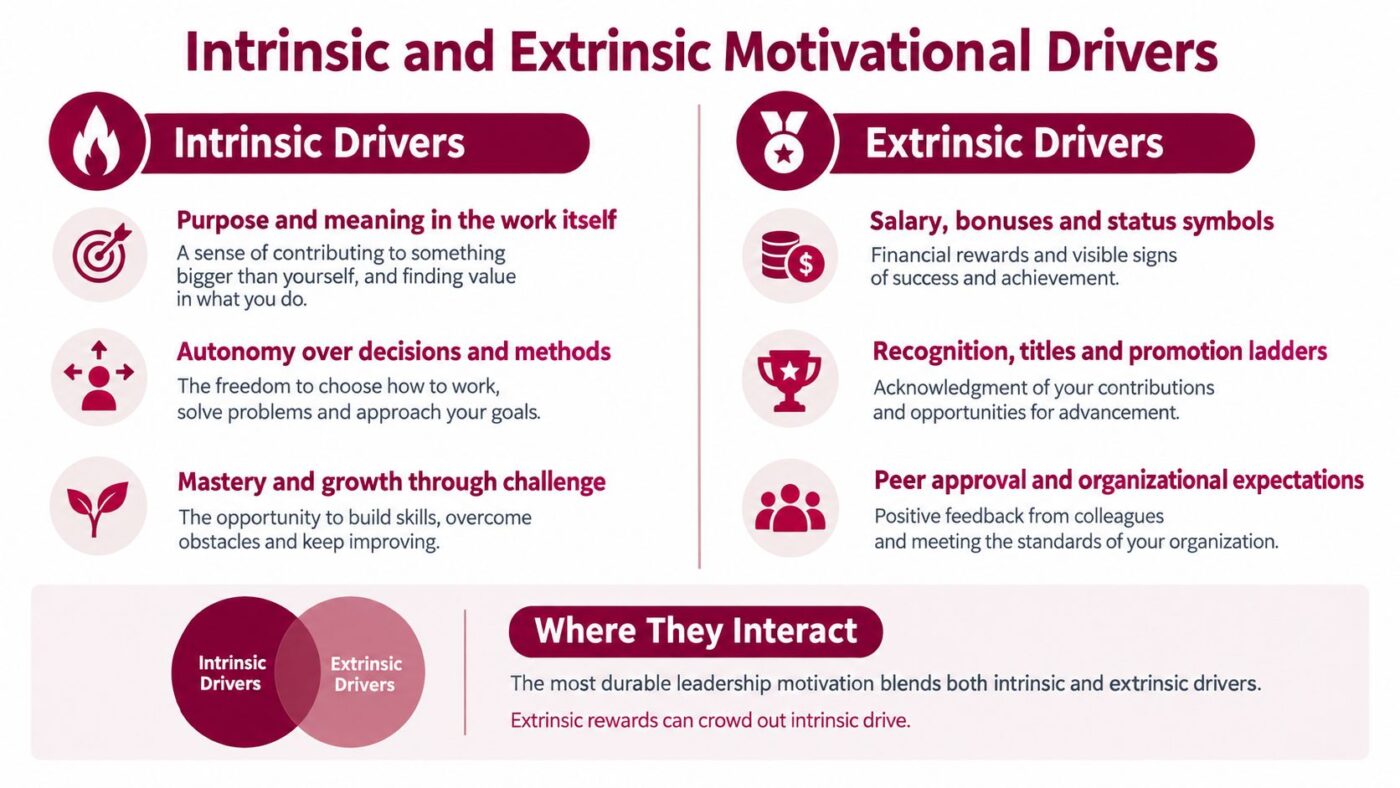
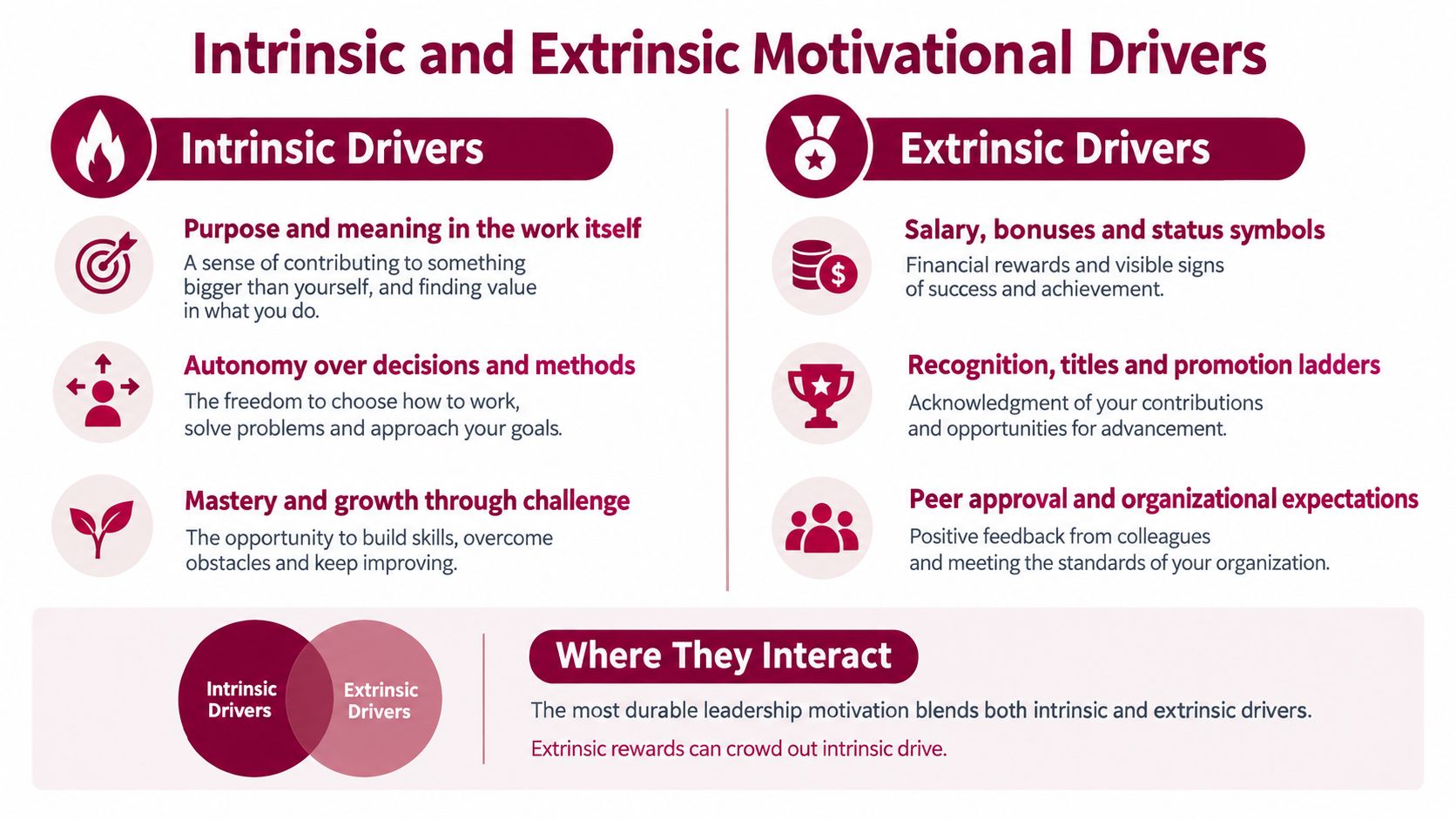
Intrinsic motivation comes from the value a person finds in the work itself. A leader may want to solve difficult problems, develop other people, exercise judgement or contribute to a purpose that has clear significance. Extrinsic motivation comes from conditions surrounding the work, including pay, promotion, formal status, recognition and the expectations attached to a position.
These drivers should be assessed together. Fair rewards and reasonable employment conditions establish whether leadership is a credible employment proposition. Meaningful work, autonomy and the opportunity to become more capable determine whether the role remains engaging after its initial status has faded. The UK Motivational Maps analysis cited earlier supports this distinction qualitatively. The relatively weak appeal of directing others suggests that leadership aspiration cannot be explained by ambition alone. People also assess whether managerial responsibility offers enough meaning and development to justify its costs.
Why authority loses force
Formal authority provides permission to allocate resources, set priorities and make decisions. It does not, by itself, give those activities meaning. A title becomes administratively thin when a manager cannot see whom the work serves, what outcomes it improves or how much discretion the role genuinely permits.
Intrinsic drivers are tied to the quality of the leadership experience:
| Driver | What it contributes | What organisations must provide |
|---|---|---|
| Purpose | A reason to persist beyond immediate tasks | A clear connection between decisions, people and outcomes |
| Autonomy | Ownership of methods and judgements | Appropriate decision rights and room to act |
| Mastery | Satisfaction from developing capability | Challenging work, feedback and structured learning |
| Recognition | Social confirmation that contribution matters | Specific, credible acknowledgement rather than symbolic praise |
Extrinsic rewards still have a legitimate function. Pay and promotion signal how the organisation values additional responsibility, while recognition can reinforce a contribution that might otherwise remain invisible. Their effect depends on the role's design. A bonus cannot compensate for absent decision rights, and a title cannot create confidence when the organisation provides no opportunity to develop judgement.
Practical rule: Use external rewards to make leadership fair and credible. Use purpose, autonomy and growth to make it worth doing.
A useful diagnostic asks what would remain if the title disappeared. Would the manager still value the decisions, the contribution and the opportunity to develop? A negative answer indicates that the organisation may be relying on status symbols to sustain a role whose underlying conditions offer too little meaning. That is a design problem, not proof of insufficient ambition.
The same test applies to leadership education. Someone comparing foundational options such as Leadership Fundamentals should examine whether the learning addresses judgement, relationships and responsibility in actual managerial work. A course centred mainly on authority may reproduce the same narrow view that makes leadership unattractive.
The interaction between the two
Intrinsic and extrinsic drivers interact through interpretation. An external reward can affirm competence, protect fairness and make additional responsibility sustainable. It can also weaken internal commitment if leaders conclude that the organisation values only visible outputs, competition or compliance.
A viable arrangement combines fair compensation, a credible route to progression, a clear understanding of who benefits from the work and enough discretion to exercise judgement while building capability. Remove one element and motivation becomes less stable. Remove several, and the role depends increasingly on personal sacrifice, which makes leadership aspiration a poor substitute for institutional support.
The Impact of Learning and Development Deficits
Leadership motivation depends partly on whether people believe they can succeed in the role. That belief isn't created by optimism alone. It develops when an organisation provides structured learning, practice, feedback and access to people who can help a new manager interpret difficult situations.
The UK leadership development survey of 1,008 employees and 500 HR decision makers shows a substantial institutional gap. 84% of HR decision makers reported barriers to providing learning and development for leaders, 69% of HR leaders judged their leadership L&D offering inadequate, and 23% said they provided no L&D at all to new leaders, according to People Management's report on the survey.
Capability and confidence
These figures change the interpretation of leadership reluctance. If a new manager receives little or no structured development, hesitation is not just a motivational deficit. It may be an accurate assessment of risk. The organisation asks someone to manage conflict, performance, priorities and relationships while withholding the learning infrastructure needed to perform those activities with confidence.
Employees recognise this gap. In the same research, 72% believed employers could do more to support progression into leadership, rising to 83% among those under 35. The data indicate a structural mismatch: employees can want progression while doubting that the organisation will help them become ready for it.
This produces a self-reinforcing cycle:
- Few development routes make leadership appear unattainable.
- Perceived difficulty reduces applications and informal preparation.
- Thin pipelines increase pressure on those who do accept promotion.
- Visible strain confirms the original perception that management is undesirable.
Breaking that cycle requires more than a course catalogue. Development must connect to actual leadership decisions. A useful pathway gives prospective managers opportunities to practise delegation, feedback, conflict resolution, prioritisation and strategic communication, then reflect on the results.
The employer's responsibility
The employer also has to make development visible. Employees can't value a progression route they can't see, and they can't trust a promise that has no time allocation, assessment or managerial sponsorship. L&D becomes motivational when it changes the expected experience of leadership, not when it exists as an isolated benefit.
For individuals seeking a structured route, The Credential of Leadership and Management is described as an eight-course, CPD-accredited pathway covering areas including leadership fundamentals, strategic direction, decision-making, emotional intelligence, conflict resolution, change, communication and team management. Its relevance to motivation lies in the relationship between competence and perceived cost. Better preparation doesn't remove structural problems, but it can make responsibility more intelligible and manageable.
The broader lesson is that organisations shouldn't ask whether an employee is motivated enough to lead before asking whether the organisation has made leadership learnable. A role becomes more attractive when people can see how to enter it, develop within it and recover from inevitable mistakes.
Operational Conditions for Sustained Engagement
Leadership vision has limited motivational power when managers lack time to coach, make decisions or recover from pressure. UK engagement evidence indicates that employees respond when senior leaders and line managers give people issues sustained attention in strategic and daily decisions. The NTU Employee Engagement Survey found engagement was 14 percentage points above the national average in organisations where both leadership levels gave those issues that priority, as reported in the NTU survey analysis.
The finding points to an operating mechanism. Senior leaders establish the strategic narrative and demonstrate organisational integrity. Line managers convert that narrative into priorities, support, employee voice and everyday decisions, as explored in emotional intelligence in leadership: driving team motivation and trust. Motivation strengthens when these layers reinforce the same expectations rather than creating conflicting signals.
The frontline reality
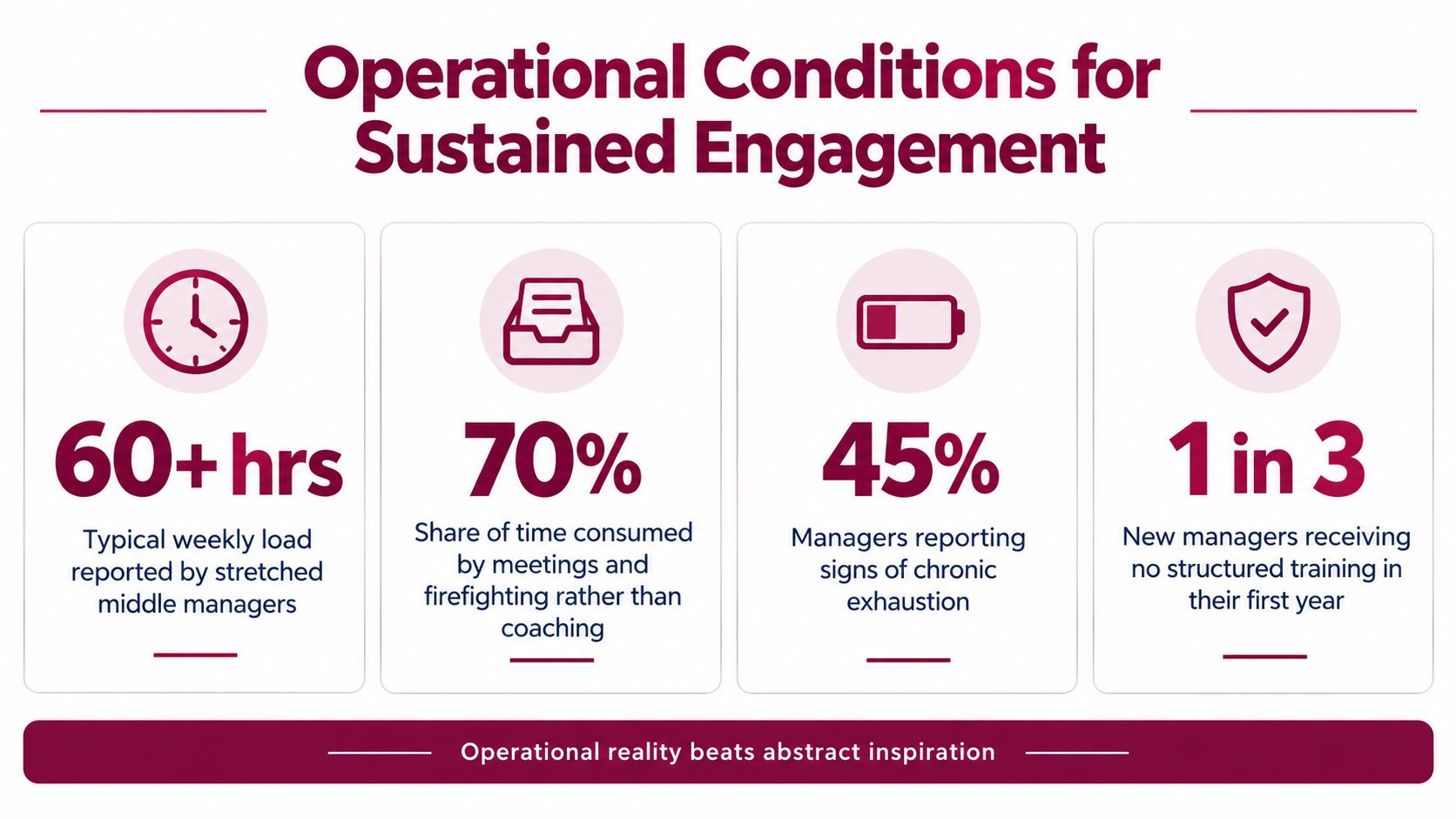
The UK engagement situation reflects more than weak inspirational communication. In 2025, employee engagement fell to 65% in the UK, while only 56% of employees said senior leaders made the effort to listen and 58% said leaders provided a clear vision, according to the UK leadership and engagement analysis. The same source reports that 53% of managers were burned out, 35% were considering leaving because of disengagement, and only 14% said their organisations consistently provided effective engagement tools.
These figures make time and practical support direct motivational variables. A manager expected to support staff but occupied by meetings and firefighting cannot consistently enact the organisation's stated values. That credibility gap reduces the manager's motivation and weakens the team's trust.
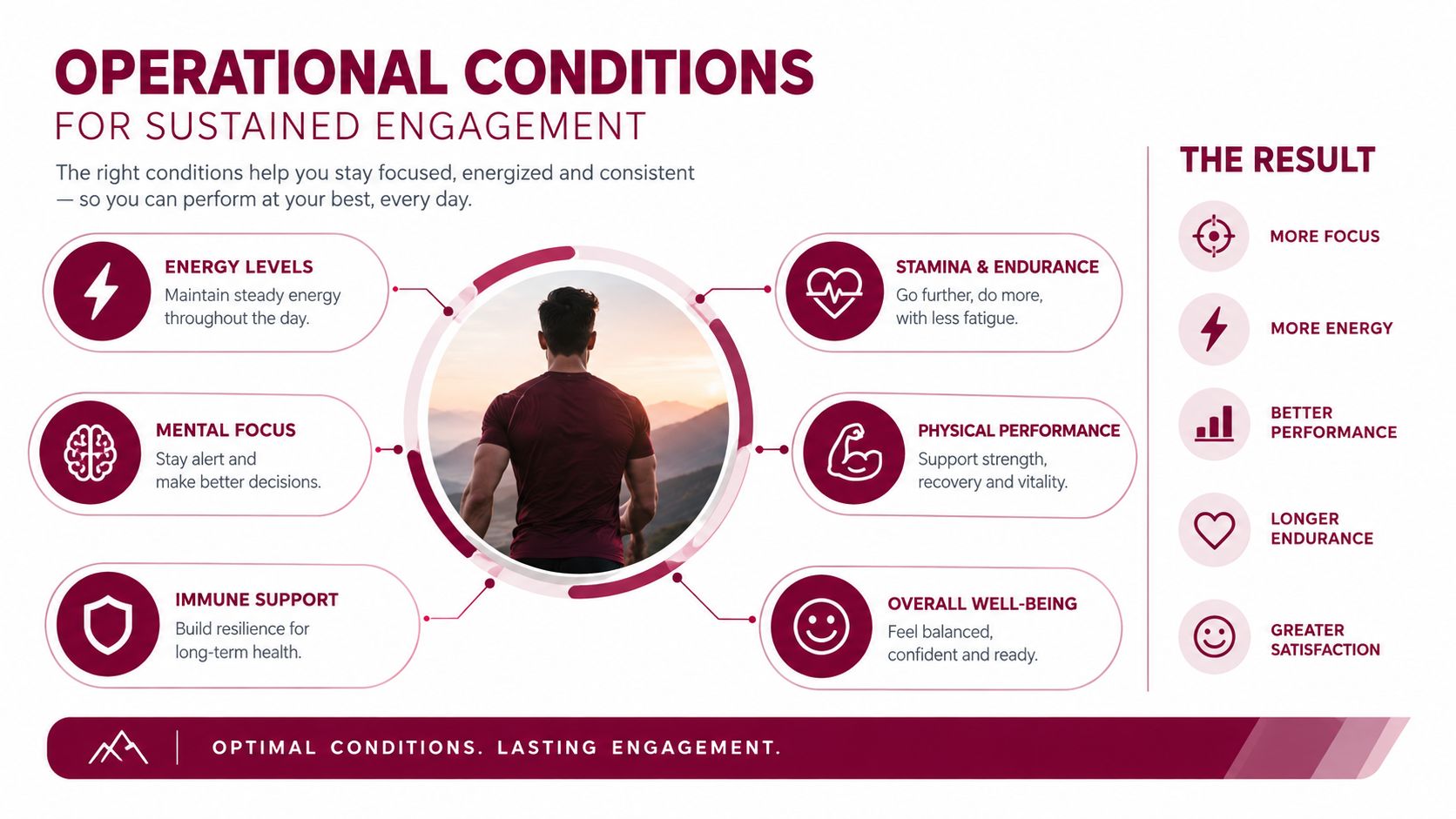
The UK employee motivation guidance, drawing on CIPD engagement evidence, reports that around half of workers feel enthusiastic and immersed in their roles, while only about one third feel full of energy at work. It also records that about one-fifth feel exhausted or under excessive pressure, and roughly 15% feel lonely, miserable or bored. The UK employee motivation guidance therefore supports a dual responsibility for leaders: stimulate meaningful effort and reduce the conditions that drain it.
Four operational tests
A practical review of leadership infrastructure should ask four questions:
- Time: Does the manager have protected capacity for one-to-one conversations, planning and development?
- Training: Has the organisation prepared the manager for the role's interpersonal and technical demands?
- Accountability: Are expectations clear, with authority and resources matched to responsibility?
- Dialogue: Can employees raise concerns and influence decisions through regular two-way communication?
The CMI evidence links these conditions with organisational outcomes. Organisations investing in management and leadership development programmes see an average 23% increase in organisational performance and 32% increase in employee engagement and productivity. Workers with good managers report 74% job satisfaction and 77% motivation, while 50% of employees who rate a manager ineffective plan to leave within 12 months, compared with 21% who rate managers effective. These figures come from the Chartered Management Institute's good management report.
Operational test: If an organisation wants better leadership, it must measure whether managers have the conditions required to lead, not merely whether they can repeat the vision.
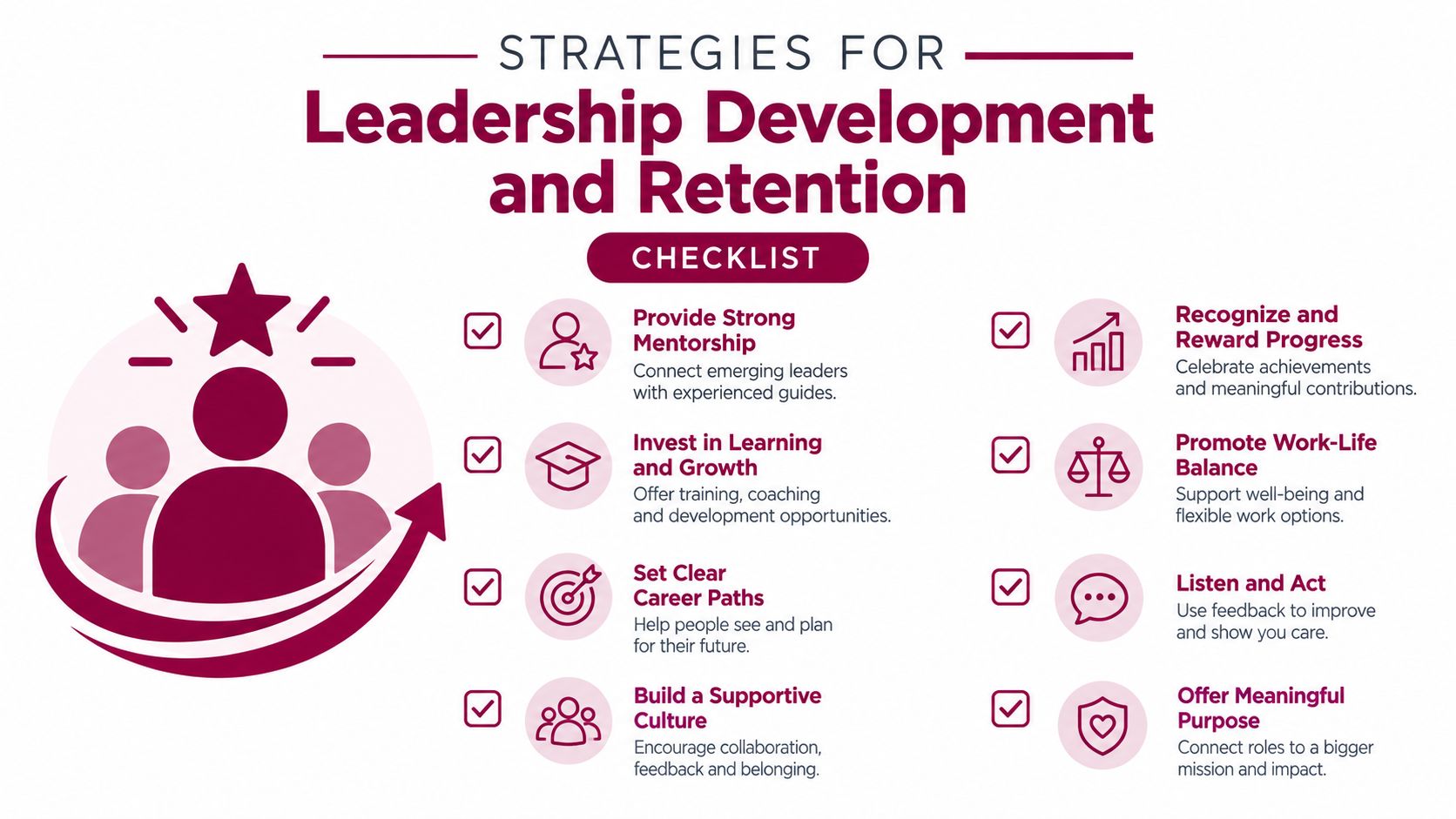
Strategies for Leadership Development and Retention
Leadership development rarely fails because employees lack ambition. It fails when the organisation presents management as a costly promotion, with heavier workloads, limited authority and uncertain support. A credible retention strategy must therefore redesign the route into leadership, not merely encourage individuals to accept its existing demands.
For organisations
Begin by examining the entry point. Ask employees what makes leadership unattractive, then distinguish role defects from the legitimate responsibilities of management. If reporting consumes time without improving decisions, remove low-value administration. If availability expectations undermine personal commitments, clarify how responsiveness is defined, monitored and rewarded. These changes address the perceived cost of leadership directly.
Progression should function as a developmental process rather than a reward granted after informal observation:
- Define readiness: Describe the behaviours, judgements and decisions expected before appointment, using criteria that employees can understand and discuss.
- Create practice opportunities: Let potential managers lead projects, facilitate discussions or mentor colleagues, with access to feedback and an appropriate level of oversight.
- Provide structured learning: Combine formal development with coaching, reflection and feedback from experienced managers. Leadership training course information can help organisations compare structured learning options, although the programme should match the role and its development needs.
- Review the role after appointment: Test whether the actual workload, authority and support correspond with the expectations described before promotion.
- Track retention signals: Monitor employee voice, manager confidence, absence, internal progression and stated intention to leave. These indicators show whether a leadership pathway is functioning in practice.
Training has greater value when the job permits managers to apply what they learn. The management and leadership development findings cited earlier support investment, but they should not be treated as proof that courses alone resolve weak role design. An organisation can provide high-quality instruction and still lose managers if learning is added to an already excessive workload.
For individuals
Prospective leaders should assess organisational infrastructure before accepting management responsibility. Ask who owns development, how decisions are escalated, which duties will be removed from the existing workload and how success will be judged. The answers reveal whether leadership is treated as a supported profession or as an additional layer of responsibility.
Current managers can build an intrinsic motivation portfolio:
- Purpose: Identify the people, customers or public outcomes that benefit from the team's work.
- Autonomy: Record decisions that require unnecessary approval and raise them as questions of role design.
- Mastery: Select a capability, such as feedback, conflict resolution or delegation, and seek evidence of improvement.
- Recovery: Treat energy and workload as conditions for reliable performance, rather than as personal weaknesses.
Development should connect directly to these applications. A structured, self-paced programme may help a manager organise learning around professional commitments, while assessment and verifiable completion can provide evidence of progress. The appropriate choice depends on the learner's role, development gap and available organisational support.
Retention becomes more plausible when leaders can see competence growing without the job becoming unsustainable. The objective is not permanent enthusiasm. It is a role with enough meaning, agency and progress to withstand ordinary periods of pressure.
Aligning Individual Purpose with Organisational Infrastructure
The evidence supports a clear conclusion: leadership motivation is a systemic outcome. Individual purpose matters, but purpose can't compensate indefinitely for an organisation that withholds training, overloads managers or assigns accountability without authority.
The most persuasive motivational design aligns four elements. Leaders need meaningful goals, discretion over appropriate decisions, opportunities to develop mastery and external rewards that make responsibility fair. Organisations need visible progression routes, protected managerial time, effective learning and development, employee voice and senior behaviour that matches the stated strategy.
This alignment also changes how employers interpret reluctance. A professional who rejects management may not lack ambition. They may be responding to a role whose economic and psychological costs are too high. Redesigning that role can improve the leadership pipeline more effectively than persuading individuals to tolerate conditions that experienced managers already find unsustainable.
In practical terms, organisations should ask whether leadership is worth taking, learnable and sustainable. Individuals should ask whether a prospective role offers purpose and autonomy, or merely a title attached to unresolved organisational problems. The strongest answer will combine both perspectives, turning motivation from a personal demand into a shared design responsibility.
London School of Business Administration offers online, self-paced, CPD-accredited courses and structured programmes across leadership and management, with recorded lectures, learning materials and assessments. Explore the London School of Business Administration to compare learning routes that can help connect leadership purpose with structured capability development.