


A finance director presents two options to a UK manufacturer's board. Relocating production could improve the margin, but it would weaken a local employment base. A community loyalty programme would support relationships and morale, yet its financial return would be less immediate. The decision looks simple only if the board counts one kind of value.
That is the problem triple bottom line theory addresses. It asks leaders to assess people, planet and profit together, not as separate charitable concerns but as connected dimensions of organisational performance. The practical challenge is harder than adopting three memorable words. Managers must decide what to measure, who owns the data, how trade-offs are recorded and whether the board gives social and environmental outcomes the same governance attention as financial results.
Table of Contents
- Why Profit Alone Is No Longer Enough
- The British Origins of Triple Bottom Line Theory
- The Three Dimensions of People, Planet and Profit
- How Businesses Measure the Triple Bottom Line
- Triple Bottom Line in UK Law and Reporting
- Trade-Offs When People, Planet and Profit Collide
- Applying Triple Bottom Line Theory as a Leader
Why Profit Alone Is No Longer Enough
A profit-only decision may select the relocation because its benefits appear in the next management accounts. Yet the same decision can create costs elsewhere: experienced employees may leave, local suppliers may lose demand, recruitment may become harder and the company may face criticism from customers or lenders. Those effects aren't sentimental additions to the analysis. They can affect productivity, reputation, financing discussions and future operating resilience.
Profit also fails to price externalities adequately. Pollution, unsafe working conditions and community disruption may not appear on the invoice that authorises a project, but they still impose costs on people beyond the transaction. A board that ignores them can report a healthy result while transferring risk to employees, communities or future operations.
The business consequences of hidden costs
People-related performance reaches the profit and loss account through practical channels. Employee disengagement can increase absence and turnover. Weak supplier oversight can expose a business to interruptions, labour disputes or reputational damage. Environmental inefficiency can increase exposure to energy costs, resource constraints and changing regulatory expectations.
The reverse is also true. A company that retains skilled workers, manages suppliers responsibly and reduces waste may strengthen its operating base. The result isn't guaranteed, and triple bottom line theory doesn't promise that every responsible action produces an immediate financial gain. It does insist that management identifies the effects rather than excluding them because they are difficult to measure.
A useful introduction to this broader view appears in guidance on sustainability in business, where sustainability is treated as part of business decision-making rather than as a communications exercise.
From a single result to a fuller account
The three Ps provide a disciplined correction to narrow reporting:
- People: How the organisation affects employees, suppliers, customers and communities.
- Planet: How operations affect emissions, resources, ecosystems and waste.
- Profit: Whether the organisation remains financially viable and resilient.
This isn't an argument for abandoning commercial discipline. Profit funds investment, wages, innovation and continuity. The argument is that profit should be assessed alongside the conditions that make it durable. A board that measures only financial return can select a project that looks efficient today but weakens the organisation's ability to operate tomorrow.
Triple bottom line theory therefore begins as a measurement question. What has the business created, consumed or damaged, and which of those effects has the conventional accounts failed to show?
The British Origins of Triple Bottom Line Theory
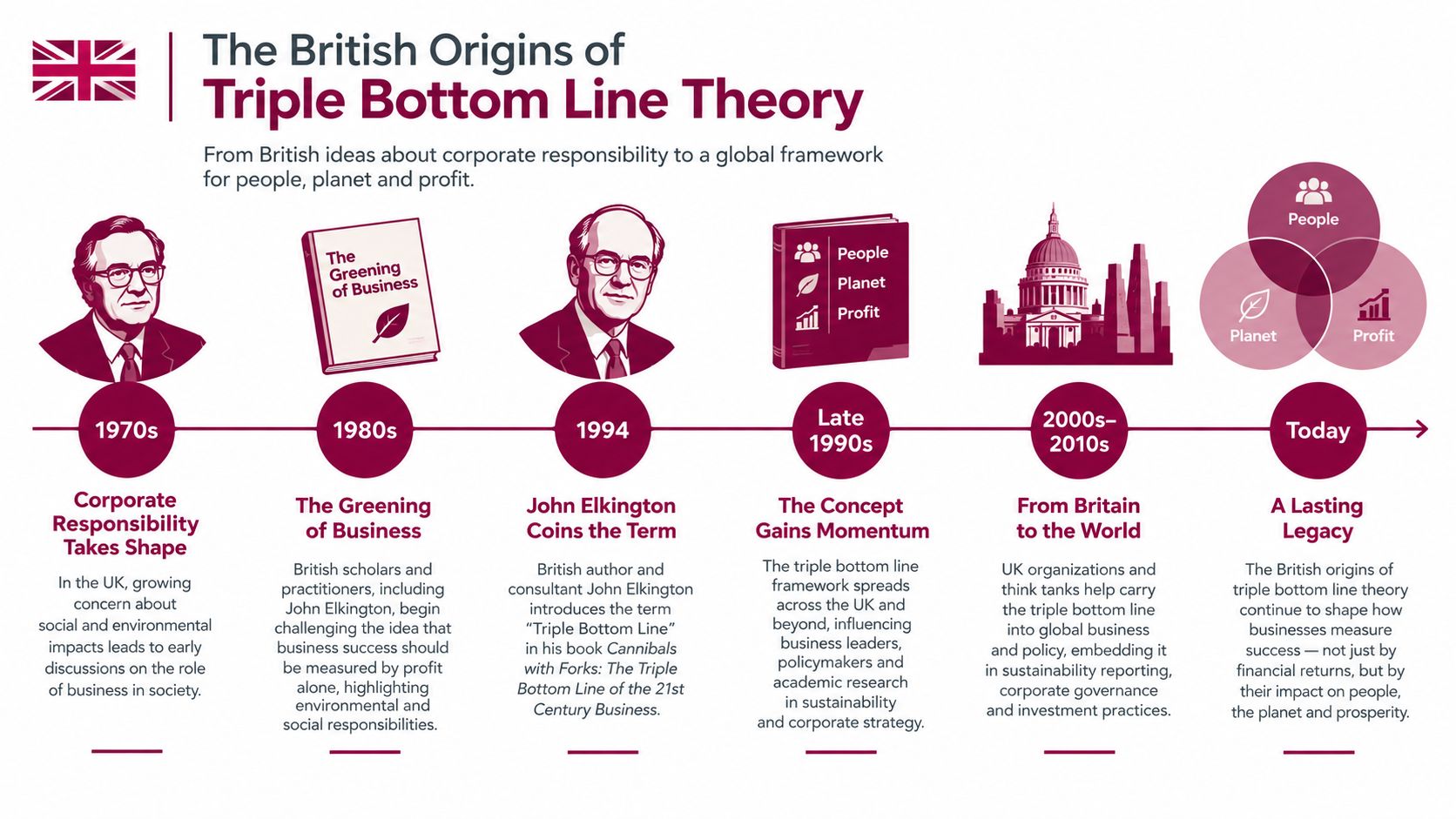
The framework emerged from a British sustainability debate that was gaining momentum during the 1980s and early 1990s. Businesses, policymakers and civil-society organisations were increasingly questioning whether financial return alone could describe responsible corporate performance. The debate was shaped by environmental concern, social accountability and a growing interest in sustainable development.
British businessman John Elkington coined the term triple bottom line in 1994. He founded the UK-based consultancy SustainAbility, and later developed the concept into a fuller framework in his 1997 book, Cannibals with Forks: The Triple Bottom Line of 21st Century Business according to Robeco's account of the theory's development. The phrase was deliberately provocative. A conventional bottom line suggested a single final test, while Elkington proposed three measurable dimensions, profit, people and planet.
From sustainability thinking to measurement
The importance of the idea lies in its accounting implication. A company shouldn't describe itself as successful solely because it generated financial returns if it also caused serious social or environmental harm. TBL reframed performance as a wider assessment of what the organisation produces and what it consumes.
The framework later travelled beyond corporate language. The UK Office for National Statistics launched its National Wellbeing Programme in 2010, building on earlier work from 2007 that used existing datasets to measure societal wellbeing. A European Commission document on UK wellbeing grouped the framework into economy, social, and environment and sustainability, and described the triple bottom line as part of the accepted statistics used to understand and monitor national wellbeing in its discussion of UK wellbeing measurement.
Why the origin matters to UK managers
This history explains why TBL isn't merely an imported corporate slogan. It grew from Anglo-European arguments about sustainable development, public wellbeing and the responsibilities of business. Its central challenge was practical: could organisations measure social and environmental consequences with enough discipline to place them alongside financial results?
That question remains unresolved in many boardrooms. The theory's British roots matter because the UK has repeatedly translated broad sustainability ideas into governance, public measurement and reporting expectations. The movement from a business concept to national measurement practice shows that TBL can shape institutions, not just company values.
The Three Dimensions of People, Planet and Profit
The three Ps work best when managers treat them as interdependent performance lenses. People affects productivity and licence to operate. Planet affects resources, compliance and operational continuity. Profit provides the financial capacity to maintain the organisation and fund improvements.
A practical definition of each P
People covers the human consequences of business activity. A UK operations director might monitor pay distribution, workforce diversity, health and safety, employee retention, supplier fair pay and community effects. The exact indicators depend on the organisation's material impacts. A manufacturer with a large contracted workforce may need stronger supplier labour controls than a professional services firm with a small physical footprint.
Planet covers the organisation's environmental footprint and dependence on natural systems. Relevant measures can include Scope 1, 2 and 3 emissions, energy and water use, waste, biodiversity effects and the movement towards circular material flows. Scope 1 concerns direct operational emissions, Scope 2 purchased energy and Scope 3 value-chain emissions. Managers should define the boundary clearly, otherwise a falling operational footprint may conceal rising supply-chain impact.
Profit extends beyond the current margin. It includes return on invested capital, cash generation, tax contribution, financial resilience and the ability to fund future operations. A decision that improves this quarter's margin while increasing supply disruption or regulatory exposure may not represent strong economic performance over a longer horizon.
Comparing the Three Ps of Triple Bottom Line
| Dimension | Core Objective | Key UK Metrics | Example Indicator |
|---|---|---|---|
| People | Support fair, safe and productive relationships | Pay, diversity, safety, retention, supplier standards, community impact | Lost-time incidents or supplier fair-pay coverage |
| Planet | Reduce environmental harm and resource dependence | Scope 1, 2 and 3 emissions, water, waste, biodiversity, material flows | Emissions intensity per unit of output |
| Profit | Maintain viability and build durable economic value | Margin, return on invested capital, cash flow, tax contribution, resilience | Return on invested capital after a major efficiency investment |
The table should not be read as three isolated scorecards. A supplier decision can affect all three dimensions at once. Paying suppliers fairly may raise direct costs, improve labour stability and reduce disruption. Redesigning packaging may require investment, reduce material dependence and alter customer demand.
Practical rule: Every major proposal should state its expected effect on all three Ps, even when one effect is difficult to quantify.
Managers developing the organisational judgement to assess these connections may encounter related subject matter in Leadership and Organisational Behaviour. The relevant capability is not memorising the model. It is learning to ask better questions about incentives, behaviour and consequences.
How Businesses Measure the Triple Bottom Line
TBL becomes credible when a board can trace an outcome from definition to data owner, calculation method and decision. The measurement system doesn't need to turn every social or environmental effect into money. It does need consistent boundaries, reliable evidence and clear accountability.
Start with a measurement architecture
A practical sequence begins with material impacts. The organisation identifies the issues that could significantly affect people, planet or economic viability, then selects indicators that managers can collect repeatedly. Possible measures include Scope 1 to 3 emissions, employee engagement indices, supplier audit pass rates and community investment ratios.
The board should separate leading indicators from lagging outcomes. Training completion, supplier assessments and energy-efficiency projects are activities. Emissions, safety incidents, retention and financial returns are outcomes. Activity data can show whether a plan is being implemented, but it can't prove that the plan produced the intended result.
Deloitte's People-Planet-Profit index illustrates one way to create a common benchmarking architecture. It assessed 92 companies across 5,500 data points, scoring each firm on a 0–100 scale for people, planet and profit, with a maximum composite score of 300, as described in its People-Planet-Profit index methodology. The value of such an index is comparability, although a composite score can conceal important differences if executives don't inspect the underlying measures.
A sample operating scorecard
| Pillar | Indicator | Metric example | Reporting frequency |
|---|---|---|---|
| People | Workforce safety | Recordable incidents and corrective actions | Monthly |
| People | Supplier labour standards | Audit findings and remediation status | Quarterly |
| Planet | Emissions | Scope 1, 2 and relevant Scope 3 inventory | Quarterly |
| Planet | Resource efficiency | Energy, water and material use per output unit | Monthly |
| Profit | Economic resilience | Margin, cash generation and return on invested capital | Monthly |
| Profit | Long-term exposure | Approved investment linked to efficiency or resilience | Quarterly |
Integrated reporting can bring these measures into the same strategic narrative as financial results. A board can then assign each measure to an executive, agree a calculation protocol and review performance through an existing committee. Executive remuneration may include TBL targets, but the target must be auditable and balanced. Otherwise, managers may optimise a visible activity while neglecting the outcome.
The ESG factors in finance learning material provides a relevant context for understanding how non-financial information enters financial decisions. Social Return on Investment and natural capital accounting can add useful perspectives, but monetisation involves assumptions. A precise-looking monetary value isn't automatically more truthful than a transparent physical or social indicator.
Triple Bottom Line in UK Law and Reporting
Triple bottom line theory sits close to UK governance, but it isn't itself a statutory reporting regime. Directors must understand the difference between a voluntary management framework, a legal duty and a disclosure requirement.
Section 172 of the Companies Act 2006 requires directors to promote the success of the company for the benefit of members as a whole, while having regard to matters including employees, suppliers, customers, community and environmental impact. That wording creates space for broader boardroom reasoning, but it doesn't remove the need for directors to exercise judgement about the company's long-term success.
Reporting moves from narrative to controls
The current UK reporting direction makes measurement more demanding. The most current UK source identified in the supplied material says the UK Sustainability Reporting Standards were published in late February 2026, with Scope 1 and 2 reporting phased in from 2026–27, Scope 3 from 2027–28, and material sustainability risks from 2028–29 as set out in the UK sustainability reporting stakeholder impact report. These are future reporting phases, so affected businesses should verify the detailed scope, applicability and implementation guidance before treating them as settled obligations for a particular entity.
The governance implication is significant. A company cannot treat people and planet as communications themes while keeping financial KPIs under formal control. Definitions, data ownership, evidence trails and review procedures become necessary if sustainability information is expected to stand beside financial information.
The Better Business Act proposal
The Better Business Act campaign proposes replacing section 172 with a mandatory triple bottom line purpose for all companies. Its proposal for reforming directors' duties presents shareholder returns as one stakeholder interest rather than the overriding purpose.
That proposal isn't the same as current law. Its importance lies in showing how TBL has entered a concrete UK corporate-governance argument. Boards already applying the framework voluntarily should therefore ask whether their decisions would withstand a fuller stakeholder review. A documented decision process, with clear reasons for prioritising one outcome over another, is more reliable than a general statement of purpose.
Trade-Offs When People, Planet and Profit Collide
The three Ps don't always move together. A fashion retailer may raise wages towards a living wage, improving worker welfare and potentially strengthening trust, while facing a near-term cost increase. A food manufacturer may choose recycled packaging, reducing dependence on virgin materials while increasing unit costs and leaving customer response uncertain. A logistics firm may invest in a lower-emission fleet rather than distribute cash to shareholders.
These aren't failures of the framework. They are the situations for which the framework is most useful. A profit-only model hides the choice by making the immediate financial outcome appear complete. TBL forces the decision-maker to describe the social and environmental consequences, the affected stakeholders and the assumptions behind the expected economic return.
Three decision rules for difficult choices
Test reversibility. A reversible pilot can justify a different approach from an irreversible closure or long-term supply contract. Leaders should identify what can be tested, paused or redesigned before committing capital or imposing social costs.
Set a materiality threshold. Not every effect deserves equal board attention. A materiality assessment should consider the scale of the impact, the number of people affected, the environmental sensitivity involved and the likelihood that the issue will affect financial resilience. The threshold mustn't be set so narrowly that only current accounting impacts qualify.
Apply a time-horizon discount carefully. Immediate costs are easier to see than benefits that emerge through retention, resilience or lower environmental exposure. That doesn't mean distant benefits should be inflated to justify any preferred project. It means the business should state the time horizon, test alternative assumptions and avoid allowing quarterly optics to decide a long-lived investment.
Document the choice, not just the result
A sound board paper can include:
- The affected groups: Employees, suppliers, customers, communities, investors and regulators.
- The three outcomes: Expected people, planet and profit effects, with confidence levels.
- The alternatives rejected: Options considered, including the reason for rejection.
- The safeguards: Conditions, milestones and review points that could change the decision.
- The accountability: An executive owner for monitoring the results.
Consider the logistics example. Fleet electrification may reduce environmental impact but compete with dividend distribution and create transition demands for drivers, technicians and infrastructure teams. The appropriate response isn't to declare one P the automatic winner. Leaders should test the investment's reversibility, identify material impacts and explain why the chosen time horizon reflects the organisation's responsibilities and risk exposure.
Applying Triple Bottom Line Theory as a Leader
A board approves a low-carbon investment that protects jobs but reduces near-term returns. The decision exposes the practical challenge of triple bottom line theory: leaders must convert three broad objectives into measures, owners and review points. Without those controls, the framework remains a statement of intent while profit continues to determine behaviour.
A mid-career manager can start with a manageable operating design. Assign one accountable owner to each P, even when several departments provide data. Finance may own economic measures, operations may own environmental information and the people function may own workforce outcomes. Ownership must include authority to act, not just responsibility for preparing a dashboard.
A one-year adoption sequence
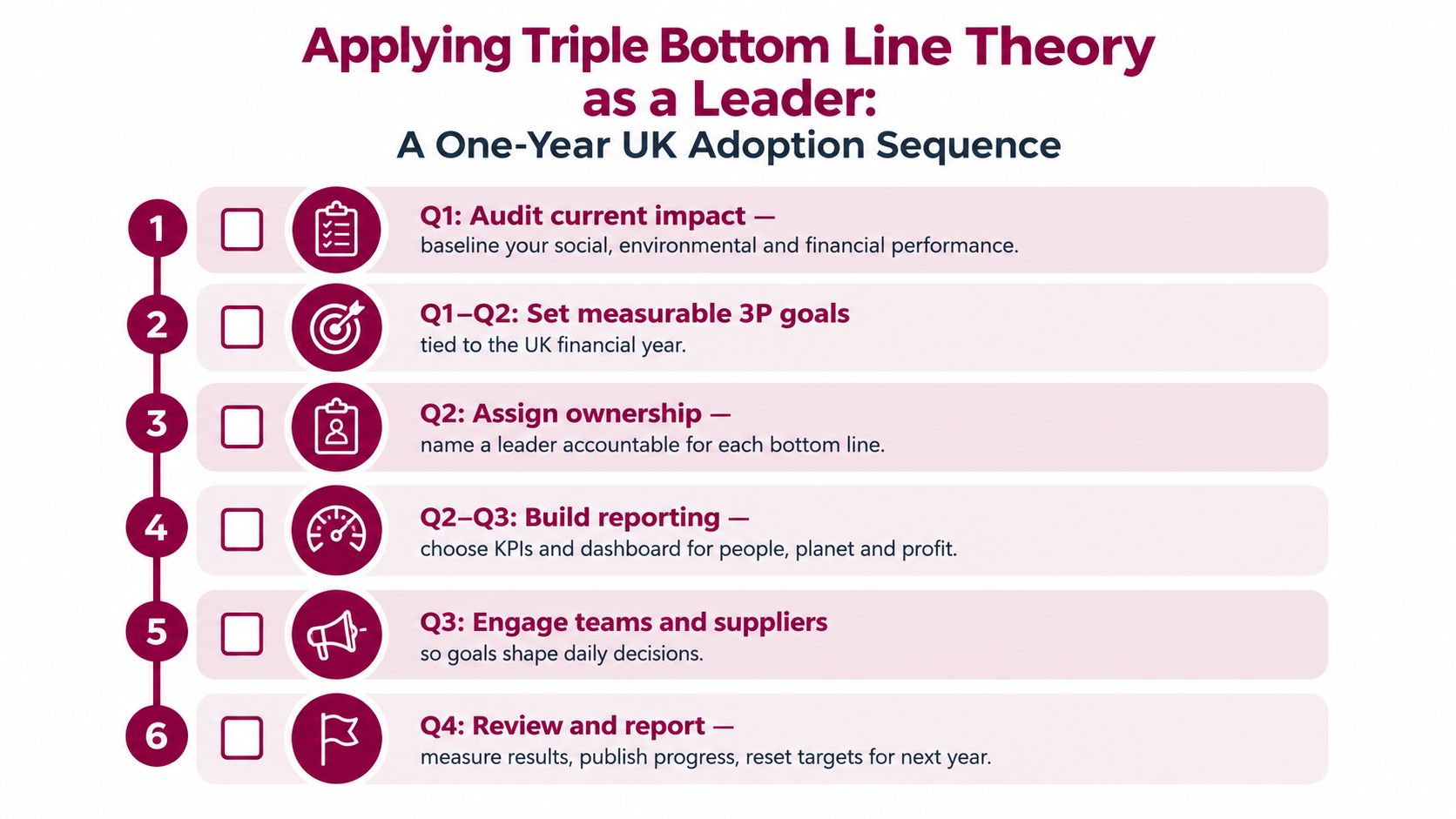
Begin with a baseline quarter. Record the current position using agreed boundaries and definitions. Cover financial performance, workforce and supplier conditions, material use, emissions and relevant community effects. If a measure is unavailable, record the gap rather than inserting an unverified estimate.
Choose a limited KPI set. Select two to four measurable indicators per dimension. Every measure needs a named owner, data source, calculation method and review date. A short list of reliable indicators is easier to interpret than a crowded dashboard.
Align measures with existing duties. Map the indicators to relevant board responsibilities, Companies Act considerations and applicable UK sustainability reporting expectations. This keeps TBL within established governance instead of creating a parallel process.
Change meetings and rewards. A board sub-committee can review the combined scorecard. Capital proposals can present people, planet and profit effects in one approval paper. Executive remuneration may include selected outcomes where targets sit within management influence and rely on auditable data.
The manager's control checklist
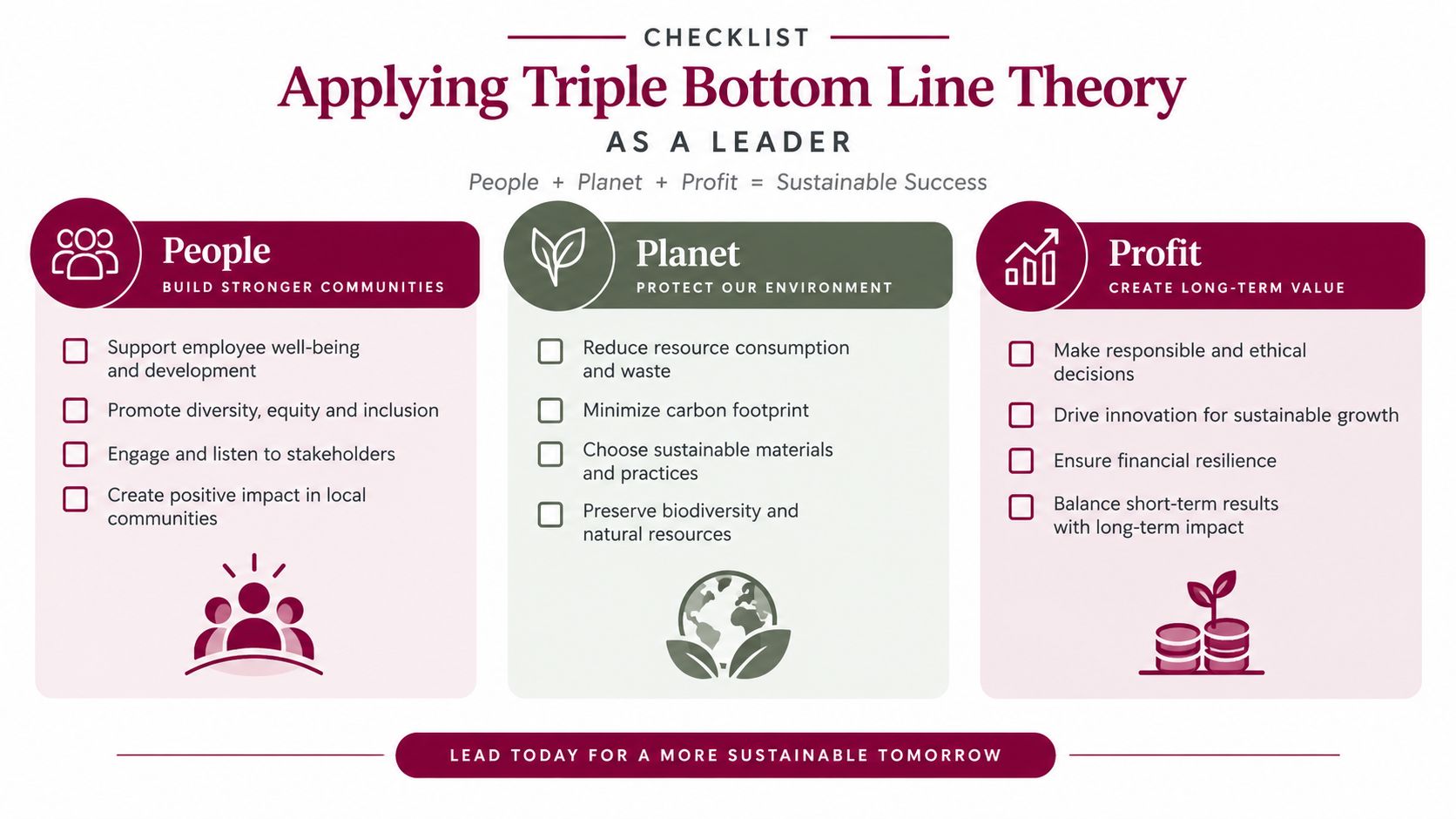
- Baseline audit: Establish what the organisation measures and where evidence is weak.
- KPI selection: Choose balanced indicators that reflect material impacts and financial resilience.
- Accountability mapping: Name owners, approvers and escalation routes for each measure.
- Remuneration linkage: Connect selected outcomes carefully to executive evaluation.
- Quarterly review cadence: Examine results, assumptions, unintended effects and corrective action.
The same discipline applies to community investment and corporate philanthropy. Leaders should define the activity's purpose, identify measurable consequences and place it within governance, rather than treating it as an isolated goodwill project.
Leaders seeking structured development in strategic judgement, ethical leadership and business decision-making can explore online programmes from London School of Business Administration. Its self-paced courses use recorded lectures, learning materials and assessments, while its CPD-accredited leadership pathway offers a structured route for managers seeking formal evidence of capability.
Start with one board-level decision. Rewrite its approval paper around people, planet and profit, assign owners and establish a baseline for the next review. Visit London School of Business Administration to examine flexible business and leadership study options supporting the governance skills needed to turn triple bottom line theory into accountable management.