


Servant leadership is a leader-first-serves-followers philosophy rooted in Greenleaf's work, and the UK evidence base shows it as a cross-sector approach, not a niche idea. In a study of 208 employees, with 109 from private organisations, 81 from public organisations and 18 from non-profit or private organisations such as charities, servant leadership appeared across settings and moderately influenced followers' motivation to serve others.
You're probably dealing with a manager who needs to decide whether to push harder, listen longer, or step back and let the team solve the problem. That tension is where servant leadership becomes practical, because it asks what your people need to do better work, grow more capable and act more responsibly, while keeping outcomes visible and accountable.
Table of Contents
- Understanding Servant Leadership at Its Core
- Origins and the UK Development of the Idea
- Core Principles and How They Show Up Day to Day
- How Servant Leadership Works in UK Practice
- Why Servant Leadership Is Not Just Being Nice
- Comparing Servant Leadership With Related Styles
- Adopting Servant Leadership as a Mid-Career Manager or Entrepreneur
- Measuring Impact and Continuing Your Leadership Development
- Your next step
Understanding Servant Leadership at Its Core
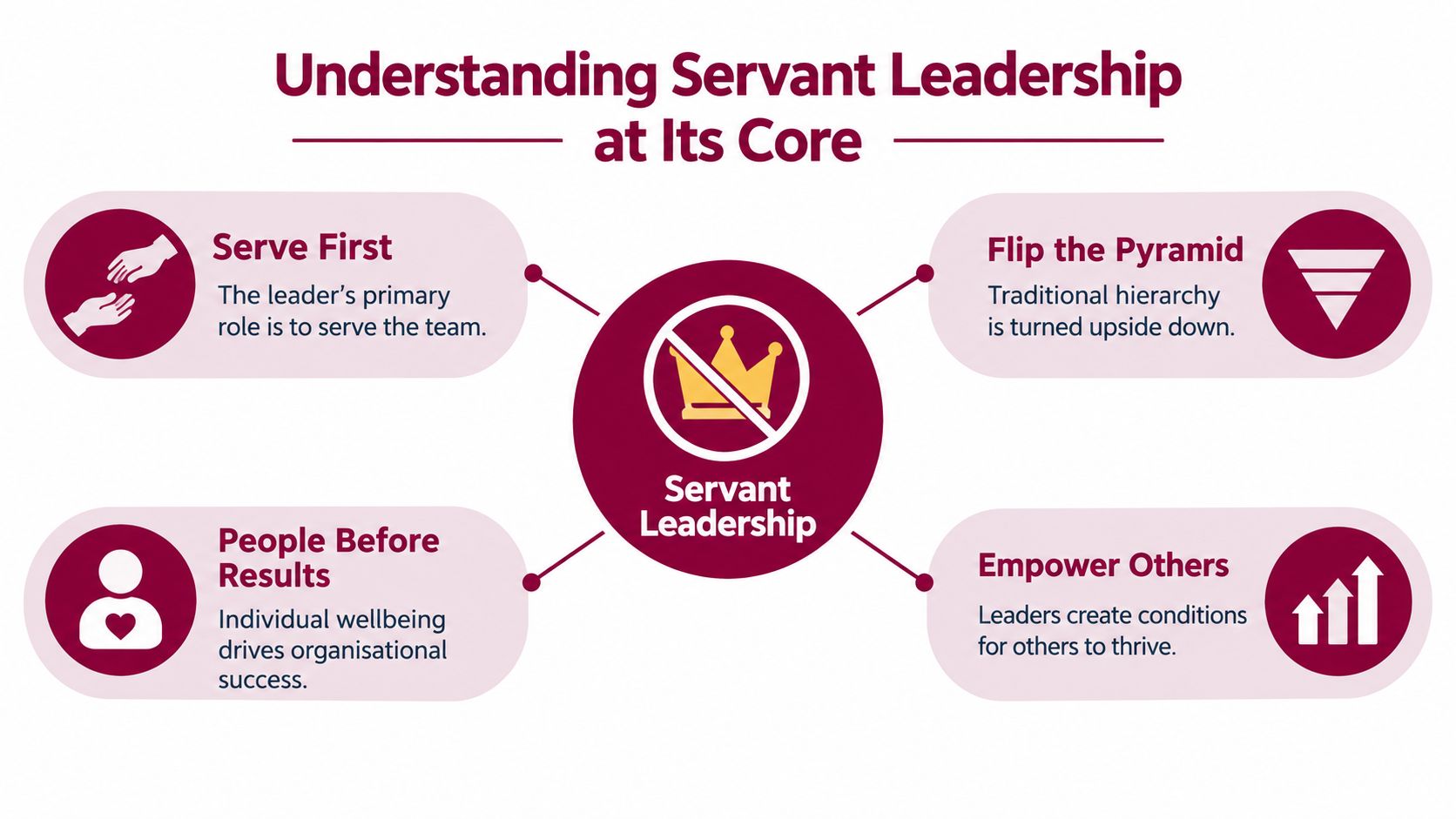
Servant leadership starts with an inversion of the usual authority model. The leader's primary job is not to protect status or maximise control, but to serve followers, ethical principles and the wider organisation, while building capability, autonomy and wellbeing.
A useful way to test the idea is to compare two line managers faced with the same situation. One sees a struggling colleague and reaches for correction, escalation and deadline pressure. The other asks what is blocking the person, what support is missing, what decision rights need to shift and what development would help the colleague improve without lowering standards. That second response is not soft. It is structured service.
What it is and what it is not
Servant leadership is not passivity, appeasement or a promise that everyone gets their own way. It still involves standards, decisions and accountability, but those are exercised in service of other people's growth and the organisation's ethical obligations.
Practical rule: if your approach increases clarity, capability and responsibility, you're moving towards servant leadership. If it mainly avoids friction, you're probably just being cautious.
That distinction matters in UK workplaces because voice, trust and engagement are measurable management concerns, not abstract ideals. When people are heard but never see action, they stop treating consultation seriously. When they see a leader respond, explain and follow through, they are more likely to invest their own effort.
The phrase what is servant leadership style is often treated as if it describes a personality type. It doesn't. It describes a disciplined way of leading in which service comes before status, and development comes before display.
Origins and the UK Development of the Idea
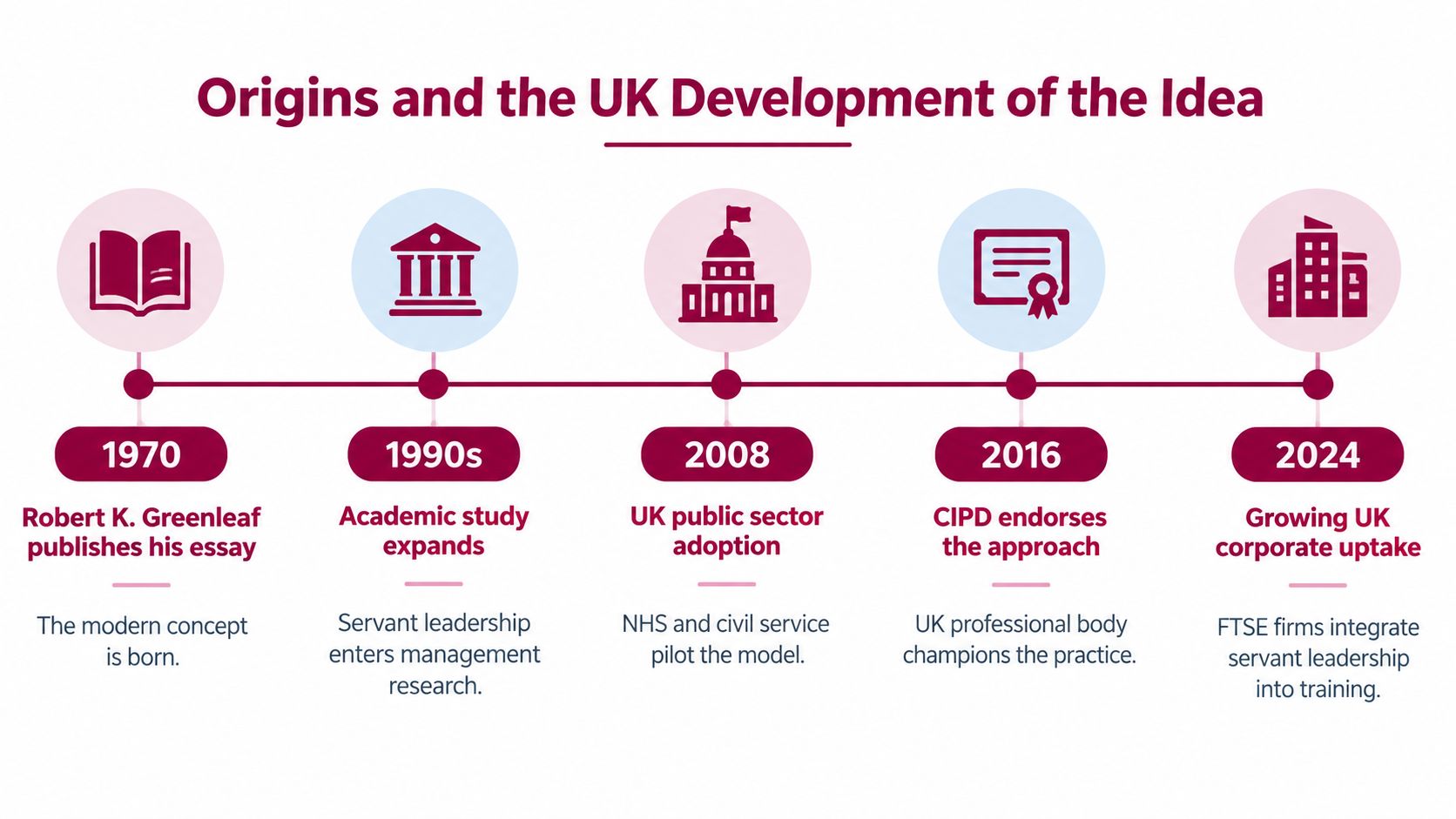
Robert K. Greenleaf's original 1970 essay gave servant leadership its modern shape, but the UK version of the idea gained its own institutional footing later. A key milestone was the 1997 co-founding of the Greenleaf Centre for Servant Leadership United Kingdom by John Noble and Ralph Lewis, which helped give the philosophy a British platform for discussion and development. Greenleaf's wider test still matters, whether people grow healthier, wiser, freer and more likely themselves to become servants.
The historical point is important because it shows that servant leadership was never meant to be a decorative slogan. It was intended as a moral and practical test of whether people are developing under a leader's influence. That criterion maps neatly onto UK concerns about public service quality, healthcare culture and managerial responsibility.
The model's relevance is especially visible in sectors where staff voice and service quality are tightly linked. In UK health and public-service settings, leaders need more than command-and-control habits. They need listening, stewardship and a willingness to build trust in conditions where people are already under pressure.
A useful academic doorway into the subject is Leadership and Organisational Behaviour, which sits naturally beside this topic because servant leadership is really a question of how behaviour shapes organisations.
Why the UK context matters
UK healthcare evidence helps explain why these ideas resonate. In a King's Fund survey from February and March 2014, more than 2,000 NHS managers and clinicians responded. Although 89% said patients were encouraged to give feedback, only 61% believed that feedback would be acted upon. Just 39% felt their organisation was characterised by openness, honesty and challenge, while 28% rated NHS leadership as poor or very poor. Those figures show the gap servant leadership tries to close, by turning listening into response and voice into action.
Core Principles and How They Show Up Day to Day
The classic servant-leadership principles can sound abstract until you tie them to ordinary managerial behaviour. In practice, they're visible in how someone runs one-to-ones, handles dissent, allocates development opportunities and explains difficult decisions.
From principle to behaviour
| Principle | UK Manager Behaviour | Self-Check Prompt |
|---|---|---|
| Listening | Runs regular one-to-ones, asks about blockers and writes down what changed after feedback | Did people see action, not just a hearing? |
| Empathy | Adjusts support when someone is under pressure without lowering expectations | Did I understand the person before judging the work? |
| Stewardship | Treats team resources, time and decision rights as a trust, not a privilege | Am I using authority for the team's benefit? |
| Commitment to growth | Gives coaching, stretch tasks and clear feedback on development | Did I help someone become more capable? |
| Community-building | Encourages collaboration across roles and reduces silo behaviour | Did the team work as a whole, not as isolated individuals? |
Reading the principles in real life
A servant leader doesn't just ask for ideas, they also explain what was accepted, what wasn't and why. That is where fairness enters the picture. The UK study of 208 employees found that servant leadership had a stronger association with an ethic of justice, and that public and private organisations did not differ significantly in servant-leadership scores, with a public-sector mean of 135.74 and a private-sector mean of 131.48. The difference was 4.7 points, with a 95% confidence interval from -2.13 to 10.65, and the effect size was very small, eta squared = 0.009; p = 0.204 (Liverpool University research abstract).
That matters because it shows servant leadership is not confined to one type of UK organisation. It can appear in both public and private settings, but only if the leader behaves in a way people can recognise as fair, developmental and responsible.
Leaders who want to test themselves should ask a simple question, did my behaviour increase other people's clarity, capacity and confidence, or did it only make me feel supportive?
If you want a related lens on how managers turn values into behaviour, the article on the role of emotional intelligence in leadership fits naturally here, because servant leadership depends on self-awareness as much as it depends on intent.
How Servant Leadership Works in UK Practice
The best way to understand the mechanism is to watch a normal week in a team led well. A manager delegates a stretch task instead of hoarding decisions, checks in on workload before problems become visible, and gives a junior colleague the space to learn while still setting clear expectations. That's not a vague kindness. It's a sequence of behaviours that strengthens capability.
The developmental chain
The Aston University research is useful here because it shows the route from leader behaviour to outcome. In a multilevel study of 33 leaders and 86 followers across six organisations, servant leadership was associated with follower wellbeing and leader-rated performance through positive psychological capital. That means behaviours like listening, humility, stewardship and concern for growth can build self-efficacy, optimism, hope and resilience, which then shape how people feel and perform (Aston University research thesis).
This is also why servant leadership can't be treated as a lone personality trait. The same research found that organisational health policies and a developmental team climate affected the strength of the relationship. In other words, values matter, but systems matter too.
What to look for in practice
- Delegated decision rights, because people develop faster when they own real decisions.
- Developmental coaching, because feedback only helps when it changes future action.
- Psychological safety cues, because staff won't raise issues if they expect punishment.
- Ethical stewardship, because support without standards becomes drift.
The point is not that every manager should become a therapist. It's that servant leadership works by creating conditions in which people can use their judgement better. When the workplace environment supports that, the leadership style has a real chance of showing up in performance, retention and wellbeing.
Why Servant Leadership Is Not Just Being Nice
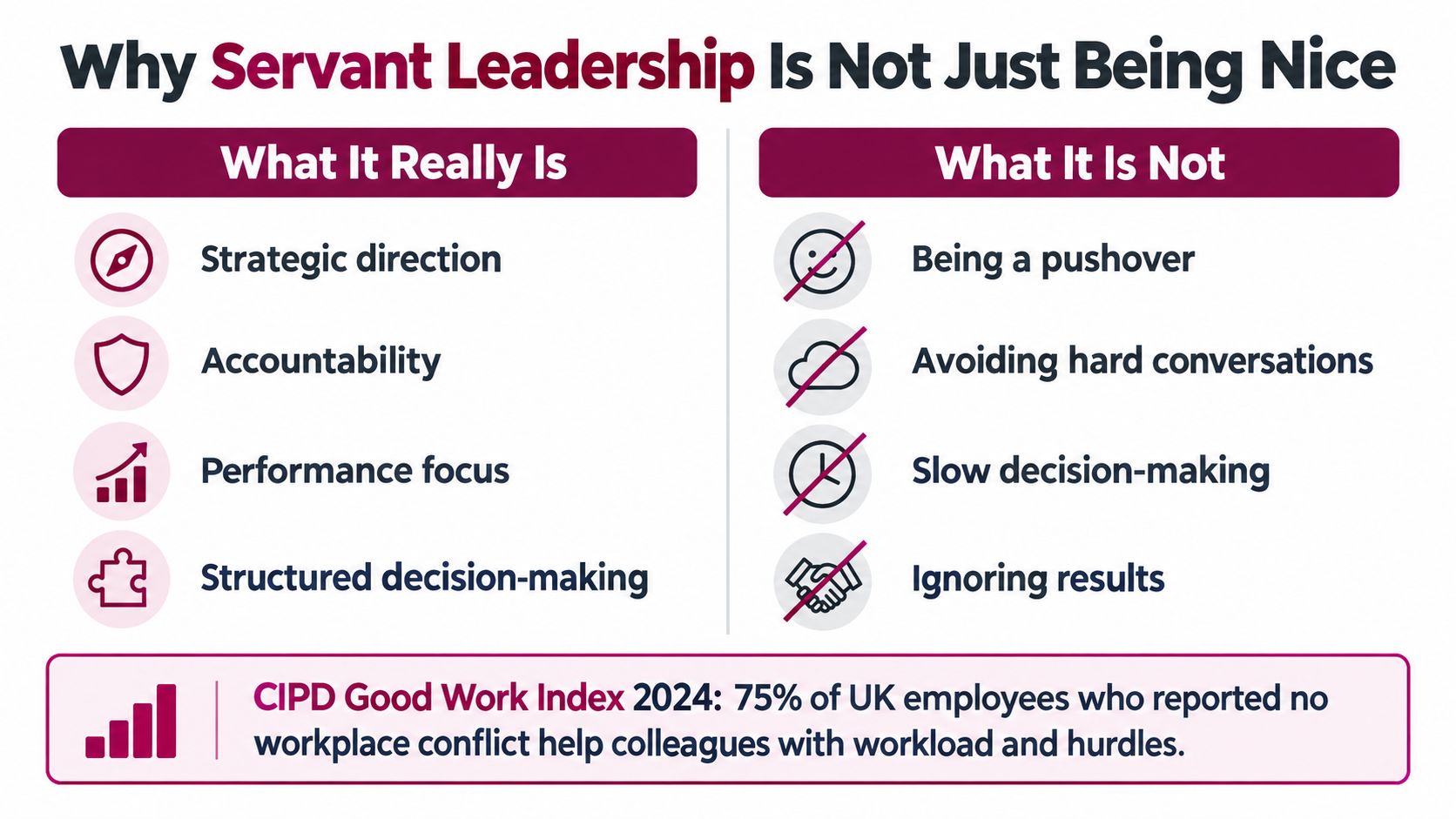
The biggest misunderstanding is that servant leadership means avoiding hard calls. That reading is too shallow, and UK evidence on employee voice makes the problem obvious. In the CIPD Good Work Index 2025, 51% of employees said managers sought their or their representatives' views, but only 37% said managers allowed them to influence final decisions (CIPD Good Work Index 2025).
Consultation is not influence
That gap shows how easily “listening” turns into symbolic consultation. People are asked, but nothing changes. Or they are heard, but never told why the final decision went another way. A servant leader can't leave that loop broken, because the style depends on visible decisiveness and transparent explanation.
What makes the difference is the feedback loop, ask, decide, explain, review. Without that, employee voice becomes performance theatre.
This is especially important for early-career managers and small-business owners. If your authority is unclear, you create role ambiguity, and role ambiguity weakens performance management. Employees need to know that their input mattered, even when it didn't become the final answer.
A practical voice loop looks like this:
- Ask for views early enough to matter.
- Explain the decision, including the constraints.
- Show what evidence was considered.
- Review the outcome later, so people see the effect of the process.
That's not softness. It's disciplined leadership. Real servant leadership can be more decisive than the imitation, because it refuses to hide behind vague consensus.
Comparing Servant Leadership With Related Styles
Servant leadership overlaps with transformational, authentic and ethical leadership, but it's not the same thing. All four care about values and follower development, yet servant leadership is distinct because it reverses the direction of priority. The leader's first responsibility is to serve followers and the wider organisation.
That distinction becomes clearer when you compare the styles by mechanism. Transformational leadership tends to emphasise vision and change. Authentic leadership focuses on self-awareness and alignment between values and action. Ethical leadership centres on norms, fairness and moral conduct. Servant leadership includes all of those concerns, but it starts with the follower's growth and wellbeing as the organising principle.
The meta-analytic evidence matters here because servant leadership showed predictive value beyond the other styles across 130 independent studies (Liverpool meta-analysis). Its effects on individual and team behaviour were partly explained by trust in the leader, procedural justice and leader–member exchange. Those are practical mechanisms, not abstract virtues.
For UK organisations, that means the style shows up in transparent allocation of opportunities, participative decision-making and consistent explanations for decisions. It also means servant leadership should be evaluated at more than one level, because a single engagement score won't tell you whether trust and fairness are improving.
If you only measure sentiment, you miss the operating system underneath it.
Adopting Servant Leadership as a Mid-Career Manager or Entrepreneur
For a manager with limited time, the useful question is not whether the style sounds admirable. It's how to build it into routines without turning it into a slogan. A practical route is to move through diagnosis, training, piloting, embedding and measurement.
A workable adoption sequence
- Diagnose the current pattern. Look for observable behaviours, who speaks in meetings, who makes final calls and whether feedback changes anything.
- Train for specific skills. Listening and developmental coaching are learnable, and they matter more than a polished leadership label.
- Pilot in one team. Try the approach where you can watch the effects on one-to-ones, workload and decision quality.
- Embed it in HR practice. Objective-setting and performance review should reinforce, not contradict, servant behaviours.
- Measure over time. Track what changes in trust, retention, absence and team performance.
The UK evidence on capability building fits this pathway. CIPD data show that organisations training managers in mental-health support are more likely to feel confident holding sensitive conversations and signposting employees to help, with 73% expressing that confidence compared with 57% in organisations without such training, a difference of 16 percentage points (CIPD wellbeing infographic 2025). The Aston study also found that training improved perceptions and application of servant leadership.
For readers who want a structured course route, Management and Leadership is a natural fit, because servant leadership only becomes stable when it's linked to practice, not just belief.
Measuring Impact and Continuing Your Leadership Development
A servant-leadership dashboard should go beyond whether people say their manager is “good.” Track follower ratings of servant-leadership behaviours, trust, perceived fairness, the quality of manager relationships, discretionary effort, and objective measures such as absence and retention.
That mix matters because leadership works through a chain of effects. The manager's behaviour shapes daily experience, daily experience shapes what people do, and those actions shape team outcomes. A pleasant reputation on its own can hide weak capability or uneven decision-making.
UK evidence helps set realistic expectations. The cross-sector study found no statistically significant difference in servant-leadership scores between public and private organisations, which shows that results depend on how the approach is used, not on sector alone.
Wellbeing data point in the same direction. The CIPD 2023 Health and Wellbeing at Work survey reported average sickness absence of 7.8 days per employee, equal to 3.4% of working time lost, while 70% of organisations saw wellbeing activity as an engagement opportunity and 59% saw it as a retention strategy (CIPD Health and Wellbeing at Work 2023). These figures show why servant leadership matters, but they also show its limits if workload, staffing, or policy remain unchanged.
To continue building these capabilities, explore leadership training courses and connect your dashboard measures to specific development actions.
Your next step
If you want to build this capability properly, the most useful move is to study leadership as a practice, not just a philosophy. The London School of Business Administration offers structured, online learning that helps managers connect leadership theory to day-to-day decisions, and that's exactly where servant leadership becomes credible. Visit London School of Business Administration to explore study routes that can help you turn this style into something observable, accountable and useful in your own team.