

You've got the team meeting at nine, the budget review at eleven, and three messages waiting from people who need decisions now. In between, you're also meant to coach a new supervisor, calm a frustrated client, and translate the latest strategy update into something your team can actually deliver. That is where management and leadership meet in real working life, not as rival labels, but as two disciplines you have to use together.

For many mid-career managers, the pressure comes from being judged on both the smooth running of today's work and the quality of tomorrow's direction. That tension is familiar in UK organisations, where people are often promoted because they can keep operations steady, then expected to influence change with very little transition time. If you've ever felt that gap, the issue is not that you lack potential, it's that the job has outgrown a single skillset. A useful starting point is the argument in Why Effective Leadership Is Key to Organisational Success, which shows why the people side of management cannot be treated as an afterthought.
Table of Contents
- Introduction to Management and Leadership
- Understanding the Core Distinction
- Leadership Styles and Management Approaches
- The Evidence Impact on UK Business Performance
- Practical Frameworks for Development
- Common Misconceptions About Management and Leadership
- Conclusion Integrating Management and Leadership
Introduction to Management and Leadership
A mid-career manager often discovers that the job has split into two layers. One layer is visible and immediate, such as allocating work, chasing deadlines, and making sure standards hold. The other layer is broader and less tidy, which involves earning trust, shaping behaviour, and helping people work through uncertainty.
Those layers are easy to confuse because both appear in the same diary. A team leader might spend the morning solving absence cover, then spend the afternoon explaining why a new process matters. The first task is managerial, the second is leadership in action, yet both affect performance on the same day.
Why the distinction matters
The distinction matters because the wrong expectation can distort appraisal, promotion, and development. If an organisation rewards only task control, managers learn to focus on short-term compliance. If it rewards only inspiration, teams can be left without structure, follow-through, or clear priorities.
This is why the most capable managers learn to switch modes without turning those modes into separate identities. They still plan, organise, and track delivery, but they also create clarity, confidence, and momentum. In practice, that means a manager who can handle a service backlog while also helping the team understand what will change next month.
Practical rule: if people know what to do but still hesitate, the problem is often leadership. If they feel motivated but the work keeps slipping, the problem is often management.
A stronger vocabulary helps here. When a manager says, “I need better leadership,” they may mean clearer direction, better communication, or more consistent follow-through. When they say, “I need better management,” they may mean fewer surprises, better coordination, and tighter routines.
Understanding the Core Distinction
Management is about making work organised, visible, and repeatable. Leadership is about making work purposeful, adaptable, and human. That simple split is helpful, but it becomes more useful when you see how each discipline handles different decisions.
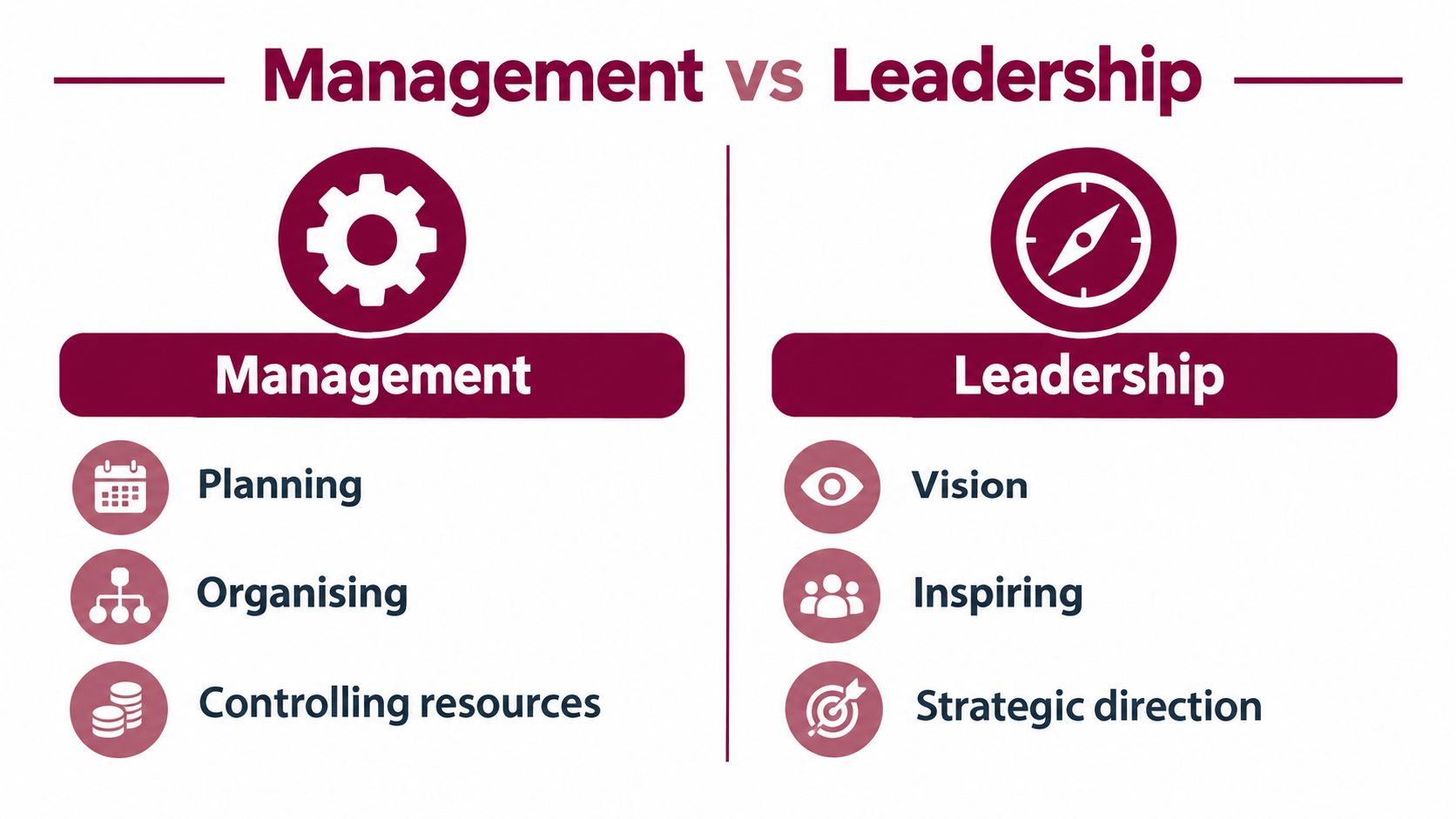
A manager asks, “What needs to happen this week, who is responsible, and how do we track it?” A leader asks, “Where are we trying to go, why does it matter, and how will people commit to the change?” One deals with execution, the other with direction, although good leaders still need the discipline to execute and good managers still need enough influence to bring people with them.
Management as navigation
A practical way to think about management is ship navigation through known waters. The route exists, the destination is set, and the key task is to keep the vessel moving safely and efficiently. That means planning, organising resources, checking whether the course is still correct, and making corrections before small issues turn into disruption.
That logic appears in the UK evidence on structured management practice. The ONS found that a 0.1-point increase in management-practice score was associated with a 9.6% increase in labour productivity, measured as gross value added per worker, in manufacturing businesses in Great Britain, and an earlier analysis found a 6.7% productivity increase for the same size change in management score (ONS). The point is not that management alone causes output growth, but that structure, monitoring, and continuous improvement are not soft extras, they are part of how organisations produce results.
Leadership as route setting
Leadership is closer to charting a route into less familiar waters. Conditions change, the destination may shift, and the team has to stay confident while the plan evolves. Influence matters more than instruction, because people need to understand not just what is changing, but why they should commit to it.
A helpful academic distinction in UK business education is that leadership deals with meaning and movement, while management deals with order and control. If you blur the two, appraisals become muddled. Someone may be excellent at coordinating work but poor at building commitment, or very persuasive but weak at routine discipline.
| Style | Focus | Best context | Mid-career application |
|---|---|---|---|
| Management | Planning, organising, tracking | Stable operations, repeatable work | Use it to keep delivery visible and accountable |
| Leadership | Vision, influence, change | Transition, uncertainty, growth | Use it to align people behind a new direction |
That comparison is why a course such as Business Management Fundamentals can be relevant for managers who need to build stronger operational judgement without losing sight of the human side of work.
Leadership Styles and Management Approaches
A project hits trouble on a Monday morning. The team needs a decision, but not every problem calls for the same kind of response. Mid-career managers often find that one style works well for a new team, another suits a steady department, and a third is better during change or pressure. The task is to match the style to the moment.
A clearer way to judge these approaches is by purpose, rather than by popularity.
| Style | Focus | Best context | Mid-Career Application |
|---|---|---|---|
| Transformational leadership | Inspiring change and innovation | Periods of redesign or growth | Use it when the team needs a new sense of direction |
| Transactional leadership | Structure, performance management, clear exchange | Routine delivery and short-term targets | Use it when expectations need tightening and progress needs tracking |
| Situational leadership | Adapting style to team maturity and task complexity | Mixed capability levels | Use it when one person needs coaching and another needs autonomy |
| Autocratic management | Fast direction and firm control | Urgent decisions or high-risk tasks | Use it when speed and clarity matter most |
| Democratic management | Shared input and discussion | Complex issues with broad impact | Use it when commitment improves the quality of the decision |
| Participative management | Involving staff in decisions and problem-solving | Team ownership and process improvement | Use it when buy-in matters as much as the decision itself |
Style is a tool, not a personality verdict
Managers sometimes worry that a directive style makes them authoritarian, or that inviting input means giving up authority. That confusion wastes time. A manager who gives clear instructions during a system outage is not becoming rigid, they are responding to risk and time pressure.
The reverse can create problems too. If a manager seeks participation for every decision, the team can lose pace and clarity about who is accountable. Judgement lies in knowing when consultation improves decisions and when it only slows action. For a closer look at the human side of that judgement, see the psychology of leadership and what shapes good leaders.
The best managers do not perform one style all day. They change their behaviour when the work changes.
That is why Leadership and Organisational Behaviour matters. It examines how behaviour, group dynamics, and authority shape what teams do, which helps managers understand why the same message can land differently across different people and settings.
The Evidence Impact on UK Business Performance
A manager can run a tidy team meeting and still leave performance unchanged. The missing piece is often capability, not effort. UK evidence shows why management and leadership development deserves attention, because it is tied to how organisations perform.
The CMI reports that organisations investing in management and leadership development programmes have seen an average 23% increase in organisational performance and a 32% increase in employee engagement and productivity. Those findings matter because they connect development activity to workplace outcomes, not just training records. The same report found that employees who said they had good managers were more likely to be satisfied with their jobs, motivated, and positive about organisational culture, at 74%, 77%, and 67% respectively. Day-to-day management behaviour shapes how people feel about work, and those feelings affect how work gets done.
What the UK data suggests
ONS evidence links management quality with productivity and shows that it varies by organisational size and sector. In 2023, firms with more than 250 people had an average management-practice score of 0.68, while firms with 10 to 19 people averaged 0.53; services firms averaged 0.58, compared with 0.54 in production (ONS). The practical reading is straightforward. Formal targets, monitoring, and structured improvement are more common in some settings than others, so development has to fit the context.
A separate CIPD report points in the same direction. In British manufacturing, firms in the top half for structured management practices had average productivity 38% higher than firms in the bottom half (CIPD). That does not turn management into a spreadsheet exercise. It does show why routines, measurement, and corrective action matter when managers want better results from people and processes.
What good development should measure
A useful development programme should test whether managers can do more than complete a course. It should examine whether they run clearer one-to-ones, improve team coordination, and translate strategy into behaviour. It should also ask whether people experience better support, better feedback, and better decision-making.
Use behaviour, not attendance, as the signal. If the team still lacks clarity after the training, the learning has not transferred.
For mid-career managers, that makes development a business issue as much as a personal one. A credential pathway can help when it combines theory with workplace application, especially on emotional intelligence, conflict resolution, and change management.
Practical Frameworks for Development
Development works best when it changes what you do on a Tuesday morning, not just what you understand in theory. That means using small frameworks that fit real schedules, real pressure, and real teams.
Start with self-awareness and a gap check
The first step is to notice where your time goes. If you spend most of it solving immediate problems, your management muscle may be stronger than your leadership muscle. If you spend most of it talking about direction but rarely checking execution, the opposite may be true.
A simple self-check can help:
- Decision clarity: Do people leave meetings knowing who does what?
- Feedback quality: Do you give feedback early enough to change behaviour?
- Change communication: Do people understand why things are shifting?
- Team rhythm: Are one-to-ones and reviews regular enough to matter?
Use one framework for coaching, another for change
Coaching conversations work well when a manager asks better questions instead of supplying every answer. Change work needs a more deliberate structure, because people do not adopt new habits just because the business wants them to. Emotional intelligence matters in both cases, because people respond to tone, consistency, and fairness before they respond to policy.
The Credential of Leadership and Management offers a structured CPD route for managers who want to study these topics in a formal way, and its modules cover leadership fundamentals, emotional intelligence, team building, conflict resolution, change management, decision making, communication, and strategic direction. That kind of structure is useful when you need your learning to connect directly to practice.
Make the learning visible at work
A development plan should show up in everyday behaviour. A manager might start with better meeting agendas, clearer task ownership, or a more disciplined review rhythm. The point is not to add more process for its own sake, but to reduce confusion and make progress easier to see.
That is where the transition from managing tasks to leading people becomes real. People begin to trust you when your guidance is consistent, your feedback is specific, and your decisions are tied to shared priorities. In practice, the best framework is the one your team can feel in how work gets done.
Common Misconceptions About Management and Leadership
One common mistake is to treat management as merely administrative and leadership as purely inspirational. That split sounds neat, but it breaks down quickly in practice. A manager who cannot structure work will not create stability, and a leader who cannot organise delivery will not create results.

Another myth is that leadership belongs only to senior executives. In real organisations, leadership happens wherever someone clarifies direction, settles tension, or helps a team move through change. That means a project lead, team manager, or supervisor can all exercise leadership without waiting for a grand title.
AI makes the misconception worse
The challenge is sharper now because digital change has blurred the line between performance and visibility. A 2026 CMI survey found that 68% of organisations were still experimenting with AI or running pilots, while 52% of managers expected their organisations to be AI-ready within 12 months. The same survey found that 70% reported some productivity improvement, yet only 5% described those gains as transformational and 26% reported no gains.
That matters because managers now have to judge whether AI is improving work or merely speeding up output. The deeper leadership task is to establish trust, accountability, and role clarity when change is happening faster than formal governance.
The integrated view is more useful
A better assumption is that management and leadership are interdependent disciplines. Management gives work its shape. Leadership gives work its direction and meaning. When you separate them too sharply, you either get efficient drift or inspiring disorder.
That is why integrated programmes are more relevant than siloed labels. They help managers practise both the discipline of delivery and the skill of leading people through uncertainty. As workplaces change, that combination becomes less of a nice-to-have and more of a requirement.
Conclusion Integrating Management and Leadership
Mid-career progression in the UK increasingly depends on whether you can do both jobs at once. You need the habits that keep work organised, measurable, and reliable, and you need the judgement that helps people stay aligned when priorities shift. Treating management and leadership as separate camps leaves a gap that shows up quickly in morale, coordination, and delivery.
The evidence is clear enough to be practical. Structured management practice is associated with stronger productivity, and good management is linked with better employee attitudes and performance. Leadership development, meanwhile, helps people move from supervising tasks to shaping commitment, especially when teams face change, pressure, or new technology.
The most effective managers are not choosing between control and inspiration. They are learning when to tighten the system, when to widen participation, and when to lead with direction rather than detail. That balance is what makes capability durable rather than cosmetic.
If you want to formalise that balance, look at structured CPD learning that combines leadership theory with workplace application. The London School of Business Administration offers online, self-paced programmes that connect management practice with leadership development, and its framework is designed for working professionals who need to apply learning while they keep delivering.
If you're ready to strengthen both your management discipline and your leadership judgement, visit London School of Business Administration and explore a structured CPD pathway that fits alongside your work. It's a practical next step if you want learning that supports team performance, change leadership, and clearer decision-making in the same development journey.