
A survey of 4,000 UK employees conducted in early 2024 found a 40-point increase in engagement in organisations where employees rated internal communication as excellent, compared with weaker communication environments. The Institute of Internal Communication's survey findings also report that 40% of respondents experienced five or more methods of employee voice, alongside an average Employee Engagement Index score of 68%. These associations do not establish causation, but they show why communication belongs in management practice, not just administration.
Start by asking whether employees can influence decisions, access the same information regardless of location, and receive a meaningful response when they raise a concern. Meetings already exist in many teams; improvement depends on closing the loop after discussion, sharing decisions with hybrid colleagues, and setting clear rules for AI-drafted messages.
Table of Contents
- Why Team Communication Is a Leadership Discipline
- Diagnose Where Team Communication Breaks
- Run a Six-Step Communication Routine
- Use Templates to Run the Routine
- Set Norms for Safety Hybrid Work and AI
- Measure Improvement and Avoid False Progress
- Choose Training That Scales the Routine
Why Team Communication Is a Leadership Discipline
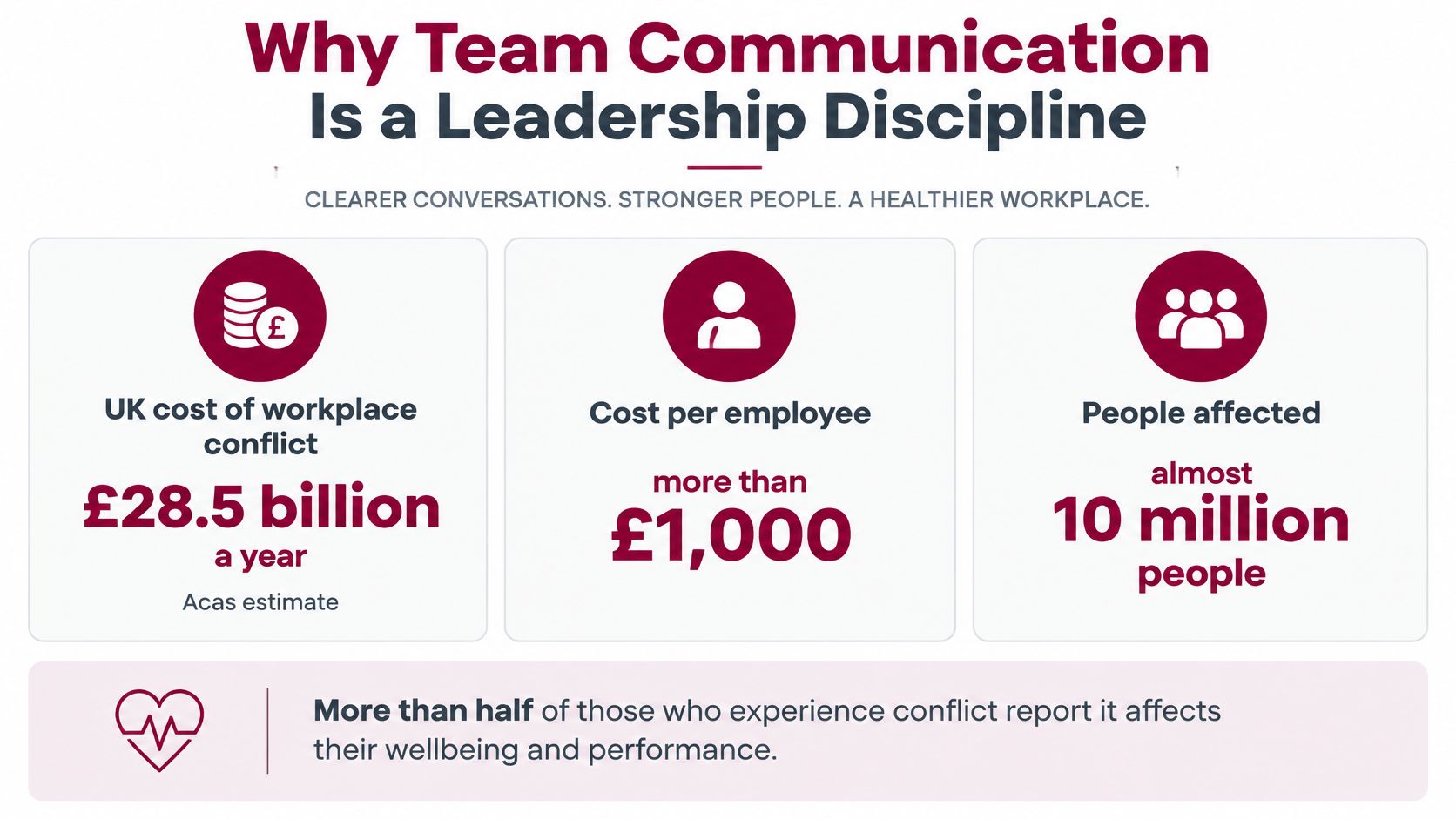
Acas estimated that workplace conflict costs UK organisations £28.5 billion annually, or more than £1,000 per employee, and affects almost 10 million people. Its estimates also included nearly 900,000 people taking time off work, almost 500,000 resigning and over 300,000 being dismissed; more than half of those experiencing conflict reported stress, anxiety or depression, according to Acas's research on the cost of workplace conflict. These estimates describe conflict's consequences, not outcomes caused by unclear messages alone.
Managers shape whether disagreement becomes productive discussion or unresolved conflict. They set expectations for when concerns receive attention, how disputed facts are checked and how decisions are explained.
Distinguish communication activity from organisational value
A meeting invitation shows that an opportunity was scheduled, not that relevant information reached the discussion, disagreement was considered or the outcome was understood.
A hybrid project team might meet weekly yet reopen the same decision repeatedly. Attendance is strong, but the team has no settled record of the choice, its rationale or the conditions for reconsidering it. The gap is in the decision process: discussion has not been closed with a clear outcome.
Closed-loop communication gives the team a practical standard. Employees can contribute, understand how their input was considered and see what action followed. A decision record works like a receipt: it confirms what was agreed and makes the next step visible.
Communication is complete when the recipient understands the decision and the contributor knows what happened to their input.
Make managerial responsibility explicit
Managers should distinguish between informing, consulting and deciding. An announcement communicates an established position; consultation invites views before that position is settled. Calling an announcement consultation creates an expectation of influence that the manager cannot meet.
During organisational uncertainty, separate settled facts from provisional assumptions. When an answer is not yet available, name the decision owner and explain when the issue will be reviewed. This gives employees a clear route to follow without offering unsupported reassurance.
Communication belongs alongside workload allocation, risk management and performance review. Managers need to clarify who responds, how decisions are recorded and whether employees have equal access to the information they need. The practical test is whether the team can act on what was agreed without guessing.
Diagnose Where Team Communication Breaks
Team communication failure signals and first responses
| Failure signal | UK evidence | What to inspect | First response |
|---|---|---|---|
| Low decision voice | In the Nottingham Business School study with the CIPD and YouGov of more than 2,370 UK employees, only 50% were satisfied or very satisfied with decision-making involvement, and 22% who raised an issue received no advice or support. | Whether each concern has a named respondent and documented reply. | Publish the response and explain the decision that followed. |
| Meetings without influence | The study found that 62% used manager one-to-ones and 49% expressed views through team meetings. | Whether staff can challenge a decision before it's settled. | Add a standing challenge item and a written outcome. |
| Information delay | A UK employee-information survey reported by IT Brief found that 55% experienced delays waiting for information and 53% needed to consult colleagues or arrange meetings to obtain required information. | Whether decisions and owners have one authoritative location. | Name the source of truth, owner and deadline. |
| Hybrid peer gaps | A UK hybrid-working study identified co-worker communication as challenging for 46.3% of respondents and organisational communication, particularly cascades, for 28.5%. | Participation and information access by work location. | Record decisions and rotate meeting times. |
| Unproductive virtual meetings | In a 2024 Robert Walters poll reported by HRreview, 73% of UK professionals said virtual meetings hampered productivity and 67% preferred in-person meetings for important business decisions. | Whether the meeting produces a decision or usable deliverable. | Convert status updates to asynchronous notes. |
| Unmanaged conflict | Research summarised by the University of Warwick found that 40% of employees experiencing conflict discussed it with a line manager, compared with 11% consulting HR and 6% an employee representative. | Time to the first managerial conversation and access to alternative support. | Clarify disputed facts early, without delaying necessary formal action. |
Read the signals together
These findings concern different employee groups and survey designs. Use them to identify questions, not to calculate a composite benchmark for your organisation.
Meeting frequency deserves scrutiny. In 2024 Lucid Software findings reported by Computer Weekly, 74% of UK knowledge workers identified regular team meetings or stand-ups as their main progress-tracking method. A familiar channel can be useful yet still leave decisions unclear.
The Nottingham Business School study found that work pressure affected 43% of employees and significant organisational change affected 29%. Under pressure, examine whether managers explain shifting priorities and how those changes affect ongoing work.
Select the primary failure
A regional services team has reliable meeting attendance but few documented replies to concerns. Adding another collaboration channel would not resolve the underlying issue: employees cannot tell whether their input was considered.
First, identify unresolved concerns and assign someone to respond. Then check whether staff can find the reply and understand the decision that followed. Add a channel only if the review reveals an access problem.
For interpersonal disputes, distinguish a misunderstanding from allegations that require formal handling. The guidance on how to handle conflict at work offers a separate framework for making that judgement. Informal clarification must not delay appropriate safeguarding, grievance or disciplinary processes.
Run a Six-Step Communication Routine
Hybrid work makes deliberate information design necessary. The Office for National Statistics reported that 28% of working adults in Great Britain were hybrid workers in early 2025.
Evidence submitted to the UK Parliament from a diary study of graduate interns found that they spent only 15% of working time co-located with peers, while 47% of communication occurred through scheduled video meetings and 31% through online chat. That specific group isn't representative of every workforce, but its experience illustrates why managers cannot rely on shared physical context.
Establish the operating sequence
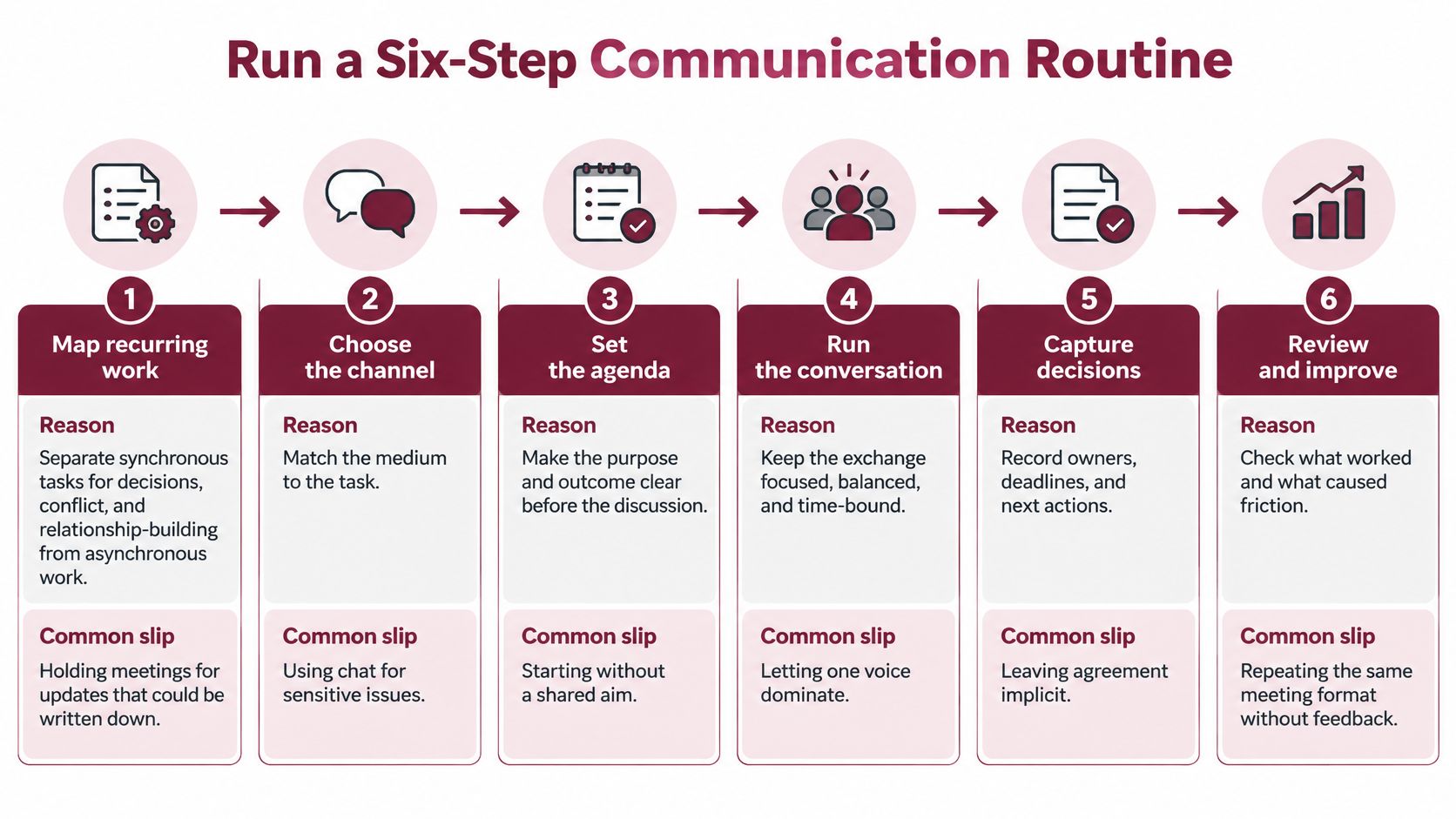
Map recurring work. Separate synchronous activities, which require live exchange, from asynchronous activities, which colleagues can complete at different times. Decisions involving contested assumptions, conflict resolution and relationship-building usually benefit from dialogue. Status updates, document review and routine approvals can often proceed in writing. The common slip is turning every update into a meeting.
Assign an authoritative location. Keep settled decisions, action owners and deadlines in a shared log or workspace with appropriate access controls. Messages should direct colleagues to that record rather than create competing versions. Assign responsibility for maintaining it. The mistake to avoid is creating a central repository that nobody updates.
Specify meeting inputs and outputs. Require an agenda identifying the question, relevant pre-reading and intended outcome. End with a written decision, accountable owner, deadline and concise record of unresolved matters. If a recurring meeting produces neither a decision nor a deliverable, test an asynchronous replacement. Don't confuse a transcript with an actionable record.
Publish response expectations. Distinguish urgent operational escalation from routine questions and non-urgent discussion. State which channel to use, who monitors it and how to escalate when the responsible person is unavailable. Response expectations should reflect working hours and operational requirements. Avoid implying that every message requires immediate attention.
Collect structured feedback. Use a short monthly pulse covering priority clarity, ability to challenge decisions, psychological safety and confidence in receiving a response. Combine the results with facilitated retrospectives and private one-to-ones. This helps managers distinguish a widespread design problem from an issue requiring confidential support. The common error is treating an average score as a complete explanation.
Review and remove friction. Examine response time, duplicated work, unresolved actions, meeting load and participation by location each month. Hold a quarterly retrospective to simplify channels that create repetition without improving decisions. Preserve routes that support relationships or confidential concerns, even when they don't generate a formal decision. Removing a channel solely because it produces little visible activity can exclude quieter contributors.
Judge outcomes rather than traffic
Look for fewer reopened decisions, fewer clarification messages, faster action closure and balanced participation between remote and office-based colleagues. Interpret these together: fewer questions are only encouraging if employees also report greater clarity.
A manager should be able to explain which operational problem each communication practice addresses. If that explanation is missing, the practice needs review rather than automatic continuation.
Use Templates to Run the Routine
Templates reduce ambiguity by making essential information difficult to omit. Keep them short enough to complete during normal work, with additional detail attached only when the decision warrants it.
Decision record template
| Field | What to record | Example entry |
|---|---|---|
| Decision | One sentence stated as settled. | Client review moves to Thursday from next sprint. |
| Owner | Named individual accountable for the action. | Team lead, regional services, with the individual's name entered. |
| Deadline | Calendar date for the action. | Date agreed in the meeting, entered before circulation. |
| Dissent | Recorded challenge and whether it changed the outcome. | Challenge considered; decision confirmed after review. |
| Location | Single authoritative place where the record is filed. | Team decision log. |
In this hypothetical project, the Leeds office objects because the revised review clashes with a local handover. The record should explain why the objection didn't change the outcome, for example because the client's availability was fixed, and identify the alternative handover arrangement.
Recording dissent isn't an invitation to attribute blame. It preserves the reasoning so colleagues don't have to reconstruct it later.
Meeting agenda and monthly pulse
Use the following meeting agenda fields as a copyable starting point:
- Purpose: Explain why the discussion is necessary.
- Decision required: State the question to be settled.
- Pre-read location: Identify the current document and relevant sections.
- Time allocation: Allocate time to each item.
- Record owner: Name who will circulate the written outcome, with a suggested team standard of within 24 hours.
For the monthly pulse, use a five-point agreement scale as a practical design choice, with a separate option for insufficient experience to answer:
- Priority clarity: I understand our priorities.
- Constructive challenge: I can challenge a decision without penalty.
- Early concern: I can raise a concern early.
- Feedback response: I receive a response to the feedback I give.
Finish with an open question: What is the biggest communication blocker affecting your work? Explain who will see responses and how confidentiality will be protected before asking employees to participate.
Set Norms for Safety Hybrid Work and AI
Hybrid policies can set expectations, yet they do not show whether colleagues have equal access to decisions. A Deskbird compilation of hybrid-work statistics reports that 82% of business decision-makers believed leaders actively championed inclusion, compared with 60% of employees. It also reports regular team-building opportunities for 83% of decision-makers and 57% of employees, while 74% of organisations had formal hybrid policies in 2025 and 65% required minimum weekly workplace attendance.
Managers need to check who is missing from the information network, including colleagues who cannot join informal office conversations or regularly scheduled discussions.
Protect challenge and hybrid access
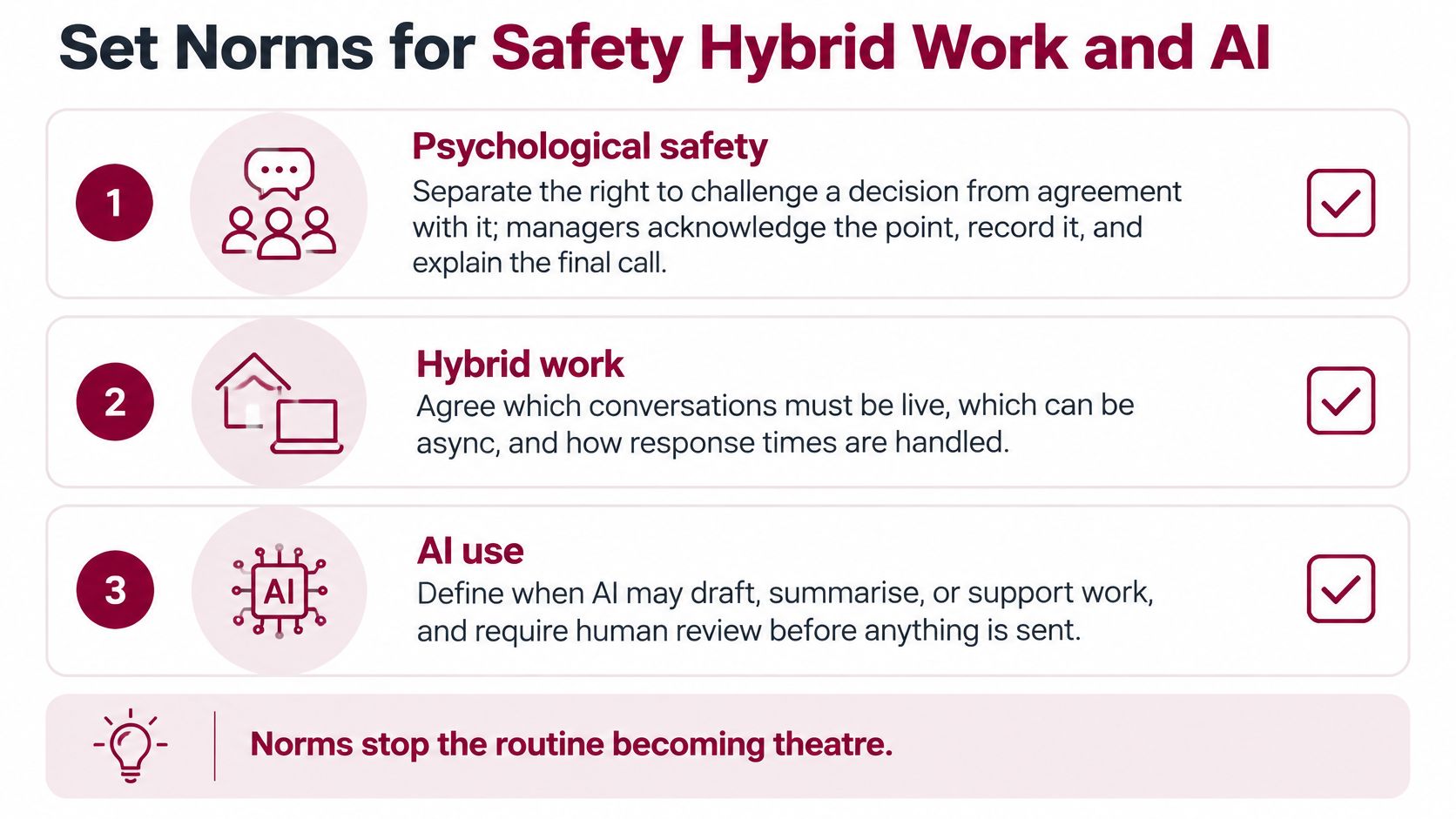
Make respectful challenge safe, then explain how it informs a decision. Managers should acknowledge concerns, record their substance and explain the final judgement without penalising disagreement.
Check how decisions that begin in corridors or after meetings reach everyone affected. An informal discussion can generate a proposal, but colleagues need to see and respond to it before it becomes a commitment. Rotate meeting times where working arrangements or caring patterns create repeated disadvantage, and keep records searchable. A named cross-team relationship owner can help resolve handover gaps. Guidance on managing distributed teams effectively explores the wider management context.
Establish an accountable AI protocol
The Ipsos Karian and Box Internal Communication Index 2025 reports that only just over four in ten employees said their employer had clearly explained responsible generative AI use. The same report says 36% had been told how AI was expected to be used in their jobs. It also records that 43% of workers felt deceived when senior leaders relied on AI-generated communications, while 91% wanted limits or clear guidelines.
Turn these concerns into clear team rules:
- Disclose material assistance: Explain when AI substantially drafts a leadership message or summarises employee contributions.
- Require human review: Check accuracy, tone, omissions and implications before sending sensitive or people-related messages.
- Protect confidentiality: Do not enter confidential organisational, employee or learner information into generative AI systems.
- Preserve direct dialogue: Give employees an accessible route to ask questions and receive answers from an accountable person.
- Assign error ownership: The approving sender remains responsible for corrections and follow-up.
An AI-polished all-staff note about restructuring can read clearly and still fail employees. Generic reassurance may weaken trust if it avoids the questions people are asking. The manager should verify the facts, remove unsupported promises and provide a direct route for questions. Human review keeps the message accurate and accountable.
Measure Improvement and Avoid False Progress
A dashboard is useful only when managers can interpret changes in context. Set a baseline before altering the communication routine, then keep the measures and collection method stable for one quarter. This gives the team a consistent comparison, rather than a series of results shaped by changing questions.
Communication dashboard measures and review cadence
| Measure | What to record | Cadence | Sign of improvement |
|---|---|---|---|
| Priority alignment | Whether teams can identify the current priorities and how they connect to operational work. | Monthly | Teams describe priorities consistently and can link decisions to them. |
| Decision follow-through | Share of decisions with a named owner, deadline and recorded outcome. | Monthly | Fewer decisions remain without an owner or update. |
| Response reliability | Share of requests requiring a management decision that receive a response by the agreed deadline. | Monthly | More requests receive a timely answer or a clear revised deadline. |
| Meeting-to-decision conversion | Meetings held for decisions and the proportion that produce a recorded decision or next step. | Monthly | The same decision workload requires less meeting time. |
| Hybrid access to decisions | Whether relevant decisions and their rationale are accessible to colleagues across locations. | Quarterly | Fewer differences in access between locations. |
| Conflict resolution | Time between an issue being raised and a management conversation, considered alongside absence and delivery rework. | Quarterly | Issues are addressed sooner without a rise in related disruption. |
Read trends before reporting them
Two measures can move in opposite directions without either being wrong. For example, fewer meetings may coincide with slower decisions if teams have lost a reliable route for resolving questions. Check the decision records and response times before concluding that meeting time has become more productive.
Operational indicators also have multiple causes. Absence, voluntary turnover and rework can prompt investigation, but they do not prove that communication caused a change. Report the pattern, its limits and the next question managers will examine.
Publish actions, not merely scores
After each review, publish the leading themes, an accountable owner and a deadline. Explain what changed, what did not and why, while protecting confidential individual cases.
For example, a service team might identify unclear handovers as its main blocker. Its response should name the handover document to be revised, who will maintain it and when the team will review whether decisions are being completed more reliably.
A communication measure matters when it helps managers make decisions and account for what follows.
The CIPD's collective employee voice report found that 52% of employers reported not using employee representatives to inform and consult their workforce, compared with 33% reporting no representative arrangements in the comparison period. Where arrangements existed, positive ratings of representatives' ability to represent views to senior management rose from 40% in 2020 to 49% in 2021 and 2022.
Protect the integrity of the measures
Provide routes for feedback that do not rely solely on the line manager. Anonymous feedback, representative arrangements and facilitated discussions can help surface concerns employees may be reluctant to raise directly.
- Surveying without action: Repeated requests for feedback need visible responses.
- Filtering negative findings: Explain context without suppressing uncomfortable themes.
- Counting activity as success: More messages or meetings do not demonstrate better understanding.
Keep the dashboard stable for one quarter as a practical review period. Then assess whether decisions are completed more reliably and information reaches colleagues across locations, rather than treating survey completion or message volume as progress.
Choose Training That Scales the Routine
Start with the team's weakest communication finding and select development that addresses it. For example, silence in one-to-ones may call for practice in listening, challenge and feedback. Delays across hybrid teams may point to unclear ownership, handovers or decision processes.
Before choosing study, set a workplace objective that can be observed. A manager addressing unanswered concerns could assess whether colleagues receive clear responses. A manager working on cross-team delays could review whether handovers specify who accepts work and when to escalate issues.
Match study to an observable weakness
The guidance on communication skills for managers can help identify a capability to strengthen. Choose development that includes applying learning to a current management problem, then reviewing the resulting work.
London School of Business Administration's Credential of Leadership and Management is an eight-course, CPD-accredited pathway of 160 hours. It covers Leadership Fundamentals, Strategic Leadership and Corporate Direction, Decision Making and Problem Solving, Emotional Intelligence in Leadership, Conflict Resolution, Change Management, Communication Skills for Leaders, and Team Building and Management.
Require evidence of application
The programme is self-paced, with recorded lectures, structured study materials and assessments. Successful completion leads to a certificate that can be verified online.
Completion records study; workplace evidence shows whether learning has been applied. This might be a decision record that clarifies ownership, a revised consultation process or a dashboard tracking response reliability.
Training scales communication when it changes whose voice reaches a decision.
Commit to deliberate practice over a quarter. Run the communication routine, maintain the dashboard and use the weakest measure to set the next development objective. This keeps further study connected to the team's needs.
London School of Business Administration offers self-paced, CPD-accredited leadership and management study supported by recorded lectures, learning materials and assessments. Visit London School of Business Administration to explore a structured pathway, using a specific communication weakness from your team's dashboard to guide your choice.