
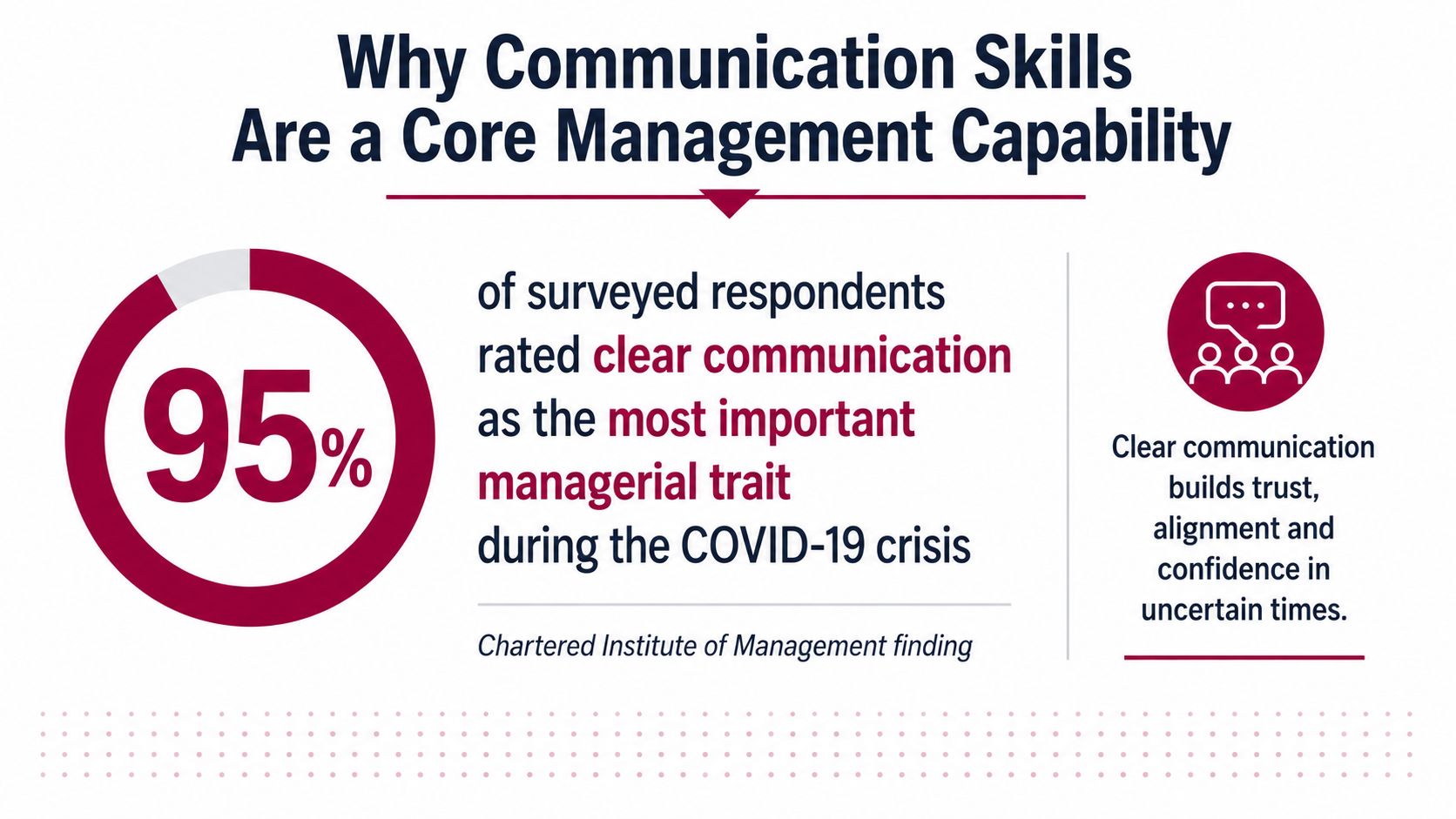
Communication skills for managers are the applied capabilities of active listening, clear messaging, structured feedback and channel adaptability that turn organisational strategy into coordinated team action; during the COVID-19 crisis, 95% of surveyed respondents considered clear communication the most important managerial trait. These capabilities help managers explain decisions, establish expectations and understand what employees need to act effectively.
A manager can understand a business decision perfectly yet leave the team uncertain about what to do next. The practical test of communication is therefore not whether a message sounds professional, but whether people can interpret it, question it and act on it.
Table of Contents
- Why Communication Skills Are a Core Management Capability
- The Core Communication Skills Every Manager Needs
- Giving Feedback That Improves Performance
- Handling Difficult Conversations and Workplace Conflict
- Communicating in Digital and AI-Supported Workplaces
- Adapting Communication for Diverse and Neurodivergent Teams
- Developing Your Communication Skills Through Structured Learning
Why Communication Skills Are a Core Management Capability
The Chartered Management Institute's research on communication and wellbeing found that 95% of respondents considered communicating clearly the most important managerial trait during the COVID-19 crisis, while 68% rated it very important. These findings concern an exceptional period of workplace disruption, not a timeless ranking of every management skill. Nevertheless, they demonstrate how strongly respondents valued clear communication when familiar working arrangements became uncertain.
Managerial communication means exchanging information and establishing shared understanding so that people can coordinate their work. It differs from passing on a senior leader's announcement. Managers must explain what a decision means locally, identify competing demands and listen for difficulties that decision-makers may have overlooked.
From organisational intention to practical action
Consider an illustrative instruction to improve customer responsiveness. Repeating that phrase gives employees little guidance. A manager needs to explain which enquiries take priority, who owns unresolved cases and how employees should raise competing commitments.
The manager also needs to communicate upwards. If the proposed service standard exceeds available capacity, reporting that constraint is part of responsible management, not resistance to change.
Practical rule: A message isn't complete merely because it has been sent. Check whether the recipient can identify the required action and raise relevant concerns.
This makes communication an operational capability, a skill used to organise and sustain work, rather than merely an interpersonal preference. A warm manner cannot compensate for an unclear instruction; equally, an accurate instruction may be ineffective if employees feel unable to question it.
Message quality and channel choice
Managers should distinguish what they need to communicate from how they communicate it:
- Meetings suit discussion where participants need to test assumptions together.
- Email provides a durable account of decisions, responsibilities and expectations.
- Messaging can support brief coordination, provided consequential decisions aren't left scattered across conversations.
- Video calls allow dialogue across locations, but require deliberate opportunities for participation.
These are practical selection criteria, not rigid rules. The appropriate channel depends on sensitivity, ambiguity and the need for a record.
Developing communication skills for managers consequently requires more than presentation practice. It involves listening, explaining, influencing, giving feedback and adapting everyday routines, supported by rehearsal and evidence of how recipients experience the communication.
The Core Communication Skills Every Manager Needs
Think of the manager as a signal relay between strategy and execution. The task isn't to repeat the original signal unchanged, but to preserve its meaning while making it usable for a particular team. The following skill clusters provide a practical way to examine that responsibility.
Historical UK employer evidence illustrates why both spoken and written capability matter. In the UK Commission's Employer Skills Survey 2013, 41% of employers reporting skills lacking in applicants identified oral communication deficiencies, while 38% identified written communication deficiencies. These figures describe that surveyed group, not all employers or applicants.
Understanding people and making meaning clear
Active listening means attending carefully to someone's account, including tone and omissions, while checking rather than assuming its meaning. If an employee says a deadline is unrealistic, try: “Which part of the work creates the difficulty?” Then reflect back the explanation before proposing a solution.
Clarity of message means making the purpose, required action and relevant constraints explicit. Instead of “Please prioritise the report”, say: “Complete the analysis before starting the presentation, and tell me if that changes the delivery date.” The employee can then assess an identifiable request.
Feedback is information about work that helps someone recognise effective performance or make an improvement. It should concern evidence and standards rather than personal labels. Its detailed application requires particular care, as the next discussion demonstrates.
Persuasion and influencing mean explaining a proposal in terms that address another person's legitimate priorities. When requesting support from another department, explain the shared problem and acknowledge the work your proposal creates. Influence isn't the same as withholding inconvenient information.
Communicating through behaviour and channels
Nonverbal communication includes posture, expression, pace and pauses. A manager who invites questions while looking repeatedly at another screen may appear unavailable. However, don't treat eye contact or body language as reliable evidence of someone's attitude or understanding.
Virtual and written communication require messages that remain intelligible without immediate explanation. A useful meeting follow-up separates decisions from unresolved questions and names the person responsible for each action.
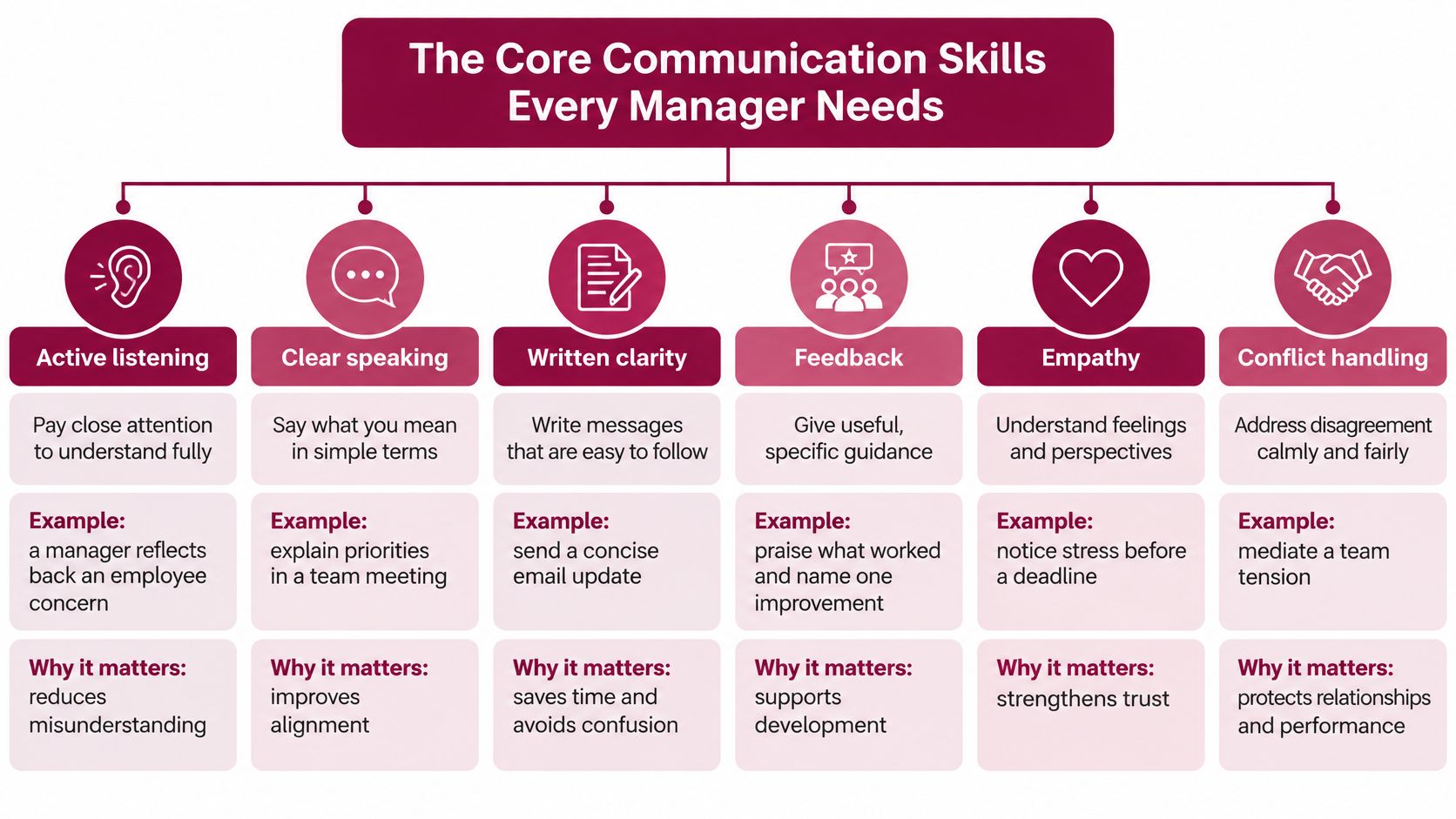
These clusters overlap with empathy, the effort to understand another person's perspective without necessarily agreeing with it. The relationship between self-awareness, emotional regulation and communication is explored further in why emotional intelligence is important.
To identify your development priority, examine where communication becomes difficult:
- Repeated clarification requests may indicate unclear wording or missing context.
- Late disclosure of problems warrants examining how you respond to unwelcome information.
- Unresolved cross-team requests may require better explanation of mutual priorities.
For formal study, Communication Skills for Leaders is a relevant course title to consider alongside workplace practice and mentoring.
Giving Feedback That Improves Performance
“You're unreliable” is an interpretation of a person. “The agreed report wasn't available when the review began” is an observation about work. Effective feedback begins with the latter, because an employee can examine the event and discuss what should happen differently.
The CIPD evidence review on performance feedback identifies effective feedback as specific, job-relevant, constructive, credible and unbiased. It also emphasises employees' perceptions of fairness and usefulness. Feedback doesn't improve performance just because a manager delivers it confidently.
Applying the CIPD Feedback Principles in Practice
| Principle | What It Means in Practice | Example Phrasing |
|---|---|---|
| Specific | Describe an observable action or omission. | “The report didn't include the agreed cost breakdown.” |
| Job-relevant | Connect the issue to the task and its standard. | “The breakdown is needed to assess the proposal.” |
| Constructive | Identify a workable next action. | “Let's agree how you'll check completeness before submission.” |
| Credible | Use evidence you can explain and verify. | “I'm referring to the version submitted for review.” |
| Unbiased | Apply comparable standards and examine context. | “What affected delivery, and was the requirement clear?” |
The practical reasoning is straightforward. Observable evidence makes feedback more specific; specificity helps establish relevance; perceived relevance and fairness make acceptance more likely. Acceptance can then support learning and behaviour change, although it doesn't guarantee either.
A worked script might read:
“The report wasn't available at the agreed review point. We needed the completed analysis to consider the proposal, so the discussion couldn't proceed as planned. What prevented completion, and what support or change would make the next submission achievable?”
This script identifies the deliverable, standard and impact before inviting the employee's account. It doesn't assume that the cause was laziness, disregard or lack of capability.
Timing, balance and a quality check
Give feedback close enough to the event for its context to remain clear, but allow time to verify the facts and prepare. Immediate criticism delivered in frustration is not the same as timely feedback.
The CIPD review also cautions against concentrating exclusively on weaknesses. Positive feedback can be more effective than negative feedback in some circumstances, so describe what the employee should continue doing rather than offering only correction.
Use the following as a practical conversation benchmark, not a mandatory formula:
- A verified strength identifies effective behaviour worth retaining.
- An improvement priority keeps attention on an actionable issue.
- A jointly agreed action establishes what will happen next.
- A review date provides an opportunity to examine progress.
Afterwards, an anonymous pulse check can ask whether the feedback was clear, fair and useful. Treat responses as evidence about your communication, not a judgement on whether the employee welcomed the message.
For related formal study, Emotional Intelligence in Leadership is a course option to consider.
Handling Difficult Conversations and Workplace Conflict
In NatCen's research on workplace conflict, 44% of working-age adults in Great Britain reported disagreement, dispute or a difficult workplace relationship during the preceding 12 months. Separately, Acas's analysis of conflict topics found that capability and performance accounted for 94% of conflicts between managers and their direct reports. Difficult conversations are therefore closely connected to everyday performance management.
Consider an illustrative manager who has noticed declining output but avoided discussing it. Instructions become shorter, irritation becomes visible, and the employee hears only that their work “isn't good enough”. Neither person has a shared account of the problem.

Replacing frustration with a fair process
The manager should first gather relevant work examples and check the previously agreed expectations. In a private setting, a neutral opening would be: “I'd like to discuss the recent submissions, understand what's affecting them and agree what needs to change.”
The employee might explain that priorities changed without a corresponding adjustment to workload. That explanation needs examination, not automatic acceptance or dismissal.
A repeatable conversation sequence is:
- Prepare the evidence and distinguish established facts from assumptions.
- Explain the concern neutrally, without suggesting a conclusion has already been reached.
- Listen to the employee's account, including workload, instructions and support.
- Agree observable expectations, responsibilities and a review point.
- Document the outcome, allowing misunderstandings in the record to be corrected.
Delayed or vague criticism can turn a manageable work issue into a disagreement about fairness. Documentation should clarify what was agreed, not become a substitute for dialogue.
Knowing when informal discussion isn't enough
The consequences deserve proportionate attention. Acas reports that stress, anxiety or depression affected 57% of people involved in conflict; its earlier modelling, based on 2018–19 evidence, estimated that nearly 900,000 employees took time off and almost 500,000 resigned following workplace conflict. These findings shouldn't be interpreted as proof that communication alone causes or resolves every dispute.
Escalate through the organisation's procedures when informal agreements repeatedly fail, allegations require investigation, or the manager cannot act impartially. Serious concerns shouldn't be kept informal merely to avoid discomfort.
Guidance on how to handle conflict at work can support preparation. Conflict Resolution is also a relevant formal-learning option, alongside organisational guidance and supervised practice.
Communicating in Digital and AI-Supported Workplaces
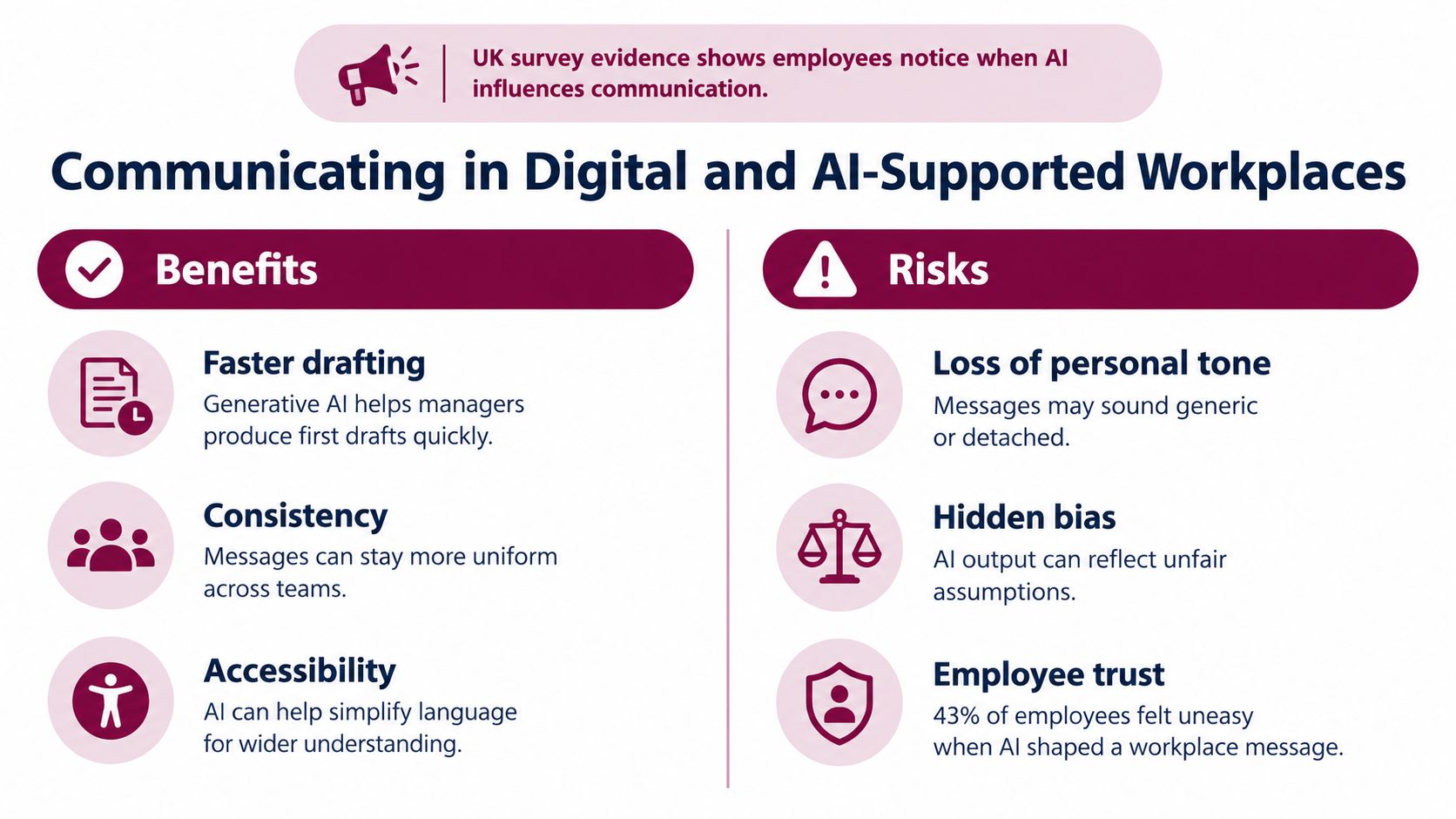
A polished message can still weaken confidence if employees cannot identify who stands behind it. In a 2025 survey of 1,000 UK employees reported by Raconteur, 43% felt deceived when senior leaders relied on AI-generated communications, while 91% wanted strict limits or clear guidelines on leaders' use of AI in employee interactions. These findings concern employee perceptions, rather than demonstrating that every AI-assisted message damages trust.
The managerial implication is nevertheless important: efficiency can undermine credibility when human ownership becomes unclear. An immediate, fluent announcement may be less reassuring than a carefully prepared conversation in which the responsible manager answers questions.
A disclosure and human-ownership protocol
Material AI involvement means assistance substantial enough to shape the message's substance, explanation or tone, rather than a minor spelling correction. Managers should apply organisational policy and make consequential use visible.
A practical protocol is:
- Disclose substantial assistance. Explain the role AI played without implying that the system made the decision.
- Verify the content. Check factual accuracy, commitments, tone and assumptions about the recipients.
- Invite questions. Provide access to someone who understands the decision and can respond meaningfully.
- Retain responsibility. The manager must own the communication and its consequences.
For example: “I used AI to help organise this update. I've checked the content, and I'm responsible for the explanation and the decisions described.”
Disclosure isn't a remedy for an insensitive message. A manager must still judge whether the communication acknowledges uncertainty, answers likely concerns and treats recipients respectfully.
Match the medium to the consequences
Drafting a routine scheduling update is different from explaining a performance outcome or restructuring proposal. For consequential matters, use a visible human conversation, supported by an accurate written record where appropriate.
Don't use an automated draft to create distance from a decision that requires your explanation.
Channel selection matters even without AI. A short message may suit a straightforward coordination question; email can preserve detailed information; a conversation is preferable when people need to explore sensitive or ambiguous issues.
Before sending, ask: Does this person need information, dialogue or both? That question is more useful than selecting the fastest available channel. It also prevents managers from mistaking a completed draft for a completed communication task.
Adapting Communication for Diverse and Neurodivergent Teams
Neuroinclusive communication means designing everyday exchanges so that people with differing ways of processing information can participate effectively. It shouldn't depend entirely on an employee disclosing a diagnosis or requesting an exception after instructions have already become confusing.
The Acas research report on neurodiversity at work identifies the need for specific managerial guidance, including adaptable practices such as written instructions, regular feedback and flexible communication approaches. Managers should use these principles without assuming that everyone with a particular diagnosis has identical preferences.
Make clarity part of ordinary work
Suppose a team makes a rapid decision during a meeting. An employee who needs time to process the discussion may leave unsure whether a suggestion became an instruction. A brief decision log, recording the decision, responsibility and unresolved questions, makes the outcome available for later reference.
Useful everyday practices include:
- Written follow-ups that supplement verbal instructions with clear actions and expectations.
- Explicit priorities that distinguish essential requirements from optional suggestions.
- Processing time before expecting responses to complex proposals.
- Flexible channels that let employees raise questions in conversation or in writing.
These practices needn't produce lengthy documentation. A short, accurate record is preferable to a detailed account that nobody can use.
Check understanding without testing the person
Replace “Did you understand?” with “What would be useful to have in writing?” Another option is: “Let's compare our understanding of the next action so I can check I've explained it clearly.”
The wording matters because the manager shares responsibility for establishing clarity. Ask about preferences directly rather than interpreting hesitation, eye contact or speaking style as evidence of capability.
Consistency means access to clarity, not an identical communication style for everyone.
The same principle supports cross-cultural and multilingual communication. Avoid unexplained idioms, provide context for unfamiliar terms and allow time to formulate a response. Don't confuse accent, conversational confidence or rapid fluency with the quality of someone's judgement.
Flexibility doesn't mean abandoning standards. Managers can maintain a common expectation for the work while varying how employees receive information, ask questions and demonstrate their understanding.
Developing Your Communication Skills Through Structured Learning
Improvement begins with observable practice rather than a general intention to communicate better. Choose a recurring situation, such as delegation, a project briefing or a feedback discussion, and define the behaviour you want to change.
A useful goal might be: “I'll distinguish decisions from discussion points in meeting follow-ups.” That's more testable than “I'll become a stronger communicator”, because a colleague can review whether you did it.
Build a deliberate practice routine
Use workplace exercises that reveal a specific habit:
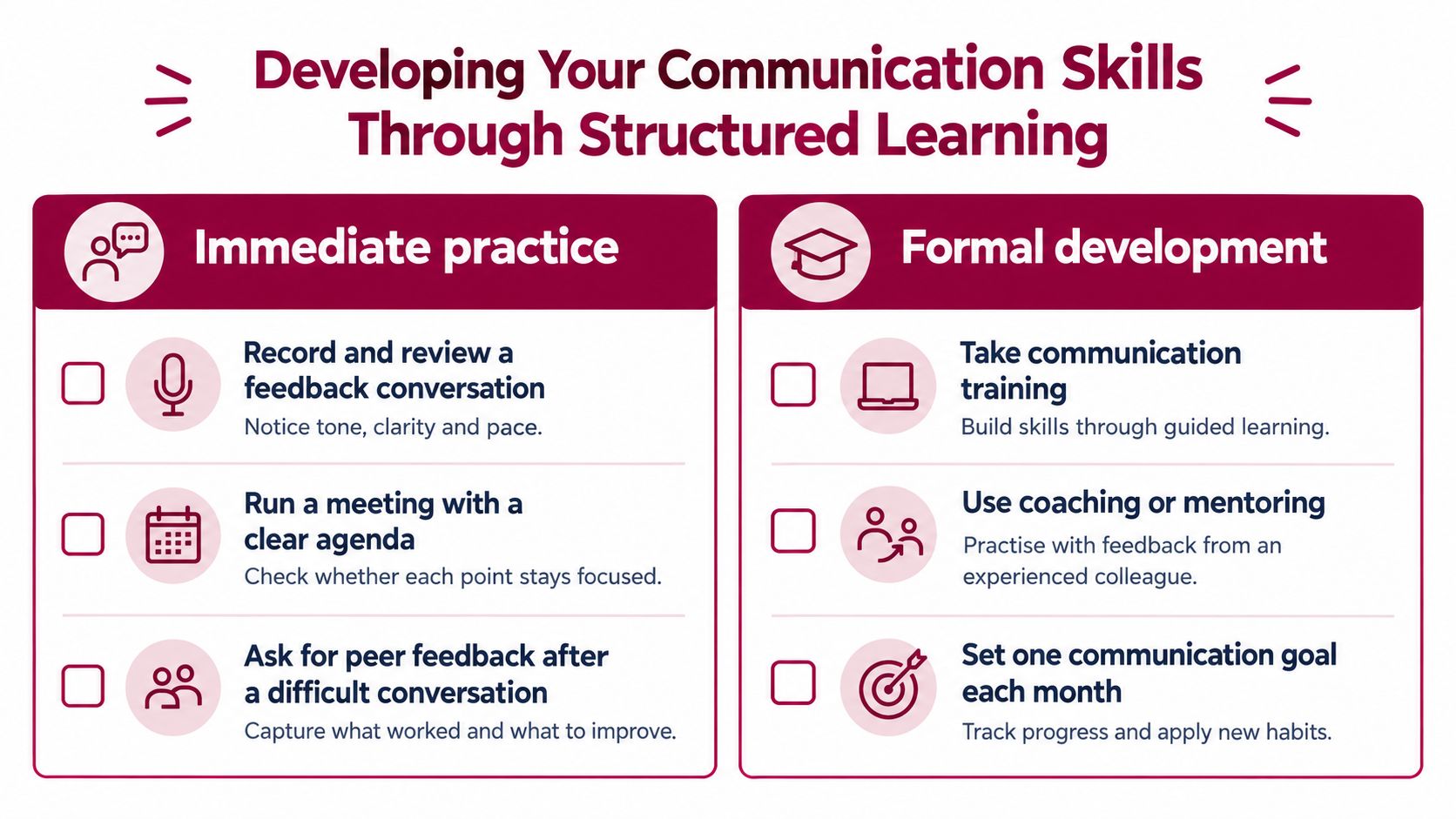
- Review a conversation. With informed consent and organisational permission, record a practice feedback discussion and examine tone, pace and clarity. If recording isn't appropriate, use a role-play.
- Repeat the feedback-quality check. Compare responses over time and investigate recurring concerns rather than seeking a favourable score.
- Audit a week's messages. Identify where channel choice created avoidable uncertainty or unnecessary interruption.
- Rewrite interpretations as observations. Ask a trusted colleague whether the revised wording describes evidence rather than personality.
- Seek focused peer feedback. Request comments on a defined behaviour, not a general assessment of your leadership.
Keep recordings and notes appropriately protected, particularly when discussions concern identifiable employees. Development activity shouldn't compromise the privacy of the people involved.
Connect practice with a coherent learning pathway
Self-directed exercises are useful, but managers can overlook weaknesses they don't yet recognise. Structured learning offers a sequence of concepts, opportunities for application and assessment against stated expectations. Coaching and mentoring can complement that structure by examining how learning transfers into actual conversations.
When considering leadership training courses, examine the curriculum, assessment methods and evidence of completion. A certificate records achievement within a programme; continued workplace practice remains necessary to demonstrate managerial capability.
The communication course named earlier sits within The Credential of Leadership and Management, a CPD-accredited, eight-course pathway comprising 160 hours. Its scope includes leadership fundamentals, emotional intelligence, conflict resolution and change management. Delivery is self-paced through recorded lectures, study materials and interactive assessments, with a verifiable certificate on completion.
Choose a skill cluster to practise this month and arrange a specific opportunity to receive feedback on it. Consider structured study where you need a coherent foundation rather than isolated techniques.
London School of Business Administration offers self-paced business and management education, including a structured leadership pathway covering communication and related people-management subjects. Visit London School of Business Administration to examine the curriculum and assessments, then select study that supports the communication behaviour you've committed to practising.