
Only 47% of UK employees said they weren't afraid to take risks or make mistakes because their company didn't have a blame culture, according to Reward Gateway's 2024 survey. That finding reframes psychological safety in the workplace: the issue isn't only whether managers invite contributions, but whether employees expect a reasonable response when they reveal something uncomfortable. For UK managers, the practical task is to examine both how work is organised and what happens after someone raises a concern.
Table of Contents
- What Psychological Safety Means at Work
- Why Silence Costs More Than Conflict
- How to Measure Psychological Safety in Your Team
- Six Work Conditions That Make Speaking Up Feel Risky
- Leader Behaviours That Build Safety Day to Day
- Case Examples From the NHS and UK Workplaces
- Start a Closed Feedback Loop This Quarter
What Psychological Safety Means at Work
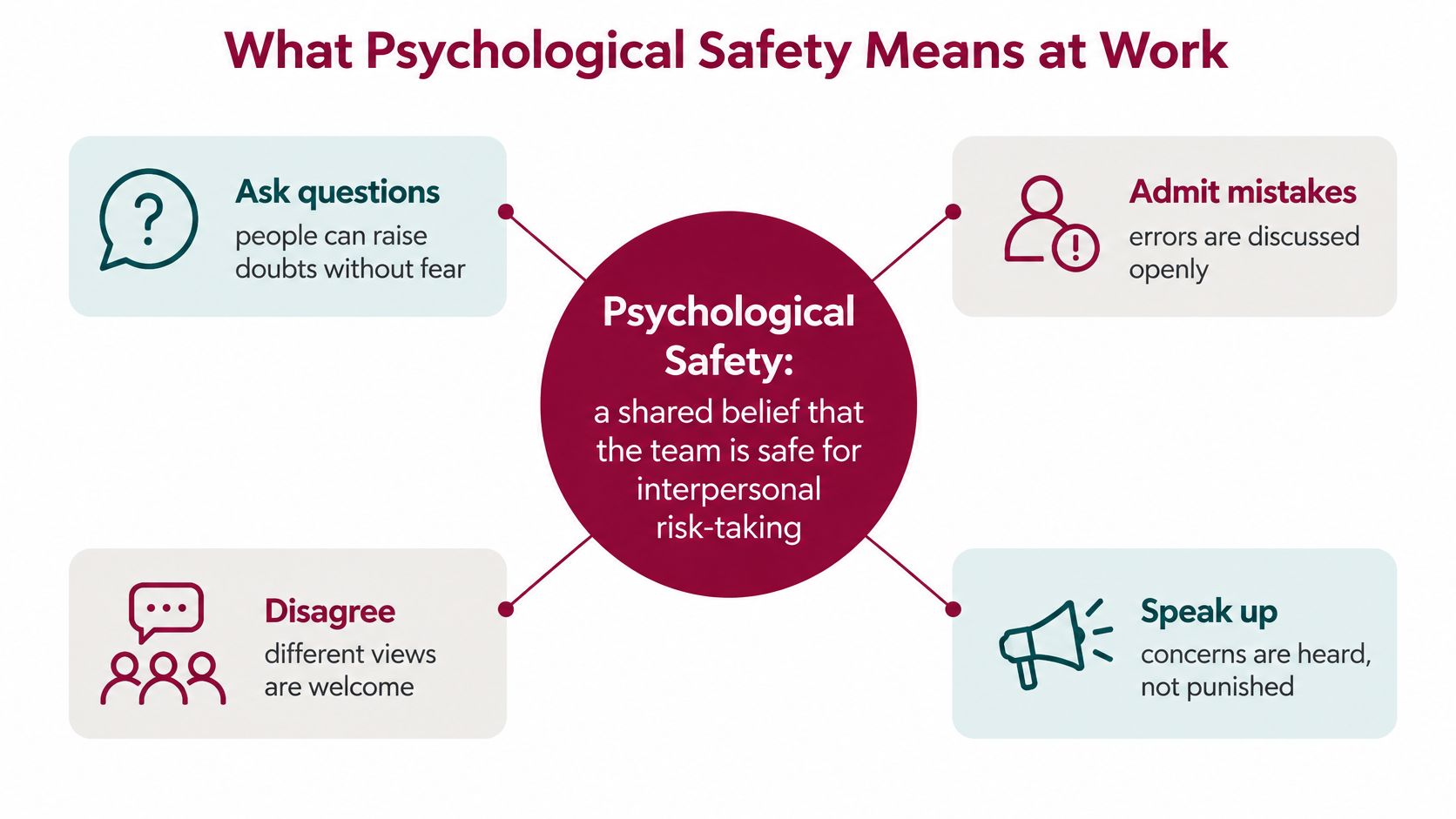
Psychological safety is a shared belief that a team is safe for interpersonal risk-taking. People can ask questions, acknowledge mistakes and disagree without expecting humiliation or punishment for doing so. A climber trusts a partner's rope not because the climb is easy, but because the safety system holds when it matters.
Consider a project meeting where an analyst notices that a forecast rests on an unreliable assumption. Speaking carries a personal risk: the analyst might appear negative, embarrass a senior colleague or delay a decision. Psychological safety concerns whether the team can examine that objection without treating its author as the problem.
Safety isn't the same as comfort
Amy Edmondson's research popularised the concept, which is now used in health care, engineering and professional services. Its application requires an important distinction: safety concerns the consequences of contributing, not freedom from difficult conversations.
A supportive manager may still reject an idea, question weak evidence or investigate an error. Niceness without honest challenge can leave serious problems untouched. Equally, accountability without a fair hearing can teach employees to conceal precisely the information managers need.
Behaviours in psychologically safe and unsafe teams
| Behaviour | Safe team | Unsafe team |
|---|---|---|
| Raising a concern early | Flagged within the week and discussed openly | Held back until it becomes a crisis |
| Admitting an error | Reported and reviewed as learning | Hidden, or blamed on an individual |
| Challenging a senior decision | Questioned on its merits | Accepted to avoid friction |
| Asking for help | Requested without any cost to status | Delayed until deadlines slip |
| Reporting a near miss | Logged and acted on | Rarely reported |
Treat this comparison as a diagnostic lens, not a validated score or a universal reporting timetable. Urgent safety concerns require immediate attention, while other issues need an agreed route and response period.
The distinction also applies to responsibility. An honest mistake, a poorly designed process and deliberate misconduct require different responses; psychological safety doesn't mean treating them as equivalent.
Try a practical self-test this week: when did a team member last disagree with you in a meeting, and what happened next? Examine your response, the reactions of colleagues and whether the objection influenced the decision.
Why Silence Costs More Than Conflict
In its 2024 reporting, the Chartered Institute of Personnel and Development found that 47% of employees who experienced conflict at work let it go, while 29% discussed it with their manager or HR.
These figures describe what people said they did. They do not prove that every quiet employee was afraid, or that every unspoken disagreement later caused harm. Some people settle small differences on their own. Others judge, reasonably, that an issue does not need a formal route.
Silence is still a poor signal of agreement. An employee can stay quiet because they expect damage to their reputation, a dispute that goes nowhere, or no change at all. People with more authority often experience that calculation differently: the same comment feels safer when the speaker can influence what happens next. The costly gap is not only whether someone is willing to speak. It is whether they believe a manager will act on what they hear.
The operational consequences of withheld information
A customer-service agent received two conflicting refund rules within one shift. Earlier questions had drawn criticism, so the agent applied the rule that carried less personal risk and left the contradiction unreported.
That choice is rational for the individual and expensive for the operation. Withheld information works like a closed valve on a pipe: pressure builds out of sight, and the first visible sign is often a leak rather than a warning. Managers miss recurring defects, inappropriate behaviour and unreliable procedures. Decision-makers hear apparent agreement instead of the objections and uncertainties that would change the plan. People who stop believing the conditions will change may reduce their effort or look for another role.
Silence is one contributor, not the only one. Workload, pay, staffing and conditions outside the team also shape these outcomes.
Constructive disagreement gives managers something they can examine. Silence gives them very little basis for judging whether agreement is genuine.
The practical reverse is ordinary, not mysterious. A defect raised before delivery can still be corrected. An unsuccessful experiment discussed in the team can stop the next person repeating it. Both depend on follow-through: a route for the concern, a decision, and a visible result. If the design of the work keeps producing contradictory instructions, listening alone will not fix the next shift.
Learning how to handle conflict at work therefore means more than calming disputes that are already visible. Managers also need room for disagreements that have not surfaced yet, without treating every concern as a confrontation or a formal grievance.
How to Measure Psychological Safety in Your Team
Measure behaviour, not mood. A general question about happiness or engagement won't tell you whether employees can challenge a senior colleague, admit an error, request help or report a near miss.
Measurement methods and what each reveals
| Method | What it reveals | Main limitation |
|---|---|---|
| Behaviour-specific survey items | Whether staff can challenge, admit error, ask for help and report near misses | Self-reported, so anonymity is needed for honest answers |
| Anonymous pulse survey | Trends by team across quarters | Response rates fall when nothing changes |
| Team listening sessions | Reasons behind low scores | Hard to run consistently; louder voices dominate |
| Near-miss and incident reporting | Whether problems surface early | More reports can mean more trust or worse conditions |
| Grievance, absence and turnover data | Downstream signs of silence or strain | Lagging indicators that change slowly |
| Response-time and follow-up records | Whether concerns lead to action | Requires disciplined logging |
A 2024 UK survey reported by Ipsos Karian and Box covered 2,646 employees aged 18–75, with only just over half reporting a workplace where they could speak up, challenge established practices, make mistakes and innovate without fear. These are related behaviours, but they aren't interchangeable: someone may comfortably ask for technical help while feeling unable to challenge a director.
Ask specific questions and protect respondents
Use a consistent agreement scale for statements such as being able to question a senior colleague's decision or acknowledge an error without unfair treatment. Include an item about whether raising a concern leads to a meaningful response. This separates permission to speak from confidence in action.
Before collecting answers, explain who can access responses, how comments will be handled and what anonymity means in practice. Don't promise anonymity if a small team or a distinctive incident would identify the respondent.
Segment results by hierarchy, function, employment status and demographic group, where confidentiality permits. An acceptable organisation-wide average can conceal a frontline team whose experience differs sharply from that of head-office managers.
Compare patterns rather than isolated scores
Repeat the same items quarterly and examine changes within teams. Keep wording stable so that an apparent improvement doesn't merely reflect an easier question.
Combine survey findings with listening sessions and operational records. If a team reports that help-seeking is safe but repeatedly misses deadlines because employees escalate problems late, explore the mismatch rather than choosing whichever indicator looks better.
Low participation can signal fear, although survey fatigue or poor timing may also explain it. Equally, repeated surveys without visible decisions can increase cynicism.
Before launching a first survey:
- Choose focused items: Cover challenge, error, help-seeking, reporting and managerial response.
- Set anonymity rules: Establish access controls and minimum reporting groups.
- Agree meaningful segments: Identify groups whose experiences might otherwise disappear within an average.
- Publish an action commitment: Specify when employees will receive findings, decisions and progress updates.
Six Work Conditions That Make Speaking Up Feel Risky
In Great Britain, an estimated 964,000 workers experienced work-related stress, depression or anxiety in 2024/25, accounting for 22.1 million working days lost, according to the Health and Safety Executive. These Labour Force Survey estimates describe reported work-related illness; they don't prove that low psychological safety caused those cases.
The management implication is nevertheless substantial. Asking employees to communicate more openly won't resolve an excessive workload, an absent supervisor or conflicting responsibilities.
Diagnose the work, not just the conversation
The Management Standards guidance published by HSENI identifies demands, control, support, relationships, role and change as work-design domains. Apply them as diagnostic questions rather than labels for a training workshop.
- Demands: Could admitting an error make an already impossible deadline harder to meet? Compare assigned work with available capacity, then adjust priorities rather than merely encouraging resilience.
- Control: Can employees change how they perform a task? Where every deviation requires approval, clarify which improvements people can test independently.
- Support: What happens when someone needs assistance? Check whether the nominated manager is accessible and whether cover exists during absence.
- Relationships: Does disagreement become personal? Examine interruptions, dismissive comments and repeated patterns of exclusion, not just formal complaints.
- Role: Are responsibilities clear enough for someone to challenge a problem without appearing to overstep? Resolve conflicting instructions and identify decision owners.
- Change: Do employees understand what is changing and what remains undecided? Provide opportunities to question proposals before implementation makes objections harder to accommodate.
For each domain, record an accountable owner, a targeted intervention and a review date. A workload intervention might involve stopping a low-priority task; a role intervention might involve clarifying who approves exceptions.
Test whether the intervention changes working conditions
Compare pulse responses with overtime, sickness absence, turnover, grievances, missed deadlines and near-miss reports. None is a direct measure of psychological safety, but together they can help managers distinguish a communication difficulty from an unsafe or poorly designed job.
Consult employees when evaluating risks and record the reasoning behind proposed controls. Review whether the change removed the obstacle, rather than treating the completion of an action as proof of success.
Practical rule: Don't ask employees to be more candid while leaving intact the conditions that make candour costly.
Clear performance standards and proportionate investigation still apply. The aim is to make honest information available while addressing the organisational pressures that might otherwise encourage concealment.
Leader Behaviours That Build Safety Day to Day
A team member reports that a project will be late. The manager immediately asks why the problem wasn't reported sooner, before understanding when it became apparent or what prevented escalation. Even if the question is legitimate, its timing may make the conversation feel like an accusation.
A more useful opening acknowledges the information, establishes the immediate risk and then examines the reporting delay. The first reaction helps determine whether the next concern arrives early.

A 2025 Safecall survey of more than 2,000 UK employees found that 36% identified fear of personal consequences as the main barrier to speaking up, while 40% believed they would face workplace consequences if they reported misconduct. These measures concern anticipated consequences, not verified instances of retaliation, but they identify a concrete management problem.
Practise responses that keep information flowing
- Thank the person before judging the concern. Acknowledging the contribution doesn't mean accepting every allegation as established fact.
- Ask questions before deciding. Establish what happened, what remains uncertain and whether anyone faces immediate harm.
- Acknowledge your own mistakes. Describe a genuine error and the corrective action, rather than performing vulnerability without accepting responsibility.
- Invite dissent before giving your view. Ask colleagues for independent assessments so they aren't responding to the most senior opinion.
- Explain what happens next. Name the person responsible for reviewing the matter and agree when the reporter will receive an update.
- Separate the issue from the person. Examine decisions and circumstances without using humiliating labels or assumptions about character.
- Check for retaliation after disclosure. Look for exclusion, changed treatment or unexplained disadvantages, and provide a route to report them.
Understanding why emotional intelligence is important is useful here because managers must recognise their own defensiveness without allowing it to determine the response. Remaining composed isn't enough if the subsequent decision is dismissive or unexplained.
Rehearse difficult conversations
Case-based leadership development allows managers to practise handling incomplete information, disagreement and uncomfortable disclosures before facing them at work. In our programme design, Jenna Tiffany integrates real-world organisational scenarios with structured frameworks and applied case-based learning.
The Public Interest Disclosure Act 1998 provides a legal backdrop for protection against detriment when workers make qualifying protected disclosures. Not every workplace complaint meets those conditions, so managers should explain the applicable rights and reporting routes without promising that every disclosure has identical legal protection.
Confidentiality also has limits. Explain who may need information to assess the concern, and don't promise secrecy that a fair investigation cannot maintain.
Case Examples From the NHS and UK Workplaces
A reporting route and a decision that changes the work are different achievements. In the National Guardian's analysis of the 2023 NHS Staff Survey, 71.3% of respondents felt safe speaking up about unsafe clinical practice, but only 56.8% believed their organisation would address those concerns.
NHS Freedom to Speak Up figures, 2023
| Measure | Value | What it signals |
|---|---|---|
| Felt safe speaking up about unsafe clinical practice (2023) | 71.3% | Willingness to speak is relatively high |
| Believed the organisation would address clinical-safety concerns (2023) | 56.8% | Confidence in follow-through is lower |
Read the gap as a follow-through problem, not only a speaking problem. Staff can know the channel and still doubt that a report will alter staffing, kit, or a senior decision. The survey does not show why each person withheld confidence. A missing “yes” can mean uncertainty rather than a firm “no”. Managers can still treat the two results as separate: people will raise clinical risk more readily than they expect the organisation to act.
Why a reporting policy may not be enough
A Lancaster University study of psychological safety in NHS settings combined a synthesis of 18 papers with 11 semi-structured interviews with operating-theatre staff. It treats organisational environment, structure, resources and attitude as relevant dimensions. That is context for how safety is built, not a national prevalence figure.
Those dimensions show where a written policy meets the design of the job. A junior employee may know the procedure and still hesitate because a senior colleague controls access to development. A team may be told to discuss mistakes and still have no protected time in the list to do it. The invitation and the timetable contradict each other.
Leaders' attitudes sit beside resources. If a manager treats a question as proof of incompetence, staff learn that compliance is safer than clarification. A policy on the intranet does not repair that lesson. The safer habit is already in the room: stay quiet, finish the list, leave the awkward fact unsaid.
A night shift that the average hides
A night supervisor at a hypothetical UK logistics firm illustrates the same split. The organisation-wide survey looks reassuring. Split by shift, night workers feel less able to raise operational concerns than day workers.
Listening sessions point to two design faults, not a vague culture problem. The supervisor dismisses near-miss reports as unnecessary paperwork. Staff also cannot get replacement equipment outside normal office hours. One fault is how a person responds. The other is a resource rule that makes a night report pointless: even a fair hearing cannot produce a pallet jack at 02:00.
An intervention has to touch both. Review the supervisor's handling of near misses, open a reliable equipment-escalation route for unsocial hours, and check how night-shift concerns are closed. A generic listening workshop leaves the paperwork habit and the locked stores in place.
The useful question for your own organisation is narrow. Where do employees appear willing to report, but doubtful that reporting will change anything? Set those answers beside the actual file: unresolved cases, repeat issues, and the explanation the reporter received.
Start a Closed Feedback Loop This Quarter
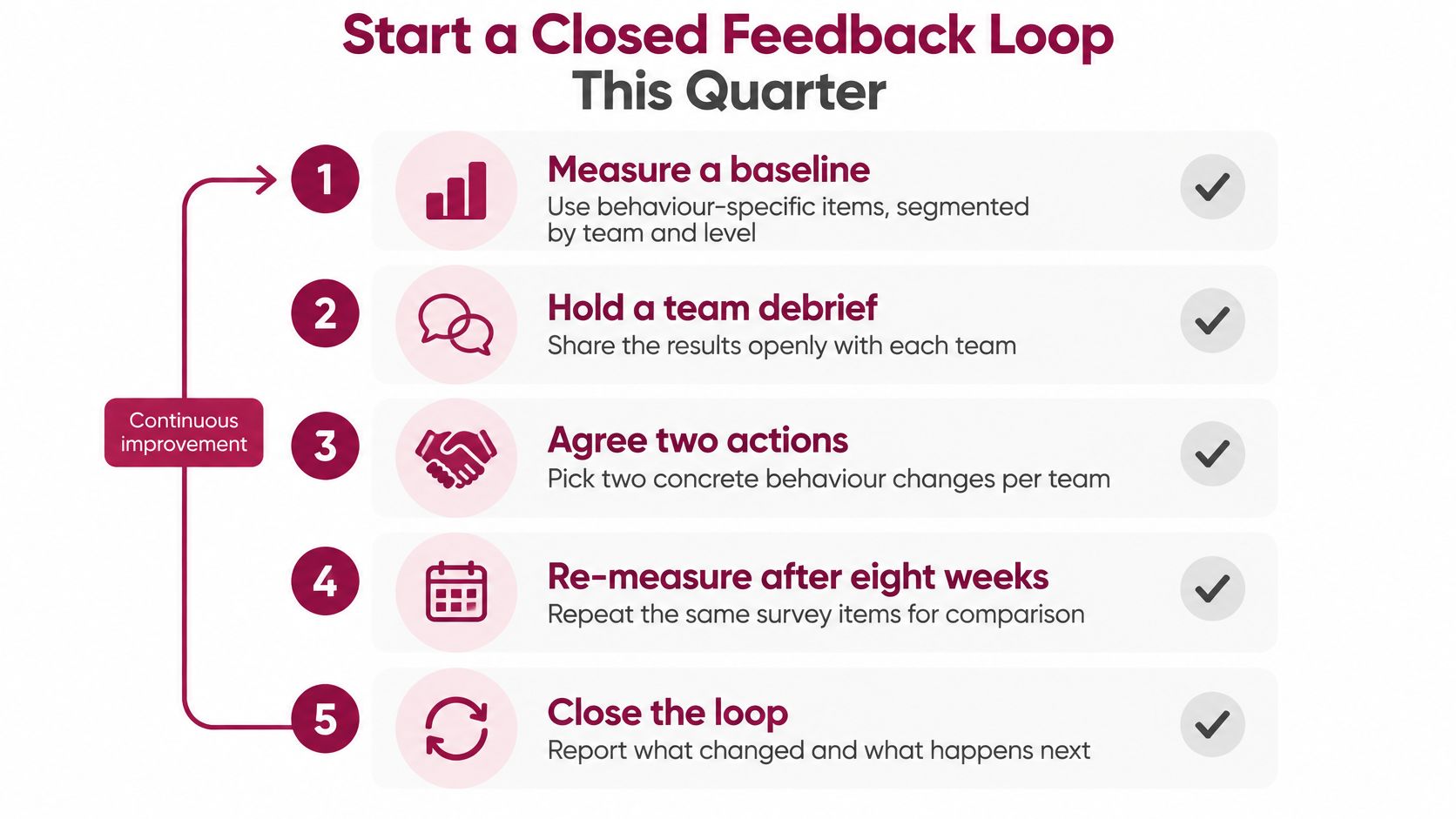
Establish a closed feedback loop as your first action. Give employees a traceable route from raising an issue to understanding the decision and seeing whether conditions improve.
- Establish a baseline: Use behaviour-specific items and examine results by team and level.
- Listen where confidence is low: Hold facilitated discussions that explore situations rather than demand names.
- Assign a work-design intervention: Select a relevant domain, name an owner and set a review date.
- Acknowledge concerns consistently: Agree response expectations and explain the review process.
- Investigate proportionately: Record evidence, decisions and necessary escalation.
- Communicate the outcome: Tell reporters what changed, or explain why a different response was appropriate.
- Repeat the assessment: Schedule a quarterly review using the same items and examine whether employees' experiences changed.
Judge the response, not just the reporting total
The National Guardian's 2024/25 annual data report recorded 14,171 concerns related to worker safety or wellbeing, an increase of 36.2%. A rising total alone cannot distinguish improved access and trust from worsening conditions.
Track response times, substantiated concerns, recurring issues, perceived retaliation and whether reporters receive meaningful outcomes. Practical efforts to improve team communication should include these response routines, not just opportunities to submit feedback.
For structured practice, The Credential of Leadership and Management is an eight-course, CPD-accredited pathway covering Leadership Fundamentals, Strategic Leadership, Decision Making, Emotional Intelligence, Conflict Resolution, Change Management, Communication Skills and Team Leadership. Our leadership curriculum emphasises communication excellence, emotional intelligence, team development, decision-making frameworks and corporate direction, with scenario-based learning supporting rehearsal before workplace application.
London School of Business Administration offers online, self-paced business and management education combining recorded lectures, learning materials and assessments. To develop the communication, judgement and conflict-handling skills that support psychologically safer management, visit London School of Business Administration and explore a learning pathway alongside a concrete improvement plan for your team.