


You can sit in a review meeting, hear the same feedback for the third time, and watch two capable people react in completely different ways. One treats the criticism as a verdict, gets cautious, and stops volunteering for stretch work. The other treats it as information, adjusts, and comes back with a better attempt next week. That difference is the practical heart of growth and fixed mindset, and it shows up in schools, teams and boardrooms every day.
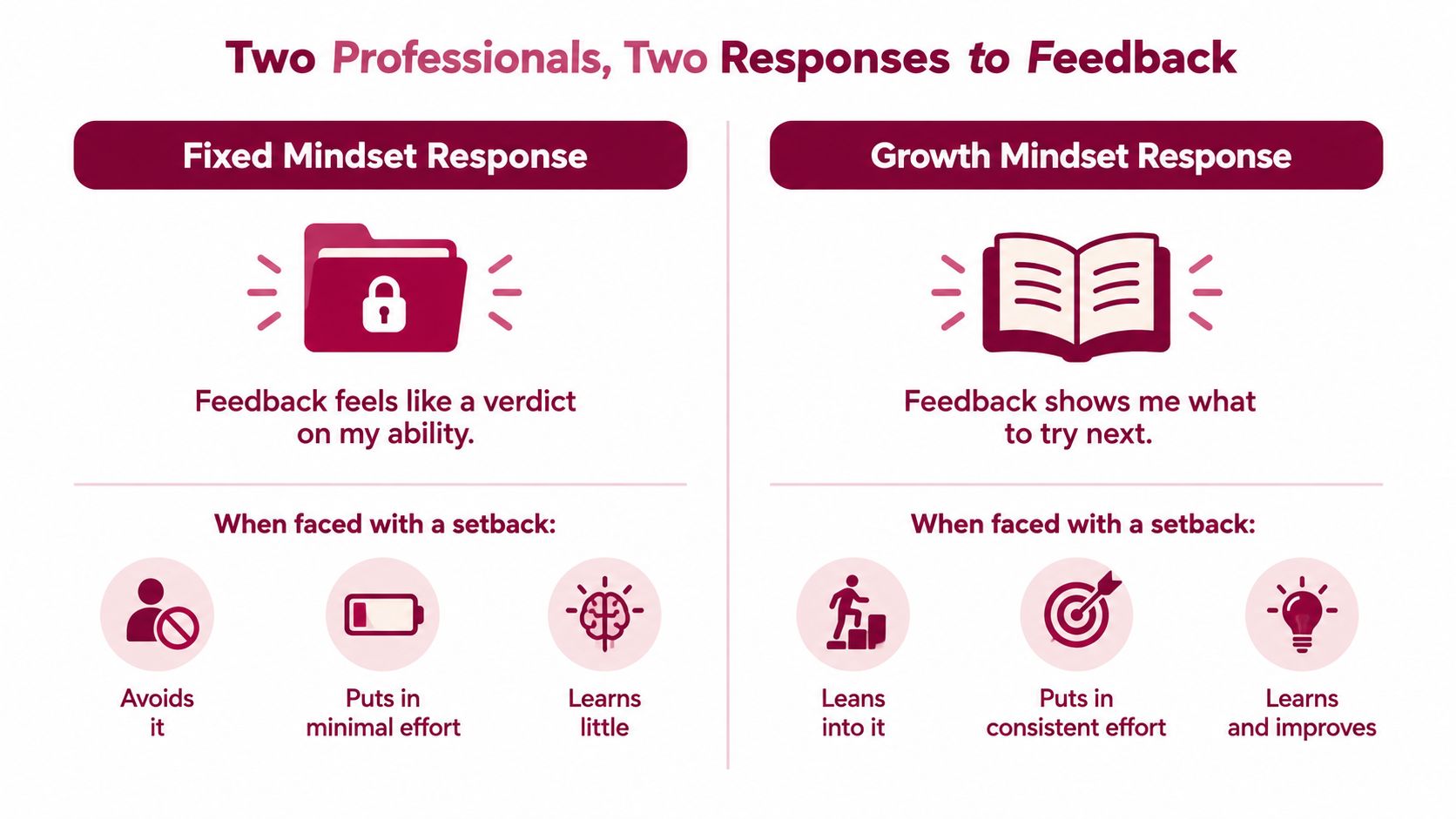
A fixed mindset treats ability as largely innate and stable. A growth mindset treats ability as something that can develop through effort, strategy, feedback and repetition. In workplace terms, the first response often avoids exposure, defends past performance and gives up faster under strain. The second keeps learning visible, absorbs criticism without spiralling, and changes method when the current one fails.
For leaders, the issue is not whether one mindset sounds more positive. It's whether people have the conditions to turn developmental beliefs into better decisions, better work and better learning. That is why emotional intelligence matters as much as attitude, and why understanding emotional intelligence in leadership sits so close to this topic.
Table of Contents
- Understanding Growth and Fixed Mindset
- The Evidence Behind Mindset Interventions
- When Growth Mindset Fails or Causes Harm
- Leadership Implications of Mindset Research
- Cultivating Growth Mindset in Organisations
- Conclusion – Beyond the Mindset Binary
- Frequently Asked Questions About Mindset
Understanding Growth and Fixed Mindset
A project lead misses a deadline and receives blunt feedback. One manager immediately starts protecting themselves, explaining why the brief was flawed and why the team should have anticipated problems. Another asks which part of the process failed, what can be improved, and what support is needed before the next cycle. Same setback, different interpretation, very different next move.
What the two mindsets look like in practice
The distinction developed by Carol Dweck is not about optimism versus pessimism. It is about the assumptions people carry into difficulty. A fixed mindset tends to read ability as something you have or don't have, which can make challenge feel threatening. A growth mindset treats ability as developable, so challenge becomes part of learning rather than proof of inadequacy.
That difference shows up in behaviour. People leaning towards a fixed mindset often avoid hard tasks that might expose limits, become defensive when criticised and stop earlier when a task gets uncomfortable. People leaning towards a growth mindset are more likely to keep going, ask for feedback and change their approach when the first attempt does not work.
Practical rule: watch what someone does after correction, not what they say about learning. The response to pressure reveals more than a slogan ever will.
The concept is useful because it names a real pattern of thought, emotion and action. It is not a magic explanation for achievement, and it certainly isn't a substitute for instruction, coaching or time. But as a diagnostic, it helps leaders notice when people are protecting their identity instead of improving their performance.
A simple professional test
If feedback feels like an attack, the mindset is probably fixed in that moment. If feedback becomes a prompt for the next attempt, the person is acting from a growth orientation. Both states can appear in the same individual, depending on the task, the stakes and the environment.
The Evidence Behind Mindset Interventions
The evidence is more mixed than popular writing often suggests. In English schools, the Education Endowment Foundation's Changing Mindsets evaluation, independently conducted by the National Institute of Economic and Social Research, involved 5,018 Year 6 pupils in 101 English schools and found no evidence that participating pupils made additional progress in literacy or numeracy compared with control schools, using national Key Stage 2 assessments in reading, grammar, punctuation and spelling, and mathematics. The EEF concluded that the intervention did not produce a measurable attainment benefit and advised caution about treating growth mindset as a standalone route to higher achievement. EEF's published findings on growth mindsets
What the UK studies actually show
Earlier UK work was more encouraging on the surface, but still uncertain. The first EEF-funded Changing Mindsets efficacy trial, delivered by the University of Portsmouth between January and May 2013 in Year 5 settings across Portsmouth, Southampton and Hampshire, reported an average of two additional months' progress in English and mathematics for pupils receiving workshops, but that result was not statistically significant. The teacher-training arm produced no additional mathematics progress and lower English progress than the control group, again without statistical significance. The original Changing Mindsets project summary
A later UK university study points to a more effective mechanism. In a randomised study of first-year students at a research-intensive UK university, a light-touch intervention increased validated growth-mindset scores by about 0.25 standard deviations, raised academic performance by about 0.17 standard deviations and increased the probability of crossing the threshold for the highest UK degree classification by 5.7 percentage points. The useful detail is not the slogan, it is the behaviour change: students reported more efficient study through active learning and spacing work on the same material. The conference paper on the UK university intervention
A Scottish study of Mindset Teams found a moderate positive association with writing attainment, estimated at about 3% higher outcomes for participating schools, with a 95% confidence interval from 1% to 6%, and schools were about 1.5 times as likely to move up one decile category for the writing criterion, though the reported probability value was 0.08 and the confidence interval was broad. It found little evidence of effects on reading, numeracy or listening and talking, and no demonstrated impact on attendance. Mindset Teams research
| UK Growth Mindset Research Findings | Sample | Outcome |
|---|---|---|
| Changing Mindsets evaluation | 5,018 Year 6 pupils in 101 English schools | No additional progress in literacy or numeracy |
| Portsmouth efficacy trial | Year 5 settings across Portsmouth, Southampton and Hampshire | Average of two additional months' progress, not statistically significant |
| UK university intervention | First-year students at a research-intensive UK university | About 0.17 standard deviations higher performance, with a 5.7 percentage point increase in highest-degree classification threshold attainment |
| Mindset Teams research | Scottish schools | About 3% higher writing outcomes, with little evidence of effects elsewhere |
If you work in leadership or management education, the lesson is clear. Mindset content only matters when it changes what people do next. Digital Transformation in Business makes sense as an example of this principle, because digital capability usually improves through repeated application, review and adjustment rather than attitude alone.
The strongest pattern in the evidence is not universal success or failure. It is conditional effectiveness. The intervention matters, but so do task design, feedback quality and whether learners have a realistic method for improvement. Motivation for leaders becomes useful only when motivation is connected to the work itself.
When Growth Mindset Fails or Causes Harm
A growth mindset message can go wrong when it asks people to persist while the system stays unchanged. At first it sounds supportive. Then it starts to feel punitive. If an employee, student, or junior manager is told to try harder but still lacks time, coaching, access, or a workable route forward, the message stops being developmental and starts sounding like blame.
The risk of turning development into responsibility alone
UK evidence does not support the idea that growth mindset automatically improves motivation or resilience. Earlier replication work found no meaningful relationship between mindset and motivation or resilience in pupils, and it also reported worse performance among children with a growth mindset when material became more difficult. A 2025 review of 24 higher-quality school studies reported null or very modest effects on academic outcomes, with possible conflicts of interest in seven studies. A critical overview of growth mindset interventions
That matters because the label can hide a moral error. Saying “ability can develop” is one thing. Suggesting that people are personally responsible for overcoming every barrier, regardless of context, is another. Those are different claims, and they lead to different management behaviour.
Growth language without resources becomes a test of endurance, not a support for learning.
What the UK studies show
A University of Cambridge summary of international research using PISA data covered 248,375 secondary-school pupils in 74 countries. Across the dataset, the average science-score gap between pupils in the highest and lowest socioeconomic-status quartiles was 70.5 points, almost three years of schooling, and differences in social and emotional characteristics, including attitudes associated with growth mindset, accounted for no more than 9% of that gap. Cambridge on socioeconomic achievement gaps
That should change how leaders talk about underperformance. Mindset is part of the picture, but it is not a substitute for material support, fair assessment, usable development time, or skilled instruction. In business terms, you cannot fix a capability gap by asking people to want it harder.
Leadership Implications of Mindset Research
Leaders reveal their own mindset in how they handle other people's mistakes. A fixed mindset tends to show up as overprotection of ego, reluctance to delegate and a preference for being seen as right rather than being improved by feedback. A growth orientation shows up differently, in how leaders absorb criticism, discuss skill gaps and make learning visible in the team.
What fixed and growth leadership looks like
A leader with fixed-mindset tendencies may avoid giving stretch assignments because failure could reflect on their judgement. They may also praise natural talent more than disciplined practice, which signals to the team that some people are “better” and others are stuck. Over time, that creates a low-trust culture where people hide uncertainty until problems become larger.
A growth-minded leader behaves differently. They normalise productive failure, run short post-project learning reviews and separate the person from the performance issue. They make it normal to say, “That approach didn't work, what will we change?” rather than “Who is at fault?”
Useful standard: if your team can only talk about success, it is not learning, it is image management.
The best leaders also avoid the false binary. A manager can hold a fixed view of a current skill level and still adopt a growth-oriented development plan. That is not inconsistency, it is accuracy. Good leadership requires both realistic assessment and a belief that performance can improve with the right support.
The role of environment
Mindset is not just a personal trait, it is shaped by systems. Workload, coaching quality, evaluation fairness and psychological safety all affect whether people can act on developmental intent. If the environment punishes error harshly, people will protect themselves. If it allows measured experimentation, they are much more likely to learn in public.
The article The Psychology of Leadership and What Makes a Good Leader fits this discussion because leadership effectiveness is never only about intent. It is also about the conditions leaders create for others to think, speak and improve.
Cultivating Growth Mindset in Organisations
The first mistake organisations make is treating growth mindset as a messaging campaign. The second is praising persistence without checking whether the person has a realistic path to progress. If you want a growth-oriented culture, start with the learning behaviour you can observe, then build the system around it.
Five checks before you use the language
- Model learning openly: leaders should admit what they are still learning, especially when the topic is close to their own role.
- Reward process as well as outcome: notice the quality of the method, not only the result at the end.
- Make failure usable: review setbacks as data, not as a reason to shame the person involved.
- Give time for development: stretch work without recovery time usually produces pressure, not growth.
- Measure what matters: track learning behaviours alongside performance results, so improvement is visible rather than assumed.
These checks matter because mindset only becomes practical when it changes behaviour. The UK university study makes that clear, since gains appeared when belief shifts were linked to active learning methods, spaced study and strategic adjustment after failure. In other words, the habit changed first, then the outcome followed. That is why Communication Skills for Leaders is relevant here, because coaching, feedback and developmental conversations depend on how leaders speak and listen.
A workable development cycle
Use brief, repeated learning reviews after projects rather than one annual conversation. Separate a developmental discussion from a judgemental one. Ask what was tried, what was learned, what needs more practice and what support would make the next attempt better.

A useful test is simple. If your team leaves a meeting knowing only that they should try harder, the culture is still motivational. If they leave knowing what to practise, what to change and how success will be reviewed, the culture is becoming developmental.
Conclusion – Beyond the Mindset Binary
Growth mindset is useful, but only when it stays connected to actual learning conditions. Fixed mindset still describes a real pattern, one where ability is treated as relatively unchangeable and feedback feels threatening. The problem is not the language itself. The problem is what happens when the language is presented as if it were enough on its own.
The UK evidence points to a careful conclusion. School interventions have shown no universal attainment lift, and where benefits do appear, they are usually tied to specific behaviours and specific contexts. That means leaders should stop asking whether growth mindset is “good” or “bad” in the abstract. They should ask whether the organisation is giving people the tools, time and feedback they need to improve.
There is a better way to use the idea. Treat growth and fixed mindset as a diagnostic lens, not as a slogan. Use it to spot when people are protecting themselves, when they are ready to learn, and when the system is blocking development. That approach is more honest, and it is far more useful.
Frequently Asked Questions About Mindset
Is a fixed mindset always negative
No. Sometimes a fixed judgement is an accurate assessment of current capability. A leader who knows a person is not ready for a task yet may be making a sound decision about risk, not expressing defeatism. The mistake is to confuse realism with resignation.
Can growth mindset be learned
Yes, but brief belief change rarely lasts unless the surrounding system supports it. The evidence above suggests that people change more reliably when mindset language is tied to feedback, practice and repeated application. A one-off motivational talk is unlikely to produce durable behaviour change.
Does growth mindset work equally well in every context
No. The evidence varies by age group, outcome and implementation quality. Academic results, writing attainment and behavioural change do not always move together, which is exactly why leaders should avoid one-size-fits-all claims. A method that helps with one task may do little for another.
Does growth mindset improve wellbeing
Not by itself. The 2025 UK trial of an online, single-session intervention changed mindset measures in 104 young people aged 14 to 18, but it produced negligible, statistically non-significant effects on anxiety and depression. That does not make the idea useless, but it does show that mindset is not a mental-health treatment. UK trial on mindset and wellbeing
Should leaders use growth mindset language with struggling staff
Only if they are also changing the conditions around the work. Growth language without coaching, time, feedback and realistic goals can sound like pressure to endure rather than support to improve. The better question is not, “How do we motivate harder?” It is, “What would make progress more possible?”
London School of Business Administration offers structured, self-paced business and management learning for professionals who want to build capability, not just motivation. If you want to develop leadership practice that turns feedback, reflection and improvement into real workplace habits, visit London School of Business Administration and explore how its courses support practical development.