
Strategic leadership is the discipline of converting long-term purpose into coordinated choices, measurable objectives, resource allocation and adaptation. The hardest part is rarely vision, it's building the execution architecture that makes strategy visible in day-to-day work.
Table of Contents
- Why Strategic Leadership Is More About Execution Than Vision
- Defining Strategic Leadership Through the UK Governance Lens
- The Four UK Management Practices That Turn Strategy Into Action
- Five Core Competencies Every Strategic Leader Needs
- Three Decision-Making Frameworks Worth Knowing
- A Monthly KPI Routine That Makes Strategy Observable
- Strategic Leadership in the Age of AI
- Putting It All Together and Where to Go Next
Why Strategic Leadership Is More About Execution Than Vision
The popular story says strategic leadership begins with a compelling vision. That sounds tidy, but it misses the harder test, turning direction into routines people can follow, review and improve. A leader who can talk elegantly about the future but cannot shape priorities, decision rights and review rhythms has not yet led strategically.
The more useful way to think about it is simple, execution comes before inspiration. In practice, strategy only matters when managers translate it into targets, accountabilities, operating rules and feedback loops. That is why the article centres on mechanisms, not charisma.
From traits to systems
Many leadership discussions stay at the level of personality traits. That is too vague for mid-career professionals who need to run teams, make choices and defend results. Strategic leadership becomes clearer when you ask what structures make good intentions repeatable.
Practical rule: if a priority cannot be reviewed, escalated and adjusted, it is still an ambition, not a strategy.
This also changes how readers should evaluate themselves. Instead of asking whether they sound visionary, they should ask whether their team knows what matters, who owns each decision and how progress is checked. A manager who can answer those questions is already closer to strategic leadership than someone who only speaks in high-level language.
For a concise companion view on turning intent into action, see Strategic Thinking for Leaders.
What this means for the rest of the discussion
The useful shifts are threefold. First, from definition to mechanism. Second, from traits to systems. Third, from human judgement alone to human judgement supported by AI, without surrendering accountability.
That framing gives the reader four jobs: understand the concept, recognise the competencies, choose the right decision frameworks and translate strategy into routine practice.
Defining Strategic Leadership Through the UK Governance Lens
In the UK, strategic leadership sits close to corporate governance. It is about setting long-term direction, aligning organisational resources with that direction, managing risk and ensuring accountability at board level. That is why the concept has always had a structural dimension, not just a motivational one.
A formative moment was the Cadbury Report. The committee was formed in May 1991 by the Financial Reporting Council, the London Stock Exchange and the accountancy profession, and the report was published in 1992. Its argument was clear, governance should combine a voluntary code with transparent disclosure rather than rely only on statutory rules.
What Cadbury still teaches
The recommendations remain instructive for modern managers because they show how leadership should be constrained and tested. The report supported separating the roles of board chair and chief executive, or ensuring a strong independent board presence. It also favoured a majority of outside directors, remuneration committees mainly composed of non-executive directors and audit committees with at least three non-executive directors.
Those ideas matter because they formalised a practical definition of strategic leadership. Senior leaders are not only meant to set objectives, they are meant to design decision-making structures that challenge executives, monitor performance and protect stakeholders. In other words, strategic leadership is not just about choosing direction, it is about creating the conditions under which direction can be scrutinised.
A useful way to place the term is to separate it from adjacent ideas. Operational management keeps work flowing today. General leadership influences people through direction and support. Strategic leadership sits above both, because it shapes the long-term logic that operations and people management must serve.
Strategic leadership is most credible when authority is shared with scrutiny.
For readers who want a structured course reference, Strategic Leadership and Corporate Direction is the relevant title in the London School of Business Administration catalogue.
For a governance-oriented companion discussion, see corporate governance and accountability in today's business environment.
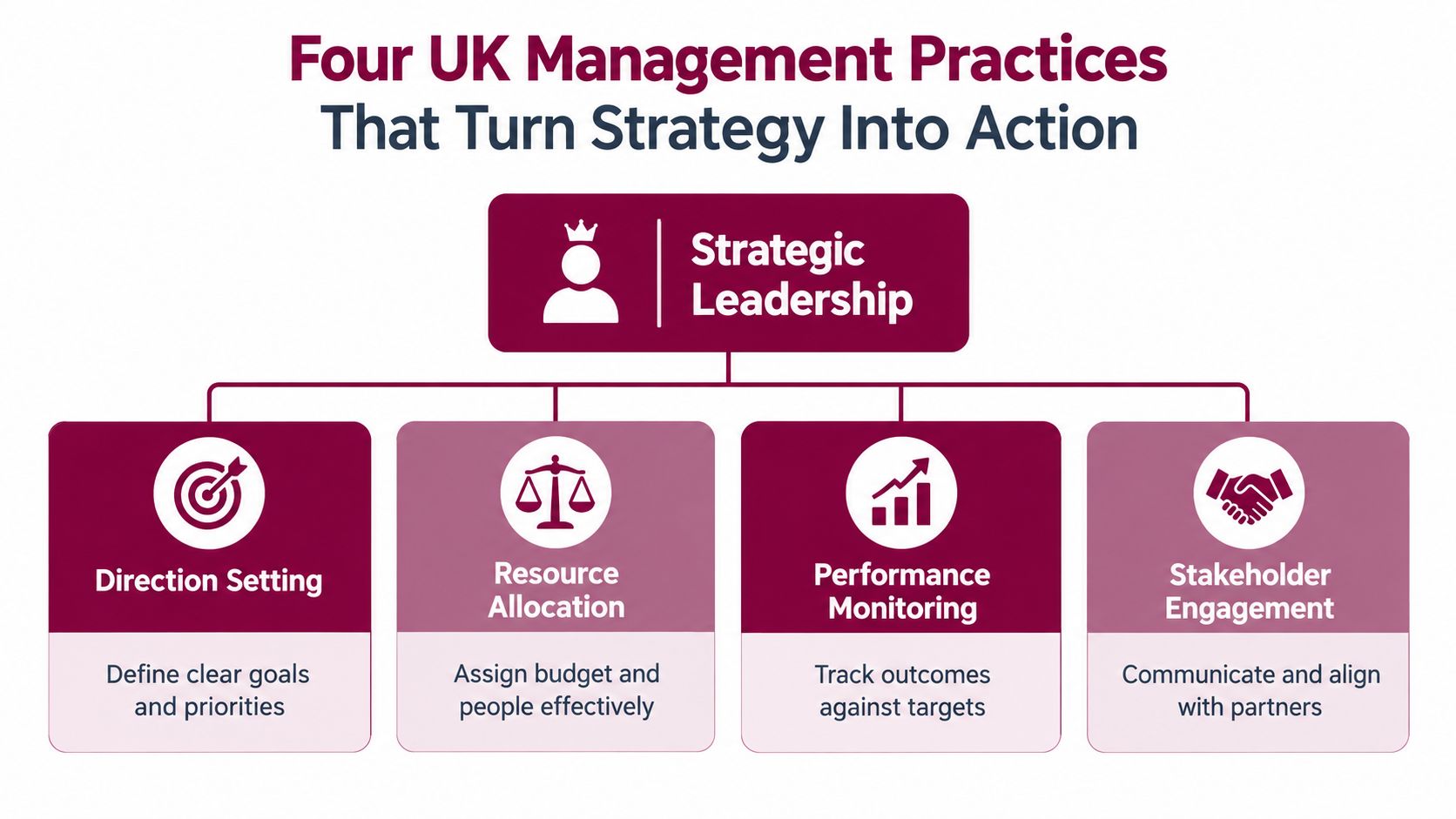
The Four UK Management Practices That Turn Strategy Into Action
The Office for National Statistics gives strategic leadership a practical shape. It measures management quality through continuous improvement, key performance indicators, target-setting and employment practices covering promotion, training and underperformance. That matters because these are observable systems, not personality traits.
The average UK management-practice score was 0.55 in 2023 on a 0-to-1 scale, and KPI use was the weakest of the four dimensions at 0.42. Those figures matter less as league tables and more as reminders that many organisations still struggle to make performance visible and actionable (ONS management practices bulletin).
Turning each practice into a manager's routine
Continuous improvement means problems are examined, not hidden. In a team meeting, that might mean reviewing one recurring failure and agreeing what will change before the next cycle.
KPI use is about choosing a small set of indicators and reviewing them often enough to shape behaviour. If the numbers only appear in a quarterly report, they are too slow to guide execution.
Target-setting checks whether objectives are clear, realistic and still relevant. Employment practices ask whether people are being hired, developed, promoted and corrected in ways that support the strategy.
A simple self-check
A manager can use four questions to test whether strategic leadership is real:
- Do our improvement discussions end with specific actions?
- Do our KPIs expose variance early enough to act on it?
- Are targets reviewed, or just announced?
- Do we address underperformance in a defined and timely way?
The ONS framework shows that strategic leadership is visible in routines. If those routines are absent, strategy tends to stay aspirational. If they are present, strategy becomes something people can see, discuss and adjust.
Five Core Competencies Every Strategic Leader Needs
The systems above only work if the leader has the competence to use them well. Strategic leadership therefore depends on a small set of behavioural skills that shape how a manager thinks, chooses and communicates. The point is not to collect a list of admirable qualities, but to build capabilities that change execution.
The five competencies in practice
Strategic thinking means scanning market, technology and regulatory signals, then narrowing them into a few priorities. A leader who does this well does not try to pursue every opportunity at once.
Decisive judgment means making timely choices under uncertainty instead of waiting for perfect information. That usually requires explicit criteria, not instinct alone.
Communication and influence means translating strategy into language each stakeholder group can use. A board, a frontline team and an external partner rarely need the same explanation.
Emotional intelligence means managing the anxiety and resistance that strategic change creates. People rarely object only to the idea, they object to ambiguity, loss of control or unclear consequences.
Execution discipline means turning priorities into targets, owners and review rhythms. It is the bridge between intention and performance.
These competencies map neatly onto the four UK management practices. Strategic thinking informs targets. Decisive judgment shapes KPI interpretation. Communication supports improvement. Emotional intelligence strengthens employment practices, especially when promotion, training or underperformance decisions are sensitive.
The case for developing them is not abstract. Organisations that invest in management and leadership development experienced, on average, a 23% increase in organisational performance and a 32% increase in employee engagement and productivity according to Chartered Management Institute evidence (UK leadership development evidence).
How to self-assess honestly
A useful self-check is blunt. Can you name the few priorities that matter? Can you explain why one option should be chosen over another? Can you say difficult things without losing trust? Can you keep the team focused after the first wave of enthusiasm fades?
If any of those answers is weak, the gap is probably not ambition. It is competence.
Three Decision-Making Frameworks Worth Knowing
Frameworks matter because they reduce bias. They do not replace judgment, they make judgment more disciplined. The right choice depends on the speed, stakes and uncertainty of the decision in front of you.
When each framework helps most
Porter's Five Forces is useful when deciding where to play. If a mid-sized firm is considering entering a crowded market, the framework helps leaders think about competitive pressure, supplier strength, buyer power, substitutes and barriers to entry.
The Ansoff Matrix helps leaders separate growth bets. Market penetration, market development, product development and diversification are not equivalent choices, and the matrix makes the risk profile visible.
The OODA loop suits fast-moving situations. Observe, orient, decide and act works best when conditions change quickly and waiting for a perfect analysis would be a mistake.
A leader does not choose one framework forever. A pricing decision may need Five Forces. A growth decision may need Ansoff. A live operational shock may need OODA. The skill is matching the model to the question.
A practical comparison
- Five Forces works best when the main question is whether a market is worth entering or defending.
- Ansoff works best when the question is how bold the growth move should be.
- OODA works best when speed matters more than extended analysis.
The framework should fit the decision, not the other way round.
For managers sharpening that skill, Decision Making and Problem Solving is the relevant catalogue item. The point is not to memorise models for their own sake, but to use them to improve the quality of choice.
A Monthly KPI Routine That Makes Strategy Observable
A good KPI routine is small enough to run every month and strict enough to change behaviour. It should contain a limited set of leading and lagging indicators, named owners, escalation thresholds and a rule for reallocating attention when variance appears. Without that discipline, strategy becomes a slide deck.
The UK evidence for that discipline is strong enough to justify the effort. A 0.1-point increase in management scores was associated with a 9.6% increase in productivity in UK government evidence, which gives a concrete reason to treat review routines seriously (UK management and productivity evidence).
A worked example for a learning provider
For a continuing professional development education provider, the KPI set might cover learner growth, completion, satisfaction, assessment quality and certificate verification. Each measure needs one owner, a defined review date and a clear threshold for escalation.
The monthly meeting should not be a general update. It should answer three questions only. What changed, why did it change and what will we do now?
If completion falls while satisfaction stays high, the issue may be course structure rather than learner interest. If assessment quality varies, the problem may be in content design or marking standards. If certificate verification is slow, the issue is likely process control, not strategy.
What makes the routine work
- Keep the number of indicators small. Too many measures hide the signal.
- Separate leading from lagging indicators. Waiting for end results alone is too late.
- Name an owner for each metric. Ambiguity weakens action.
- Set escalation thresholds in advance. Managers should not improvise every time.
For readers who use spreadsheets to support reviews, Advanced Excel for Business is the relevant catalogue item. The main point is still managerial, not technical, the data must drive a decision.
Strategic Leadership in the Age of AI
AI adds a legitimacy problem to strategic leadership. Leaders can no longer ask teams to adopt intelligent systems while remaining vague about how those systems will be used, monitored or corrected. The central question is whether leaders can stay credible if they encourage AI adoption without demonstrating informed, accountable use of it.
Recent Chartered Management Institute evidence makes that tension visible. 68% of organisations were still testing AI or running early pilots, while only 12% of managers felt very confident managing AI-enabled teams, and confidence fell to 10% for agentic AI. The same research found that 64% of senior leaders encouraged AI experimentation, yet only 13% of managers strongly agreed senior leaders actively used AI tools themselves (CMI AI and management evidence).
What strategic leaders must do differently
Strategic leaders need to set boundaries for AI use, maintain human oversight and make responsibility explicit when automated recommendations go wrong. They also need to protect employee voice, because teams will not trust AI-enabled change if concerns are dismissed or hidden.
The capability gap is not only technical. A manager can learn the tool and still fail as a leader if they cannot explain uncertainty, handle resistance or own the consequences of a bad recommendation. Technical literacy matters, but leadership legitimacy depends on judgment.
There is also a structural link between management quality and technology adoption. In 2023, 88% of firms in the top decile of ONS management-practice scores had adopted at least one of artificial intelligence, cloud computing systems or applications, robotics, specialised software or specialised equipment, compared with 51% in the bottom decile (ONS technology and management practices). That does not prove causation, but it does show that stronger management systems and stronger technology adoption tend to sit together.
For a deeper look at the management implications of automation, see the impact of artificial intelligence on business management.
Putting It All Together and Where to Go Next
Strategic leadership is easiest to diagnose through a short checklist. Do you have clear targets, useful KPIs, active improvement routines and fair employment practices? Do you review performance monthly, not occasionally? Do you know how AI is being used, and who remains accountable when it fails?
For structured study, the London School of Business Administration offers the Credential of Leadership and Management, an eight-course, CPD-accredited programme of 160 hours that includes Strategic Leadership and Corporate Direction, Decision-Making and Problem Solving, Emotional Intelligence in Leadership, Conflict Resolution, Change Management, Communication Skills for Leaders and Team Building and Management. Strategic leadership is built through repeated practice, not a single event.
London School of Business Administration provides CPD-accredited, self-paced learning in leadership and management, with structured pathways that connect strategy to practical execution. If you want to develop the routines, judgement and accountability this topic demands, visit London School of Business Administration to explore the relevant programmes and blog guidance.