


In 2023, just under 30% of working-age people in the UK were already involved in entrepreneurial activity or intended to start a business within the following three years. That's a sizeable startup pipeline, not a small circle of established founders, and it makes pitching a business a test of evidence and fit, not a contest in confidence. Your job is to show who needs your offer, why they'll choose it, how the business earns money and what the funding will make possible. (UK government evidence on small businesses)
The UK also has active sources of private capital, but that doesn't make funding automatic. A compelling pitch earns a serious conversation by making a clear case for demand, commercial viability and execution. The same discipline matters when the right route is borrowing rather than equity.
Table of Contents
- Why Pitching Matters in the UK Right Now
- Building the Pitch Deck and Story Arc
- Storytelling With Numbers, Not Just Words
- Investor Pitch Versus Lender Credit Case
- Handling Tough Investor and Lender Questions
- Risk, Resilience and the Numbers You Cannot Ignore
- Rehearsal Checklist and Post-Meeting Follow-Up
Why Pitching Matters in the UK Right Now
A pitch is a qualification exercise. The founder qualifies the opportunity by showing that customers have a real problem and that the proposed business can solve it commercially. The audience qualifies the founder by testing whether the team understands its market, numbers and risks.
That pipeline of would-be founders has a second implication. With so many people approaching the same limited pool of capital, the pitch acts as a filter. Investors and lenders use it to sort credible evidence from enthusiasm, and they make that judgement quickly. A founder who treats the meeting as a performance will lose to one who treats it as a funding decision.
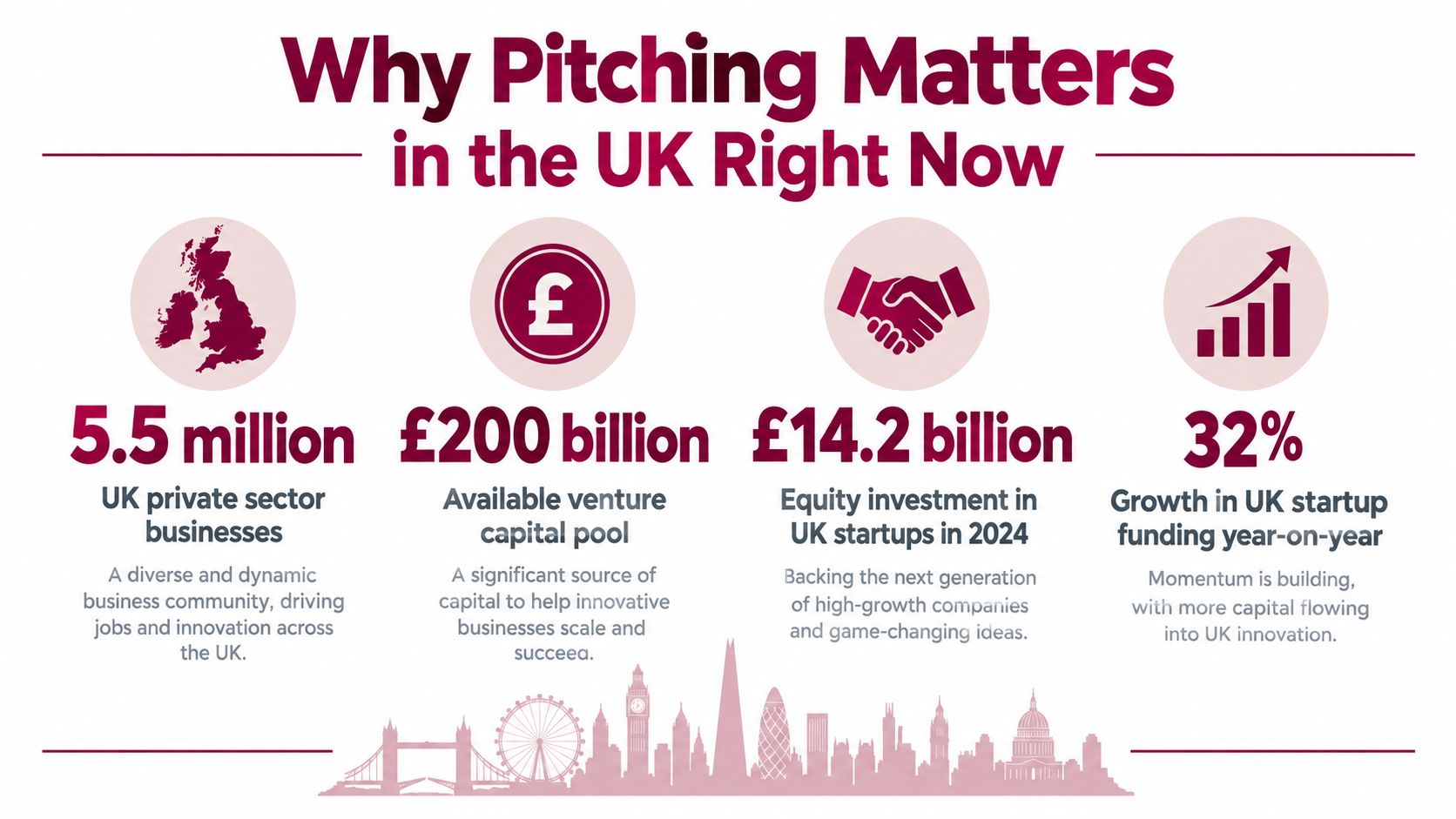
The potential investment audience is substantial. In 2024, venture-capital funds, co-investors and financial institutions invested £9 billion in British businesses, a 12.5% increase on 2023. UK venture capital backed more than 9,000 businesses and supported more than 378,000 jobs as of 2025. Those figures show a functioning financing ecosystem, not a guarantee that capital is available to every applicant. (UK private-capital venture-capital figures)
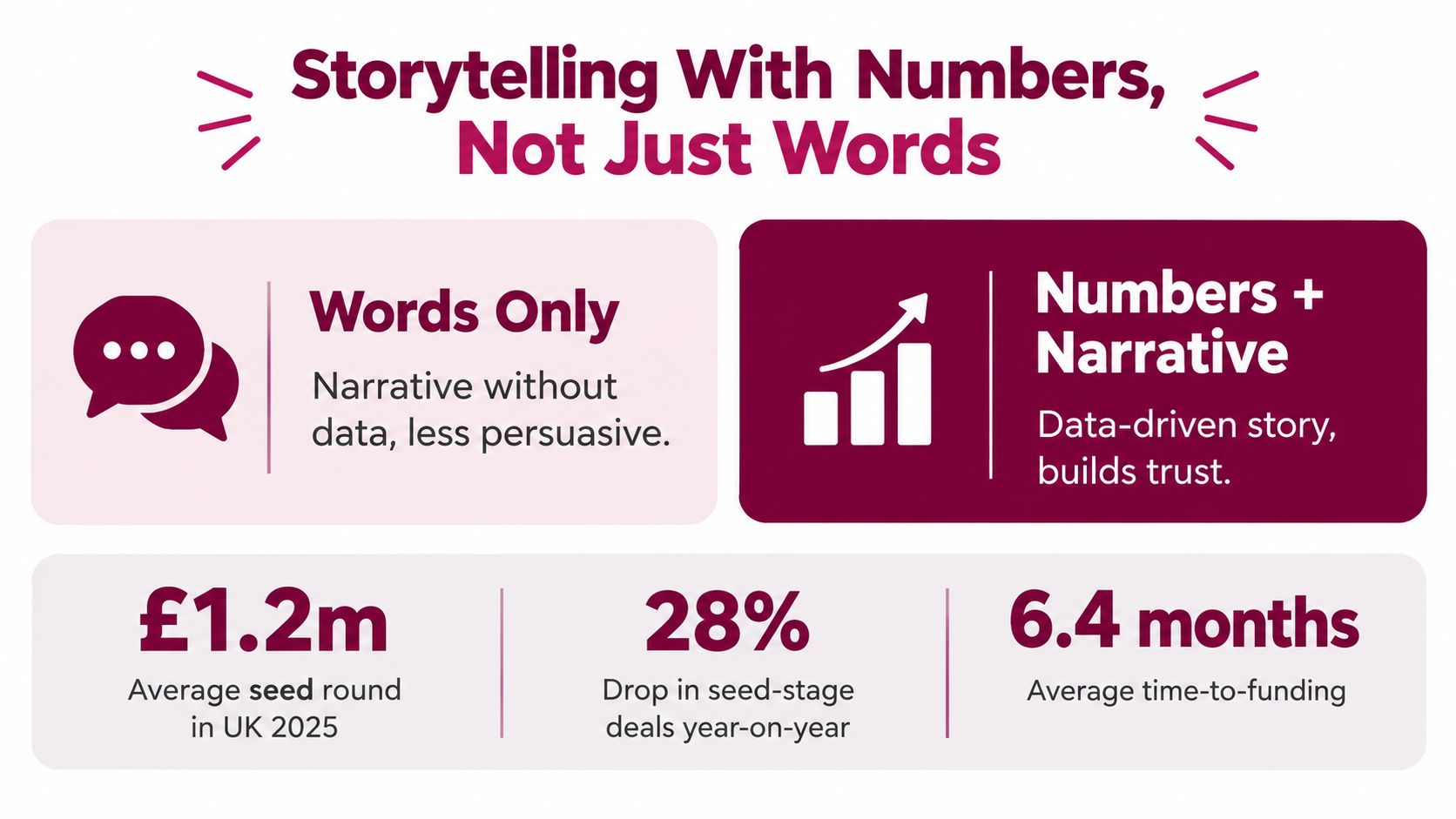
The selectivity runs deeper than the headline totals suggest. The British Business Bank reports that UK smaller businesses raised £12.3 billion through equity investment across 2,002 deals in 2025, while total investment and deal numbers fell year on year. The ten largest fundraisings accounted for 23% of total investment, and seed-stage deal numbers fell by 27%, with seed companies taking longer on average to secure funding. Early-stage founders face the tightest part of the market, so the quality of the case matters more at seed than at any later stage. (British Business Bank equity tracker)
A good pitch doesn't ask an audience to admire your ambition. It gives them reasons to believe the business can deliver.
Lead with the customer problem, then prove demand, explain the commercial model and make a specific case for the funding route. Investors want a credible path to growth and returns. Lenders want a credible path to repayment. A founder who knows that difference can build a pitch that advances a decision rather than merely filling a meeting.
Building the Pitch Deck and Story Arc
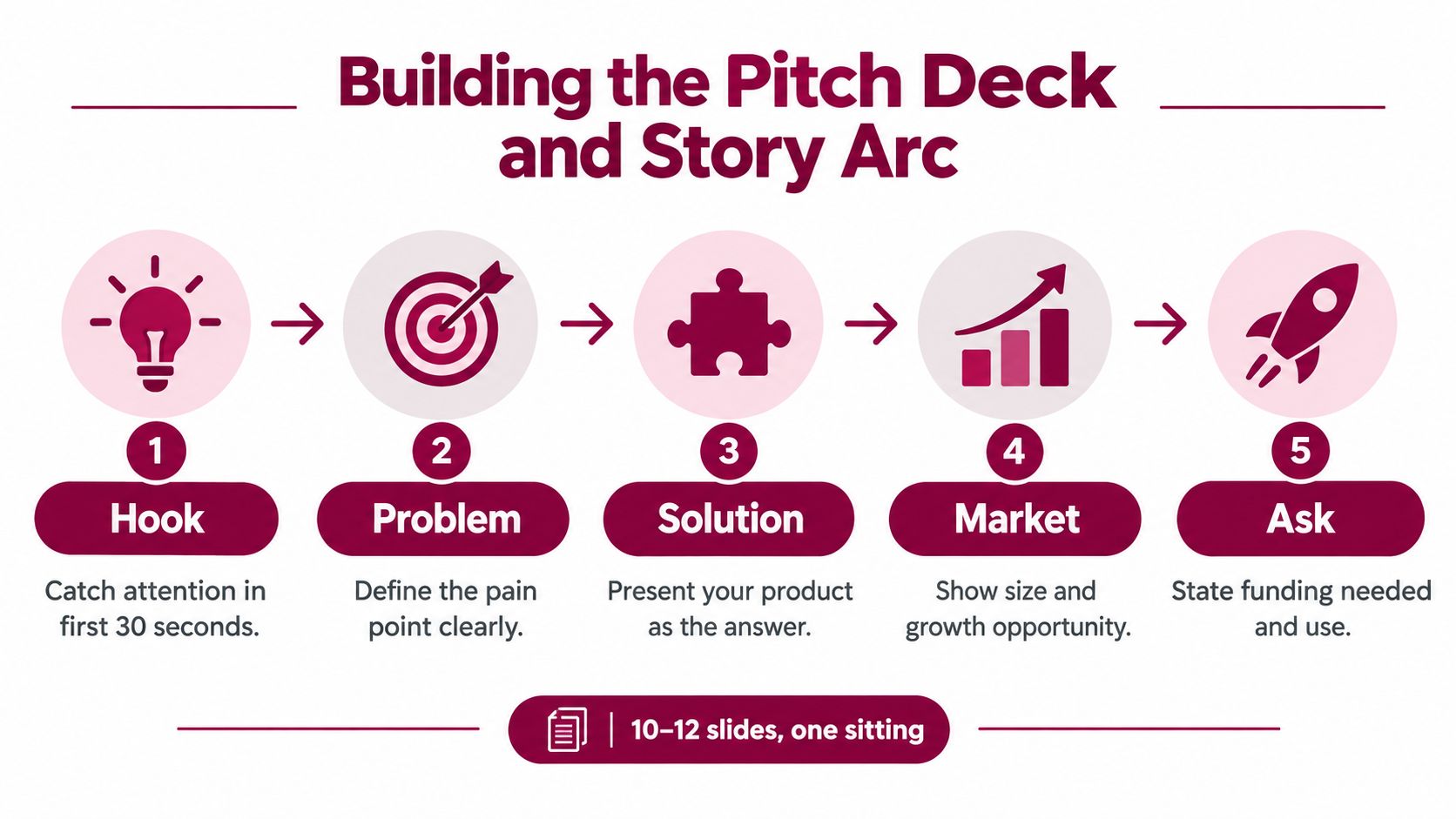
Build a 10–12-slide deck that an investor can follow in one sitting. Give each slide one job. If a slide tries to prove the market is huge, explain the product, introduce the team and ask for money all at once, it's doing too much.
Make the story easy to follow
Open with the customer and the pain point, not a grand claim about changing an industry. Show what the customer struggles to do, what that problem costs in time or money where you can substantiate it, and how you know it exists. Then present your product or service as the answer, including what makes it meaningfully different from existing options.
Move from solution to market. Define the buyers you can reach, the way you'll reach them and how the business will make money. Don't use a large headline market estimate as a substitute for explaining your first realistic customer segment. Follow with evidence of demand: paid customers, pilots, repeat purchases, signed agreements or another measure that fits your stage. Introduce the team in terms of relevant execution capability, then close with the amount sought, its intended use and the milestones it will fund.
A Business Model Canvas can help a founder organise the underlying business logic before turning it into a presentation. It's a planning aid, not a substitute for customer evidence or a funding case.
Edit for clarity, not decoration
Use charts when they make a comparison or trend easier to grasp. Keep labels legible, define unfamiliar terms and move detail that won't fit on the slide into speaker notes or supporting documents. Design choices should help the audience understand the evidence, not compete with it.
UK investor research reports that investors value communication, chemistry and resilience alongside the business plan and expected return. It also reports that nearly three-quarters of investors had rejected an opportunity on gut feeling, while 97% had rejected one because of a weak management team. The presentation itself should therefore demonstrate preparation: clear reasoning, careful answers and a coherent story from problem to ask. (Royal Bank of Scotland guidance citing Innovate UK research)
Pair the deck with a one-page investment memo that summarises the business, traction, funding request and key risks. Keep a structured data room ready with incorporation records, management accounts, cap table, forecasts, customer evidence and key contracts. The slides start the discussion; those materials let a decision-maker test the case.
Storytelling With Numbers, Not Just Words
A story without evidence is a promise. Investors need to see what has happened, what the business has learned and why the next stage is plausible. The UK's private-capital market is active, but activity alone doesn't give a founder a pass on proof. Your narrative should connect the customer problem to evidence of demand, then connect the funding request to outcomes the business can measure.
The most useful evidence depends on the business and its stage. An early venture may have customer interviews, prototype use or signed pilots. A company with trading history should show revenue, margins, repeat purchases, retention and acquisition costs. Don't inflate a small result into a sweeping market claim, and don't bury a meaningful result beneath vanity totals such as unqualified website visits.
Match evidence to the decision
Use the table as a prompt for what to prove, not as a rigid template. Choose metrics that answer the investor's likely question at your stage.
| Pitch stage | Primary evidence | Supporting metrics |
|---|---|---|
| Idea validation | Customer problem and observed demand | Interview patterns, pilot interest, early usage |
| Early trading | Paying customers and repeat behaviour | Revenue, conversion, retention, refunds |
| Scaling | A repeatable route to growth | Acquisition cost, margins, cohort performance |
| Funding round | A credible plan for capital deployment | Runway, milestones, forecast assumptions |
Make every number traceable to a source in your own records. If you present a forecast, show the assumptions behind it and explain how you will respond if actual results diverge. financial projections and forecasting for startup financing is relevant as a subject: investors need to understand the logic behind the forecast, not just the final figure. The Advanced Professional Certificate in Data Analytics for Business is a programme offered by London School of Business Administration.
Practical rule: Every major claim should have a metric, a source or a clear explanation of how you'll test it.
Investor selection is part of the evidence work. Segment prospective investors by sector, stage, ticket size and portfolio fit before making contact. Keep a CRM that records the investor thesis, warm-introduction route, contact date, response, objection category and next action. A well-targeted pitch gives both sides a reason to continue; a generic pitch wastes the founder's time and the investor's.
Investor Pitch Versus Lender Credit Case
Equity and debt are different decisions. An investor is assessing whether the business can grow enough to justify the risk and potential return. A lender is assessing whether it can repay what it borrows, when repayment is due, and how it will manage downside.

| Decision-maker | What the case must establish | Evidence to put forward |
|---|---|---|
| Equity investor | A sizeable opportunity and a credible route to returns | Customer demand, growth potential, team capability, funding milestones |
| Bank or lender | Repayment capacity and acceptable risk | Cash-flow forecasts, affordability, trading records, repayment plan |
Don't send an investor deck to a lender and expect it to answer a credit question. Rework the same underlying business facts for the audience. In an equity pitch, explain how capital advances product development, customer acquisition or another growth milestone. In a lender case, show where repayments will come from, how the cash position behaves under pressure and what controls protect the business if receipts arrive late.
A rejection doesn't automatically mean the business has no funding options. UK bank-finance success rates are below 50%, and 21% of rejected applicants reportedly receive no reason for refusal. The Bank Referral Scheme had referred nearly 111,000 rejected small businesses by January 2025, while 5,387 deals had been completed by Q3 2024, a cumulative conversion rate of 4.9%. Those figures make the lesson plain: ask for the decision rationale, identify the issue and consider whether another finance route fits better. (UK government evidence on small-business access to finance)
For a lender, diagnose whether the concern was affordability, incomplete information, cash-flow performance or perceived sector risk. Rebuild the credit case around that issue, then assess whether an alternative lender or government-backed route is appropriate. For equity, consider whether the company and round may suit SEIS or EIS, but verify eligibility before presenting a tax-relief route as available. Founders preparing for equity discussions should understand the implications of negotiating term sheets and investment agreements, including how the proposed ownership and terms affect both parties.
Handling Tough Investor and Lender Questions
Rehearse the questions that can expose weak assumptions. Don't memorise polished speeches. Prepare short answers that state the evidence, name the uncertainty and explain what you'll do next.
“How much are you raising, and why now?” Name the amount, its use and the milestones it will fund. If relevant, explain the intended SEIS or EIS route without implying eligibility until it has been checked. HM Revenue & Customs records that 2,430 companies raised £276 million through SEIS in the 2024–25 tax year, while 3,735 companies raised £1.575 billion under EIS. These are market benchmarks, not a promise that your round qualifies or that investors will participate. (HMRC SEIS and EIS statistics)
“How did you set the valuation, and what dilution are you offering?” Explain the assumptions and terms behind your proposal, then show how the funding supports the next financeable milestone. Don't defend a number by saying it feels right. Be ready to discuss what changes if the round takes longer or closes at a different size.
“What could stop the business reaching its plan?” Name the material risks: customer concentration, regulation, supplier dependence, cash pressure or a gap in management capability. Then show the mitigation and the signal you'll monitor. A credible answer includes what you'll do if the signal moves in the wrong direction.
“What happens if growth is slower than forecast?” This is the question that separates equity conversations from credit cases. An investor wants to know whether the company can still reach a meaningful milestone. A lender is asking a narrower question: can you service the debt if receipts arrive late? Answer both. State your current runway, the costs you control and the specific decisions you'd take at each trigger point.
“Why should we trust this team to execute?” Connect relevant experience to specific responsibilities and show where the team recognises its limits. UK investor research also finds that investors weigh communication and resilience alongside the business plan, so answer this question with evidence of how the team has handled a setback, not just a list of job titles.
“What happened after your previous rejection?” Give the reason, if known, the evidence you gathered and the change you made. Don't blame the decision-maker or pretend every rejection proves the market is wrong. Treat each objection as a testable hypothesis, record it, and update the deck when new evidence warrants it.
One discipline ties all of these answers together: verify before you assert. Founders who walk through due diligence and assessing the financial viability of startups before the meeting are the ones who answer hard questions with documents rather than adjectives.
Risk, Resilience and the Numbers You Cannot Ignore
A pitch that shows only upside is incomplete. Investors and lenders need to understand the conditions that could interrupt execution, and what management will do if they occur.
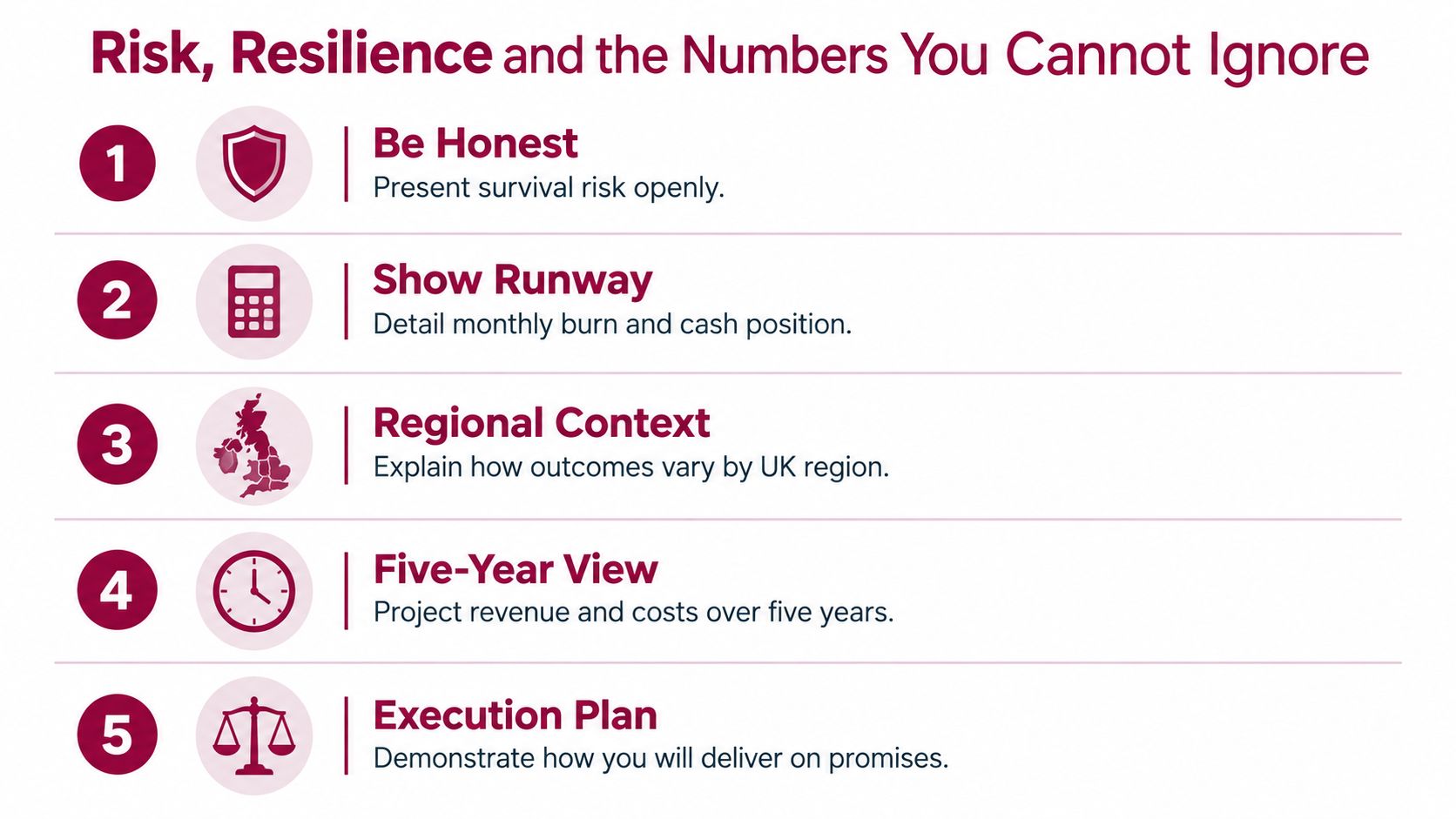
Regional outcomes offer a reason to avoid treating survival as a universal assumption. For businesses born in 2019 and observed in 2024, the Office for National Statistics recorded a five-year survival rate of 43.5% in the South West and 30.6% in the West Midlands. Those figures don't predict the fate of any individual company. They do underline why a founder should describe the operating risks that matter to their own business and location. (Office for National Statistics business demography)
Put the risk case into practical terms:
- Cash position: Show how the funding affects runway and what happens if income arrives later than forecast.
- Customer concentration: Explain dependence on major customers and how you'll reduce it.
- Operational continuity: Identify staffing, supplier and regulatory risks, with clear ownership for mitigation.
- Plan changes: State which indicators trigger a change in spending, hiring or growth priorities.
Stress-test the forecast rather than presenting a single smooth path. Show the assumptions that matter, the performance indicators you'll review and the actions you'll take when results miss plan. Risk earns credibility when the founder explains how it will be managed, not when it's hidden behind confident projections.
Rehearsal Checklist and Post-Meeting Follow-Up
Before a partner meeting, check that the deck is current, the data room is organised and every key claim has supporting evidence. Research the investor's fit, prepare answers on valuation, dilution, runway and risk, and practise delivering the story without reading from the slides.
After the meeting, log every question, requested document, objection and next action in your CRM. Update the deck after qualified meetings when new evidence changes the case, not merely to please the last person you spoke to.
One UK-focused investment-advice source reports that a firm receiving 2,000–3,000 startup approaches a year invests in only ten, and meets roughly 300–350 businesses, implying a meeting-to-investment rate of about 3%. That is a firm-specific benchmark, not a universal market average. Use it to set realistic expectations, keep your pipeline active and preserve enough runway for a fundraising process that may take months. (UK investment-advice fundraising benchmark)
London School of Business Administration offers self-paced, CPD-accredited courses and structured programmes across business management, entrepreneurship, leadership, marketing and data analytics. If you're strengthening the commercial and analytical skills behind your pitch, explore the programmes at London School of Business Administration.