

Leaders of teams in the United Kingdom were often never trained to do so. The Chartered Management Institute estimates that 82% of managers had not received formal management and leadership training before entering management, and only 65% of managers were rated effective by their staff in the same evidence base. Sustainable performance therefore depends less on formal authority than on whether a manager can listen, delegate, align goals, resolve conflict and create conditions in which people can speak openly.
Team management skills are learnable, observable practices, not stable personality traits. They're exercised through judgement in context, such as deciding when to intervene in a disagreement, how much autonomy a task can carry, or whether a missed deadline signals a workload problem rather than a motivation problem. Technical expertise may explain why someone was promoted, but it doesn't by itself equip them to coordinate the work of others. That distinction matters because, in the CMI evidence cited above, 50% of employees with ineffective managers were planning to leave within the following 12 months.
The eight areas that follow are equally valuable and mutually reinforcing. Each is examined through its underlying concept, practical benefits and limitations, workplace examples, actions you can apply, and considerations that differ for new, experienced and senior managers. Taken together, they form an integrated practice rather than a checklist of isolated competencies.
Table of Contents
- 1. Active Listening
- 2. Delegation and Empowerment
- 3. Constructive Feedback
- 4. Conflict Resolution
- 5. Goal Setting and Performance Alignment
- 6. Fostering Psychological Safety
- 7. Role Clarity and Decision Rights
- 8. Team Development Facilitation
- 8 Essential Team Management Skills: Comparison Guide
- Turning Competence into Management Practice
1. Active Listening

Carl Rogers and Richard Farson formalised active listening in their 1957 essay of that name as an intentional activity, not a passive state. The listener concentrates fully, confirms understanding and responds in ways that encourage further disclosure. Many team breakdowns begin with misunderstanding rather than substantive disagreement, which is why listening is a diagnostic skill before it's a courtesy.
The engagement case is substantial. In a survey of approximately 50,000 employees across UK organisations, employees who felt supported by their line manager were 3.4 times more engaged than those who did not, with an engagement index of 74% among those who felt supported compared with 22% among those who did not. Listening to employee ideas was among the behaviours associated with scores above 80% in that research. A manager who doesn't hear concerns early can't act on them proportionately.
What this looks like in practice
A project manager in a software firm holds scheduled one-to-one sessions in which she summarises each developer's concerns before responding, and late-stage design disputes have become less frequent. Hospital ward managers in several NHS trusts use structured listening during handover meetings so junior staff concerns are recorded rather than lost. In both cases, the structure matters more than good intentions.
- Summarise before responding: Begin with a paraphrase, such as noting that the deadline appears unrealistic because a dependency hasn't been confirmed.
- Ask one clarifying question: Do this before offering a solution, so you don't solve the wrong problem.
- Remove distractions: Put devices aside during one-to-one discussions and close the conversation by checking agreed next steps.
Active listening has limits. It can raise expectations you can't meet, and new managers sometimes confuse listening with agreeing to every request. Experienced managers should distinguish acknowledgement from commitment, while senior managers need listening systems, such as pulse items on support and trust, rather than relying on individual conversations alone.
2. Delegation and Empowerment
A marketing director at a mid-sized consultancy assigned a client campaign to a junior analyst, specifying outcomes, budget limits and review points. The campaign launched successfully and the analyst was subsequently promoted. That outcome wasn't produced by handing over tasks informally. It followed a clear transfer of authority within agreed boundaries.

Delegation transfers responsibility and accountability for a specific task while the manager retains overall oversight. Empowerment supplies the resources, information and decision-making latitude that make that transfer workable. Without empowerment, delegation becomes abdication or, conversely, micromanagement with extra steps. Spotify's squad model, documented by Henrik Kniberg and Anders Ivarsson in 2012, illustrates the same principle at scale by distributing decisions to autonomous teams within agreed strategic boundaries.
Briefing and autonomy
Use a simple what, why and by when structure when you brief, and ask the person to confirm their understanding in their own words. Match autonomy to demonstrated competence. A new starter may need close guidance and frequent check-ins, whereas an experienced colleague should own method as well as outcome, with review focused on results.
Practical rule: Agree decision rights before work begins, so the team member knows which choices they can make alone and which require escalation.
Delegation fails most often when managers retain invisible vetoes, delegate only low-value work, or intervene at the first sign of a different approach. New managers should start with well-defined tasks and explicit review points. Senior managers face a different risk, which is delegating delivery without delegating context, leaving teams unable to prioritise when circumstances change. Reviewing both outcome and process after completion turns each delegation into evidence for the next judgement about autonomy.
3. Constructive Feedback

Constructive feedback communicates observations about performance or behaviour in a form intended to support improvement. It differs from criticism because it's specific, timely and oriented towards future action. The Situation-Behaviour-Impact (SBI) model, developed by the Center for Creative Leadership, gives that specificity a structure by naming the context, the observable action and its consequences.
A team leader in a financial services firm used SBI to address repeated late submissions, describing the reporting situation, the missed submission behaviour and the effect on client reporting. The conversation produced an agreed revised workflow rather than a dispute about attitude. Kim Scott's Radical Candor framework, set out in her 2017 book, makes a related point by combining direct challenge with genuine care for the individual.
Handling sensitive conversations
Confidence in this area can't be assumed. CIPD research reports that only 50% of respondents said their managers or leaders had attended inclusive-leadership training or coaching during the previous 12 months, a gap that affects how fairly feedback is given and received. Separate UK workplace evidence in the same reporting indicates that just 38% believe managers are confident having sensitive discussions. Structured preparation is therefore a fairness issue, not only a communication preference.
- Prepare one or two observations: A long list invites defensiveness and obscures priority.
- Discuss behaviour, not character: Address a missed deadline rather than questioning work ethic.
- Invite the other perspective: Ask for the recipient's account before offering your interpretation.
- Agree a follow-up date: This converts a single comment into an ongoing dialogue.
New managers often delay feedback until frustration accumulates. Experienced managers should watch for uneven patterns in who receives developmental feedback, particularly in hybrid teams where visibility differs by location. Feedback that isn't reviewed rarely changes performance.
4. Conflict Resolution
Conflict isn't damaging. Task-related disagreement can improve decision quality, whereas relationship conflict typically impairs it. The managerial skill lies in telling the two apart and intervening at the right level.

The Thomas-Kilmann Conflict Mode Instrument, developed by Kenneth Thomas and Ralph Kilmann in 1974, identifies five approaches, namely competing, collaborating, compromising, avoiding and accommodating. No single mode is correct in all circumstances. A safety breach may require a competing response, while a dispute over shared resources usually rewards collaboration, and a minor scheduling clash may need only compromise. Managers who default to one style, most commonly avoidance, apply a habit rather than a judgement.
The scale of the problem is routine rather than exceptional. The CIPD Good Work Index 2024, based on 5,496 UK workers, found that 25% had experienced at least one form of workplace conflict during the preceding 12 months. Training appears to change behaviour. Research summarised by Acas and the University of Westminster reports that 47% of managers in the main study became less likely to avoid conflict after targeted training, while 71% adopted a more problem-solving approach.
Early intervention
In a multinational engineering project, a manager brought two departments with competing priorities into a joint session, reframed the dispute around shared delivery milestones and agreed a phased resource plan. Many UK public sector organisations use structured mediation within grievance procedures, drawing on Acas guidance. Further practical guidance on handling conflict at work can support that process, and Conflict Resolution is listed as a course for managers who want structured study.
Address disagreements privately and promptly, clarify what matters most to each party, and document agreed actions with a review date. New managers need a defined process to follow. Senior managers need to ensure escalation routes and mediation exist before a dispute tests them.
5. Goal Setting and Performance Alignment
Goal setting translates strategy into daily priorities and provides a shared basis for evaluating performance. Without it, feedback becomes subjective and delegation lacks a test of success. With too many goals, however, teams learn that everything is a priority and therefore nothing is.
George T. Doran proposed the SMART framework in a 1981 article in Management Review, recommending goals that are specific, measurable, achievable, relevant and time-bound. Objectives and Key Results (OKRs), practised at Intel under Andy Grove and popularised by John Doerr, link qualitative objectives to quantifiable key results. Google adopted OKRs in the late 1990s and early 2000s after Doerr introduced the approach, using them to align teams across rapidly growing product areas.
UK evidence supports treating this as a system rather than an annual form-filling exercise. The Office for National Statistics reported that in 2023, 89% of surveyed UK firms had taken at least one action to improve management quality, and among those firms 64% consulted employees about areas for improvement. CIPD reporting of earlier UK manufacturing evidence noted that businesses in the top half for structured management practices achieved average productivity 38% higher than those in the bottom half. That association doesn't mean training alone produces such a gain. It indicates that structured objective setting, monitoring and people management operate together.
Applying goals in different contexts
A UK retail operations manager applied SMART targets to store teams, linking weekly sales, stock accuracy and customer service indicators to regional strategy. That worked because the measures were visible, few in number and reviewed frequently. Hybrid teams need output-based objectives of the same kind, since presence isn't a reliable proxy for contribution.
- Involve team members in setting goals: Participation improves ownership and surfaces unrealistic assumptions.
- Limit priority objectives: Focus is a managerial decision, not an accident.
- Pair numbers with quality: Quantitative results should sit alongside qualitative assessment of work and behaviour.
- Review and revise: Goals set for one context may misdirect effort in another.
New managers should resist inheriting goals without testing them. Senior managers should check whether team objectives conflict with each other before holding individuals accountable for the resulting friction.
6. Fostering Psychological Safety
Amy Edmondson introduced psychological safety in her 1999 paper in Administrative Science Quarterly as a shared belief that interpersonal risk-taking is acceptable. Members can speak up, admit errors, ask questions or challenge ideas without fear of humiliation or punishment. Google's Project Aristotle, conducted between 2012 and 2015, identified it as the most important of five dynamics distinguishing high-performing teams.
This isn't a call for comfort without standards. A psychologically safe team can still set demanding goals and give direct feedback. The distinction is that challenge is directed at ideas and processes, and bad news reaches the manager early enough to be useful. Where safety is absent, silence is often misread as agreement.
Wellbeing, workload and boundaries
Psychological safety also has a structural dimension that empathy alone can't resolve. CIPD reports that 25% of UK workers, an estimated 8.5 million people, said their job negatively affected their mental health in 2025, and only 60% of managers reported having the training and information to manage staff well. In the same reporting, only 59% said they had enough time. A manager therefore needs decision boundaries. Some problems require workload redesign, others require a private conversation, and others require referral to professional support. Managers shouldn't diagnose employees or act as therapists.
Respond to bad news with curiosity first and evaluation second, so the next problem is raised earlier rather than later.
Google introduced manager training on listening, inclusion and responding to concerns following Project Aristotle. In a UK hospital surgical team, structured pre-operative briefings that invite all staff to raise concerns, drawing on the WHO Surgical Safety Checklist, have been associated with improved communication and safety. Reflection on emotional intelligence in leadership is relevant here, since self-awareness affects how a manager reacts under pressure.
Model the behaviour by acknowledging your own mistakes, use round-robin input so quieter members are heard, and monitor climate through anonymous surveys or retrospectives. New managers can start with meeting habits. Senior managers must also examine workload, staffing and escalation routes, because individual supportive behaviour can't compensate indefinitely for an unworkable system.
7. Role Clarity and Decision Rights
Ambiguity about who does what, and who decides, produces delay, duplication and interpersonal friction that is frequently misdiagnosed as a personality clash. Role clarity makes responsibilities, accountabilities and decision authority explicit. It's unglamorous work, and it's often the fastest route to better performance.
The RACI matrix assigns each task a Responsible, Accountable, Consulted or Informed role. The RAPID framework, developed by Bain & Company and described by Paul Rogers and Marcia Blenko in their 2006 Harvard Business Review article, clarifies who recommends, agrees, performs, inputs and decides. Both tools reduce reliance on informal hierarchy, in which the most confident or most visible person settles questions by default.
A product development team in a UK fintech firm adopted a RACI matrix for its release process, which reduced unplanned sign-offs and clarified the compliance function's role. Bain & Company has applied RAPID to large-scale transformation programmes to distinguish recommending from deciding. Guidance on building and leading high-performing teams addresses related questions of structure and accountability.
Flexible work as a clarity test
Flexible working exposes weak role definition quickly, because availability, coverage and assessment of outcomes must be agreed rather than assumed. Acas data for 2024 to 2025 recorded 11,371 flexible-working calls to its helpline, alongside 655 early-conciliation notifications and 251 employment tribunal claims in that jurisdiction. Acas recommends holding a meeting with the employee even when the employer intends to accept a request, because discussion supports effective communication. Consistent handling prevents informal arrangements from becoming perceived favouritism.
- Keep matrices concise: Focus on the most significant recurring tasks and decisions.
- Name one Accountable person: Shared accountability usually means diffused responsibility.
- Review at each project phase: Roles that fitted initiation may not fit delivery.
- Discuss decision rights openly: People can't follow a process they haven't seen.
New managers should document the decisions they encounter most often. Senior managers should audit whether remote colleagues have equal access to information, meetings, development and recognition, since unclear systems tend to reward proximity.
8. Team Development Facilitation
Teams don't arrive fully formed, and friction in a new group isn't necessarily dysfunction. Team development facilitation is the capacity to recognise a team's stage of maturity and adjust leadership accordingly. Treating a newly formed team as if it should already perform at full capacity is a common and avoidable error.
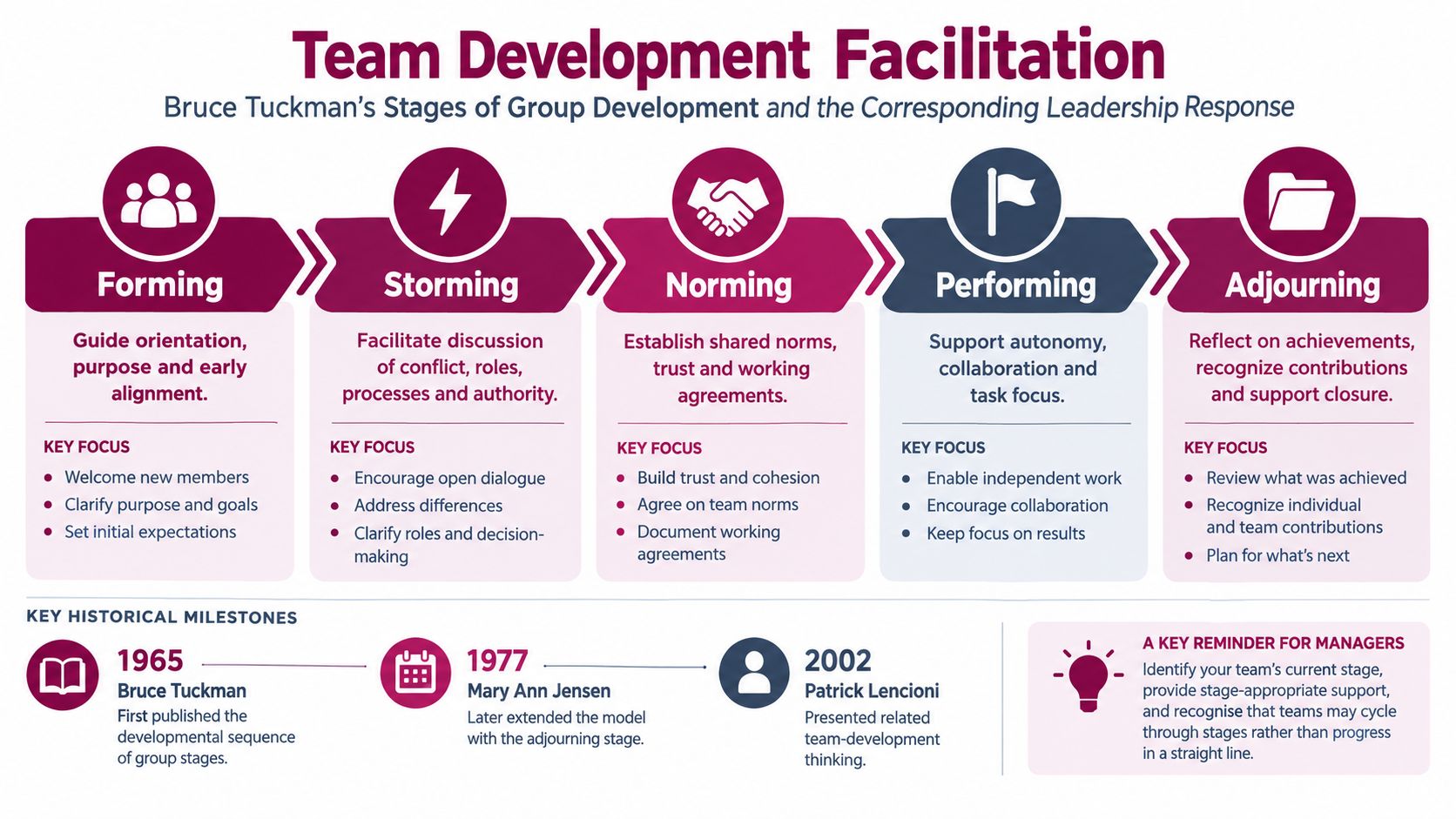
Bruce Tuckman's model, first published in 1965 in Psychological Bulletin and extended with Mary Ann Jensen in 1977, describes forming, storming, norming, performing and adjourning. Forming involves orientation and dependence on the leader. Storming surfaces disagreement about roles and methods. Norming establishes shared practices, performing reflects coordinated delivery, and adjourning concerns closure and transition. Each stage calls for a different balance of direction, facilitation and delegation.
A newly formed cross-functional team at a UK logistics company used a structured charter-setting workshop during its forming phase, reducing a storming period that had previously lasted several months. Project managers in construction often use Tuckman's model to plan interventions at kick-off and during periods of known pressure. Team Building and Management is listed as a course for managers who want to study this area in a structured way.
Matching intervention to stage
Hybrid arrangements complicate stage diagnosis because informal signals are harder to read. Grant Thornton reporting from September 2025 found that 79% of UK businesses surveyed said remote working improved productivity, while managing remote teams was cited as a skills gap by 18.22% of respondents. Team-level working agreements on communication, documentation and meeting access help a dispersed group move from forming to norming deliberately rather than by chance.
During storming, facilitate open discussion of roles and working practices instead of suppressing disagreement. During norming, formalise agreements in a team charter. At adjourning, hold a closing review that consolidates learning and recognises contributions. New managers should observe before intervening. Experienced managers should remember that a change in membership, leadership or mandate can return an established team to an earlier stage.
8 Essential Team Management Skills: Comparison Guide
| Team Management Skill | Implementation Complexity | Resource Requirements | Expected Outcomes | Ideal Use Cases | Key Advantages |
|---|---|---|---|---|---|
| Active Listening | Moderate; requires consistent attention and practice | Time for focused conversations; minimal tools | Better understanding, fewer misunderstandings, earlier issue detection | One-to-ones, handovers, or discussions involving concerns | Builds trust and incorporates diverse perspectives |
| Delegation and Empowerment | Moderate to high; requires clear boundaries and follow-up | Briefing time, suitable resources, and progress checkpoints | Greater ownership, stronger team capability, and reduced managerial bottlenecks | Distributing work, developing skills, or enabling autonomous teams | Frees leaders to focus on priorities while building team resilience |
| Constructive Feedback | Moderate; depends on specificity and communication skill | Preparation time and regular follow-up | Clearer expectations and improved performance | Performance discussions, coaching, and development planning | Supports learning and addresses issues before they persist |
| Conflict Resolution | High; may require mediation and careful facilitation | Time, impartial facilitation, and follow-up | Workable agreements and reduced escalation | Interpersonal or cross-functional disagreements | Preserves relationships and can improve decisions through constructive debate |
| Goal Setting and Performance Alignment | Moderate; requires measurable goals and review cycles | Planning time, progress measures, and review meetings | Clear priorities and visible progress toward shared objectives | Strategy execution, project planning, and performance reviews | Focuses effort and aligns team activity with organisational priorities |
| Fostering Psychological Safety | High; requires sustained, consistent leadership behaviour | Ongoing attention, inclusive practices, and feedback channels | More open communication, earlier risk reporting, and improved learning | Teams handling uncertainty, complex work, or safety-critical tasks | Encourages speaking up, innovation, and learning from mistakes |
| Role Clarity and Decision Rights | Moderate; requires agreement and periodic updates | Time to define responsibilities; tools such as RACI or RAPID | Fewer ownership gaps, less duplication, and faster decisions | Projects with interdependencies or overlapping responsibilities | Clarifies accountability and decision authority |
| Team Development Facilitation | Moderate; requires assessing team dynamics and adapting support | Observation, team discussions, and stage-appropriate activities | Better-timed interventions and more effective team progression | New, changing, or project-based teams | Helps managers anticipate challenges and treat development-related friction appropriately |
Turning Competence into Management Practice
These eight capabilities function as a system. Active listening supplies the information that makes delegation and goal setting realistic. Role clarity reduces the volume of conflict that requires resolution, and psychological safety determines whether feedback is heard as development or as threat. Team development facilitation then sets the tempo, because the right intervention in a performing team can be counterproductive in one that's still storming. Weakness in one area therefore tends to appear as a symptom in another, which is why isolated training in a single technique rarely produces durable change.
A practical starting point is to select one capability for deliberate improvement rather than attempting all eight at once. Identify a recurring workplace situation in which that capability is needed, such as a weekly one-to-one, a project briefing, a handover meeting or a performance conversation. Then choose a framework that fits the situation, whether that's SBI for feedback, RACI for decision rights, Thomas-Kilmann for conflict or Tuckman's stages for team maturity. Frameworks are useful because they convert an abstract intention into a sequence you can follow under pressure.
Define one observable action for the next four weeks. That might mean summarising a colleague's point before responding in every one-to-one, agreeing decision rights at the start of each delegated task, or reviewing a documented conflict action on a fixed date. Observable actions can be counted and discussed, whereas intentions to communicate better can't. Keep the commitment narrow enough to sustain when workload increases, since a practice abandoned in the second week produces no evidence about its value.
Reviewing progress
Progress should be reviewed through several lenses. Team feedback indicates whether behaviour is experienced as intended, and anonymous pulse items on support, trust and clarity can be tracked alongside absence and retention. Performance indicators show whether goals, deadlines and quality measures are moving, though they should be interpreted cautiously because many factors influence them. Reflective practice, such as a brief written review after a difficult conversation, helps you separate what happened from what you assumed. Peer or mentor observation adds an external check on habits you're unlikely to notice yourself.
Career stage shapes the priority. Early-career managers usually benefit from mastering one-to-one conversations, briefing discipline and early conflict intervention. Mid-level managers need to formalise capabilities they've acquired informally, particularly in inclusion, sensitive discussions and performance alignment across teams. Senior managers and business owners carry additional responsibility for systems, including escalation routes, flexible-working consistency, workload design and the training of other managers. In each case, the question is the same. Which behaviour, practised consistently, would most improve the experience and output of the people you lead.
Structured study is one optional route for managers who prefer a defined curriculum and assessment to self-directed reading. The London School of Business Administration offers a Team Building and Management course and a broader Credential of Leadership and Management, an eight-course pathway that also includes conflict resolution, communication skills for leaders and emotional intelligence in leadership. Presenting these as options rather than requirements is appropriate, since development can also come through coaching, mentoring, internal programmes and supervised practice. What matters is that learning is applied to real decisions and then reviewed against evidence.
Team management is ultimately a professional discipline with its own concepts, tools and failure modes. Managers who treat it that way are better placed to build teams that perform reliably without depending on individual heroics. That outcome is built incrementally, through clearer goals, fairer processes, earlier conversations and the willingness to examine your own practice.
The London School of Business Administration provides self-paced, CPD-accredited online courses in leadership and business management, including study routes that address team building, conflict resolution and communication for leaders. If you'd like to develop these team management skills through structured materials and assessed learning, visit London School of Business Administration to review the available programmes and choose a course that fits your current role.