
In 2025, 68% of UK employees said that an approachable manager who fosters open communication was among the most important management qualities, according to YouGov and Investors in People research reported by People Management. That finding reframes leadership styles in management. Staff are not mainly scoring charisma. They are scoring whether they can speak up, whether information moves, and whether a decision feels fair.
A leadership style is a setting you adjust to the task, the team's readiness and the risk in front of you. It isn't a personality type, and no single setting suits every team. The comparison below, and the five-question diagnostic later, show how to choose a style and when to change it, including when part of the work sits with AI tools.
Table of Contents
- The Seven Leadership Styles at a Glance
- How Style Shapes Decisions and Behaviour
- Autocratic and Bureaucratic Leadership
- Democratic and Laissez-Faire Leadership
- Transformational, Transactional and Servant Leadership
- Outcomes and Trade-offs Across Styles
- Diagnosing Needs and Matching a Style
- Practise Your Style and Plan Your Next Development Step
The Seven Leadership Styles at a Glance
A leadership style is the pattern a manager uses to decide, communicate and motivate. In many UK teams that pattern is tighter than the manager believes. Employees often do not feel involved in decisions that affect their work, which is why the pattern has to be named before anyone tries to change it.
Bureaucratic leadership belongs in the same lookup as the familiar seven, because it is a distinct directive style. Authority runs through formal rules and approval chains, not only through one person's preference. The table compares all eight on who decides, where the style fits, and the main risk. Read across a row. Don't treat the left-hand label as a compliment or an insult.
Leadership styles compared on decision rights, fit and risk
| Style | Who decides | Best suited to | Main risk |
|---|---|---|---|
| Autocratic | Leader alone, with little input | Emergencies and safety-critical tasks | Low engagement and bottlenecks |
| Democratic | Leader after consulting the team | Complex work needing buy-in | Slow decisions and unclear final authority |
| Laissez-faire | The team, with minimal oversight | Experienced, self-directed experts | Drift and unclear accountability |
| Bureaucratic | Leader applying formal rules and approval chains | Regulated, procedure-heavy work | Rigidity and rule proliferation |
| Transformational | Leader sets vision; team shapes delivery | Change, innovation and growth | Dependence on the leader's personal appeal |
| Transactional | Leader against agreed targets and rewards | Stable, measurable tasks | Limited initiative beyond the target |
| Servant | Leader serves the team's needs; team decides within boundaries | Developing people and trust | Slow responses when speed is essential |
| Situational | Leader adapts per person and task | Mixed teams with varied experience | Inconsistency if the reasons are not explained |
What the columns are actually testing
Who decides is the column that separates the rows. Autocratic and bureaucratic styles keep the call with the leader or the rulebook. Democratic, transformational and servant styles keep a visible leader, but they pass more of the shaping work to the team. Laissez-faire passes the decision itself. Situational leadership refuses a fixed row and resets the setting for each person and each task.
Read main risk before you admire best suited to. A style that speeds an emergency can bottle ideas the following week. A style that builds buy-in can miss a deadline if nobody owns the final call. No row is better than the others. You select one by matching decision rights to the task, then you watch for the failure that follows if you leave that setting on.
How Style Shapes Decisions and Behaviour
Treat leadership style as a dimmer switch, not an on-off light. Most managers sit somewhere along a spectrum, not inside a single box.
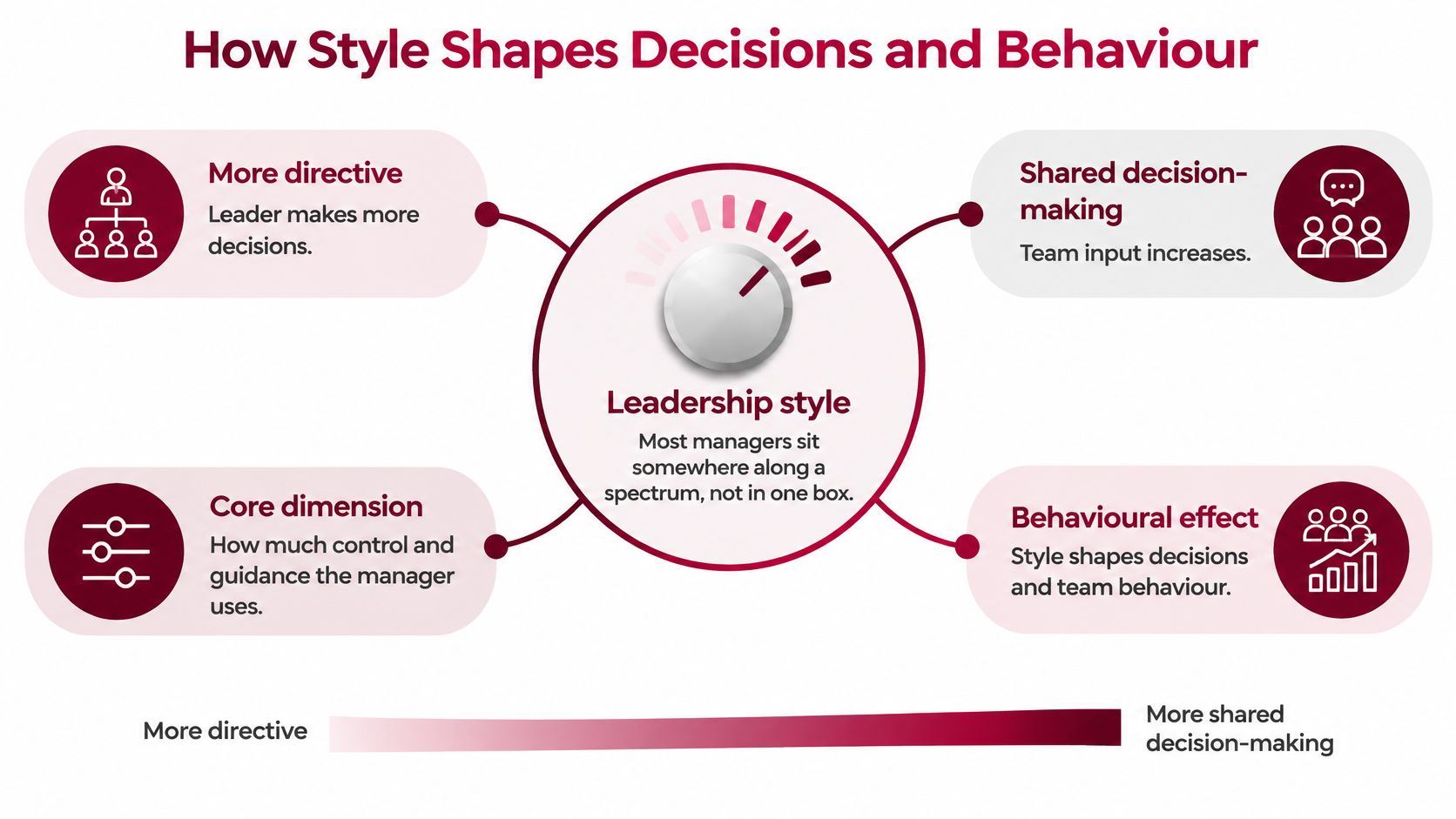
The core dimension is how much decision authority stays with the leader, and how much passes to the team. More directive means the manager chooses and instructs. Shared decision-making means team input rises before anyone commits. Control and guidance move together along that range, and the team's behaviour moves with them.
Where the range came from
In 1939, Kurt Lewin, Ronald Lippitt and Ralph White compared authoritarian, democratic and laissez-faire leaders with groups of schoolchildren. Group behaviour and output differed clearly across the three patterns. In 1958, Robert Tannenbaum and Warren Schmidt laid the same idea on a continuum from leader-centred to team-centred decisions. They asked managers to weigh the team's readiness, the nature of the problem and the time available.
Style isn't personality. Personality is relatively stable. Style is a set of observable behaviours you can change from one week to the next. A quiet manager can run a tight briefing. An outgoing manager can stay out of a capable team's way. Judging which people need which setting is part of the same craft as emotional intelligence in leadership.
Three markers you can see this week
- Who sets the agenda: the leader's list alone, or items the team added.
- Who speaks first: a conclusion, or an open question.
- Who has the final say when the team disagrees: one person, a published rule, or a decision the group can trace.
If those three answers surprise you, the style in use isn't the style you think you have.
Autocratic and Bureaucratic Leadership
Picture an emergency department lead during a surge. Triage calls can't wait for a round of views. The lead assigns bays, redirects staff and stops discussion that would delay care. That is autocratic leadership doing its proper job. Speed prevents harm, and the team lacks both time and a full picture.

When the rule decides
Bureaucratic leadership is the second directive style. The leader doesn't invent a fresh order for each case. Authority sits in formal rules, approval chains and written procedures. Aviation checklists, food-safety controls and financial sign-off exist so that two competent people reach the same safe action. Consistency is the point, not personal dominance.
Directive management is common in Britain, not a textbook leftover. A 2024 UK workforce survey of 5,000 adults, commissioned by the Chartered Management Institute and reported by HR Magazine, found that 21% of respondents described their management as authoritarian and 16% as bureaucratic. In that survey, 12.5% characterised management as secretive, and only 10% described their bosses as accessible.
Practical rule: Directive leadership isn't automatically weak. It becomes weak when the crisis, the missing information or the regulation that justified it has already passed.
Three checks before you decide alone
If command continues into routine work, staff stop offering ideas. Information stops travelling upwards. Errors go unreported because people expect blame rather than a fix.
- Is the risk immediate? Look for harm, a breach or a missed safety window, not mere inconvenience.
- Does the team lack the information to decide? If they hold it, consultation is often faster than repairing a bad solo call.
- Is the rule still justified? A procedure that no longer reduces risk is bureaucracy for its own sake.
Once the crisis passes, step back in public. Explain why you decided alone, then ask what the team learned and which decisions should become shared again. Practising that shift, rather than treating temperament as destiny, is part of what The Credential of Leadership and Management is built to teach.
Democratic and Laissez-Faire Leadership
A ward manager needs a new shift pattern. She doesn't announce it. She asks what nights, handovers and training days feel like, weighs the clashes, then chooses a pattern and states the reasons. That is democratic leadership. It isn't a vote on everything. The leader keeps final authority and makes that authority visible, so the team can see which view moved the call.
A research group of senior scientists works on a different setting. They set their own priorities against a published aim. The manager reviews outcomes at agreed points and stays out of the method. That is laissez-faire leadership, sometimes called delegative leadership. It fits highly skilled people with clear goals and strong self-discipline.
Where hands-off becomes absence
The same light touch fails with a mixed-experience team, with unclear objectives, or with a manager who confuses stepping back with disappearing. Experts drift when nobody names the output. Newer colleagues stall because freedom arrived before skill.
Leaders often believe the asking has already happened. In 2025, only 45% of UK employees said management involved them in decisions affecting their work, compared with 77% of senior leaders who believed they did so, according to Great Place To Work's European Workforce Study, as reported by Workplace Insight.
Participation that lives in the leader's mind, and not in the team's week, isn't participation.
Three practices close that gap.
- Ask before deciding. Put one specific question to the people affected, with a deadline, rather than an open invitation that never closes.
- Say which input changed the decision. Name the point you adopted, so consultation is visible.
- Publish a short reason when input didn't change it. Silence reads as a sham exercise.
Participative decisions take longer. Set the deadline and the decision boundary at the start. The team should know which choices are open and which are already fixed by safety, budget or policy.
Transformational, Transactional and Servant Leadership
These three styles differ in what they ask of the team, not only in how warm the manager sounds.
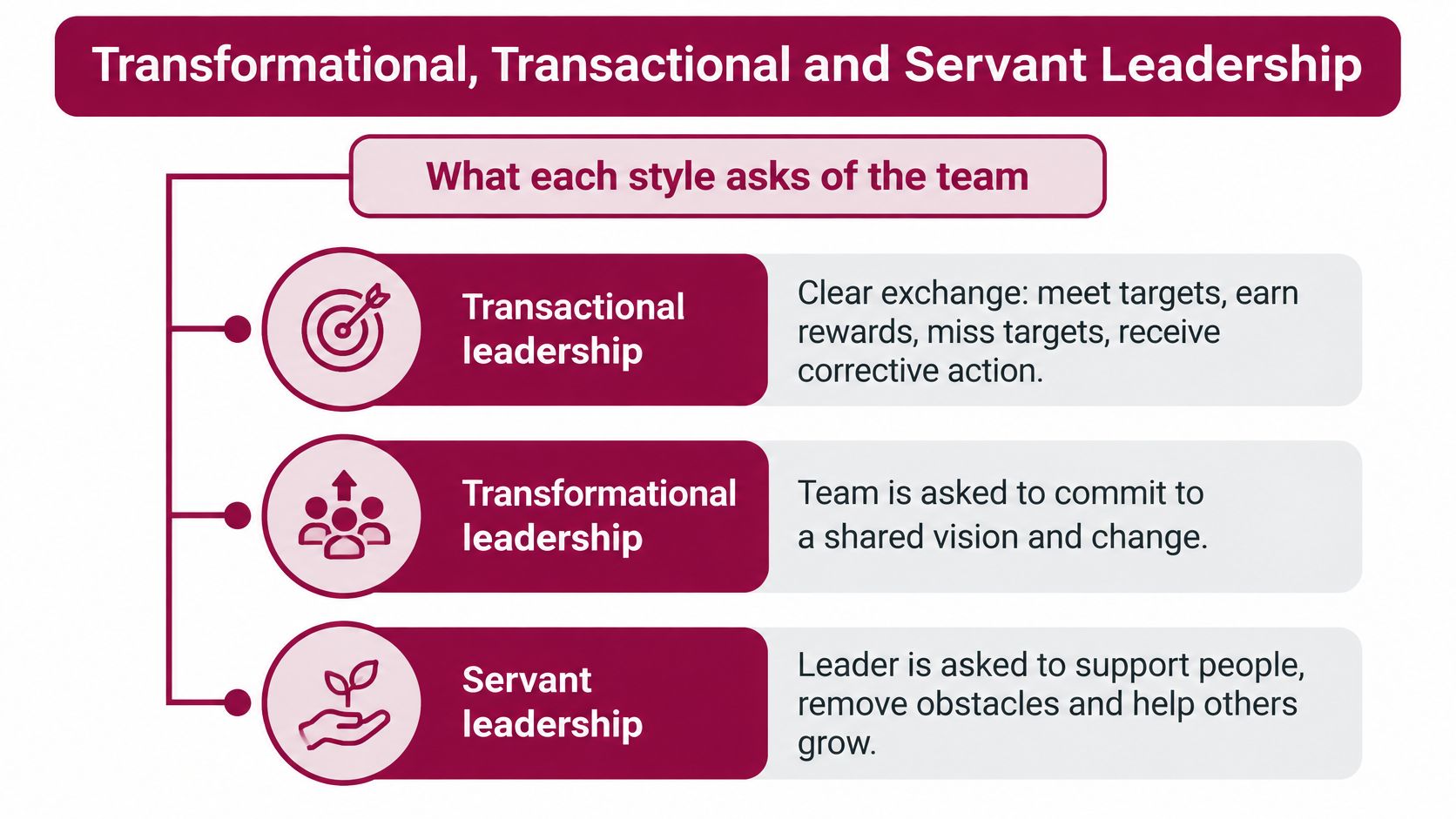
Transactional leadership is a clear exchange. Meet the target and receive the reward. Miss it and receive corrective action. A sales team with monthly quotas and commission is the familiar case. People know the score. They also tend to stop at the score.
Transformational leadership, as Bernard Bass set it out in 1985, works through four behaviours. Idealised influence means you model the standard. Inspirational motivation connects today's task to a shared aim. Intellectual stimulation invites a better method. Individualised consideration coaches the person, not the crowd. In a hospital trust redesign, the mission is stated in plain language, clinicians are asked to challenge the old pathway, and each ward lead gets different support. The team is asked to commit to the change, not only to repeat last year's numbers.
Servant leadership, introduced by Robert Greenleaf in 1970, reverses the usual order. The leader asks what people need in order to do the work well. A retail shift supervisor who asks each person what would make the week easier, before writing the rota, is using that style inside ordinary operations.
Trade-offs, then a blend
Transactional leaders get reliable delivery and limited initiative beyond the target. Transformational leaders move people through change, and they can create dependence on personal appeal if the vision leaves when they do. Servant leaders build trust, and they can be slow when a fast call is required.
Strong managers blend the three. A transactional structure holds the measures. A transformational purpose explains why the measures matter. A servant approach deals with the individual who is struggling to meet them. Telling those responses apart is a practical use of Emotional Intelligence in Leadership.
Outcomes and Trade-offs Across Styles
A UK-focused evidence review by the Chartered Institute of Personnel and Development links style to behaviour and attitude. Transformational leadership is associated with stronger work engagement. Supportive leadership is linked with organisational commitment, altruism and conscientiousness. Ethical leadership is linked with more ethical employee behaviour. The mechanism is relational. Leaders shape how people read support, meaning, fairness and autonomy, and those readings influence discretionary effort.
Typical outcomes by leadership style. The High, Medium and Low ratings are editorial judgements of typical tendencies drawn from the CIPD review, not measured values. Context can overturn any cell.
| Style | Engagement | Decision speed | Innovation | Stress and turnover risk | Measure to watch |
|---|---|---|---|---|---|
| Autocratic | Low | High | Low | High when used routinely | Decision cycle time |
| Democratic | High | Low to medium | Medium to high | Low | Engagement scores |
| Laissez-faire | High with experts, low with novices | Fast if skilled, stalled if not | High with experts, low otherwise | Medium | Clarity of accountability |
| Transformational | High | Medium | High | Low | Engagement and change delivery |
| Transactional | Medium | High | Low | Medium | Target attainment and absence |
| Servant | High | Medium | Medium | Low | Voluntary turnover |
| Situational | High when matched | High when matched | Medium to high | Low when matched | Fit between style and team readiness |
How to read a mixed result
The CIPD review points managers towards a balanced dashboard: engagement scores, voluntary turnover, absence, ethical incidents, and delivery of change objectives. Financial results alone can hide a style that is fast and corrosive.
Say engagement rises for two quarters while change delivery slips. That pattern fits support without a clear direction. The remedy isn't more warmth. It is a purpose people can act on, plus milestones they can see. If decision cycle time is excellent and ideas have dried up, an autocratic or transactional setting has been left on too long. The result of a style follows the fit between that style and the situation. You remake the fit when the task, the people or the risk changes.
Diagnosing Needs and Matching a Style
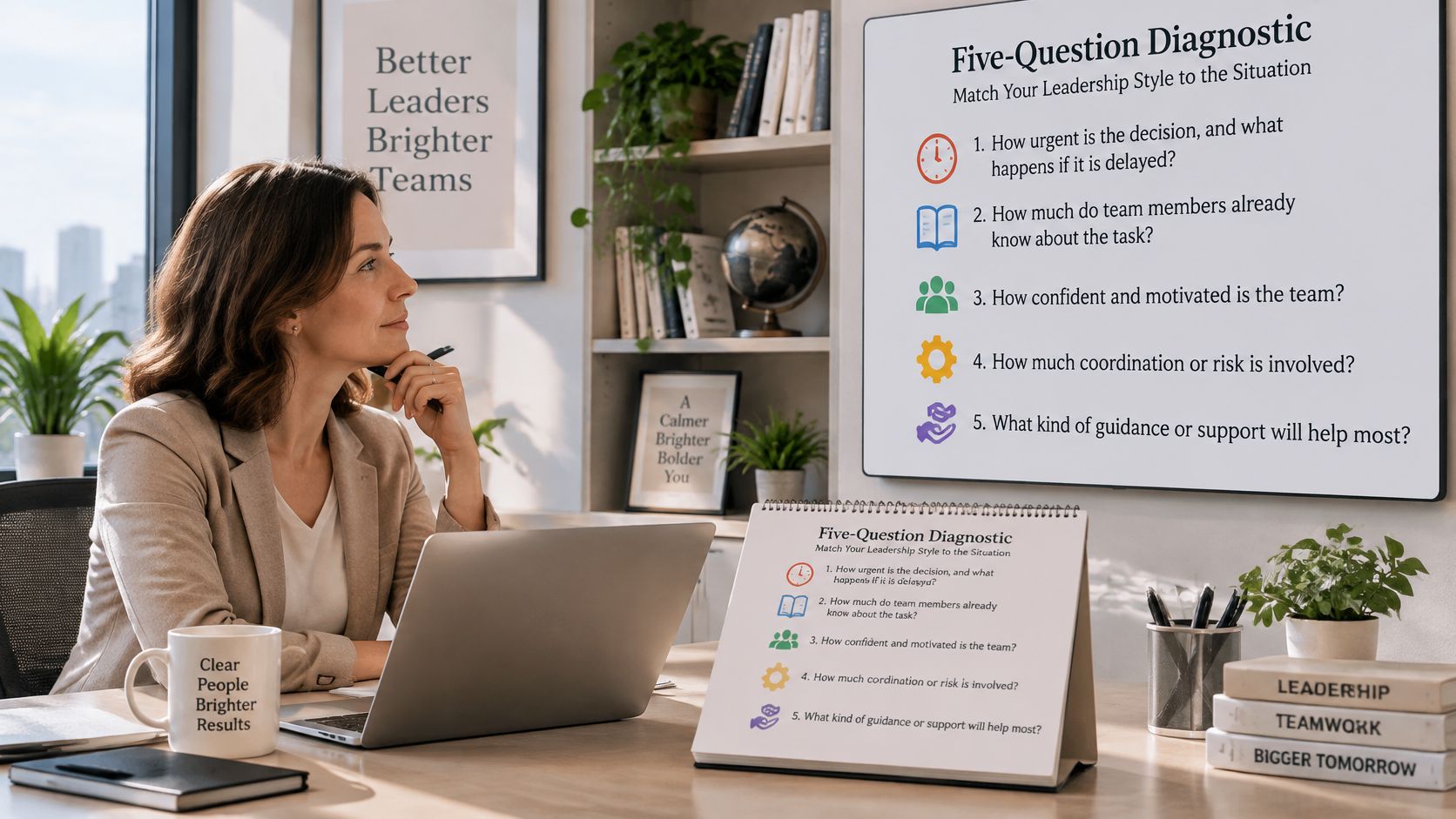
Run five questions before you pick a style. The answers point towards a lean, not a single correct label.
- How urgent is the decision, and what happens if it is delayed?
- How much do team members already know about the task?
- What are the safety, legal or privacy risks?
- Is the goal to maintain, improve or change the work?
- Is the team uniform in readiness, or does it vary by person?
Matching leadership style to organisational situation
| Situation | Lean towards | Adjust by | Avoid |
|---|---|---|---|
| Crisis or safety-critical task | Autocratic | Explain the reason once the risk passes | Keeping command style for routine work |
| Regulated, procedure-heavy work | Bureaucratic with scheduled review | Review rules yearly with staff input | Adding rules for every small decision |
| Experienced, self-directed experts | Laissez-faire or delegative | Agree outcomes and review at set points | Leaving goals and accountability undefined |
| Mixed readiness within one team | Situational | Direct novices, coach experienced staff | Applying one style to everyone |
| Major organisational change | Transformational with transactional milestones | State purpose and measures together | Vision without a delivery plan |
| Human-AI workflows | Directive on data and accountability, participative on process | Set boundaries, check outputs, explain decisions | Leaving AI use unmanaged |
| Team strained by workload | Supportive with clear priorities | Delegate and reset priorities | Adding more command pressure |
When an AI output should tighten the setting
UK organisations are adopting AI faster than many managers feel ready to lead it. Evidence from the Chartered Management Institute shows that 68% of organisations remain in AI testing or early-pilot stages. Only 12% of UK managers feel very confident managing AI-enabled teams, falling to 10% for agentic AI.
A compelling vision doesn't govern a tool that drafts, recommends or acts. Move from participative to directive when an AI output can affect quality, privacy, safety or employment. Stay participative on how the team reviews and improves the workflow around that boundary.
Say a team uses an AI tool to draft client reports. You set the data-handling rules yourself: what may be entered, what must stay out, who is accountable for the sent version, and how outputs are checked. You then invite staff to shape the review steps, because they know where drafts go wrong. If the answers to the five questions change, change the style, and tell the team why. Picking the decision method is itself a management skill, set out further in decision-making models in management.
Practise Your Style and Plan Your Next Development Step
The Chartered Management Institute's 2024 annual report states that 82% of people entering management roles do not receive formal management or leadership training, as set out in the CMI annual report. Most managers therefore learn a style by habit, often the habit of the person who used to manage them.
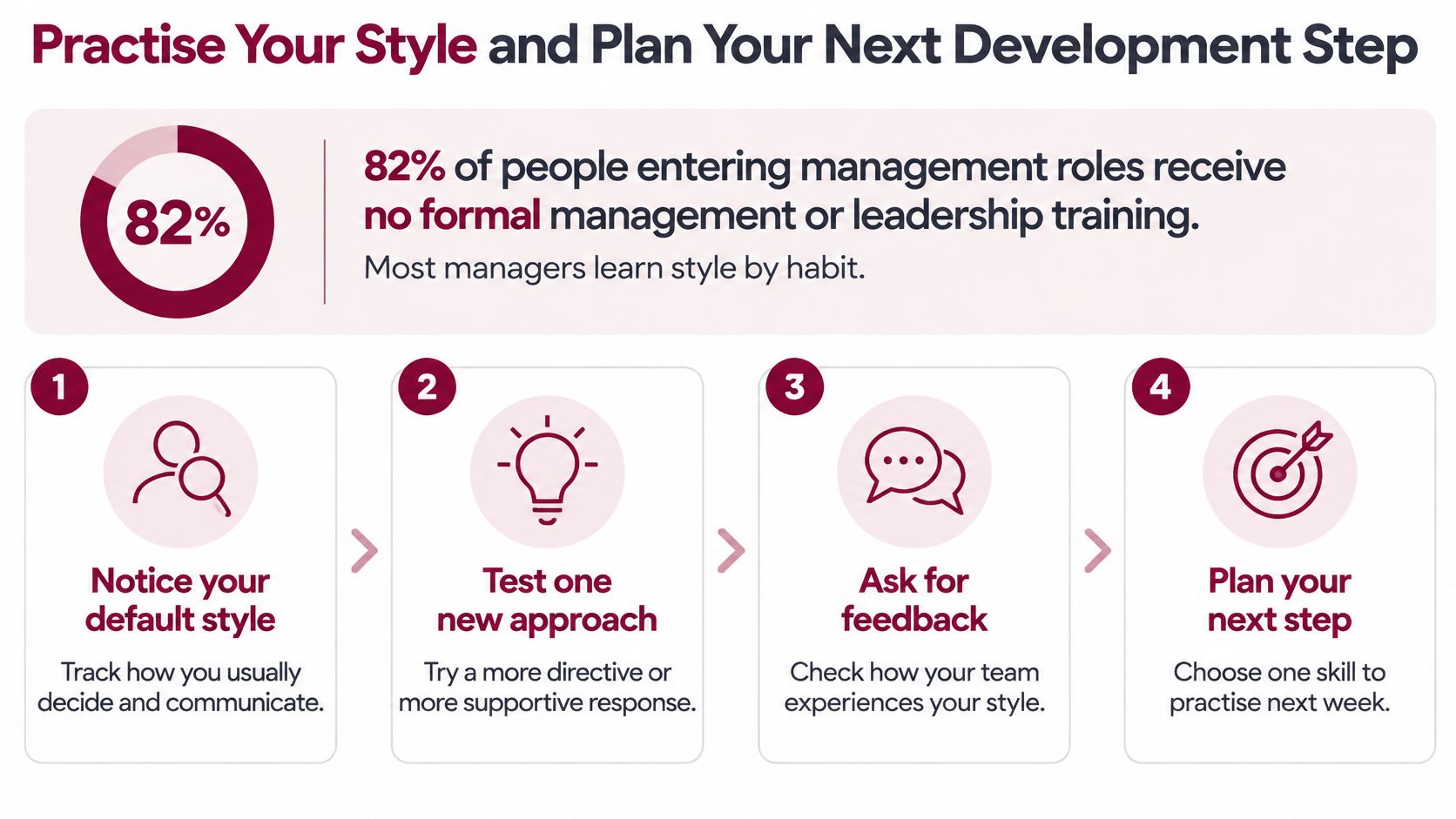
Four exercises that show the default
Decision log. For two weeks, record each significant decision and the style you used. Mark which ones needed more input than they got.
Style switch. Once a week, take one routine decision and deliberately use a different style. Note what the team did differently, not only how you felt.
Meeting observation. Ask a colleague to note who speaks first and who has the final word. Compare that note with your intention.
Conflict role-play. Practise the same disagreement twice, once with a directive opening and once with a participative opening. Keep the opening that fitted the risk.
Five prompts, then a study route
Which decision did you make alone this month, and was that necessary? Which team member would say you listen least, and what evidence do you have? When did you last change your style, and why? Where did your style match the team's readiness? What would your team say you should keep doing?
Formal study helps when habit is the only teacher. Our leadership pathway is eight CPD-accredited courses, online and self-paced, with a duration of 160 hours, recorded lectures, structured materials and assessments. Jenna Tiffany builds that design from structured frameworks and real organisational scenarios. The Change Management course is the piece for managers in transition. Learners diagnose drivers and barriers, apply ways to handle resistance, and examine how leadership, communication and culture sustain a change after the announcement. Strategic Leadership and Corporate Direction sits with that work for people setting longer-range direction. Day-to-day leadership skills for managers are the behaviours those frameworks depend on.
Start this week with the decision log. Two weeks of honest entries will show your default faster than any personality label.
London School of Business Administration offers self-paced, CPD-accredited leadership and management study for people who need to choose and adapt how they lead, not only learn the labels. The leadership pathway covers fundamentals, decision-making, emotional intelligence, change and team leadership through recorded lectures and applied scenarios. Visit London School of Business Administration to see the leadership courses and begin with the decision skill you most need to practise.