

Only 54% of respondents said their organisations based decisions on data and insights, while up to 45% reported using gut feeling and 33% described decisions made in departmental silos, according to a 2020 UK survey of 500 senior decision-makers. These findings reframe decision making models in management: the challenge isn't choosing a clever framework, but establishing how people combine evidence, judgement and responsibility.
Table of Contents
- Why Structured Decision-Making Matters for Managers
- What a Decision-Making Model Is
- Classical and Behavioural Decision-Making Models
- Structured and Participative Models for Organisational Decisions
- Decision-Making Models in Practice
- How to Choose the Right Decision-Making Model
- Developing Your Decision-Making Practice
Why Structured Decision-Making Matters for Managers
A manager can reach a sensible conclusion through an unreliable process. Equally, a carefully reasoned decision can produce a disappointing result because circumstances change. Structured decision-making helps distinguish the quality of the reasoning from the luck of the outcome.
Without an explicit process, colleagues may use different criteria for similar choices. A department might recruit to relieve immediate pressure while another postpones recruitment to protect its budget. Neither decision is necessarily wrong, but senior managers need to understand the competing assumptions before accepting their combined consequences.
Match responsibility to the decision
Managerial decisions operate at different levels:
- Strategic decisions concern organisational direction, such as entering a market or launching a programme. Senior leadership normally retains responsibility because the consequences extend across the organisation.
- Tactical decisions translate strategy into resource choices, including departmental budgets, staffing plans and delivery schedules.
- Operational decisions concern day-to-day execution, such as allocating work or responding to a service disruption. Managers should delegate these within clear boundaries.
These categories aren't rigid compartments. A recurring operational problem may reveal a strategic weakness, while a strategic commitment creates numerous tactical choices. Delegation therefore needs escalation rules, not merely a chart showing who reports to whom.
Make reasoning inspectable
An explicit model gives colleagues a shared basis for asking useful questions. What problem are we solving? Which evidence would change our view? Who has authority to proceed?
Practical rule: Document enough reasoning for someone who wasn't present to understand why the decision was reasonable at the time.
This isn't an argument for lengthy approval procedures. A routine, reversible choice may need only a short record; a consequential commitment deserves more scrutiny. The purpose is proportionate discipline, making choices consistent enough to explain, challenge and improve without preventing managers from acting.
What a Decision-Making Model Is
A decision-making model is a repeatable structure for moving from recognising a problem to taking action and reviewing the result. It does not guarantee the right answer. It delivers something more modest and more useful: reasoning that colleagues can see, question and improve.
A laboratory notebook offers a helpful comparison. Part of an experiment's value lies in a record that lets another researcher retrace each step. A decision model does the same work for managers, turning a private judgement into something a team can inspect.
Consider a department struggling to answer customer enquiries. The manager proposes recruiting another employee. A model interrupts that jump, requiring the manager to establish whether insufficient staffing is the problem before treating recruitment as the answer.
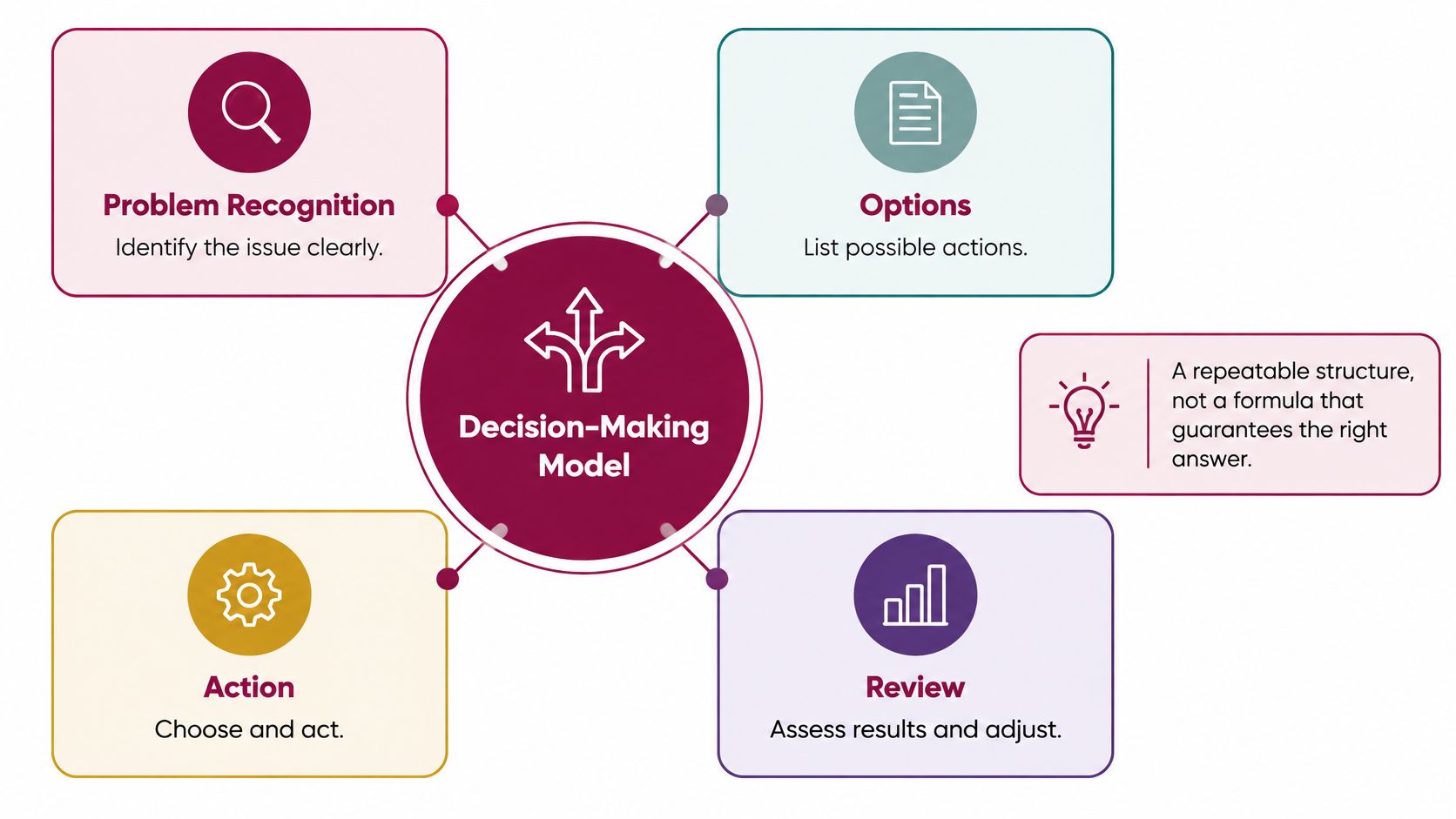
Follow the reasoning from problem to review
Problem framing comes first. Slow responses might stem from workload, unclear responsibilities, unsuitable systems or missing skills. Each cause points to a different remedy, so a recruitment exercise could easily leave the underlying difficulty untouched.
Evidence gathering follows. Examine work patterns, consult employees and check whether the problem is persistent or temporary. Then establish criteria before comparing alternatives. Service quality, affordability, capability and implementation time are all reasonable candidates here.
The remaining stages turn understanding into a commitment:
- Generate alternatives. Compare recruitment with training, reallocating responsibilities or redesigning the process. Include maintaining the current arrangement if it remains a credible option.
- Choose and implement. Explain why the preferred option meets the criteria, identify an accountable owner and specify the resources needed.
- Review the outcome. Assess whether service improved and whether the original explanation of the problem still holds.
Review means more than checking whether the new employee performs well. It asks whether the decision addressed the organisational need that justified it. A perfectly good hire can still be the wrong answer to a poorly framed question.
Separate the model, technique and context
Three terms that managers often merge deserve separating. A model provides the overall architecture. A technique, such as a weighted decision matrix, supports a particular activity within that architecture. A context describes the setting and level of the choice.
A manager might use an analytical model, apply a weighted matrix to compare staffing options, and operate within a tactical resource-allocation context. These are complementary descriptions of one decision.
Keeping them separate prevents a familiar mistake: assuming that completing a spreadsheet amounts to managing the decision. Stakeholders need to understand the problem definition, the authority behind the choice, the implementation arrangements and the grounds for reconsideration. The calculation is only one part of that account.
Classical and Behavioural Decision-Making Models
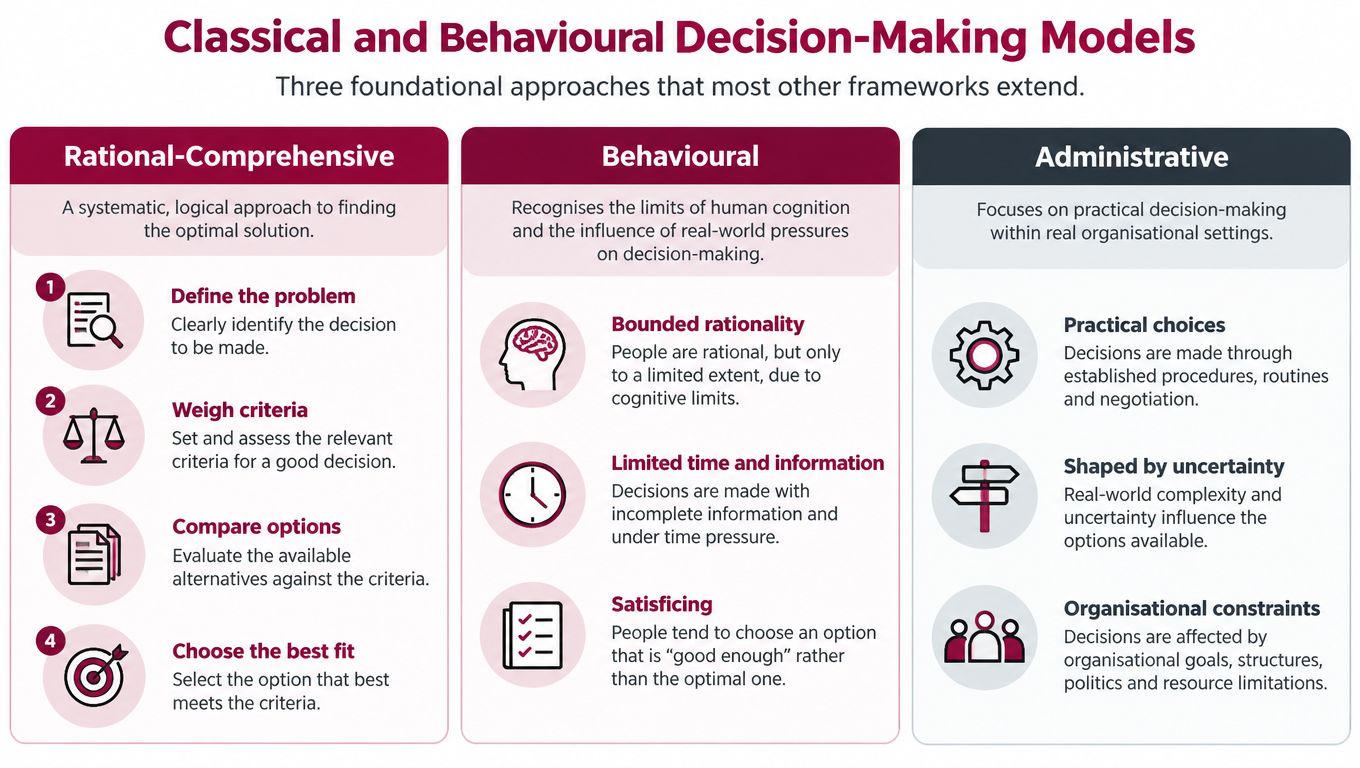
UK managers lean heavily on data without always trusting it. A survey of 263 UK managers and directors found that 95% used data and analytics in making or contributing to decisions, yet respondents believed only 58% of decisions requiring data had sufficient information behind them. That gap, between confidence in analysis and doubt about the evidence beneath it, is where the foundational models part company. Each makes a different assumption about how much information, time and reliable judgement a manager can bring to a choice such as the staffing problem.
Rational analysis and its practical limits
The rational model asks managers to define the objective, weight the relevant criteria, identify alternatives, estimate consequences and select the option that maximises the desired outcome. Its appeal is rigour: colleagues can inspect the criteria and challenge the comparison.
Applied to recruitment, it would weigh the expected benefits and costs of hiring, training and process redesign side by side. The difficulty lies in its assumptions. Managers rarely know every alternative, cannot reliably predict every consequence and may disagree about how to value competing outcomes. The survey figures capture the point neatly: widespread use of analytics coexisted with widespread doubt about whether the data justified the decisions built on it.
Generative AI can extend the search for alternatives the rational model demands, yet it inherits the same constraint. Its outputs are only as dependable as the data and prompts behind them.
Herbert Simon's bounded rationality describes this situation more accurately. Managers work with limited information, time and analytical capacity, so they often satisfice: they select an option that meets an acceptable threshold rather than proving it is the best conceivable one. A hiring manager might appoint a candidate who meets clearly defined requirements instead of funding an open-ended search. Satisficing still requires standards, and the acceptance threshold should be defensible before a preferred candidate appears on the horizon.
Intuition, administration and organisational behaviour
Intuitive decision-making draws on experience-based pattern recognition. An experienced service manager may recognise a familiar scheduling problem before any formal analysis is complete. Intuition earns its place when time is short and the situation resembles previous cases; familiarity by itself, however, says nothing about accuracy.
In management teaching the terms behavioural and administrative sometimes overlap. Behavioural approaches focus on how people judge, including cognitive limitations and bias. Administrative accounts focus on workable choices under uncertainty and organisational constraint. Treat them as complementary emphases within one explanation of how managers decide.
| Approach | Main assumption | Principal caution |
|---|---|---|
| Rational model | Alternatives and consequences can be compared systematically | Apparent precision can conceal uncertain inputs |
| Bounded-rationality or administrative | Managers need acceptable choices under constraints | Acceptance thresholds may become undemanding |
| Intuitive | Experience can reveal relevant patterns quickly | Confidence may exceed the relevance of experience |
Which approach serves best depends on three practical questions: how reversible the decision is, how many people it affects and how trustworthy the available data are. All three also operate inside organisational relationships. A manager may favour familiar candidates, defend a departmental budget or hesitate to challenge an influential colleague. Understanding the role of emotional intelligence in leadership helps managers examine those pressures without confusing empathy with agreement.
A plausible judgement deserves examination, whether it comes from a spreadsheet, an experienced manager, a cohesive team or an algorithm.
Structured and Participative Models for Organisational Decisions
Individual reasoning is only part of organisational decision-making. Managers must also decide who participates, how quickly the organisation responds and how it tests proposed improvements.
Choose participation deliberately
The Vroom-Yetton model uses a decision tree to guide the choice between manager-led, consultative and group decision styles. Managers consider the importance of decision quality, their own information, whether the problem is structured and whether colleagues' commitment is necessary for implementation.
Its central question isn't whether participation is desirable in general. It's whether a particular decision requires additional expertise, acceptance or shared ownership.
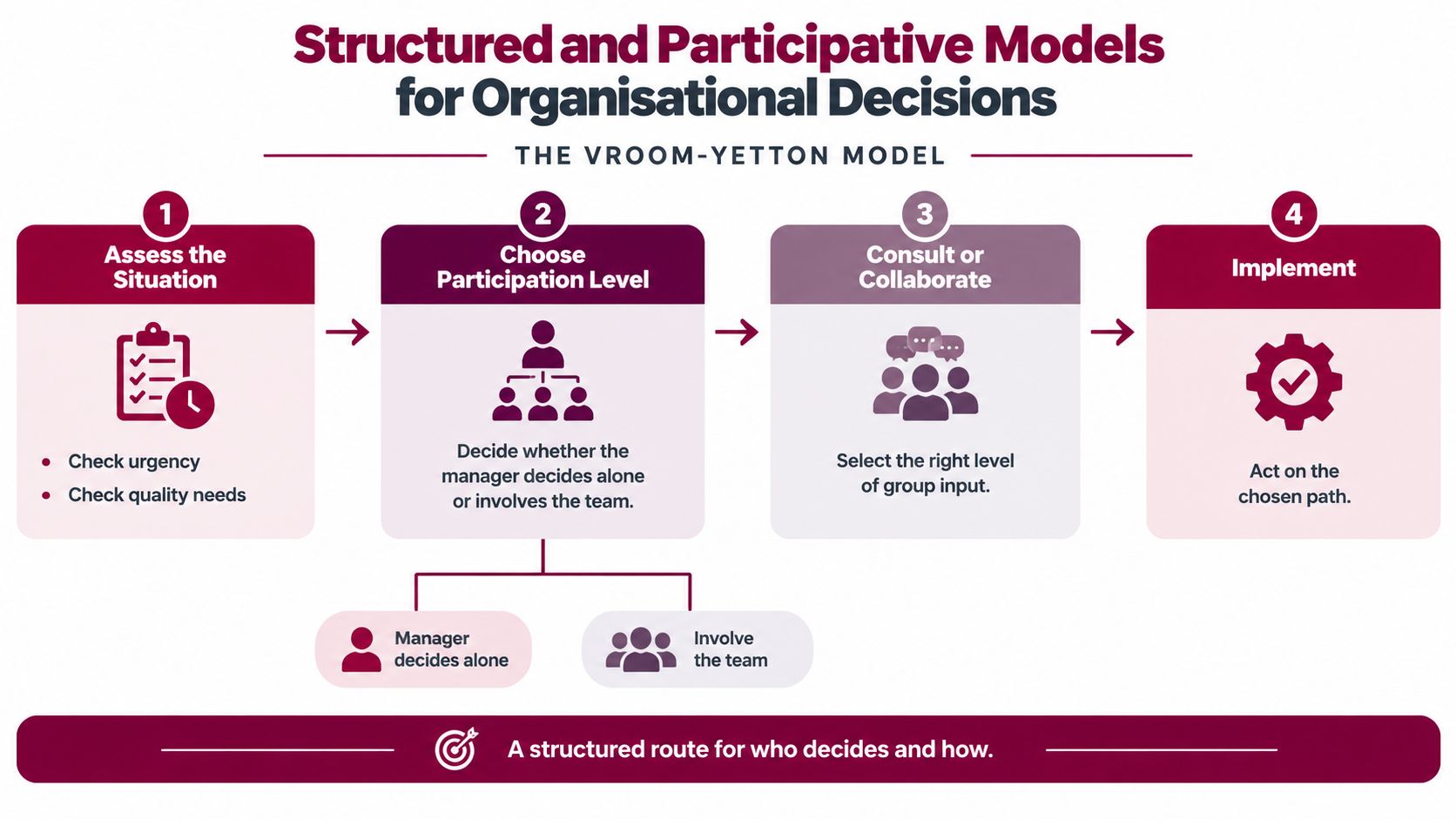
For example, a manager might decide an urgent room reassignment independently but consult teaching staff before changing a timetable. A wider redesign of working arrangements could require collaborative development because implementation depends on colleagues changing their behaviour.
Consultation must be honest about authority. Asking for opinions doesn't mean promising consensus, and group decision-making and consensus building require more than collecting supportive comments.
Use iteration for different purposes
Boyd's OODA loop, observe, orient, decide, act, suits situations where conditions change while managers are responding. During a service disruption, the team observes what is happening, interprets its significance, chooses a response and acts, then updates its understanding. The aim is timely adaptation, not speed without comprehension.
PDCA, plan, do, check, act, provides a different rhythm. It suits continuous improvement: plan a revised enquiry-handling process, trial it, check the results and decide whether to adopt or adjust it.
Their triggers differ:
- Use OODA when changing conditions may invalidate the current response.
- Use PDCA when a process improvement can be tested and refined.
- Use participative selection when expertise or implementation commitment determines who needs involvement.
Distinguish evidence from automation
Evidence-based management combines the best available evidence with practitioner expertise and stakeholder considerations. Managers should assess relevance and reliability, not merely prefer whatever is easiest to measure.
In the 2024 UK Business Data Survey, 77% of businesses handled digitised data, but only 2% of those businesses used data for artificial intelligence or automated decision-making purposes; the equivalent figure among large businesses was 12%. These findings underline why possessing data, analysing it and delegating decisions to a system are distinct capabilities.
The Advanced Professional Certificate in Data Analytics for Business is a relevant named study option. In practice, however, managers must still specify who interprets analytical findings and who authorises action.
Decision-Making Models in Practice
Research into strategic decision-making in 109 British-firm acquisitions examined procedural rationality alongside collective intuition. The relationships between management-team characteristics, decision processes and acquisition performance depended on organisational context, environmental dynamism and the strategic importance of the decision.
The lesson is conditional rather than universal. Combining analysis and intuition isn't a recipe that automatically improves outcomes; managers need to consider whether their process fits the circumstances.
A programme-launch decision
Consider an illustrative education provider assessing a new programme. The leadership team begins by examining market demand, existing completion patterns, delivery costs and likely contribution margin. It also checks whether staffing and learning resources can support the proposal.

An analytical comparison might favour the launch, yet experienced staff may question whether historical demand remains relevant. Learner preferences, technology or regulatory expectations could be changing. Their concerns shouldn't override the evidence automatically, but they should become explicit assumptions that the team can investigate.
The leadership team could distinguish between established facts, reasonable estimates and unresolved uncertainties. It might then authorise a limited pilot rather than commit immediately to a full launch. This is a hypothetical application, not a reported institutional result.
Sequence methods around the work
The programme example suggests a practical sequence:
- Screen analytically. Establish whether the proposal meets essential financial, educational and delivery requirements.
- Challenge collectively. Invite staff with different responsibilities to identify missing assumptions and alternative explanations.
- Commit proportionately. Choose a pilot or staged approval where uncertainty makes a full commitment premature.
- Evaluate deliberately. Specify what evidence would justify continuation, adaptation or closure.
Discussion of big data and its impact on strategic decision-making belongs within this wider process. More observations may strengthen demand analysis, but they don't settle questions about educational purpose or acceptable risk.
Contrast this with a routine scheduling decision. A frontline manager could select an available classroom that meets accessibility and equipment requirements without conducting a strategic appraisal. Bounded rationality is appropriate because the acceptance criteria are clear and the decision remains within delegated authority.
The strategic choice to enter a new subject area remains with senior leadership. Effective delegation therefore separates the local action from the organisational commitment, rather than insisting that everyone use the same level of analysis.
How to Choose the Right Decision-Making Model
Start with the situation, not your preferred framework. A model that feels efficient to the decision-maker may still be unsuitable for the people who bear its consequences.
Diagnose stakes, evidence and legitimacy
Ask these questions before deciding how to proceed:
- How consequential and reversible is the choice? A readily reversible trial needs different safeguards from a restructuring decision.
- How much time is available? Distinguish an external deadline from pressure created by poor planning.
- How reliable is the evidence? Check relevance, completeness and freshness, including whose experience is absent.
- Whose commitment and legitimacy matter? Identify those who must implement the decision and those entitled to question it.
Choosing a Decision-Making Model by Situation
| Model | Best suited to | Key limitation |
|---|---|---|
| Rational-comprehensive | Consequential choices with comparable options and credible evidence | Can imply certainty that the evidence doesn't support |
| Bounded-rationality | Constrained decisions with defensible acceptance criteria | May stop the search too early |
| Intuitive | Familiar, time-sensitive situations with relevant experience | Vulnerable to misplaced confidence |
| Vroom-Yetton | Decisions requiring deliberate choices about participation | Depends on an accurate assessment of the situation |
| OODA | Rapidly changing conditions requiring repeated adaptation | Hasty interpretation can misdirect action |
| PDCA | Reversible operational improvements | A local trial may not establish wider suitability |
| Evidence-based management | Choices requiring different forms of evidence and stakeholder input | Evidence may be incomplete or conflicting |
For people decisions, add explicit procedural protections. An employee should have a meaningful opportunity to correct inaccurate information, offer context and challenge an adverse conclusion. Efficiency and legitimacy are different tests.
Give generative AI a bounded role
A Chartered Management Institute study of more than 1,000 UK managers found that 70% used generative AI for workplace advice, but only 12% felt very confident managing teams using AI. Use therefore shouldn't be mistaken for managerial readiness.
Place AI inside the decision process as an aid to drafting alternatives, exposing assumptions or organising material, not as an unaccountable decision-maker. For high-impact choices, require traceable evidence and a named human approver.
Human–AI safeguard: If a manager can't explain and defend a recommendation without referring to the system's confidence, the recommendation isn't ready for approval.
Operating rules should cover authorised data use, source checking, data freshness, bias checks and an audit trail. When an AI recommendation conflicts with evidence or organisational values, pause for structured challenge or escalation. Record the final reasoning and inspect the outcome afterwards.
For formal study, options include Decision Making and Problem Solving within the CPD-accredited Credential of Leadership and Management, and Data Driven Decision Making within the data analytics curriculum. These address related but distinct learning interests; analytical capability doesn't replace responsibility for judgement.
Developing Your Decision-Making Practice
Good decision-making practice begins with intellectual honesty. Managers need to acknowledge what they know, what they're assuming and what would make them reconsider. No framework removes uncertainty, conflicting interests or the possibility of error.
The central discipline is situational. Match the decision process to the consequences, available time, evidential quality and people affected, then treat evaluation as part of the commitment rather than an optional administrative task.
Build a useful decision record
For your next significant choice, keep a short decision record. Write it before the outcome becomes known, when you can still distinguish your actual expectations from explanations developed afterwards.
Include the following:
- The question and authority. State what must be decided, who owns the decision and where their authority ends.
- The basis for judgement. Record the options considered, decisive evidence and unresolved assumptions.
- The challenge. Note substantive objections and explain how you addressed them.
- The review trigger. Specify the event or evidence that should prompt reconsideration.
At review, ask more than whether the result was favourable. Did the reasoning omit an available warning? Did implementation depart from the approved plan? Would the same process remain defensible if the outcome had been less fortunate?
Develop judgement through deliberate study
The learning task has connected parts: understand what a model does, recognise the assumptions of the major approaches, and diagnose the situation before selecting a process. Knowing framework names is useful only when you can explain why a particular approach fits.
Experience provides material for learning, but repetition alone doesn't establish sound judgement. Comparing your expectations with outcomes, seeking informed criticism and studying alternative approaches can make that experience more instructive.
A certificate can provide verifiable evidence of completed learning; it cannot, by itself, establish the quality of every subsequent managerial choice. Professional credibility also depends on how you explain decisions, respond to challenge and change course when the evidence warrants it.
If structured study is your next step, consider enrolment in the decision-making course within the leadership credential described above. Use a current workplace decision as the practical context for your learning, so that study produces a more defensible process rather than a collection of terminology.
London School of Business Administration offers self-paced business and management study, including a CPD-accredited leadership pathway with recorded lectures, learning materials, assessments and verifiable completion certificates. Visit London School of Business Administration to review the decision-making course and its place within the leadership credential, then choose a study route that fits your responsibilities and development needs.