
When two colleagues tense up in a meeting, do you read it as a clash of personalities, or as a signal that interests, roles, or norms haven't been made explicit? Conventional advice often stops at "talk sooner". That advice is incomplete. In 2025, 44% of working-age people in Great Britain reported experiencing workplace conflict during the previous 12 months, in findings Acas published from NatCen research. Disagreement is already part of ordinary working life. What separates a capable manager is the method used once it appears.
Conflict resolution is a learnable leadership practice. You name the dispute, choose a fitting process, and leave a record both sides can recognise. A private chat still matters, but it isn't a substitute for criteria, ownership, or a date to review what was agreed.
The conflict resolution examples below are complete cases, not a catalogue of types. You'll move through a budget contest, a workload row, defensive feedback, a client invoice dispute, a distributed-team breakdown, a cross-cultural misreading, a formal UK grievance, and stakeholder conflict after a merger. Each case sets the context, sequences the actions, offers sample wording, and closes with a lesson you can repeat.
Leaders who only try to smooth tension lose the information inside it. Handled with a structure, the same disagreement can clarify priorities and reduce the chance of a formal claim.
Table of Contents
- 1. Interest-Based Negotiation Between Competing Department Heads
- 2. Workload Allocation Dispute Within a Project Team
- 3. Performance Feedback Conversation That Becomes Adversarial
- 4. Scope and Payment Dispute With a Client
- 5. Communication Breakdown in a Distributed Team
- 6. Cross-Cultural Misunderstanding in an International Team
- 7. Formal Workplace Grievance Under UK Employment Practice
- 8. Stakeholder Conflict During a Merger or Change Initiative
- Comparison of the Eight Conflict Resolution Examples
- From Examples to Capability: Building Your Conflict Resolution Practice
1. Interest-Based Negotiation Between Competing Department Heads

Two department heads request the same share of a budget. Finance hears two fixed demands: “We need the whole allocation” and “So do we.” The meeting has become a contest over positions. Interest-based negotiation, developed by Roger Fisher and William Ury at the Harvard Negotiation Project, shifts attention to the reason behind each demand.
From the demand to the need
Suppose analytics needs storage to keep overnight jobs running, while commercial needs faster monthly reporting for the board. The requests sound incompatible, but the underlying needs may allow a different design. The orange example in Getting to Yes illustrates the same distinction: two sisters quarrel over one orange, then discover one needs the peel for baking and the other wants the juice.
Practical rule: Don't evaluate options until both sides have confirmed, in writing, the interests you think you've heard.
A facilitator can ask: “You've both asked for the full pot. What fails if you don't get it?” One department might reply, “Our pipeline misses the regulatory window.” The other might say, “The board pack is three weeks late.” With those consequences clear, the heads can agree objective criteria, such as risk, statutory duty and cost of delay, then develop at least three options.
- Ask why first: “Why does this matter to you?” opens discussion of the need behind each demand.
- Record the interests: Write down both sides' priorities and check that each recognises its own concerns.
- Agree the criteria: Set the tests before comparing proposals, so neither side can change the rules to favour its preference.
- Develop three options: A single compromise may preserve the original contest. Several options make room for different combinations of cost, timing and risk.
The budget round can then end with an allocation tied to agreed needs and criteria, rather than a split that merely leaves both department heads dissatisfied.
2. Workload Allocation Dispute Within a Project Team
A high-profile task lands on one person. She says the split is unfair. Her colleague says his diary is already full. The rest of the team goes quiet and starts keeping score. Workload disputes are among the most common sources of friction in project work, and a sense of inequity spreads further than the two people arguing.
A neutral facilitator helps more than a manager who reassigns the task. The Acas account of practice at Bradford Metropolitan District Council shows mediation used early, so disputes were handled before they became employment tribunal matters and recurring patterns became visible to managers. The same logic fits a project team. Make capacity visible, then decide.
Agile teams often use a workload board in sprint planning so commitments are on the wall, not in private calendars. You might open with: "We're not judging performance today. We're matching this task to time and skill. Walk me through what is already committed."
If you can't see the current load, you're negotiating stories, not capacity.
- Show the work first: Put current commitments where the whole team can see them.
- Fix the criteria: Skill, deadline, and dependency come before names.
- Set a review date: Don't let a temporary split harden into a precedent.
- Keep performance out of it: A workload decision isn't an appraisal.
Courses such as Team Building and Management treat this as a management skill: how a group agrees work, not only how two people feel about it. The lesson for you is that fairness has to be inspectable. Hidden diaries produce hidden resentment.
3. Performance Feedback Conversation That Becomes Adversarial
A review can turn adversarial when an employee hears a judgement about their character instead of a clear account of their work. The manager's task is to make the feedback specific enough to act on, while leaving room for the employee's perspective.
Kim Scott's idea of radical candour pairs direct feedback with care for the person. Situational leadership adds a practical reminder: state the expectation, then offer support suited to the employee's needs. A useful structure is situation, behaviour, impact. It works like a map: it shows what happened, what action is being discussed, and why it mattered, without turning the conversation into a verdict.
One conversation, two turns
Prepare two or three specific examples and identify their effects. Begin with one example, then invite the employee to explain how they saw it. For instance: “The client pack went out on Thursday without the risk section, and the sponsor queried it in the steering group. What's your view of how that went?”
Listen without interrupting. Then connect the behaviour to its impact and agree a next step: “The impact I saw was a delayed decision. I'd like us to agree one change before Friday's pack.” This keeps the discussion focused on an observable event and a workable response.
The Acas individual mediation monitoring report for 2024–25 reports that 92% of commissioners identified improving the relationship between disputing employees as an objective. Among participants, 74% of those who reached a written agreement reported satisfaction with it, compared with 20% of those who did not.
Close the feedback conversation just as clearly. Record one or two actions, name who owns each, and send a short written summary within 24 hours. Specific expectations and agreed actions make the next conversation easier to have.
4. Scope and Payment Dispute With a Client
The final invoice arrives and the client replies that the work fell short of the brief. You can feel the relationship, and the cash, slipping in the same email. Principled negotiation gives you a way through that isn't a discount offered in panic. You test both positions against a best alternative to a negotiated agreement, your BATNA, and you anchor the talk in the statement of work.
Separate what is owed from what is argued
Read the original scope before you call. Mark what was delivered, what was varied, and what was never written down. In professional services, a phased settlement often works. Undisputed fees are paid now. Contested items go through a short review. Large IT and consultancy contracts do something similar with change control. A variation is priced and signed before the extra work starts. If that step was skipped, you're negotiating history, so be precise about it.
Write your BATNA before the meeting. That might be a part-payment and a clean end, or a formal claim you would rather avoid. Knowing the walk-away point stops you inventing one under pressure.
You might say: "The statement of work covers the diagnostic and the two workshops. The third workshop was requested in March and isn't in the fee. I can invoice the agreed sum this week, and we can price the extra session separately. Which of those do you want to settle first?"
Offer options, not a single weary compromise. A preserved client relationship is usually worth more than winning the argument about a line item, provided you don't teach the client that scope is optional.
5. Communication Breakdown in a Distributed Team
Messages pile up overnight. Someone in another time zone reads silence as avoidance. Someone else reads a short reply as rudeness. The substance of the work may not even be in dispute. The channel, the hour, and the missing decision are.
Remote and hybrid work has multiplied this pattern. Acas, drawing on CIPD research, reported that 56% of organisations allowing flexible or hybrid working saw conflict when requests couldn't be agreed, and 29% of public-sector respondents reported tensions between employees who could and couldn't work remotely. Explicit norms reduce the guesswork that feeds those tensions. Managing the pattern well is also part of what Communication Skills for Leaders is built to practise.
A working agreement used by agile and distributed software teams states which channel carries which message, and how quickly a reply is required. Remote-first organisations add a decision log so choices don't live in a private chat. A longer treatment of those habits sits in managing distributed teams effectively.
Try this in the retrospective: "We keep relitigating decisions that were made in a thread only three people saw. Let's agree the channel, the response window, and where the decision is written."
- Match channel to message: Urgent, decision, and social talk don't share one inbox.
- Respect the clock: Response windows have to survive the time zones you employ.
- Rewrite the agreement: Review it at each retrospective, or it will date.
- Log the decision: A shared record beats a memory of who said what.
The lesson is that ambiguity is a design choice. If you don't set the norm, people will invent one, and they won't invent the same one.
6. Cross-Cultural Misunderstanding in an International Team
A direct correction in one office may sound hostile to a colleague elsewhere; careful, indirect wording may leave another unsure whether a decision has been made. Deadlines can slip when “soon” means different things to different people. The team needs a shared way to clarify expectations before assumptions harden into conflict.
The Thomas-Kilmann Conflict Mode Instrument describes five responses to conflict: competing, collaborating, compromising, avoiding and accommodating. Used as a reflection tool, it helps team members recognise their own default responses and discuss how those responses may be interpreted. It does not determine who is right; it gives the team language for discussing behaviour without turning it into a judgement of character.
Ask colleagues to complete a conflict-style assessment, then compare their reflections in a facilitated discussion. Treat the results as starting points, not verdicts. A practical question is: “When I give critical feedback, would you prefer it in the meeting or in a note beforehand?” Listen to the answer before explaining your own preference.
State preferences clearly, and ask colleagues how they want feedback and decisions communicated.
Then put the working agreement into plain language and check that everyone understands it: “The draft is due Thursday at 16:00 UK time. Please add disagreements to the document comments before the call.” Clear wording gives colleagues a shared reference point when communication styles differ.
The leadership lesson is to make your own preferences visible and stay curious about others'. That small adjustment can turn an apparent slight into a question the team can resolve together.
7. Formal Workplace Grievance Under UK Employment Practice
An employee writes to say a line manager's treatment has become unacceptable. This is no longer a coaching conversation you can hold in a side room. It needs a fair, documented, proportionate process, and the employee needs to see that the concern has been taken seriously.
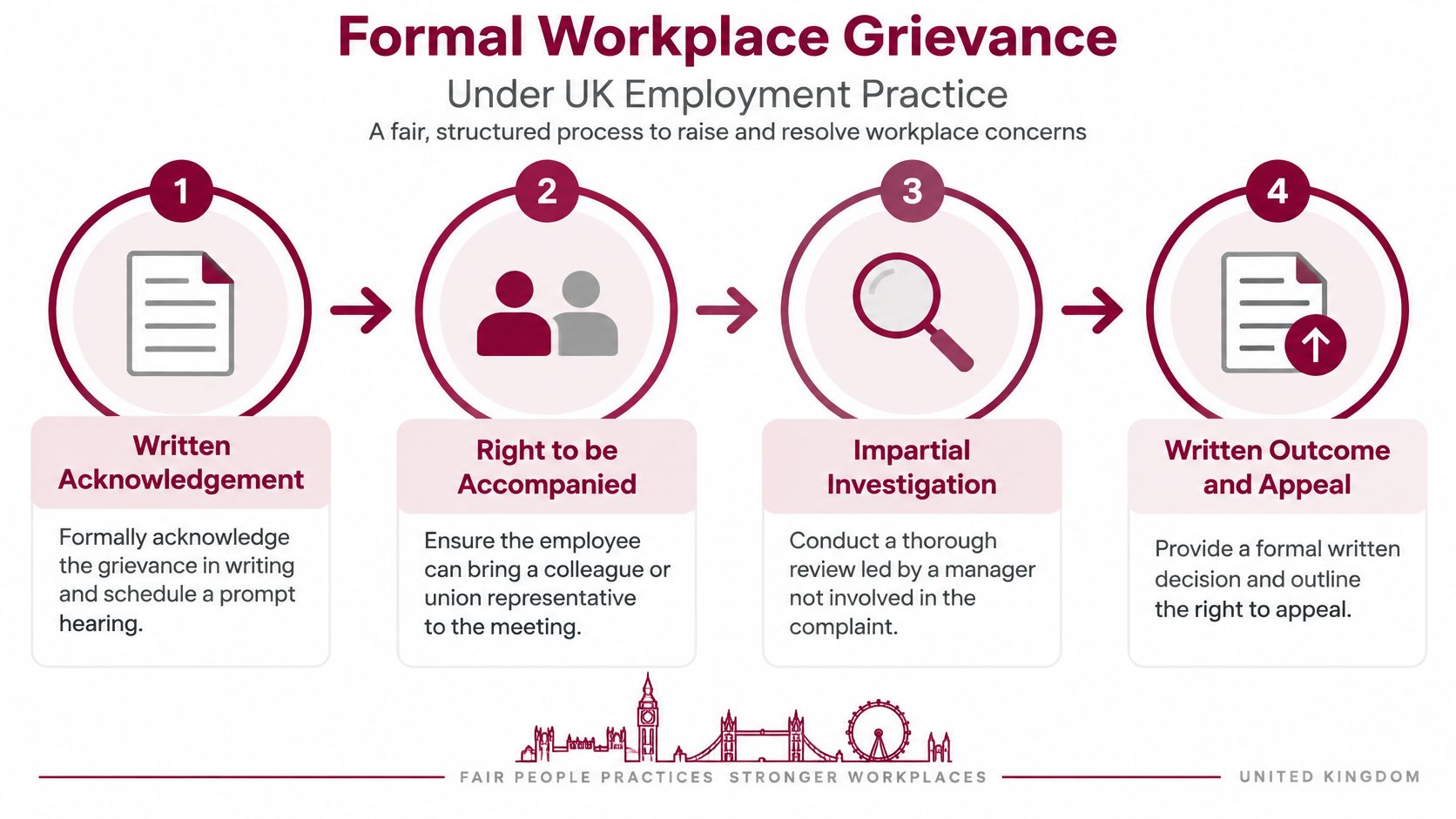
The Acas Code of Practice on disciplinary and grievance procedures expects a prompt meeting, the right to be accompanied, a considered decision, and a right of appeal. UK organisations of very different sizes align their procedures with that Code. Acas guidance on mediation and facilitated conversations adds important limits. Either party may suggest mediation, participation stays voluntary and confidential, and a formal procedure should be paused if both agree to mediate during it. Mediation isn't suitable where a decision on statutory rights is required, where someone else must impose the outcome, or where intimidation, coercion, or abuse makes voluntary engagement impossible.
During 2024–2025, Acas handled 117,951 early-conciliation cases in Great Britain and resolved 9 out of 10 without an employment tribunal. Early conciliation is a voluntary route before a hearing, not a reason to skip a fair internal process. A practical sequence for managers is set out in how to handle conflict at work.
- Acknowledge in writing: Confirm you've received the grievance and what happens next.
- Use a clean pair of hands: The investigating manager shouldn't already be involved.
- Keep the record: Meetings, evidence, and reasons for the decision all belong in it.
- Know the boundary: Offer mediation only where it doesn't replace a required investigation.
The lesson is proportionality. Informal repair and formal fairness aren't rivals. You choose the route the facts will bear.
8. Stakeholder Conflict During a Merger or Change Initiative
What happens when a merger gives senior leaders one destination, while managers and staff see different risks along the way? The acquisition has closed. Leaders want a shared operating model; middle managers are protecting practices that still work; front-line staff hear conflicting accounts of what comes next. Resistance may appear as delayed decisions rather than open opposition.
Treat the conflict as a question of purpose and decision-making. The Good Friday Agreement offers a civic example of parties with incompatible histories identifying shared aims and creating governance for disputes that would continue. An organisation should not copy a peace process, but it can apply the same discipline: establish what stakeholders are trying to protect, agree on a common purpose, and set out how unresolved disagreements will be handled. A post-merger integration framework can contribute at the early stage by mapping affected groups and their interests before leaders settle the new structure.
In 2023–2024, Acas handled 618 major collective disputes in Great Britain and promoted settlement in 94% of the disputes it conciliated. In a merger or change initiative, a shared statement of purpose gives groups a basis for discussing trade-offs before debating the organisation chart.
A chair might say: “Before we discuss reporting lines, let's agree what this function needs to achieve in twelve months. Then we'll record how disagreements will be escalated and review who is affected as the changes progress.”
- Map influence and interest: Include both the people affected by the change and those who can shape it.
- Agree purpose before structure: A shared aim gives later trade-offs a clear reference point.
- Set an escalation route: Give unresolved issues a formal place for decision, rather than leaving them to corridor conversations.
- Review the map: Stakeholders' interests can shift as the initiative develops.
From this case, the lesson is to treat agreement as ongoing governance, not a one-off workshop. Clear aims and review points help stakeholders keep making decisions together after the announcement.
Comparison of the Eight Conflict Resolution Examples
Which method fits the conflict in front of you? Choose by asking what needs to change first: a decision, a working relationship, a shared process, or a fair formal outcome. The guide below points to the most useful starting point; the case sections show how to put each method into practice.
| If the conflict centres on… | Start with… | Check progress by asking… |
|---|---|---|
| Competing departmental priorities | Interest-based negotiation, with shared criteria for weighing options | Can both department heads explain the decision and the interests it addresses? |
| Uneven or disputed workloads | A transparent review of capacity, skills, and allocation criteria | Are responsibilities clear, and can team members explain how work was assigned? |
| Feedback that has become adversarial | Specific observations, two-way questions, and agreed actions | Has the conversation produced a clear next step without closing down further discussion? |
| A client dispute about scope or payment | The written agreement, documented changes, and available settlement options | Do both parties agree on what was promised, what changed, and what happens next? |
| Misunderstandings in a distributed team | Written norms for communication, response times, decisions, and escalation | Can team members find the right channel and know when a response is expected? |
| Cross-cultural misinterpretation | Clarifying questions about intent and preferred ways of communicating | Have the parties checked their interpretation rather than treating it as fact? |
| A formal workplace grievance | A fair, documented process with investigation, outcome, and appeal | Has each party had a clear opportunity to provide relevant information? |
| Stakeholder disagreement during a merger or change | A shared purpose, stakeholder map, and agreed decision-making arrangements | Do affected groups know how decisions will be made and how unresolved issues will be raised? |
Use the questions as checkpoints, not as a substitute for judgement. If progress is unclear, return to the case that most closely matches the situation and examine its sequence of actions, dialogue, and leadership lesson.
From Examples to Capability: Building Your Conflict Resolution Practice
Across the eight cases, the first task is diagnosis. Is the dispute about competing interests, perceived unfairness, feedback, contract terms, communication, cultural expectations, a formal grievance, or organisational change? The answer helps you choose a proportionate response. A facilitated conversation may suit a disagreement that people can discuss safely; a written working agreement can clarify shared expectations. Where the issue involves safeguarding, discrimination or serious misconduct, use the formal route.
In 2025, Acas research on the prevalence of conflict at work found that 45% of workers who experienced conflict spoke to their line manager and 30% spoke informally to the other person. Only 9% used a formal grievance procedure, and fewer than 0.5% filed an employment tribunal claim. Yet only half said the conflict was largely or fully resolved, while 31% said it was mainly or completely unresolved. Informal discussion is common, but it does not always settle the issue. If it fails, record relevant facts without inflaming the dispute and consider whether a more structured process is needed.
Three habits help turn a response into a repeatable practice:
- Diagnose before you convene: Describe the conflict in one clear sentence that distinguishes the issue from assumptions about people's motives.
- Match the forum to the risk: Choose between a facilitated conversation, a working agreement or a formal grievance process according to the seriousness and nature of the issue.
- Document the close: Record agreed actions, responsible people and a review date, while protecting confidentiality and following formal procedures where required.
Together, these habits make conflict resolution a leadership capability, not just a collection of scripts. London School of Business Administration includes a Conflict Resolution course in its eight-course Credential of Leadership and Management. After each case, ask whether the process used would help colleagues handle a similar disagreement more clearly next time.