

In 2025, 72% of UK businesses surveyed by LOCALiQ reported using content marketing as part of their current strategy. That figure closes an old argument. Content is no longer something a business decides to try; it's the ground everyone is already standing on, and the audience you want is being written for by somebody else this week.
What separates the teams whose content accumulates from the teams whose content evaporates is rarely talent or budget. It's whether the decisions behind the publishing were written down before the first draft, and whether anyone agreed in advance on how the results would be judged. Planning, treated as an operational problem of ownership and coordination rather than a calendar exercise, is the whole difference.
Get six decisions right, place them in a twelve-week rhythm, and define the measurement before production begins, and the rest is craft.
Table of Contents
- Why Content Marketing Needs a Written Plan
- The Six Parts of a Content Plan
- How to Set Goals and Research Your Audience
- Choosing Formats and Channels for Each Audience
- How to Build a Quarterly Calendar and Production System
- Measuring Content Results Beyond Page Views
- Confirm Your Plan Before the Next Quarter Starts
Why Content Marketing Needs a Written Plan
A 2024 survey of more than 500 UK businesses, published by LOCALiQ, found that 74.5% used content marketing as part of their current strategy. That is a crowded field. An organisation publishing without a defined plan is still competing, but its choices are harder to coordinate and easier to repeat.
A small team without a written plan can commission the same guide twice, once from the social team and once from the course team, because neither owner could see what the other had promised. The wasted cost is not just the second draft. It is the review time, the delayed launch and the missed chance to publish something more useful in that slot.
The same dataset shows that the field is not uniform. Blog production sits at the top of the list, image and video work follow, and podcasting trails well behind. That spread matters for planning because each format carries a different production chain. An article needs research, subject review and search optimisation. A video needs scripting, filming and captioning. A case study needs interviews and sign-off from the people in it. Choosing a format is choosing a workload, and that choice needs an owner before it needs a deadline.
For small marketing teams, the week is where a written plan proves its value. A grid that shows who is working on what is the smallest useful unit of planning. It turns a broad intention into named work. Without that level, a quarterly theme can sound clear in a meeting and still leave three people unsure which asset they own.

Three decisions that stay unwritten
Ask a team to describe its content plan and you'll usually get a list of formats and a rough frequency. The decisions that determine whether the work succeeds are the ones nobody wrote down.
- The commercial objective. Teams can often describe what they want content to do in general terms, such as building authority or supporting sales, but not as a number attached to a quarter. Without that number, every topic debate becomes a matter of taste and the loudest preference wins.
- The audience each asset serves. An article written for "our market" serves nobody in particular. Naming the reader, the stage they're at and the problem they arrived with changes the opening paragraph, the examples and the call to action.
- How success will be judged. If nobody records the measure before publication, the measure chosen afterwards will be the one that flatters the piece.
Use a simple handover check. Give the plan to someone who joined last month. If they can't say which asset serves which audience, who owns it and which number it should move, the plan is still in somebody's head.
For a team of two or three people, writing these three decisions down changes the week more than it changes the year. Duplicated topics disappear because someone checked the grid before commissioning. Last-minute pieces become rarer because the brief existed before the deadline did. And each asset acquires a reason for existing that survives the meeting where it gets questioned.
A plan that holds those decisions has six parts, and each one depends on the ones before it. Before you read them, answer one question for your own team: of the objective, the audience and the measure, which is currently unwritten?
The Six Parts of a Content Plan
Six elements carry a plan. Each answers one question, and each should leave the team holding a concrete output rather than a shared understanding that lives in one person's memory.
| Planning element | Question it answers | Example for a UK education provider | Output to hold |
|---|---|---|---|
| Business objective | What commercial result must the content support? | Enrolments on a leadership credential | One measurable goal per quarter |
| Audience | Who is reading, and what do they need? | Early-career professionals new to management | Named segments with stated problems |
| Buyer stage | Where is the reader in their decision? | Comparing CPD courses against free guides | A funnel stage for each asset |
| Content proposition | What distinctive value does this piece offer? | A managers' case study on a sector shift | One primary job per asset |
| Distribution | Where will the reader meet the content? | Email, LinkedIn, search and the course page | Channel roles and named owners |
| Measurement model | How will success be judged? | Enquiries and assisted enrolments, not page views | A KPI and review date per asset |
Read the table downwards and the dependencies become obvious. The proposition can't be chosen until the objective and the audience are fixed, because "distinctive" only means something relative to a particular reader and a particular result. Distribution depends on the proposition: a data-led guide earns search traffic and email forwards, while a case study earns sales conversations. Measurement depends on all five, because a KPI is only meaningful when you know which audience, which stage and which job the asset was meant to do.
Coordination, not creativity, is where plans come apart. A late-2025 survey of 1,000 UK and international marketing professionals identified cross-channel integration as the leading planning and execution challenge, followed by coordination between internal teams and agency partners, with organisations of all sizes reporting difficulty measuring channel contribution (PPC Land's summary of the survey). Smaller businesses reported particular difficulty with budget allocation and with developing a clear marketing strategy.
That finding has a practical consequence for a small team. Combine the proposition and distribution conversations into one sitting if you must, since the same person often writes the piece and sends the email. Don't combine measurement with anything. An asset with no named KPI and no review date can't be judged later, and in practice it gets judged by how much everyone enjoyed writing it.
Each row should end with a name and a date. A row without either is a preference, not a decision.
How to Set Goals and Research Your Audience
Goal setting and audience research are usually treated as separate exercises, run by different people at different points in the year. They aren't separable. A goal tells you which audiences matter, and the audience tells you whether the goal is achievable with the content you can produce. Think of the relationship the way a satnav works: the destination is useless without a starting point, and the starting point is meaningless without a destination.
Two moves come before any topic list gets written.
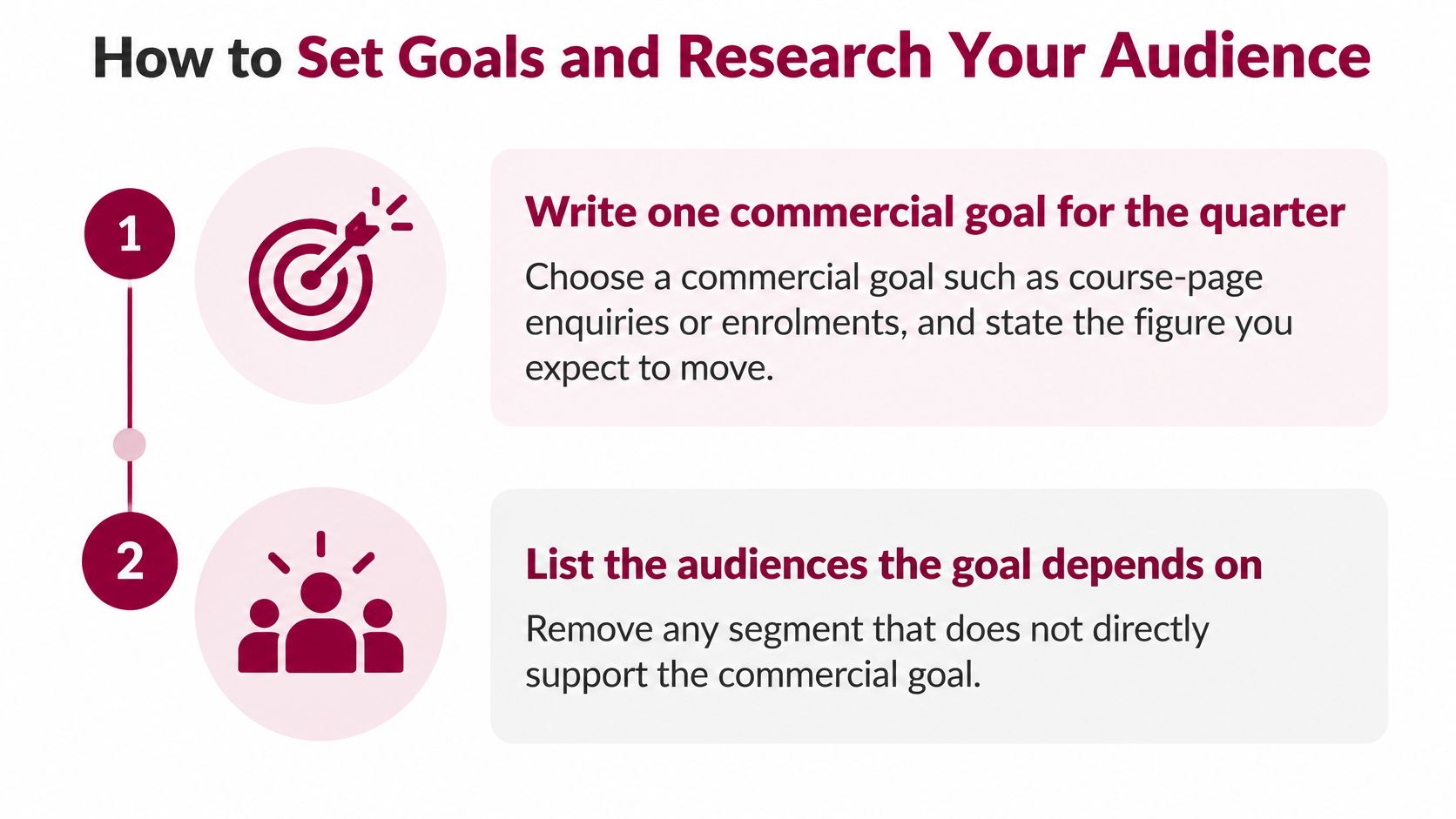
Seven steps from a goal to a question list
- Put a number on one commercial goal for the quarter. Choose something the business already counts, such as course-page enquiries or enrolments, and state the figure you expect to move. The reason is arithmetic rather than ambition: without a number, you can't decide which of two topics to drop when capacity tightens. The usual mistake is writing the goal as traffic, which is a means rather than a result.
- List the audiences that goal depends on, then delete the ones you can't describe a problem for. A segment that can't be summed up by a question its members are trying to answer won't produce a brief anyone can write.
- Interview three to five real people from each surviving segment. Ask what they searched for, read or asked a colleague before they last changed job or took on a new responsibility. This is ordinary market research done at small scale, and the guide to conducting market research sets out how to structure it so the conversations produce usable material rather than reassurance.
- Record the questions in the interviewee's own words. Internal vocabulary rarely matches what someone types into a search box at ten in the evening. The words people use are the words your headings should use.
- Map each question to a stage. Awareness questions ask what something is; consideration questions compare options; decision questions ask about cost, credibility and time. An asset that tries to answer all three at once usually answers none of them.
- Score each question on audience importance and commercial relevance. Keep the ones that score high on both and park the rest. A topic can be fascinating and commercially irrelevant, and the score makes that visible before someone spends three weeks on it.
- Check the list against the goal, and cut anything that doesn't move it. Under deadline pressure this final check is the first casualty, because cutting a finished idea feels like wasting work. It isn't. Every topic that survives the cut earns a clearer brief, a sharper distribution plan and a measurement question you can answer at the end of the quarter.
There's a second version of the same error: interviewing only colleagues who already agree with the strategy. They'll confirm the segments you've already chosen and phrase the problems the way your internal deck phrases them. The point of talking to five outsiders is to hear a question in words your organisation would never have used.
One more coordination point belongs here. Whoever runs the interviews should also own the scoring in step six, because the nuance of how a question was phrased rarely survives a handover. Split the two jobs and you get scores that reflect the interviewer's notes rather than the interviewee's meaning.
Practical rule: if a topic can't be tied to a question a named segment asked, it's a guess wearing a content brief.
The discipline behind steps six and seven is the same discipline a formal marketing strategy teaches: aligning activity with organisational goals, then defending that alignment when resources tighten. London School of Business Administration's Marketing Strategy course is built around that sequence, moving through scenario, targets, reach, awareness, tactics, execution, generation and yield across eight chapters, with developing a marketing strategy that aligns with organisational goals and objectives among its stated learning outcomes. For a practitioner who keeps skipping step seven, structured study is a more durable fix than another downloaded template.
Choosing Formats and Channels for Each Audience
Format choice is an ownership decision before it is a creative decision. If nobody is named for research, approval, publishing and review, a format becomes a favour rather than a repeatable operation. Treat the choice like fitting a pipe: the content has to carry the reader's question from first contact to a decision, and someone has to own each joint.
The shares below are drawn from 2024 LOCALiQ data on UK businesses, set beside the stage each format serves best and what it costs to produce. Use the usage share to judge likely market habit, then use production demand to judge whether the team can sustain it.
| Format | UK businesses using it (2024) | Best funnel stage | Production demand |
|---|---|---|---|
| Blogs | 59.5% | Awareness and consideration | Moderate: research and search optimisation |
| Images | 54.1% | Awareness | Low to moderate: design and alt text |
| Video | 43.4% | Consideration | High: scripting, filming and captions |
| Infographics | 41% | Awareness | Moderate: data checking and design |
| Case studies | 35.6% | Consideration and decision | Moderate: interviews and approval |
| Podcasts | 18% | Consideration | High: recording, editing and show notes |
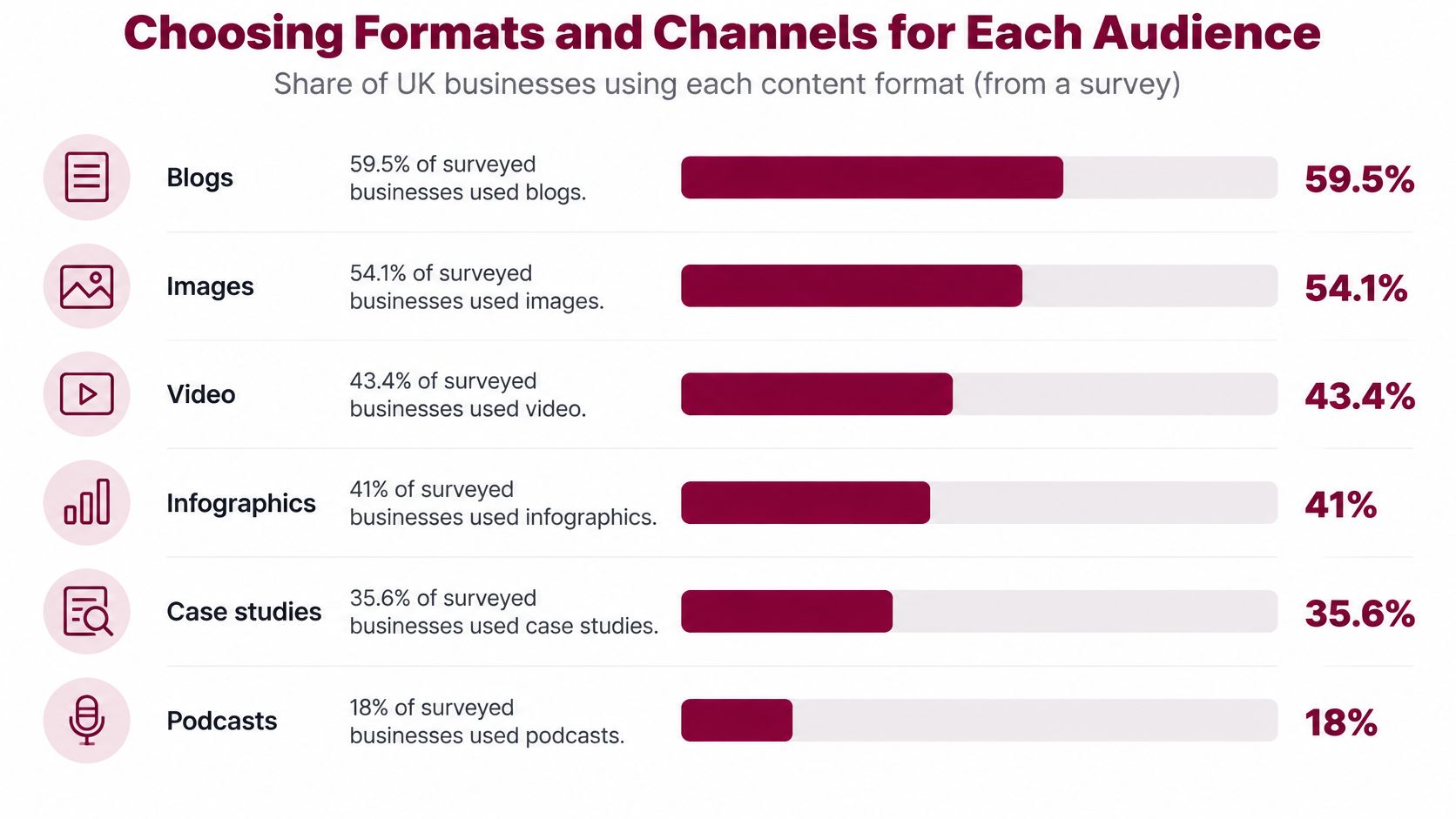
Read the share as a sign of what audiences may already expect, and the demand as the workload your named owners must absorb. A small team should hold off video and podcasts until the blog and email routine runs without heroics for a full quarter. A fortnightly article that gets reviewed beats a video series that stops in week five.
Format then follows audience rather than fashion. Foundational learners need explanatory articles with definitions and worked examples. Managers deciding whether to sponsor a colleague need case-based material showing what changed afterwards. Analysts want tables, method notes and a clear statement of what the numbers don't prove. Match the format to the question the reader arrived with, and the production decision becomes straightforward.
Give each audience one primary channel, and add a second only once the first has produced results you can point to:
- Search rewards structure, specificity and a clear answer to one question.
- Email rewards regularity and a reason to open beyond the fact that something was published.
- Professional networks reward a point of view with a person's name attached to it.
The economics behind that discipline have shifted. UK digital advertising expenditure rose from £11.55 billion in 2017 to £35.5 billion in 2024, according to UK digital adspend figures drawn from IAB UK's Adspend research, which the Advertising Association has used as its official measure since 1997. Paid distribution is now a substantial budget line, so owned content has to earn its place before anyone amplifies it. Record the cost per assisted enrolment before scaling paid reach, rather than assuming it will repay itself.
Channel reviews deserve a fixed date, because the digital marketing trends that shape audience costs move faster than an annual plan. Teams that want a structured route through the channel mix can study it through The Credential of Digital Marketing.
How to Build a Quarterly Calendar and Production System
A calendar built from isolated ideas produces a year of unrelated posts. A calendar built from themes produces a body of work. Pick three or four authority themes and give each quarter to one of them. For a business education provider those might be leadership development, digital marketing skills, data-driven management and entrepreneurship, but the key question is whether a theme can carry a pillar page, several supporting articles, a downloadable asset, an email sequence and social adaptations without repeating itself.
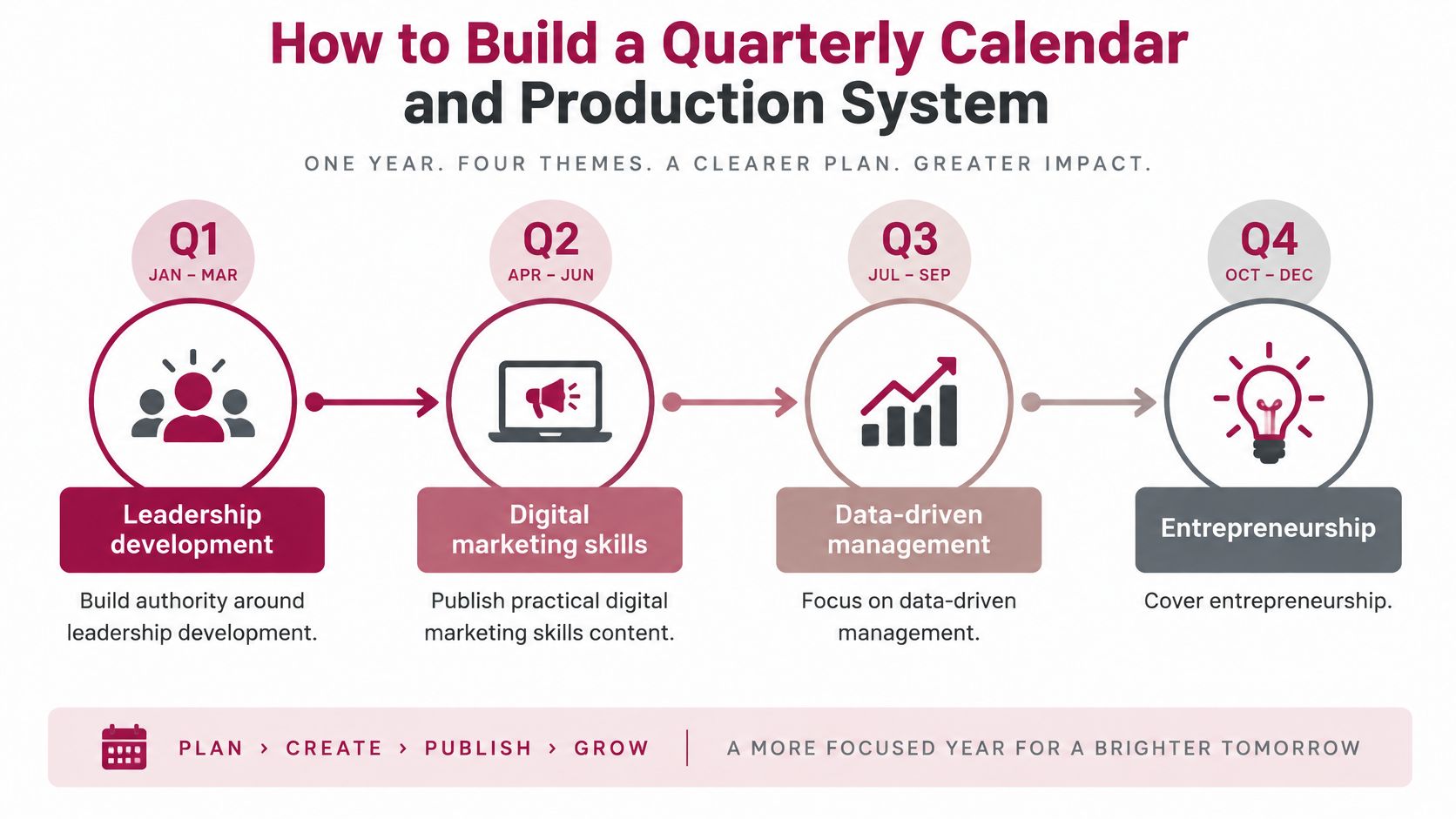
The twelve-week rhythm
- Score candidate topics on audience importance, commercial relevance, search demand, evidence strength, production effort and update frequency.
- Place the highest scorers into a twelve-week grid, with one named owner per asset.
- Write a reusable brief covering the primary job, target segment, funnel stage, approved claims and internal links, and record in that brief the KPI the asset must hit, because a target agreed after publication is a target nobody can be held to.
- Set a review step for subject accuracy and accessibility before anything publishes.
- Schedule refresh checks at 30, 90 and 180 days after publication, so statistics, links and examples are re-verified while the piece is still young enough to rescue rather than rewrite.
- Drop or repurpose any asset that has missed its KPI for two consecutive cycles.
The capacity rule: plan no more assets per quarter than the least busy owner can finish, review included. Anything above that line is a schedule you'll break in week six.
That rule exists because the bottleneck sits in how the work is organised, not in how hard anyone tries. Current B2B benchmark research reports that 54% of marketers identify insufficient resources as a challenge and 45% lack a scalable content-creation model, while only 22% describe their content marketing as extremely or very successful (Content Marketing Institute's content marketing statistics). A written brief and a fixed review step are the cheapest parts of a scalable model, and they are the parts many teams skip because neither feels like producing content. Think of the grid as a rota rather than a wish list: every asset has one owner, one deadline and one reviewer, so a delayed piece fails loudly in week three instead of unnoticed in week eleven.
Ownership matters more than volume here. Two owners on one asset usually means no owner, because each assumes the other is holding the pen.
The pre-publication check
Before anything goes live, the reviewer checks the claims, the links and every planned visual. Each image needs a stated editorial purpose, which determines its treatment: informative images carry meaningful alternative text, while decorative ones take an empty alt attribute so screen readers skip them (GOV.UK Design System guidance on images).
Where a chart or a photograph carries a point, that point also belongs in the body copy, because information conveyed only in an image is unavailable to anyone who can't see it (GOV.UK publishing guidance on images).
Build the check around the three failures it exists to catch: publishing in bursts to hit a monthly number, duplicating a topic because nobody searched the archive, and making educational claims that never went through subject review. Each one has a cheap countermeasure. Bursts stop when the grid is sized to the least busy owner. Duplication stops when the archive search becomes step one of the brief. Unreviewed claims stop when subject sign-off is a named stage rather than a favour. The calendar only works as a system when these counters are part of the routine, not corrections applied after something embarrassing publishes.
Measuring Content Results Beyond Page Views
Traffic is the easiest number to collect and the least useful one to argue about. It tells you that people arrived, not that the right people arrived or that anything followed.
The gap between intention and documentation is where measurement usually fails. UK benchmark research found that 78% of organisations had a content-marketing strategy but only 38% had documented it, with 40% relying on a verbal strategy, and only 43% rated the alignment between their metrics and their content goals as good or better (Clarity Performance's UK content marketing research). A verbal strategy can't be measured, because nobody can check a claim against a document that doesn't exist.
| Measurement tier | Example metrics | What it tells you |
|---|---|---|
| Leading indicators | Reach and qualified organic visits | Whether the right readers arrive |
| Consideration metrics | Engaged sessions, email sign-ups and course-page progression | Whether readers move towards a decision |
| Commercial outcomes | Enrolments and assisted enrolments | Whether content contributes to revenue |
Read the tiers as a sequence of questions rather than a hierarchy of importance. Leading indicators answer whether the right readers arrive. Consideration metrics answer whether they move. Commercial outcomes answer whether the work paid for itself. A plan that records only the first tier will keep publishing to an audience that never converts, and won't be able to say why.
A definition worth adopting: an assisted enrolment is any enrolment where the learner touched at least one content asset before applying, whether or not that asset was the final click.
Measurement difficulty is widespread rather than local. 31% of UK industry respondents identified measurement as a top challenge, linked to fragmented channels and a lack of standardisation, and 52% of businesses are actively using AI in SEO tasks with a further 28% planning integration (Andava's summary of UK digital marketing statistics). Discovery is changing shape, and a plan built only on rankings will misread it.
That shift matters because an answer can now be delivered without a visit. Where it's practical, record whether assets are surfaced or summarised by AI search tools and treat that as a leading indicator alongside organic visits. Define the KPI before drafting, review cohorts of content by assisted enrolment rather than reach, and keep the marketing key performance indicators you report to the business few enough that people read them.
Confirm Your Plan Before the Next Quarter Starts
A plan that can't be checked in one sitting won't be checked at all. Run this pass before the next quarter opens, and treat any item you can't tick as a decision waiting to be made rather than a weakness to explain away.
- One objective, one figure. You can state the commercial goal and the number you expect to move.
- Named audiences with named problems. Every segment is described by the question it brings, not by a demographic label.
- A retirement rule for every KPI. Decide now what result would make you drop each metric. A KPI that misses its target for two consecutive quarters either gets a new owner and a new plan, or it comes off the report. Metrics without a retirement rule accumulate until nobody reads any of them.
- A stop list. Name the content types you will not produce this quarter. Capacity planning fails when everything is a yes, and a written stop list is what protects the assets that matter.
- An escalation path for missed deadlines. Agree who decides whether a late asset gets rescheduled, reduced in scope, or cut. Without this, every slip becomes a negotiation.
- The plan in writing, somewhere the team looks weekly rather than annually.
- A review rhythm. Monthly for performance, quarterly for themes and capacity.
The written-down point isn't bureaucratic. Teams relying on a verbal strategy can't measure it and can't brief a new starter without convening a meeting, which is how the same topics get commissioned twice.
Some teams finish this checklist and find the core gap is confidence in the underlying craft rather than time on the calendar. If that's where you land, our Content Marketing course sits within the digital marketing programme, and the Marketing Strategy course lists seven learning outcomes, including developing a marketing strategy that aligns with organisational goals and objectives.
If you take one action this week, take the smallest one. Write your first KPI retirement rule, and tell the person who owns the asset. What's yours?
London School of Business Administration delivers self-paced, CPD-accredited online courses across business management, leadership, marketing management and digital marketing, with recorded lectures, structured materials and assessments, and certificates that can be verified online. If this article has shown you a gap between your content ambition and your content system, our marketing and digital marketing programmes are built to close exactly that gap at your own pace. Visit London School of Business Administration to see the full course list and choose where to start.