

Fewer than 1% of the UK's approximately 5 million SMEs have accessed public green support, according to London-focused Middlesex University research-Developing-Londons-SME-Green-Business-Transition.pdf). For smaller firms, this points to a practical management challenge: how to test changes when the premises are rented, specialist staff are unavailable and large grants are out of reach.
A low-capital pilot can start with a flow the business already controls, such as energy use, materials or deliveries. The UK Government's Net Zero Strategy executive summary projects that associated policies and regulations could support up to 440,000 jobs and attract as much as £90 billion in private investment by 2030. These projections describe the wider market taking shape; they do not show what an individual site can change this quarter. For a 90-day test, begin with a narrower question: which operational flow can you influence, and what commercial result could demonstrate progress?
Table of Contents
- What Innovating for Sustainability Means
- The UK Business Case in Numbers
- Strategic Frameworks Managers Can Apply
- Metrics That Prove Operational Savings
- A 90 Day Plan for Constrained Firms
- How Flexible Demand Cut Carbon in Practice
- Choose the Skills Pathway and Start a Pilot
What Innovating for Sustainability Means
Innovating for sustainability is the disciplined creation of new or significantly improved products, processes, services or business models that cut environmental harm while protecting or raising commercial value. It sits with strategy, operations and responsible leadership. It is not a communications layer added after the offer is fixed, and it is not only a new plant or on-site generation.
Innovating for sustainability is the disciplined creation of improved products, processes, services or business models that reduce environmental harm while holding or raising commercial value.
Think of changing a ship's course rather than repainting the hull. Customers, routes and profit still matter. What changes is how fuel, materials and risk are designed into the voyage. A brochure about greener packaging does not alter the heading if the same scrap, the same energy per unit and the same take-make-dispose loop remain.

Three levels of change
Efficiency improves the current process. A bakery that weighs dough offcuts and resets oven schedules is working on energy and scrap per unit. The product stays the same. The gain is less input for the same output, which finance can see in utility bills and waste tickets.
Redesign changes the product or the material loop. Repair, reuse, remanufacture and longer life keep value in the item instead of treating waste at the end of the line. A furniture firm that offers a refurbishment service, rather than only new units, is redesigning the loop. Customers still pay. The firm sells a second life of the same materials.
System innovation changes the offer itself. Selling performance instead of equipment, or using software to move electricity use away from carbon-intensive hours, alters when and why value is created. A cold-store operator who sells guaranteed temperature, and shifts compressor load inside safe limits, has changed the system without buying a new building.
What does not count
Two substitutes fail the test. Reporting that does not change throughput leaves kilograms, kilowatt-hours and yield untouched. A capital project that a rented site or a small balance sheet cannot fund is a wish, not a pilot. The evidence, the frames, the 90-day sequence, the metrics and the worked case that follow are built for the second constraint.
The UK Business Case in Numbers
The UK Innovation Survey 2025 classifies a business as innovation active when it introduced or developed new or significantly improved products, processes or related activities. Environmental results already sit inside that group. Scale and place still decide who joins it.
| Indicator | Figure | Managerial reading |
|---|---|---|
| Businesses innovation active | 34% | Down from 36% (2020–2022) and 45% (2018–2020) |
| Broader innovators with at least one environmental benefit | 51% | Sustainability already sits inside mainstream innovation |
| Reduced energy use or CO2 footprint | 33% of broader innovators | The most common environmental outcome |
| Recycling or reuse of waste, water or materials | 20% of broader innovators | For own use or sale, not only disposal |
| Large businesses innovation active | 47% | Against 34% of SMEs |
| Innovation active by nation | England 35%; Scotland 29%; Wales 28%; Northern Ireland 30% | Place and capability shape participation |
How to read each row
In the survey covering 2022–2024, 34% of businesses were innovation active. That share is down from 36% in 2020–2022 and 45% in 2018–2020. The pool of firms doing innovation has shrunk across three waves. A sustainability plan that assumes "most firms are already innovating" starts from the wrong baseline.
Among broader innovators, 51% introduced at least one innovation with environmental benefits. Once a firm is in the innovating group, an environmental outcome is common, not a niche badge. The managerial reading is direct. If you are not innovation active, you are outside the group in which those benefits appear.
The most common outcome was reduced energy use or a lower carbon-dioxide footprint, reported by 33% of broader innovators. Energy and carbon are the first place many firms can measure a change, because meters and bills already exist.
A further 20% introduced innovations involving the recycling or reuse of waste, water or materials for their own use or sale. That is a commercial loop, not only a disposal contract. Material that returns as an input or a saleable stream belongs in the margin, not only in a narrative.
Business size is a hard divide. 47% of large businesses were innovation active, compared with 34% of small and medium-sized enterprises. The same survey shows place matters. Innovation activity reached 35% in England, 29% in Scotland, 28% in Wales and 30% in Northern Ireland.
The capacity gap
Environmental gain is already a mainstream result inside innovation, especially through energy and materials. Organisational scale and regional capability shape who can develop and implement it. Treat the table as a baseline for ambition, not a league table to copy. The practical question is which environmental outcome your next innovation can measure, and whether finance, management time and analytical skill, not a missing technology, explain why your firm sits with the smaller share.
Strategic Frameworks Managers Can Apply
Pick one primary frame for the next initiative. Splitting effort across all five produces slides, not a pilot.
| Framework | Core question | Use it when |
|---|---|---|
| Resource efficiency | Where do energy, materials and waste cost money and carbon? | Throughput, disposal cost and yield are already measurable |
| Circular redesign | How do materials stay in use longer? | The gain is in reuse, remanufacture or life extension, not end-of-pipe kit |
| Staged net-zero innovation | How does an idea reach demonstration and commercial scale? | The technology needs shared public and private risk capital |
| Digital demand flexibility | Can existing loads move to cleaner, cheaper hours? | Assets cannot all be replaced and the site may be rented |
| Governance and change | Who decides, communicates and sustains the pilot? | The work crosses functions and will meet resistance |
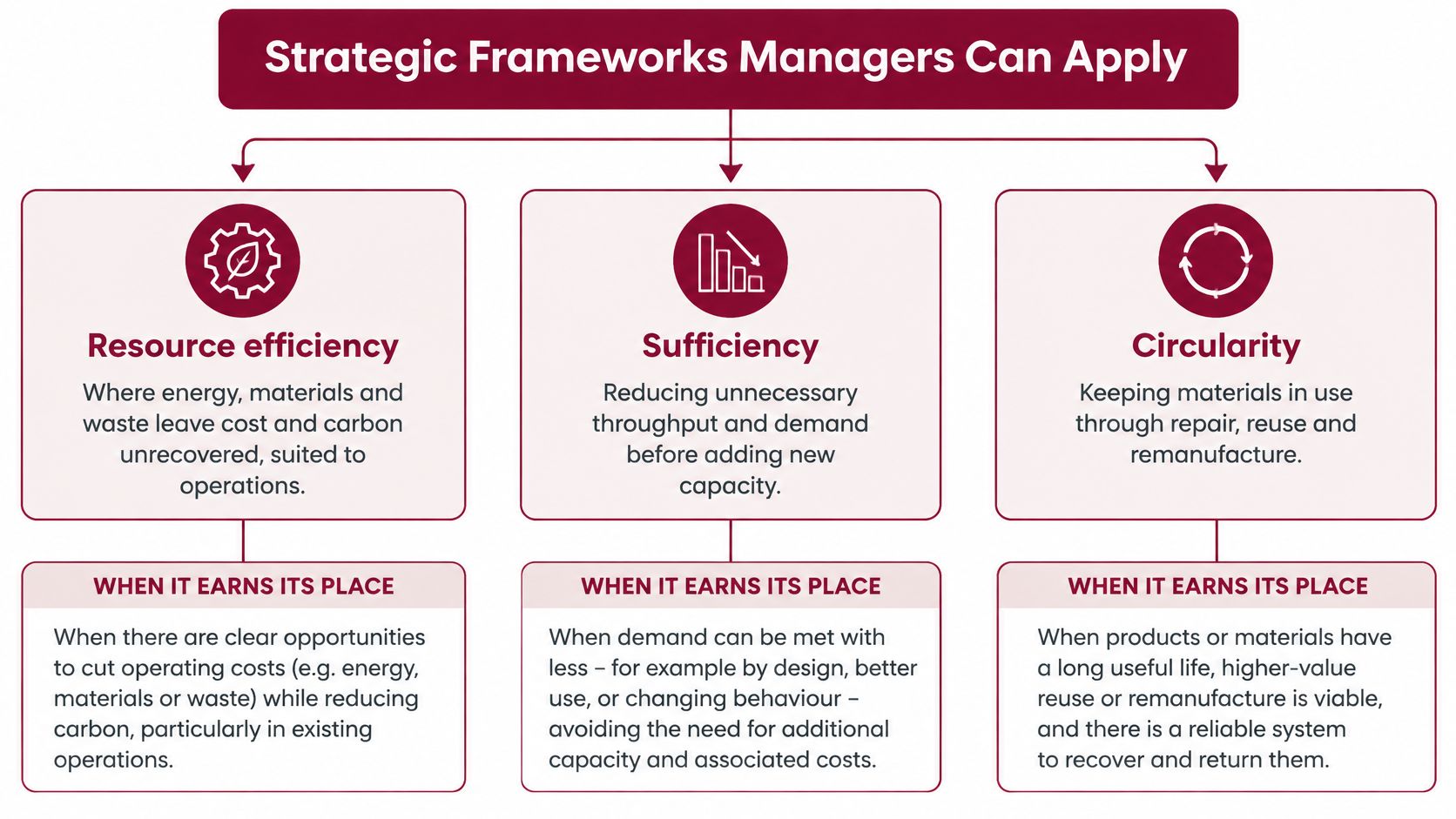
When each frame earns its place
Resource efficiency asks where energy, materials and waste leave cost and carbon unrecovered. It suits a line whose throughput, disposal cost and yield are already on a spreadsheet. You are not inventing a market. You are closing a leak.
Circular redesign asks how materials stay in use through reuse, remanufacture, life extension or process change. Prefer it when the gain is in the loop, not in a filter bolted on at the end. End-of-pipe kit can be necessary. It is the wrong frame if the material should never have become waste.
Staged net-zero innovation follows an idea from research to demonstration, commercialisation and scale. Use it only when the technology needs shared public and private risk capital. The UK Net Zero Research and Innovation Framework records that, following the Ten Point Plan, £26 billion of government capital investment had been mobilised, with at least £1.5 billion committed to net-zero innovation projects and a £1 billion Net Zero Innovation Portfolio, including £100 million for direct-air-capture and other greenhouse-gas-removal technologies. The UK Infrastructure Bank was intended to crowd in more than £40 billion. Later, Powering Up Britain identified £4.2 billion for net-zero research and innovation during 2022–2025, and Innovate UK's £60 million Net Zero Living Programme for place-based energy-system demonstrations. That is how clean energy, industrial decarbonisation and carbon removal move toward commercial scale. It is not the frame for a leased unit with one supervisor.
Digital demand flexibility cuts carbon by timing loads you already own. It earns its place when you cannot replace assets and the landlord controls the roof and the plant room.
Governance covers decision rights, communication and culture when the work crosses functions. A pilot dies when nobody owns the checkpoint. The triple bottom line is a useful reminder that commercial, social and environmental results have to be held together, but it does not choose the frame for you.
Match the frame to the constraint, not to the most ambitious technology on offer.
Metrics That Prove Operational Savings
A claim survives a finance challenge only if it starts from a baseline. Copying a long-term target from a strategy document does not.
| Metric | What to record | How to use it |
|---|---|---|
| Material throughput | Kilograms of input by major material | Prioritise high-volume or high-loss lines |
| Waste | Kilograms by stream, before and after | Benchmark a median 14% reduction from UKRI circular projects |
| Emissions | CO2e at plant or product level | Benchmark a median 18% CO2e reduction from the same monitoring |
| Yield | Output per unit of input material | Report waste and CO2e avoided per unit |
| Cost | Material cost, disposal cost, yield value | Show the pounds linked to the physical change |
Benchmarks, not promises
UKRI monitoring of circular-economy innovation projects found that participating manufacturers achieved a median 18% reduction in CO2e emissions and a 14% reduction in waste. The mechanism was redesign around resource efficiency, including material reuse, remanufacturing, product-life extension and process optimisation, rather than end-of-pipe treatment alone. Treat those medians as a check on a pilot, not as a result you can book in advance.
The same delivery record describes the UKRI-backed NICER programme as a four-year, £30 million national investment in circular technologies, collaboration and data infrastructure. Circular work is being treated as a productivity agenda. Prioritise high-volume or high-loss materials, run a closed-loop trial, and report CO2e avoided and waste avoided per unit of output.
A worked line
Say a line sends 1,200 kg of waste a month. A 14% reduction would bring it to 1,032 kg, avoiding 168 kg a month. Multiply the avoided kilograms by your disposal cost per kilogram. Apply your own emission factor to the same kilograms if you need an estimate of CO2e avoided. Those are hypothetical figures for the method. They are not a survey result.
Publish four numbers internally at day 90: baseline, result, percentage change, and pounds saved or avoided. A single long-term emissions target with no plant-level denominator cannot be audited. Connecting physical units to cost is the same discipline set out in writing on operations management and productivity. If the barrier is turning meter readings into a decision, the Advanced Professional Certificate in Data Analytics for Business is built around data for business decisions, which is the skill this table requires.
A 90 Day Plan for Constrained Firms
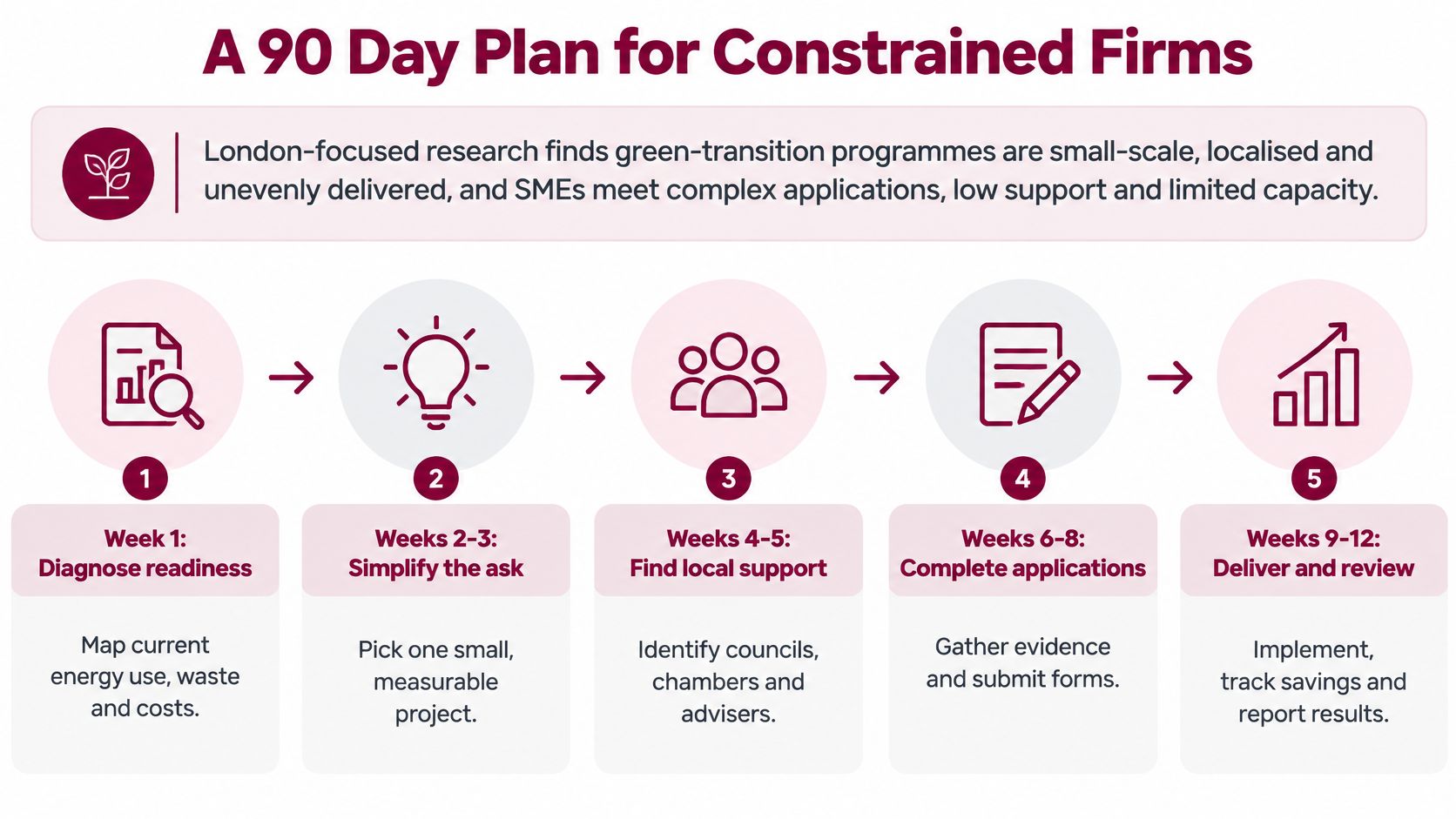
A small firm can make a useful sustainability change without a specialist team or a major grant. For managers who rent their premises, the first task is to choose an operational change that sits within their control. Research on London's SME green transition from Middlesex University-Developing-Londons-SME-Green-Business-Transition.pdf) describes support as small-scale, locally focused and unevenly delivered. It also identifies barriers including complex funding applications, limited awareness, fragmented services, skills shortages and landlord–tenant restrictions on retrofits or renewable energy. Fewer than 1% of the UK's approximately 5 million SMEs have accessed public green support. The British Chambers of Commerce reported that 43% of surveyed firms, mostly SMEs, identified cost as a significant net-zero barrier, while 34% cited insufficient finance or grants.
Map local support alongside the pilot, rather than making a grant the starting condition. A 90-day trial works like a small controlled experiment: set a baseline, change one process, then compare the result against the original measure.
- Choose one flow you control. Select a material with avoidable loss, a waste stream, or an electrical load that can shift in time. Record a four-week baseline for quantity, energy, output and cost. Without a clear denominator, the comparison will be hard to interpret.
- Write down the constraints. Check lease terms, landlord consent, production deadlines, temperature or service limits, and which staff can run the trial. A change that the lease prevents is not a suitable pilot.
- Select one low-capital change. Options might include tighter scheduling, better material segregation, supplier take-back, or shifting charging, refrigeration or heating within safe limits. Set a quality or service limit in advance so the team knows when to reverse the change.
- Seek the permission you need. Identify the relevant landlord or supplier, explain the proposed trial and record the decision. If permission is refused, choose a change that does not depend on it.
- Name an owner and set a day-30 check. The owner checks whether staff are following the agreed method and compares early results with the baseline. Give the task to one named person; shared responsibility can leave no one accountable.
- At day 90, keep, adjust or stop. Present the baseline, result, percentage change and pounds saved or avoided in terms the finance team can assess. A stopped trial still provides a decision, provided the reason and result are recorded.
If operating savings can fund the change, map local support in parallel. The pilot should test what the firm can control, not wait for a funding decision.
How Flexible Demand Cut Carbon in Practice
National Grid's distribution-system evidence shows carbon falling because loads moved, not because every asset was replaced. In 2024/25, the average carbon intensity of dispatched flexibility fell from 13.83 gCO2e/kWh to 1.50 gCO2e/kWh, with reported savings of 1,124 tCO2e and an associated value of £298,000, according to the National Grid DSO performance panel submission. Set that beside average GB system carbon content of 125 gCO2/kWh. The gap is the point. Timing did the work.
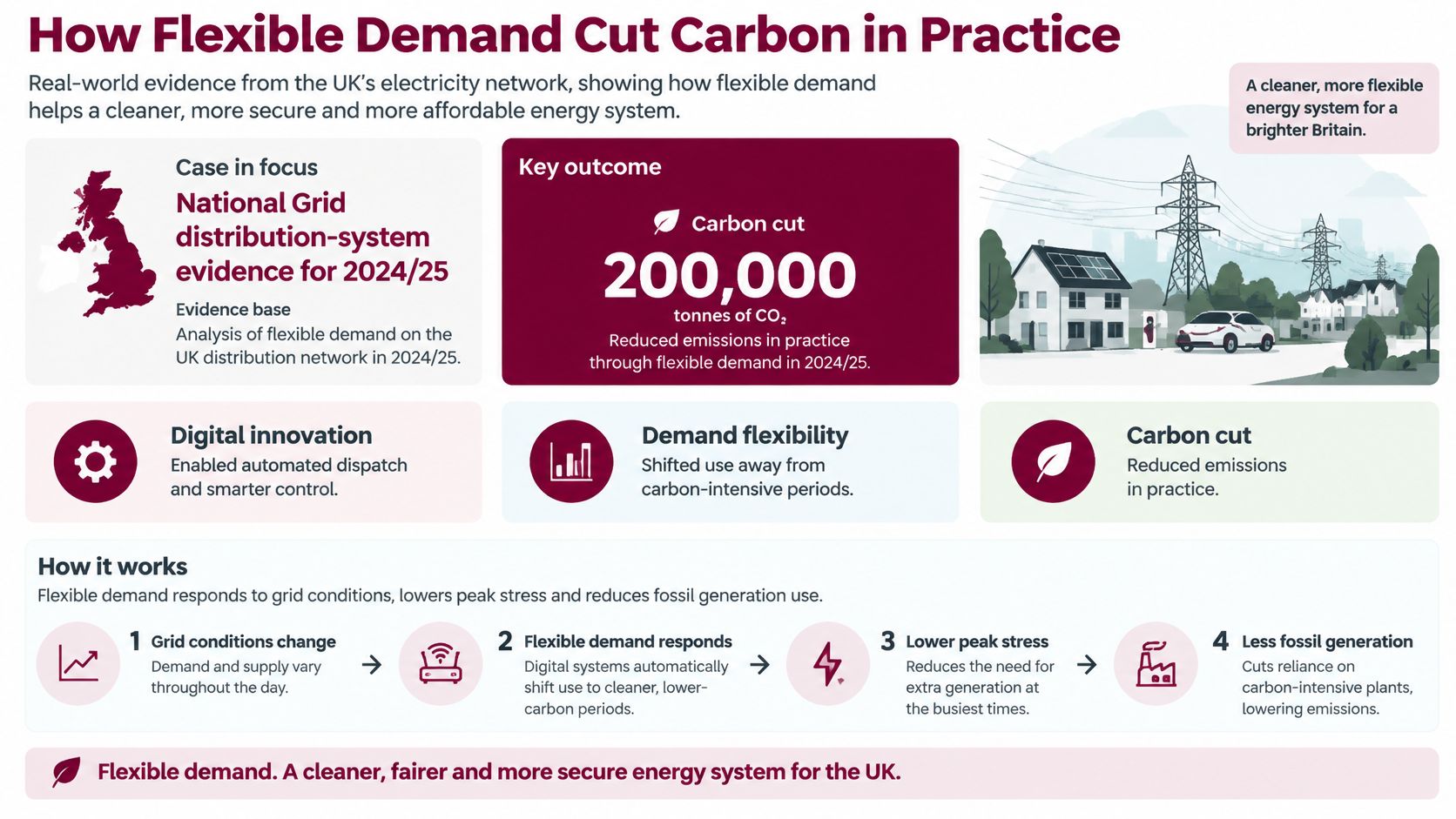
What the operator actually moved
Flexibility uses software, controls, storage or connected assets to shift consumption away from constrained or carbon-intensive periods. The loads that can wait are familiar on a commercial site. EV charging, refrigeration, heating, battery charging and some industrial processes can move if temperature, a production deadline or state of charge stays inside a written limit. A cold room does not "become flexible" because a dashboard says so. It becomes flexible when the allowable temperature band is agreed and the controller respects it.
The management model has three moves. Meter the flexible loads at short intervals so you can see what shifted. Write the operational constraints so service does not slip. Dispatch against electricity price and carbon intensity. Judge the result with baseline-adjusted kilowatt-hours shifted, grams of CO2e avoided, peak-demand reduction, and revenue or cost saved. That package is technically auditable. It uses assets already on site, which is why it fits rented premises and smaller teams better than a generation project.
Material versus hour
Circular redesign changes the material. Flexibility changes the hour. Do not claim both unless you have metered both. A non-specialist team can instrument the hour in the next quarter if one load already has a meter and a safe window. Instrumenting a new material loop usually needs a supplier and a quality sign-off that the quarter may not contain.
Choose the Skills Pathway and Start a Pilot
A sustainability pilot can stall because a manager lacks a specific skill, not because the firm needs a specialist team. Match one learning goal to the pilot's main barrier: interpreting operational information, guiding people through a change, or using digital tools to alter a process. This keeps study connected to a practical decision.
London School of Business Administration is a UK-based provider of self-paced, CPD-accredited courses and programmes, using recorded lectures, study materials and assessments. For process-related work, Operations and Process Management offers additional resources on supply chains, Six Sigma, risk and sustainability. If the pilot may meet resistance, the Change Management course examines Lewin's model, Kotter's 8-Step Model, ADKAR and McKinsey's 7-S. For a pilot involving digital tools or data, the Digital Transformation in Business course is a relevant study option.
Where progress depends on agreement from a landlord, supplier or staff, Communication Skills for Leaders can support the conversations needed to move the pilot forward. A longer route is the Credential of Leadership and Management, an eight-course pathway that includes decision-making and change management. If the pilot requires a change to the product or service itself, design thinking for business innovation offers a related perspective.
Choose one course that addresses the capability gap, then apply that learning to a defined pilot. A short baseline can help establish what the process currently uses or costs, while the pilot gives the manager a focused setting in which to test a change. Start with the decision the course should help you make.
London School of Business Administration offers self-paced, CPD-accredited courses and programmes in areas including operations, change management, digital transformation and leadership. Explore London School of Business Administration to select a course that fits the pilot's specific needs.