
53% of UK employees said a lack of recognition negatively affected their motivation, according to a 2025 survey of 2,000 people reported by People Management. The managerial response, however, shouldn't be to offer more praise. Recognition has limited value when employees still face unclear priorities, unequal opportunities or workloads they can't sustain.
Understanding how to motivate a team means examining the conditions under which people work. Energy, autonomy, fair recognition and visibility need to operate together as a management system, rather than as disconnected initiatives.
Table of Contents
- Read the UK Motivation Baseline
- Run an Autonomy and Feedback Cycle
- Leadership Behaviours and Communication Scripts
- Recognise Work Without Undermining Trust
- Motivate Hybrid Teams Through Work Design
- Measure Motivation Over Eight to Twelve Weeks
- Commit to a Twelve Week Leadership Plan
Read the UK Motivation Baseline
UK signals of day-to-day motivation
| Signal | UK benchmark | Weak score suggests |
|---|---|---|
| Enthusiasm | 51% always or often enthusiastic | Purpose or goals are unclear |
| Time flying | 50% regularly felt time flew | Work is fragmented or constantly interrupted |
| Immersion | 49% felt immersed in their work | Tasks lack ownership or meaningful stretch |
| Energy | Fewer than one-third regularly full of energy | Pressure, workload or poor recovery |
| Inspiration | 41% felt inspired at work | Contribution is disconnected from organisational purpose |
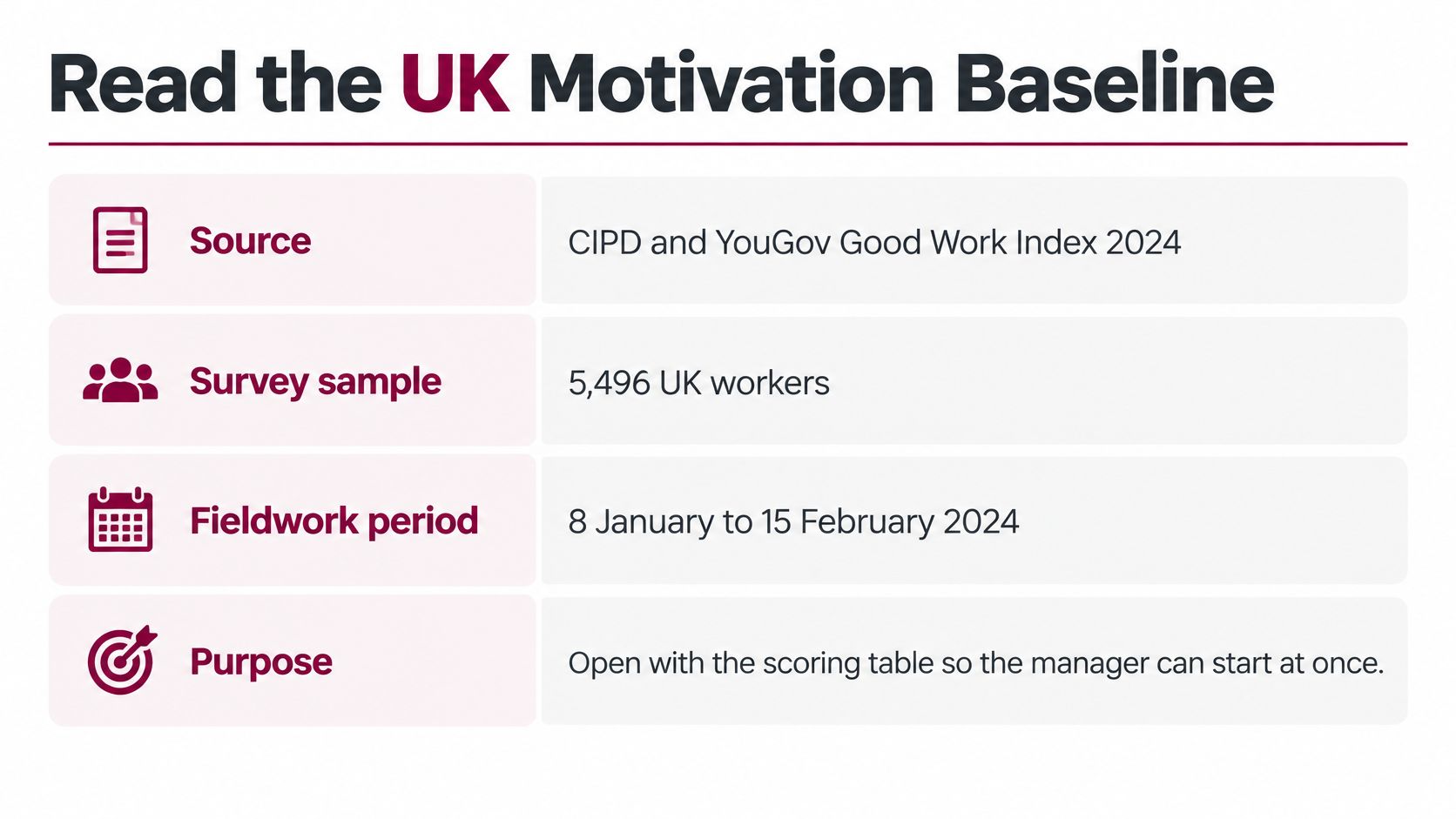
These benchmarks come from the CIPD and YouGov Good Work Index 2024, which surveyed 5,496 UK workers between 8 January and 15 February 2024. The possible work-design problems in the final column are diagnostic prompts, not findings about why individual respondents answered as they did.
Ask colleagues how often they experience each signal, using consistent response options from never to always. Record the proportion reporting each experience regularly, and invite brief explanations rather than asking people to defend their answers.
Distinguish willingness from capacity
The important contrast is between enthusiasm and energy. A team can be willing to contribute while lacking the capacity to sustain that contribution.
For example, employees may care a lot about a service but spend their working day switching between urgent requests. A motivational speech wouldn't resolve the interruption pattern; clearer priorities and protected working time would address the more plausible constraint.
Use the national benchmarks as context, not performance targets. Differences in roles, working conditions and team size mean that a local result needs discussion before action.
Treat management as a repeatable practice
The Office for National Statistics reported that the UK's average management-practice score rose from 0.51 in 2020 to 0.57 in 2023, with a 2023 median of 0.61; a 1% increase in a firm's labour productivity was correlated with a 0.01 increase in its management-practice score. These are associations, not proof that a particular management intervention causes a specified productivity gain.
Nevertheless, they support a disciplined approach: define outcomes, involve employees, track progress and follow through on agreed changes.
Core principle: Motivation is a management system, not a one-off incentive.
Before choosing any reward, mark the team's weakest signal and write down the working condition you will investigate.
Run an Autonomy and Feedback Cycle
Autonomy means having meaningful influence over how work is carried out. It doesn't mean employees must solve every problem without support, or that managers surrender accountability.
The CIPD employee engagement factsheet identifies autonomy as an established motivational driver and reports that, among 5,017 employees in the UK CIPD/YouGov Working Lives survey, 64% said their manager helped people work together successfully, 62% received helpful feedback, 63% were helped to perform well and 64% received support for learning and development. The same factsheet reports objective achievement above 90% among employees regularly experiencing positive engagement states, compared with under 80% among those experiencing negative states, while nearly one-quarter of UK employees regularly experience exhaustion or excessive pressure.
These findings justify combining discretion with support. They don't justify assuming that positive feelings alone cause better performance.
Put the cycle into practice
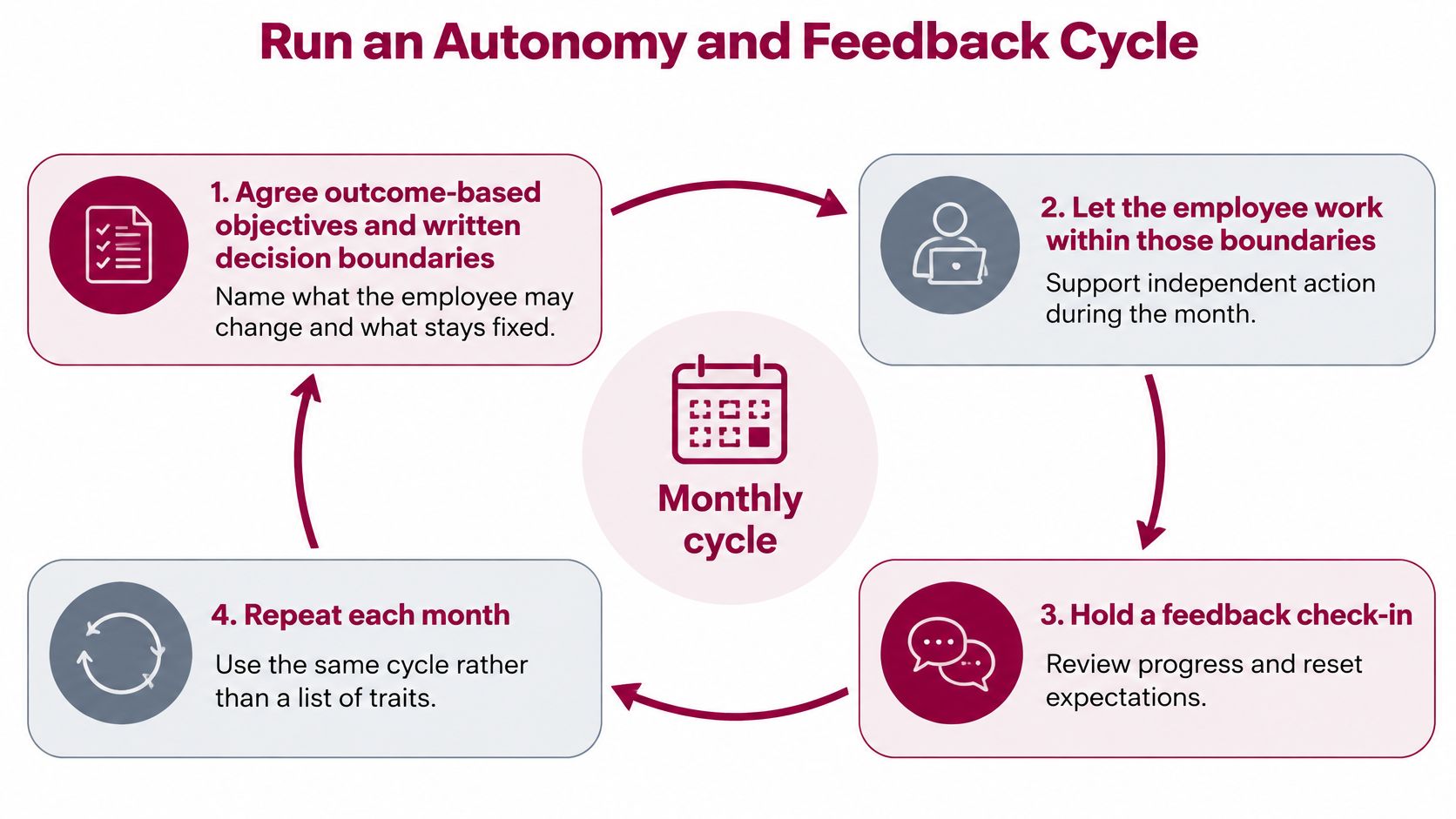
Agree outcomes and written decision boundaries. State the deliverable, deadline, quality requirement and available resources. Identify what the employee may change, such as sequencing or method, and what remains fixed, such as client commitments. This gives discretion a usable shape. The failure mode is vague delegation: asking someone to take ownership without explaining what success means.
Let the employee shape execution. Invite them to propose the method, sequence and local priorities. For example, an analyst might choose whether to test assumptions before drafting a recommendation, provided the evidence standard remains unchanged. The reason is practical as well as motivational: employees often understand local obstacles. Avoid prescribing every step after apparently granting choice.
Hold a brief fortnightly obstacle check-in. A practical format is a 20-minute conversation about progress, constraints, resources and one useful piece of feedback. Ask what needs a managerial decision rather than demanding a spoken version of the task tracker. The failure mode is turning supportive contact into a status interrogation, which discourages employees from revealing uncertainty.
Recognise a measurable contribution close to the event. Identify what changed because of the employee's action. A clear handover that prevented rework deserves more useful feedback than a general statement that someone has been helpful. Avoid rewarding visibility alone, or praising an outcome without understanding who contributed.
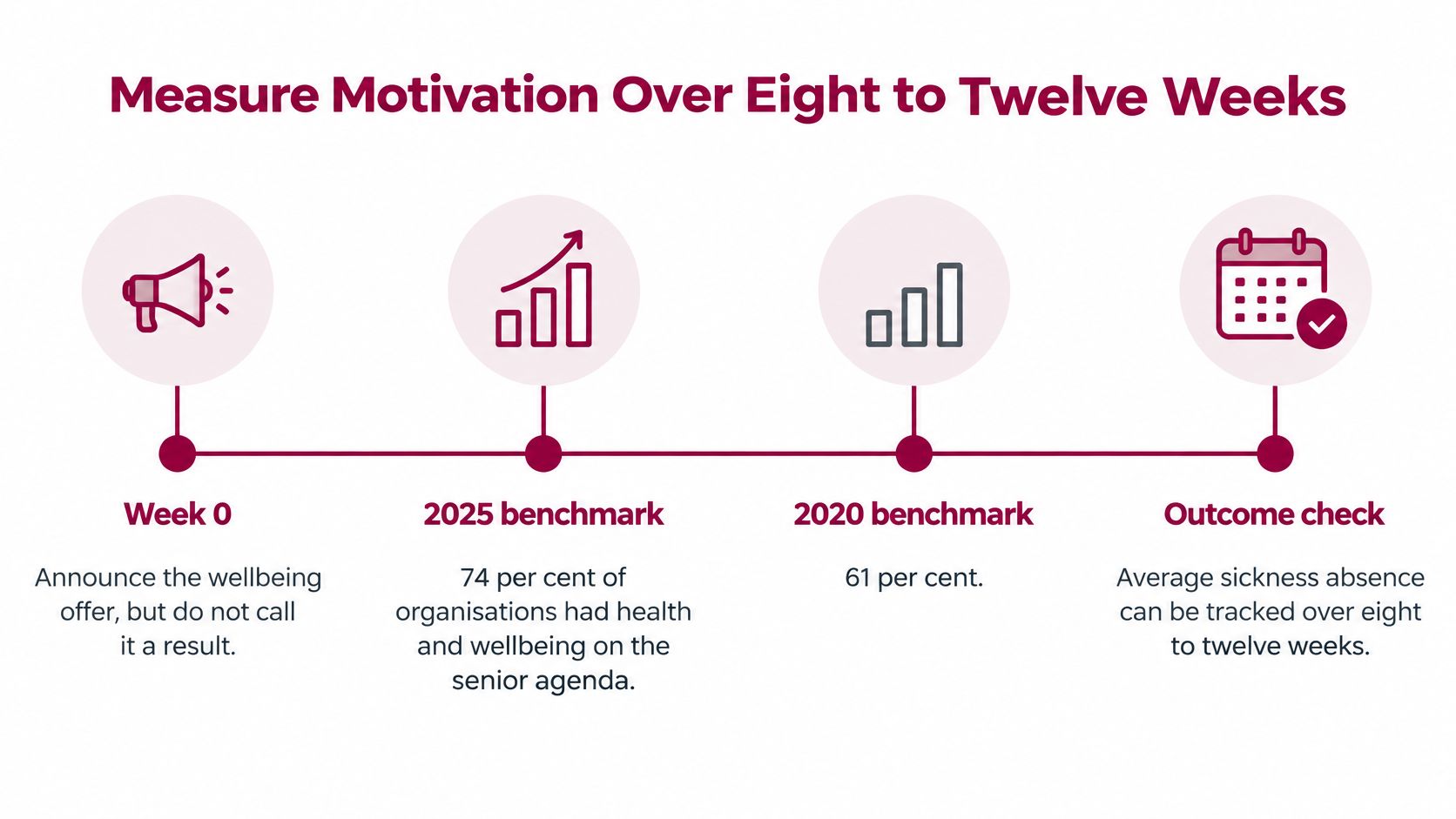
Review the arrangement after eight to twelve weeks. Examine objective achievement alongside energy, pressure and intention to stay. Keep the decision boundaries that supported progress and adjust those that created delay or confusion. The failure mode is celebrating delivery while ignoring the extra hours required to achieve it.
Keep managerial responsibility visible
A shared outcome sheet can hold the objective, decision rights, constraints and next review date. Employees should be able to see whether a promised resource has arrived and who owns an unresolved dependency.
Don't confuse autonomy with withdrawal. If someone lacks tools, authority or coaching, additional freedom may transfer risk to them.
Give employees control over execution while remaining accountable for the conditions that make execution possible.
A concise closing script is: The outcome is X by Friday; the method is yours; tell me which constraint I should remove.
Leadership Behaviours and Communication Scripts
The cycle depends on how managers behave when work becomes difficult. Employees need to know that raising an obstacle won't automatically produce blame or tighter supervision.
Listen before advising, and ask what each person values before assuming that everyone wants the same reward. Follow through on promised resources within the agreed time, admit uncertainty openly, and distinguish a performance concern from a wellbeing concern.
Choose language that leads to action
These scripts provide starting points, not a substitute for listening. Use them in your own words and leave room for an answer.
Opening a low-energy conversation. You have seemed stretched over the last fortnight. What is using up most of your energy, and what would make next week lighter?
Adjusting workload. Which of these three tasks can move to next month without harming the client? Tell me what you need to make that work.
Recognising a behaviour. The summary you wrote on Tuesday made the decision possible. Lead with the decision and then the evidence, and use that approach again.
Responding to a concern. Thank you for raising this. I will check what I can change and come back to you by Thursday.
Declining a request. We cannot take this on this sprint. What would you drop to make room, and who should we tell?
The difference between reassurance and support is a concrete commitment. Record the promised action, owner and return date, including when the answer may be that a proposed change isn't possible.
Conversation rule: Ask a question you are prepared to act on, then explain what you will do with the answer.
Developing communication skills for managers includes learning to tolerate silence and check understanding without interrogating. If exhaustion or anxiety persists, discuss appropriate referral to occupational health or an employee-assistance programme; managers should support access to help, not attempt diagnosis.
Recognise Work Without Undermining Trust
Praise can conceal an unresolved fairness problem. Thanking employees for exceptional effort while leaving excessive workloads unchanged may communicate that overextension is expected.
The CIPD discussion of engagement's risks and rewards reports that employees experiencing positive work emotions are around one-quarter more likely to go the extra mile and less than half as likely to consider voluntary departure as those experiencing negative emotions, yet its 2025 UK benchmark found only 52% felt paid appropriately for their responsibilities and achievements. Recognition therefore belongs alongside fair reward and job quality, not in place of them.
Match recognition to the person
Start by defining three to five observable behaviours connected to team outcomes. Useful examples include identifying a delivery risk early, producing a clear decision summary and helping a colleague complete a reliable handover.
Ask each employee which working conditions and forms of acknowledgement they value. Explore autonomy, mastery, security, purpose, status and social connection as possibilities, not fixed personality types.
Recognition methods and their limits
| Method | Use when | Backfires when |
|---|---|---|
| Public praise of an outcome | The win is visible and tied to a stated value | Workload, pay or progression still looks unfair |
| Private note on effort | The person dislikes the spotlight or the work is sensitive | Thanks name no behaviour and no impact |
| Development or stretch assignment | Mastery or progression is what they value | The reward quietly adds unpaid hours |
| Wider decision rights | Autonomy is the stated motivator | Priorities, tools or coaching are missing |
| Pay and workload review | Contribution and reward have drifted apart | Praise is offered instead of a fair settlement |
Appreciation for effort and recognition of outcomes serve different purposes. An employee can deserve acknowledgement for careful preparation even when an external decision prevents the intended result.
Equally, a successful outcome doesn't justify endorsing every behaviour that produced it. Recognising delivery achieved through avoidable last-minute work could encourage colleagues to repeat an unsustainable approach.
Make the criteria inspectable
Give recognition close to the event and name the behaviour, impact and repeatable lesson. Where development is the reward, specify what existing work will be removed to create room for it.
Audit recognition monthly across roles, demographic groups and remote or on-site working arrangements. Check who receives high-value assignments, whose contribution appears in shared updates and whether quieter enabling work receives attention.
Recognition complements job quality. It never substitutes for fair pay, manageable work or credible progression.
Continuous dialogue matters more than a polished recognition scheme. Employees should be able to question a decision without being treated as ungrateful, an important consideration when building a strong company culture.
Finish the exercise with a practical record: three valued behaviours and one preferred recognition method for each team member. Treat that preference as revisable, and ask permission before making sensitive achievements public.
Motivate Hybrid Teams Through Work Design
Adding meetings isn't a reliable response to weak hybrid-team motivation. A team may already communicate frequently while leaving employees uncertain about priorities, excluded from decisions or unable to protect focused working time.
CIPD's 2025 flexible and hybrid working research found hybrid working in 74% of organisations, with employers most often reporting negative effects on managers' ability to lead effectively, employees' connection to organisational purpose and organisational culture. The managerial question is therefore how work is coordinated, not how often colleagues share a location.

Replace presence measures with working agreements
Use routines that make expectations explicit without monitoring employees continuously.
- Agree communication norms. Specify expected response windows, where decisions are recorded and which issues require a live conversation. Use a shared agenda and a rotating chair so that meeting participation doesn't depend on proximity to the manager.
- Make contribution visible through outcomes. Maintain a shared record of deliverables, decisions and dependencies. Don't install a surveillance dashboard or treat online status as evidence of useful work.
- Rotate access to high-value work. Allocate client exposure, presentations and substantive problem-solving deliberately. Check that remote colleagues aren't repeatedly assigned coordination and follow-up while office-based colleagues receive developmental opportunities.
- Review sustainable participation. Ask about energy, clarity, belonging and workload. Before adding a collaboration slot, identify what it replaces and whether employees can attend without extending their working day.
Flexibility increases control when employees can influence working arrangements within clear service requirements. It transfers coordination costs when they must remain indefinitely available to accommodate everyone else's schedule.
The Employment Relations (Flexible Working) Act forms part of the UK context for handling requests seriously. Individual decisions still require appropriate organisational guidance; a team agreement isn't legal advice.
Correct unequal visibility in practice
Consider a split professional-services team. Office-based colleagues receive client discussions because they're nearby when opportunities arise, while remote colleagues receive the follow-up documentation.
The manager introduces a visible rotation for client ownership and presentation opportunities. Each assignment includes responsibility for both the substantive discussion and the associated follow-through, with preparation support where needed.
Bringing people together more often won't motivate them if the work or the recognition remains unfair.
This is a practical issue in managing distributed teams effectively: access to important work must be designed rather than left to informal encounters. Use office time where it serves a clear purpose, such as resolving a difficult interdependency, rather than treating attendance as proof of commitment.
Measure Motivation Over Eight to Twelve Weeks
Announcing a wellbeing offer is an activity, not evidence of improvement. The CIPD wellbeing factsheet reports that 74% of surveyed organisations placed health and wellbeing on their senior-leadership agenda in 2025, compared with 61% in 2020, while average annual sickness absence reached 9.4 days per employee, up from 7.8 days in 2023.
The implementation gap is equally important. CIPD's Health and wellbeing at work report found 75% of organisations were taking wellbeing action and 57% had a standalone strategy, compared with 44% in 2020; 64% were taking steps to identify or reduce stress, but only 50% believed those efforts were effective.
Manager capability also needs attention: the CIPD's 2025 health and wellbeing findings identify lack of line-manager skills and confidence as the most common wellbeing challenge, cited by 43% of organisations, while line managers have primary responsibility for short-term absence in 70%.
Build a small, usable review
Motivation measures for an 8–12 week review
| Measure | What to record | Owner | Review point |
|---|---|---|---|
| Energy | Share regularly full of energy | Line manager | Baseline and week 8–12 |
| Pressure | Share reporting excessive pressure or exhaustion | Line manager | Fortnightly and week 8–12 |
| Perceived support | Whether employees can obtain help with obstacles | Line manager | Baseline and week 8–12 |
| Recognition | Whether recent feedback named behaviour and impact | Line manager | Monthly audit |
| Intention to stay | Stated intention in the one-to-one | Line manager | Baseline and week 8–12 |
| Objectives | Share of agreed outcomes completed | Line manager | Baseline comparison and week 8–12 |
| Absence | Days lost, without medical detail | HR with the manager | Quarterly |
| Manager confidence | Managers trained and willing to hold the check-in | Senior leader | Before the cycle and week 8–12 |
Choose four primary measures rather than collecting everything without a decision in mind. Energy, pressure, intention to stay and objective completion offer a balanced starting point, with the remaining indicators helping explain results.
Compare like-for-like questions at baseline and follow-up. Examine patterns by team and hybrid arrangement only where confidentiality can be protected; don't publish small groups that make individuals identifiable.
Connect each intervention to a mechanism
A monthly workload review should lead to reprioritisation or removal of work. Protected breaks require coverage arrangements, while a flexible-working trial needs agreed service expectations and a review date.
Manager development should include practice in listening and responding, not attendance alone. A confidential concerns route needs a named recipient and a clear response process.
Measurement test: If no decision would change after receiving a result, reconsider whether you need to collect it.
Interpret absence cautiously over a short period, particularly in small teams. Managers should notice changes, discuss work-related adjustments and refer to occupational health or an employee-assistance programme where appropriate, without recording unnecessary medical detail.
Leave the review meeting with four metrics, one accountable owner and one review date.
Commit to a Twelve Week Leadership Plan
Put the decisions in the calendar before announcing another initiative. A workable leadership plan gives each stage a concrete output.
- Week 1. Score the five baseline signals and hold individual conversations about preferred recognition. Record the work-design issue requiring attention.
- Weeks 2 to 4. Publish outcome goals, decision boundaries and hybrid communication norms. Confirm who can resolve dependencies and approve changes.
- Weeks 5 to 8. Maintain fortnightly obstacle check-ins and the monthly recognition audit. Track whether promised resources and workload changes arrive.
- Weeks 9 to 12. Compare energy, pressure, intention to stay and objective completion with the baseline. Keep, change or stop a practice on the basis of that comparison.
Judge changes by work rather than applause
Consider a hypothetical six-person professional team preparing to introduce a blanket bonus. Instead, the manager postpones the proposal, rotates client work and removes meetings that duplicate written updates.
The team judges the trial through completed outcomes and reported pressure, not enthusiasm at the announcement. If delivery improves only because employees extend their hours, the manager hasn't established a sustainable solution.
The test of a motivation plan is whether employees can contribute effectively under conditions they can sustain.
From months four to twelve, repeat the review quarterly, rotate ownership of the review and incorporate the measures into routine one-to-ones. Early-career supervisors can use the same sequence: early conversations make expectations and available support visible before misunderstandings become established habits.
Once these workplace actions are under way, the Team Building and Management course within The Credential of Leadership and Management offers an optional study route. Our programme comprises eight CPD-accredited courses covering leadership fundamentals, strategic leadership, decision making, emotional intelligence, conflict resolution, change management, communication skills and team leadership.
The programme emphasises communication excellence, emotional intelligence, team development, decision-making frameworks and corporate direction. It supports professionals moving into supervisory roles as well as experienced managers strengthening executive-level effectiveness.
Book the week-one conversations before commissioning a new reward. Begin with the conditions employees need to do good work, then make managerial follow-through visible.
London School of Business Administration offers self-paced business and management education, including structured leadership study supported by recorded lectures, learning materials and assessments. Visit London School of Business Administration to explore learning that supports your leadership plan, and schedule your team's baseline conversations before choosing another incentive.