
A leader can possess formal authority and still lack genuine influence. The distinction matters because employees may comply with an instruction while withholding trust, information or commitment. Power can produce obedience; influence earns participation. Ethical leadership begins when managers stop treating agreement as proof that their power is legitimate.
In organisations, power is shaped by access to resources, decision rights, networks and information. Influence is relational: people accept a proposal because they consider the person credible, fair, competent or aligned with a legitimate purpose. This means that leadership isn't merely a matter of charisma. It concerns the conditions that allow some voices to shape decisions while others remain unheard.
Table of Contents
- Understanding Power and Influence in Organisations
- Typologies of Organisational Power
- The Role of Networks and Social Capital
- Employee Voice and Decision-Making
- Influence as a Trust Problem
- Ethical Leadership and Sustainable Influence
Understanding Power and Influence in Organisations
Power is the capacity to affect decisions, allocate resources or change conditions. A manager may hold power because their role grants authority over budgets, priorities or performance assessments. Influence, by contrast, is the ability to shape how other people understand an issue and whether they willingly support a course of action.
The two overlap, but they aren't interchangeable. A manager can require a team to adopt a process, yet still fail to influence how employees interpret that process. Staff may follow the instruction because they have no safe alternative, not because they regard the decision as sensible or fair. Compliance therefore offers weak evidence of effective leadership.
Practical rule: Measure influence by the quality of participation and follow-through, not by silence in the room.
A more useful analysis asks where power comes from and how relationships convert it into action. Formal authority is one source. Control over scarce information, expertise, funding or access to senior decision-makers can be equally important. A respected specialist may shape a decision without holding a senior title, while a senior manager may struggle to secure support if colleagues distrust their judgement.
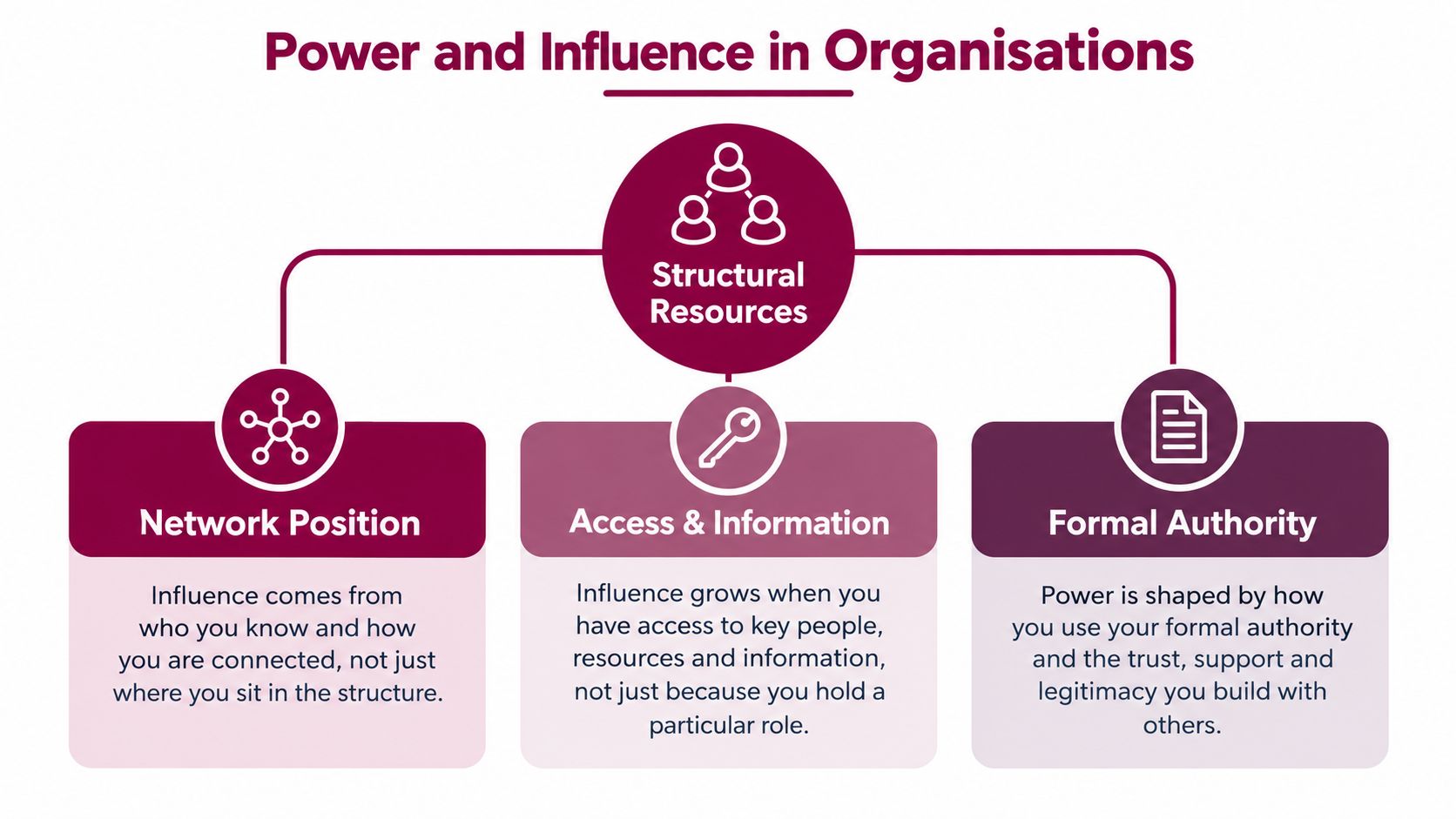
Legitimacy provides the bridge between authority and influence. People are more likely to accept decisions when they believe the decision-maker has a valid role, has considered relevant interests and will apply standards consistently. The history of UK electoral reform illustrates this wider principle. Voting rights were limited in 1908, when only men over 21 who met rate-paying or property requirements could vote, representing approximately 60% of the adult male population. The Representation of the People Act 1918 removed the property qualification for men and extended voting rights to some women over 30, while full electoral equality arrived in 1928. The voting age later fell from 21 to 18 in 1969, as recorded in Parliament's educational material on influence and representation.
The organisational lesson is clear. Authority becomes more durable when affected people have meaningful opportunities to participate, question decisions and hold leaders accountable. Power isn't unethical by nature, but its legitimacy depends on how it is exercised.
Typologies of Organisational Power
A practical power analysis starts with stakeholders rather than job titles. In UK higher education, a stakeholder-calibration study assessed influence through attributes including legitimacy, perceived importance and the capacity to affect decisions. UK governments received the highest rating among external stakeholders, scoring 4.64 out of 5, while devolved governments scored 4.00 out of 5. 86% of respondents identified government as highly influential in the study of UK higher education stakeholders, as reported in the stakeholder-calibration research.
The result isn't surprising once the mechanism is made explicit. Governments shape funding conditions, regulation and policy. Their power is both coercive, because they can impose requirements, and resource-based, because they influence access to conditions that institutions need. Formal hierarchy doesn't fully explain their influence. Structural dependence does.
Three questions for stakeholder analysis
Managers can apply the same reasoning to regulators, accrediting bodies, learners, employers, payment providers and delivery partners. For each stakeholder, ask:
- What can they decide? Identify formal authority, veto rights and approval responsibilities.
- What do they control? Map scarce resources, information, funding, expertise and access.
- Why is their involvement legitimate? Consider who is affected by the decision and whose interests the stakeholder represents.
This process prevents a common error, treating all stakeholders as equally influential or assuming that the most visible stakeholder is the most powerful. A vocal group may attract attention while lacking decision rights. A less visible regulator or funding body may shape the organisation's options much more substantially.
Three forms of power often appear together. Coercive power rests on the ability to impose penalties or restrictions. Resource power comes from controlling something others need. Legitimate power arises from a recognised role, fair process or accepted right to participate. Leaders should distinguish these sources because each creates different risks. Coercion may secure short-term compliance, resource control can create dependency, and legitimacy can weaken if stakeholders experience inconsistent or opaque treatment.
Turning a map into a leadership decision
After identifying stakeholders, compare their influence with the legitimacy of their claims. A stakeholder with high decision capacity and high legitimacy deserves early, sustained engagement. A stakeholder with significant power but weak legitimacy requires careful scrutiny, particularly where affected groups have little ability to challenge decisions.
Power maps also need regular review. Changes in funding, regulation, institutional priorities or organisational structure can alter stakeholder rankings. A manager who relies on an old map may misjudge both risk and opportunity.
The deeper principle is that influence isn't a fixed possession. It changes when relationships, dependencies and rules change. Ethical managers therefore audit not only who can approve a decision, but also who bears its consequences and who has a credible route to object.
The Role of Networks and Social Capital
A person's position in a network can matter as much as their position on an organisational chart. Networks determine who receives information early, who gets invited into decision forums and whose judgement becomes familiar to influential people. This creates social and informational power, which differs from formal authority and budgetary control.
Research examining 2,858 directors across 187 UK quangos and public corporations found that academics, particularly professors from Russell Group universities, were disproportionately represented on influential boards. Nearly two-thirds of academic board members came from Russell Group institutions, according to coverage of the research into academic prestige and board influence.
The mechanism is cumulative. Institutional prestige can open access to elite networks. Board appointments then create repeated contact with decision-makers, and those connections may lead to further appointments. Over time, access itself becomes a resource.

Access changes what people can influence
Consider two employees with similar technical ability. One is regularly invited to planning discussions, speaks with senior sponsors and understands how decisions are framed. The other receives information only after decisions have been made. Their formal roles may look similar, but their influence will differ because their access differs.
Leaders can examine this invisible layer by asking:
- Who appears repeatedly in decision forums?
- Which people connect otherwise separate teams or sectors?
- Whose recommendations travel beyond their immediate department?
- Who receives informal opportunities before they become formal vacancies?
Measures such as board interlocks, cross-sector appointments, network centrality and frequency of access to decision forums can make these patterns more visible. The purpose isn't to reduce relationships to a score. It is to identify where influence is concentrated and where capable people may be excluded from the conversations that shape their work.
Professional relationships also develop through deliberate, respectful practice. Learners seeking to build networks can use practical guidance on networking for business students, particularly by offering useful knowledge, following up reliably and building connections across different groups rather than collecting contacts superficially.
The risk of prestige without diversity
Prestigious networks can improve access, but over-reliance on them creates a legitimacy problem. If the same institutions, professions or social circles supply most advisers and board members, leaders may receive efficient access to familiar expertise while missing dissenting perspectives.
A network audit should therefore include viewpoint diversity. Ask who isn't connected to senior decision-makers, whose experience is absent from strategic discussions and whether informal sponsorship is distributed fairly. Broadening access may make decisions slower in the short term, but it can improve the credibility and resilience of those decisions.
Influence grows through repeated access, but ethical leadership asks who receives that access and who remains outside it.
Employee Voice and Decision-Making
Many organisations confuse consultation with influence. They invite employees to meetings, distribute surveys and create feedback channels, then assume that participation has occurred. The more demanding question is whether employee contributions can alter a final decision.
The CIPD Good Work Index 2025 reports that around two-thirds of staff have access to channels such as one-to-one meetings, team meetings and employee surveys. Yet only 37% say that managers allow employees or their representatives to influence final decisions. 51% report that managers seek employee or representative views, creating a 14 percentage-point gap between being consulted and being able to affect the outcome.
That gap exposes the difference between consultation power and decision power. An organisation may gather opinions while retaining complete control over priorities, resources and policy. Employees can speak, but their voice remains symbolic if managers never show how it changed the result.
The manager as a gateway
Line managers often determine whether employee influence moves upwards or stops locally. A CIPD survey of 2,372 UK employees found that 62% expressed their views in one-to-one meetings with a line manager, compared with 49% through team meetings and 17% through trade unions, according to CIPD evidence on employee voice.
The figures show why everyday management behaviour matters. A line manager controls access to conversations, information and escalation routes. They can frame disagreement as useful evidence, or as disloyalty. They can explain a rejected proposal, or allow employees to conclude that speaking up has no value.
A credible voice system should answer four practical questions:
- Who is heard? Review participation across teams, shifts, locations and employment arrangements.
- Who can challenge? Check whether employees can disagree without retaliation or informal exclusion.
- What reaches decision-makers? Track which issues move beyond the immediate manager.
- What changed? Record decisions influenced by employee input and explain rejected suggestions.
Conflict tests the system
The 2024 CIPD Good Work Index found that only 36% of employees positively assessed managers seeking employee views, 35% said managers kept employees informed about discussions and decisions, and 32% said managers responded to employee suggestions. Among employees who hadn't experienced workplace conflict, the corresponding positive figures were 51%, 51% and 50%, as reported in the 2024 Good Work Index summary.
Conflict therefore reveals whether power-sharing is real. Leaders who want to strengthen this capability should develop clear escalation processes, document responses and explain decisions in plain language. Guidance on handling conflict at work can support that practical work, but the central test remains organisational: can employees see a connection between speaking up and what managers ultimately do?
Influence as a Trust Problem
Visibility is not credibility. A professional may publish frequently, attract attention and reach a large audience while still failing to persuade people who question their motives or evidence. Trust depends on whether audiences believe that the communicator is accurate, transparent and willing to accept accountability.
The 2025 Ipsos Veracity Index found that only 6% of Britons trusted social-media influencers to tell the truth, while 87% did not, placing influencers below politicians, government ministers and advertising executives in perceived truthfulness, according to the Ipsos Veracity Index 2025.
The finding challenges a common assumption in professional branding. Reach can create awareness, but awareness doesn't guarantee respect. Influence becomes sustainable when audiences can assess the basis for a claim, identify incentives and observe how the communicator responds when challenged.
Quality matters alongside reach
Ofcom's 2025 UK news-consumption research adds an important qualification. Among the relevant younger audience, trust in news on social media rose from 45% in 2024 to 52% in 2025, while news from search engines or aggregators received higher ratings for quality, trustworthiness, accuracy and impartiality than news consumed through social media, as described in Ofcom's UK news-consumption research.
These findings shouldn't be reduced to a simple judgement about one channel. They show that audiences evaluate information differently depending on its context, source and presentation. A manager, marketer or entrepreneur should therefore separate five measures that are often collapsed into a single idea of influence:
| Dimension | Question to ask |
|---|---|
| Reach | How many relevant people can access the message? |
| Engagement | Do people respond, discuss or seek clarification? |
| Trust | Do they regard the communicator as credible? |
| Expertise | Does the person demonstrate relevant knowledge? |
| Accountability | Do they disclose incentives and correct errors? |
Earning consent
Ethical influence depends on evidence and consistency. Leaders should state what they know, identify uncertainty and avoid presenting a preference as an objective fact. They should disclose commercial or personal interests, give credit to alternative views and correct mistakes without waiting for pressure.
This approach may appear less forceful than promotional communication, but it gives stakeholders a reason to remain engaged when circumstances change. Trust doesn't remove disagreement. It makes disagreement more productive because people can challenge a proposal without treating the communicator as deceptive.
A useful test: If people can repeat your message but can't explain why they should trust it, you have achieved visibility rather than influence.
Ethical Leadership and Sustainable Influence
Ethical leadership treats power as a responsibility to shape conditions, not merely as permission to direct others. The UK's international reputation offers a useful example of this principle. In a British Council survey of young people across G20 countries, the UK achieved an overall attractiveness score of 81%, narrowly ahead of Germany at 79% and Japan at 78%, while Canada led with 84%. The British Council's analysis of the UK's soft-power challenge links attractiveness with perceptions of culture, institutions, justice, openness and fair treatment.
The lesson for organisations is that influence extends beyond formal resources. Stakeholders evaluate whether an institution is credible, open and socially constructive. Reputation can affect decisions about international business, overseas study, tourism, cultural consumption and security cooperation. Organisational influence similarly depends on what stakeholders believe an organisation represents, not only on what it can compel.
A diagnostic for leaders
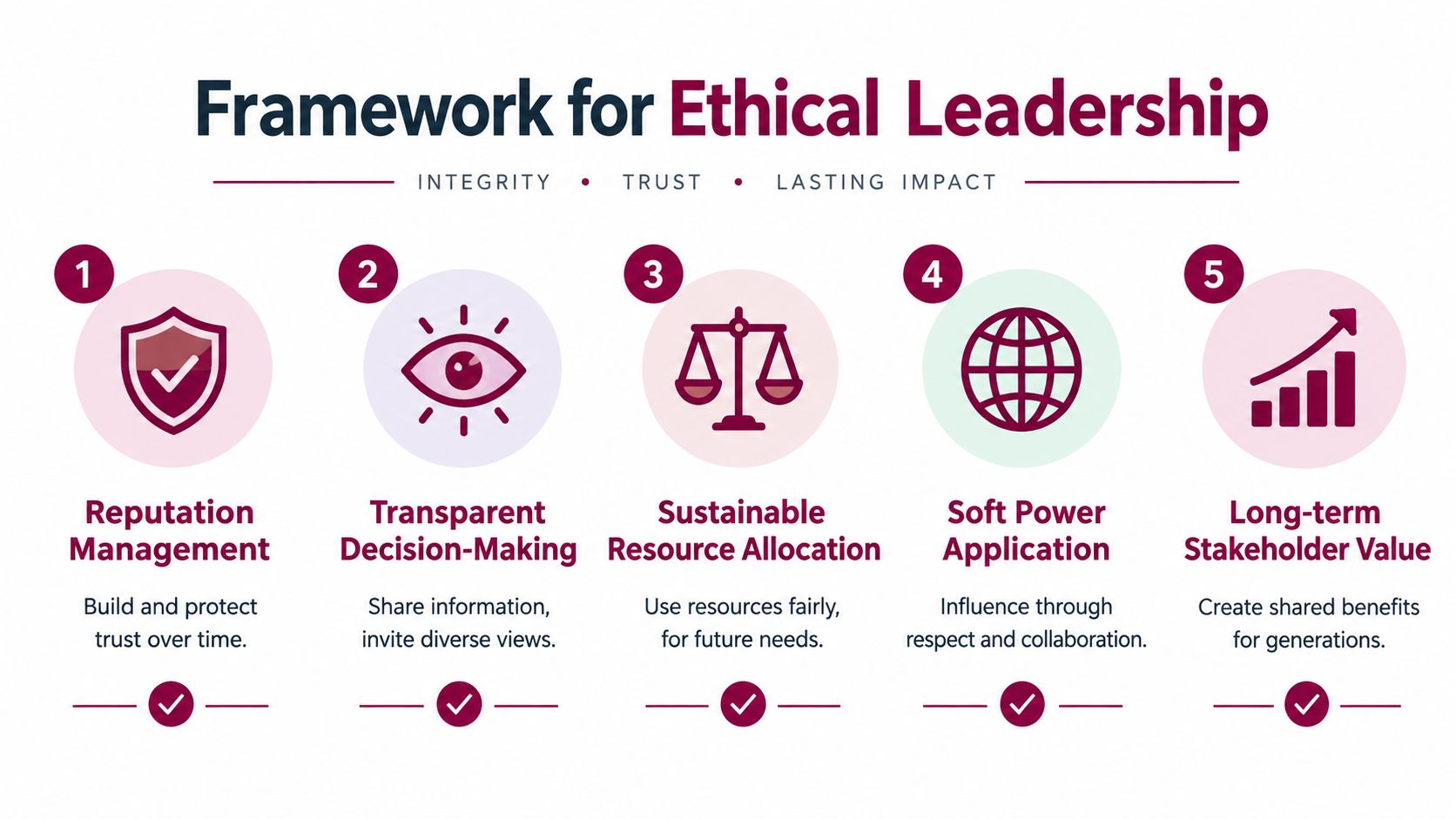
Use the following five tests to examine whether your influence is legitimate and sustainable.
- Trace the source of power. Identify whether your authority comes from role, resources, expertise, relationships or control of information. Different sources create different responsibilities.
- Check representation. Compare the people who make decisions with the people affected by them. Look for missing groups, narrow networks and repeated reliance on the same advisers.
- Separate voice from impact. Record who can contribute, who can challenge and which decisions have changed because of that contribution.
- Make reasons visible. Explain the evidence, constraints and trade-offs behind important decisions. Where you reject an idea, say why.
- Review trust over time. Look for consistent conduct, transparent incentives, reliable follow-through and credible correction when mistakes occur.
Leaders should also assess conflict-resolution arrangements. Acas reported more than 1 million notifications involving over 1.5 million claimants across the ten years of its early-conciliation service. Fewer than one-third of notifications proceeded to an employment tribunal claim, and 76% of those that did were resolved without a judicial hearing, according to Acas's 2024 account of early conciliation. Structured intervention can give employees and employers a route to negotiate when direct power is unequal.
Build influence through conduct
Sustainable influence requires more than a persuasive message. Managers need decision processes that employees can understand, networks that don't exclude relevant expertise and voice channels that lead to visible responses. The practical aim isn't to remove hierarchy. It is to ensure that hierarchy is constrained by fairness, evidence and accountability.
The importance of ethics in business becomes clearest in these everyday choices. Ethical leadership allocates resources responsibly, acknowledges affected stakeholders and treats trust as an asset that can be strengthened or depleted through repeated conduct.
London School of Business Administration offers self-paced, CPD-accredited learning in leadership, organisational behaviour, strategic management and ethical leadership, with recorded lectures, structured materials and assessments designed to connect theory with workplace decisions. Visit London School of Business Administration to explore programmes that can help you develop a more accountable approach to power and influence.