


You can be in the middle of a familiar decision right now, reading a course page, weighing whether the time commitment is realistic, and then leaving the tab open while work interrupts. That pause is exactly where a customer experience mapping example earns its value. A single average journey would miss the point, because the same learner can move smoothly through discovery and then stall at enrolment, onboarding, assessment, or verification. Seven annotated maps make those differences visible, each one tied to a separate decision, owner, metric, and intervention for a business education provider.
Table of Contents
- 1. The Awareness-to-Enrolment Journey Map
- 2. The Learner Onboarding and Course Commencement Map
- 3. The Active Learning and Engagement Journey Map
- 4. The Assessment and Competency Validation Journey Map
- 5. The Completion-to-Credential Award Journey Map
- 6. The Credential Stacking and Continuous Learning Journey Map
- 7. The Employer Partnership and B2B Learning Journey Map
- 7-Map Customer Experience Comparison
- From Seven Maps to One Measurement Plan
1. The Awareness-to-Enrolment Journey Map

A prospective learner rarely starts with a programme page. They begin with a problem, then find a blog article, then decide whether the institution feels credible enough to explore further. That is why this map starts before the click, with search, social discovery, and editorial content, not with a form.
The awareness lesson on reaching your audience is a useful anchor because it shows how content and course pathways should sit together. A marketing professional may land on Digital Customer Experience material, then move towards the Digital Marketing Programme. An early-career manager may read about Emotional Intelligence in Leadership and then inspect the Leadership and Management route. A data analyst may enter through predictive analytics content and then evaluate the Data Analytics for Business programme.
Practical rule: if the map cannot show how a reader becomes a prospect, it is not a journey map, it is a page list.
The tactical logic is simple. Track the source of the visit, the next page, and the first signal of intent. UTM parameters, segment-specific landing pages, clear calls to action, bounce behaviour, and heatmap attention all belong in the same view because each one explains a different stage of hesitation. In practice, the best annotation is not “more traffic”, it is “more readers moving from educational content into programme exploration.”
2. The Learner Onboarding and Course Commencement Map
The most fragile moment in self-paced education is the first 24 hours after enrolment. The learner has already spent money, but has not yet built routine. If account activation, access instructions, and orientation feel clumsy, the organisation has created doubt exactly when it should be creating momentum.
A mid-level manager entering Introduction to Digital Customer Experience needs a fast start, not a tour of disconnected pages. The same applies to an entrepreneur opening a Business Model Canvas module, or a data analyst reaching the first assessment in Data Analytics Fundamentals. Each learner needs one visible path from welcome email to first meaningful action.
Implementation note: the onboarding map should treat “first login completed” and “first learning asset opened” as separate events, because they reveal different points of failure.
A useful annotation layer here includes welcome sequence, platform orientation, module access, first assessment submission, and progress confirmation. The operational question is whether the learner understands what to do next without waiting for support. That is why progress dashboards, concise module structure, and optional live Q&A should sit in the same map. The learning experience becomes legible when the learner can see both the route and the next checkpoint.
The deeper logic is that onboarding is not a courtesy stage. It is the first test of trust. If the first session feels orderly, the learner is more likely to interpret later workload as rigorous rather than confusing.
3. The Active Learning and Engagement Journey Map
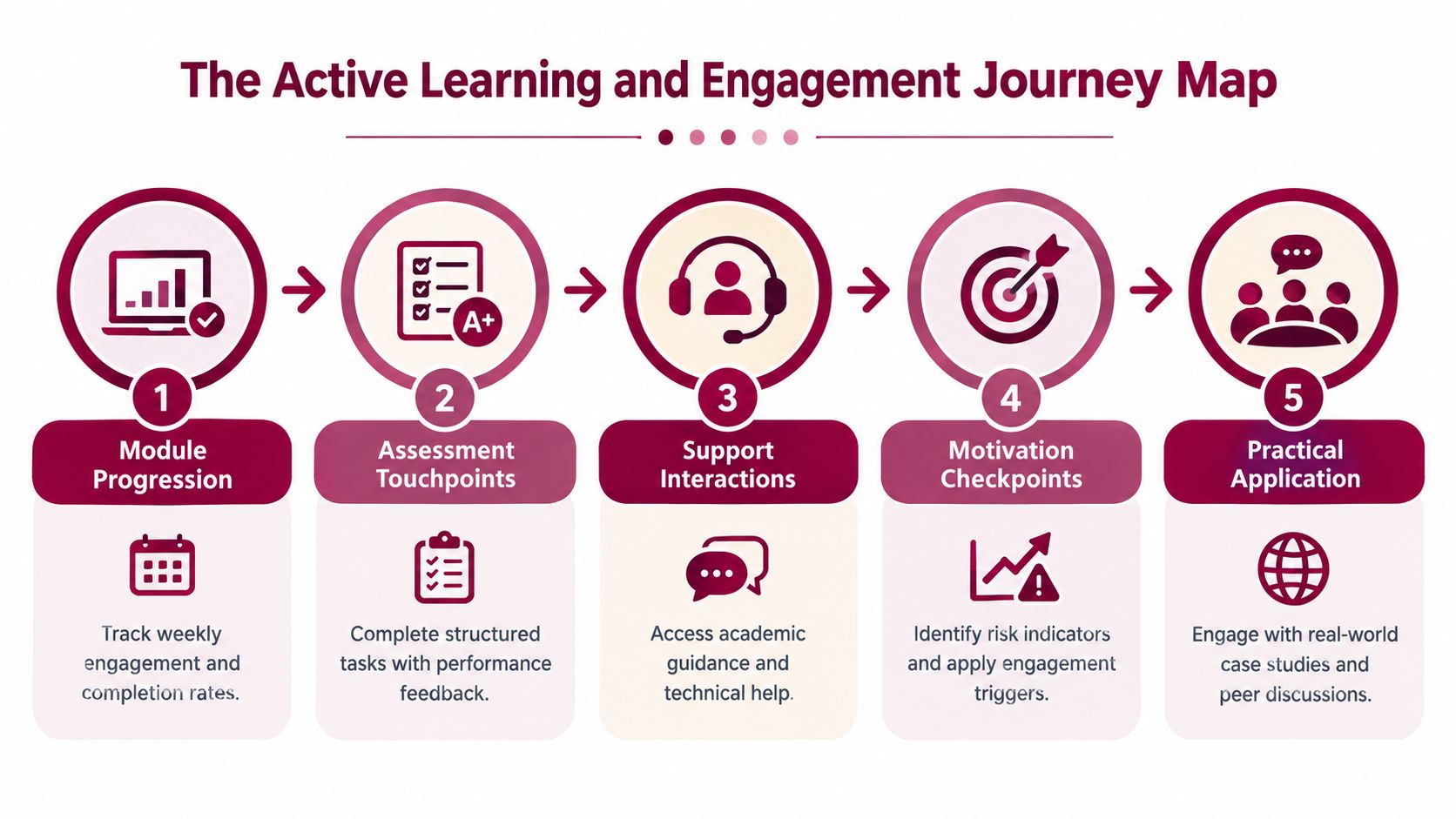
A learner may begin with clear intent and still drift. The map needs to show where momentum holds, where it breaks, and what brings the learner back. Self-paced study often stalls because work, family duties, and weak accountability interrupt the learning rhythm.
A manager may complete Leadership Fundamentals quickly, then stall during the Strategic Leadership and Corporate Direction course when workload intensifies. An entrepreneur may revise the Business Model Canvas repeatedly because the content solves an immediate problem. A data analyst may move steadily through Data Analytics Fundamentals and Advanced Excel for Business, then ask for more support before Machine Learning for Business. These patterns point to different needs, so the map should annotate them differently.
A learner who goes quiet for two weeks is not always disengaged, often the issue is overload and a lack of a clear reason to return.
The map should track inactivity windows, assessment failures, time estimates remaining, case-study relevance, and optional peer interaction. It should also include the feedback loop described in customer feedback and experience optimisation, because delayed or unclear feedback often explains why learners hesitate to re-enter a module. Real-world examples matter because they answer a private question: will this help at work this week? When the case material matches the learner's role, drift becomes easier to spot and easier to interpret.
A functional note can sit beside the engagement line. Flag learners with no activity for 14 or more days, offer flexible extensions, and direct them to support before withdrawal becomes the default. The aim is not higher activity for its own sake. It is continuation when professional life interrupts study.
4. The Assessment and Competency Validation Journey Map
Assessment changes the meaning of the journey. Up to this point, the learner has been accumulating exposure. Here, the organisation decides whether that exposure has become competence. That is why formative and summative stages must be separated instead of blended into a single “assessment” box.
A marketing professional may complete Digital Marketing Fundamentals exercises, read the feedback, then achieve a summative score that justifies certificate award. An early-career manager may narrowly miss the standard in Emotional Intelligence in Leadership, use remediation resources, and retake successfully. An entrepreneur may perform strongly on valuation but need more development in stakeholder negotiation scenarios. Those outcomes are not administrative detail, they are evidence of where the curriculum is working and where it is too blunt.
Strategic point: assessments should show learners what was understood, what was not, and what to do next, otherwise the credential lacks explanatory power.
This map should therefore include rubric visibility, response feedback, reassessment rules, and employer-facing transcripts. It also needs a verification stage that is simple enough for external readers to trust without effort. If a certificate can be checked quickly, it becomes portable evidence rather than a decorative file.
The logic is especially important for CPD-accredited learning. A verifiable certificate only carries weight if the path to it is transparent. Learners need to know the standard before they sit the assessment, not after they fail it.
5. The Completion-to-Credential Award Journey Map
Completion is not the same as closure. The learner may have passed the final module, but the value of the journey is only partly realised until the credential is issued, understood, and used. This stage deserves its own map because motivation changes the moment achievement becomes visible.
A mid-level manager finishing the 160-hour Leadership and Management Credential can move from study mode into career application mode, updating a LinkedIn profile or promotion pack. An entrepreneur who receives the Business Management Credential may treat it as a signal of seriousness before progressing to more advanced study. A data analyst may ask for an employer reference letter that highlights machine learning and data-driven decision-making rather than requesting proof of completion.
The map should record the moment the certificate is sent, the verification facility is used, and the learner begins to translate learning into professional language. That includes CV wording, employer sharing, badge use, and follow-up points at 30, 90, and 180 days. It is a practical way to see whether the credential is being absorbed into a career narrative.
A good award process makes the learner's next conversation easier, because the certificate already says what the learner can do.
The implementation step is straightforward. Use a short congratulatory message, a one-page summary of competencies, and a verification process that an employer can complete quickly. A credential only becomes durable when it can travel beyond the platform and into a hiring manager's hands.
6. The Credential Stacking and Continuous Learning Journey Map

A learner who finishes one programme does not always stop. In many cases, the credential creates confidence, and confidence creates the next enrolment decision. That is why stacking should be mapped as a loop, not a dead end.
A manager may complete the Leadership and Management Credential, then move into Business Management to broaden operational judgement. A marketing professional may finish Digital Marketing, then take Data Analytics for Business to support campaign optimisation. An aspiring entrepreneur may complete Business Management and then progress into Entrepreneurship because the earlier learning has already clarified venture language and planning. A business analyst may specialise by adding Marketing Management after data training.
The logic of the map is cumulative. Each credential changes what the learner can notice, ask, and apply at work. That means pathway recommendations should not be generic lists, they should show where prior study creates a credible next step. A composite pathway, such as a digital marketing specialist route, can reduce the sense of fragmentation.
The map also helps the organisation see where confidence is turning into commitment. If a learner has already completed one path, the next prompt should be sharper, more personalised, and easier to act on. That is not aggressive upselling. It is curriculum continuity.
7. The Employer Partnership and B2B Learning Journey Map
Employer journeys have different stakes. The organisation is not buying a course for curiosity, it is buying a development mechanism for staff capability. That means the map must show buyer, sponsor, learner, and manager as distinct actors, not a single blended customer.
A professional services firm may enrol a cohort of consultants in Leadership and Management to support promotion readiness. A retail or hospitality employer may look at Team Building and Management as part of a broader capability conversation for distributed teams. A technology company may want data-focused staff to build stronger decision-making habits, while a financial services team may want marketing capability with sector-relevant context.
Practical rule: the employer map should not stop at enrolment, it should show how managers are briefed, how progress is reviewed, and how completion is translated into workplace application.
The useful metrics here are not just completion rates. They include team uptake, engagement, and whether line managers can discuss application of learning with their staff. A dedicated contact person, employer-facing programme summary, and quarterly review cycle make the map operational rather than ceremonial. If the map includes a feedback loop, the provider can refine cohort support instead of guessing what employers need.
The deeper insight is that employer success depends on visibility. When leaders can see who has started, who is progressing, and where support is needed, the programme becomes easier to defend internally and easier to renew.
7-Map Customer Experience Comparison
| Journey Map | Implementation complexity | Resource requirements | Expected outcomes | Ideal use cases | Key advantages |
|---|---|---|---|---|---|
| The Awareness-to-Enrolment Journey Map | Medium, cross-channel tracking and funnel mapping | Marketing team, SEO/SEM, analytics (UTMs), content production | Improved awareness, higher traffic-to-enquiry conversion, optimized marketing ROI | Early-funnel acquisition, content-led discovery, thought leadership campaigns | Identifies high-performing channels, reduces enrolment friction, enables targeted messaging |
| The Learner Onboarding and Course Commencement Map | Low–Medium, standardised workflows and automated sequences | LMS configuration, orientation content (videos/FAQs), automated emails, support staff | Faster activation, higher initial engagement, reduced early dropouts | New enrolments, self-paced course starts, first-week onboarding | Clarifies expectations, reduces abandonment, measurable onboarding KPIs |
| The Active Learning and Engagement Journey Map | Medium–High, continuous monitoring and personalised interventions | Engagement analytics, progress dashboards, instructional design, community features | Sustained engagement, early risk detection, improved completion rates | Core course delivery, long-duration or multi-module programmes | Enables targeted interventions, informs instructional improvements, predicts at-risk learners |
| The Assessment and Competency Validation Journey Map | High, rigorous assessment design and secure verification | Assessment specialists, grading/invigilation systems, verification tech, remediation workflows | Verified competencies, credible certificates, audit-ready performance data | CPD-accredited credentials, employer-facing qualifications, high-stakes validation | Ensures competency, boosts employer confidence, provides transparent assessment evidence |
| The Completion-to-Credential Award Journey Map | Medium, certificate issuance, verification and post-completion workflows | Digital credential platform, verification portal, communications, career-support resources | Formal recognition, increased employability, marketing-ready outcome data | Graduation phase, employer validation, alumni engagement and promotion | Creates milestone recognition, supports career advancement, facilitates employer checks |
| The Credential Stacking and Continuous Learning Journey Map | Medium, pathway design, credit recognition and incentives | Curriculum mapping, academic advising, CRM, promotional/discount systems | Higher lifetime learner value, coherent multi-credential skill growth | Learners pursuing multiple credentials, career pivots, structured professional development | Encourages repeat enrolment, builds multidisciplinary profiles, strengthens learner momentum |
| The Employer Partnership and B2B Learning Journey Map | High, enterprise sales, customisation and systems integration | Dedicated partnerships team, custom content, employer dashboards, integration support | Bulk enrolments, measurable organisational impact, long-term revenue relationships | Corporate upskilling, leadership pipeline development, enterprise L&D programmes | Scales revenue, aligns learning to business goals, creates long-term employer partnerships |
From Seven Maps to One Measurement Plan
Seven maps only matter if they lead to one disciplined measurement system. The strongest approach is to choose one journey first, name an owner for each touchpoint, and set a review date that forces action rather than admiration. The right first test is usually the point where abandonment is most visible, because that is where the map can reveal a hidden break in the learner lifecycle.
A practical measurement plan starts with one priority touchpoint, one metric, and one experiment. For awareness, that might be content-to-programme transition. For onboarding, it may be first-login completion. For learning, it may be 14-day inactivity. For assessment, it may be first-attempt pass rate. For credential award, it may be verification usage. For stacking, it may be second-enrolment conversion. For employers, it may be manager engagement with learner progress.
The common mistake is to make the map too broad and then measure nothing well. A better model is narrow, explicit, and reviewable. Each stage should answer three questions. Who owns it, what evidence proves it is working, and what change will be tested if it is not?
London School of Business Administration is a relevant option for readers who want a self-paced, CPD-accredited context in which to apply this approach. Its course structure, digital certificates, and programme pathways make it suitable for mapping discovery, onboarding, validation, and progression as separate stages rather than one generic learner experience.
If you want to turn this framework into a working map for your own team, review the learner stages on London School of Business Administration, then choose one touchpoint to measure first. Use that single journey to define ownership, isolate friction, and test the first improvement before extending the model across the full learner lifecycle.