
The UK's largest listed companies reported women in 43% of board roles in 2025, yet women occupied only 35% of leadership roles across FTSE 350 companies. This contrast captures the central difficulty facing women's leadership courses: access to formal leadership education can develop capability, but course completion alone doesn't guarantee appointment to executive power. The most useful programmes therefore connect communication, strategy and confidence with sponsorship, negotiation, organisational diagnosis and evidence of workplace impact.
For prospective learners, the question isn't just which course looks most thorough. It's whether the programme helps you translate learning into a stronger promotion case, a more influential role, access to senior networks and readiness for responsibilities that employers recognise.
Table of Contents
- Understanding the Landscape of Women's Leadership Development
- Identifying the Types of Leadership Programmes Available
- Comparing Key Features of Top Leadership Courses
- Essential Criteria for Selecting the Right Programme
- Evaluating Career Impact and Professional Outcomes
- Strategic Implementation of Leadership Learning
Understanding the Landscape of Women's Leadership Development
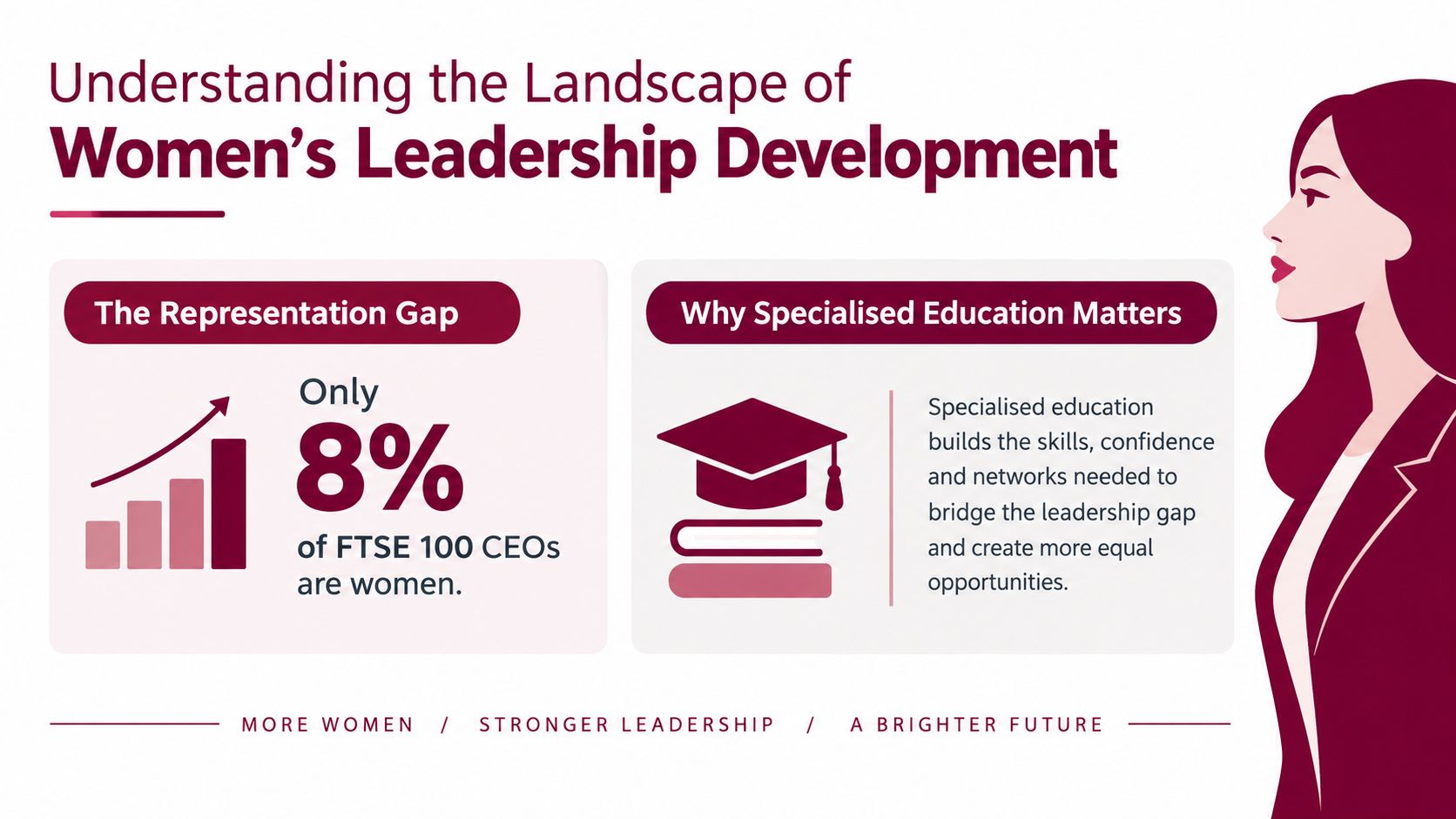
Women's leadership development sits within a UK environment where representation has improved, but progress remains uneven across levels and roles. LinkedIn's UK analysis found that women held 31% of leadership positions in 2015, rising to 37% in 2022, a six-percentage-point increase over seven years (LinkedIn's UK analysis of women in leadership). The change is meaningful, but it doesn't amount to parity, and it doesn't show whether women are gaining operational authority or remaining concentrated in particular leadership categories.
The historical context matters. Nancy Astor became the first woman to take a seat in the House of Commons in 1919, women gained equal voting rights with men in 1928, and Margaret Thatcher became the UK's first woman Prime Minister in 1979. In the 2025 FTSE Women Leaders Review, women occupied 1,275 board positions, equivalent to 43% of board roles, while women held 6,743 leadership positions, representing 35% of leadership roles across FTSE 350 companies (the UK Government's summary of the 2025 FTSE Women Leaders Review).
Representation is not the same as authority
A board appointment can provide governance influence without conferring responsibility for daily operations, revenue, people or strategic execution. This distinction explains why a headline improvement in board representation shouldn't be treated as proof that leadership systems have removed the barriers women encounter.
Women's leadership courses are relevant because they can address capabilities that affect progression in complex organisations, including:
- Strategic judgement: Moving from task delivery to enterprise-level thinking.
- Influential communication: Presenting recommendations clearly to different audiences.
- Decision-making: Acting responsibly when information is incomplete or contested.
- Conflict resolution: Managing disagreement without avoiding difficult decisions.
- Emotional intelligence: Reading context, regulating responses and building trust.
- Change management: Guiding people through uncertainty and competing priorities.
These capabilities won't substitute for fair promotion processes, transparent pay decisions or institutional equality measures. They can, however, help learners interpret organisational expectations and present their contribution in terms senior decision-makers understand. Practical discussion of the wider context is also available in this guide to women in leadership and breaking barriers in business management.
Identifying the Types of Leadership Programmes Available
The phrase “women's leadership course” covers several distinct educational models. A short online module may introduce a single skill, while a structured credential can build a broader sequence of management capabilities. Residential programmes provide concentrated discussion and practice, but they demand greater control over time, travel and employer support.
A useful starting point is to distinguish breadth from intensity. Foundational programmes suit early-career professionals or managers who need a coherent grounding in leadership and organisational behaviour. Specialist courses may focus on executive presence, negotiation, emotional intelligence, inclusive management or strategic influence. Neither format is automatically superior. The appropriate choice depends on the learner's current responsibilities and the specific gap between present performance and target role.
Four common formats
Self-paced online courses offer flexibility for learners managing work, caring responsibilities or variable schedules. Their quality depends on more than recorded lectures. Look for structured materials, assessments, feedback, clear learning outcomes and a method of verifying completion.
Modular CPD-accredited credentials divide learning into connected units and provide a formal record of development. CPD accreditation can make a course easier to explain to an employer, although accreditation alone doesn't prove that the course offers meaningful application or sustained support.
Blended programmes combine independent study with live workshops, peer discussion or mentoring. They can provide stronger opportunities to practise difficult conversations and receive feedback, while preserving some flexibility.
Intensive workshops and residential programmes create concentrated time for role-play, case analysis and networking. They may suit managers preparing for an immediate transition, but learners should confirm how the programme supports workplace application after the teaching ends.
The key issue is transfer. A course covering strategic leadership, communication and conflict resolution has greater practical value when learners must apply those ideas to a promotion case, a team decision or a real organisational change. A broader overview of leadership training courses can help learners compare educational approaches before examining individual providers.
Comparing Key Features of Top Leadership Courses
Course titles often conceal significant differences in academic depth. Two programmes may both advertise leadership development, yet one may rely on passive viewing while another requires analysis, reflection and assessed application. Learners should compare the educational mechanism rather than the promotional label.
Comparison of Leadership Course Attributes
| Course Type | Delivery Format | Key Focus Areas | Accreditation Status |
|---|---|---|---|
| Self-paced introductory course | Recorded lessons and digital materials | Leadership foundations, communication and self-awareness | May offer a completion record; check the provider's stated status |
| Modular professional credential | Sequential online units with assessments | Strategic leadership, decision-making, emotional intelligence and team management | Look for clearly stated CPD accreditation and certificate verification |
| Blended leadership programme | Independent study, live sessions and peer activity | Applied leadership, negotiation, feedback and organisational influence | Confirm whether attendance and assessments contribute to completion |
| Intensive workshop | Concentrated live or residential delivery | Case analysis, role-play, conflict resolution and executive communication | Establish whether the award is accredited, institution-issued or attendance-based |
What a substantive curriculum looks like
A credible curriculum should show how its topics relate to workplace responsibility. Strategic leadership should involve priorities, trade-offs and organisational direction, not only definitions. Communication should include stakeholder alignment and concise recommendation-making, rather than generic advice to speak confidently. Emotional intelligence should be connected to judgement, feedback and team relationships.
Assessment provides another useful distinction. Quizzes can test comprehension, but stronger programmes may also require reflective analysis, scenario responses, leadership plans or applied assignments. These tasks reveal whether a learner can use a framework when circumstances are ambiguous.
Support after the final module
Post-course support separates learning from isolated consumption. Mentoring, peer accountability and professional networking create opportunities to test new approaches and receive challenge. In the evaluation of Advance HE's Aurora programme, all ten respondents reported substantial developmental value, including changes in outlook, behaviour and workplace practice shortly after completion (the 2018/19 Aurora programme evaluation).
A structured credential such as the Advanced Professional Certificate in Leadership and Management should therefore be assessed not only by its syllabus, but also by its assessment design, certificate verification, learner support and relevance to the responsibilities the participant wants to undertake.
Essential Criteria for Selecting the Right Programme
The right programme is the one that connects recognisable evidence, relevant capability and workplace transfer. Selecting on subject matter alone can lead learners towards an interesting course that doesn't help them address the decision they're facing, whether that's applying for a management role, requesting a stretch assignment or preparing for executive responsibility.
Start with the progression objective
Write the target outcome before comparing providers. It might be a move into first-line management, readiness for a senior role, stronger influence across functions or preparation for an entrepreneurial venture. Then identify the capabilities and evidence that outcome requires.
A useful diagnostic asks:
- What must you be able to do? For example, lead a difficult conversation or make a strategic recommendation.
- What must others observe? Consider judgement, reliability, stakeholder management and ownership of results.
- What evidence will support progression? This may include completed projects, measurable responsibilities, feedback or a documented development plan.
- Who must recognise your readiness? The relevant audience could include a line manager, promotion panel, board or investor.
CPD accreditation is helpful when it gives employers a clear account of structured development. It shouldn't replace scrutiny of the syllabus, assessment or faculty expertise. A certificate records completion, but an applied portfolio can show how the learner used the material.
Treat flexibility as a design requirement
Flexibility isn't a minor convenience for many women. Vodafone's 2025 survey of 2,000 UK adults found that 36% of women cited schedule inflexibility as preventing sufficient participation in learning, while 53% wanted to spend more time on learning and development (Vodafone's UK survey on women, learning and leadership). A programme should therefore state how learners can pause, resume and complete assessments around professional commitments.
Inspect the support structure
Mentoring and networking shouldn't appear as vague promises. Check whether the course offers named activities, guided introductions, peer groups, manager discussion tools or structured reflection. The strongest design treats support as part of learning transfer, not an optional social benefit.
Finally, examine whether the curriculum addresses contemporary problems such as ethical leadership, digital transformation, strategic decision-making and organisational power. Women's leadership education should develop personal capability while also teaching learners how systems allocate visibility, opportunity and authority.
Evaluating Career Impact and Professional Outcomes
A leadership course has career value when learning changes what a participant can do, demonstrate and negotiate. Confidence may make a difficult conversation easier to enter, but senior appointment depends on observable contribution, relevant capability and access to opportunities. The gap between completing a course and securing greater responsibility resembles the gap between learning a musical score and performing it publicly: knowledge matters, but performance requires practice, evidence and an audience able to assess it.
The UK representation figures show why this distinction matters. The Women-led High-growth Enterprise Taskforce report found that women held only 11% of senior investment roles in the venture-capital and private-equity ecosystem, compared with 23% at mid-level and 37% at junior level. It also reported that only 6% of high-growth enterprises were wholly or majority led by women. These figures indicate a structural bottleneck in progression, rather than a simple shortage of individual ambition.

Use a career-impact test
Before enrolling, ask whether the programme supports this sequence:
- Map capability to a target role. Relate course topics to the competencies in a job description, promotion framework or business plan. A general claim of increased confidence is weaker than evidence linked to a defined organisational need.
- Build an evidence record. Document decisions made, problems solved, stakeholders influenced and outcomes delivered. Record the context as well as the result, because senior reviewers need to understand the scale and complexity of the work.
- Practise negotiation. Prepare for a promotion conversation, compensation discussion or request for a stretch assignment. Use evidence of contribution, and establish which criteria the organisation applies.
- Identify sponsors. A mentor offers advice and reflection. A sponsor advocates for access to visible assignments and decision-making forums. A serious programme should explain this distinction and help learners recognise both relationships.
- Test organisational conditions. Examine access to succession planning, stretch work, feedback and pay information. Individual capability has limited effect where systems distribute opportunity unevenly.
The Chartered Management Institute gender pay gap report reported that 82% of managers had no formal management or leadership training, while 64% would consider an organisation's gender pay gap when deciding whether to join it. Among female managers, the figure rose to 81%, and the UK median gender pay gap was reported at 12.8% in 2025. Career readiness therefore includes two forms of judgement: developing personal capability and assessing whether an employer's systems reward that capability fairly.
Practical rule: Treat course completion as the starting point for an evidence plan, not the outcome of professional development.
Ask how the provider evaluates impact. A credible approach may combine pre-course and post-course measures of leadership self-efficacy with workplace follow-up on applied behaviour, mentoring access, promotion readiness and changes in responsibility. Satisfaction can indicate a useful learning experience, but it cannot establish career progression on its own.
Strategic Implementation of Leadership Learning
Leadership learning produces career value only when it changes workplace behaviour and creates evidence that others can assess. Completing a course is therefore a milestone, not proof of readiness for a senior appointment. The relevant question is whether the learner can apply a concept in a real setting, demonstrate improved judgement and gain access to opportunities where that capability becomes visible.
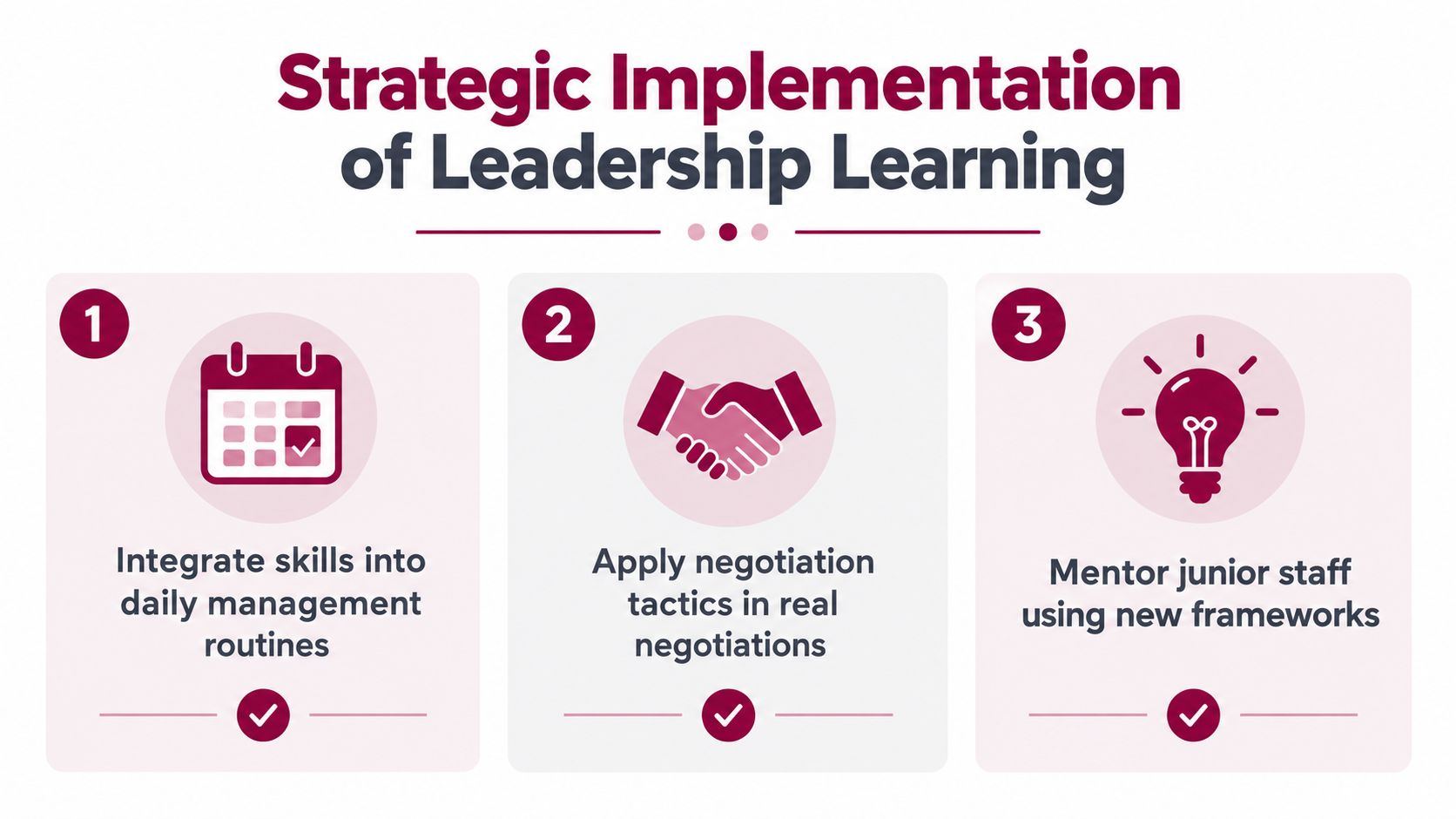
Choose one workplace situation as the first application site. It might be a team experiencing conflict, a cross-functional project without clear direction or a strategic proposal requiring senior support. Apply one framework at a time, record the outcome and request specific feedback from a trusted colleague. This controlled approach resembles a small workplace experiment: the learner tests an idea, observes the response and adjusts the next intervention.
Turn learning into visible practice
A personal development plan should connect each capability with an observable behaviour and a professional opportunity. Strategic decision-making could result in a concise options paper for a senior meeting. Conflict-resolution learning could support a structured conversation with agreed actions and follow-up. Emotional-intelligence frameworks could guide feedback when pressure is high.
Maintain a simple evidence log:
- Situation: Which decision, relationship or organisational challenge required leadership?
- Action: Which course framework did you apply, and what did you change?
- Response: How did colleagues, stakeholders or senior decision-makers respond?
- Next step: What will you refine, repeat or escalate?
The record can inform performance reviews and promotion discussions. It also helps distinguish a skills gap from an opportunity gap. A participant may deliver strong work yet remain absent from visible assignments, influential meetings or succession discussions. In that case, further confidence training may not address the constraint. A sponsor, manager conversation or organisational review may be more appropriate.
Build networks and sponsorship deliberately
Networking works best when it has a defined purpose. Discuss the leadership problems course peers are addressing, exchange feedback on career plans and maintain contact around specific professional interests. A mentor can support reflection. A sponsor has a different function: recommending the learner for assignments, introducing them to decision-makers or testing assumptions about their readiness.
Visible female leadership also affects whether advancement appears plausible to employees. Representation can influence how women assess an employer and whether senior progression seems attainable. Role models therefore matter to organisational culture, although they cannot be expected to correct structural barriers alone.
Select a women's leadership course that develops both capability and navigation. Before enrolment, identify how the learning could lead to a stretch assignment, mentoring relationship or defined progression review. Agree these arrangements with the employer where possible, because course completion rarely produces senior appointment without an organisational pathway.
London School of Business Administration offers self-paced, CPD-accredited business and management courses, including a structured leadership pathway covering strategic leadership, decision-making, emotional intelligence, conflict resolution, change management, communication and team management. Assessments and verifiable certificates provide documented evidence of completion. Review the London School of Business Administration options against your immediate development needs and longer-term progression plan.