
More teamwork does not necessarily mean better teamwork. Research on British workplaces found that the proportion of employees in self-directive teams fell from 21% in 1992 to 14% in 2006, even as teamwork became more widespread; the benefits for productive potential and employee welfare were largely confined to teams with meaningful decision-making authority, according to University of Oxford research on teamwork and employee involvement.
The implication for managers is practical. Effective team building isn't a social extra, but a deliberate management intervention through which colleagues practise sharing information, challenging assumptions, making decisions and accepting responsibility. An enjoyable event may support relationships, but enjoyment alone doesn't establish whether people can work together more effectively.
Useful team building activities for managers therefore begin with a recognisable difficulty: unresolved disagreement, unclear responsibilities, reluctance to speak, weak coordination or repeated operational mistakes. Managers then select an exercise that lets participants practise the missing capability and apply it to their work.
Judge an activity by the working behaviour participants change afterwards, not simply by how positively they describe the session.
The activities below connect purpose with implementation, including suitable group arrangements, scheduling, remote participation, facilitation risks and assessment. Timing and group size should remain responsive to the task: use groups small enough for meaningful contribution, protect time for reflection, and avoid treating suggested formats as validated prescriptions.
Formal leadership study can complement this practice. However, course completion, participation and demonstrated workplace improvement are different outcomes, and managers should assess each separately.
Table of Contents
- 1. Action Learning Sets
- 2. Belbin Team Roles Workshop
- 3. Psychological Safety Dialogues
- 4. Trust-Building Exercises Based on the Five Dysfunctions of a Team
- 5. Desert Survival Simulation
- 6. LEGO Serious Play Team Workshops
- 7. Structured Team Retrospectives
- 8. Outdoor Experiential Leadership Challenges
- 8 Team-Building Activities for Managers: Comparison Guide
- From Activity to Management Practice
1. Action Learning Sets
A manager facing a recurring handover problem may not need more advice. They may need colleagues to question why the problem persists, which assumptions remain untested and what authority they have to change the process.
Action learning sets provide a structured setting for this examination. A small, facilitated group discusses live management problems, with participants taking turns to present an issue and return later to explain what happened after they acted.

Question before advising
Ask the presenter to explain the situation, their desired outcome and the limits of their decision-making authority. Other members should initially use questions rather than offer solutions, distinguishing evidence from interpretation.
For example, a public-service manager could bring a fictionalised cross-departmental delay. Colleagues might ask whether the difficulty concerns competing priorities, missing information or an approval process that nobody owns.
- Setup: Establish confidentiality, remove identifying details and agree how the facilitator will interrupt premature advice.
- Timing and group size: Use a stable, small peer group and recurring protected sessions, allowing presentation, questioning, reflection and commitment.
- Remote delivery: Circulate an anonymised issue summary beforehand and accept written questions alongside live discussion.
- Measurement: Record the proposed action, the manager's reasoning and the outcome reviewed at the next meeting.
The main risk is that senior or confident members prescribe answers before the presenter has examined the problem. Rotate facilitation where appropriate, and ask the presenter to identify what they learned rather than merely list suggestions.
This activity offers a practical pairing with Decision Making and Problem Solving. Its rationale also fits the broader management challenge identified in CIPD's research on improving UK management capability: managers operate with differing experience and organisational support, so development should address realistic decisions rather than assume a uniform starting point.
2. Belbin Team Roles Workshop
Role confusion isn't always a shortage of skill. Colleagues may contribute similar strengths while leaving essential work, such as evaluating proposals or checking completion, insufficiently covered.
A Belbin Team Roles workshop can structure a discussion of these behavioural contributions. Meredith Belbin's framework includes roles such as Plant, Implementer, Coordinator, Monitor Evaluator and Completer Finisher, but managers should treat profiles as prompts for enquiry rather than permanent descriptions of people.
Connect roles to actual work
Begin with a current project, not a display of personality labels. Ask participants where ideas originate, who tests feasibility, how work becomes organised and who verifies that commitments have been met.
Consider a hypothetical consultancy team that repeatedly submits work late. Rather than labelling someone disorganised, the group could examine whether responsibility for final checking is explicit and whether colleagues have sufficient time to perform it.
- Preparation: Use appropriate assessment materials and explain how responses will be handled.
- Timing and group size: Schedule the workshop before a project launch or after membership changes, using the working team or smaller project groups.
- Remote adaptation: Gather reflections asynchronously, then annotate the same project map during a shared discussion.
- Assessment: Compare participants' understanding of responsibilities before and after the workshop, then review missed or duplicated tasks.
The facilitator should challenge statements that turn preferences into restrictions. Someone who enjoys generating ideas must still meet delivery obligations, while quieter colleagues shouldn't automatically inherit checking work.
The distinction between behavioural contribution and formal responsibility is important in understanding team management. Pair the workshop with leadership study on delegation and team design, then require managers to explain how they will allocate work differently.
For evaluation, the Civil Service People Survey highlights provide a useful example of treating manager and team experience as measurable subjects. They don't establish the effectiveness of Belbin workshops; managers must assess that locally through clearer responsibilities and observable coordination.
3. Psychological Safety Dialogues
When colleagues withhold concerns, another brainstorming session may produce little. Managers first need to examine what happens when somebody disagrees, acknowledges a mistake or brings unwelcome information.
Psychological safety dialogues make those interactions explicit. Their purpose isn't to remove accountability, but to establish how people can question decisions and discuss errors without humiliation or retaliation.

Make speaking up a practical behaviour
Send questions in advance about how the team responds to uncertainty, disagreement and mistakes. Invite written responses, and begin with a fictional scenario if personal disclosure would create unnecessary risk.
A hypothetical healthcare administration team might discuss what should happen when a junior colleague notices an incomplete handover. Participants can practise acknowledging the concern, clarifying the facts and agreeing an action without speculating about blame.
Facilitation principle: A manager's response to the next difficult disclosure matters more than their assurances during the workshop.
Use a small enough group for balanced participation, with a separate facilitator where hierarchy could inhibit discussion. Hold the dialogue during working time, allowing enough space to agree behavioural commitments rather than ending immediately after concerns emerge.
For remote teams, combine advance written contributions with moderated discussion. Don't promise anonymity if the circumstances or wording could identify the contributor, and don't record sensitive exchanges by default.
EY's research on neuroinclusion reports strong psychological safety among 37% of its least-included group, compared with 90% of those who felt included. That finding supports careful attention to inclusion, but doesn't demonstrate that a dialogue alone will change outcomes.
Measure willingness to challenge decisions before and after the intervention, alongside whether managers fulfil agreed commitments. Pair the exercise with emotional-intelligence study and reflection on why emotional intelligence matters in leadership, particularly listening, emotional regulation and responses to criticism.
4. Trust-Building Exercises Based on the Five Dysfunctions of a Team
Trust-building becomes unsafe when managers confuse openness with compulsory disclosure. A colleague should be able to discuss a working preference without explaining private experiences or revealing personal vulnerabilities.
Patrick Lencioni's The Five Dysfunctions of a Team provides a discussion framework connecting trust, conflict, commitment, accountability and collective results. Use it as a way to organise reflection, not as proof that every team follows an identical developmental sequence.
Start with professional interdependence
Ask participants to describe a contribution they can offer, a situation in which they need support and a working habit colleagues may misunderstand. Allow them to pass or submit a written response instead.
For example, a fictional leadership team recovering from repeated disagreements could discuss how members interpret delayed replies. What appears dismissive to a colleague might reflect competing deadlines, but the discussion should still produce an agreed response expectation.
- Group arrangement: Work with an established team, using paired discussion before a facilitated whole-group conversation.
- Timing: Schedule the exercise when members can follow through, then arrange a later review rather than treating disclosure as completion.
- Remote format: Use advance prompts and a shared record of working agreements, excluding personal disclosures from that record.
- Measures: Review confidence in asking for help, clarity of commitments and whether colleagues address missed agreements constructively.
Acas research on workplace conflict and resolution found that 32% of people experiencing conflict reported conflict with their line manager. Managers should therefore consider whether they are appropriate facilitators, rather than assuming their presence will reassure participants.
Pair the exercise with study of conflict management skills, especially the distinction between disagreement about work and unacceptable behaviour. Where grievances, bullying allegations or serious misconduct are involved, use appropriate procedures and independent support.
The meaningful outcome isn't greater personal disclosure. It is more dependable professional behaviour, including asking for assistance, acknowledging limitations and addressing disagreements without personal attack.
5. Desert Survival Simulation
A team can reach agreement while overlooking its strongest reasoning. The Desert Survival Simulation gives managers a contained setting in which to examine that possibility without experimenting on a live business decision.
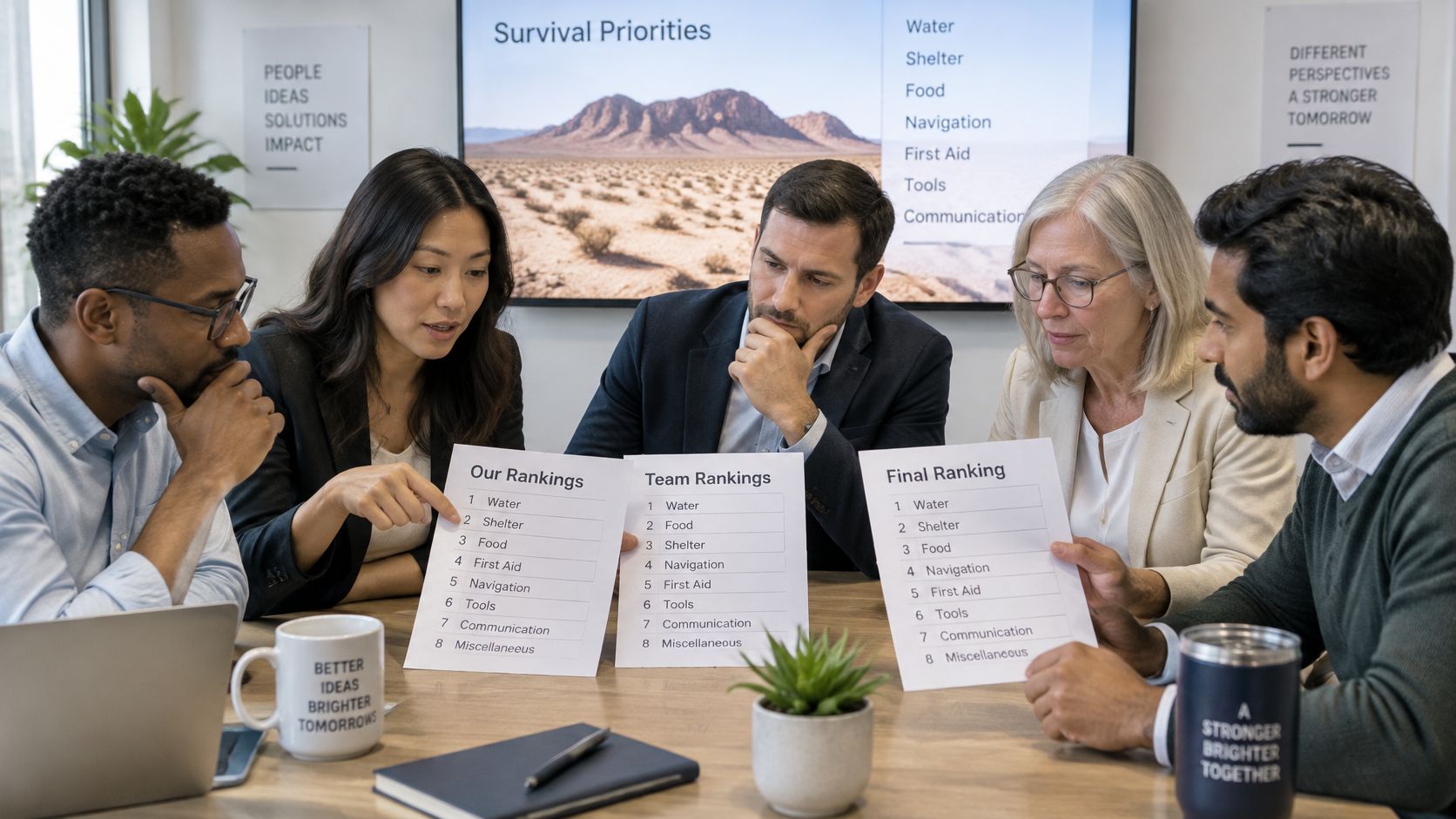
Participants first rank survival items individually, then negotiate a shared ranking. Where authorised materials provide an expert comparison, the facilitator can use it during the debrief, while keeping the emphasis on reasoning and participation rather than declaring winners.
Observe the decision process
Ask participants to record why they made their initial choices. During group discussion, an observer can note who requests evidence, who changes their view and whether the manager's preference becomes the default.
A hypothetical procurement team could use the debrief to examine a recent supplier decision. Did colleagues share all relevant information, or did they converge quickly on the most confidently presented option?
- Setup and size: Use small decision groups, providing identical instructions and a clear distinction between individual and collective stages.
- Timing: Protect a complete workshop slot, including a substantial debrief rather than allocating all available time to ranking.
- Remote delivery: Collect individual responses privately before opening a shared ranking document.
- Measurement: Track whether the group considers competing explanations and can explain why it accepted or rejected them.
The broader rationale concerns constructive disagreement. Acas research marking its anniversary found that 44% of working-age adults in Great Britain experienced workplace conflict during the previous 12 months. This doesn't validate the simulation itself, but it establishes the relevance of practising difficult conversations.
Pair the exercise with leadership study on decision quality, negotiation and cognitive bias. Don't treat a group's simulation score as a measure of managerial competence, and don't imply that the exercise qualifies participants to make real survival decisions.
6. LEGO Serious Play Team Workshops
A manager may describe a team as aligned while colleagues hold quite different pictures of its priorities. A LEGO Serious Play workshop provides a physical way to represent those differences and discuss their meaning.
Participants build models in response to a defined question, then explain their own constructions. The builder interprets the model, rather than allowing colleagues to infer personality traits or hidden motives from it.

Turn a model into a working agreement
Use a concrete prompt, such as representing a reliable customer handover. In a hypothetical manufacturing business, participants might construct different models of the relationship between production, sales and customer support.
The facilitator then asks what each model communicates about dependencies, risks and responsibilities. Participants can identify a shared operating requirement without needing to agree on an identical visual representation.
Use a facilitator familiar with the method unless the manager has appropriate training. Work in small groups that allow everyone to explain their contribution, and protect time for building, interpretation and an action-focused discussion.
Equal materials don't guarantee equal participation. Managers still need to provide preparation, accessible alternatives and fair opportunities to explain.
Remote delivery requires advance planning for equivalent materials, camera positioning and accessible participation. Where someone prefers a written account or diagram, preserve their opportunity to contribute rather than treating physical construction as a test.
The CIPD evidence review on high-performing teams identifies information sharing, shared goals, trust and team reflection as important characteristics, and recommends planned interventions with debriefing and goal setting. That supports the workshop's intended mechanisms, not an assumption that building models necessarily improves performance.
Pair the activity with strategic-leadership or change-management study. Assess whether participants leave with a clearer shared objective, explicit dependencies and actions that they subsequently complete.
7. Structured Team Retrospectives
Repeated problems require more than repeated reminders. A structured team retrospective asks colleagues to examine what happened, what helped, what hindered them and what they will change.
The session should distinguish observable events from assumptions about intention. A learning-focused approach doesn't mean ignoring misconduct or avoiding performance standards; it means investigating how work was organised before assigning explanations.
Review work without staging a trial
For a hypothetical customer-service team, begin with a missed handover rather than a general question about morale. Map what information existed, when colleagues received it and where responsibility became unclear.
Ask participants to contribute a success and a difficulty, then select a manageable improvement. Record its owner and review point, and begin the next retrospective by checking whether the previous commitment was implemented.
- Timing and group size: Use the team responsible for the work, meeting after a meaningful delivery period or incident while details remain accessible.
- Facilitation: Rotate the role where appropriate, but use independent support if the manager's behaviour is part of the difficulty.
- Remote participation: Collect observations asynchronously before discussion, with equivalent access to the shared action record.
- Measurement: Monitor recurring problems, completed improvements and confidence in raising concerns, not attendance.
The need for appropriate boundaries is clear from Acas's research on the costs of workplace conflict: 74% of respondents who participated in workplace mediation reported that their conflict was fully or largely resolved. A retrospective isn't mediation, so managers shouldn't use it to force a public settlement between colleagues.
Pair the practice with study of continuous improvement, reflective leadership or operational management. Its value depends on whether managers permit useful changes and provide the resources to implement them.
A session that repeatedly collects concerns without action may undermine confidence. Close by explaining what will change, what cannot change immediately and who will provide an update.
8. Outdoor Experiential Leadership Challenges
Outdoor challenges can provide a shared experience, but physical difficulty isn't evidence of leadership development. Their management value depends on the behaviours participants practise and how carefully facilitators connect those behaviours to work.
Suitable tasks might involve navigation or coordinated problem-solving. Managers should select the activity only when its demands are relevant and participation can be made inclusive.
Assess behaviour rather than endurance
Consider a hypothetical leadership group completing a navigation task. Observers could examine whether the appointed leader checks understanding, invites corrections and reallocates responsibilities when circumstances change.
During the debrief, ask participants to connect a specific incident to a workplace habit. For example, failing to confirm a route before moving might prompt discussion of how the team checks assumptions before approving operational changes.
- Preparation: Assess physical, sensory and communication needs confidentially, and select providers with clear safety arrangements and appropriately qualified facilitators.
- Timing and size: Use manageable groups with adequate supervision, protecting time for briefing, rest, reflection and subsequent review.
- Remote alternative: Offer an equivalent planning or coordination exercise with the same learning outcomes and organisational status.
- Evaluation: Review delegation, information sharing and responses to challenge during the exercise, then revisit workplace commitments.
Participation should be employer-funded rather than depend on personal resources. A UK survey reported by PA Life found that 51% of workers were less likely to attend when required to pay all or part of the cost.
Pair the activity with leadership study on delegation, situational judgement or risk management. Avoid equating speed, confidence or physical fitness with leadership capability, and don't require colleagues to disclose medical information publicly.
An accessible alternative must not become a lesser experience reserved for excluded participants. Managers should assess whether everyone can practise the intended capability, not merely whether everyone received an invitation.
8 Team-Building Activities for Managers: Comparison Guide
| Team-Building Activity | Implementation Complexity | Resource Requirements | Expected Outcomes | Ideal Use Cases | Key Advantage |
|---|---|---|---|---|---|
| Action Learning Sets | Medium; requires ongoing facilitation | 6–8 participants, facilitator, recurring sessions | Stronger reflection, decision-making, peer accountability | Developing managers while addressing real workplace problems | Applies learning directly to current challenges |
| Belbin Team Roles Workshop | Low to medium; structured assessment and debrief | Assessment tools, facilitator, half- or full-day session | Greater awareness of team strengths, role balance, and gaps | Team formation, recruitment, or improving team composition | Provides a shared language for discussing working styles |
| Psychological Safety Dialogues | Low; can be integrated into meetings | Manager facilitator, discussion time, optional pulse surveys | More open communication, learning, and constructive challenge | Teams needing trust, candour, or better reporting of concerns | Low-cost approach that supports speaking up |
| Five Dysfunctions Trust-Building Exercises | Low to medium; requires careful facilitation | Facilitator, discussion exercises, optional assessment | Increased trust and stronger accountability | Teams facing conflict or weak collaboration | Offers a clear, memorable framework for team development |
| Desert Survival Simulation | Low; simple to run and debrief | Scenario materials, 60–90 minutes, facilitator | Insight into group decision-making and information sharing | Introducing decision-making and collaboration concepts | Produces concrete comparisons of individual and group decisions |
| LEGO Serious Play Team Workshops | Medium to high; facilitator-led and structured | Trained facilitator, building materials, dedicated time | Shared understanding and surfaced assumptions | Strategy, culture, team identity, or change discussions | Enables tangible, inclusive contributions from participants |
| Structured Team Retrospectives | Low; repeatable meeting format | Facilitator, 45–60 minutes, action log | Continuous improvement and follow-through on team actions | Regular reviews of projects, processes, or incidents | Embeds learning and improvement into routine work |
| Outdoor Experiential Leadership Challenges | High; requires planning and safety oversight | External provider, venue, travel, one or more days | Shared experience and insight into leadership under pressure | Intensive leadership development and relationship-building | Makes team behaviours visible in unfamiliar situations |
From Activity to Management Practice
Choose an activity because it addresses the team's present constraint. If colleagues withhold concerns, prioritise psychological safety and manager responses; if responsibilities remain confused, examine roles and handovers; if the same operational problem recurs, use a retrospective with authority to implement changes.
Select the behaviour before selecting the format. A team that needs clearer decision rights may gain little from an elaborate off-site if its manager still retains every meaningful decision afterwards.
Define the outcome before booking the session
Write a concrete statement of intended change. For example, colleagues should know who approves a handover, feel able to question an unsupported assumption or raise a delivery risk before it becomes urgent.
Gather a baseline using short, consistently worded questions and an observable work measure. Repeat those questions after an agreed interval, examine whether behaviour changed and ask participants what helped or obstructed progress.
- Match the mechanism: Choose questioning for untested assumptions, structured listening for disagreement, or role mapping for unclear responsibilities.
- Protect participation: Provide advance information, written contribution routes, accessible arrangements and an alternative to personal disclosure.
- Assign ownership: Record who will implement each commitment and who can authorise necessary changes.
- Review proportionately: Consider workload, staffing and process changes before attributing an improvement entirely to the activity.
Attendance and enjoyment remain useful implementation signals, but neither demonstrates improved collaboration. Equally, a difficult discussion may be valuable if participants surface a problem and managers respond responsibly.
Design for distributed work
Remote adaptation should be part of the initial design, not an adjustment made after the venue is booked. CIPD's flexible-working report found that 74% of UK organisations had hybrid working in place in its 2025 employer survey.
Use shared documents, advance prompts and asynchronous reflection where simultaneous attendance would disadvantage colleagues. Check whether remote participants can influence decisions, rather than observe discussions among people gathered in an office.
Managers wishing to formalise these capabilities can connect workplace exercises with accredited study. The London School of Business Administration's Team Building and Management course sits within its CPD-accredited Credential of Leadership and Management, offering a relevant study pairing alongside practical reflection.
Study and implementation should reinforce each other. Keep a reflective record of the team's difficulty, the selected intervention, the evidence gathered and the changes made, while avoiding identifiable personal information.
Start with a well-defined problem, not a calendar of events. Run an appropriate activity, review what changed and retain the practices that help colleagues exercise sound judgement, cooperate reliably and improve their work.
London School of Business Administration offers online, self-paced business and management study, including CPD-accredited leadership courses supported by recorded lectures, learning materials and assessments. Visit London School of Business Administration to explore study options that complement practical work on team decision-making, communication and collaboration.